
The Urethane Blog
August 4, 2025
Covestro AG (CVVTF) Q2 2025 Earnings Call Transcript
Aug. 01, 2025 6:20 AM ETCovestro AG (CVVTF) Stock, COVTY StockCVVTF, COVTY

Covestro AG (OTCPK:CVVTF) Q2 2025 Earnings Conference Call July 31, 2025 9:00 AM ET
Company Participants
Carsten Intveen – Investor Relations Director
Christian Baier – CFO & Member of Management Board
Markus Steilemann – CEO & Chairman of Management Board
Ronald Koehler – Head of Investor Relations & Corporate Controlling
Markus Steilemann
Thank you, Ronald, and good afternoon to everybody, and a warm welcome to our second quarter call. With the end of today, Covestro’s Chief Commercial Officer, Sucheta Govil, will go into her well-deserved retirement after 2 consecutive terms on the Board of Covestro. I would like to express my sincere gratitude to Sucheta for her exceptional contributions and her dedication to shaping our company.
On behalf of the entire Board of Management, I now have the great pleasure to introduce the new Chief Commercial Officer of Covestro, Monique Buch, to the investor community. Monique is an esteemed top manager with an impressive track record and a long-standing experience in the materials business. In her last position, she served as Executive Vice President, Nonwoven at Lenzing AG Austria. This position had been preceded by various leading positions at Freudenberg and Dow Corning. She obtained a master in Industrial Engineering & Management from the University of Twente.
The other members of the Board of Management of Covestro and I are delighted that Monique will take an active role in improving our business performance while transforming Covestro to the circular economy and execute our sustainability — sustainable future strategy. Turning to the next page. Positive news are coming from our M&A team. We always said that we are looking for bolt- on acquisitions for our Solutions and Specialty business. Now with the acquisition of Pontacol, a Swiss manufacturer of multilayer adhesive films, we have done another step in this direction. This move expands our specialty films product and technology portfolio, enhancing our European market presence.
The acquisition offers attractive value creation through portfolio, organizational and procurement synergies. The addition of production sites in Switzerland and Germany strengthens our global manufacturing network and improves regional availability of adhesives films. This expansion enables us to deliver more powerful customer solutions, increase competitiveness and grow sustainably. We expect sales growth in the low double-digit euro million range by accessing growing applications, including security glazing, flexible printed electronics and wind blade leading edge protection.
The EBITDA contribution of these attractive applications is expected in the mid-single-digit million euro range. The closing is expected in the second half of this year. After these encouraging news, let us now turn to the key effects of the last quarter. Turning to next page. The key effects of the second quarter were sales volumes remained stable. We had lower sales of EUR 3.4 billion, and they were caused by lower prices and unfavorable currency. We achieved an EBITDA of EUR 270 million, which is in the upper half of our guidance range. The free operating cash flow came in negative at EUR 228 million. Following our July 11 announcement, we adjusted our guidance for EBITDA, free operating cash flow and return on capital employed above WACC. We were the first of several chemical companies that have since revised their guidance in response to adverse market conditions.
Turning over to the next page. We are looking at the business and the volume development in the second quarter of 2025. Year-over- year, global sales volume remained flat, almost balancing negative developments in Europe, Latin America and Asia Pacific with positive volume trends in North America. Across different industries, construction showed the highest growth with a mid-single-digit percentage increase, mainly driven by regional supply and demand patterns without major import-export trade flows. All industries depend on imports/exports declined. Automotive saw a low single-digit decline. Furniture followed with a mid-single-digit decline and Electronics was most affected with a high single-digit decline.
Regional performance varied significantly. Europe and Latin America presented a mixed picture. Furniture/wood showed a slight increase. Automotive remained flat, while construction declined slightly and electronics dropped significantly. North America sales volumes, especially in Performance Materials, increased significantly, driven by strong growth in construction due to gaining market share from competitors relying on imports. Furniture/wood increased slightly. Electronics developed flattish, while automotive
showed significant decline. Asia Pacific maintained a slight sales volume increase due to significant growth in construction, automotive with slight growth, but strong negative trends persisted in electronics and furniture.
Christian Baier
After Solutions and Specialties, we now turn to the Performance Materials segment. Year-over-year sales declined by 11.8%, driven by negative contributions of minus 6.6% from pricing, minus 3.0% from FX and minus 2.2% from volumes.
Quarter-over-quarter, sales increased in APAC and North America, while EMLA declined. The Q2 ’25 EBITDA of EUR 149 million is lower year-over-year, mainly due to a negative pricing delta, while positive volume effects from reducing low-margin or loss- making business. Sequentially, the EBITDA in Q2 ’25 rebounded after the Q1 impact from onetime costs related to the closure of our PO JV with Lyondell. It increased due to positive effects from others, mainly from bonus provision release and cost contingency, positive volumes and pricing delta following the high energy costs during the winter period. We are also reducing the EBITDA guidance from EUR 400 million to EUR 700 million and now expect PM to contribute between EUR 200 million to EUR 500 million. This adjustment is based on the low probability of a margin recovery for H2 2025.
Markus Steilemann
Thanks a lot, Christian. We are continuing with the outlook for Covestro’s core industries on Page 12 of the presentation. Global GDP forecast has decreased to 2.5% from February’s 2.8% outlook. This reduced global outlook also affects most of Covestro’s core industries. Automotive growth forecast decreased to 0.6% from 2.7%, primarily due to U.S. tariff policies disrupting global supply chains and demanding weakness in Europe and North America.
EV and battery electric vehicles outlook remains strong at 24% growth. Construction industry growth forecast increased to 0.6%, partly due to stabilization in the Chinese housing market, though ongoing conflicts and political uncertainty limit further growth. Furniture industry growth forecast decreased to 0.5%, which is 1 percentage point below earlier forecast, mainly due to weaker production in APAC and North America regions. Electronics industry growth forecast is now at 3.7% with persistent uncertainty regarding U.S. trade policy and potential tariffs affecting investments. Household appliances showed slightly higher expected growth at 2.4%.
Let’s turn to the next page. As already mentioned, we have adjusted our guidance as published on July 11 due to downgraded industry growth expectations following U.S. tariff announcements and the lack of substantial margin recovery prospects. The EBITDA guidance is now between EUR 700 million and EUR 1.1 billion, down from EUR 1.0 billion to EUR 1.4 billion after the first quarter. The free operating cash flow guidance has been adjusted in line with EBITDA and is now expected between minus EUR 400 million and plus EUR 100 million.
Unfortunately, the day after our ad hoc release, we were impacted by a fire in the transformer station in Dormagen owned by the chemical site operator, Currenta. The sudden lack of electricity led to a shutdown of our polyol plants, but mainly damaged our chlorine production, which subsequently impacts our TDI as well as several solutions and specialty value chains.
We are still uncertain about the full financial impact. However, first preliminary evaluations revealed a possible high double-digit to low triple-digit million euro EBITDA burden for the full year 2025.
Christian Faitz
Two questions, please. First of all, at the low end of your EBITDA guidance for the Materials segment, you’re not expecting much of a positive contribution in H2. So just about EUR 40 million at best, I guess, kind of H2 ’22 situation. What are the assumptions for this lower end? And I take it this includes the force majeure effects, correct?
And the second question would be, are there any signs of a demand revival into Q3 from any key customer industries, furniture, electro/electronics, automotive?
Markus Steilemann
Yes. Thanks, Christian. This is Markus speaking for your questions. Let me start with the second part or second question, the revival signs of any industries going into the third quarter. I hope we could provide you with an overview about where the different industries in terms of overall industry outlook look like. And I’m here specifically referring to one of the slides that we have in our presentation that supports the respective call.
And there you see that many of the industries that we are serving mainly take automotive, construction, furniture, electro — and electronics, there is a positive growth outlook for the full year 2025. However, in general terms, we have to say that this industry growth outlook has been revised downwards for some major industries. And that downward revision having now Q1 and Q2 behind us, for sure, would impact the second half of this year stronger. So if you do the math, you would figure out that currently, there is limited to no signs of a significant uplift. It might be regionally slightly different here and there. But in general terms, we have to say that the world is still challenged. And one of the major reasons is the ongoing uncertainty due to ongoing negotiations of U.S. tariffs.
So that is the underlying thing. And that all comes on top of the uncertainties that we have seen so far and the prolonged crisis, and I don’t want to reiterate it since when we already have consecutive crisis going on 2021 with Corona, energy peak and so on and so forth. So long story short, the market currently is in a very challenged overall situation. So that means for second half, I personally would not see a significant broad-based across the board uplift in demand. And once again, there might be here and there some regional differences by industry or in general. But I do not think that this is sufficient to provide a broad positive overall uplift of the markets for our industries and for our main customers, yes.
Well, let’s not forget, Covestro is doing a lot on self-help. We have just — and I have been mentioned today is this program is strong. We also have made it very clear where we stand in terms of the rest of the year outlook with our updated guidance. And now coming back, let’s say, to your first question, the costs that we had to digest this year for example, restructuring costs for PO11 are nonrecurring then, let’s say, for the next year, most likely.
And the Dormagen case that I just mentioned has not been included in the midpoint, but should be covered at the low point. So there will be ongoing margin pressure also for our materials like polycarbonate and polyols. So it will remain a challenging year. And at the same time, we have to also make clear that we do everything that is in our own power to make sure that we deal with the current
situation. So the underlying is relatively stable, yet at, for us, also low levels. And therefore, we would expect that Q3 is therefore similar to the second quarter, but excluding the Dormagen incident. So I hope that gives you somewhat a picture and a flavor.
Chris Counihan
I just wanted to ask about Dormagen and specifically how long you expect the plant to be out for, firstly? Obviously, you’ve given a financial impact, but just I wasn’t sure if I heard how long you expect it to be on force majeure for as of today.
And then secondly, obviously, that’s about 1/3 of your TDI capacity. If I look at my supply demand. Is there the potential for the other 2/3 to benefit from the market being a bit tighter?
Markus Steilemann
Yes, Chris, thanks for your question. Very roughly speaking, we expect Dormagen to be out for several months. And now comes the big but. What is mainly affected for the several months is the chlorine supply. The chlorine supply is absolutely essential to run the TDI plant. However, there’s other chlorine customers internally as well as externally, and that’s why we also issued that force majeure because there is onward opportunity to gradually at least bring back some of the other internal value chains, for example, in the Solutions and Specialty area, but that will also be a matter of weeks, so not days, but really weeks.
So gradually, we expect that more and more plants will come up on stream, but the big volume and also a margin contributor, TDI that is definitely out from today’s perspective for several months. With regard to your second part, we have just observed that Asia prices have rebounded based on the prices that were quoted by traders. First, we have to take a look at it, is it sustainable? And in the U.S., we have, let’s say, in the entire industry, not so fast-moving prices due to contractual basis, and I’m talking more about what I perceive as a general industry pattern rather than our own situation. And therefore, we have not seen any reaction so far. And also, please bear with me, we’re not going into any further details because the TDI market is a very, let’s say, narrow market. And therefore, anything I say could be one word too much around this. And from that perspective, please allow me that I leave it with that.
August 4, 2025
Manufacturing PMI at 48%, wood dips while furniture grows
By Dakota Smith
August 1, 2025 | 10:41 am CDT

TEMPE, Ariz. — Economic activity in the manufacturing sector contracted in July for the fifth consecutive month, following a two-month expansion preceded by 26 straight months of contraction, say the nation’s supply executives in the latest Manufacturing ISM Report On Business.
The report was issued today by Susan Spence, MBA, Chair of the Institute for Supply Management (ISM) Manufacturing Business Survey Committee:
“The Manufacturing PMI registered 48 percent in July, a 1-percentage point decrease compared to the 49 percent recorded in June. The overall economy continued in expansion for the 63rd month after one month of contraction in April 2020. (A Manufacturing PMI® above 42.3 percent, over a period of time, generally indicates an expansion of the overall economy.) The New Orders Index contracted for the sixth consecutive month, following three months of expansion. The figure of 47.1 percent is 0.7 percentage points higher than the 46.4 percent recorded in June. The July reading of the Production Index (51.4 percent) is 1.1 percentage points higher than June’s figure of 50.3 percent. The Prices Index remained in expansion (or ‘increasing’) territory, registering 64.8 percent, down 4.9 percentage points compared to the reading of 69.7 percent reported in June. The Backlog of Orders Index registered 46.8 percent, up 2.5 percentage points compared to the 44.3 percent recorded in June. The Employment Index registered 43.4 percent, down 1.6 percentage points from June’s figure of 45 percent.
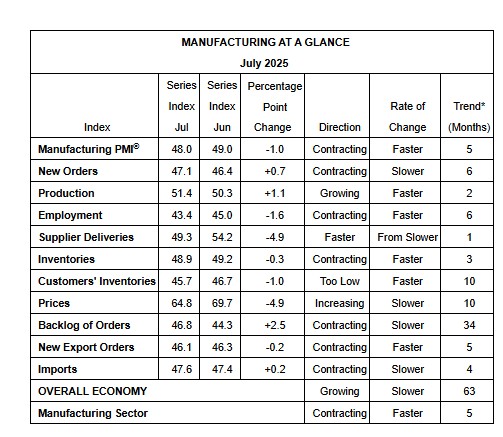
“Looking at the manufacturing economy, 79 percent of the sector’s gross domestic product (GDP) contracted in July, up from 46 percent in June. Notably, 31 percent of GDP is strongly contracting (registering a composite PMI® of 45 percent or lower), up from 25 percent in June. The share of sector GDP with a PMI at or below 45 percent is a good metric to gauge overall manufacturing weakness. Of the six largest manufacturing industries, none expanded in July, compared to four in June,” says Spence.
“The demand indicators improved, with the New Orders and Backlog of Orders indexes contracting at slower rates, while the Customers’ Inventories and New Export Orders indexes contracted at slightly faster rates. A ‘too low’ status for the Customers’ Inventories Index is usually considered positive for future production.
“Regarding output, the Production Index increased month over month to move further into expansion territory, however; the Employment Index dropped further into contraction as panelists indicated that managing head count is still the norm at their companies, as opposed to hiring. The mixed indicators in output suggest companies still cautious in their hiring, even with an increase in production.
“Finally, inputs (defined as supplier deliveries, inventories, prices and imports), on net, declined further into contraction territory. The Inventories Index moved marginally further into contraction territory after expanding in April, as companies work to reduce or adjust inventory to better align with demand. The Supplier Deliveries Index indicated faster deliveries as supply chain performance improved and sluggish demand continued. Prices continued to increase, but at a slower rate. The Imports Index remained in contraction but moved upward slightly,” Spence concludes.
“Business is steady, with solid bookings and backlog. Still uncertainty about tariffs and associated inflation,” says a Furniture & Related Products respondent.
Other respondents, including representatives of Machinery, Electrical Equipment, and Fabricated Metal Products, state that tariffs are disrupting overall manufacturing and imports & exports.
The seven manufacturing industries reporting growth in July — listed in order — are: Apparel, Leather & Allied Products; Plastics & Rubber Products; Nonmetallic Mineral Products; Textile Mills; Miscellaneous Manufacturing; Furniture & Related Products; and Primary Metals. The 10 industries reporting contraction in July — in the following order — are: Printing & Related Support Activities; Paper Products; Chemical Products; Machinery; Wood Products; Fabricated Metal Products; Computer & Electronic Products; Transportation Equipment; Electrical Equipment, Appliances & Components; and Food, Beverage & Tobacco Products.
The Wood Products sector reported a dip in:
- New orders
- Inventory Index
- Order backlogs
- Imports
A rise in:
- Customer inventories
Furniture & Related Products reported a dip in:
- Customer inventories
A rise in:
- Supplier Deliveries
- Prices
- Backlog of Orders
- New Export Orders
To read the full report, visit ismworld.org.
August 3, 2025
Huntsman Corporation (HUN) Q2 2025 Earnings Conference Call Transcript
Aug. 01, 2025 1:41 PM ETHuntsman Corporation (HUN) StockHUN

Q2: 2025-07-31 Earnings Summary
EPS of -$0.20 misses by $0.08
| Revenue of $1.46B (-7.37% Y/Y) misses by $36.74M
Huntsman Corporation (NYSE:HUN) Q2 2025 Earnings Call August 1, 2025 10:00 AM ET
Company Participants
Ivan Mathew Marcuse – Vice President of Investor Relations & Corporate Development
Peter R. Huntsman – Chairman, President & CEO
Philip M. Lister – Executive VP & CFO
Peter R. Huntsman
Ivan, thank you very much, and thank you all for joining us. Our second quarter results were not unexpected and came in about where we thought they would. We did see a nice rebound back to what we would see as more normalized earnings from Advanced Materials, offsetting the disappointing sluggishness of construction activity and tariff uncertainty, especially in polyurethanes.
As we step back and look at the macro condition, it appears that the volatility caused by tariff and trade disputes over the past few months is starting to dissipate at least as of 12 hours ago. I believe that inventories remain very low in most of our downstream supply chain, while consumer confidence seems to be muted. We look into the third quarter, we see neither reason to panic nor to be overly optimistic. However, long term, we do anticipate an improvement in construction and perhaps some gradual change as China seems to be focusing more on their overcapacity.
Our focus will continue to be on our balance sheet. To this end, we will continue to be extremely prudent on spending capital beyond our normalized run rate of safety, maintenance and reliability. We remain focused on our cost structure and making sure that our business expenses are in line with market conditions and our cash generation. Our aggressive inventory and working capital focus allowed us to generate positive cash flow in the second quarter. This cost us about $25 million of EBITDA in the second quarter. This charge was offset by reduced bonus accruals and other smaller onetime benefits. This inventory impact will be less in the third quarter, again, offset by bonus accruals.
As markets improve or raw materials drop in value, we want to make sure that we’re in a position to take advantage as soon as possible. We will operate our business to create value over volume to the extent that we can. We continue to review our asset portfolio and engage with shareholders. The last thing we want to be doing is sitting around waiting for things to get better. Over the next few quarters, we will see usual seasonality, but also the possible influences of higher tariffs and duties for MDI coming into North American markets, a possible interest rate cut, the benefits of more of our cost reductions falling to the bottom line and hopefully, a greater focus on prices over volume. In short, we will manage our balance sheet as effectively as possible while also pushing for better P&L outcomes. With that, operator, why don’t we open the line up for any questions.
Kevin William McCarthy
Peter, would you comment on MDI utilization rates in the second quarter and how you see those progressing into the third quarter for the industry as well as Huntsman?
Peter R. Huntsman
Yes. Much of that, Kevin, a very good question, something that we struggle with because there’s not a great deal of information as to how people are running their plant and what capacity they’re running their plant. Obviously, with the tariff situation and so forth with product that was coming into North America from China, that product is either being scaled back in capacity or going into other markets. We’re not seeing a lot of that product, for instance, showing up in Europe, which is something that some of us feared a couple of months ago would be the case.
So it really is quite a fluid question. I would say that, by and large, the industry is operating somewhere in the low to mid-80 percentile. That’s going to probably be a little bit higher than that in North America, perhaps a little bit lower than that in China. But that’s — I believe that’s about where we are today.
Patrick David Cunningham
Can you give us an update on how your order books have progressed in July? I think we’re hearing some mixed signals on sort of if things are stable or things are getting worse in July? And what are some of the conversations you’re having from larger customers in auto and building and construction given the recent tariff implementation?
Peter R. Huntsman
I think that stable would probably be the best singular description of what we’re seeing across the board. I mean there are some pockets here and there. Just anecdotally, I think that there are a number of truckload orders, rail, which would tell you that people are ordering just in time, which should tell you that inventories are probably lower than usual.
In my personal opinion, I believe that the supply chains are pretty thin right now, people in times of uncertainty, especially where the overall energy market, the energy structure is down from where it was 6 months ago. People are probably not going to be holding a lot of inventory on the expectation that the energy costs will be coming down, chemical costs and so forth.
So I think that it’s very thin right now and people are kind of ordering just what they need for the next 30 days or so. But right now, I’m not seeing a pickup that would give me a great deal of optimism. Conversely, I’m not seeing a big drop-off in any one area that would give me pessimism.
Patrick David Cunningham
Great. Very helpful. And Peter, you seem to be optimistic on potential China supply rationalization, but it seems there’s still pretty healthy capacity build expectations in MDI. So where do you see this potentially having the most significant impact in terms of the key chains or what it might mean for Huntsman’s earnings levels going forward?
Peter R. Huntsman
Well, I would say that as we think about Chinese capacity and so forth, China, where you have the greatest concentration of production continues to be our most profitable market for MDI, and our business in China is performing quite well in comparison to North America and a very well in comparison to Europe. So I think that there’s a combination probably of volume discipline, pricing discipline and what have you. And we’re also seeing some greater trade movements and so forth.
At the time — as we look at the first 6 months of this year, we’ve seen Chinese imports into North America of MDI virtually stop. For some reason, we’ve seen imports coming in from Europe of all places increase. Now that’s not offsetting each other one for one, obviously. But — so there are some rather unusual trade patterns. But by and large, I don’t think there’s anything terribly surprising taking place right now.
Jeffrey John Zekauskas
I think earlier in the call, you said that utilization rates in polyurethanes were in the low to mid-80s. Is that where your utilization rates are?
Peter R. Huntsman
Yes. I’m not sure that we’re too dissimilar from — they’d probably be — we run our plant in China at pretty high rates because we’ve got good market demand there. The automotive sector in China continues to perform quite well and everything else is pretty stable. I wouldn’t say that it’s growing through the roof. Europe obviously continues to struggle. In North America, we’re probably running in the mid-80s, give or take a few percentage points. So I’m not sure that we’re terribly different than most of our peers.
Jeffrey John Zekauskas
What are your utilization rates in Europe?
Peter R. Huntsman
Those would probably be around 80%.
John Ezekiel E. Roberts
Peter, the prepared remarks mentioned Advanced Materials is the primary focus for bolt-on acquisitions. I don’t expect that you’d be making any bolt-on acquisitions near term, but are you no longer interested in Huntsman Building Services or Huntsman Building Systems, HBS as an area long term?
Peter R. Huntsman
Well, I think I learned from my father a long time ago, you never say never in the area of M&A. But at the same time, you do have to have a strategy. You can’t just look and buy anything that is available. I think that as we look at where we want to be moving as a company, we want to be able to take advantage of adhesives. We want to be taking advantage of aerospace, lightweighting, energy conservation.
And as we look at our most stable lens of our business, as we go down, we look at electronics, we look at elastomers, as we look at our adhesives, lightweighting, carbon fiber, composite materials and so those are all areas, I think, for us that we’ve been able to build a nice platform, and we’d like to continue to do that.
Now you look at something like polyurethanes, and of course, within our polyurethane business, we have elastomers. We have some of those applications. So that are further downstream. Those businesses are the best performing parts of our polyurethane business today. So I don’t want to sit here and say that we’d never do anything in polyurethanes. But if we do, it would probably be something that would complement that end of the business more so than the more volatile in commodity side of things.
David L. Begleiter
Peter, do you expect the tariffs you now have on Chinese MDI to lead to, at some point, a new U.S. MDI plant not by you, but maybe a competitor?
Peter R. Huntsman
Well, I can only give you — okay, I will tell you, it will not lead to a new plant by Huntsman. I can — at least not while I have anything to do with managing the company. But what competition decides to do, I have no idea. I personally believe that there’s more than enough MDI in the world today, and we’ll be just fine. But I — if you put barriers up around the U.S. on imports, let’s remember that the U.S. also exports its MDI into markets, for instance, into Latin America and into Canada and so forth.
You’ve got — you’ve also got to realize that if you’re putting imported materials are going into Latin America and Canada and so forth. There’s less export from the U.S. I think that a lot of people can make a mistake by just drawing a circle around the United States and somehow thinking that that’s going to be this fortress of what’s in the United States stays within the United States and nothing can penetrate it from Europe or any place else. Like I said, trade is a messy subject. And I don’t — I think presently, the world’s got plenty of MBI capacity doesn’t need anymore.
Salvator Tiano
Perfect. And if I may ask about the future of your European footprint, not on a little bit more downstream polyurethanes, but on the core MDI Rotterdam facility. I mean, there’s a bunch of PO shutdowns, a number of them more likely to come as well. So at what point do you think that European demand may permanently be impaired for MDI and there may not be enough demand for your own facilities there?
Peter R. Huntsman
I think that we have either the lowest or among the lowest production sites in Europe. And I believe that, that site is going to be competitive relative to other European producers for some years to come. I would be — if we get to a point where we can’t justify the operations of our European facility, I think that there’ll probably be other facilities that will come to that conclusion before we do. However, we do continue to look at all of our operating costs there. We look at our operating viability. And — but I see longer term, as I see today, that’s a very limited vision. But as I see today, that’s a site that we’re going to continue to operate. And it’s a segment of the market in polyurethanes that we’re going to continue to feed.
Michael Joseph Sison
Peter, when you think about China, they talked about involution. Is there a good amount of capacity there that could or maybe should be looked at and maybe taken out that could help the supply-demand situation we’re in now?
Peter R. Huntsman
Very good question. I think China is — I’ve heard more in the last 30 days and having been in the last couple of 2, 3 weeks ago, more discussion in country, certainly than I hear out of country about the government looking at overcapacity, looking at older facilities. As I look at the MDI situation in China, most — every facility in MDI in China is — it’s not only very good technology, but it’s also some of the largest scale — largest, best integrated facilities that are integrated all the way up to energy production, aniline production, coal production, all the way down through the line.
So I think that there will be a number of closures that will take place in the chemical industry over the next year, 2 or 3. I do not believe that, that will be the case for MDI, particularly if you compare the competitiveness of those facilities with 30-, 40-, 50-year- old facilities that are operating in Europe that are subscale and having to struggle with much higher raw material costs and supply chain costs and so forth.
Philip M. Lister
Mike, one area we are looking at is our joint venture in China on PO/MTBE has been significantly under pressure. It could be that over the coming years, there could be some of the older MTBE producing facilities that come out, but that will be over a number of years.
Hassan Ijaz Ahmed
Peter and Phil. Just wanted to stick to the theme of a recovery, however far it is. In your prepared remarks, on the polyurethane side of things, you mentioned that sequentially, volumes were up around 3%. And typically, Q1 to Q2, you see an 8% to 10% sort of uptick in volumes. So I’m just trying to get a sense of how far below normal volume levels are we just to get a better sense of as and when that recovery happens, how much higher these volumes can actually go?
Peter R. Huntsman
Yes. I think that for the most part, when we look — when we take out kind of onetime contracts and business that we won in the second quarter, you’re probably looking at somewhere between 5% and 8% that I would say is kind of missing in the numbers. And that typically is around housing and construction. We saw an incredibly anemic housing and construction market this year. I don’t think we’ve seen anything like this since COVID and since The Great Recession before that.
So there’s — I think there’s a great deal of uncertainty around people wanting to commit to what is usually the largest purchase in their lifetime during times of market volatility and uncertainty and also with higher interest rates. So I’m very hopeful that those markets will recover early this next year, and we’ll be in a much stronger position this next year. But we definitely — the single biggest impact in the second quarter that was — that I think — I’m not going to say surprised us because we were talking about this on our last call, but was the other lack of seasonality that we typically see at this time around construction.
Hassan Ijaz Ahmed
Understood. Very helpful. And as a follow-up, I mean, again, in the prepared remarks for polyurethanes, you guys talked about how through the course of the quarter, you saw a more intense competitive environment in Europe. And I guess you mentioned driven by domestic producers. So can you just expand on that? And do you see any sort of resolution around that in the near term as well?
Peter R. Huntsman
Unfortunately, I don’t see a great deal of resolution around that. We push very aggressively in the second quarter as we did in the first quarter, as we did in the quarter previous to that, for better, higher pricing margin expansion in Europe. And the — I believe that I can’t — again, I don’t know what the decision of our competitors are, but it seems like people are putting volume over value and they’re moving volume at any price sort of a thing. So surprisingly, in Europe, that is today our highest cost urethane production in the world and our lowest value of MDI in the world. So you kind of got — both sides are hitting you.
Philip M. Lister
So what do we do, Hassan? We continue to focus on the announcements we made, getting our cost base correct and all of the activities that we’re doing, including closing some of our facilities there and then work within the competitive environment that’s existing.
Peter R. Huntsman
Yes, 85%, 90% of our cost reductions right now across the company are focused in this market.
Aleksey V. Yefremov
Peter, I was hoping you could deconstruct for us Polyurethanes segment price declines of 5% year-over-year this quarter. I mean you just talked about Europe, but was this the sole reason for this decline? Were other regions particularly bad or good? And also from the perspective of just polymeric MDI versus systems, were these thesis better or worse than the 5%?
Peter R. Huntsman
Yes. I think that we did see a price fall from the first going into the second quarter. We started off the second quarter, the beginning of the second quarter, particularly in China, where we’ve gone from about RMB 18,000, RMB 18,500 down to about RMB 15,000. So was that 20% — 15%, 20% drop in price from the end of the first quarter going into the beginning of the second quarter. We came out of that quarter with stabilization, a bit of an increase through the quarter and stabilization as we look into the third quarter. I think that we’re hoping that we’ll see some price increases in China with that stabilization getting better. In the U.S. and Europe, we’re just seeing some very competitive pricing dynamics in place. A lot of people chasing little volume.
Philip M. Lister
Aleksey, if you were looking at the 5% year-on-year, which I think you are in our press release on polyurethanes, you go back to this time last year, it was about RMB 18,000 for polymeric. And today, we’re at about that sort of RMB 15,000, RMB 16,000. So you’ve seen a drop of 10% to 15%. So it’s mostly in the polymeric area. You would have had some pressure on system prices, some on MDI variance. But in general, the move that you’ve seen is polymeric MDI related.
Aleksey V. Yefremov
And here, in the past, said that it’s hard to move U.S. MDI demand offshore or at least it could be tariff-related repercussions. Can you update us on this view? Have you seen any demand maybe move to Mexico, Canada or it’s been pretty steady?
Philip M. Lister
Yes. So Aleksey, I think you’re asking about the trade flows there and whether some product instead of coming into the United States moves into Mexico or into Canada. Look, I think — yes, I think we’ve said if you look through the first sort of 6 months of the year, clearly, the imports coming into the U.S. are considerably lower. There will be some which would have gone into the Canadian business, into the lumber business there. A little bit into Mexico. Mexico is not an enormous market here at all and mainly driven by automotive and furniture actually, where in general, you have to spec in.
As we said in our earlier remarks, what we’ve been watching is that whilst the imports have dropped off from China. The European imports into the U.S. have actually increased in that time. And that, coupled with a lower demand environment, those 3 elements combined have led to a pricing environment, which is relatively stable rather than, say, the increases that I think the industry had hoped for.
Arun Shankar Viswanathan
Just wanted to ask about 2 things. So first off, I understand that, obviously, Huntsman, it’s not the view that the world needs another MDI plant, especially under your leadership, Peter. But I guess others may not necessarily feel that way. Is there anything else that potentially — what’s kind of the pushing point when others kind of get to the same conclusion that you do? And maybe if you could frame that, whether it be cost per ton or pricing or anything like that?
And then similarly, on epoxies in your Advanced Materials business, there’s been some exits by others in the BLR market. Does that affect your sourcing at all? Or what can you share there?
Peter R. Huntsman
Yes. Well, I think that on the BLR side, I’ll take that first. On the BLR side, I think that we’ve got plenty of suppliers. We have seen some higher cost facilities that have cut back or slowed down. There’s plenty of BLR on the market, and I wouldn’t be — I wouldn’t assume that, that’s going to impact our earnings on our Advanced Materials at all, the few that have exited.
On MDI capacity, I just — Arun, I simply can’t imagine what takes place in a boardroom when people decide they’re going to take $1 billion, $2 billion and invest it in something that’s going to take 5, 7 years to build in a product that we’re swimming in today. I don’t know, maybe they got a crystal ball as to where we’re going to be in the decade from now, but I guess I can see the rationale that the Chinese have had over the last couple of decades as they wanted to become more independent, self-sufficient. I get that. But I look at the growth rates and so forth across Europe and North America and even China today, I just don’t see any justification for that. So I can’t speak to the rationale that would go into a decision like that.
Philip M. Lister
And Arun, I think there’s a reality none of the Western manufacturers as far as we know, have announced any new capacity, major capacity additions and major plants. There may have been some debottlenecking, but nothing from a major new plant perspective.
Arun Shankar Viswanathan
Right. But I guess I’m just curious, would they and yourselves get to a place here where that utilization rate remaining in the low 80s or high 70s is just not acceptable and would force some closures? Do you foresee that happening? And would it make sense for you guys as well? I appear not, I guess not just given your position on the cost curve, but do you foresee any supply takeout materializing that way?
Peter R. Huntsman
Yes. I would — I believe that there are some very high-cost facilities in Europe, but that’s just from information that I read publicly, I would have thought that would have happened before now, but it hasn’t. Chemical facilities, by and large, are very expensive to shut down. In Europe, it’s very problematic when you have to deal with government authorities and so forth. I was going to give into my own experience, but I won’t. We don’t have time.
But it’s — particularly in Europe, it’s expensive. And particularly in sites where you’ve got 4 or 5 other chemical companies that are dependent on your operations, you’re dependent on their operations and you may be able to or want to shut down, but you’ve got 15-, 20-year supply agreements and offtake agreements and shared site costs and so forth. So yes, a lot of these, it’s a tough and very expensive decision to just simply walk away. But I think you’re at that point where I can’t imagine they’re not companies today that are looking at those economics and decisions.
August 3, 2025
Polyol Prices Poised to Surge As Brazil Bars Cheap Imports
PUdaily | Updated: July 31, 2025

Brazil has joined the global wave of protectionist trade actions by imposing definitive anti-dumping (AD) duties on polyether polyol imports from China and the U.S., effective July 3, 2025, via GECEX Resolution No. 754. The measures cover polyether polyols with molecular weights of 300–4,500 g/mol and ≥90% purity, including blends, under NCM 3907.29.39. While some respondents, such as Wanhua, aimed to exclude “formulated” mixtures, authorities maintained a broad scope to ensure effective enforcement.
The decision followed a petition by Dow Brasil Sudeste, Brazil’s sole domestic producer, and a year-long investigation by SECEX under Decree 8058/2013, in line with WTO rules. The final ruling confirmed that dumped imports caused material injury to the local industry.
Comparative Historical Context
Brazil has deployed trade remedies in chemicals before. Most recently (May 2025), Brazil raised duties on suspension PVC from the U.S. to protect local resin producers. Like the polyol case, PVC-makers (Braskem, Unipar) petitioned against “artificially low” imports, leading to dramatic duty hikes. That PVC case shows how duties can swiftly shift supply chains: importers began sourcing from Egypt, Mexico or Taiwan instead of the U.S.. We expect polyol trade flows may likewise divert.
Internationally, anti-dumping on polyols is not new. For example, India has repeatedly investigated Chinese polyether polyols. In March 2024, India issued duties on Chinese Wanhua polyol and others, much like Brazil’s approach. This reflects global oversupply: China’s polyol exports have expanded rapidly, pressuring markets from Asia to Latin America. India’s experience shows similar concerns: domestic producers felt undercut by cheap Chinese polyol, prompting duties. On balance, Brazil’s action mirrors a worldwide trend where emerging industries use AD measures to defend local PU chemical sectors against aggressive imports.
Global Supply Chain Implications
The new Brazilian duties will reshape trade flows for polyether polyols. Imports from China and the U.S., which historically account for the bulk of Brazilian polyol intake, will become much more expensive. Market participants are likely to seek alternative suppliers. Possible candidates include producers in Southeast Asia or even domestic Mercosur neighbours. Analysts noted how Brazil’s PVC AD led buyers to Egypt, Mexico and Taiwan; a polyol case could see similar redirection. However, significant new sources may not exist in Mercosur: current heavy polyol capacity resides outside Latin America.
Logistically, trade routes could shift. Instead of U.S.-China barrel-ship shipments via the Panama Canal, we may see more long-haul deliveries from Asia or smaller traders from Europe. In addition, global suppliers might restructure contracts: for example, U.S. exporters facing high duties could redirect some tonnage to other markets, while Brazilian buyers may negotiate spot contracts. In short, Brazilian polyol imports will likely decline from China/US and either be replaced by other sources or simply shrink, causing tighter supply and longer lead times.
Higher duties also change the cost structure and competitiveness. Pre-duty, China and U.S. polyols were reportedly sold at substantially lower prices. Brazilian data cited in the resolution show U.S. import prices were consistently below Chinese levels, except briefly in Q1 of 2021. For instance, SECEX found U.S. polyol CIF prices were lower than those from China throughout the review period, with the U.S. share of imports around 30%. Post-duty, import prices effectively jump by the duty amounts, so Brazilian foam producers can expect steeply higher feedstock expenses. This creates inflationary pressure: Brazil’s mattress association (ABICOL) warned in April 2024 that combined AD and tariff measures could raise polyol costs and spark a chain of price hikes throughout foam manufacturing. They pledged to fight the measures politically and legally, stressing that protection should favour genuine Brazilian producers and not necessarily foreign-owned multinationals.
Impact on Brazil’s Domestic PU Industry
Domestic producers, primarily Dow Brasil Sudeste Industrial Ltda, stand to gain protected market share as imported polyols become less price-competitive. With China and the U.S. effectively sidelined, Dow may gain pricing power and expand sales volumes, though capacity constraints and the need for consistent quality remain challenges. While Dow and industry association Abiquim also lobbied to raise Brazil’s MFN tariff from 12.6% to 20%, GECEX rejected the request in November 2024 due to strong opposition from downstream users. As a result, only the anti-dumping duties were adopted. The mattress industry association ABICOL supported keeping the MFN tariff unchanged but remained active in the AD case, reflecting the sector’s mixed priorities. In the short term, domestic producers will likely raise prices closer to the new duty-inclusive level, though Brazilian polyol supply may remain tight.
Longer term, higher protected margins could spur new investment by existing or new producers. If economics are attractive, we may see either expansion of Dow’s plant or interest from global polyol makers, though global oversupply could dampen that. Higher local prices might also encourage some end-users to invest in modest in-house blending or to shift some formulations toward locally available chemistries.
Downstream Effects (Automotive, Furniture, Footwear, etc.)
Brazil’s foam-using sectors face the sharpest impact. Polyether polyols are key to flexible PU foam, used in mattresses, upholstered furniture, automotive seating and interiors, footwear, and more. Analysts warn that an immediate effect will be higher raw material costs for foam producers.
The mattress industry, represented by ABICOL, is especially vocal. In April 2024, it issued a bulletin noting that Dow’s petition claims dumping margins of 59% (China) and 31% (US) below domestic prices. ABICOL argued that imposing an AD duty (and higher tariffs) would “increase the price of Brazilian PU products and hurt the entire mattress sector”. It pointed out that Dow alone cannot satisfy even half of the national polyol demand, so restricting imports risks foam shortages. The association warned that Brazilian foam-makers would become vulnerable to competition from Mercosur neighbours who could supply final PU products without Brazil’s new import duties. In effect, ABICOL fears that the policy could transfer the raw material cost issue to a finished goods trade issue.
The automotive and shoe industries will also experience secondary impacts. Automakers and their seat suppliers may see foam sheet prices rise modestly, slightly increasing car production costs. Footwear uses some polyol-based PU; higher polyol costs could feed into minor cost hikes. While these sectors are less concentrated than mattresses, they rely on the same competitive market for raw foam. All told, consumers in Brazil may see higher prices for sofas, beds, car seats and certain shoes over the coming years. Economists note this will add upward pressure on Brazil’s inflation, 5.35% in June, which is already above the target of 4.5%.
Economic and Pricing Analysis
From a trade data perspective, the newly imposed anti-dumping duties are expected to significantly reduce imports of polyols from the United States and China. Before the investigation, Brazil’s polyol import volumes were on the rise, with official filings indicating that Chinese-origin imports grew by 29% more tonnage in 2024 compared to 2023. However, with final duties ranging from $1,408 to $1,469 per metric ton on Chinese exporters and $555 to $680 per metric ton on U.S. suppliers, these products are poised to become economically unviable in the Brazilian market.
Price-wise, domestic polyol will be repriced upward. The combined effect of duty and existing tariffs means the import cost could double for many suppliers. Dow and any other suppliers will likely take advantage, and foam producers will pass on much of the costs.
Given foam’s share in final products, macro effects are muted but visible. Furniture inflation could tick up, as could mattress prices. Brazil’s IPCA inflation index may see a small bump from higher intermediate chemical costs. The central bank will likely monitor any ripple into consumer prices. Notably, one risk is that high domestic polyurethane prices incentivise cross-border shopping or grey-market imports from Uruguay/Argentina using Mercosur free-trade, adding uncertainty to enforcement.
Outlook and Monitoring
The duties took effect immediately on 4 July 2025. Parties will watch for three key developments: First, SECEX’s public interest review (per Art. 4 of the resolution) may lead to adjustments if industry relief is justified. Second, actual import statistics will reveal whether U.S./China polyol shipments indeed collapse and if other countries fill the void. Third, downstream inflation gauges will be monitored. Notably, IBGE will report any uptick in furniture and automotive prices in late 2025.
Brazil will also announce a review schedule. Under Decree 8058/2013, AD duties are reviewed typically at 2-year intervals and sunset after 5 years unless extended. The first substantive milestone will likely be early 2027, when companies can request an interim review or expiry review. Affected stakeholders (importers and foreign governments) could mount challenges at that point if they can argue that circumstances have changed or that harm is limited. Meanwhile, Domestic foam producers may explore alternative feedstocks or adjust formulations to manage polyol shortfalls and cost increases.
In summary, the new anti-dumping duties mark a protectionist shift for Brazil’s PU supply chain. They will bolster the lone domestic polyol maker in the near term, but at a price: higher costs and potential supply tightness for foam users. The measure rebalances trade flows (likely reducing U.S./China exports, redirecting to other sources) and is emblematic of Brazil’s recent tougher stance on chemical imports. Monitoring will focus on trade statistics, commodity prices, and any legal countermeasures.
August 1, 2025
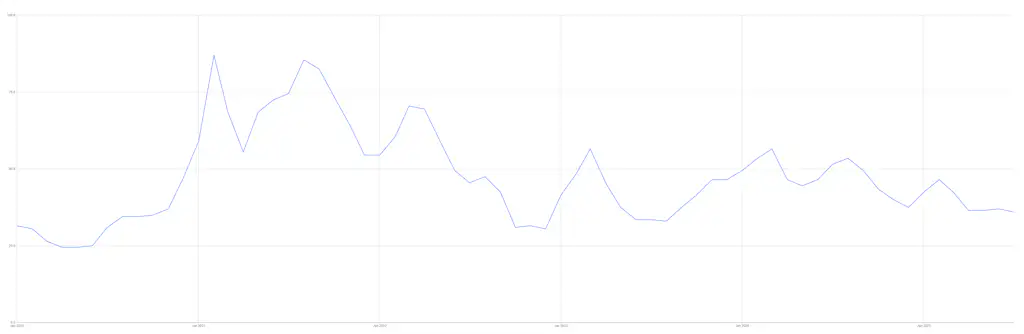
Chemical Grade Propylene is $0.36/lb in July, down 1cpp from June
 Everchem Updates Archive
 Sign Up for Email Updates