
The Urethane Blog
July 14, 2025
Marshall Cogan

From Wikipedia, the free encyclopedia
| Marshall S. Cogan | |
|---|---|
| Born | 1937 (age 87–88) |
| Nationality | American |
| Education | Harvard Business School Harvard University Boston Latin School |
| Occupation(s) | Investment banker, Private equity investor |
| Known for | Partner of Cogan, Berlind, Weill & Levitt, Founder of United Automotive Group and Foamex International |
Marshall S. Cogan (born 1937) is an American investor and entrepreneur and former financier and trader. Cogan was the founder of United Automotive Group, which he built into one of the largest retailers of cars and trucks in the U.S. As a private equity investor, Cogan acquired a number of businesses in the 1970s and 1980s. He was also a partner of Cogan, Berlind, Weill & Levitt an investment banking and brokerage firm that would be instrumental in the consolidation of the financial services industry in the 1970s.
Early life and education
Born to a Jewish family,[1] Cogan graduated from Harvard College in 1959 and received his MBA from Harvard Business School. Cogan is also an alumnus and benefactor of the Boston Latin School having graduated in 1955.[2]
Career
Early career
Cogan started his career at CBS and worked at the investment firm, Orvis & Co., before joining the investment banking and brokerage firm of Carter, Berlind & Weill as an auto sector research analyst in 1964. Cogan was soon a partner in the firm and his name replaced the departing Arthur L. Carter in 1968 as the firm was renamed Cogan, Berlind, Weill & Levitt. Among Cogan’s partners at CBWL were Sandy Weill, later chairman and CEO of Citigroup, Arthur Levitt, later the head of the Securities and Exchange Commission and Roger Berlind a noted Broadway producer and long-time member of the board of Lehman Brothers.
In August 1973, Marshall Cogan left the firm after disputes with his fellow partners to focus on leveraged buyouts. Cogan’s first deal was the takeover of General Felt Industries (GFI) in 1974 which he completed with fellow investment banker Stephen Swid. Cogan would then merge GFI with Knoll International and use Knoll as a holding company to acquire a series of businesses.[3] Among Cogan’s most notable acquisitions were takeover of the Sheller-Globe Corporation and later the purchase of the 21 Club.[4] Cogan was unsuccessful in his high profile bids to acquire the Boston Red Sox, Sotheby’s[5][6] and L.F. Rothschild in the buyout boom of the 1980s.[3][7][8]
Foamex and United Auto
Cogan began building what would become Foamex International in the mid-1980s after the departure of his long-time partner Stephen Swid. Swid would go on to acquire the music publishing division of CBS Records, later known as SBK Records. Meanwhile, Cogan bought Foamex Products, a division of Firestone Tire & Rubber.[9] Over the next few years, Cogan continued to acquire businesses to merge with Foamex, acquiring three regional producers in 1988.[9] Cogan merged General Felt into Foamex and acquired Great Western Foam Co., a major foam producer on the West Coast.[9] In 1993, Cogan created Foamex International bringing together his various businesses and took the company public in December 1993. During the mid-1990s, Foamex grew to become the largest manufacturer and marketer of flexible polyurethane foam and foam products in North America.[9]
In 1990, Cogan founded United Automotive Group, today known as Penske Automotive Group.[10] Under Cogan, United Auto was a leading acquirer, consolidator and operator of automobile and truck dealership franchises. Cogan merged his company with Roger Penske‘s business in May 1999 after Cogan ran into financial difficulties and the company name was changed from United Automotive to Penske Automotive in 2007.[11]
Bankruptcy of Trace International
In July 1999, Cogan’s holding company, Trace International Holdings filed for bankruptcy protection. Cogan had used Trace International to hold his controlling interests in two publicly listed companies, Foamex International and United Automotive Group. Trace had pledged its stock in the two companies as collateral for certain loans.[12] After declines in the value of Foamex and United Auto Group in 1998 and 1999, Trace became insolvent as the value of its assets fell below the debt it owed. In 2003, Cogan and several directors of Trace would be accused of having drained cash from Trace International. Cogan was found by second circuit court of Delaware not guilty of all charges on June 25, 2005.[13][14][15]
Trace was a holding company through which Mr. Cogan held his principal investment assets. It was owned 70% by Mr. Cogan and 30% by three investors who were friends of Mr. Cogan. In 1999, Trace ran into serious financial difficulties because a major bank withdrew a $1 billion commitment to finance a restructuring of Trace and its holdings due to events, which had nothing to do with Trace or Mr. Cogan that led to a serious disruption in US financing markets. These financial difficulties caused Trace to file in 1999 for bankruptcy protection under Chapter 11 of the U.S. Bankruptcy Code. At that time, Trace’s principal assets were shares of Foamex International and United Auto Group, both of which were publicly traded U.S. corporations, and shares of CHF Industries. Eventually, a Trustee was appointed for Trace, and he sued Mr. Cogan and the other former directors of Trace. His theory was that Mr. Cogan had treated Trace as a personal holding company (which it was), and had improperly taken money out of Trace in the form of unduly high salary, salaries to his wife and payments to his daughter, loans to Mr. Cogan, his wife and others that had not been repaid and other expenditures for what the Trustee characterized as primarily personal purposes. Significantly, the other shareholders of Trace did not complain. However, the Trustee said that Trace had been in “the zone of insolvency,” (which Mr. Cogan and the other directors vehemently disputed) and that because of that Mr. Cogan and the Trace Board had owed fiduciary duties to Trace’s creditors. In 2003, the U.S. District Court for the Southern District of New York, in a very lengthy opinion, agreed with most of the Trustee’s contentions. For example, it found that Mr. Cogan had received salary over a six-year period totaling $39.6 million, which it said was $6.9 million more than executives with similar responsibilities would have received at other companies. The court also rejected claims by Mr. Cogan that he was entitled to substantial offsets against his obligation to repay the loans he had received from Trace. In 2005, the decision of the District Court was reversed on appeal on the basis that the judge had improperly failed to submit the case to a jury. However, by then, Mr. Cogan had settled the case as to himself. Putting aside the correctness of the factual determinations made by the District Court, including the hotly disputed question of when Trace had entered the zone of insolvency, in 2007, the Supreme Court of Delaware, the laws of which governed the obligations of the directors of Trace, ruled that the fact that a company may be near insolvency (i.e., in a “zone of insolvency”) does not cause the directors of a Delaware corporation to have obligations to creditors. Therefore, the basic legal premise on which the court found Mr. Cogan and others to be liable to Trace or its trustee (other than with regard to borrowed money, for which Mr. Cogan clearly was liable to Trace) turned out not to exist.
In 2006, Cogan was named to the board of Ener1, a company that manufactures lithium-ion batteries for plug-in hybrid vehicles.
Other affiliations
Cogan has also served as Chairman and Director of Color Tile, Inc., Knoll International and Sheller-Globe Corporation.
Cincinnati, Ohio, USA (July 14, 2025)

Emery Oleochemicals is pleased to announce the appointment of Min Chong as its new Group Chief Executive Officer. Mr. Chong brings to Emery Oleochemicals a distinguished career in the specialty chemicals industry, having held multiple senior leadership roles across the sector. With a proven track record driving strategic growth, operational excellence, and innovation, he is uniquely equipped to lead the company into its next phase of growth and transformation.
“We are very pleased to welcome Min to Emery Oleochemicals,” said Peter Hawthorne, Chairman of Emery Oleochemicals’ Board of Directors. “His deep industry expertise, customer focus, and visionary leadership will be instrumental in advancing Emery’s mission, enhancing product and service offerings for our customers, and realizing new growth opportunities for our business and people.”
Mr. Chong’s appointment marks an exciting new chapter for Emery Oleochemicals as the company continues to build on its legacy of delivering sustainable, high-performance solutions to customers worldwide.
“I am excited to be joining Emery Oleochemicals at such a pivotal moment,” said Min Chong. “I look forward to building on the company’s strong foundation in oleochemicals to drive innovation and deliver exceptional value to our customers and stakeholders.”
About Emery Oleochemicals
Founded in 1840 and headquartered in Cincinnati, Ohio, USA, Emery Oleochemicals is a globally trusted name in high-performance, natural-based chemicals used in a broad range of industries including automotive, building and construction, industrial lubricants, packaging, personal care, and more. As a true pioneer in green chemistry and with a commitment to innovation, quality, and environmental responsibility, Emery continues to advance sustainable solutions. For further information, visit www.emeryoleo.com.
July 10, 2025
Multifamily completions reach 40-year high, reports National Association of Home Builders
By Dakota Smith
July 9, 2025 | 10:41 am CDT

Multifamily units completed reached 608,000 in 2024 — their highest level since 1986, according to NAHB analysis of the Census Bureau’s Survey of Construction. For the eighth consecutive year, most (54%) were high-density buildings comprising 50 or more units — a relatively new trend compared to early estimates in the series.
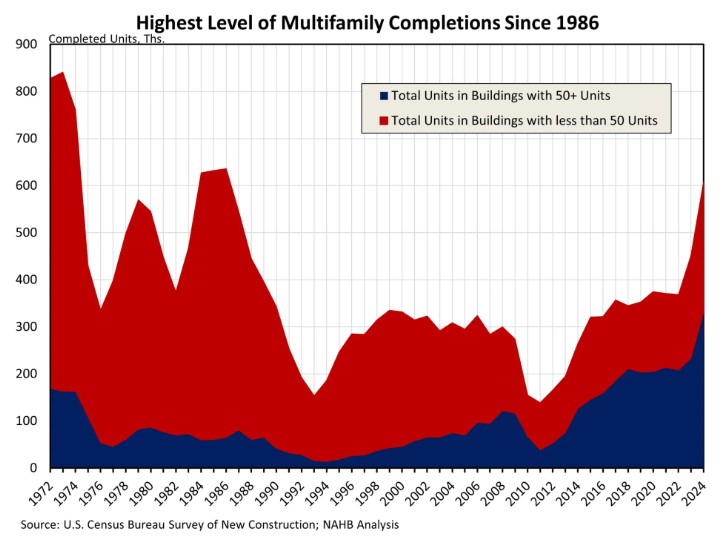
Among multifamily units completed in 2024, 580,000 (95%) were built-for-rent. More than half of these units (55%) were in high-density buildings. This is a seismic shift towards high-density buildings, as this share was only 25% in 2004. Over the past 20 years, the share of units in buildings with 10-19 units has been consistently falling, dropping from 24% in 2004 to only 4% in 2024.
The South accounted for 292,000 completions (48%) in 2024, while the West held 163,000 (27%), the Midwest 87,000 (14%) and the Northeast 68,000 (11%). Completions in the South were weighted toward low-medium density buildings — a reverse on the overall trend — while high-density buildings in the Midwest and the Northeast were nearly double the amount of low-medium density completions.
The number of multifamily units built-for-sale rose from 20,000 in 2023 to 29,000 in 2024. High-density buildings continued to be the primary type of building, comprising 40% of built-for-sale units. This share was up from 28% in 2023.
Jesse Wade, NAHB director of tax and trade policy and housing policy research, shares more details in this Eye on Housing post.
July 6, 2025
A human dog bed was a surprise start-up hit – now tariffs threaten their business
Siddharth Cavale
Wed, July 2, 2025 at 7:44 AM EDT
6 min read

The quirky concept of “dog beds for humans” has proven a surprising hit for startup Plufl, but a steep tariff on Chinese imports is now forcing the company to consider a significant shift in its manufacturing strategy.
Co-founders Yuki Kinoshita and Noah Silverman, who envisioned their plush, snuggly, memory foam beds being made in China and retailing for $299 in the U.S., are now exploring domestic production.
Their innovative idea first gained national attention in 2022 when they pitched their prototype on Shark Tank. The appearance secured a joint investment of $200,000 from Mark Cuban and Lori Greiner for 20% of the company, which went on to make over 1 million in sales in 2023 through Amazon and their own website.
However, the company’s original production model was disrupted after the U.S. imposed a substantial 145% tariff on items imported from China in April. This significant levy prompted Kinoshita and Silverman to re-evaluate their supply chain.
In response, the entrepreneurs have begun investigating the feasibility of manufacturing their human-sized pet beds within the United States. While a domestic production shift might lead to a higher retail price, the co-founders believe a “made-in-the-USA” label could serve as an attractive selling point and alleviate concerns among U.S. retailers regarding the impact of ongoing China tariffs.
Silverman and Kinoshita had previously toured a factory in Las Vegas that could make the memory foam beds for $150 per unit compared to the $100 overall cost to make the beds in China. But that $150 manufacturing cost didn’t include the faux fur lining for the cover, which would still need to be imported from China—adding another $100 per unit.
They pitched a sub-$500 made-in-the-USA version to Costco, which it turned down, saying it couldn’t stock the product this year and might revisit the idea next year. Costco did not respond to a request for comment.
The duo behind Plufl are among tens of thousands of American small and midsize manufacturers facing the choice between paying steep tariffs on Chinese imports or taking on significantly higher domestic production costs. Even those willing to pay more to make goods in the U.S. are confronting another reality: retailers set prices for consumers and have been largely unwilling to budge in the face of tariffs.
On June 11, when the U.S. announced a deal to lower tariffs on Chinese goods to 55%, Kinoshita and Silverman decided to stay the course manufacturing their human dog beds in China and maintain the $299 retail price.
“We’re absorbing costs in a number of ways, such as finding shipping efficiencies by shrinking the box down more and also taking some hit on our margin,” Kinoshita said.
White House spokesperson Kush Desai said the Trump administration remains committed to reviving U.S. manufacturing, citing provisions in the Big, Beautiful Bill, which passed on Tuesday with a slim majority in the Senate, such as allowing businesses to fully expense equipment investments.
“These complementary policies will turbocharge growth and drive investment throughout the supply chain,” he said in an emailed statement.
https://www.yahoo.com/news/human-dog-bed-surprise-start-114452652.html
July 4, 2025

Yesterday, the greatest question was decided which ever was debated in America, and a greater, perhaps, never was nor will be decided among men. A resolution was passed without one dissenting colony, “that these United Colonies are, and of right ought to be, free and independent States, and as such they have, and of right to have, full power to make war, conclude peace, establish commerce, and to do all other acts and things which other States may rightfully do.” You will see in a few days a Declaration setting forth the causes which have impelled us to this mighty revolution, and the reasons which will justify it in the sight of God and man. A plan of confederation will be taken up in a few days.
John Adams to Abigail
Philadelphia, July 3, 1776
The Declaration of Independence is an unmatched American document that has made a lasting impact on the global stage. It enshrined the essential principles that form the foundation of our great nation, summarizing the basic rights of life, liberty, and the pursuit of happiness, along with the significance of consent from the governed and the necessity to oppose tyranny. As the first success in the field of declarations of independence, its effect resonates worldwide, acting as a source of inspiration for many movements striving for autonomy, self-determination, and revolutionary change in the years after 1776.
The 56 brave men of the Continental Congress committed treason by signing that great document that inspired our patriot ancestors to continue the struggle for independence and throw off the most powerful empire in the world.
 Everchem Updates Archive
 Sign Up for Email Updates