The Urethane Blog

June 11, 2020

Apollo vs Serta Simmons

Leon Black’s Apollo to go to war over Serta Simmons debt deal, sources say

Billionaire Leon Black wants to go to the mat with America’s largest mattress maker.

Black’s Apollo Global Management — together with investment firms Angelo Gordon and Gamut Capital — is gearing up to sue Serta Simmons over its efforts to lower its $2.4 billion debt stack through a refinancing because it never agreed to the deal, The Post has learned.

Legal papers will be filed as soon as this week in New York State Supreme Court seeking injunctive relief to stop the refinancing, which comes as the privately held mattress maker struggles with sagging sales made worse by the coronavirus, sources said.

The defendants will include Serta Simmons, its private equity owner Advent International and investment firms Eaton Vance, Invesco and Credit Suisse Asset Management, the sources said.

At issue is Serta Simmon’s announcement this week that it has come to a deal with a majority of its senior and junior lenders to borrow an additional $200 million while also reducing its massive debt pile by $400 million through a refinancing.

Apollo, Angelo Gordon and Gamut — who recently bought about one-third of Serta’s $1.95 billion in senior debt at a deep discount — are expected to claim that they didn’t agree to the deal in violation of the company’s credit agreements.

Companies normally require all senior lenders to agree to any loan modifications, including a refinancing and lawyers for the angry investors plan to argue that if allowed to proceed, the refinancing will endanger the $2 trillion credit market by allowing companies to pit senior lenders against each other when angling for better loan terms or more capital.

“This could really upend the $2 trillion banking market,” a source close to the case said.

Serta Simmons didn’t immediately return a request for comment. Advent declined to comment.

https://nypost.com/2020/06/11/apollo-global-to-go-to-war-over-serta-simmons-debt-deal-sources-say/?utm_medium=SocialFlow&utm_source=NYPTwitter&utm_campaign=SocialFlow

June 11, 2020

Rock Bottom

Europe PU feedstocks prices hit new lows as demand pickup lags

Author: Fergus Jensen

LONDON (ICIS)–Incremental improvements in demand for polyurethane (PU) products have slowed downward pressure on the Europe isocyanates and polyols markets where supply is abundant, and producers are now hoping for a reversal in the coming months.

– June isocyanates contracts at lowest levels on record

– June polyols contracts at lowest levels since 2009

– Summer holiday demand weakness anticipated

June contracts for polyols, toluene diisocyanate (TDI), and crude and pure methylene diphenyl diisocyanate (MDI) were all settled below May contract levels, and in some cases at hit new record lows.

The industry is largely focused on lockdowns being lifted and what impact economic difficulties resulting from the coronavirus will have on consumer spending.

POLYOLS
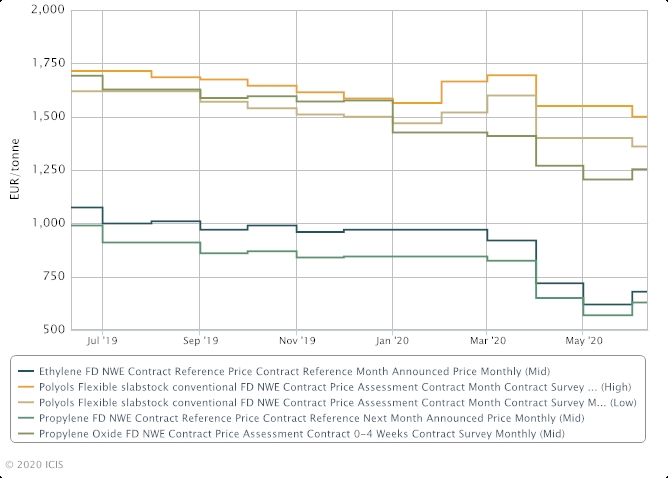
Polyols contracts for June were assessed this week down €40/tonne at the lower end and down €50/tonne at the upper end of the range to €1,360-1,500/tonne on a free delivered (FD) basis in northwest Europe (NWE).

Sources quoted deals as low as €1,100/tonne FD NWE, however the bulk of feedback pointed to price reductions in mid-double-digit territory.
ICIS Editorial Chart goes here–
“All the producers cut prices with the hope of making business,” one Europe-based polyols buyer said.

“But at the moment, we cannot increase our volume.”

There was a broad range of feedback this month, depending on grade and application, with prices quoted as high as €1,500/tonne FD NWE in some cases.

The range is now at its lowest levels since September 2009.

“It’s disastrous, to be honest,” one Europe-based polyols producer said, referring to the increase in competition and in the base polyols market and recent low price levels.

Polyols producers are competing for market share in Europe, where demand has only marginally improved from May levels and remains significantly below levels seen in 2019.

“They don’t want to lose out,” a second Europe-based polyols buyer said, referring to producers.

“Maybe it’s not about losing out now but when volumes come back.”

The flexible foam market has seen some gains in demand as a result of coronavirus lockdowns being lifted.

However, some players said demand could weaken again as the summer holiday period normally prompts lower activity.

FOAMS PROPS UP TDI
Demand for TDI used in flexible foam is improving, and some producers estimate June orders to be up to 20% below normal.

One Europe-based TDI producer said June orders were now at normal levels after a flurry of activity in the past week.

“They said they had to buy more because their stocks were already low in March and had to order more,” he said, referring to the recent increase in business.

Others were less optimistic about demand though.

“People are not going to shops. There’s no real enthusiasm in the market,” a Europe-based TDI buyer said.

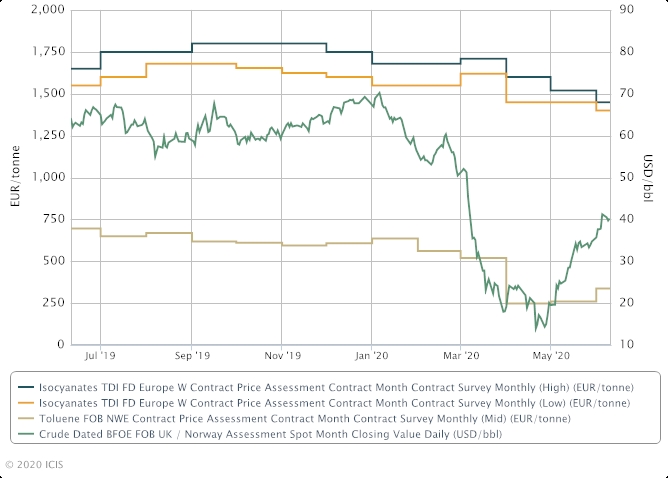
Despite gains in demand, June TDI contracts were assessed this week dropping €50/tonne at the lower end and €70/tonne at the upper end of the range to €1,400-1,450/tonne FD W (west) Europe – the lowest level ICIS has on record.
ICIS Editorial Chart goes here–
Some June deals were transacted for as little as €1,300/tonne FD W Europe, said sources, although most deals have been at higher levels.

Similarly, prices as high as €1,600/tonne FD W Europe were also quoted but did not represent the wider market.

TDI players are eyeing demand for consumer goods, bedding and furniture, which has increased in May and June although it is still well below levels in 2019.

Further weakness is also expected over the summer holiday period, although there are some expectations that delayed purchasing that would have taken place from March to May could now take place.

CRUDE MDI: MOST SECTORS IMPROVE
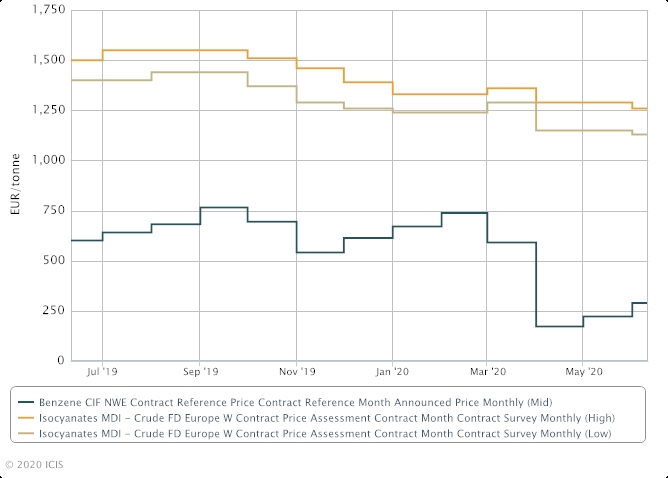
The crude MDI June contract was assessed this week dropping €20/tonne at the lower end and €30/tonne at the upper end of the range to €1,130-1,260/tonne FD W Europe, the lowest level ICIS has on record.
ICIS Editorial Chart goes here–
Demand for crude or polymeric MDI (PMDI) has been stabilising as demand for rigid insulation foams has been improving; some prices rolled over, sources said.

According to one Europe-based reseller, the construction market in NWE was now at 90% of activity, compared with this time in 2019.

Demand for adhesives and wood binding has also improved, as well as that for insulation panels and spray foam, among others.

In other cases, however, demand weakened, according to some players.

“Industrial adhesives have reduced volumes more than construction,” a Europe-based PMDI buyer said.

Absolute prices as low as €1,100/tonne FD W Europe were heard, but the bulk of feedback pointed to deals transacted above this level.

Reduced operating rates and an ongoing outage at the 200,000 tonne/year Covestro, Brunsbuettel plant have had no impact on availability, which remains abundant.

The MDI market is broadly exposed to the automotive sector, where demand has been hammered by the coronavirus pandemic and other factors.

“Automotive is still very quiet,” a second Europe-based PMDI buyer said.

Technical applications for PMDI have also seen more recent declines in demand.

PURE MDI: SLOW TO PICK UP
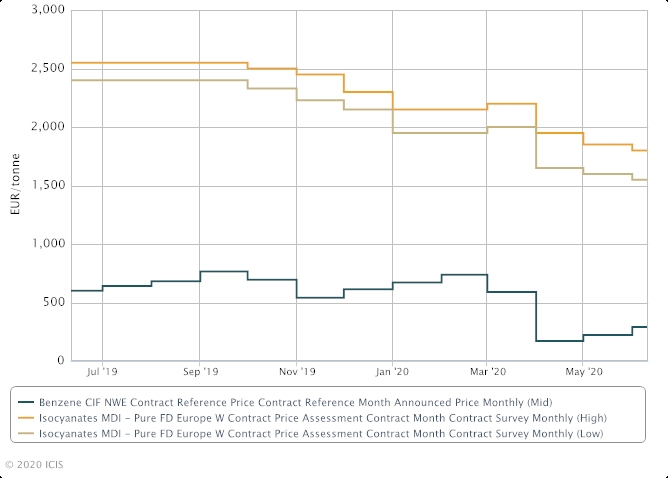
Pure or monomeric MDI (MMDI) contracts for June were assessed this week dropping €50/tonne at the upper and lower ends of the range to €1,550-1,800/tonne FD W Europe, the lowest level ICIS has on record.
ICIS Editorial Chart goes here
–
Deals transacted as low as €1,400/tonne FD W Europe were quoted but not believed to reflect the bulk of business.

The market had little activity this week; demand for MMDI for use in the automotive sector in Europe has declined significantly in recent months, while technical polyurethane applications that use MMDI have seen demand deteriorate more recently.

“You can’t get rid of pure MDI,” a Europe-based MMDI reseller said, referring to declines in demand in thermoplastic polyurethane (TPU), footwear and synthetic leather applications.

“The situation will probably only really improve after the summer holiday.”

Demand from the footwear sector has improved in some areas but remains fragile.

“It’s still a bit challenging because of the shoe sole industry. Demand is a little bit low,” one Europe-based MMDI producer said.

MMDI premiums over polymeric MDI (PMDI) have been squeezed in recent months, reducing producer margins and prompting output curbs.

https://www.icis.com/explore/resources/news/2020/06/11/10518229/europe-pu-feedstocks-prices-hit-new-lows-as-demand-pickup-lags

June 11, 2020

Rock Bottom

Europe PU feedstocks prices hit new lows as demand pickup lags

Author: Fergus Jensen

LONDON (ICIS)–Incremental improvements in demand for polyurethane (PU) products have slowed downward pressure on the Europe isocyanates and polyols markets where supply is abundant, and producers are now hoping for a reversal in the coming months.

– June isocyanates contracts at lowest levels on record

– June polyols contracts at lowest levels since 2009

– Summer holiday demand weakness anticipated

June contracts for polyols, toluene diisocyanate (TDI), and crude and pure methylene diphenyl diisocyanate (MDI) were all settled below May contract levels, and in some cases at hit new record lows.

The industry is largely focused on lockdowns being lifted and what impact economic difficulties resulting from the coronavirus will have on consumer spending.

POLYOLS
Polyols contracts for June were assessed this week down €40/tonne at the lower end and down €50/tonne at the upper end of the range to €1,360-1,500/tonne on a free delivered (FD) basis in northwest Europe (NWE).

Sources quoted deals as low as €1,100/tonne FD NWE, however the bulk of feedback pointed to price reductions in mid-double-digit territory.

ICIS Editorial Chart goes here–
“All the producers cut prices with the hope of making business,” one Europe-based polyols buyer said.

“But at the moment, we cannot increase our volume.”

There was a broad range of feedback this month, depending on grade and application, with prices quoted as high as €1,500/tonne FD NWE in some cases.

The range is now at its lowest levels since September 2009.

“It’s disastrous, to be honest,” one Europe-based polyols producer said, referring to the increase in competition and in the base polyols market and recent low price levels.

Polyols producers are competing for market share in Europe, where demand has only marginally improved from May levels and remains significantly below levels seen in 2019.

“They don’t want to lose out,” a second Europe-based polyols buyer said, referring to producers.

“Maybe it’s not about losing out now but when volumes come back.”

The flexible foam market has seen some gains in demand as a result of coronavirus lockdowns being lifted.

However, some players said demand could weaken again as the summer holiday period normally prompts lower activity.

FOAMS PROPS UP TDI
Demand for TDI used in flexible foam is improving, and some producers estimate June orders to be up to 20% below normal.

One Europe-based TDI producer said June orders were now at normal levels after a flurry of activity in the past week.

“They said they had to buy more because their stocks were already low in March and had to order more,” he said, referring to the recent increase in business.

Others were less optimistic about demand though.

“People are not going to shops. There’s no real enthusiasm in the market,” a Europe-based TDI buyer said.

Despite gains in demand, June TDI contracts were assessed this week dropping €50/tonne at the lower end and €70/tonne at the upper end of the range to €1,400-1,450/tonne FD W (west) Europe – the lowest level ICIS has on record.

ICIS Editorial Chart goes here–
Some June deals were transacted for as little as €1,300/tonne FD W Europe, said sources, although most deals have been at higher levels.

Similarly, prices as high as €1,600/tonne FD W Europe were also quoted but did not represent the wider market.

TDI players are eyeing demand for consumer goods, bedding and furniture, which has increased in May and June although it is still well below levels in 2019.

Further weakness is also expected over the summer holiday period, although there are some expectations that delayed purchasing that would have taken place from March to May could now take place.

CRUDE MDI: MOST SECTORS IMPROVE
The crude MDI June contract was assessed this week dropping €20/tonne at the lower end and €30/tonne at the upper end of the range to €1,130-1,260/tonne FD W Europe, the lowest level ICIS has on record.

ICIS Editorial Chart goes here–
Demand for crude or polymeric MDI (PMDI) has been stabilising as demand for rigid insulation foams has been improving; some prices rolled over, sources said.

According to one Europe-based reseller, the construction market in NWE was now at 90% of activity, compared with this time in 2019.

Demand for adhesives and wood binding has also improved, as well as that for insulation panels and spray foam, among others.

In other cases, however, demand weakened, according to some players.

“Industrial adhesives have reduced volumes more than construction,” a Europe-based PMDI buyer said.

Absolute prices as low as €1,100/tonne FD W Europe were heard, but the bulk of feedback pointed to deals transacted above this level.

Reduced operating rates and an ongoing outage at the 200,000 tonne/year Covestro, Brunsbuettel plant have had no impact on availability, which remains abundant.

The MDI market is broadly exposed to the automotive sector, where demand has been hammered by the coronavirus pandemic and other factors.

“Automotive is still very quiet,” a second Europe-based PMDI buyer said.

Technical applications for PMDI have also seen more recent declines in demand.

PURE MDI: SLOW TO PICK UP
Pure or monomeric MDI (MMDI) contracts for June were assessed this week dropping €50/tonne at the upper and lower ends of the range to €1,550-1,800/tonne FD W Europe, the lowest level ICIS has on record.

ICIS Editorial Chart goes here
–
Deals transacted as low as €1,400/tonne FD W Europe were quoted but not believed to reflect the bulk of business.

The market had little activity this week; demand for MMDI for use in the automotive sector in Europe has declined significantly in recent months, while technical polyurethane applications that use MMDI have seen demand deteriorate more recently.

“You can’t get rid of pure MDI,” a Europe-based MMDI reseller said, referring to declines in demand in thermoplastic polyurethane (TPU), footwear and synthetic leather applications.

“The situation will probably only really improve after the summer holiday.”

Demand from the footwear sector has improved in some areas but remains fragile.

“It’s still a bit challenging because of the shoe sole industry. Demand is a little bit low,” one Europe-based MMDI producer said.

MMDI premiums over polymeric MDI (PMDI) have been squeezed in recent months, reducing producer margins and prompting output curbs.

https://www.icis.com/explore/resources/news/2020/06/11/10518229/europe-pu-feedstocks-prices-hit-new-lows-as-demand-pickup-lags

June 10, 2020

Economic Overview

US, Canada; Spectacular Rebounds

Dan North | June 5, 2020

It’s hot

Recently here in Baltimore, the temperature is around 96° F, or 36° C, and in Toronto, it’s around 84° F, or 29° C, both much hotter than normal for this time of year.

And the US and Canadian economies were also running much, much hotter than could have ever been imagined a few months ago, posting stunning job gains compared to expectations of huge losses, and compared to even larger losses the previous month. It would appear that both economies have hit bottom and are on the rebound.

US

In the US, jobs rose a stunning +2.5 million jobs in May. It was literally stunning – the TV reporter I was watching had to stop, pause, squint, and re-read the number, with a “this can’t be right…  I must be reading this wrong” look on his face.  Economists and commentators had known that April was likely to have been the worst, but they were still expecting big job losses in May since many States were far from fully open. April job losses had set a record -21 million jobs so expectations were for a big improvement this month to a loss of only -8 million jobs. Instead, we got a massive gain of +2.5 million jobs, more than twice the previous record increase going back to 1939. The unemployment rate was equally stunning, actually falling from 14.7% to 13.3% versus much gloomier predictions of a sharp increase to 19.5%, which would have been the worst since the Great Depression.

The details of the report were superlative:

  • Job gains were widespread across almost all industries.
  • The biggest winner was leisure and hospitality which gained 1.2 million jobs, eight times the previous record vs. a loss of -7.5 million in April. Almost all of the gains in that sector came in restaurants and bars.
  • The labor force participation rate rose a very sharp +0.6% from 60.2% to 60.8% as the labor force grew by 1.7 million people, the second-largest increase ever.
  • The employment to population ratio rose an even more impressive 1.5% vs. the previous record of +1.0%, from 51.3% to 52.8%.
  • Average weekly hours worked rose a gargantuan +0.5 hours (previous record +0.2) to 34.7 hours, the highest on record.
  • Hourly wages fell -0.3% as workers in lower wage-earning jobs returned.

It’s no accident that the headline increase of +2.5 million very closely reflected the -2.7 million decrease in temporary layoffs. In other words, workers who had been laid off in the previous two months went right back to work in May, just as they thought they would. The data suggests that the idea the economy could just be simply be re-opened appears to have actually worked in May.

Canada

The Canadian economy posted an equally stunning performance in May, gaining +290k jobs vs. a consensus of a -500k loss. The gain came after two crushing months of losses. It was the largest increase on record, easily beating the previous record of +100k.  Quebec, which had opened several weeks before the other provinces, created the most jobs, +230k. All of the other provinces gained, and six set records. However, Ontario, which has been a bit slower to reopen, lost -64.5k jobs.

Job gains were widespread. The goods sector added +165k jobs, three times the previous record of +51k, while services piled on another +125k vs. the previous record of +89.3. On a more detailed level, big winners included manufacturing which added +79k (previous record +31k), construction which contributed +74k (previous record +41k), and accommodation and food services which piled on another +42k (previous record +31k).

Hours worked rose +6.3% m/m, twice the old record of +3.1%. The participation rate rose +1.6% (three times the old record) to 61.4%, while the employment rate rose 0.8% (vs. the previous record +0.5%) to 52.9%.  Even the increase in the unemployment rate from 13.0% to 13.7% was for the good reason that more Canadians who were out of work said they were now looking for jobs and hence are being counted as unemployed.

Let’s have some caution in our exuberance though.  The rapid turnaround in the jobs situation in May probably reflects the “low-hanging” fruit of workers who were anxious to return to their jobs, and who had jobs awaiting them. While next month may show another strong increase in jobs, further increases in the coming months and quarters are likely to evolve at a much slower pace. It will take until well after 2021 to get back to any semblance of “full employment”.

Finally, the COVID data, while not so encouraging worldwide, looks quite good in the US and Canada.

We have clearly bottomed out and in fact, we have made a sharp rebound about one month earlier than expected. And that is monumental, unabashed, definitive good news.
https://www.eulerhermes.com/en_US/resources-and-insights/economic-insights/us-canada-rebounds-june5.html?mkt_tok=eyJpIjoiTldaaU9Ua3pNbVUzTnpBMiIsInQiOiI1cVdpdldPd1g5ZlYrSjY2SG9xbmhtR0RQMys1RjhCcU90dHpZXC9zdmtCa3dVQlNjak1FMVpRSmUzbkhDNlo0VTFGa2Zaa3NyOHlsXC9hWFdTVjdXUW0zVFlPRWxGbmpUUUZGajFyQWNJcElIWm1KVVQzUlZaZ3gxNStUXC9nbU1hMiJ9