
The Urethane Blog
April 6, 2025
United States Tariff Changes: What You Need to Know NOW
Published: April 3, 2025

Table of Contents
- Massive New Tariff Changes: What You Need to Know NOW
- For Further Guidance….
Massive New Tariff Changes: What You Need to Know NOW
The latest round of tariff changes is here, and the impact will be swift and significant.
The White House recently announced sweeping new tariffs, including a 10% baseline tariff on all imports and country-specific tariff rates set to take effect soon. Adding to the pain for many importers, the de minimis exemption for low-value shipments from China is being eliminated. Here’s what you need to know to prepare.
Key Points:
1. 10% Tariff on All Imports (Effective April 5)
- An Executive Order issued on April 2 imposes an additional 10% ad valorem duty on all goods imported into the U.S.
- Applies to goods entered for consumption or withdrawn from warehouse on or after 12:01 a.m. ET on April 5.
- Transit Exemption: Goods loaded and in transit on the final mode of transit into the U.S. before 12:01 a.m. ET on April 5 will not be subject to the 10% duty.
2. Country-Specific Tariffs Begin April 9
- Starting April 9, goods from countries listed in Annex I of the Executive Order will face individual ad valorem tariff rates.
- For example:
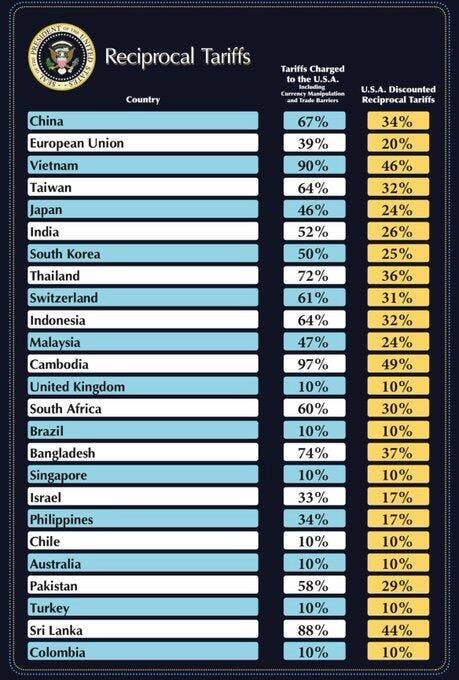
- China: 34%
- South Korea: 26%
- India: 27%
- European Union: 20%
- See Annex I for the complete list of countries and their applicable rates.
- Transit Exemption: Goods from Annex I countries that are already in transit on the final mode of transit into the U.S. before 12:01 a.m. ET on April 9 will not be subject to these country-specific tariffs. Again, GET YOUR PRODUCTS LOADED NOW!
3. Free Trade Agreements Not Exempt
- These tariffs will apply to all goods from impacted countries, regardless of existing U.S. Trade Agreements, unless explicitly excluded.
4. Elimination of China De Minimis (Effective May 2)
- Beginning May 2, low-value imports (≤ $800) from China will no longer qualify for duty-free de minimis treatment.
- All applicable duties must be paid under normal entry procedures.
- Packages valued at or below $800 sent through non-postal methods will be subject to all applicable duties.
- Packages valued at or below $800 sent through the international postal network will be subject to a duty rate of 30% of their value or $25 per item (increasing to $50 per item after June 1, 2025).
5. CBP Guidance Expected Soon
- Customs and Border Protection (CBP) will release additional instructions on how these measures will be implemented. We will provide updates as soon as official guidance is issued.
6. Additional Considerations from Annex I and Annex II
- Annex I: Provides a detailed list of countries subject to country-specific tariffs starting April 9.
- Annex II: Lists products that are excluded from the tariffs, including:
- Products already covered by Section 232 tariffs (e.g., steel, aluminum, autos, auto parts)
- Pharmaceuticals (some), semiconductors, copper, lumber, energy, and critical minerals
- Goods under 50 USC 1702(b) exceptions
- Additionally, USMCA-compliant goods from Canada and Mexico remain duty-free. However, non-compliant goods are still subject to existing tariffs related to fentanyl or migration under IEEPA (25% or 10% tariffs).
What This Means for Importers
These changes represent some of the most significant trade policy shifts in recent memory. Importers, particularly those bringing in goods from China, South Korea, India, and the European Union, will be hit hardest.
The elimination of the de minimis exemption for low-value shipments from China is likely to cause major disruptions and increase costs for U.S. businesses relying on small-scale imports.
Preparing for the Changes
Here’s what you should do to prepare:
- Review Your Supply Chain: Assess which of your products will be affected by the new tariffs and adjust your sourcing strategies accordingly.
- Reclassify Your Products (If Applicable): Review your HTS codes to determine if your products might qualify for exclusion or a lower rate.
- Review Annex I and Annex II Thoroughly: Ensure you understand which of your products are impacted and whether you qualify for any exemptions.
- Consult Legal Experts: These tariffs are layered on top of existing tariffs, so it’s essential to have expert guidance to navigate the complexities. Very little is clear about what just came out, and we do expect that the tariff rates for various countries will change.
- https://harris-sliwoski.com/chinalawblog/united-states-tariff-changes-what-you-need-to-know-now/
Annex II: https://www.whitehouse.gov/wp-content/uploads/2025/04/Annex-II.pdf
April 4, 2025
USITC Votes to Continue Investigation on Methylene Diphenyl Diisocyanate (MDI) from China

March 28, 2025
News Release 25 -041
Inv. No(s). 731-TA-1733
Contact: Jennifer Andberg, 202-205-1819
USITC Votes to Continue Investigation on Methylene Diphenyl Diisocyanate (MDI) from China
The U.S. International Trade Commission (Commission or USITC) today determined that there is a reasonable indication that a U.S. industry is materially injured by reason of imports of methylene diphenyl diisocyanate (MDI) from China that are allegedly sold in the United States at less than fair value from China.
Chair Amy A. Karpel and Commissioners David S. Johanson and Jason E. Kearns voted in the affirmative.
As a result of the Commission’s affirmative determination, the U.S. Department of Commerce will continue its investigations of MDI from China, with its preliminary antidumping duty determination for China due on or about July 22, 2025.
The Commission’s public report, Methylene Diphenyl Diisocyanate from China (Inv. No 731-TA-1733 (Preliminary), USITC Publication 5606, April 2025), will contain the views of the Commission and information developed during the investigations.
The report will be available by May 5, 2025; when available, it may be accessed on the USITC website.
https://www.usitc.gov/press_room/news_release/2025/er0328_66700.htm
April 3, 2025

Bassett Furniture manufactures living, dining, bedroom, outdoor and upholstered furniture in Virginia and North Carolina.
Bassett builds profitability in Q1; CEO talks price plan in wake of tariffs
Bobby Dalheim //Senior Editor of Case Goods and Global Sourcing//April 3, 2025
BASSETT, Va. – Bassett Furniture reported consolidated first quarter sales of $82.2 million, a decrease of 5.1% from last year. However, when considering that last year’s quarter had an extra week, sales increased 2.2%.
The company reported positive operating income of $2.5 million, compared to a loss last year of $2.4 million. This marks the second consecutive quarter of profitability, which followed five straight quarters of losses previously.
Improved wholesale margins in the quarter drove company gross margin to 57%, a 170 basis point increase over the prior year, and marking some of the highest levels ever seen, according to the company.
Considering the extra week, wholesale sales climbed 4.2% to $52.9 million. Margins grew 250 basis points due to gains in Bassett Custom Upholstery and manufacturing efficiency gains.
In retail, with the extra week considered, sales increased 6.8% to $53.3 million. Gross margin in the segment fell 80 basis points due to lower margins in in-line and clearance goods, as the company said it became more aggressive in cycling through unproductive inventory.
“We had a strong December and January, due in part to the shorter time frame between Black Friday and Christmas,” said Rob Spilman, CEO. “The sales environment was a little more challenging in February.”
Tariffs were, of course, a talking point on the earnings call.

“Tariffs have been top of mind for several months and especially since 4 p.m. yesterday,” Spilman said. “Although 79% of our wholesale shipments in the first quarter were manufactured or assembled in the U.S., many materials used in the process, like fabric and plywood, will now be exposed to tariffs, as will the remaining 21% of our product.
“The entire industry is working with outside experts to gain clarity on this unusual situation. We will determine what this means for our pricing structure on goods that are affected over the next several days. We’re thinking about everything. We’ve been reaching out to our best customers.
“If it stays like it is, we’re going to have to increase prices at some level.”
Spilman said on an earnings call that it’s not feasible to bring the remaining 21% of the company’s product to the U.S. to be made domestically.
“We can certainly emphasize the domestic product more prominently if we choose to do so,” Spilman said. “But we have some nice selling imported product that’s really making a difference for us. We have to study that. We do have some flexibility with our five U.S. factories, and we’re not totally reliant on imports.”
Spilman gave his overall outlook:
“Our strategic plan for 2025 was designed to weather another year of tepid demand and to keep us disciplined and focused on growth. Our management team is running with a leaner mindset.
“We plan for housing sales to remain slow and we’re moving to react quickly to the ups and downs and economic data and changes from Washington. Last week’s report that consumer confidence is plummeting is disconcerting, but we believe the steps we’ve taken will help us run efficiently and get through this tough furniture economy.”
April 2, 2025
“Well we have some very, very good news today,” Trump began his address exclaiming that “This is Liberation Day.”
“April 2, 2025, will forever be remembered as the day American industry was reborn, the day America’s destiny was reclaimed and the day that we began to make America wealthy again,” Trump says.
Mexico and Canada are not on the list as US will continue to exempt USMCA-compliant goods.
“For decades, our country has been looted, pillaged, raped and plundered by nations near and far, both friend and foe alike. American steel workers, auto workers, farmers and skilled craftsmen — we have a lot of them here with us today. They really suffered gravely.”
“In a few moments, I will sign a historic Executive Order, reciprocal tariffs on countries throughout the world. Reciprocal. That means they do it to us and we do it to them. Very simple. Can’t get any simpler than that.”
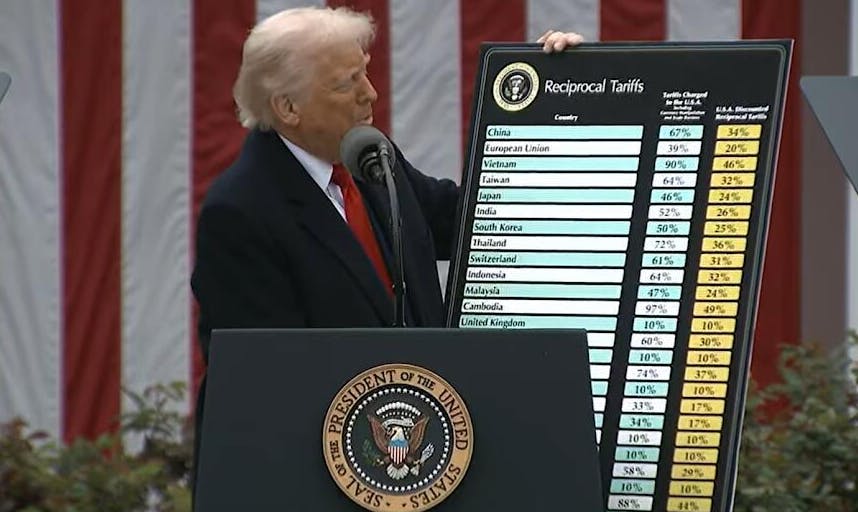
Trump lays out his theory that tariffs will bring back a “golden age” for the US, a phrase he also used in his inaugural address:
“Jobs and factories will come roaring back into our country, and you see it happening already. We will supercharge our domestic industrial base.”
Trump says the reciprocal tariffs will bring “stronger competition and lower prices for consumers” in the US.
Finally, Trump announces his tariff plan details as a “Declaration Of Economic Independence”
The bottom line is that this is targeted reciprocal tariffs, NOT a broad-based 15% or more tariff slap on all products.
Additionally, Trump confirmed that the new reciprocal tariffs will begin at midnight tonight.
However, they did announce a baseline tariff rate of 10% for all countries (below the 15% consensus and 20% worst case) and Trump confirmed the 25% tariff on all auto imports.
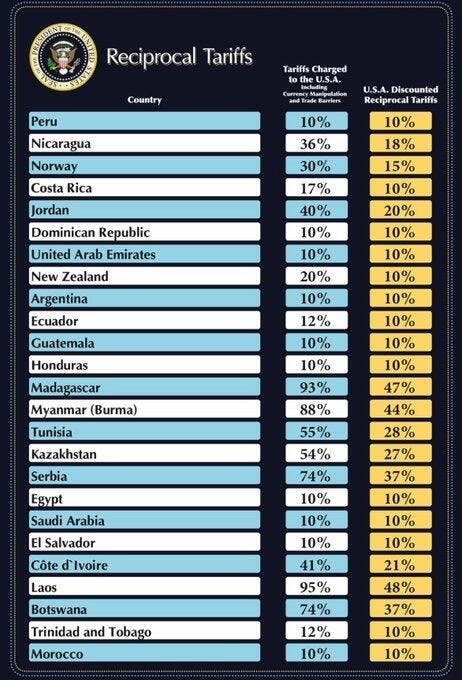
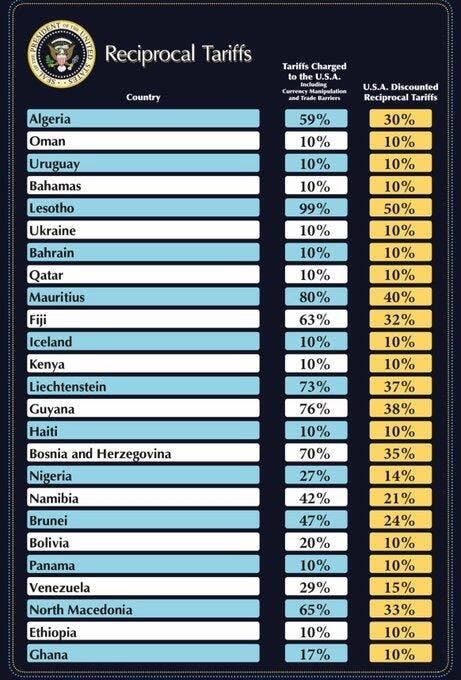
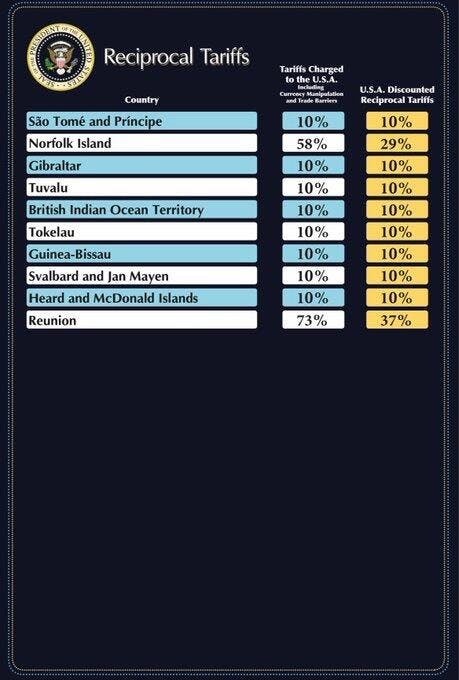
Additionally, Trump said they will not be full reciprocal tariffs, then held a chart up showing the individual nation (trade-weighted average) tariff levels:
Full List of Countries Hit With Reciprocal Tariffs:
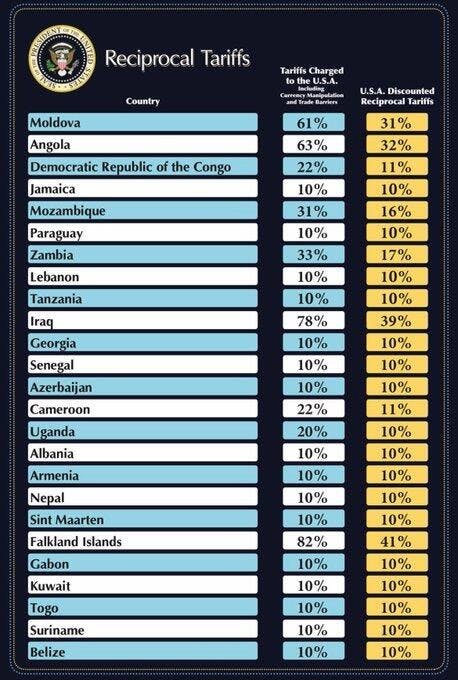
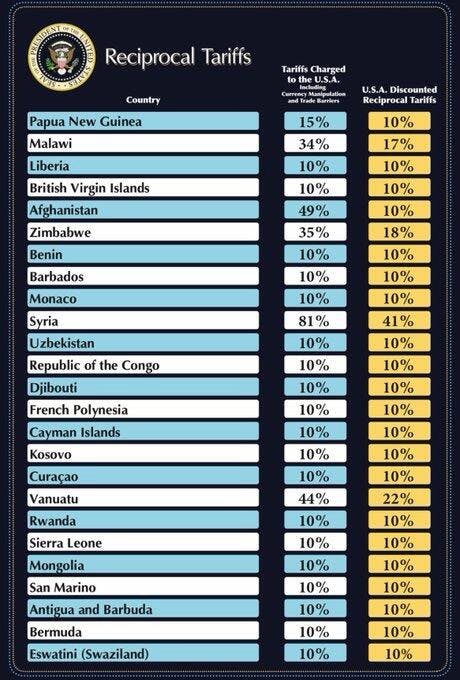
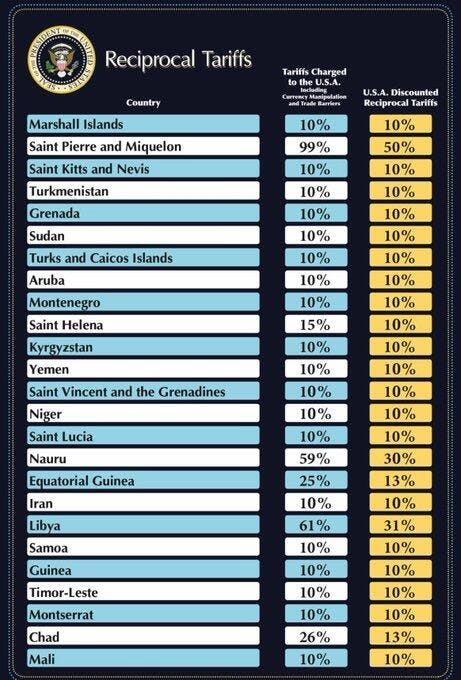
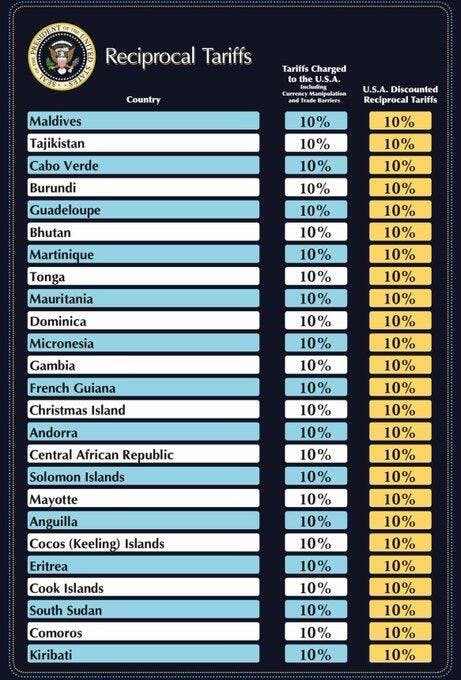
For a deeper dive, see: https://www.zerohedge.com/markets/trumps-liberation-day-live-blog-all-you-need-know
April 2, 2025
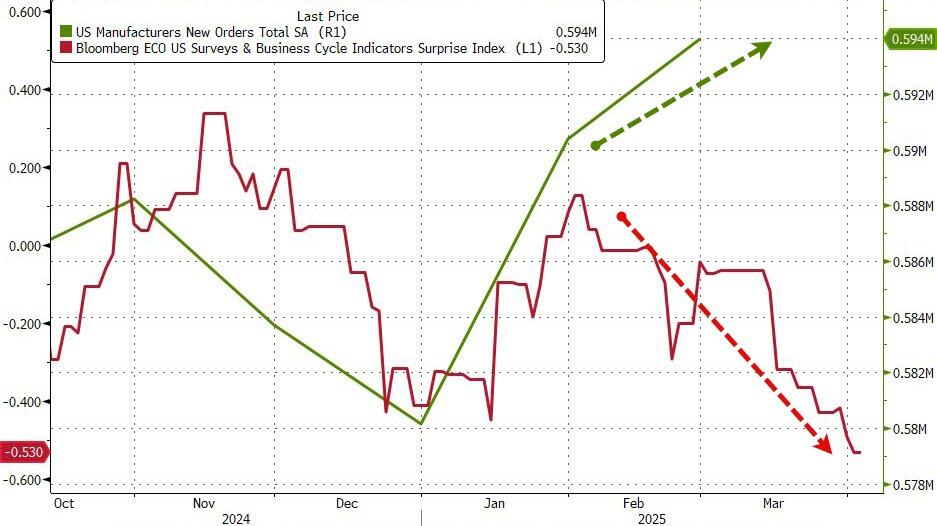
US Factory Orders Surge Near Record Highs In Feb
by Tyler Durden
Wednesday, Apr 02, 2025 – 10:11 AM
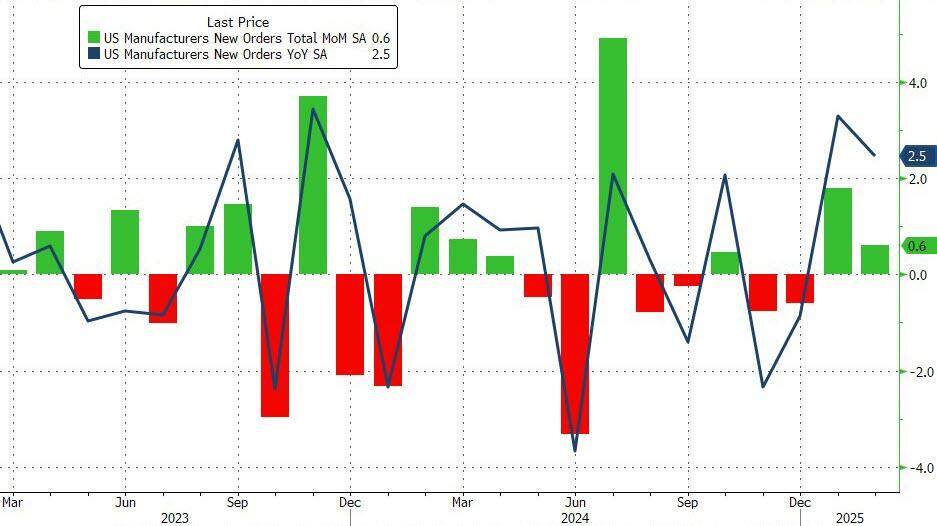
Despite all the ‘soft’ data slumping and legacy media narrative creation that a recession is imminent, US Factory Orders (hard data) surged for the second month in a row (beating expectations). Headline factory orders rose 0.6% MoM (+0.5% MoM exp) in March and February’s 1.7% MoM jump was revised up to +1.8% MoM. This left Factory Orders up 2.5% YoY…
Source: Bloomberg
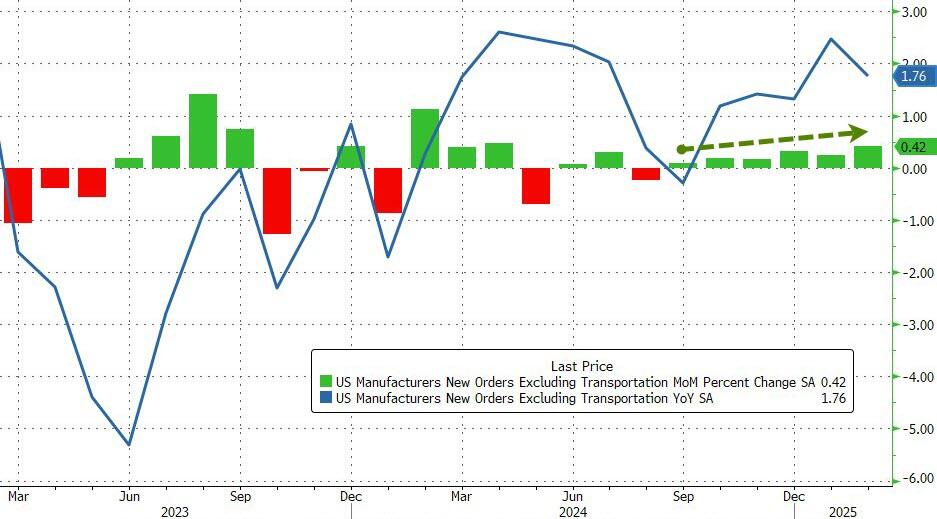
Core Factory Orders (excluding the more volatile Transportation sector) rose 0.4% MoM – accelerating on a MoM basis for the sixth straight month…
Source: Bloomberg
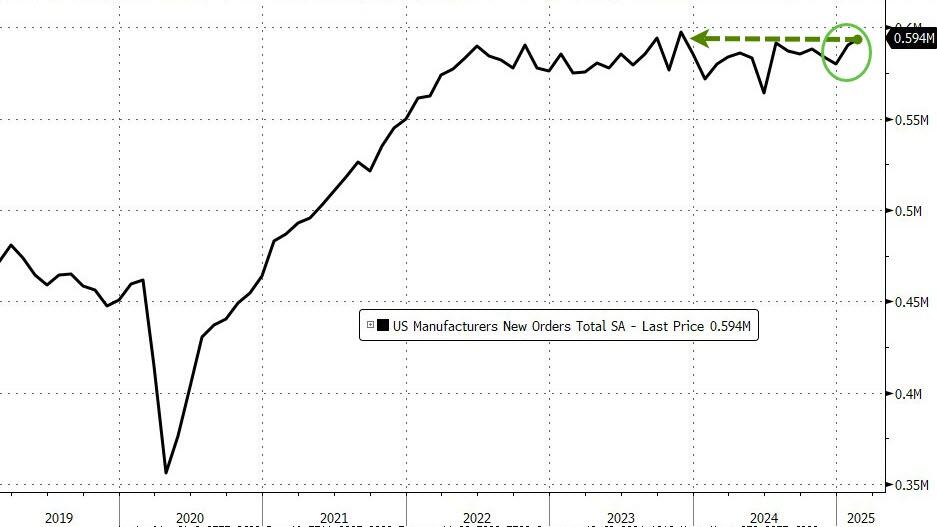
Finally, February’s rise lifted US Factory Orders very close to record highs…
Source: Bloomberg
So much for the ‘soft’ data-driven recession talk?
 Everchem Updates Archive
 Sign Up for Email Updates


