
The Urethane Blog
November 11, 2024
Huntsman Corporation (HUN) Q3 2024 Earnings Call Transcript
Nov. 05, 2024 4:08 PM ETHuntsman Corporation (HUN) Stock

Q3: 2024-11-04 Earnings Summary
EPS of $0.10 beats by $0.00 | Revenue of $1.54B (2.26% Y/Y) misses by $9.98M
Huntsman Corporation (NYSE:HUN) Q3 2024 Earnings Conference Call November 5, 2024 10:00 AM ET
Company Participants
Ivan Marcuse – Vice President-Investor Relations and Corporate Development
Peter Huntsman – Chairman of the Board, President and Chief Executive Officer
Philip Lister – Executive Vice President and Chief Financial Officer
Peter Huntsman
Hi, Ivan. thank you very much and thank you all for taking the time to join us this morning. We got quite a few people online for questions. So, I am just going to be very brief. The third quarter ended about where we expected it to finish and we’re now focused on the fourth quarter and year end. But we expected the year to be better than it’s shaping up to be. There’s still a number of positives as we move from quarter three to quarter four at year end. As we said to many of you during our investor conferences, an improvement in North American housing and construction will be the single most impactful change in our earnings. And harder to see that interest rates are dropping in both U.S. Presidential candidates for making new housing a major part of the economic platform for improvement.
We are hopeful that another rate cut between now and the end of the year will continue to improve the VMID [ph] growth we’re still seeing today. In addition to falling interest rates over the past few quarters, we’ve seen a return to more traditional MDI growth that exceeds the rate of GDP growth. As we’ve said in the past quarters, we need to see demand growth improve and capacity utilization rates increase before we see meaningful margin expansion. The demand growth is moving in the right direction, but I was disappointed to see our recent Q4 MDI price increases get little traction with customers. We continue to see very low inventories across the board and rising demand will eventually support price increases and margin expansion.
Additionally, we see a number — we see a record amount of global chemical assets, especially in Europe that are on the market. I would personally be surprised if all of these assets are sold. So, I imagine very few of these are actually making money. Given Europe’s desire to rid itself of manufacturing, which I see reflected in its adherence to anti-growth energy and regulatory policies, I doubt the prospects will change anytime soon. We may well see a number of facilities closed due to a combination of regulatory and high-cost structures.
Longer-term, I think there will be a much needed consolidation in a number of chemical products in Europe. Having returned recently from visiting government leaders, customers and partners in Malaysia, China, Saudi Arabia and Korea, I believe that these markets are seeing relatively low growth. but as they continue to sort out their conflicts and housing bubbles, we’ll continue to see opportunities grow. 2025 should be a year of gradual improvement across Asia and the Middle East. We continue to look at all of our production sites and examine our cost structures, supply agreements and operating rates. For the end of the year, we will be initiating a further $50 million cost reduction program in our global polyurethanes business.
This is in addition to the $280 million in costs we’ve taken out of the entire company over the past few years. We will continue to manage our way through challenges such as the recently settled Boeing strike, which will cost an estimated few million dollars in the fourth quarter. We’ll also capitalize on growing EV battery opportunities, tightening insulation standards, and energy efficiency in home and building materials. While too early to say much about 2025, I believe lower interest rates pent-up housing demand, Asian stimulus announcements, lower inventories and greater political certainty in Europe and the U.S. will all work towards improving market conditions.
With that, operator, why don’t we open the line up for any questions?
David Begleiter
Do you expect MDI assets to be closed in Europe in this iteration of restructurings and reviews?
Peter Huntsman
Of Huntsman’s restructuring?
David Begleiter
No, of competitors’ MDI assets.
Peter Huntsman
Look, I simply have no idea what our competition is doing. As I look around the world, you look at the cost curve in Asia, I think given the size and the relative recent construction of the capacities of MDI in Asia, There’s a relatively flat cost curve in Asia. I think Wanhua has an advantage just simply because of the scale and integration that they enjoy. But it’s a pretty flat cost curve. I think it’s pretty similar in the U.S., where you have a handful of players that all have about the same size facility, single-site locations and so forth. Europe continues to operate multiple smaller facilities and multiple — across multiple countries.
And as I look at that and you look at the raw material costs, energy costs, transportation costs, regulatory costs, everything else across Europe, I’d be very surprised if we’re sitting here a year or two from now and all of those particularly, the smaller non-integrated facilities are still operating. But again, I just look at that on a cost curve, U.S. versus Asia versus Europe, and certainly Europe is the outlier. But again, I haven’t had any idea what goes on in the competition.
David Begleiter
Very good. And just on your new restructuring program in Polyurethanes, $50 million. Can you detail the functions and regions, where that cost is being removed from?
Peter Huntsman
Yes. Most of that is going to be in Europe. It will be centered around our automotive in construction. We will be giving some more detail about this during our fourth quarter call in a couple of months. But safe to say, this will be about a $50 million cost savings over the next few years. The majority of this ought to be seen by the — on a run rate basis by the end of next year. And the cost typically when you’re looking at these sort of programs, it pretty much costs you the same as the savings. So, there’s about a one-year give or take a quarter to a one-year payback on this. Thank you.
Jeffrey Zekauskas
And in terms of your — can you describe your volume expectations in MDI for the fourth quarter in general and by region?
Peter Huntsman
I think that as we look at this, we’ll see a seasonal decline that’s usually about 15% to 20% depending on year-end inventory stock and so forth. Jeff, I am not trying to evade a direct answer on this, but typically in the middle of November, in the next week or two, we’ll start to see just how much people are trying to cut inventories and try to preserve working capital and so forth. And literally, as you start to see this in the last four to six weeks of the year, people will, in some cases, will just stop ordering and they will take their inventories down.
Now, I believe that inventories are anecdotally, as you look across MDI, inventories are very low. But some regions of the world, where growth demand is pretty anemic as well. So, I think that we’ll see what we typically see during seasonality, which is on a global basis anywhere from 10% to 15%.
Patrick Cunningham
Hi. Good morning. So, you mentioned MDI price increases were rebuffed into 4Q 2024. What are your expectations for prices by region in 4Q and what are you reflecting in terms of raw material declines?
Peter Huntsman
Well, I think that as we look at pricing for MDI in Q4, it’s looking pretty flat. I mean, as we look at some of the spot markets, there’s a little bit of upward pressure in China. But as I look at the spot prices in Europe and the U.S., it fits flat to down a little bit in tracking the cost of benzene. So, I think we will pick up a little bit of benefit from benzene, but that will not wholly, but partially be offset by flat pricing and probably higher natural gas prices.
Michael Sison
Hey, guys. Good morning. Peter, for polyurethane, you are getting volume growth. The earnings leverage or EBITDA leverage just doesn’t seem to be kicking in yet. What level of volume or sales do you think you need to see to start seeing the appropriate leverage for that business going forward?
Peter Huntsman
It’s an excellent question and one that we ask ourselves quite often as well. As we really see in this market, we start getting leverage when capacity utilization gets in the high-80s. Now, exactly what segment of the market does that have to hit and so forth. That’s all yet to be determined. But as we look around the world, I believe that the global operating rates are probably in the mid-eighty 5% to 87%, 88%. We might be — if we continue to see the sort of growth in demand and recovery in MDI that we’ve seen this past year, I believe that we ought to be seeing some expansion in pricing and margins early in 2025.
Again, that’s predicated upon demand continuing to improve, particularly in North America around housing. But it’s — look, we’re coming off of a very low base of where we were last year. So, when we look at the demand, I’m happy with the demand I’ve seen in 2024 in MDI, but we need to see that continue to get out of the hole that we got into the end of 2022 and 2023. And of course, during that time period, we’ve also seen capacity additions that have come into the market.
So, I think all of that offsetting each other as we look into 2025. I’m hopeful that as we kick off 2025 post Chinese New Year’s, start getting into construction season, hopefully we’ll start to see orders in the February, March timeframe start picking up materially.
Michael Sison
Great. And as a quick follow-up on 2025. I know it’s a little bit early to give specific outlook. A lot of the consultants do see margin expanding quite a bit potentially. Do you sort of agree with that cadence? And what type of EBITDA potential or power do you think you should see in polyurethanes if things pick up next year?
Peter Huntsman
I think, again, I would agree with that. I mean, as we talk about margin expansion 2025, a lot of that’s going to be predicated again, about what sort of demand we see in North America housing. China, we have got to see consumer confidence return and Europe’s just got to see some sort of return to some element of sanity when it comes to a manufacturing policy around energy and so forth. We may well see an improvement in North America, because of housing and Asia, because of consumer demand. And Europe continues to lag behind. I do believe fundamentally that we are seeing a lot of capacity utilization that traditionally has been European based, particularly in automotive and probably a couple of other materials that are moving to the U.S., moving to the Middle East or moving to Asia.
So, I think that you are seeing a global dislocation from Europe to other regions. And so, you might actually see an improvement take place in North America and Asia before you do Europe. So, I’m not sure that it’s necessarily going to be an even tide in all regions simultaneously as we’ve seen in the past.
Frank Mitsch
Thank you and good morning. Peter, I saw a news item recently about a chemical company doing a capacity expansion of non-PU-based insulation materials, and they’re targeting the European market. And the release read positively about future demand for insulating materials in Europe. Now obviously, as I read the prepared remarks and listened to you so far, didn’t seem like there was much to get excited about insulating materials in Europe, which obviously would be very helpful for you. What’s your take on that market and when might we see a recovery there?
Peter Huntsman
To be honest with you, I’m rather frustrated with Europe, as you could probably tell, Frank. In one of the areas, where you would think with higher energy prices, Europe would be one of the most proactive areas on legislating construction materials and insulation standards. In reality, virtually every state in the United States has a higher and tougher energy conservation standard than most European countries do. So Europe, when they get their act together, they really want to start looking at how do you conserve as much as and put that into an active energy policy. I believe that there is some real upside there. I think that we’re sitting in a position. We have blending facilities in Europe. We can make polyurethane spray foam materials. We don’t export it from the U.S.
We can make it there. We can utilize our own technologies and our own polyols and so forth. And we’ve got a real opportunity in Europe. But without the correct incentives inducements and regulatory environment, I don’t think you’ll want to see the sort of growth in Europe that we’ve been able to see in the U.S.
Joshua Spector
Yes. hi, good morning. I was curious on Europe, the deal that’s kind of apparent between Covestro and ADNOC kind of has them keeping capacity intact in Europe. Is that an impediment to Europe improving for the NDI market for Huntsman?
Peter Huntsman
I’ve got — I’m not again, I’m not trying to evade an answer. I’ve just got no idea what ADNOC and Covestro would be planning. I assume that between signing and closing, you’re not going to want to do no matter what your plans are, you’re not going to want to do a whole lot that would antagonize regulators and your labor unions and so forth. So, let’s keep everything kind of as is and — but I’m just speculating at that. So look, I’d always rather see less capacity than more capacity all things being equal, but I’ve no idea what they’re planning to do.
Aleksey Yefremov
Thanks. Good morning, everyone. Peter, I wanted to ask you about pricing in MDI. In prepared remarks, you say you don’t have much exposure to spot. But I also recall traditionally, you don’t have much exposure to contract as well with a big chunk of your business tied to just raw materials pass through. Can you just explain what’s the current state of your — sort of leverage to contract, benchmark contract pricing for MDI that we can observe in North America?
Peter Huntsman
Yes. I think, well, I’ll just touch on all three regions. So, I consider and I don’t want to oversimplify this, so forgive me. But let’s just put it in kind of three buckets. One is, how much is just spot and that’s what you oftentimes will read in ISIS or these sort of publications. The other one is going to be around formula pricing. And the other one around, I would say, variable pricing, which is going to be MDI is more than just three buckets of pricing. That variable pricing depending on, if it’s pure MDI or if it’s a formulated product or whatever, it’s going to be all over the place.
So, if you look at spot materials, it’s typically around 10% Europe, 10% Europe and about 40% in China. If you look at formula pricing, it’s around 20% of our total volume globally. That’s going to be preponderantly in North America, China; it will be lesser than that. And then that third bucket on the variable side, that’s what’s coming out of the splitter, for the most part or into formulations or into pure MDI. That pricing is going to be on a contract.
It’s going to be on a customer by customer. Very little of that is going to be throughput pricing. And that’s going to be on a negotiated basis customer to customer. So that’s kind of the three buckets. I do think people have a tendency probably to read too much into published pricing.
I think it’s probably a good macro indicator. But you just got to remember that MDI, unlike ethylene, benzene or some of the other chemicals that are traded, the pricing of which is regional and it is all over the place.
Aleksey Yefremov
Thanks. Very helpful, Peter. In your automotive polyurethanes business, I mean, it appears that European OEMs are losing share. These are some traditionally some of your best customers, right, biggest customers in PU. How are you addressing this sort of sea change in the auto world? How are you changing your strategy in terms of going after sort of the emerging OEMs in China and elsewhere?
Peter Huntsman
Well, I think, fortunately, we have very strong regional platforms in the U.S., Europe and Asia. I think these regional platforms are probably getting stronger and stronger. With Asia, it used to be just probably four years ago, five years ago, we made more money in European auto than we did in our than we did in the other two regions combined.
Today, that can be said about Asia. The relationships that we have with Asia, be it anything from a Hyundai in Korea to BYD in China and so forth, the relationship and the applications, not just in traditional applications like seating, but also now with more EVs and the sound insulation, in the materials and the battery and so forth. As we look at Asia, we make more money even though that’s only 40% of our global automotive business is in Asia.
We make more money in Asia than we do the rest of the world, the other regions combined. So, I think that we’re — as we look at our automotive business, it continues to be very stable for us. But again, I think under the water, there are a lot of very fast moving currents between ICE and EV, between Europe and Asia, U.S. and the rest of the world. And the global trades are going to continue to, I think, move very rapidly in those areas. We look at what the Chinese EV markets are doing in the Latin America and so forth. But rest assured that I think we have very good platforms to address EV and ICE, and to address the regional formations and that’s how we’ve been organized and we’ll continue to be organized.
Salvator Tiano
Yes. Thank you very much. So firstly, you mentioned your splitter before on the contract-by-contract base. I believe earlier in the year, you said that the new Geismar splitter wasn’t really adding any EBITDA so far. So, where do we stand right now? Has it started contributing? And if not, why is that and what should we expect for 2025 on the splitter?
Peter Huntsman
Yes, Sal, so obviously both the splitter investment, but at Geismar, what really needs to happen to get the full benefits of that splitter is a return from a consumer perspective on areas such as furniture. Auto needs to be quite a bit stronger in North America as well. And so, as our deep and coating, some of which ends up on the consumer side. And that really needs to be a lot stronger in order to benefit substantially from that split of investment. We still expect that to happen over time. That’s not the issue. It’s all around timing. It’s all around the consumer confidence that Peter spoke about.
If you think about next year, maybe $10 million to $15 million year-on-year benefit. But that’s really dependent upon how our furniture market develops, how automotive develops, as well as how our adhesives and coatings develop.
Hassan Ahmed
Good morning, Peter and Phil. Not to bore you guys, but just wanted to go back to a bunch of the questions that were asked about the European restructurings going on, assets being put up for sale and the like. I mean, look, one of the virtues obviously of the polyurethane sort of story has been, it’s obviously an oligopoly, right? And if I heard your comments correctly, it sounds as if you are leaning towards at least some of these assets being permanently shut down. So, my question I guess is that looking at the Covestro deal and I obviously understand a different company and the like, you have no idea what ADNOC is thinking. But I mean, how do you think about players like ADNOC, other sort of state players or Asian players coming out, buying up those assets and fragmenting an otherwise relatively consolidated industry?
Peter Huntsman
Well, yes, it’s a very good question and very complicated one. In many sense, I am not sure that ADNOC really changes the dynamics. I mean, you are just having the name of one company, Covestro, being changed to another one, ADNOC. If they decide to build in the Middle East or if they decide to build a new facility, I mean, you’re probably looking at anywhere from six years to eight years away between the — in the time that it would take to build a facility somewhere, even if it’s in addition to an existing site, given the opposition that you see in large scale chemical production and so forth. So, I’m really not sure that unless you saw splintering that took place of a company, I’m not sure that the whole ADNOC-Covestro deal really changes those dynamics any.
Kevin McCarthy
Yes. Thank you and good morning. Peter, can you speak to how you see international trade flows today in MDI and perhaps maleic anhydride and how they might evolve if tariffs were to escalate in that scenario bilaterally between?
Peter Huntsman
Yes. I think they’ll probably remain pretty much the way they are today. The U.S. has about a 30% tariff, give or take a few points on MDI and on maleic, and a number of other products. And so, those people that are importing in today, I don’t see tariffs going up through the roof. I don’t see them disappearing or necessarily coming off, depending on some recently filed cases in certain products and so forth, you might see them go up a bit.
But largely with the exception of Wanhua in China that has all the production in China, the exception of a single European site, they’re obviously moving product around the world. They have for years and they’ll continue to do so. But the trade flows from most of the producers of MDI that have regional production, I see that as continuing and there’s not a great deal of trade flow in MDI from one region to the next. I would say the same is probably true with maleic and with most of the other products we produce. I would say the exception of that with maleic would be what you see in China, there is a quite a lot of overcapacity in China for maleic. That was supposed to be the raw material for a biodegradable plastic that’s coming on stream a little bit slower than I think most people anticipated. But nonetheless, some of that maleic is spilling over in Europe. Other than that, I think most products are staying within region.
Mike Harrison
Hi. Good morning. You mentioned some new business wins in North America polyurethanes. I was wondering, I guess if you can speak to specifically what markets those are occurring in? And if they are in construction, can you maybe just talk about your competitive position within construction and insulation markets? Has that improved compared to a few years ago? Maybe, also wrap in an update on spray foam insulation adoption today versus a few years ago? Thank you.
Peter Huntsman
Yes. In construction, it’s mostly and I would say, kind of three buckets, if you will. One is going to be what we see in the OSB into the wood market that goes into construction, what we see in insulation going into construction. I think in both of those positions, we have very stable positions and positions, where we’re not just selling molecules, but we’re also selling solutions to the customers. The third area, I would say, would also be in furniture and appliances and so forth.
While we don’t supply a lot of material that goes into appliances and some of the low-end furniture applications, others do. And that sucks a lot of MDI out of the market that goes into that kind of third bucket of construction. Oftentimes, when we focus on construction, we’re talking about OSB. But construction and housing also takes up a lot of MDI in other areas that aren’t necessarily big markets for Huntsman, but are for others. And it’s a good drain for the product generally.
November 10, 2024
The Great Freight Recession Is Officially Over
by Tyler Durden
Sunday, Nov 10, 2024 – 02:00 PM
By Craig Fuller of FreightWaves
I’ve been closely following the freight market, and it’s clear that the Great Freight Recession has ended. After the most prolonged freight recession in history, the market has been showing signs of recovery over the past few months. This shift is backed by SONAR data, confirming a market turnaround.
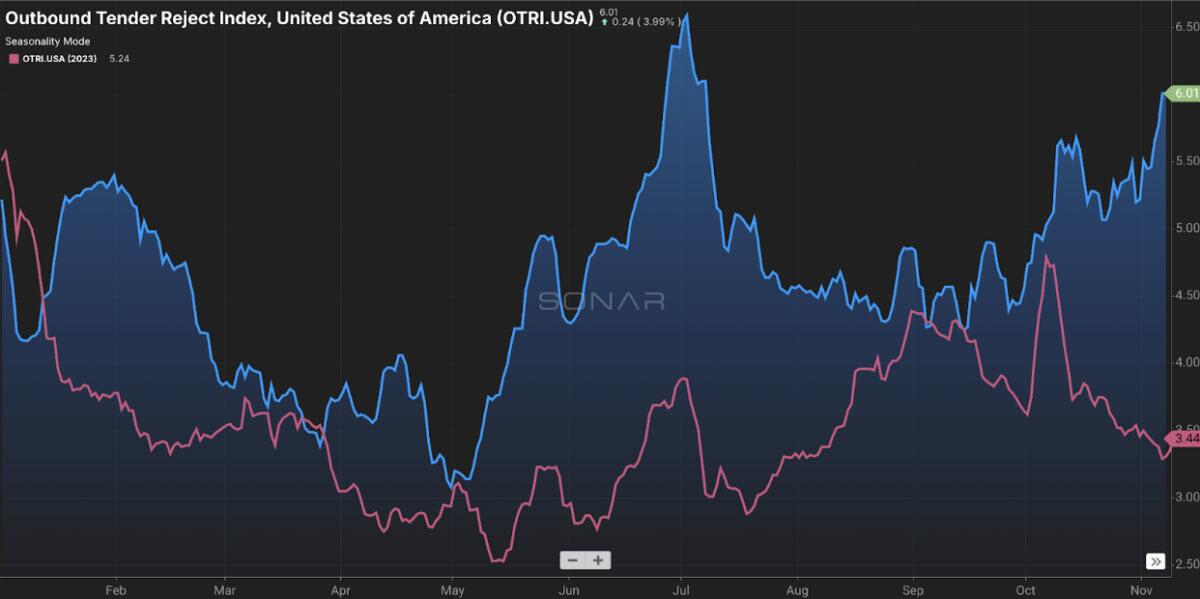
Tender rejections rising: The increase in tender rejections to over 6% signals that the market is tightening. After seeing rejections dip to 3.4% post-Labor Day last year, this change indicates that carriers now have more control in choosing which loads they accept, thus shifting market dynamics in their favor.
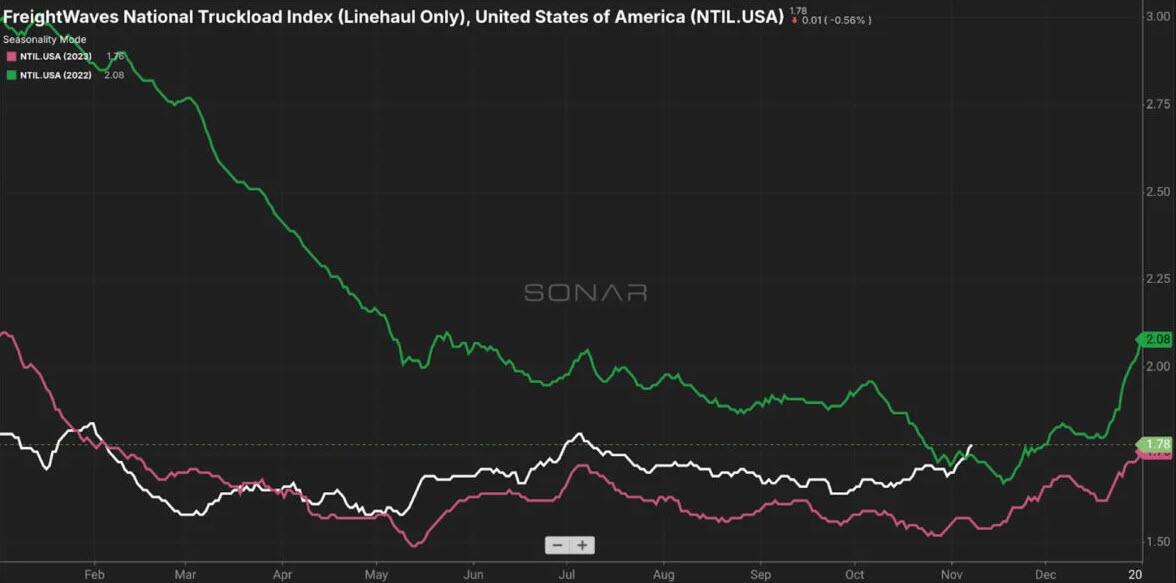
Spot rates increasing: Spot rates are also climbing, surpassing those of 2022 and 2023, which tells me there’s either a surge in demand or a decrease in available capacity, possibly both. This could catch many expecting the low rates to persist off guard. Truckload rates are up to $1.78 from $1.54 a year ago.
Carrier revenge could be coming next year: “Carrier revenge” implies that carriers, after a period of low rates and high competition, might leverage their position to negotiate better rates or reject tenders more selectively in the coming months, affecting shippers’ logistics strategies, especially routing guides.
Decreasing capacity: Speaking of capacity, the upcoming implementation of the FMCSA’s Clearinghouse-II regulations on Nov. 18, 2024, will have a significant impact. Trucking expert Adam Wingfield stated that 177,000 truck drivers could potentially lose their CDLs, further tightening the market as state agencies need to query the Clearinghouse for any licensing actions.
This regulation requires:
- State Driver Licensing Agencies (SDLAs) to remove the commercial driving privileges of drivers in a “prohibited” status in the Clearinghouse. This action will result in a downgrade of the Commercial Driver’s License (CDL) until the driver completes the return-to-duty (RTD) process.
- SDLAs must query the Clearinghouse before issuing, renewing, upgrading, or transferring CDLs and Commercial Learner’s Permits (CLPs). This step ensures that drivers with unresolved drug or alcohol violations are not allowed to operate commercial motor vehicles.
Political influence: Trump’s election could accelerate freight demand as policy changes could stimulate economic activity, increasing the need for freight services. This includes income and corporate tax cuts, bonus depreciation, pre-stocking for tariffs, investment in domestic manufacturing and the change in freight dynamics from containers to surface (trucking, rail and domestic warehousing).
Immigration deportation: According to the Bureau of Labor and Statistics, 20% of truck driver employees are immigrants. While many of these are legal immigrants into the U.S., there are numerous reports of drivers using international driver’s licenses and fake documents to drive in the U.S.
It is hard to know the percentage here, as the data is sparse (after all, the undocumented workers would not admit it). Having been around the industry, any opportunity to game the system will undoubtedly be used. Are undocumented workers 1% of the population of immigrants or 10%?
I don’t know, but if Trump follows through with his threats of deportations, this could remove some percentage of the trucking industry’s excess capacity and make it harder for carriers that skirt the law to stay in business.
Current sentiment: Following a decisive election, I believe the freight market is recovering and might exceed expectations over the next year.
Don’t rely on lagging data: The current conditions in the freight market have been debated extensively, but with the volatility of freight, it is imperative to make decisions based on the freshest and most accurate data. This can only be accomplished with high-frequency data that offers real-time insights into market direction. SONAR’s high-frequency data is refreshed data and offers real-time supply and demand metrics with the most accurate spot and contract data in freight.
This scenario points towards a robust recovery in the freight market, potentially leading to higher freight rates, a shift in power dynamics between shippers and carriers, and an overall more vibrant market environment.
Shippers are advised to prepare for these changes by locking in rates or diversifying their carrier base to mitigate risks associated with routing guide breakdowns.
https://www.zerohedge.com/economics/great-freight-recession-officially-over
November 4, 2024
Huntsman Announces Third Quarter 2024 Earnings
Download as PDFNovember 04, 2024 4:15pm EST
Third Quarter Highlights
- Third quarter 2024 net loss attributable to Huntsman of $33 million compared to net income of $0 million in the prior year period; third quarter 2024 diluted loss per share of $0.19 compared to diluted income per share $0.00 in the prior year period.
- Third quarter 2024 adjusted net income attributable to Huntsman of $17 million compared to adjusted net income of $27 million in the prior year period; third quarter 2024 adjusted diluted income per share of $0.10 compared to adjusted diluted income per share of $0.15 in the prior year period.
- Third quarter 2024 adjusted EBITDA of $131 million compared to $136 million in the prior year period.
- Third quarter 2024 net cash provided by operating activities from continuing operations was $134 million. Free cash flow from continuing operations was $93 million for the third quarter 2024 compared to $117 million in the prior year period.
- Successfully placed $350 million of senior notes due 2034 with a 5.7% coupon rate. The proceeds were used for general corporate purposes, including repayment of debt.
| Three months ended | Nine months ended | |||||||
| September 30, | September 30, | |||||||
| In millions, except per share amounts | 2024 | 2023 | 2024 | 2023 | ||||
| Revenues | $ 1,540 | $ 1,506 | $ 4,584 | $ 4,708 | ||||
| Net (loss) income attributable to Huntsman Corporation | $ (33) | $ – | $ (48) | $ 172 | ||||
| Adjusted net income(1) | $ 17 | $ 27 | $ 30 | $ 103 | ||||
| Diluted (loss) income per share | $ (0.19) | $ – | $ (0.28) | $ 0.95 | ||||
| Adjusted diluted income per share(1) | $ 0.10 | $ 0.15 | $ 0.17 | $ 0.57 | ||||
| Adjusted EBITDA(1) | $ 131 | $ 136 | $ 343 | $ 428 | ||||
| Net cash provided by operating activities from continuing operations | $ 134 | $ 167 | $ 126 | $ 85 | ||||
| Free cash flow from continuing operations(2) | $ 93 | $ 117 | $ (7) | $ (62) | ||||
| See end of press release for footnote explanations and reconciliations of non-GAAP measures. | ||||||||
THE WOODLANDS, Texas, Nov. 4, 2024 /PRNewswire/ — Huntsman Corporation (NYSE: HUN) today reported third quarter 2024 results with revenues of $1,540 million, net loss attributable to Huntsman of $33 million, adjusted net income attributable to Huntsman of $17 million and adjusted EBITDA of $131 million.
Peter R. Huntsman, Chairman, President, and CEO, commented:
“The third quarter was consistent with our outlook of a stable environment at trough conditions in our core construction and industrial markets. Total volumes for the Company did improve 5% in the quarter versus the prior year with stable margins sequentially. Construction and transportation account for approximately three quarters of our volumes and we expect near term trough conditions to persist through a seasonally lower fourth quarter. For the medium to long-term, interest rate cuts by the Federal Reserve and ECB, combined with government stimulus in China, should have a positive impact across our global portfolio, primarily in construction. In the meantime, we are focused on what we control – improving our cost position and our balance sheet strength to maintain optionality to invest in our core businesses in a disciplined manner. We were pleased by the success of our strong bond offering in the third quarter which points to the long-term strength of our portfolio and anticipation of market improvements in the coming years.”
Segment Analysis for 3Q24 Compared to 3Q23
Polyurethanes
The increase in revenues in our Polyurethanes segment for the three months ended September 30, 2024 compared to the same period of 2023 was primarily due to higher sales volumes, partially offset by lower MDI average selling prices. Sales volumes increased primarily due to improved demand and share gains in certain markets. MDI average selling prices decreased primarily due to less favorable supply and demand dynamics. The decrease in segment adjusted EBITDA was primarily due to lower MDI average selling prices and lower equity earnings from our minority-owned joint venture in China, partially offset by lower fixed costs and higher sales volumes.
Performance Products
The increase in revenues in our Performance Products segment for the three months ended September 30, 2024 compared to the same period of 2023 was primarily due to higher sales volumes, partially offset by lower average selling prices. Sales volumes increased primarily due to improved demand in fuels and lubes and coatings and adhesives markets. Average selling prices decreased primarily due to competitive pressure. The decrease in segment adjusted EBITDA was primarily due to lower average selling prices and unfavorable sales mix, partially offset by higher sales volumes and lower fixed costs.
Advanced Materials
The decrease in revenues in our Advanced Materials segment for the three months ended September 30, 2024 compared to the same period of 2023 was primarily due to lower average selling prices, partially offset by higher sales volumes. Average selling prices decreased primarily due to unfavorable sales mix. Sales volumes increased in our aerospace and coatings markets driven by market recovery, partially offset by lower demand in our industrial market. The decrease in segment adjusted EBITDA was primarily due to higher fixed costs.
Corporate, LIFO and other
For the three months ended September 30, 2024, adjusted EBITDA from Corporate and other was a loss of $34 million as compared to a loss of $41 million for the same period of 2023. The increase in adjusted EBITDA from Corporate and other resulted primarily from decreases in corporate overhead costs and unallocated foreign currency exchange losses, partially offset by an increase in LIFO valuation losses.
Liquidity and Capital Resources
During the three months ended September 30, 2024, our free cash flow from continuing operations was $93 million as compared to $117 million in the same period of 2023. As of September 30, 2024, we had approximately $1.7 billion of combined cash and unused borrowing capacity.
During the three months ended September 30, 2024, we spent $41 million on capital expenditures from continuing operations as compared to $50 million in the same period of 2023. During 2024, we expect to spend between approximately $180 million to $190 million on capital expenditures.
Income Taxes
In the third quarter of 2024, our effective tax rate was 115% and our adjusted effective tax rate was 41%. We expect our 2024 adjusted effective tax rate to be between approximately 30% to 34%. We expect our long-term adjusted effective tax rate to be between approximately 22% to 24%.
November 4, 2024
Manufacturing PMI at 46.5%, wood products and furniture contract overall
By Dakota Smith
November 1, 2024 | 11:15 am CDT

TEMPE, Ariz. — Economic activity in the manufacturing sector contracted in October for the seventh consecutive month and the 23rd time in the last 24 months, say the nation’s supply executives in the latest Manufacturing ISM Report On Business.
The report was issued today by Timothy R. Fiore, CPSM, C.P.M., chair of the Institute for Supply Management (ISM) Manufacturing Business Survey Committee:
“The Manufacturing PMI registered 46.5 percent in October, 0.7 percentage point lower compared to the 47.2 percent recorded in September. This is the lowest Manufacturing PMI reading in 2024. The overall economy continued in expansion for the 54th month after one month of contraction in April 2020. (A Manufacturing PMI above 42.5 percent, over a period of time, generally indicates an expansion of the overall economy.)
Fiore continues, “U.S. manufacturing activity contracted again in October, and at a faster rate compared to last month. Demand continues to be weak, output declined, and inputs stayed accommodative. Demand slowing was reflected by the (1) New Orders Index remaining in contraction territory, (2) New Export Orders Index contracting moderately, (3) Backlog of Orders Index dropping further into strong contraction territory, and (4) Customers’ Inventories Index indicating customers’ inventories were ‘too low.’ Output (measured by the Production and Employment indexes) continued in contraction.

Wood products and furniture & related products overall manufacturing metrics were not measured in this report.
Wood products saw a contraction in:
- Inventories
Growth:
- Employment
- Inventories
- Prices for raw materials
A respondant in the wood products industry stated, “The seasonal business cycle is as planned: Consumer confidence in building materials remains relatively strong, and expectations are for continued growth into 2025 due to reduced interest rates and the potential for further small cuts.”
Furniture & related products saw a contraction in:
- New orders
- Employment
- Supplier deliveries
- Backlogs
- Volumes of imports
Growth:
- Customer inventories
The data presented herein is obtained from a survey of manufacturing supply executives based on information they have collected within their respective organizations. ISM makes no representation, other than that stated within this release, regarding the individual company data collection procedures. The data should be compared to all other economic data sources when used in decision-making.
October 31, 2024
US Sues Executive for Tariff Evasion on Chinese Imports

10/31/2024Updated: 10/31/2024
The United States has opened a civil suit against a furniture company executive for allegedly making false statements to customs officials to avoid paying import duties on products manufactured in China to be sold in the United States.
The Department of Justice (DOJ), Customs and Border Protection, and Homeland Security Investigations officials announced the suit on Oct. 31, alleging Lawrence Bivona, former president of Delaware-based company LaJobi Inc., evaded paying around $7 million in duties. The company sold children’s furniture.
The goods that Bivona imported were subject to tariffs of 216 percent, but the executive allegedly made false statements that resulted in the company only paying up to 7 percent import duty rates. According to the DOJ, Bivona misrepresented the manufacturers of goods imported so the company could pay lower duties.
The tariff had been implemented as an antidumping measure to counter the Chinese communist regime’s subsidization of Chinese industries to the point of harming United States businesses, according to officials.
“Anti-dumping duties play an important role in countering illegal foreign trade practices and protecting U.S. manufacturers,” said Principal Deputy Assistant Attorney General Brian M. Boynton, head of the DOJ’s Civil Division. “We will continue to pursue those who seek to gain an unfair advantage by violating our trade laws.”
The furniture imports occurred in 2009 and 2010. The government is seeking $15 million in civil penalties in addition to $7 million in recovery of unpaid tariffs.
Earlier this month, the interagency fraud task force similarly brought civil action against a former energy executive for evading tariffs on imported Chinese solar panels between 2014 and 2018, seeking $300,000 in recovery of unpaid duties and $800,000 in civil penalties.
The United States, the European Union, and other nations have recently increased the use and enforcement of tariffs on Chinese imports to combat the Chinese Communist Party’s (CCP’s) trade practices. China under the CCP does not have a free market economy; the regime instead sets and enforces industry output to align with the regime’s goals.
U.S. and international trade officials continue to warn that the CCP’s “predatory“ trade practices are meant to run global competitors out of business. The CCP may subsidize a Chinese industry so that it can export goods at a price so far below market rate that foreign businesses cannot compete, a practice known as dumping. The European Union recently hiked tariffs on Chinese electric vehicles to up to 45 percent after a year-long investigation concluded that Chinese makers were dumping their products on the European market. The vast majority of the EU’s trade investigations last year targeted imports from China.
White House national security adviser Jake Sullivan recently said these tariffs have helped prevent a second “China shock” on U.S. industries.
“The PRC [People’s Republic of China] is producing far more than domestic demand, dumping excess onto global markets at artificially low prices, driving manufacturers around the world out of business and creating a choke hold on supply chains,” Sullivan said at a Brookings Institution event in Washington on oct. 23.
U.S. officials and lawmakers have also highlighted national security risks as an additional reason to limit Chinese imports, recently proposing a new rule to ban Chinese auto parts for connected vehicles.
https://www.theepochtimes.com/us/us-sues-executive-for-tariff-evasion-on-chinese-imports-5751446
 Everchem Updates Archive
 Sign Up for Email Updates

