
The Urethane Blog
August 12, 2024
“The Worst Is Behind Us”: The US Trucking Industry Is Showing Signs Of A Resurrection
by Tyler Durden
Monday, Aug 12, 2024 – 06:55 AM
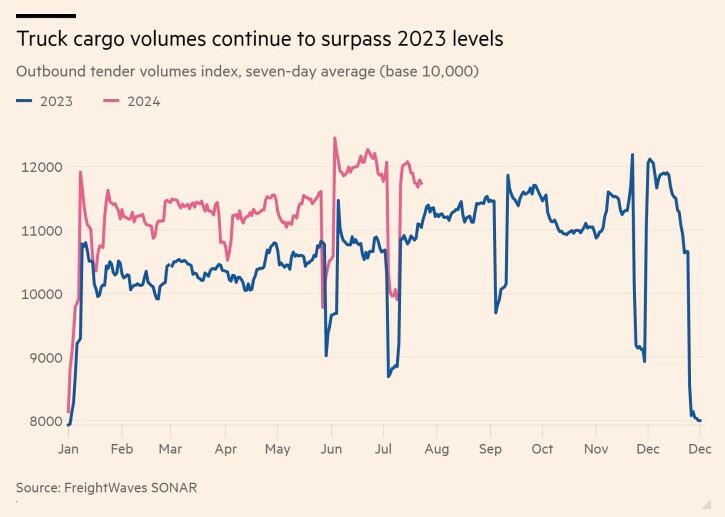
It has been a long ugly road for the trucking industry in the U.S. since Covid caused one of its deepest recessions in history.
But now, it is showing “signs of life” as demand ticks higher and prices remain suppressed, according to the Financial Times. Requests for U.S. shipments increased by an average of 9% year-over-year in Q2 2024, the financial news site says.
Tender rejections, indicating carriers’ willingness to accept loads, rose by 1.3% compared to the same period last year, suggesting that truckload capacity is gradually tightening, according to FreightWaves.
Bob Costello, chief economist for the American Trucking Associations told FT: “I do think the worst is behind us.”
After a pandemic-driven surge in consumer products led to a spike in trucking demand, the industry faced a “freight recession” in 2022 as inflation curbed consumer spending, reducing cargo volumes and rates.
Michael Castagnetto, president of North American surface transportation for logistics firm CH Robinson, confirmed that “rates went into freefall” in 2022.
The FT reported that the excess trucks from the pandemic boom weren’t matched by demand, creating a capacity overhang still affecting companies.
For instance, US transporter JB Hunt missed earnings expectations for the fifth straight quarter on July 15, with a 24% drop in operating income compared to last year, citing underutilized assets and flat pricing as key factors for the low revenue.
On JB Hunt’s earnings call, its VP of Sales and Marketing said: “We still see oversupply across all modes with shippers having options on both mode and provider to move their freight. While capacity is not a top concern right now, there is an awareness that this will change at some point.”
Now, as consumer demand steadily rises, the trucking industry is optimistic about potential rate gains in 2025, especially if interest rates decrease, according to Avery Vise of FTR Transportation Intelligence. Vise predicts a more comfortable market for carriers by mid to late next year.
However, trucking firms still face challenges, particularly with rising costs and competition. Marginal costs, excluding fuel, increased over 6% in 2023, with insurance and maintenance costs up by a third due to high interest rates, new technology, and more truck-related accidents, according to FreightWaves.
Despite these pressures, many small carriers have survived thanks to cash reserves from the pandemic freight surge, though over 25,000 firms have already exited. Small carriers, which make up over 85% of the market, have grown due to easier access to commercial licenses and digital platforms that allow drivers to find and take on freight independently.
As supply decreases and demand grows, rate improvements are expected to follow, the report concludes.
https://www.zerohedge.com/markets/worst-behind-us-us-trucking-industry-showing-signs-resurrection
August 9, 2024
Massive explosion rocks Yang Ming boxship at berth in Ningbo
Bojan LepicAugust 9, 2024
1 28,070 1 minute read

An explosion occurred on the boxship YM Mobility at a container terminal in the Beilun Port area of Zhoushan Port.
The cause of the accident was initially determined to be an explosion of a container on the ship, and there were no reports of casualties.
According to timestamps from surveillance footage videos posted online, the explosion occurred around 1:46 pm on Friday. The video first showed a large amount of smoke coming from the ship followed by a huge blast which started a fire and scattered debris.
A video from a much further distance showed massive clouds of smoke rising after the explosion. The vessel was reportedly berthed at the Ningbo Phase 3 Terminal. Some reports suggest that the cargo that exploded was glycerin.
The Ningbo Maritime Search and Rescue Center has started an emergency plan and assigned patrol boats to the scene. Three fire tugboats and shore-based fire department forces were also deployed.
The YM Mobility is a Liberia-flagged, 2011-built containership owned by Taiwanese carrier Yang Ming. It has a container capacity of 6,589 teu.
splash247.com/massive-explosion-rocks-yang-ming-boxship-at-berth-in-ningbo/
(August 5, 2024 – Rochester Hills, Mich.) The CertiPUR-US® program announces the appointment of Dan Dobratz as deputy executive director. Dobratz, who has spent most of his 50-year career in various technical and managerial roles in the flexible polyurethane foam industry, will initially serve as deputy executive director. When the organization’s current executive director, Michael Crowell, retires later this year, Dobratz will lead the nonprofit foam certification program as executive director.

Earlier roles included first-line supervision for synthetic detergent manufacturing with Procter & Gamble, pouring line manager for Carpenter Company, and field technical service for flame retardants used in rigid polyurethane foams at ExxonMobil Chemical.
Dobratz says he is pleased to be reunited with Crowell after working together in the industry several years ago. “I’ve known Mike since he was head of automotive sales for Foamex and have tremendous respect for his ability and dedication to the CertiPUR-US® program,” said Dobratz. “I’m very excited for the opportunity to work with foam producers, manufacturers and retailers and to continue the program’s success and remarkable growth.”
Established in 2008, the CertiPUR-US® program is a certification program for flexible polyurethane foam used in mattresses, sleep-related products and upholstered furniture. More information, including technical criteria for certification, may be found at www.certipur.us.
August 1, 2024
BASF SE (BASFY) Q2 2024 Earnings Call Transcript
Jul. 26, 2024 3:52 PM ETBASF SE (BASFY) Stock, BFFAF Stock
BASF SE (OTCQX:BASFY) Q2 2024 Results Conference Call July 26, 2024 2:30 AM ET
Company Participants
Stefanie Wettberg – Senior Vice President of Investor Relations
Markus Kamieth – CEO & Chairman of the Board of Executive Directors
Dirk Elvermann – Member of the Board of Executive Directors, CFO & Chief Digital Officer
Markus Kamieth
Yes. Thanks, Stefie. Good morning, ladies and gentlemen. Dirk and I welcome you to our analyst conference call. And it’s my first one since taking over as the Chairman at the end of April. And I’m really looking forward to many more of those calls and our discussions about BASF.
And you might have seen that something’s changed, some things stay the same. The music, at least, we have not changed while you were in the waiting line.
We will provide you with details on our business development in the second quarter, and we will highlight some notable aspects today.
Let’s start with an overview slide. Overall, the development of EBITDA before special items in Q2 was in line with our expectations and the analyst consensus. We saw a continuation of the dynamics of the first quarter marked by positive volume momentum across most of our businesses.
At BASF Group level, volumes, excluding precious and base metals, increased by 2.4% compared with Q2 2023. Sales declined by 7% to €16.1 billion, mainly due to lower prices. However, price pressure has eased.
We achieved an EBITDA before special items of €2 billion, which is at prior year quarter level.
Overall, stronger earnings in our Chemical businesses were offset by considerably lower earnings in the Agricultural Solutions segment due to a difficult market environment.
Here is a snapshot of how the markets and our segment volumes and specific margins developed in the second quarter. In a slightly improving market environment for base chemicals, we were able to realize strong volume growth in both divisions in the Chemicals segment. EBITDA before special items increased considerably despite slightly lower segment margins due to a margin decline in the Intermediates division.
In the Petrochemicals division, margins improved due to temporary supply constraints at competitors.
The Materials segment benefited from slightly higher volumes, particularly in Performance Materials in an overall improving market. A considerable increase in margins was largely driven by a few product lines in the Monomers division, especially in the ammonia value chain.
Industrial Solutions operated in an overall stable market environment. Nonetheless, both divisions achieved considerable volume growth and margin expansion. In particular, our Dispersions & Resins division contributed to the strong performance of the segment.
The global automotive production was basically flat in the second quarter. In this environment, volumes in our Surface Technologies segment had a considerable negative impact on EBITDA before special items. In particular, Environmental Catalyst and Metal Solutions recorded lower volumes. Overall, margins improved mainly due to a continued strong performance of our Coatings division.
The market environment for Nutrition & Care further improved in the quarter. The considerable increase in EBITDA before special items compared with the prior year quarter was supported by higher volumes in both divisions as well as margin expansion. In particular, in our personal care specialties and vitamins businesses.
The crop protection market is characterized by continued destocking and faced adverse weather conditions that negatively affected business development in our Agricultural Solutions segment. The segment’s EBITDA before special items was negatively impacted by considerably lower volumes and margins.
The factors I have just described led to the following developments in EBITDA before special items compared with the prior year quarter. Despite the considerably lower earnings in Agricultural Solutions segment, EBITDA before special items of BASF Group was at the prior year quarter level. While the Materials and the Surface Technologies segments recorded slightly lower earnings, we were able to increase EBITDA before special items considerably in the Industrial Solutions, Chemicals and Nutrition & Care segments as well as in Other.
Christian Kepler
All right, good. To Markus, well done for your first official analyst call. Two questions, please. First of all, what is your current order book visibility in your more traditional Chemical activities? Would it be fair to assume 4 to 6 weeks? And what kind of demand trends do you see at present in automotive, construction and electronics out of this order book? And then I’ll come back with the second question.
Markus Kamieth
Yes. Thanks, Christian. Analyst call is not over yet, so let’s wait, I would guess. So overall, I think the current order book visibility is tough to always put one number in there. But it hasn’t changed dramatically. It has been shorter than historically visible already for quite some time, and I would say 4 to 6 weeks is probably a good guess. Some businesses are a little bit longer, of course, some businesses less. But overall, across our Chemicals business, that’s a pretty good assumption.
I comment a little bit on trends that we see. Currently, I mean, heading into the third quarter, I already said in my speech that the current momentum that we see — that we saw in the second quarter already shapes up to be valid for the third quarter as well. So in most industries, rather sideways movement on demand and that also relates to the segments that you have pointed out.
Automotive has been, for the first half of the year, flat compared to prior year. And we expect the second half to be even a bit more under pressure, so maybe even a slightly lower number compared to last year’s number if you look at the global picture. And this comes with a bit of a conservative look also on the inventory developments in the automotive history, which are increasing, especially in Asia. So a bit of a cautious approach there. Overall, we expect build numbers, automotive, to be in line with last year, roughly around 89 million cars.
Construction overall, also, I would say, unspectacular development right now. A little bit positive developments in the more commercial construction segment, and infrastructure is also doing okay in all regions. But the residential construction market is depressed, especially in Europe and in North America. And here, the high interest rate environment and the inflationary environment certainly are not going away so quickly.
And then electronics, I have to say also, here, this is one of the few exceptions where we see continued good growth, especially in the more — in the semiconductor/chips segment. When you go into the consumer electronics segment, I would say also here, rather a sideways movement because also here we see consumer spending and consumer confidence in most areas not really growing strongly.
Peter Clark
Nice to hear you, Markus. I’ve got one clarification and two questions. The first clarification, in September, we’re going to hear from the divisions as well as the update on Ludwigshafen.
And then the questions you announced the ring-fencing in December. So we’re almost 9 months on from the ring-fencing of the Verbund by the — versus the pure-play business. Just wondering how that’s progressing and we’re still looking at 2026.
And then on the fixed cost performance. Obviously, in the first quarter, I was certainly encouraged that fixed costs pretty much went down in every segment. A couple of segments saw them up. I know the one-off effect is preparing for a shutdown, et cetera. But just getting on top of that fixed cost, again, as we go forward from here and making sure all the divisions or segments start to see them come down.
Markus Kamieth
I’ll try to take the first two questions, but I didn’t quite get the second one, so you might have to help me with that, Peter. So yes, to clarify on the Capital Markets Day, we are going to give you, let’s say, in the keynote strategy update so where the Board sees the priorities for BASF Group going forward, what’s our strategic pathway. We’re going to go into the divisional details — into the segments. And we’re also going to give an update on what we call target picture Ludwigshafen, so basically where we will — how and where we will develop the site towards short term and long term.
The question on the capital market reference to last December, I didn’t quite get that question acoustically. Could you repeat that, please, Peter?
Peter Clark
Yes, the ring-fencing was announced in December last year, obviously, with the target date of ring-fencing Verbund operations from Ag, Coatings, et cetera, by ’26. Just wondering how that’s progressing because we’re 9 months in from that announcement.
Markus Kamieth
Okay. I didn’t quite get that word ring-fencing. That’s a word I would not have used. But anyway, I get your question. Yes, we are well underway with our structural measures. As we have announced, we are in the course of putting our non-Verbund businesses into a more independent structure with regards to legal entities, but also on — in the process environment, IT, for example, putting them on separate SAP instances and so forth. And these projects are all progressing well and in line with our original plan. So no further updates or news there.
Georgina Fraser
I’ve got two questions. The first one is, would you agree that given the weak local demand and a lot of extra capacity that China has been responsible for a lot of the pricing pressure that you’ve seen in the first half of the year and that we might be starting to see a stronger antidumping duty response from other producing regions that are feeling pressure from China. Does your expectation of improving pricing power factor in a tighter global tariff regime? And just any comments that you could give on the impact of possible tariffs for BASF.
And then my second question is a bit more philosophical, and it’s following up on the question that Peter asked about the Verbund. What do you think is the reason that we haven’t seen more recent players in the chemical market, thinking particularly in China and Asia, adopt the same Verbund business model and the reason that some players in regions like the U.S. have been exiting this business model in recent years? Would love to hear your thoughts on that.
Markus Kamieth
Yes, Georgina, thanks for your questions. First of all, I would say that the situation in China certainly has an impact on the overall pricing situation in the world. That is — there’s no question on that because China is by far the largest chemical market in most of the chemical categories that we are looking at here. As you know, we talk always about the overall chemical market, China represents 50%.
And of course, it requires tremendous capacity buildups to continue to support the growth of maybe in the past 5%, 6%, 7% per year in this industry. Now China over the last 3 years has grown lower than expected in GDP, in industrial activity. And that also meant that overcapacity is also in the chemical markets have built up. And these products are looking for a home. And of course, that sets price pressure. There’s export pressure also in all regions impacting pricing.
However, given the size of the Chinese industry, that also can change very quickly because when China’s industrial activity also goes up, domestic manufacturing again strengthens. With currently in 2024 is happening, then this capacity will also be quickly absorbed.
But I would say, overall, you see in especially export markets for China that are easy to reach, Southeast Asia, South Asia, Latin America, where you see particularly strong price pressure coming from the Chinese volume. So I think this is fair.
I cannot talk so specifically to your question on antidumping duty response, it’s a bit hypothetical. I think overall, I have not seen a wave of antidumping tariffs now being applied for, being implemented overall. This is not something that drives our thinking. And that’s certainly also not something we see as a general theme in the industry. There’s always specific cases that you look at where we are also, of course, protecting our interest in the one or the other case. But it’s spotty, it’s not a general broad theme, I think, in the chemical industry.
Your question on the Verbund business model, it’s very difficult to answer, I have to say. Because this word Verbund means a lot and it means a lot of things. And I think our specific setup that we have at our Verbund sites works very well for us. It’s a particular strength for us. And we also build our future view of BASF very much on this strength that we have in the Verbund — at our Verbund sites because it will give us a lot of opportunities, especially in the new regime where the green transformation of the chemical industry will happen over the next 10, 20 years. And this is where Verbund sites, so integrated setups, will play out their particular strength.
So we very much are convinced that for a large part of our portfolio, Verbund or a more specific integrated production setups really make a lot of sense and also in the future will rather gain in competitiveness than the opposite.
So I cannot comment now specifically on why other people chose other different setups, but we feel very comfortable with what we are doing. And as you know, our new site in South China is a very integrated site. And also here, we expect, especially with regards to lowering the carbon footprint, introducing circularity that the Verbund setup will definitely be a strong asset for BASF also in the future.
August 1, 2024
Covestro AG (CVVTF) Q2 2024 Earnings Call Transcript
Jul. 30, 2024 11:49 AM ETCovestro AG (CVVTF) Stock, COVTY Stock
Covestro AG (OTCPK:CVVTF) Q2 2024 Earnings Conference Call July 30, 2024 10:00 AM ET
Company Participants
Ronald Koehler – Head, Investor Relations
Markus Steilemann – Chief Executive Officer
Christian Baier – Chief Financial Officer
Carsten Intveen – Director, Investor Relations
Markus Steilemann
Thank you, Ronald and hello and a warm welcome to our second quarter call. The highlights of the second quarter were continued strong volume increase of 9.3% year-on-year. With this, we are fully on track to our target of a high single-digit percentage volume increase in the full year 2024.
However, lower prices are still affecting sales, which came in at €3.7 billion. We achieved an EBITDA of €320 million, landing on midpoint of our guidance range. Free operating cash flow was minus €147 million, in line with our expectations. And we are narrowing our EBITDA guidance to €1 billion to €1.4 billion.
Let me take the opportunity and give you a brief update on ADNOC. As we stated on June 24th, we believe that ADNOC and Covestro can generally reach a common understanding regarding core aspects of a possible transaction. Therefore, we have decided to open our books for a confirmatory due diligence and to start concrete negotiations regarding a potential transaction, including the potential conclusion of an investment agreement. This phase is ongoing in a constructive manner.
We pursued the negotiations in accordance with our fiduciary duties in good faith, open-minded and in the interest of our shareholders, our company, our employees, and all other stakeholders. This said, we ask for your understanding that we will not make any further statements at this stage and do not intend to comment further on this issue unless legally required.
Let’s turn pages to Page number 3. Turning back to the business and the volume development in the second quarter of 2024, year-on-year, the global sales volume continued to increase by 9.3%. This is driven by an improving demand, but also by fixing our reliability issues in Europe.
Going through the different industries, construction showed the highest growth rates with a low-teens percentage increase. Furniture and electro follow with a high single-digit increase. Auto exhibited flattish development.
Looking into the different regions, EMLA continued to benefit significantly from the resolved internal availability issues. Drilling it down into the different industries, we see a mixed picture. Construction and furniture are exhibiting strong growth, mostly associated with better availability of our core products, MDI and TDI. Electro and auto, however, are showing a strong decline.
Overall, sales volumes in North America increased slightly, driven by strong growth in furniture and a slight increase in the construction industry. Electro developed rather flattish, while auto shows significant decline.
Asia-Pacific continues with positive growth across all industries that Covestro is focused on. Furniture, auto, and construction exhibited significant growth, while electro showed a slight increase.
With this summary of the demand development, I’m now handing over to Christian, who will guide you through the financials.
Christian Baier
Thank you, Markus, and a warm welcome also from my side. We are on Page 4 of the presentation. Sales for Q2 2024 are stable at €3.7 billion. The strong increase in volume was offset by negative pricing and FX.
Prices declined by 9.7%, counterbalancing the volume increase of 9.3%. The negative FX effect of minus 0.4% was neglectable, and mainly driven by the weaker Chinese renminbi.
With that, let’s turn to the next page where we are showing the Q2 2024 EBITDA, bridge. Year-on-year, we have a decrease in EBITDA of 17% to €320 million. This is at the midpoint of our Q2 guidance range of €270 million to €370 million.
Selling prices declined stronger than raw material costs due to the ongoing unfavorable industry supply-demand ratio. As a consequence, EBITDA was impacted with minus €186 million from a negative pricing delta.
The volume increase only partially compensated the negative pricing delta. And the volume leverage was clearly below the long-term average, due to the historically low margins. FX And other items also contributed to the negative development to a minor extent.
Just to provide full transparency on the EBITDA, bridge. Other items were impacted by €23 million of restructuring costs in the S&S segment as part of the transformation program, STRONG.
Markus Steilemann
Yeah. Thanks, Christian. And let’s turn to page number 10. And also let’s turn now the focus to the future. On June 25th, we launched our new transformation program, STRONG. With STRONG, we are shaping the sustained competitiveness of Covestro with effective structures and efficient processes and supported by a broad AI implementation. After ramp-up phase, beginning 2028, STRONG targets to generate annual savings of €400 million. This is slightly below 10% of our global fixed cost base.
In order to make this happen, we are expecting cumulated €300 million restructuring cost. Our updated 2024 EBITDA guidance assumes a mid-double-digit million euro positive impact from STRONG as savings will be partly counterbalanced by restructuring costs. What are we doing content-wise with STRONG? We have an underlying set of measures that leads to these savings, one-time costs and potential impairments.
For example, we are streamlining our structures and asset footprint, and we are pushing forward our near and offshoring activities. We also skipped already our 2024 non-tariff selling increases. Further content, we will share with you based on the implementation of further steps and after having informed the respective employees.
On the next page, we are now coming to the outlook for Covestro for 2024. We are narrowing our EBITDA guidance for full year 2024. We’re now expecting the EBITDA for full year 2024 to come out between €1 billion and €1.4 billion.
The mark-to-market EBITDA is calculated at around €1.2 billion based on June 2024 margins flat forward and our current budget assumptions for 2024. The updated guidance now assumes only limited changes in our product margins per ton. A more pronounced rebound from the historical low levels is getting rather unlikely in the second half of 2024.
As there has been no significant change in the global demand picture and the industry outlook, we are skipping the comprehensive discussion and the slide here. Let me just highlight the overall trend. The market outlook on global GDP is now around 2.6%, and the outlook for our core industries is mostly unchanged versus the Q1 call.
Sebastian Bray
Hello. Good afternoon, and thank you for taking my questions. I have two, please. The first is related to the operations in Germany, and I think you touched on it already in response to Christian’s question. But has there been — how close to net income breakeven are the operations in Germany currently? And has there been a sequential improvement? Or is it roughly stable between Q1 and Q2?
My second question is on trading by geography. Could you give us a feel for how China is developing and if you expect any bigger recovery moving into 2025? And likewise, any comments on Europe and the US to welcome? Thank you.
Christian Baier
Yes, very happy, Sebastian, to take the first one, and then Markus will go on the second one. With respect to operations in Germany, between the quarters, it’s broadly the same development that we see here. Operationally, we are reasonably close without any special items, if you will, to the zero line, if you take into account the German tax group, it obviously also includes relevant parts of administrative functions, which are then trending in that context. So operationally stable, reasonably close to the zero line from the bottom and then further burden, if you will, from an administrative perspective, which is then driving also the tax losses that we do have sitting in Germany that can be used indefinitely. Markus, please?
Markus Steilemann
Yes. Thanks, Sebastian, also warm welcome from my side. Well, Asia Pacific and that is mainly China continues with positive growth actually across all industries that we are serving, particularly strong has been auto as well as electro. And currently, let’s say, we see this trend ongoing for us also in the third quarter.
For Europe, the picture is different. We have seen also here a good second quarter. But if you now look at the base in Q3 2023, that base was already increasing because we started to fix the reliability issues exactly from the third quarter 2023 onwards, gradually continuing into the fourth then. And that means that also the base for comparison is therefore increasing. That would then lead to lower, let’s say, comparable year-over-year growth rates, which doesn’t indicate a weakness in the market just a different comparison basis, to be clear. And for the US, we see and expect that the third quarter should be relatively stable and steady with regard to the growth rates. Helpful?
Jaideep Pandya
Thanks a lot. The first question is on the different products in the portfolio of Performance Materials. Could you give us some color where are we with regards to margin development for MDI, TDI, PC and polyols? Like what do you see sort of in the market?
And sort of a related question, I think your utilization has now jumped to around mid-80s. So maybe you have another 5%, 7% go, but spreads are really not piping in the market. So I mean when — could you give us a reference point to last time when utilization was 85%, what was the sort of mark-to-market you were looking at back in the day? Because I’m just trying to understand what is the leverage Covestro has internally versus, let’s say, improvement in external factors to get out of this €1.2 billion, €1.3 billion EBITDA ZIP code.
And then, sorry, my last question, and apologies, I’ll stick to the party line, but I just want to understand from the ADNOC situation, is there any sort of scope for the deal to break because, obviously, you have made considerable progress in terms of even reporting or communication, and I understand there is a three-months window. But is there any reason why we should be worried? Or is that completely off the table now and it is really merely a question of price and a timing point of view? Thanks a lot.
Markus Steilemann
Yes, Jaideep, also welcome from my side. So on the different commodities in our portfolio, let’s start with MDI, we perceive the current situation compared to the previous situation that we have talked about to be at a stable margin situation; TDI as well as polyols going slightly down from our expectation and also what we currently see in the first couple of weeks in Q3. And the polycarbonate business is also stable. But more importantly, in this context is getting by the day, basically, the respective downstream business because we’re selling the minority of polycarbonates in the, let’s say, commodity area. This has now only be about one-fifth of the entire polycarbonate we’re selling externally, whereas four-fifth is in the more stable downstream business. And that EP part of our Solutions & Specialties has shown to be, from my perspective at least, very resilient in the overall context. So shall I continue then with the second part or — yes.
Jaideep Pandya
Yes, please.
Markus Steilemann
Okay. So I can also dwell further, let’s say, on MDI. But with regard, let’s talk about Adnoc. So from my perspective, the situation and also the information we can provide has been provided. It has been, from my perspective, as you said, a significant step forward on 24th of June, where we opened the books, where we entered into clear and official negotiations. And I can only reiterate what I have said today numerous times. I think in this phase, the ongoing process is how shall I put it, going well, yes, to be very clear.
And I know that Christian and I have used numerous ways to say today. But from that perspective, I would take it, as we have said it in numerous ways today, not as a, let’s say, indication that something is going right or something is going wrong, but rather as the best thing that we can say in terms of how we currently perceive the situation, yes? Because anything would say in terms of well likelihood has increased, likelihoods decreased, would maybe not express where we currently are. I can only say that everything that I have experienced so far personally is that the phase in which we are currently in is going on constructively. And yes, I could say it in different ways, but that’s really what it is.
You could now start to speculate and say, well, could this be faster? Could that slower? Is there anything that we should worry about? But I think given the very confidential environment in which we have worked so far has served us well, even though I can also fully understand that, at times, you, for sure, have more desire to get even closer to the matter and maybe your desire is there to earlier get more information than we’re currently providing it. But rest assured, we are continuing to negotiating in good faith, open-minded and in full alignment with our fiduciary duties. And secondly, I also would like to reiterate once again that we need to balance, on the one hand, hand, time and, on the other quality of the outcome. And really we balance this each and every day to the best extent possible also in your interest.
 Everchem Updates Archive
 Sign Up for Email Updates
