
The Urethane Blog
August 21, 2024
Joint News Release
BASF and STOCKMEIER Urethanes USA, Inc. partner to offer more sustainable polyurethane playground and recreational surfacing products
- BASF supplies STOCKMEIER Urethanes with BMB Lupranate MDI for the manufacturing of their Stobielast S binders
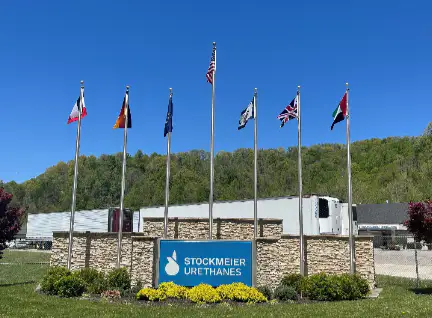

FLORHAM PARK, NJ and CLARKSBURG, WV, AUGUST 20, 2024 – BASF and STOCKMEIER Urethanes USA, Inc. (“STOCKMEIER Urethanes”) have announced the commercial production of Stobielast® S polyurethane binders for playground and recreational surfacing made with 100% domestically produced Biomass Balance (BMB) Lupranate® methylene diphenyl diisocyanate (MDI). BASF produces the BMB MDI at its Verbund site in Geismar, Louisiana. This achievement represents a pivotal milestone in the surfacing industry and highlights both companies’ commitments to driving a more sustainable future.
The use of BMB Lupranate in the polyurethane manufacturing process allows STOCKMEIER Urethanes to leverage more sustainable solutions without the need for reformulations, new production equipment or changes to its supply chain. Creating polyurethane binders from mass balanced isocyanates complements STOCKMEIER Urethanes’ efforts to promote environmental stewardship and a more circular economy. The Stobielast S product line also includes water-based & solvent-free coatings, GREENGUARD and GREENGUARD GOLD certified products, and U.S. Department of Agriculture (USDA) Certified Biobased labeled products.
“With playground season in full swing across North America, we are excited to team with BASF and become the first U.S. polyurethane pour-in-place (PIP) binder manufacturer to forge a domestic partnership over BASF’s BMB isocyanates,” said Christian Martinkat, President and CEO of STOCKMEIER Urethanes USA, Inc. “This collaboration marks a significant advancement toward enhancing product innovation and expanding manufacturing capabilities in the surfacing industry. We can take a big step toward greater sustainability of our products by offering a version of our high-quality PIP binders produced with renewable feedstock-based MDI. This partnership advances our goal of reducing STOCKMEIER Urethanes’ carbon footprint worldwide.”
“At BASF’s Monomers division, we are proud to partner with STOCKMEIER Urethanes as the company scales up its more sustainable production of PIP binders using BMB MDI,” said Stefan Doerr, Senior Vice President, Monomers North America at BASF. “All of our BMB MDI products are certified according to globally recognized ISCC PLUS and REDcert² standards and produced right here in the United States.”
BASF aims to achieve net zero emissions by 2050. Bio-circular feedstocks used to make BMB MDI play an important role in reducing the product carbon footprint (PCF), which sums up the total greenhouse gas (GHG) emissions generated by a product over the different stages of its life cycle. BASF’s Monomers division is following an ambitious sustainability roadmap and will expand its portfolio of products with a lower CO2 footprint while committing to providing a circular option in every major product line by 2025.
Like BASF, STOCKMEIER Urethanes is deeply committed to sustainability, actively participating in the Responsible Care initiative through the American Chemistry Council (ACC) to enhance health, safety and environmental practices. The company implements various sustainability measures, such as waste reduction and energy efficiency in its production processes. By prioritizing sustainability across its operations and collaborating with stakeholders including customers, suppliers, and industry partners, the company strives for responsible growth and innovation, aiming meet the market demand for greener solutions.
To learn more about BASF’s 100% BMB Lupranate and its certification process, visit https://polyurethanes.basf.us/about-us/sustainability.
To learn more about STOCKMEIER Urethanes’ sustainability commitments, visit https://www.stockmeier.com/en/responsibility/sustainability. To inquire about the Stobielast® S product line, please reach out at info@stockmeier.us.com.
Always read and follow label directions. Stobielast is a registered trademark of STOCKMEIER Urethanes. Lupranate is a registered trademark of BASF. (C) 2024, BASF Corporation. All Rights Reserved.
August 19, 2024
Virginia Tech housing commentary June 2024
By Dakota Smith
August 16, 2024 | 10:03 am CDT

BLACKSBURG, Va. — The June 2024 housing report is a free service of Virginia Tech, Virginia Cooperative Extension, and the U.S. Forest Service.
Housing data, month-over-month and year-over-year, were mostly negative. On a month-over-month
Based on total and multi-family starts, total and multi-family permits, and housing completions, the results were positive.
Year-over-year, single-family starts, total and single-family completions, and total and single-family
construction spending was positive. The influence of increased mortgage rates is evident, as aggregate
costs have decreased affordability and the “lock-in” effect has obfuscated sales. New and existing house
sales continued their respective declines.
The August 15th Atlanta Fed GDPNow total residential investment spending forecast is -1.5% for Q3
2024. Quarterly log change for new private permanent site expenditures was projected at -6.1%; the
improvement spending forecast was -1.7%; and the manufactured/mobile home expenditures projection
was 5.1% (all: quarterly log change and at a seasonally adjusted annual rate).

“North American lumber markets over the near term are expected to remain depressed as the economy continues to adjust to inflationary pressures, elevated interest rates, labor shortages, and geo-political uncertainty, and as industry-wide lumber production continues to adjust to match demand,” says Richard Pozzebon, executive vice president and CEO; Interfor Corporation. “Interfor expects that lumber markets will continue to benefit over the mid-term from favorable underlying supply and demand fundamentals. Positive demand factors include the advanced age of the U.S. housing stock, a shortage of available housing, and various demographic factors. At the same time, growth in lumber supply is expected to be limited by extended capital project completion and ramp-up timelines, labor availability, and constrained global fiber availability.”
To read the full report, visit woodproducts.sbio
August 15, 2024
Fake Images Are Everywhere Now—Here’s How To Spot Them
by Tyler Durden
Thursday, Aug 15, 2024 – 08:05 PM
Authored by Andria Pressel via The Epoch Times (emphasis ours),
As artificial intelligence (AI) continues to develop, it’s getting harder and harder to tell the difference between real photographs and AI-generated images.

AI can create everything from stunning landscapes to lifelike portraits in a matter of moments—and at first glance, they may appear perfectly legitimate.
In this age of misinformation, how can you discern if the images you’re seeing are real or fabricated?
Fortunately, there are subtle clues that can help us tell the difference, including inconsistencies in texture, anomalies in human features, and garbled writing. By understanding these telltale signs, you can better navigate digital information and assess the authenticity of the images you encounter.
1. Unnatural Hands and Limbs

Hands and limbs are surprisingly complex structures, and AI often struggles to accurately replicate them. Look for extra, oddly shaped, or misaligned fingers. They may also be positioned in an unusual way or have improper dimensions.
In the above image, the children’s hands and feet look unnatural, with misshapen fingers and toes as well as misaligned sandal straps.

2. Discrepancies in Details

AI has difficulty rendering small details, so you might also see objects and elements being subtly merged together in unnatural ways. These imperfections occur because AI relies on pattern recognition, which can fail when handling intricate or nuanced details.
So if you’re uncertain if a crowd photo is legitimate, take a look at the details. For example, background faces are often blurred or have soft, poorly defined characteristics.
In this AI-generated image, the man in the water has a blurry face and fingerless hands, while the young man on shore has a transparent leg that appears to merge into the background.

3. Overly Perfect Skin

Having an overly smooth face with very little texture is a sign of an AI-generated photo. Its lack of genuine texture and flaws can almost make the individual look comical.
In the above images, the girl on the left has extremely smooth skin and hair that blends in with her collar. The boy to the right also has skin that is too smooth.
4. Misalignments

AI can struggle with alignments, resulting in a disjointed or incoherent appearance because elements don’t align properly.
Objects may overlap in unnatural ways that defy spatial coherence.
Zoom in to spot inconsistencies, such as in the above image, where the lines of the wicker cut through the picnic items. The texture lines on the woven picnic basket and tray are misaligned.

5. Inconsistencies and Asymmetries in Small Details

Inconsistencies in minor things, such as glasses with mismatched lenses or frames, should be easy to notice.
Though they appear genuine at first glance, the following AI-generated photos from ThisPersonDoesNotExist.com have flaws that may be seen with closer examination.
The woman in the left image is wearing two completely different earrings.
The center image is betrayed as AI-generated by the left corner, where the man’s shirt blends with the background.
In the image on the far right, the endpieces of the glasses are mismatched.
6. Garbled Writing

AI-generated images often produce garbled or nonsensical text, with letters and words jumbled.
Take a close look at any writing or logos in the image to see if they are difficult to read or completely incoherent.
This image, produced by AI, depicts traffic on a crowded street. Upon closer inspection, you can see that the text on the roadside billboard is illegible.
7. Illogical Context

Read more here…
https://www.zerohedge.com/ai/fake-images-are-everywhere-now-heres-how-spot-them
August 15, 2024
Huntsman Corporation (HUN) Q2 2024 Earnings Call Transcript
Aug. 06, 2024 1:28 PM ETHuntsman Corporation (HUN) Stock

Q2: 2024-08-05 Earnings Summary
EPS of $0.14 misses by $0.00 | Revenue of $1.57B (-1.38% Y/Y) misses by $36.92M
Huntsman Corporation (NYSE:HUN) Q2 2024 Earnings Conference Call August 6, 2024 10:00 AM ET
Company Participants
Ivan Marcuse – Vice President-Investor Relations and Corporate Development
Peter Huntsman – Chairman, Chief Executive Officer and President
Phil Lister – Executive Vice President and Chief Financial Officer
Peter Huntsman
Ivan, thank you very much and thank you all for joining us this morning. I find myself in a rather precarious place this morning as I usually prepare some opening comments the afternoon before these calls. Within the last 24 hours, swords have been rattling in the Middle East, triggering massive potential for raw material volatility. Over the past few hours of trading, trillions of dollars, yen, Euros and RMB have been wiped out, and consumer confidence has been reforecasted more times in the polling data for the upcoming presidential election. All of that being said after five quarters in the chemical industry of massive inventory adjustments, plummeting margins and a tidal wave of Asian-based oversupply. These most recent events seem quite calm.
Our cost initiatives that have been ongoing for the past three years are paying off as we’ve stayed ahead of inflation. Our focus on cash generation delivered over $50 million of cash flow from our operations in the second quarter. As we outlined plans in the previous earnings call, our volumes year-over-year and quarter-over-quarter were up across the entire business by 9% and 8%, respectively. This volume improvement took place as we were able to increase margins and earn what we projected from our previous calls. While I continue to be concerned with Europe’s highly successful policy of deindustrialization and excess chemical capacity flowing out of Asia, the single largest catalyst for margin improvement for Huntsman would be a resurgence of commercial and residential construction demand.
This will not fully happen until this interest rates drop below the current levels. I believe that events in the past few weeks have increased the likelihood and timing of a rate decrease. Presently, third quarter order patterns seem flattish to the second quarter. We remain cautious regarding the second half of the year. The present time it is simply too early to have a clear picture of the fourth quarter. That being said, inventory in the supply chain remains low. Our construction, aerospace, infrastructure, power and elastomers businesses continue to improve. We will stay focused on cost, and cash management is our priority.
Michael Sison
Hi, good morning. Nice quarter there, Peter. In terms of MDI industry operating rates, I think last quarter you noted that we were at the cusp potentially of getting better pricing. I think you said operating rates are in the mid-80s. Any thoughts of where we’re at now in July and how that – how you think that’s going to shape up as we head into the rest of the second half?
Peter Huntsman
Yes, it’s somewhat of a squishy number because there is not a lot of reliable data that’s transmitted in real-time. I would say that we probably have seen a few percentage points drop in Europe, probably a few percentage points tightening in Asia and the Americas basically, I’d say, stayed flat since the second quarter. I’d say that in the second quarter we probably – we’re in – first going into the second quarter, we’re probably in the mid-80s, maybe on the weak mid-80s. And I think now we’re probably still in that mid-80s, but perhaps a few points stronger. Overall, I think trending in the right direction, but moving along ever so slowly.
Michael Sison
Got it. And you did mention if there is an improvement in construction demand longer term, it’s the big – the most important earnings driver for Huntsman. Any thoughts where you think you’ve had a lot of cost savings where you think polyurethanes EBITDA can get back to in the event that hopefully demand resurges over time?
Peter Huntsman
Well, I certainly see given that if we get back into kind of that normalized construction, that we’re looking at the mid to upper mid-teens sort of margins with polyurethanes across the board. That will require, I think, three basic things to take place I believe that China will have to see a little bit stronger growth than we’ve seen in the last year or two. We’ll have to see Europe at least start to get some traction and in a low sort of percentage growth rate in an industrial basis, kind of remember that they need to be moving from a tourist economy back to some element of an industrial economy. And then the U.S., which I feel is in a recovery phase right now. We need to see that housing come back. Those three basic things take place. I think you see urethanes back into that mid-teens plus sort of margin basis.
eff Zekauskas
Thanks very much. Your volumes were up 8% or 9%. Your inventories were down about 10%. Why is that?
Peter Huntsman
I think that we’ve tried to manage cash as carefully as we can. We did have a plan as we announced three and six months ago to try to recover some of our volumes that we have lost. I don’t think through error, but we certainly lost some volumes a year ago trying to hold on to pricing and demonstrate pricing discipline. We did give up some of the larger, particularly around insulation, composite wood, some of the more polymeric commodity side. So we also saw a lot of deinventorying that took place in elastomers, industrial applications and so forth. So we’ve gotten some of that volume back. We’ve seen some regrowth taking place in some of those applications and we have seen a lot of the deinventorying taking place. So I think it’s just a capital discipline around supply and demand and production.
Phil Lister
And Jeff, just on the numbers, our volume in inventory is down 4% overall. You’re correct. If you calculate that on a DIO basis, we’re down about 10%. And as Peter says, that’s just a real focus on our inventory levels that we have right now.
Patrick Cunningham
Hi, good morning. So the polyurethanes guide is calling for flattish EBITDA quarter-on-quarter despite maybe $15 million to $20 million in discrete headwinds and relatively stable volumes. How should we think about variable margin improvement throughout the quarter? And if there are any particular regions you want to call out that might be stronger than others.
Peter Huntsman
I think it’s largely going to be flat. I mean, there will be some give and takes we experienced an outage in our Rotterdam facility in which we’re just now starting to restart the facility and coming back online. We’ve got to rebuild some inventory there. We’ll see a little bit of headwinds on the Chinese joint venture that we have around propylene oxide and we hope to see some volume growth and pricing momentum that continues into the third quarter. And I think some of that’s going to be offsetting each other a little bit of seasonality that will – that will mostly be taking place in Performance Products in the third quarter. So yes, I think a lot of give and takes, as I said in my prepared remarks, it’s probably going to be pretty flattish.
Phil Lister
One item to consider, Patrick, on the bridge for polyurethanes from Q2 to Q3. We will aim to have an inventory build towards the back end of quarter three. We’ve got a turnaround in the fourth quarter that will necessitate some inventory build, which will give us a one-time benefit on EBITDA, which will reverse out. And that’s probably between $5 million and $10 million, which will reverse out in the fourth quarter.
Patrick Cunningham
Understood. Very helpful. And then with price mix down 10% year-on-year for advanced materials, were there any areas of structural pricing pressure or was this mostly mixed impacts? And if you have any detail on how we should think about it for the balance of the year, that would be helpful.
Peter Huntsman
I think that virtually all of that is mix. Demand trends continue to be very strong in advanced materials, very solid, and we’re seeing the gradual recovery of aerospace, I do mean gradual – they are continuing to be playing with some supply issues in aerospace. But by and large, it’s been a very consistent and very reliable end of the business.
Vincent Andrews
Thank you and good morning. Peter, in your prepared remarks, you made a comment that lower interest rates, you’re not so sure would actually improve your operating environment in Europe. I was wondering if you could just color that in a little bit.
Peter Huntsman
No. I – okay, well, maybe I meant that came out a little bit backwards. I think the lower interest rates are going to particularly impact North American construction, housing, commercial construction and so forth. I do think that lower interest rates will impact Europe. I just don’t believe that it will be nearly as material to the bottom line. We certainly welcome that in Europe, but I don’t think it’s going to be nearly as material as it will be in the United States.
Vincent Andrews
And is that just a function for you of your exposure being larger to building and construction in the U.S. versus Europe? Or is there something else that’s causing that space?
Peter Huntsman
Yes. Yes. And I think as we look at and we track multifamily, single-family construction and so forth and we look at the housing inventory of how many homes are in the market, how many homes are available, let’s go through the typical housing data. The U.S. when it rebounds, I believe it’s not going to be a very gradual rebound. It could be a very sudden and strong rebound. Again, depending on – two things on rate cuts and overall consumer optimism.
Phil Lister
For North America, construction is about a 60% exposure, U.S. about 50%, but it’s very different, as Peter says. In Europe, in general, it’s aligned with commercial construction, whereas in North America, it’s relatively balanced, but with a greater proportion of sales into residential.
Frank Mitsch
Hi, good morning. Peter, one of the priorities in 2024 was to get the volumes up and clearly, that’s been a success. But price mix in the second quarter faced a very easy comp and obviously came in on the negative side of the ledger. 3Q faces another easy year-over-year comp. How should we think about the progression of price mix in 3Q and beyond? And what will it take to get it back to neutral if not positive.
Peter Huntsman
Well, it’s going to take a combination of capacity utilization, overall demand and mix of the products we’re selling, the combination of those three. And as sort of a cataclysmic economic event, I remain bullish that we’re going to continue to see a gradual improvement that’s taking place in the business over the course of the next couple of quarters.
Phil Lister
I think price mix was mostly built in, Frank. If you look at the sequential quarter one to quarter two in general, that was relatively neutral.
Frank Mitsch
That’s right. Yes. I did pick that up. And then North America polyurethane volumes up nicely in 1Q, up nicely again here in 2Q over 20% in both of those quarters, does that continue in 3Q that level of improvement in polyurethanes North America?
Peter Huntsman
Most likely, yes. Again, kind of basing that what you said earlier, we’re starting it on a very low basis as to where we were a year ago. But no, I think that we will continue to defend our market share and we’ll continue to win back business.
Salvator Tiano
Yes, thank you very much. First, I wanted to release a little bit of polyurethanes guidance because actually, I would think when you’re taking into account the force majeure or the PO/MTBE turnaround, it looks like actually like-for-like, it would have – you’re pointing to much higher earnings in Q3 than Q2. And I’m wondering what is driving that? Is it essentially the U.S. margin expansion because of the Freeport outage and then I guess the big price increase we saw in May and June? And also, how sustainable is this margin expansion as Freeport comes back online?
Peter Huntsman
Yes, Sal. So you’re correct in that we’ve got the Rotterdam force majeure or we’ve got PO/MTBE turnaround. I think we said earlier as well we’ve got a one-time benefit from what is an intended inventory build towards the end of September, ahead of a turnaround in October.
Any benefits that we’re getting tend to be in PU Americas when you compare quarter two to quarter three, driven by a little bit of volume. But as you indicate, we’ve also got some pricing traction in the United States with our price increase, which should improve unit variable margins as we go through the quarter.
So it’s really North America plus those other pluses and minuses that we go earlier to bridge the quarter two to quarter three.
Josh Spector
Yes, hi. Good morning. I wanted to ask around your early thoughts here around 4Q and not necessarily pinning to a specific number, but just thinking about seasonality. We talked about some of the moving parts in polyurethanes, and you’re seeing some pricing. Would you expect seasonality to be normal in fourth quarter? Should that be our base case, or are there things that you would call out to say why it would be abnormal, maybe closer to stable versus what you typically expect? Thanks.
Phil Lister
Yes, great question. My guess is probably as good as any, Josh. I would suspect this year that seasonality ought to be pretty normal compared to the last couple of years, with the exception of last year. And I base that solely on demand has been fairly steady, hasn’t been growing a great deal. It’s been fairly steady. There is not a lot of inventory just anecdotally that I’m seeing in the supply chain. That’s not to say that they are not pockets here and there, and so forth. But typically, at the end of the year, if you’re sitting on a lot of the inventory customers and in certain geographic areas of the company will take that opportunity to deplete inventories and improve their working capital at the end of the fourth quarter – and seasonally – that coupled with seasonality. So, from a seasonal point of view, probably a 100% chance of certainty that Christmas and New Years will come about, there will be a slowdown.
As far as will there be a massive drawdown of inventory, and so forth, that doesn’t feel like there is a lot of inventory in the system right now. I think my biggest concern right now would be between now and the end of the year where you’ve got kind of a couple of these big macro issues, either geopolitical issues in the Middle East, U.S. elections, and so forth, consumer confidence, volatility in the stock market, consumer confidence somehow tanks in the fourth quarter, that could have a reverberating impact on overall demand. And I think that, in my mind, is probably the biggest uncertainty that’s out there right now.
But aside from that, I don’t see at this point, I don’t see a lot of areas of uncertainty and supply that’s sloshing around.
Aleksey Yefremov
Thanks. Good morning everyone. Peter, I was hoping you could update us on your spray foam story. How is your business doing this year? And if that business overall is gaining share from other forms of insulation.
Peter Huntsman
Well, I think when I look at the comparison to spray foam versus other products. I look at it first on a very macro basis, and I look at some of the earnings of our peers, and so forth, it feels like it’s a pretty sluggish area of demand right now. And we’re optimistic about some of the government initiatives and standards and so forth that are being set that will be coming in through 2025. As those standards, tax issues, building codes, and so forth, really hit the bottom line, I am quite optimistic about what I see in the pipeline. Presently, the higher crude prices, which is kind of where your polyurethane foam is based versus your natural mineral fibers, which are largely based on energy and natural gas prices it’s a competitive market out there right now.
Aleksey Yefremov
Thanks, Peter. And you reminded us of your commercial versus residential real estate exposure in the U.S. in prepared remarks. I was hoping to ask you if you see any signs of slowdown in commercial real estate? And also tell us what is the breakdown between maintenance and new within commercial?
Peter Huntsman
Yes. As we look at commercial in North America, just looking at the revenues, it’s really about on the commercial side, which makes up about 40% of our overall business, 45% of our overall North American polyurethanes business. Of that, it will be split about one third retrofit, two thirds new. Again, that’s commercial. When I look at residential, that’s making up of our polyurethanes business in North America on a revenue basis. That’s making up about 55%. And of that, that’s going to be about – of that number – it will be about three quarters that will be new and one quarter, that will be retrofit.
Hassan Ahmed
Good morning, Phil and Peter. Peter, a question, just wanted to revisit volumes in the Polyurethane segment. obviously, on a percentage basis, strong growth over there, particularly in North America. I’m just trying to get a better sense of despite – you mentioned that, obviously, we are coming off of a low base. How far away are we – be it by region, be it globally from reaching more normalized levels of volumes.
Peter Huntsman
I think that is a good question. I think that you’ve got to see that normalization again, we need to see a recovery in the construction, residential construction markets. And I believe that as we see that gradual improvement take place that’s certainly something that we would hope would have returned in 2025 as we kind of get through the rest of this year.
August 14, 2024
Mortgage Refi Activity Jumps Most Since 2020 As Lenders See Gloom Ending
by Tyler Durden
Wednesday, Aug 14, 2024 – 03:25 PM
Mortgage lenders have endured a brutal 2.5-year period of the Federal Reserve’s interest rate hiking cycle, with a high rate environment pressuring refinance applications to multi-decade lows. However, those lenders who weathered the downturn—dodging widespread layoffs, industry consolidation, and scraped by on Ramen Noodles and Zyn pouches—are now seeing a serious surge in activity as mortgage rates slide on rising recession probabilities.
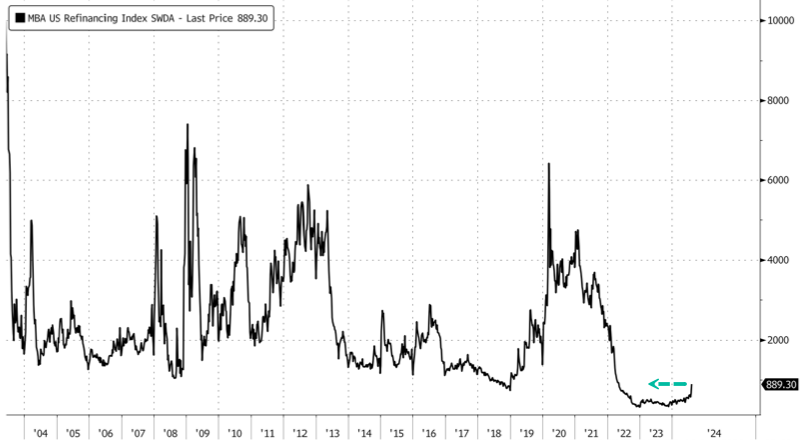
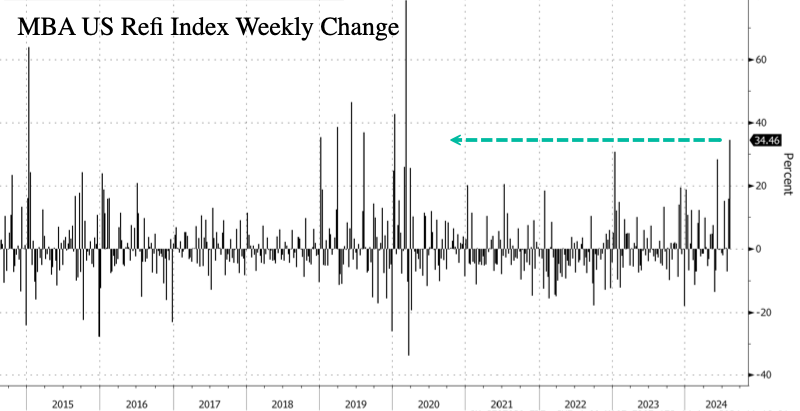
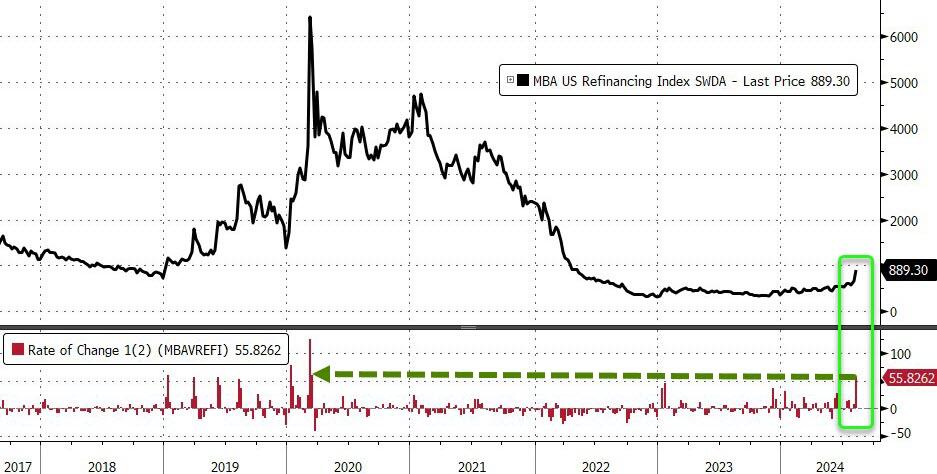
For the week ending August 9, the Mortgage Bankers Association’s refinancing index jumped a whopping 34.5% to a more than two-year high of 889.3.
The refinancing index’s weekly change recorded the biggest weekly change since the first week of March 2020, a period in time when the Fed slammed interest rates to the zero lower bound in response to the China virus.
Even more impressive is the refinancing index’s two-week move, up 55% (though obviously off a very low ‘low’).
MBA mortgage applications to purchase a home increased by 2.8% in the same week, the largest advance since the first week of June.
Freddie Mac data shows the 30-year fixed mortgage rate has dropped to around 6.47%, the lowest since May 2023. While this is a far cry from the October 2023 high of 7.79%, it remains well above Covid levels of 2.68%.
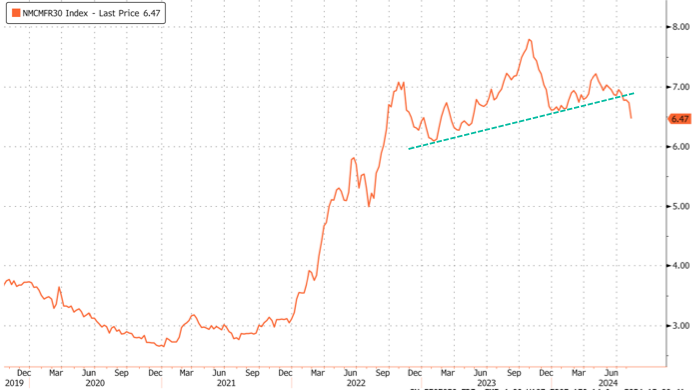
Despite the decline in mortgage rates, new costs of homeownership are dramatically higher than the average current mortgage cost. Until that gap closes (more), the housing market will remain drastically out of reach for most Americans in search of their dream.
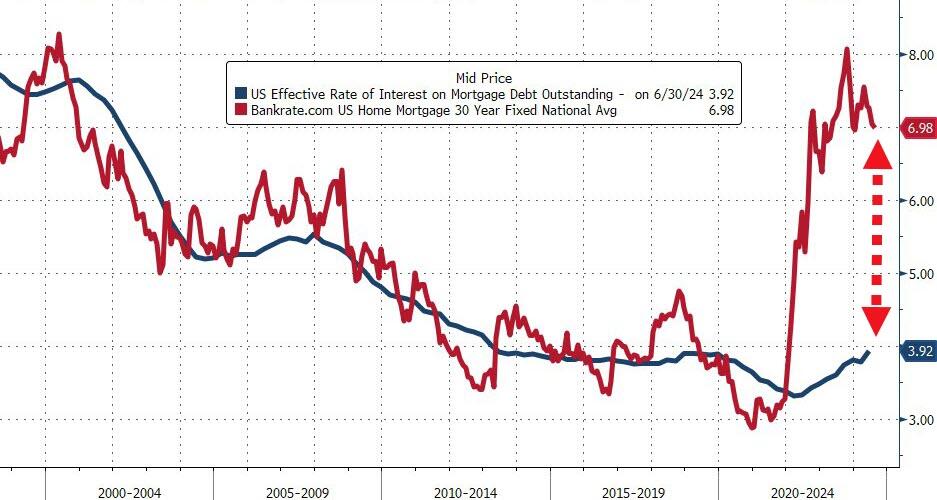
Mortgage rates track US government bonds relatively closely, and the yield on the 10-year Treasury note has fallen sub 4% on increasing recession odds amid the consumer downturn fears.
Although weaker consumer trends remain a major near-term headwind, Goldman forecasts three 25bps Fed rate cuts this year and four in 2025. With the cut cycle imminent, the refinancing index and mortgage applications will likely have further room to run.
Here’s the latest snapshot as of Wednesday, showing what traders expect the Fed’s move to be. Four 25bps cuts by the end of the year…
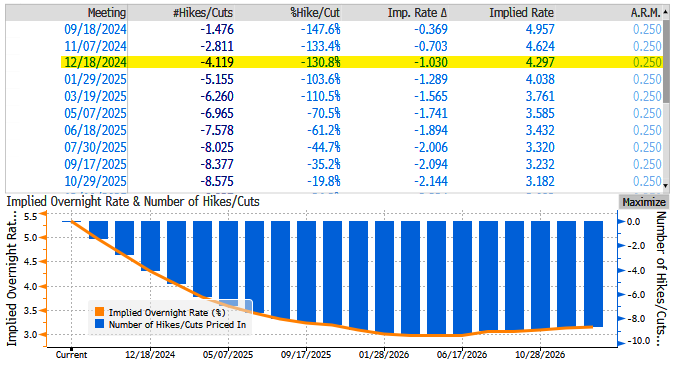
“We’ve experienced several head fakes regarding potential rate cuts during the Fed’s hiking cycle, as reflected in interest rate swaps over the last few years. But this time, it seems more concrete as recession risks build,” said Lewis Sogge, a senior loan officer at Freedom Mortgage Corporation.
Congratulations to all the millennial lenders who managed to weather the Fed’s interest rate hiking storm—you might have made it to the other side. What does this all mean? Simply put, your industry is highly cyclical.
https://www.zerohedge.com/markets/mortgage-refi-activity-jump-most-2020-lenders-see-gloom-ending
 Everchem Updates Archive
 Sign Up for Email Updates


