
Technology

August 29, 2017

Polyurethane Football Helmet Shell

Ex-New York Jets Lineman Looks To Make Game Safer With Helmet Tech

In December 2015, Will Smith took to the big screen to play a forensic pathologist who took on the NFL about traumatic brain injuries and subsequent diseases, especially chronic traumatic encephalopathy. At the same time, a product was in development that now is poised to reduce the chance of these brain injuries.

That product, ProTech, is a shell that can be attached to a variety of football helmets, primarily those models produced by Riddell and Schutt. Created by Defend Your Head, a Pennsylvania-based company founded by two former football players, John Roman and Glenn Tilley, the ProTech shell is designed to absorb and redistribute the impact of a hit to the head. The two joined forces over a shared desire to make football safer.

The shell is made of a polyurethane foam, as opposed to the polycarbonate material used to make helmets. This design aligns with proven science that a soft object, when impacted by a harder object, diffuses kinetic energy. ProTech’s polyurethane composition also means that it is slicker than a normal helmet, preventing dangerous blows from the side from having greater impact with the head. The shell moves over the helmet as it is impacted to deflect hits away from the head.

“We’re making a difference, and that’s what’s driven all of us to come together,” Roman, who was an offensive lineman for the New York Jets, told SportTechie. “We’re seeing evidence and feedback from players in the field that our product has the ability to reduce helmet collision force.”


Such evidence can be found at Holy Cross in Massachusetts. In May, the college’s athletic department moved to continue a two-year relationship with Defend Your Head after seeing the effectiveness of ProTech on its football team’s safety. Holy Cross was one of ProTech’s first users, and has since recommended the product to other teams in the Patriot League.

“At Holy Cross we are always looking for ways to improve the student-athlete experience,” Holy Cross athletic director Nathan Pine said in a statement. “ProTech has helped us do that by providing a safer environment for our student-athletes in the sport of football—which is important because that improves their experience not only on the gridiron but also in the classroom.”

According to Tilley, ProTech will be widely used this fall among youth, high school, and college football markets in an approach that seeks to gain feedback and traction to break into the NFL. Currently, Defend Your Head is in talks with the NFL, and certain players have come to the company to ask about using ProTech, Tilley said.

Currently, ProTech is used by players at Western Carolina University and, for the second season in a row, Penn State, where ProTech’s presence has grown from 10 players to about 40, according to Roman. It is also present at other schools as well. Defend Your Head is now in its third year of getting feedback and talking with coaches, equipment managers and trainers at a number of college football programs.

“This year, we’ve taken a little bit more of an aggressive step, and I think we’re in a good place to speak from substance, to say that we’re now out there,” Tilley said. “We’re on the field at different levels, and we’re doing our part to help make the game safer— and that feels very good.”

Down the line, Roman sees opportunities to partner with the major helmet manufacturers. Roman said that one undisclosed helmet maker has already approached Defend Your Head. Eventually, when teams order helmets, ProTech could very well be included as standard safety technology.

“Having played the game professionally for over a decade I have seen the damage that can be done first hand,” Roman said in a statement after research was published showing 110 of 111 deceased former NFL players who had their brains examined were shown to have CTE. “My post-football life has been spent addressing the issue of head trauma in football, which is what compelled me to establish Defend Your Head. We have made great progress in our effort to make the game safer for football players of all ages as evidenced by over 100 organizations utilizing our technology nationwide this year, but more work needs to be done.”

https://www.sporttechie.com/new-york-jets-lineman-helmet-technology/
August 25, 2017

Covestro Panelization Technology

Advanced Panelization Made Possible With Polyurethane

Advanced Panelization Made Possible With Polyurethane

PITTSBURGH, PA. – August 23, 2017 – Covestro LLC, a leading supplier of high-tech polymers, was named a finalist of the 2017 Polyurethane Innovation Award for its new polyurethane-based panelized wall technology, PUReWall™. Sponsored by the Center for the Polyurethanes Industry (CPI), this award recognizes companies and individuals whose vision and perseverance result in new products, technologies and initiatives.

“At Covestro, innovation is our direction. We strive to develop breakthrough chemical and application technologies in the markets we serve,” explained Eric Rexrode, director of research and development, Rigid Raw Materials, Covestro LLC. “PUReWall™ is proof of what’s possible through innovations in polyurethane chemistry, and we’re honored to be recognized for this work as a Polyurethane Innovation Award finalist.”

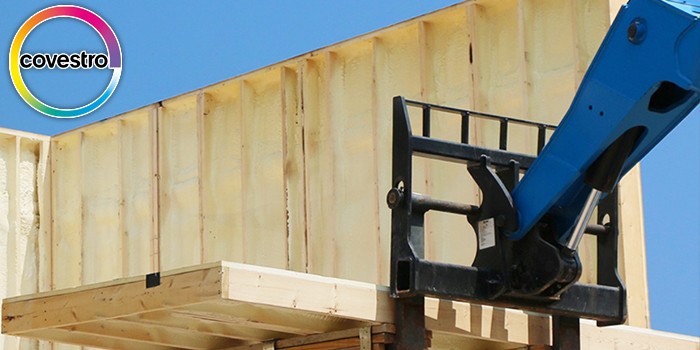
Designed for residential construction, PUReWall™ panels are manufactured at a panelization facility in a controlled environment and installed at the construction site. This structural, high-performance wall replaces traditional exterior sheathing with polyiso rigid foam board and uses a new closed cell spray polyurethane foam formulation that results in a highly structural and energy-efficient panel.

PUReWall™ provides several benefits to panelizers and builders:

  • Up to 75 percent less time to erect walls on-site and up to 30 percent less waste compared to stick-built construction
  • 30-40 percent lighter than conventional wall panels, allowing for easier lifting and placement of PUReWall™ at the construction site
  • Meets insulation requirements and stringent energy codes
  • Eliminates the need for plastic house wrap through the use of a polyiso insulation board that acts as an air and moisture barrier
  • Meets code requirements for wall shear and racking strength
  • Reduces cycle time, waste and labor costs
  • Maximizes system performance by manufacturing components in a controlled environment

“PUReWall™ is an innovative approach to construction that highlights the best attributes of polyurethane chemistry,” said Jim Lambach, manager of Building and Construction, Industrial Marketing, Polyurethanes, Covestro LLC. “Not only are we bringing this technology to a wider market, but we’re also developing polyurethane advocates across the building and construction industry in the process.”

Winners will be announced at the 2017 Polyurethanes Technical Conference on October 4, 2017, in New Orleans.

http://sprayfoam.com/foam-news/advanced-panelization-made-possible-with-polyurethane-/3071

August 25, 2017

Covestro Panelization Technology

Advanced Panelization Made Possible With Polyurethane

Advanced Panelization Made Possible With Polyurethane

PITTSBURGH, PA. – August 23, 2017 – Covestro LLC, a leading supplier of high-tech polymers, was named a finalist of the 2017 Polyurethane Innovation Award for its new polyurethane-based panelized wall technology, PUReWall™. Sponsored by the Center for the Polyurethanes Industry (CPI), this award recognizes companies and individuals whose vision and perseverance result in new products, technologies and initiatives.

“At Covestro, innovation is our direction. We strive to develop breakthrough chemical and application technologies in the markets we serve,” explained Eric Rexrode, director of research and development, Rigid Raw Materials, Covestro LLC. “PUReWall™ is proof of what’s possible through innovations in polyurethane chemistry, and we’re honored to be recognized for this work as a Polyurethane Innovation Award finalist.”

Designed for residential construction, PUReWall™ panels are manufactured at a panelization facility in a controlled environment and installed at the construction site. This structural, high-performance wall replaces traditional exterior sheathing with polyiso rigid foam board and uses a new closed cell spray polyurethane foam formulation that results in a highly structural and energy-efficient panel.

PUReWall™ provides several benefits to panelizers and builders:

  • Up to 75 percent less time to erect walls on-site and up to 30 percent less waste compared to stick-built construction
  • 30-40 percent lighter than conventional wall panels, allowing for easier lifting and placement of PUReWall™ at the construction site
  • Meets insulation requirements and stringent energy codes
  • Eliminates the need for plastic house wrap through the use of a polyiso insulation board that acts as an air and moisture barrier
  • Meets code requirements for wall shear and racking strength
  • Reduces cycle time, waste and labor costs
  • Maximizes system performance by manufacturing components in a controlled environment

“PUReWall™ is an innovative approach to construction that highlights the best attributes of polyurethane chemistry,” said Jim Lambach, manager of Building and Construction, Industrial Marketing, Polyurethanes, Covestro LLC. “Not only are we bringing this technology to a wider market, but we’re also developing polyurethane advocates across the building and construction industry in the process.”

Winners will be announced at the 2017 Polyurethanes Technical Conference on October 4, 2017, in New Orleans.

http://sprayfoam.com/foam-news/advanced-panelization-made-possible-with-polyurethane-/3071

August 23, 2017

Taylor Made Offering Urethane Filled Irons

TaylorMade P790 irons brings new face, new materials, new construction, new speed to company’s players irons

Hollow construction with new thin face design supported by resilient foam boosts power and feel

The TaylorMade P790 irons design brief sounds either amazingly simple or ridiculously complicated. For a company used to making bold steps in innovation, it ended up being one of its boldest for a category of player that’s tough to serve.

“Products like this in the past have taken advantage of different benefits of hollow construction, either to get forgiveness or to manage feel or to get more speed with a thin face,” said Tomo Bystedt, TaylorMade’s senior director of iron creation. “What if you could do something that takes advantage of all the benefits? That was kind of our mission here. How do we get all of the speed and make it feel really good at the same time and obviously deliver a look and appearance that a good player would love to look at? That was the brief that we set out to do.

“One of the things we realized in this forged distance category is that there was only so far we could go with existing constructions and existing materials,” “So we thought, ‘What if we did something entirely different?’”

That something is the P790 irons, a hollow construction set that features an ultra-thin face with a proprietary polyurethane foam filling, all in the relatively compact shape better players prefer.

That’s not an easy proposition because usually one of the keys to getting speed in an iron is to extend the size of the face to make in essence a larger trampoline. That creates more coefficient of restitution (COR) or spring-like effect to lead to more ballspeed and distance. But the P790 irons feature a shallower, compact design, forcing engineers to rethink the face from past TaylorMade irons.

The new face, made of 4140 forged carbon steel, is different in two vital ways. First, it gets as thin as 1.75 millimeters from the long irons through to the 7-iron. That’s compared to 2.2 millimeters on TaylorMade’s PSi irons. That thin face is possible because of a lightweight foam filler on the inside that supports the face.

The material, called SpeedFoam, was suggested to the iron team engineers by colleagues in the golf ball side of TaylorMade’s business. It’s not a material used in golf balls, but it had the right properties to allow the thin face to flex while not adding weight that would negatively affect the center of gravity location.

“This material is so soft that it preserves the flexibility in the face and at the same time dampens the sound,” Bystedt said. “So that was kind of the magic bullet to solving this puzzle.”

Secondly, the face insert actually extends beyond the bottom of the face and leading edge and wraps around the sole, leading into a cut-through slot similar to those seen on TaylorMade’s M2 fairway woods. This helps create greater flexibility in the lower part of the face where many iron shot impacts occur. The rest of the iron’s body is made of soft 8620 carbon steel, the same steel used in the company’s Milled Grind wedges.

Bystedt says that combination led to an iron that launches with the speed of TaylorMade’s M1 game-improvement iron with the size of TaylorMade’s better player-preferred P770 iron. He said the thin face launches shots with a peak trajectory more than a yard higher than P770 despite having lofts two degrees stronger.

Instrumental is the P790 irons’ lower center of gravity, partly a function of their slightly shallower profile but largely enhanced by positioning a metal-injected-molding tungsten alloy within the hollow body.

As the P790 irons progress to the 8-iron and shorter irons and wedges, it remains a hollow construction but the face thickens progressively and the hosel lengthens slightly. The effort there is to raise the center of gravity on the shorter clubs for a more controlled flight and spin.

Adding to the distance elements of the P790 irons is a newly developed True Temper Dynamic Gold 105 shaft, a version of the venerable Dynamic Gold shafts that’s about 25 grams lighter than the standard.

The P790 irons will be available Sept. 15 ($1,300, offered in 3-iron through pitching wedge with A-wedge option).

https://www.golfdigest.com/story/taylormade-p790-irons-brings-new-face-new-materials-new-construction-new-speed-to-companys-players-irons

August 23, 2017

Taylor Made Offering Urethane Filled Irons

TaylorMade P790 irons brings new face, new materials, new construction, new speed to company’s players irons

Hollow construction with new thin face design supported by resilient foam boosts power and feel

The TaylorMade P790 irons design brief sounds either amazingly simple or ridiculously complicated. For a company used to making bold steps in innovation, it ended up being one of its boldest for a category of player that’s tough to serve.

“Products like this in the past have taken advantage of different benefits of hollow construction, either to get forgiveness or to manage feel or to get more speed with a thin face,” said Tomo Bystedt, TaylorMade’s senior director of iron creation. “What if you could do something that takes advantage of all the benefits? That was kind of our mission here. How do we get all of the speed and make it feel really good at the same time and obviously deliver a look and appearance that a good player would love to look at? That was the brief that we set out to do.

“One of the things we realized in this forged distance category is that there was only so far we could go with existing constructions and existing materials,” “So we thought, ‘What if we did something entirely different?’”

That something is the P790 irons, a hollow construction set that features an ultra-thin face with a proprietary polyurethane foam filling, all in the relatively compact shape better players prefer.

That’s not an easy proposition because usually one of the keys to getting speed in an iron is to extend the size of the face to make in essence a larger trampoline. That creates more coefficient of restitution (COR) or spring-like effect to lead to more ballspeed and distance. But the P790 irons feature a shallower, compact design, forcing engineers to rethink the face from past TaylorMade irons.

The new face, made of 4140 forged carbon steel, is different in two vital ways. First, it gets as thin as 1.75 millimeters from the long irons through to the 7-iron. That’s compared to 2.2 millimeters on TaylorMade’s PSi irons. That thin face is possible because of a lightweight foam filler on the inside that supports the face.

The material, called SpeedFoam, was suggested to the iron team engineers by colleagues in the golf ball side of TaylorMade’s business. It’s not a material used in golf balls, but it had the right properties to allow the thin face to flex while not adding weight that would negatively affect the center of gravity location.

“This material is so soft that it preserves the flexibility in the face and at the same time dampens the sound,” Bystedt said. “So that was kind of the magic bullet to solving this puzzle.”

Secondly, the face insert actually extends beyond the bottom of the face and leading edge and wraps around the sole, leading into a cut-through slot similar to those seen on TaylorMade’s M2 fairway woods. This helps create greater flexibility in the lower part of the face where many iron shot impacts occur. The rest of the iron’s body is made of soft 8620 carbon steel, the same steel used in the company’s Milled Grind wedges.

Bystedt says that combination led to an iron that launches with the speed of TaylorMade’s M1 game-improvement iron with the size of TaylorMade’s better player-preferred P770 iron. He said the thin face launches shots with a peak trajectory more than a yard higher than P770 despite having lofts two degrees stronger.

Instrumental is the P790 irons’ lower center of gravity, partly a function of their slightly shallower profile but largely enhanced by positioning a metal-injected-molding tungsten alloy within the hollow body.

As the P790 irons progress to the 8-iron and shorter irons and wedges, it remains a hollow construction but the face thickens progressively and the hosel lengthens slightly. The effort there is to raise the center of gravity on the shorter clubs for a more controlled flight and spin.

Adding to the distance elements of the P790 irons is a newly developed True Temper Dynamic Gold 105 shaft, a version of the venerable Dynamic Gold shafts that’s about 25 grams lighter than the standard.

The P790 irons will be available Sept. 15 ($1,300, offered in 3-iron through pitching wedge with A-wedge option).

https://www.golfdigest.com/story/taylormade-p790-irons-brings-new-face-new-materials-new-construction-new-speed-to-companys-players-irons