
Uncategorized
May 1, 2025
Covestro Sells RI Site to Lamberti
April 29, 2025

Sale of Covestro site in East Providence, Rhode Island
Dear valued supplier:
We are writing to inform you of an upcoming change within Covestro LLC. As part
of our strategic business and operations realignment, we have made the decision
to sell the East Providence, R.I., site to Lamberti USA inc., part of the Italy headquartered
Lamberti Group. This transfer of ownership is scheduled to take
effect by early May.
Included in the sale is the East Providence site, along with a portion of resins for
blister packaging adhesives and solvent borne resins for textile coatings. After
careful consideration, we believe this decision will optimize operational efficiencies
and support technology alignment across our North American manufacturing
footprint.
Additionally, Lamberti Group, a global specialty chemicals manufacturer with an established presence in North America through diverse technologies and industrial
sites, aims to strengthen its position in the U.S. Surface Treatment Market. The
East Providence site, dedicated to producing synthetic polymers, will serve as a
key driver in the company’s strategy for expansion and enhanced service to local
markets.
Our priority throughout this process is to ensure a seamless transition, through the help of our suppliers, with minimal impact on customers.
What you can expect
- Uninterrupted business: We anticipate no interruptions to the business
and purchase orders will continue to be made per the existing business
requirements.
Covestro LLC
1 Covestro Circle
Pittsburgh, PA 15205
USA
Jared Rendine
Telephone
412-413-5225
Email
Jared.rendine
@covestro.com
2/2
covestro.com
•
Clear communication: During the transition, you can continue to use your existing contacts and support channels. We will provide advance notice of any updates or changes to these details.
For further details, we invite you to review the official press release: available here]. We ask you to continue to use your existing Covestro contacts and supplier management channels for orders and inquiries until the transfer is completed.
April 3, 2025
Kumho Mitsui Holds MDI Expansion Ceremony
Introducing eco-friendly processes to build up to 610,000 tons in Korea, accelerating the expansion of global supply chains for resource recycling, declaring technology independence with independent technology
Kumho Mitsui Chemical announced on the 3rd that it held the completion ceremony of the 200,000-ton MDI (Methylenyl Diisocyanate) plant, a key polyurethane material, at the Yeosu plant on the 3rd. With this expansion, Kumho Mitsui Chemical completed its annual production system of 610,000 tons. It is the world’s second largest single plant.
About 100 officials attended the event, including Kumho Petrochemical Group Chairman Park Chan-koo, Japanese Mitsui Chemical Chairman Tsutomu Tanno and Kumho Petrochemical President Park Joon-kyung, Kumho Mitsui Chemical President On Yong-hyun and Yeosu Mayor Chung Ki-myung.
Kumho Mitsui Chemical invested a total of 570 billion won in this expansion to build the largest MDI production capacity in Korea. This not only solidified its leading position in the Korean market but also established the world’s second largest single plant in terms of production capacity.
MDI is used in various industries such as furniture, insulation, automobile interior materials, memory foam, and liquefied natural gas (LNG) carrier cooling materials. Recently, the MDI market continues to grow as demand for LNG expands and demand for high-functional polyurethane increases.
Kumho Mitsui Chemical completed the expansion plant by applying its own MDI production technology based on its technology and experience accumulated for more than 30 years since its foundation in 1989. This is evaluated as a symbolic achievement of declaring the independence of MDI core production technology.
“The full-fledged operation of the new plant has laid the foundation for growth as a global leading PU maker,” said On Yong-hyun, president of Kumho Mitsui Chemical. “We will grow into a sustainable growth company that practices social responsibility.”
The eco-friendly recycling process was applied to the new factory for the first time in Korea. It is a technology that reduces by-products and wastewater generated in the MDI production process to chlorine and caustic soda and re-inserts them into raw materials. Through this, environmental pollution can be prevented and raw material self-sufficiency can be increased.
The company emphasized, “We have secured a global competitive advantage by self-sufficiency of raw materials through eco-friendly technology.”
Kumho Petrochemical Group Chairman Park Chan-koo said, “We hope that Kumho Mitsui Chemical will contribute to the development of Korea’s industry and the recovery of business conditions.”

Kumho Petrochemical CEO Baek Jong-hoon (from sixth left in the photo), Yeosu Mayor Chung Ki-myung, Kumho Petrochemical Chairman Park Chan-koo, Japanese Mitsui Chemical Chairman Tanno and Kumho Petrochemical President Park Joon-kyung are cutting commemorative tapes.<Geumho Petrochemical Co., Ltd.>
January 26, 2025
Renovation Barometer for Q1
Strong Q4 performance fuels optimism among remodeling businesses
By Dakota Smith
January 23, 2025 | 10:41 am CST

Photo By Houzz Inc.
Houzz Inc., a platform for home remodeling and design, has released the Q1 2025 Houzz U.S. Renovation Barometer. The report found that businesses across the construction sector and the architecture and design services sector are optimistic about activity in the first quarter of the year. Expectations among construction professionals are at their highest since Q3 2022. Optimism follows improved Q4 business activity compared with Q3. Recent business activity indicators for both industry sectors have increased and are above the 50-point benchmark, indicating that more firms reported improvements than declines in business performance.
“Strong Q4 performance and recent federal interest rate cuts have bolstered confidence among industry professionals as we enter the new year,” said Marine Sargsyan, Houzz staff economist. “With this solid foundation, construction firms are expressing the most positive sentiment we’ve seen for the sector in two and a half years. Confidence levels also remain high among architects and interior designers as new committed projects continue to reinforce demand expectations, though optimism among this sector has softened slightly.”
Q1 2025 Construction Sector Barometer
• The Expected Business Activity Indicator for construction businesses related to project inquiries and newly committed projects increased three points to 65 for Q1.. This marks the highest reading since Q3 2022. Compared with Q4 2024, Q1 2025 expectations for project inquiries increased 10 points to 69, while new committed projects decreased 2 points to 62. The index is above 50 points suggesting businesses expect Q1 2025 performance to be better than Q4 2024. Both build-only and design-build remodelers expect an uptick in Q1 2025 business activity, with the indicators reaching 65 and 66, respectively.
• The Project Backlog Indicator is 5.8 weeks at the beginning of Q1 2025, which is 0.9 weeks shorter than a year ago. Build-only remodelers report a decrease of 1.4 weeks to 5.0 weeks, while design-build remodelers report a 0.4-week decrease in wait times at 6.7 weeks.
• The Recent Business Activity Indicator related to project inquiries and newly committed projects increased to 54 in Q4 2024, up 7 points from the previous quarter, indicating improvement in Q4 business activity compared with Q3. This is driven by a 14-point increase in project inquiries to 60 in Q4, relative to the previous quarter. Newly committed projects remained stable at 48. Both groups reported a 7-point increase in recent business activity, bringing the indicators above 50 points. The recent business indicator reached 53 for build-only remodelers and 55 for design-build remodelers in Q4.
Q1 2025 Architectural and Design Services Sector Barometer
• The Expected Business Activity Indicator related to project inquiries and new committed projects declined to 68 in Q1 2025 (down 3 points from Q4 2024) for the architectural and design services sector. This is driven by a 7-point decline in expectations for project inquiries and stable expectations for new committed projects (66 and 69 points, respectively). While the indicator dipped 12 points for architects (65 points), interior designers expect an improvement in Q1 business activity, up 11 points reaching 72.
• The Project Backlog Indicator is 7.3 weeks at the beginning of Q1, a significant jump of 2.1 weeks compared with last year (5.2 weeks). This year-over-year increase is driven by architects, who report an 8.8-week wait time on average, up 2.7 weeks from last year (6.1 weeks in Q1 2024). Interior designers reported a 1-week increase in wait times (4.6 weeks in Q1 2025) compared with last year (3.6 weeks in Q1 2024).
• The Recent Business Activity Indicator related to project inquiries and new committed projects increased to 58 in Q4 2024 (versus 54 in Q3). This increase is driven by an uptick in project inquiries (up 4 points from Q3 to 56 in Q4) and new committed projects (up 4 points from Q3 to 59 in Q4). While the business activity indicator is only up by 1 point at 61 for architects, interior designers reported a significant 10-point jump in business performance, climbing above the 50-point line to 53 points.
The quarterly Houzz U.S. Renovation Barometer provides timely insights into the residential renovation industry, including expectations, project backlogs, and recent activity among businesses in the U.S. construction and architectural and design services sectors. Scores for each component are computed as a seasonally adjusted diffusion index on a scale of 0 to 100, with index values over 50 indicating that a greater proportion of firms reported quarter-over-quarter increases than those reporting decreases. Detailed methodology and underlying quarterly indices for the construction sector and the architectural and design services sector, and other information on market conditions, can be found on houzz.com/research. The Q1 2025 Barometer was fielded from December 16, 2024, through January 11th, 2025, and garnered responses from over 1,000 home improvement firms on Houzz. n=1,139.
The Houzz community includes more than three million home remodeling and design professionals including architects, interior designers, general contractors, and design-build firms. Houzz Pro provides professionals and their clients with all-in-one project management and design software, including CRM, estimates, and takeoffs.
May 8, 2024
Footwear Tariffs
FDRA Speaks Out: Could Section 301 Tariffs on Footwear be Lifted?
PUdaily | Updated: May 6, 2024
U.S. Section 301 tariffs on footwear has had a profound impact on the American footwear industry. Not only has it caused significant distress to major footwear exporters such as China, but Matt Priest, CEO of the Footwear Distributors & Retailers of America (FDRA), has also called for the elimination of tariffs on footwear.

Since the tariffs were implemented, retail prices for footwear have sharply risen, marking the fastest growth in years and sending a rather alarming signal. Footwear, considered an essential item, has directly felt the impact of tariff increases, with a significant portion of the tariff pressure being passed on to end consumers. The consequent price hikes have placed a heavy economic burden on working-class families. Footwear is taxed at an average rate of 12% in the U.S., while all other imported consumer goods are taxed at an average rate of just 2%, according to FDRA. The working class faces with these high tariffs when purchasing footwear, especially from brands that were meant to be more affordable, further exacerbating financial strains on households.
Of particular concern is the impact of tariffs on kids’ shoes. Kids’ shoes, being a category where replacements are more frequent, experience a compounded effect of tariffs on their prices. Some kids’ shoes have seen their tariff rates double, leading to sharp price increases. This places families under even greater economic strain, especially amid persistently high inflation rates.
The FDRA views the elimination of the 301 tariffs on footwear as an urgent necessity. By eliminating these tariffs, the government could provide direct economic relief to American families due to lowered footwear prices. This move would not only ease the financial burden on consumers but also foster competition in the footwear market, reducing the impact on consumers.
June 21, 2023
Chinese Propylene Oxide Market
Zero Tax Rebate? Technical Limitations? Reasons for China’s Extremely Rare Propylene Oxide Exports
PUdaily | Updated: June 19, 2023
China rarely exports propylene oxide (PO). The country’s PO exports in the past five years only amounted to 53,000 tonnes. In addition to short supply in the domestic market, there are another three reasons for China’s extremely rare PO exports.
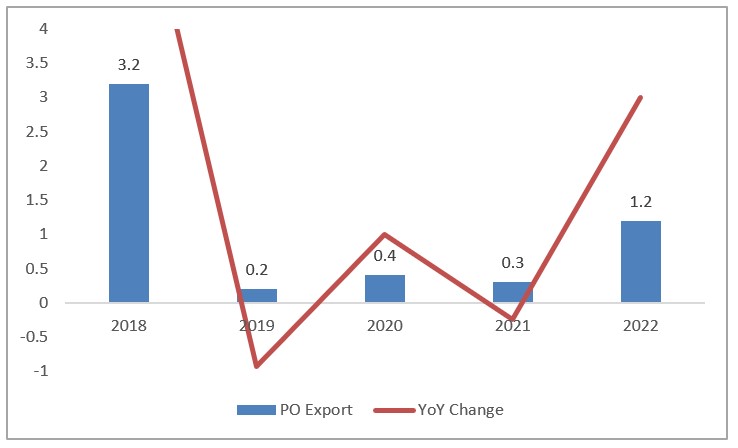
Data Source: PUdaily
1. Zero Tax Rebate
China has kept updating its tax rebate policies and accelerated the tax-rebate process in recent years, which has played a positive role in stabilizing foreign trade. Except for high energy-consuming, highly polluting and resource-based commodities, all exported goods have been completely relieved the tax burden, improving the competitiveness of Chinese goods in the international market. However, Chinese PO suppliers have been paid zero tax rebates since 2007.
2. Technical Limitations
China clearly stated that “controlling the export of high energy-consuming, highly polluting and resource-based commodities… and promoting the upgrading of domestic industries” in Outline of the 11th Five Year Plan for National Economy and Society Development (2005). This proposition is to balance internal and external economic development, guide enterprises to gradually reduce their over-reliance on foreign markets, rely more on and develop the domestic market to achieve endogenous growth; optimize the industrial structure, promote industrial upgrading; strengthen tax incentives to promote resource conservation, emission reduction, environmental protection, and accelerate the transformation of economic development mode.
Due to problems such as severe equipment corrosion and large production wastewater, the chlorohydrin process was included in the Guide Catalogue for Industrial Structural Adjustment (2019) under the restricted category, and constructing new chlorohydrin-based facilities has been prohibited since 2015. At that time, the chlorohydrin process accounted for 58.1% of PO production volume in China, while as of now, the proportion has been reduced to 27.1%.
In the Announcement No.54 (2020) on amending the catalogue of prohibited products in processing trade, it was mentioned that only the hydrogen peroxide to propylene oxide (HPPO) process is allowed to produce exported propylene oxide, and the others are still under the prohibited list. The note on the prohibited export commodities has been modified to “allow HPPO and co-oxidation processes to produce exported propylene oxide, and the others are still under the prohibited list”.
3. Limited Chemical Tankers
A chemical tanker is a type of tanker ship designed to transport liquid chemicals in bulk, including various toxic, flammable, volatile, or corrosive chemicals. PO belongs to Class 3 dangerous goods as a flammable liquid, with a low flashpoint and high danger. So it requires high packaging strength (Packing group I). To ship PO by sea for export, it is necessary to do shipside loading. If the ship docks at an outer port, the goods need to be sent to the hazardous chemicals warehouse.
Since July 2011, China’s chemical tanker market has entered a period of strict capacity control, with limited new capacity added each year. From 2012 to 2018, China’s average annual increase in maritime transportation capacity was only 21,371.43 deadweight tonnages (DWT). Under the strict capacity monitoring system, the total expansion of chemical tanker industry has been relatively slow, and the industry size has been regulated. Under the survival of the fittest mechanism, the industry maintains orderly growth. As of 2022, there were a total of 287 provincial chemical tankers in China (including dual-purpose tankers for oil and chemicals), with a total capacity of 1.399 million dwt, an increase of 3 tankers and 110,000 dwt YoY, with a tonnage increase of 8.5%. In 2022, 28 tankers with a total of 188,000 dwt were added, and 25 tankers with a total capacity of 76,000 dwt were retired from the market ahead of schedule.
With continually growing production capacity, Chinese PO suppliers will face higher sales pressure in the domestic market. While gradually reducing dependence on imported sources, the opening of the export market seems inevitable, but it is unclear whether tax rebates will be available once again.
 Everchem Updates Archive
  Sign Up for Email Updates