Asian Markets
December 12, 2022
An Entwined World
China shipyards feast on record LNG tanker orders as South Korea builders are full up
By Chen Aizhu
Summary
- Companies
- Chinese yards win nearly 30% of this year’s record orders
- Order books for Chinese yards triple as LNG freight soars
- Steep learning curves for shipbuilders new to LNG
- China needs vessels to ship U.S. LNG for energy security
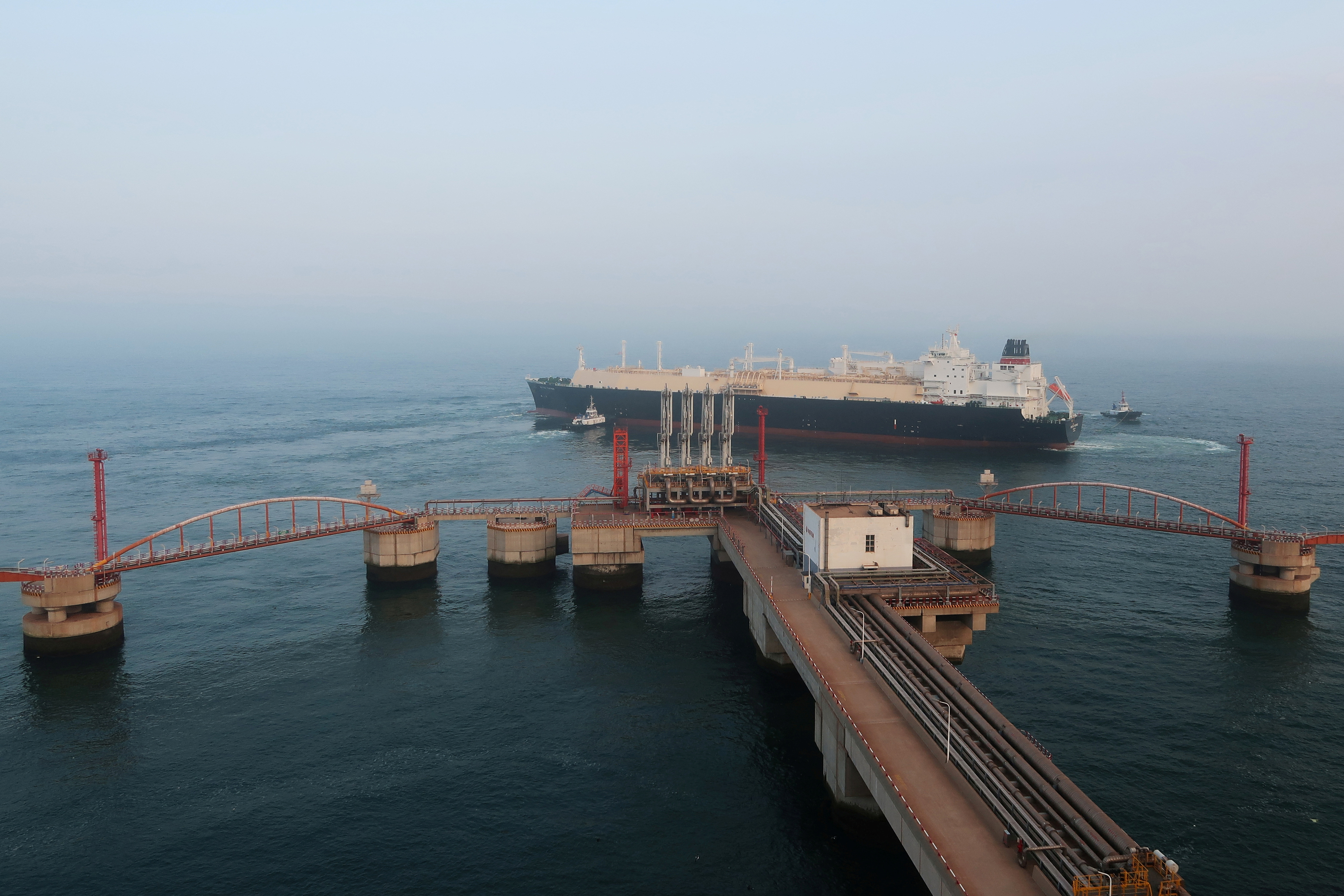
SINGAPORE, Dec 12 (Reuters) – China is making fast inroads in the market for newbuild liquefied natural gas (LNG) tankers as local and foreign shipowners turn to its shipbuilders for the specialty vessels because long dominant yards in South Korea are fully booked.
Three Chinese shipyards – only one of them having experience building large LNG tankers – won nearly 30% of this year’s record orders for 163 new gas carriers, claiming ground in a sector where South Korea usually captures most of the business.
LNG tanker order books for Chinese yards tripled as China’s gas traders and fleet operators sought to secure shipping after freight rates soared to records following the upending of global energy supply flows by Russia’s invasion of Ukraine.
With South Korean shipbuilders swamped by orders to service Qatar’s massive North Field expansion, Chinese yards also attracted more foreign bookings, including first overseas orders for some ship makers only recently certified to build membrane-type LNG carriers.
“As more Chinese gas traders engage local shipyards, they will be forced to climb the learning curve and eventually grow the whole industry,” said Li Yao, founder of Beijing-based consultancy SIA Energy.
Chinese shipyards this year won 45 LNG tanker orders worth an estimated $9.8 billion, about five times their 2021 order values, according to shipping data provider Clarksons Research.
By late November, Chinese yards had grown their LNG order books to 66 from 21, giving them 21% of global orders worth around $60 billion.
Comparatively, Chinese shipyards built just 9% of the existing global LNG fleet, according to Clarksons.

STEEP CURVE
Shanghai-based Hudong-Zhonghua Shipbuilding is the only Chinese yard with experience building large LNG carriers, delivering dozens going back to 2008. This year, it took 75% of China’s new orders.
Hudong-Zhonghua shared 26 orders from local owners – versus nine the last two years – with fellow China State Shipbuilding Corporation units, Dalian Shipbuilding Industry and Jiangnan Shipyard (Group), according to Clarksons and industry officials.
Two other yards – China Merchants Heavy Industry (CMHI) and Yangzijiang Shipbuilding (YAZG.SI) – were certified to build large LNG carriers this year and have attracted interest from local and foreign shippers.
LNG tankers, like aircraft carriers, are among the most difficult vessels to build, taking up to 30 months. For membrane-type containment tanks alone, 200 workers spend two months welding barrier walls made of paper-thin steel and 130 km (81 miles) of connecting lines.
Workers on these systems for housing gas chilled to minus 160 Celsius (minus 260 Fahrenheit) for shipping also have to be certified by Gaztransport & Technigaz (GTT) (GTT.PA), a French engineering company that holds the patents and licences its designs to shipbuilders.
“The learning curve will be steeper for the newer builders … We’ll also face a shortage of skilled workers,” said Hu Keyi, corporate technology chief at Jiangnan Shipyard.
Jiangnan is building its first 80,000 cubic metre (cu m) tanker for Guangdong-based trader JOVO Energy (605090.SS) and won an order in March from Abu Dhabi National Oil Company (ADNOC) for two 175,000 cu m LNG carriers.
“Considering relatively low financing costs thanks to Chinese banks’ support … investing in a newbuild offers greater security versus term chartering,” said Jacky Cai, a director at JOVO Energy, which is considering ordering a larger tanker.
U.S. GAS
China’s demand for LNG tankers is propelled by a need to ship 20 million tonnes a year of gas from the United States, part of a boom set to swell the global LNG fleet by a third over the next five years, said Robert Songer, analyst at commodity consultancy ICIS.
China needs about 80 vessels to transport U.S. LNG, said SIA Energy’s Li.
“Apart from servicing Chinese demand … the vessels may also be used to trade cargoes on other routes,” said Stephen Gordon, managing director of Clarksons Research.
Strong local shipbuilding benefits state energy giants PetroChina , China National Offshore Oil Corporation (CNOOC) and Sinopec , and private firm ENN Natural Gas Co (600803.SS), helping to better secure a fuel key to meeting China’s 2060 carbon-neutral target.
PetroChina and CNOOC lined up orders at Hudong-Zhonghua earlier than their peers, mostly via joint ventures with state shippers COSCO Shipping Energy Transportation (600026.SS) and China Merchants Energy Shipping (CMES) (601872.SS), following President Xi Jinping’s call for energy security.
Sinopec, a minority stakeholder of CMES, is also in talks to secure newbuilds at Jiangnan and Dalian, industry officials told Reuters. Sinopec declined to comment.
COSCO Shipping Energy is “ready to work hand-in-hand with shipowners and yards,” Qin Jiong, a company vice president, told an industry seminar last month, pointing to another advantage of using local shipyards.

FOREIGN ORDERS
While their labour costs are higher, Korean yards – such as Hyundai Heavy Industries (329180.KS) and Daewoo Shipbuilding & Marine Engineering (042660.KS) – are more efficient in design and construction and have a local supply chain, said Sunny Xu, founder of Singapore-based LNG solution provider C-LNG.
“Shipowners seem to have a more positive view about Korean shipyards … to realise the design shipowners want, ability to meet deadlines, and problem-free operation,” said a South Korean shipbuilding industry source who declined to be identified.
Still, Chinese yards received 19 foreign orders for LNG tankers this year and that number is likely to grow.
“Chinese yards have become more attractive because of the South Korean backlog, as well as rising costs,” said ICIS analyst Songer.
Chinese yards’ relationship with GTT also helps, he said.
“It is a fair assumption that China will start building a lot more vessels in the future.”
September 30, 2022
BASF Yeosu Site Celebration
BASF in Korea celebrates 30th anniversary of its Yeosu site operations, ‘a global key production base’
Petrochemical industry | 29 Sep 2022 IST | Polymerupdate.com • Yeosu site to consolidate its position through continued innovation, and producing & supplying of quality products for Korean and global customers
• A global key production base, site produces MDI, TDI, and CCD, which are essential raw materials in many value chains
• Only site equipped with its own environmental analysis facility in the Yeosu National Industrial Complex, continues its efforts for carbon neutrality
BASF Korea held a ceremony on September 29th to commemorate 30 years of operations of its Yeosu site. The event looked back at the various milestones of the Yeosu site over the last 30 years and shared the vision for a sustainable future. The event was attended by Dr. Ramkumar Dhruva, President of BASF’s Monomers Division along with executives of major customers and suppliers.
BASF in Korea Yeosu site was incorporated in 1988 and started its commercial production in 1992 with the completion of the MDI integrated production plant. As a result of expanding production facilities with continuous investments, its major products include Methylene Diphenyl Diisocyanate (MDI), Toluene Diisocyanate (TDI), Carbonyl Chloride Derivatives (CCD), Mononitrobenzene (MNB), Polyurethane Systems, Aniline, Ultrason®, and Ultra-pure NH4OH (electronic-grade ammonia water) for semiconductor. These products are widely used as raw materials in various industries for daily life, such as automotive, marine, construction, furniture, home appliances, sports, textile, medicine, and agriculture.
BASF aims to achieve net zero CO2 emissions by 2050 globally. Towards this journey of climate neutrality, Yeosu site is contributing actively by establishing a world-class quality management system, including environment, energy, safety, and health management systems, to meet its global scale production capacity. It will also continuously revamp its facility to minimize greenhouse gas emissions.
“BASF in Korea Yeosu site is an important production base supplying essential raw materials, including MDI, TDI, and CCD, to customers representing major industries in the Korean and global markets,” said Dr. David Im, Representative Director of BASF Korea. “Notably, it is the only site equipped with its own environmental analysis facility in the Yeosu National Industrial Complex. With continued R&D and investment for carbon neutrality, we will enhance our competitiveness and provide sustainable raw materials to the supply chain.”
Yeosu site – first MDI and TDI production facility in Asia Pacific, supplying core raw materials of PU to Korea and overseas
BASF in Korea Yeosu site was the first BASF production site in Asia Pacific region that started commercial production of MDI in 1992. With efficient production processes established through a series of strategic investments and production expansion, its annual MDI production capacity, which started with an annual capacity of 40,000 tons, has now increased to 250,000 tons. The facility is equipped with an integrated production system that produces raw materials such as MNB and Aniline to MDI products. MDI, a core raw material of polyurethane for the chemical industry, it plays an integral role in many industries such as construction, transportation, home appliance, and clothing.
In addition, the Yeosu site started the commercial production of TDI for the first time in the Asia-Pacific region in 2003 and currently has an annual production capacity of 160,000 tons. Along with MDI, TDI is also a key raw material for polyurethane products. The MDI and TDI produced at the Yeosu site is being stably supplied to major Korean customers in the electrical and electronics (E&E) and automotive industries. The site addresses most of the demand in the Asia Pacific region.
Only CCD production plant aside from BASF Ludwigshafen Verbund site the headquarters in Germany
This year, the CCD plant at Yeosu site celebrated 20 years of safe and reliable production. Since its commercial production in 2002, the plant has achieved an accumulative production of more than 200,000 tons of CCD. This is a significant achievement, as production of chemical specialties is highly sophisticated. Producing CCD in Korea creates an improved supply reliability for customers in the region. CCD products are also exported from Korea to other countries. Aside from BASF headquarters in Germany, Yeosu is the only CCD production plant of BASF in the world.
BASF in Korea Yeosu site has proved to be a well-accepted CCD supplier offering versatile high-quality products to many value chains. Customers value CCD as essential raw materials to make organic peroxides to produce polymers. CCD is also important to produce pharmaceuticals and plant protection agents. Further applications include cosmetics, personal care, polymer additives and electroplating chemicals.
About BASF in Korea
BASF has been a committed partner to Korea since 1954. As a leading foreign investor in the chemical industry in Korea, BASF operates eight world-scale production sites in the country. The company also maintains the regional headquarters of its Electronic Materials business and the Electronic Materials R&D Center Asia Pacific in Suwon. In addition, one R&D center for advanced material solutions and three technical development centers are located across Korea. In 2021, BASF posted sales of approximately € 1.8 billion to customers in Korea and employed 1,221 employees as of the end of the year.
https://www.polymerupdate.com/news/press-release-details.aspx?id=26450
September 30, 2022
BASF Yeosu Site Celebration
BASF in Korea celebrates 30th anniversary of its Yeosu site operations, ‘a global key production base’
Petrochemical industry | 29 Sep 2022 IST | Polymerupdate.com • Yeosu site to consolidate its position through continued innovation, and producing & supplying of quality products for Korean and global customers
• A global key production base, site produces MDI, TDI, and CCD, which are essential raw materials in many value chains
• Only site equipped with its own environmental analysis facility in the Yeosu National Industrial Complex, continues its efforts for carbon neutrality
BASF Korea held a ceremony on September 29th to commemorate 30 years of operations of its Yeosu site. The event looked back at the various milestones of the Yeosu site over the last 30 years and shared the vision for a sustainable future. The event was attended by Dr. Ramkumar Dhruva, President of BASF’s Monomers Division along with executives of major customers and suppliers.
BASF in Korea Yeosu site was incorporated in 1988 and started its commercial production in 1992 with the completion of the MDI integrated production plant. As a result of expanding production facilities with continuous investments, its major products include Methylene Diphenyl Diisocyanate (MDI), Toluene Diisocyanate (TDI), Carbonyl Chloride Derivatives (CCD), Mononitrobenzene (MNB), Polyurethane Systems, Aniline, Ultrason®, and Ultra-pure NH4OH (electronic-grade ammonia water) for semiconductor. These products are widely used as raw materials in various industries for daily life, such as automotive, marine, construction, furniture, home appliances, sports, textile, medicine, and agriculture.
BASF aims to achieve net zero CO2 emissions by 2050 globally. Towards this journey of climate neutrality, Yeosu site is contributing actively by establishing a world-class quality management system, including environment, energy, safety, and health management systems, to meet its global scale production capacity. It will also continuously revamp its facility to minimize greenhouse gas emissions.
“BASF in Korea Yeosu site is an important production base supplying essential raw materials, including MDI, TDI, and CCD, to customers representing major industries in the Korean and global markets,” said Dr. David Im, Representative Director of BASF Korea. “Notably, it is the only site equipped with its own environmental analysis facility in the Yeosu National Industrial Complex. With continued R&D and investment for carbon neutrality, we will enhance our competitiveness and provide sustainable raw materials to the supply chain.”
Yeosu site – first MDI and TDI production facility in Asia Pacific, supplying core raw materials of PU to Korea and overseas
BASF in Korea Yeosu site was the first BASF production site in Asia Pacific region that started commercial production of MDI in 1992. With efficient production processes established through a series of strategic investments and production expansion, its annual MDI production capacity, which started with an annual capacity of 40,000 tons, has now increased to 250,000 tons. The facility is equipped with an integrated production system that produces raw materials such as MNB and Aniline to MDI products. MDI, a core raw material of polyurethane for the chemical industry, it plays an integral role in many industries such as construction, transportation, home appliance, and clothing.
In addition, the Yeosu site started the commercial production of TDI for the first time in the Asia-Pacific region in 2003 and currently has an annual production capacity of 160,000 tons. Along with MDI, TDI is also a key raw material for polyurethane products. The MDI and TDI produced at the Yeosu site is being stably supplied to major Korean customers in the electrical and electronics (E&E) and automotive industries. The site addresses most of the demand in the Asia Pacific region.
Only CCD production plant aside from BASF Ludwigshafen Verbund site the headquarters in Germany
This year, the CCD plant at Yeosu site celebrated 20 years of safe and reliable production. Since its commercial production in 2002, the plant has achieved an accumulative production of more than 200,000 tons of CCD. This is a significant achievement, as production of chemical specialties is highly sophisticated. Producing CCD in Korea creates an improved supply reliability for customers in the region. CCD products are also exported from Korea to other countries. Aside from BASF headquarters in Germany, Yeosu is the only CCD production plant of BASF in the world.
BASF in Korea Yeosu site has proved to be a well-accepted CCD supplier offering versatile high-quality products to many value chains. Customers value CCD as essential raw materials to make organic peroxides to produce polymers. CCD is also important to produce pharmaceuticals and plant protection agents. Further applications include cosmetics, personal care, polymer additives and electroplating chemicals.
About BASF in Korea
BASF has been a committed partner to Korea since 1954. As a leading foreign investor in the chemical industry in Korea, BASF operates eight world-scale production sites in the country. The company also maintains the regional headquarters of its Electronic Materials business and the Electronic Materials R&D Center Asia Pacific in Suwon. In addition, one R&D center for advanced material solutions and three technical development centers are located across Korea. In 2021, BASF posted sales of approximately € 1.8 billion to customers in Korea and employed 1,221 employees as of the end of the year.
https://www.polymerupdate.com/news/press-release-details.aspx?id=26450
September 7, 2022
Currency Fluctuations
Japan, China On Edge After Record Dollar Surge Sparks “Explosive” Yen Plunge; China’s Yuan Not Far Behind
by Tyler DurdenWednesday, Sep 07, 2022 – 02:04 PM
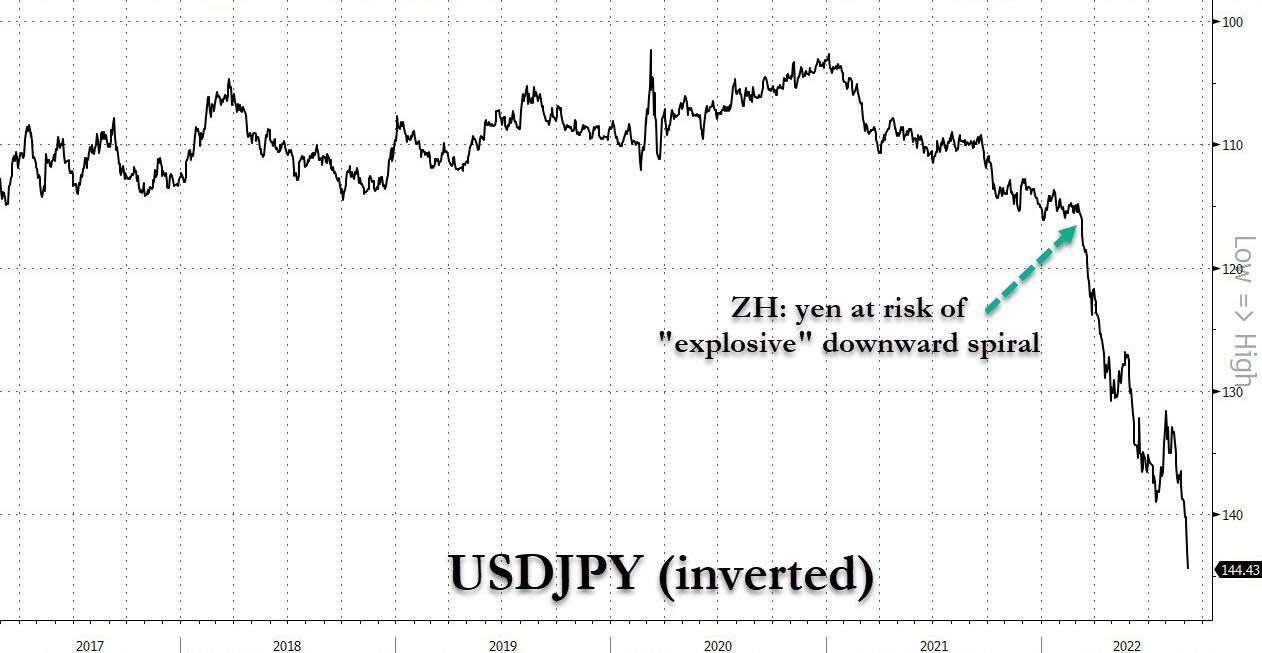
Back in late March, when USDJPY was at 121, we warned that the “Yen Was At Risk Of “Explosive” Downward Spiral With Kuroda Trapped… And Why China May Soon Devalue“, and since then the yen has… well, see for yourselves:
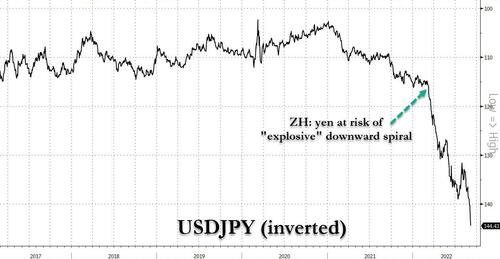
In short, we were right.
Having been in freefall for months, due to the “impossible dilemma” facing the BOJ which can’t have i) a stable currency and ii) yield curve control at the same time, the BOJ has clearly picked an interest rate cap instead of intervening in the yen, and containing the record freefall in the Japanese currency which is set for its worst annual drop on record – the yen this morning plunged as low as 144.99, the lowest level since 1998 and there is no end in sight to the drop.
Furthermore, and just to make it very clear that the BOJ sees nothing wrong with the precipitous drop in the yen which makes Japan seem like a B-grade emerging market, overnight the BOJ said it would buy 550BN yen of 5-10 year bonds at the latest scheduled operation, up from 500BN previously to protect the YCC yield caps; as Goldman notes, “BOJ is really the odd man out in global policy and it seems the market is piling on pressure into the yen ahead of the BOJ meeting at the end of this month.”
To be sure, the ongoing crash in the yen is not exactly shocking and is a result of Japan’s widening yield and policy divergence with the US. Still, the move which could unleash an inflationary shock across the otherwise sleepy, deflationary and demographically doomed islands, has prompted politicians to intervene if only verbally, and overnight, Japan’s top spokesman Hirokazu Matsuno said he was concerned about recent rapid, one-sided moves in yen and the government would need to take necessary action if these movements continue.
“We’re concerned about the rapid and one-sided moves being seen recently in foreign exchange markets,” Matsuno said at a press conference in Tokyo adding that “the government will continue to watch forex market moves with a high sense of urgency, and take necessary responses if this sort of move continues.”
Of course, it’s not just the yen that is getting demolished: with the Bloomberg dollar index hitting another, and another, and another all time high day after day with the Fed clearly oblivious of the impact its supertighte monetary policy is having on the world…

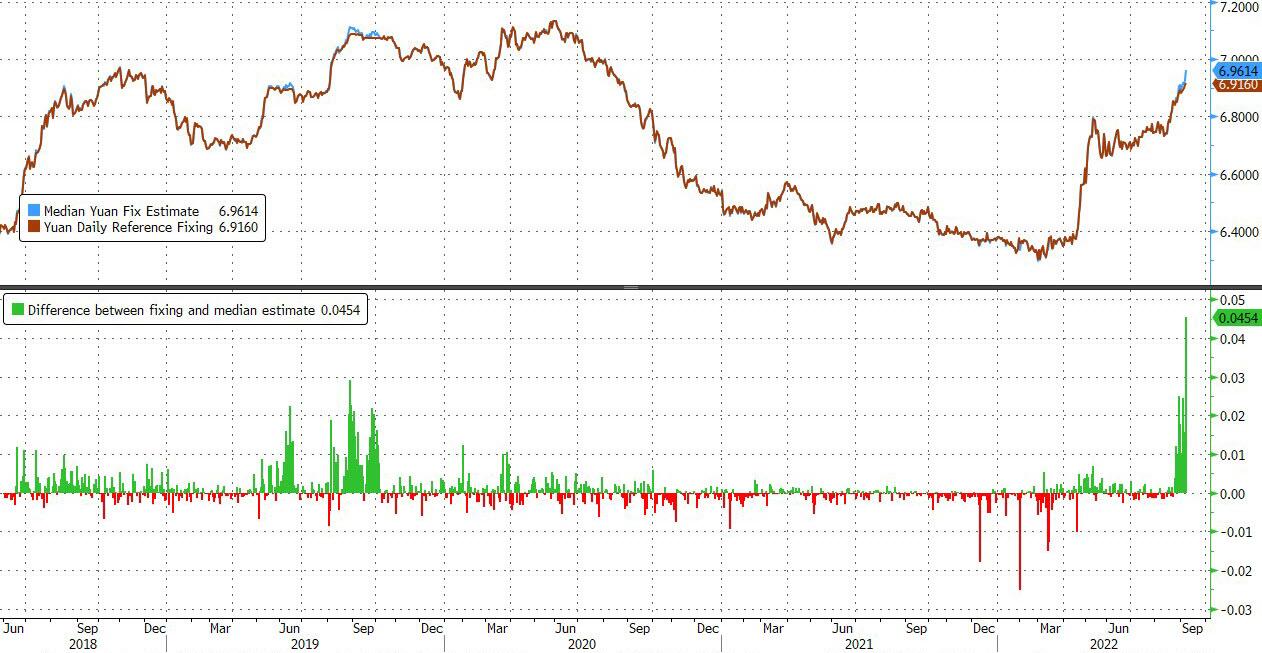
… it was China’s yuan that also got hammered overnight, and with the offshore currency trading just shy of 7.00, it forced the PBOC to scramble and stem the currency depreciation with a yuan fixing that was set at a record 454 pips stronger than the average estimate!
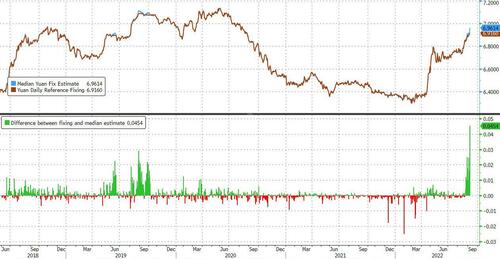
The good news is that as Bloomberg’s Simon Flint notes, the yuan tends to be rather dull after big gaps between offshore levels and the fix. To wit: “historical experience is that the yuan stabilizes after a similarly high premium is hit. Selecting for days with a similar (average) premium, I find 78 individual days when this occurred and more than 20 clusters since Bloomberg started to collect fixing consensus data. The average change in USD/CNH and CNH-CFETS was less than 0.1% one day, five days and 21 days after this premium was hit. It seems like a combination of the PBOC’s ability to pick tops in the dollar (as implied by stability in CFETS) and their resistance to appreciation is sufficient to stop the rot. Furthermore, the maximum range of outcomes over these periods is narrower than the series average. Of course, this episode may not be “average”. PBOC resistance has hit record breaking levels, suggesting a greater disconnect that the premium alone indicates.”
The bad news is that according to Goldman, it is only a matter of time before we trade through 7.00, for one simple reason: the collapse in China’s trade demands it and the export data in particular is a concern as the large trade surplus had been one of the main pushbacks to USDCNH going higher (the August surplus declined to 79.3BN vs 101BN last month). As Goldman concludes, “At this juncture it seems inevitable that China will have to accept a weaker currency to support trade/growth.“
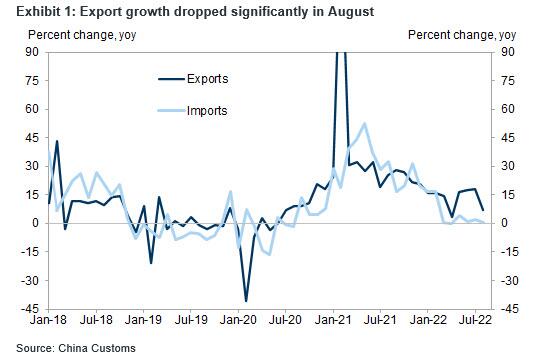
For those who missed it, overnight China reported that export growth slowed more than expected in August, as the entire world careens into a recession. Specifically, China’s export growth dropped to +7.1% Y/Y in August, well below consensus expectations of a 13% increase and a sharp drop from the 18.0% in July. Import growth decelerated to +0.3% Y/Yin August, also missing the consensus estimate of 1.1%, and down from 2.3% in July.
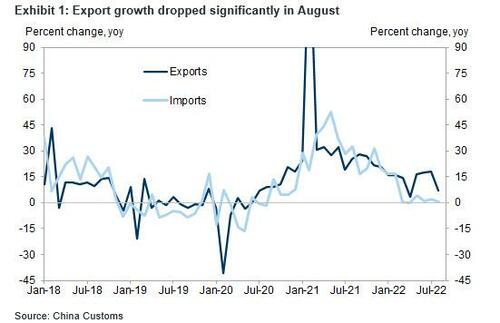
According to Goldman, the large deceleration of year-over-year export growth was partially driven by a high base last August, when the adverse impact from Typhoon In-fa unwound. Trade surplus in August fell to US$79.4bn on weaker-than-expected exports.
That said – when setting the stage for a 7.00 yuan print – Goldman says that it isn’t such a big deal, and explains why:
In Aug 2019, when USDCNY first traded above 7, the PBoC issued comment that “7 is not the age of man”, by which they meant it is not a number from which there is no return. The PBoC has made it clear in the press conference earlier this week that China’s monetary policy is mainly serving domestic purpose and they still have ample room. The RMB weakness is mainly due to USD strength, with RMB outperforming non-USD majors and so far there has not been meaningful spillover impact from currency depreciation on other Chinese assets (SHCOMP has been outperforming SPX of late). Another indicator to look at is onshore 1m risk reversal, which came off the highs. All these suggest there is not much to worry onshore about the PBoC allowing USDCNY to trade above 7.0 amid continued USD strength.
All of the above is why Goldman has shifted its USDCNH target to 7.20 area.
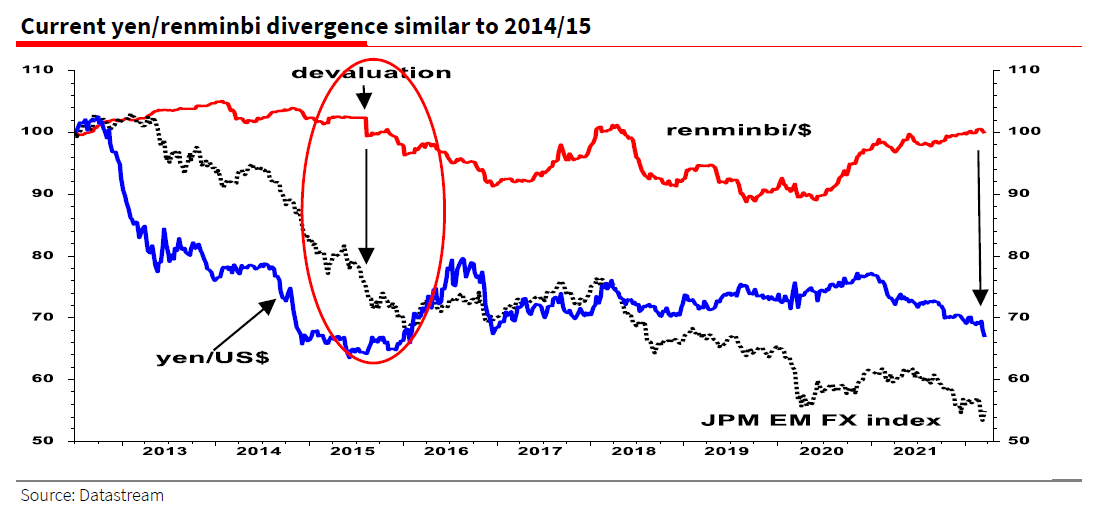
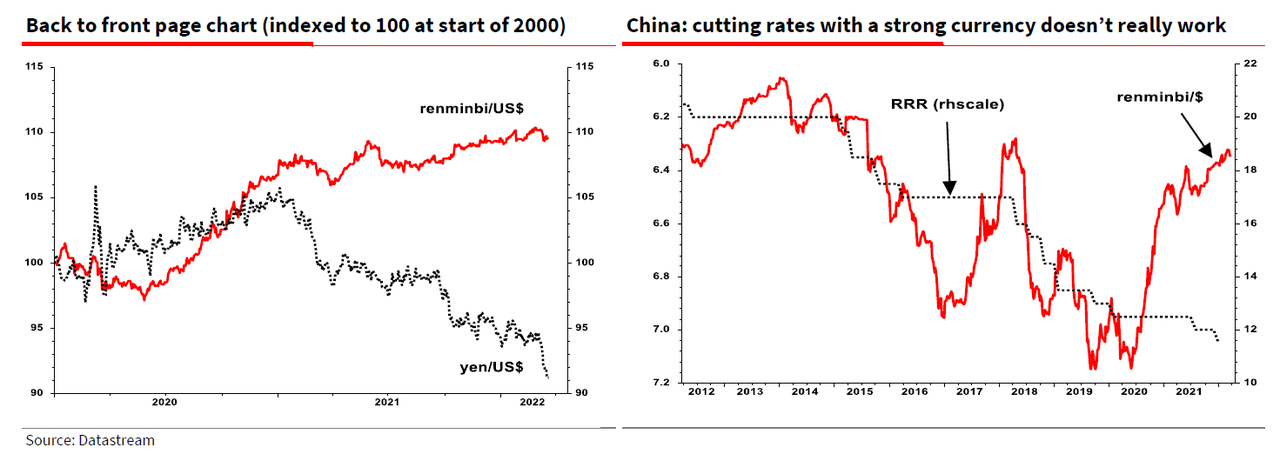
But perhaps an even bigger question is how China will react to the absolute monkeyhammering that the yen has taken in recent months, and as Albert Edwards noted back in March, maybe China will react just like they did in August 2015 when the PBoC devalued: “Back then persistent yen weakness had dragged down other competing regional currencies and left the renminbi overvalued.”
Wait, yen weakness leading to China devaluation? According to Edwards, that indeed was the sequence: as he shows in the chart below, the super weak yen of 2013-15, by driving down other competing Asian currencies, ultimately led us to the August 2015 renminbi devaluation.
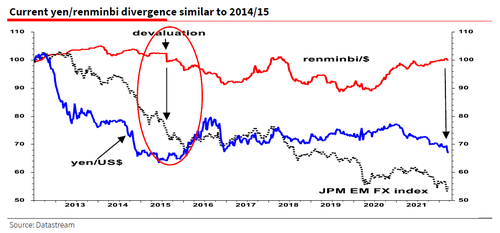
Fast forward to today when the aggressive relentless easing by the BoJ – which is terrified of losing control over the JGB curve – comes at a time when the PBoC has resolutely refused to join the global tightening posture and instead is shifting towards an easier stance (after all, China has an imploding property sector it must stabilize at any cost).
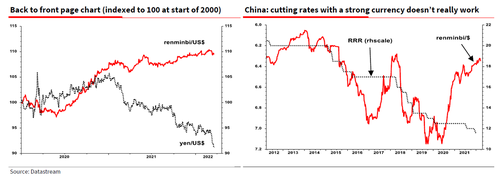
Edwards concluded that the one thing to watch out for, especially in the current febrile geopolitical environment, is if China once again is ‘forced’ to devalue because of the weak yen. Economists will tell you that cutting interest rates or the reserve requirement ratio (RRR- r/h chart below) is neutralized when you have a strong currency.
https://www.zerohedge.com/markets/japan-china-edge-after-record-dollar-surge-sparks-explosive-yen-plunge-chinas-yuan-not-far
September 7, 2022
Currency Fluctuations
Japan, China On Edge After Record Dollar Surge Sparks “Explosive” Yen Plunge; China’s Yuan Not Far Behind
by Tyler DurdenWednesday, Sep 07, 2022 – 02:04 PM
Back in late March, when USDJPY was at 121, we warned that the “Yen Was At Risk Of “Explosive” Downward Spiral With Kuroda Trapped… And Why China May Soon Devalue“, and since then the yen has… well, see for yourselves:
In short, we were right.
Having been in freefall for months, due to the “impossible dilemma” facing the BOJ which can’t have i) a stable currency and ii) yield curve control at the same time, the BOJ has clearly picked an interest rate cap instead of intervening in the yen, and containing the record freefall in the Japanese currency which is set for its worst annual drop on record – the yen this morning plunged as low as 144.99, the lowest level since 1998 and there is no end in sight to the drop.
Furthermore, and just to make it very clear that the BOJ sees nothing wrong with the precipitous drop in the yen which makes Japan seem like a B-grade emerging market, overnight the BOJ said it would buy 550BN yen of 5-10 year bonds at the latest scheduled operation, up from 500BN previously to protect the YCC yield caps; as Goldman notes, “BOJ is really the odd man out in global policy and it seems the market is piling on pressure into the yen ahead of the BOJ meeting at the end of this month.”
To be sure, the ongoing crash in the yen is not exactly shocking and is a result of Japan’s widening yield and policy divergence with the US. Still, the move which could unleash an inflationary shock across the otherwise sleepy, deflationary and demographically doomed islands, has prompted politicians to intervene if only verbally, and overnight, Japan’s top spokesman Hirokazu Matsuno said he was concerned about recent rapid, one-sided moves in yen and the government would need to take necessary action if these movements continue.
“We’re concerned about the rapid and one-sided moves being seen recently in foreign exchange markets,” Matsuno said at a press conference in Tokyo adding that “the government will continue to watch forex market moves with a high sense of urgency, and take necessary responses if this sort of move continues.”
Of course, it’s not just the yen that is getting demolished: with the Bloomberg dollar index hitting another, and another, and another all time high day after day with the Fed clearly oblivious of the impact its supertighte monetary policy is having on the world…
… it was China’s yuan that also got hammered overnight, and with the offshore currency trading just shy of 7.00, it forced the PBOC to scramble and stem the currency depreciation with a yuan fixing that was set at a record 454 pips stronger than the average estimate!
The good news is that as Bloomberg’s Simon Flint notes, the yuan tends to be rather dull after big gaps between offshore levels and the fix. To wit: “historical experience is that the yuan stabilizes after a similarly high premium is hit. Selecting for days with a similar (average) premium, I find 78 individual days when this occurred and more than 20 clusters since Bloomberg started to collect fixing consensus data. The average change in USD/CNH and CNH-CFETS was less than 0.1% one day, five days and 21 days after this premium was hit. It seems like a combination of the PBOC’s ability to pick tops in the dollar (as implied by stability in CFETS) and their resistance to appreciation is sufficient to stop the rot. Furthermore, the maximum range of outcomes over these periods is narrower than the series average. Of course, this episode may not be “average”. PBOC resistance has hit record breaking levels, suggesting a greater disconnect that the premium alone indicates.”
The bad news is that according to Goldman, it is only a matter of time before we trade through 7.00, for one simple reason: the collapse in China’s trade demands it and the export data in particular is a concern as the large trade surplus had been one of the main pushbacks to USDCNH going higher (the August surplus declined to 79.3BN vs 101BN last month). As Goldman concludes, “At this juncture it seems inevitable that China will have to accept a weaker currency to support trade/growth.“
For those who missed it, overnight China reported that export growth slowed more than expected in August, as the entire world careens into a recession. Specifically, China’s export growth dropped to +7.1% Y/Y in August, well below consensus expectations of a 13% increase and a sharp drop from the 18.0% in July. Import growth decelerated to +0.3% Y/Yin August, also missing the consensus estimate of 1.1%, and down from 2.3% in July.
According to Goldman, the large deceleration of year-over-year export growth was partially driven by a high base last August, when the adverse impact from Typhoon In-fa unwound. Trade surplus in August fell to US$79.4bn on weaker-than-expected exports.
That said – when setting the stage for a 7.00 yuan print – Goldman says that it isn’t such a big deal, and explains why:
In Aug 2019, when USDCNY first traded above 7, the PBoC issued comment that “7 is not the age of man”, by which they meant it is not a number from which there is no return. The PBoC has made it clear in the press conference earlier this week that China’s monetary policy is mainly serving domestic purpose and they still have ample room. The RMB weakness is mainly due to USD strength, with RMB outperforming non-USD majors and so far there has not been meaningful spillover impact from currency depreciation on other Chinese assets (SHCOMP has been outperforming SPX of late). Another indicator to look at is onshore 1m risk reversal, which came off the highs. All these suggest there is not much to worry onshore about the PBoC allowing USDCNY to trade above 7.0 amid continued USD strength.
All of the above is why Goldman has shifted its USDCNH target to 7.20 area.
But perhaps an even bigger question is how China will react to the absolute monkeyhammering that the yen has taken in recent months, and as Albert Edwards noted back in March, maybe China will react just like they did in August 2015 when the PBoC devalued: “Back then persistent yen weakness had dragged down other competing regional currencies and left the renminbi overvalued.”
Wait, yen weakness leading to China devaluation? According to Edwards, that indeed was the sequence: as he shows in the chart below, the super weak yen of 2013-15, by driving down other competing Asian currencies, ultimately led us to the August 2015 renminbi devaluation.
Fast forward to today when the aggressive relentless easing by the BoJ – which is terrified of losing control over the JGB curve – comes at a time when the PBoC has resolutely refused to join the global tightening posture and instead is shifting towards an easier stance (after all, China has an imploding property sector it must stabilize at any cost).
Edwards concluded that the one thing to watch out for, especially in the current febrile geopolitical environment, is if China once again is ‘forced’ to devalue because of the weak yen. Economists will tell you that cutting interest rates or the reserve requirement ratio (RRR- r/h chart below) is neutralized when you have a strong currency.
https://www.zerohedge.com/markets/japan-china-edge-after-record-dollar-surge-sparks-explosive-yen-plunge-chinas-yuan-not-far
 Everchem Updates Archive
 Sign Up for Email Updates