
Company News
March 10, 2025
Oasis Pioneers to Install MDI Splitter in Saudi Arabia
Sadara, Oasis Pioneers Sign Long-Term Supply Agreement on MDI
PUdaily | Updated: March 5, 2025
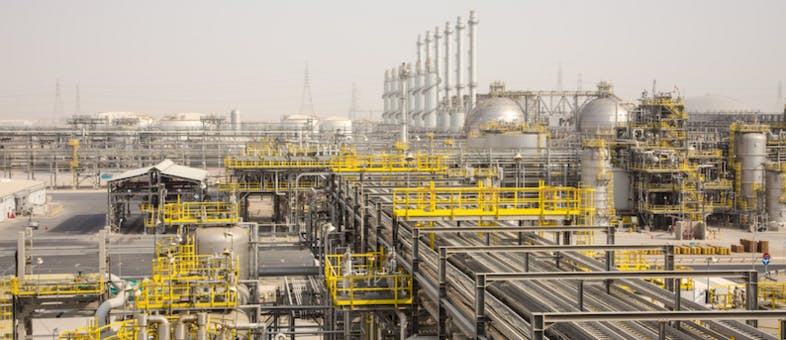

JUBAIL INDUSTRIAL CITY, Saudi Arabia, Jan. 15, 2025 – In alignment with the Kingdom’s vision to enable the downstream industry, Sadara Chemical Company (Sadara) and Oasis Pioneers Industrial Co. Ltd (Oasis Pioneers), have signed a long-term supply agreement for Methylenediphenyl Diisocyanate (MDI) amid the presence of Sadara CEO Fayez Al Sharef and Oasis Pioneers Chairman Khaled Juffali. Under the agreement, Sadara will supply MDI – a critical raw material used in high-performance applications – to Oasis Pioneers, who in turn will establish and operate a state-of-the-art MDI distillation and manufacturing facility, to produce advanced polyurethane solutions at PlasChem Park in Jubail Industrial City.
This partnership represents a significant milestone in advancing Saudi Arabia’s downstream sector, a vital component of the Kingdom’s National Industrial Strategy. The project seeks to advance innovation in applications such as thermal insulation, automotive parts, and construction materials. This will in turn drive industrial growth and sustainable development across the Kingdom.
Sadara CEO Fayez Al Sharef expressed his enthusiasm at the agreement, emphasizing its significance for the downstream sector through the introduction of high-performance products and applications that will support the local market and boost the national economy. Oasis Pioneers’ Chairman Khaled Juffali said: “I am proud and excited to reach this milestone alongside the Oasis Pioneers team and our partners at Sadara. Recognizing this project as a vital part of the Kingdom’s National Industrial Strategy is exciting but also brings enormous responsibility. For the benefit of our country, region, partners, employees, and shareholders, my team and I will continue working to deliver a new national champion in our industrial sector successfully.”
This project will serve as a groundbreaking and transformative addition to the Kingdom’s manufacturing sector. It will strengthen production capabilities and replace imported products with the locally-produced unique specialty chemicals.
Sadara’s innovative product portfolio — introducing the first of its kind in the Kingdom — has positioned the company as a catalyst for attracting diverse investments to PlasChem Park. These strategic investments span key sectors: chemicals for oil and gas, building materials, paints, coatings, and personal and household care products. Creation of these new value chains will drive growth and innovation within the Kingdom’s manufacturing landscape.
February 26, 2025
Urethane Highlights from Covestro’s Investors Call
Covestro AG (CVVTF) Q4 2024 Earnings Call Transcript
Feb. 26, 2025 2:36 PM ETCovestro AG (CVVTF) Stock, COVTY StockCVVTF, COVTY

Q4 2024 Results Conference Call February 26, 2025 9:00 AM ET
Company Participants
Ronald Koehler – Head of Investor Relations
Christian Baier – CFO & Member of Management Board
Carsten Intveen – Investor Relations Director
Christian Baier
Yes. Thank you, Ronald, and good afternoon, and a warm welcome to everyone. Reflecting on 2024, we faced numerous challenges due to the economic situation, many of which are still persisting. So let us look at the highlights of 2024 and start with a view on the key financials.
In a persistently weak economic climate, Covestro achieved sales of €14.2 billion, only slightly down versus 2023. This decline was driven by lower prices despite significantly higher volumes. The EBITDA Is stable at €1.1 billion, indicating that the difficult demand environment is far from over. Once again, we could secure a positive free operating cash flow of €89 million, in line with our guidance. Our transformation program, STRONG, yielded savings of €119 million.
Turning over to the nonfinancial highlights. The full set of greenhouse gas emissions covering Scope 1, 2 and also Scope 3 went down by 17% compared to the reference years. We added two more PPAs for renewable electricity in Europe for our sites in Spain and Belgium, contributing around 200 gigawatt hours once fully enacted. The new PPAs and other measures planned will increase our renewable share of electricity from 16% in 2024 to around 22% in 2025.
In line with the strategic goal of full circularity and climate neutrality, we consider recycling of waste plastic a key element towards achieving this goal. We made significant steps towards this goal by acquiring a stake in Bio BTX and by signing a supply agreement with Encina. Both companies recycled consumer plastic waste into valuable raw materials like benzene and toluylene for MDI and TDI. We are also collaborating with Neste and Borealis on recycling discarded tires for processing into base chemicals, phenol and acetone for polycarbonate.
In addition to the recycling activities, we inaugurated the first pilot plant for bio-based aniline, an important precursor for MDI using biomass as raw material. With that comprehensive review of the highlights, we are coming to a major investment to pursue our growth strategy.
We are now coming to the business details of 2024 and to the volume development for the last year. Year-on-year, the global sales volume increased by [7.4] availability of our assets, especially in Europe after resolving the technical issues in Q4 2023 and improved demand in APAC. This led to a sales volume increase of 10.6% in APAC and 9.3% in EMLA. Volume development in North America was flattish compared to the prior year.
So how did the different industries develop? Auto was still showing positive growth rates in H1 2024, mainly driven by APAC, however, in the second half of ’24, all regions showed a decline, leading to an overall flattish development for fiscal ’24. Furniture had an overall positive year 2024, with growth in all regions, also benefiting from our improved TDI availability in Europe. The positive trend slightly weakened in H2 ’24, but remained on a growth path.
Looking into the different regions, EMLA recovered quite nicely supported by the improved availability of MDI, TDI and PCS. And also here, construction was the main driver of growth. Sales volumes in North America were burdened by declines in auto and electronics, but benefited from a slight growth in furniture and a significant growth in construction. APAC was the strongest region with all industries with netting growth.
We are now coming to the outlook for Covestro’s core industries on Page 12 of the presentation. The global GDP expectation for 2025 is estimated to be 2.8% and is a continuation of the growth rates of the past two years. Sadly, most of the key industries for Covestro will not achieve such growth rates. But on the positive side, after several quarters, we are now looking at a stable to positive growth picture across all industries.
In automotive, we expect a slight growth of 2.7% after a global decline in the second half of 2024. Also, for EVs and battery electric vehicles, growth rates are again on the rise, with an expected increase of 22.4%. Especially, our engineering plastics entity will benefit from this renewed strength in electromobility.
The outlook for the construction industry will stabilize after two years of decline and remained flat at a growth rate of 0.2%. The crisis is still not over in the residential subsector, but has slowed down with a negative growth estimate of 1.5%. The furniture industry is set for a slight growth after stabilization in the last year. The outlook for soft furniture is even more optimistic at 2.4% growth. The electro industry has already been the highest growing industry in 2024 with 4.1% growth and this trend will also continue in 2025 with another 5.2% predicted growth.
The appliance sector will be showing slower growth versus last year and only exhibiting a 1.2% increase. Summarizing this outlook, we see some green shoots with the development in electro, auto and furniture and the stabilization in construction. We are positive on our volume development and with increasing volumes, also assume an increase in margins starting during 2025.
Our single largest project is the aniline plant in Antwerp, which should support our MDI business in Europe with low-cost raw materials. The expected start-up is in early 2026. We assume a high double-digit euro million EBITDA contribution from this plant.
And now comes the moment you have all been waiting for, the update on the ADNOC or now correctly XRG transaction. The voluntary tender of €62 per share concluded at the end of 2024 after two tendering phases with almost 82% of Covestro shares being tendered. This is an important milestone and underscores that the Board of Management of Covestro in line with its fiduciary duties, has agreed on an attractive offer for the Company, its shareholders and all other stakeholders.
In total, the aggregate of shares tendered and purchased by XRG amounts to 91.58% of the total Covestro shares. Additionally, XRG secured 3.44% of shares through instruments end of January 2025, leading to XRG direct and indirect ownership of more than 95%. Since the signing of the transaction and investment agreement, teams from ADNOC and Covestro have been diligently working on the required regulatory approvals. All foreign direct investment, the European foreign subsidies regulation and the majority of merger control proceedings were initially triggered before Christmas. The remaining merger control filings were submitted in January.
In the meantime, 50% of the approvals on FDI have been granted. This potential deal is one of the largest transactions ever in Germany. So it is not surprising that we are in a Phase 2 investigation with the German Federal Ministry of Economic Affairs and Climate Action.
On the merger control side, approvals from approximately 1/3 of the 19 countries have been achieved. Additionally, there are various requests for information from the different responsible authorities that the respective teams are following up on to ensure a closing of the potential transaction within the expected time line. We are confident that transaction will close in the second half of 2025 and will drive significant value for our investors and stakeholders, paving the way for future success and innovation.
So let me quickly summarize the highlights for fiscal year 2024. Sales have slightly decreased to €14.2 billion, which was caused by lower prices and an unfavorable FX, while positive volumes were pertaining. EBITDA for fiscal year 2024 of €1.1 billion is similar to the year ’23 and in line with our guidance. This was burdened by negative pricing delta offset by higher volumes and positive other items.
Christian Faitz
Two questions, if I may. First of all, if I look at your assumptions for end market growth on Slide 12, it actually looks like we are going to see a significantly higher growth dynamic versus ’24 in your relevant markets? I mean, I’m fully aware it’s still muted. Hence, could you please share with us some insights into what your salespeople are currently seeing in terms of order book development. I would also be particularly interested in hearing a few words on how in your order book, China has come out of a New Year celebrations. That’s question number one. Shall I pose question number two or after you answer the first one.
Carsten Intveen
Please go ahead.
Christian Faitz
All right. So second. I’m fully aware that any potential tariffs put in place by the dream teams in Washington and/or in Brussels do not have a significant direct effect on your assets. Yet, have you modeled a scenario where some of your local customer industries might be hit from automotive to furniture, for example? And if so, can you share with us some insights preferably in numerical form.
Christian Baier
Yes. Thank you, Christian, for your questions. I’m very happy to address those. So from an end market perspective, you’re absolutely right, the numbers that we are showing where we are relying also to external sources show a little bit of a positive development in ’25 compared to ’24. And then still, this is more predicated in our perspective to the later part of the year to that extent because if we now put it together with the salespeople perspective, there is the one or the other green shoot, but certainly not in a structural manner at this very stage.
As we have stated, Q1 is rather be a little bit muted from that perspective. So we’re rather relying to a certain extent also on those perspectives that we can see in some of the areas, but it’s more than the external data at this stage. When we put that together with the China perspective, so how did China come back from Chinese New Year. First of all, in our case, they went into reasonably well. And now it is about the two sessions that are about to take place on the governmental side to see what kind of incentives and what kind of approaches are being taken on the economic boost that is expected to a certain extent, but that’s, at the moment, still somewhat pending. And therefore, the crystal ball is not completely clear yet after Chinese New Year.
With respect to the perspective on the tariff side, I think, first of all, we are certainly very significantly producing within the regions and for the regions. And that’s also what you put out there. Therefore, there should be a rather limited flow in between the various pieces. And if we look at it by MDI, U.S. is a net import market for many of our products, especially for MDI. And therefore, higher tariffs should be positive for us as we are a local producer and partly are then competing with imports.
So we are modeling various topics there, but I think the bottom line to be kept in mind is that we are producing within the regions and therefore, feel quite well set up also in more tariff scenarios.
Sebastian Bray
I would have three, please. The first is on gas and energy cost guidance. European gas costs are over 50% higher than where they were last year. what is put into the guidance? And how nervous are you for Q1, Q2, that we’re going to go back into a scenario we had two years ago where people were cutting production and revising guidance down midway through the year?
My second question is on the Chinese regulatory process. I think the Chinese regulator has actually approved some deals, but Covestro filed for a simplified process, but it seems to be taking a bit of time. Is there anything to read into this? Or is everything just fine, and this takes what it takes time wise?
And my third question is on regions, and it builds on the previous one from Christian. Where are we in terms of starting the year? Is Europe okay-ish? Is it wobbly a bit because people are concerned on energy. Is China basically fine, touch wood on New Year and U.S. okay-ish, too, but any regional color is welcome.
Christian Baier
Yes. Thank you very much, Sebastian, and I will tackle two and three and then hand over to number one on gas to Ronald later on. On number two, this was China with respect to the regulatory process. We are very confident that this is the normal process that we are going through there. The team in collaboration is well prepared to address all the regulatory requirements that we go through and therefore, good confidence to properly also be successful in this very regulatory process.
From a regional perspective, very happy to look at the individual pieces. First of all, we need to keep in mind that for some to many of our industries, especially from a seasonal perspective, it’s a little bit early to call on that, but starting with China that I mentioned before, all eyes are now on the governmental hearings that are being done over the next few weeks in order to see how China really comes out of Chinese New Year at that stage. But overall, we are in a reasonably okay set up but not yet any jump in terms of demand expected at that end.
I think the same somewhat holds true with respect to Europe, where certainly, there is now also from a political perspective, a little bit more initiatives in stabilizing and pushing forward the domestic situation. So I think we are very much looking at the political landscape and not in any way scared, but to expect maybe a little bit of also business-friendly perspectives, which should then, at some point, also translate into customer confidence.
At this point of view, and of time, there is not anything specific and strong. I think that is probably somewhat different in the U.S. because there, the direction is very clear that is being taken, and we are certainly preparing for that also with the before mentioned investment in Hebron that we are doing because we see some good market opportunities to develop.
In the very short term, this is tough to gauge. And therefore, we need to put a little bit out to the second half of the year where there are a couple of structural elements that should be positive although we should be keeping in mind that still also throughout the year, there will be a bit of capacity coming online, that could be a curve ball in that context.
But overall, expected that the second half of the year should be a bit more benign on that. and now Ronald will be on the gas question.
Ronald Koehler
Yes. Energy costs, you might be aware, we last year had a global bill of €1 billion in energy costs. We forecast this year roughly €1.1 billion, mainly driven due to — from the most recent increases and especially obviously hitting Q1. And indeed, it’s also part of our Q1 guidance. And let’s say, if you look at the underlying year-on-year increase we’re having from €273 million to, let’s say, midpoint of our guidance without restructuring costs of around €200 million. So to say the gap is indeed what we would expect as margin pressure most likely coming then from these higher energy costs. So clearly, there is a negative effect on that.
However, we — as we speak, we see natural gas prices and electricity costs coming down. We also would expect that typically over the summer period with, let’s say, green energy, the prices might go lower. So that’s also part of our, let’s say, forecast. And therefore, we believe there should be not a lasting effect. And you know I mean there are several scenarios right now discussed in the market. One scenario is even very bullish, let’s say, if the Ukraine war would come to an end, that energy prices would fall. Just as a reminder, of the €1 billion last year, 2/3 of the energy costs were related to Europe.
So of course, any significant relief there would be a positive. On the other side, yes, the short-term drivers were quite negative, but covered in our guidance, I would say. That’s the important message from my side.
Sebastian Bray
That’s helpful. If I might just follow up quickly on the North American market. Do you see any signs that some of the end customers, I’m thinking of some of the adhesives manufacturers and so on have indicated about weakening domestic demand there or not really?
Christian Baier
No, overall, we don’t see any relevant signs of concern there. We rather see the U.S. as one — from the big three markets as the one that is balanced in between with China being stronger from a demand perspective, with Europe being weak and the U.S. in between, but no relevant concerns in that perspective that you just described.
February 20, 2025
Highlights from Stepan Investors Call
Stepan Company (SCL) Q4 2024 Earnings Call Transcript
Feb. 19, 2025 4:00 PM ETStepan Company (SCL) StockSCL

Q4: 2025-02-19 Earnings Summary
EPS of $0.12 misses by $0.21 | Revenue of $525.61M (-1.23% Y/Y) beats by $4.64M
Stepan Company (NYSE:SCL) Q4 2024 Earnings Conference Call February 19, 2025 9:00 AM ET
Company Participants
Sam Hinrichsen – Vice President and Interim CFO
Luis Rojo – President and CEO
Luis Rojo
Thank you, Sam. Good morning, and thank you all for joining us today to discuss our fourth quarter and full year 2024 results. I plan to share highlights of the full year performance and will also share updates on our key strategic priorities, while Sam will provide additional details on our financial results.
The company reported fourth quarter adjusted EBITDA of $35 million, down 7% versus the prior year, and full year adjusted EBITDA of $187 million. While we are disappointed with our overall financial performance in 2024, we advanced our strategic investments and took the necessary steps to return the company to profitable growth. I’m proud of the resiliency and work and dedication on the entire organization.
Full-year adjusted EBITDA grew 4% versus prior year, despite several one-time events that negatively impacted earnings and the pre-operating expenses on our new Pasadena site. Surfactants and Specialty Products delivered strong double-digit Adjusted EBITDA growth, partially offset by softer demand in polymers. Global volumes grew 1%, driven by 2.5% growth in our Surfactant business. We are encouraged by the Surfactant growth across several of our key strategic end markets.
We finished the year with $50.5 million of adjusted net income, which was flat versus the prior year. A strong earnings growth in Surfactant and specialty products was fully offset by polymers. Free cash flow for the year was positive at $39 million, and in line with our expectations and our operating plan. The company delivered $48 million in pre-tax cost out during 2024, mainly through disciplined efforts in supply chain and workforce productivity actions taken in the last quarter of 2023.
During the fourth quarter of 2024, the company paid $8.7 million in dividends to shareholders. Our Board of Directors declared a quarterly cash dividend on Stepan common stock of $0.385 per share, payable on March 14, 2025. Stepan has paid an increased dividend for 57 consecutive years.
Sam will now share some details about our fourth quarter and 2024 results.
Sam Hinrichsen
Thank you, Luis. My comments will generally follow this slide presentation. Let’s start with Slide 5 to recap the quarter. Fourth quarter 2024 adjusted net income was $2.8 million, $0.12 per diluted share versus $7.5 million or $0.33 per diluted share for the fourth quarter of last year. The 63% decrease mainly due to $4.4 million of higher pre-operating expenses, our new alkoxylation investment in Pasadena, Texas, and $2.9 million related to a one-time tax proceeding reserve in Latin America. We previously announced CEO transition also impacted quarterly results by $2.8 million.
The adjusted EBITDA for the quarter was $35 million, down 7% year-over-year. Global sales volume was down 1% versus prior year, as double-digit growth in several Surfactant end markets was fully offset by softer demand and rigid Polymers. Cash from operations was $68 million for the quarter, and free cash flow was $32 million. In the fourth quarter, the company recognized $13 million in pre-tax savings out of the $48 million for the full year of 2024.
Now, on Slide 9, polymer net sales were $130 million for the quarter, a 12% decrease versus the prior year. Selling prices decreased 4%, primarily due to the pass-through of lower raw material costs and competitive pressures. Sales volume declined 9% in the quarter, primarily due to an 11% decrease in global rigid polyols volume with the sluggish demand and competitive pressure. We believe the sluggish demand is related to continued global macroeconomic uncertainties, overall lower construction activity, and a higher interest rate environment. Specialty Polyols volume was up year-over-year. Foreign currency translation positively impacted net sales by 1%. Polymer adjusted EBITDA increased $9 million, or 44% versus the prior year, primarily due to the 9% decline in sales volume.
Luis Rojo
Thanks, Sam. I will focus my comment on our strategic priorities. Our customer will always remain at the center of our strategy and innovation efforts. Our long standing Tier 1 customers value our technical capabilities and our ability to manufacture and deliver quality products at the scale they need. Our Tier 1 customer base remains a solid foundation of our business.
Continuing our new customer acquisition with Tier 2 and Tier 3 customers remains a key priority. This is an important and profitable growth channel within our Surfactant business. For the full year of 2024, our volume grew high single digits and we added over 1,700 new customers. Our end market diversification strategy remains a key focus area. In 2024, we grew double digits in oilfield and in our construction and industrial solution businesses.
After a difficult first half of the year, our agricultural business grew volume 30% versus prior year in the second half of 2024. Insulation remains a critical enabler of a more sustainable and energy-efficient world. Our polymers business continues to focus on developing the next generation Rigid Polyols technologies that can increase the energy efficiency and cost performance of our customer insulation products. Additionally, we’re excited about the new products we’re introducing in the growing spray farm end market.
Cost and operational excellence remains as a key priority area. During 2024, the company recognized $48 million in pre-tax savings despite unfavorable one-time events. These savings were partially offset by pre-operating expenses on our new Pasadena site, the CEO transition, and overall inflation. During 2024, the company made significant expenses and CapEx investments to improve the resiliency of our supply chain network. These investments will improve our customer service levels and reduce potential production disruptions in the future.
Moving on to Slide 13, construction of our new alkoxylation production facility in Pasadena, Texas is nearing completion and we expect the plan to start up in the first quarter of 2025. We expect the full contribution run rate of the plan to be achieved within the second half of 2025.
To conclude, I’m excited and energized to continue our focus on accelerating our business strategies through improved execution to drive consistent volume growth, margin improvement, and free cash flow generation. We believe adjusted EBITDA will improve in all our reporting segments. The Stepan team is executing on opportunities to grow volume, delivering improved product and customer mix, and further progress our cost-out and cost-avoiding initiatives. We are optimistic that Polymer’s volumes will increase as we execute our innovation and growth plans. We believe our Surfactant business will experience continued growth in our key strategic end markets.
As previously announced, we expect our Pasadena facility will start up in the first quarter of 2025 and enable us to deliver volume growth and supply chain savings during the year. We believe we are positioned well to deliver full year adjusted EBITDA and adjusted net income growth and positive free cash flow in 2025.
This concludes our prepared remarks. At this time, we would like to turn the call over for questions. [Gigi] (ph), please review the instructions for the questions portions of today’s call.
Dave Storms
Understood. Thank you. And then just turning to polymers, obviously, a challenged quarter and year. Would you characterize the challenges in polymers as across the board or are there any pockets of strength or green shoots that we could look at there?
Luis Rojo
So good point, Dave. If you think about our 2024 performance and why we are disappointed with the overall financial results of the company, we can do better and we’re capable of doing better. You saw that in Surfactants we still grew 15% adjusted EBITDA in the year despite all the investments that we did in Pasadena and despite all the one-time events that we have. I just want to clarify that the reserve that we created in Latin America for the tax item is an above-the-line reserve. It’s not in the tax line. So that’s actually above-the-line and impacting operating income and pre-tax. So Surfactants did okay. Specialty products had an outstanding year, almost — you saw it, almost doubling the operating income.
And really where we saw sluggish demand was in our polymers business with high interest rate, with a slow construction activity, with challenges in Europe. But we grew our specialty polymer business. We had a great year in China, despite all the issues in China. Our polymer business in China is growing nicely. So there are pockets of strength in our polymers business, and we need to, of course, grow the core, which is North America polymers. We believe that we have a good plan for 2025. As I said in my prepared remarks, we’re introducing in — we’re launching a spray for market, and we believe the market should grow — overall the market should grow in 2025 with all the backlogs that we have in re-roofing and remodels and all of that.
Kevin Holder
Great. Thank you for that. And then maybe my last one kind of turning to China and maybe kind of your polymers business there. Can you maybe talk about your expectations in the construction market in China and maybe kind of your expectations in terms of growing spray foam into that market as well? Thank you.
Luis Rojo
Great question and what I would say is that, the China team has done an outstanding job in diversifying the business. So when you think about our polymers business in China, it’s not really focused 100% in roofing or construction. I mean, it’s a very diversified polymers business going into many end markets, including LNG ships and including many other end markets. So that’s what the team has been able to do and that’s why we keep growing at a very nice rate. Albeit it’s a small business, but we’re growing very nicely in China. So we are not exposed to the whole construction and residential issue that you see in China these days. We’re not exposed to that.
https://seekingalpha.com/article/4759799-stepan-company-scl-q4-2024-earnings-call-transcript
February 18, 2025
Huntsman Urethane Earnings Call Highlights
Huntsman Corporation (HUN) Q4 2024 Earnings Call Transcript
Feb. 18, 2025 1:23 PM ETHuntsman Corporation (HUN) StockHUN

Q4: 2025-02-17 Earnings Summary
EPS of -$0.25 misses by $0.15 | Revenue of $1.45B (3.49% Y/Y) beats by $6.93M
Huntsman Corporation (NYSE:HUN) Q4 2024 Earnings Conference Call February 18, 2025 10:00 AM ET
Company Participants
Ivan Marcuse – VP, IR & Corporate Development
Peter Huntsman – Chairman, CEO & President
Phil Lister – EVP & CFO
Peter Huntsman
Ivan, thank you very much for that exciting preamble, and thank you all for taking the time to join us this morning. The purpose of my taking a few minutes to begin these calls is not simply adding more to our script. It is to make sure that we’re sharing with you the most recent data and for me to share our views as to the direction of our company and key markets in real-time.
We’ve given you an outlook on first quarter on a divisional basis. We’re often asked why we don’t give yearly guidance. As I look at markets and the geopolitical scene over the past two weeks, I think this provides ample reason why we are reluctant to try to plan much beyond three months to six months as it relates to market conditions. I’ll come back to those most recent conditions in a moment.
I would also like to give some further clarity on the often used phrase we will focus on the things, which we can control. On our earnings call in October of 2022, reporting on the first quarter to see the full impact of Putin’s invasion of Ukraine and Europe’s failed energy policies, we stated that a new normal in Europe would include higher gas prices and recessionary conditions. To offset these actions, we announced initiatives to cut costs in excess of $40 million. We delivered those savings in less than 12 months.
As it became clear that Europe’s focus on deindustrialization was going faster than anyone expected, many global markets were slowing. We took further steps and we’ve continued to do so through 2023 and 2024. These include the closure and relocation of our Everberg, Belgium R&D and European headquarter office, offices in the UK, Brazil, Argentina and Chile. We closed or sold polyurethane system houses in Malaysia, Thailand, Indonesia, Italy and today announced the closures of our Deggendorf, Germany and King’s Lynn, UK locations.
We’ve opened global business services hubs in San José, Costa Rica and Kraków, Poland. We expanded our Kuala Lumpur, Malaysia site, now have approximately 600 positions at these locations as we have reduced headcounts and costs in Basel, Brussels, and the Woodlands.
In our Advanced Materials divisions, we’ve closed our BLR capacity in Alabama and sold our Harrison City, Pennsylvania facility. We also announced today that we’ll be taking actions with regards to our Moers, Germany, maleic anhydride facility.
Also in early 2023, we closed on the sale of our Textile Effects division. We’re not sitting about wondering what to do about Europe and other troubled areas. Decisions executed have more than offset over $150 million of global inflationary costs since 2022 and seen our SG&A drop by more than 6%.
We continue to assess our global assets in all of our divisions, as I believe this industry will continue to see consolidation, divestitures, and acquisitions. We will not only look at our cost structure but also our asset footprint. I believe that we’re well-positioned to benefit as demand and pricing recover.
Lastly, I’d like to comment about our 2025 outlook. Rather than try to predict our earnings outcome a year from now, we need to focus on capitalizing on today’s market forces. Just in the past two weeks, two such forces have emerged that have potentially longer-term ramifications. The first of these are the recent announcements on tariffs. By and large, the vast majority of what we produce in Europe, the U.S. and China stay within those regions. In fact, actions to-date that have focused on imports into the U.S. will likely help our earnings. Needless to say, these tariffs are changing almost daily. But I feel we are quite well situated that we can ship as we ship very little across the Atlantic or the Pacific Oceans.
The second shift we are seeing is around recent price announcements in many of our products. I believe that MDI was among the first of the major chemical chains to drop in demand and margins. This was due to the simultaneous rise in interest rates that slowed North American construction and the collapse of the Chinese housing market. Europe’s industrial decline and overcapacity as projects announced pre-COVID came on stream; I think Huntsman remained incredibly disciplined with respect to pricing.
We previously announced lost volume due to this. We’ve stated on past calls that demand needs to return before pricing picks up. As we have reported in the past few quarters, we’ve seen volumes improve as de-inventorying has ceased and demand has tepidly returned. I believe that we’re seeing some early signs of recovery in pricing and margins return.
As of today, we are seeing publicly reported polymeric MDI prices in China at a three-year high. Huntsman has also announced a series of price increases in North America as well. Again as publicly reported, we have seen others pushing for similar actions. It is challenging to say if these actions will be successful and how soon and to what segments they will stick. However, as we sit here today, it is fair to say that there are more positive than negative movement in the MDI industry.
My personal feeling is that MDI was one of the first major chemical chains to drop and may well be among those that show signs of recovery earlier than other chains. 2025 will be a year wherein we will continue to minimize our cost structure, optimize our asset footprint, and aggressively push for margin expansion across the Board. In short, we will not be sitting still this year.
Patrick Cunningham
Hi, good morning. Thanks for taking my questions. So in the midst of the restructuring actions, it seems like the downstream piece is a big part of this. But in the past, you kind of talked about this being part of the business you like. You’ve already gone through a lot of fixed cost takeout. First, can you help us understand the size and scope of these actions? Why is this an area of focus if not and if there’s any concern in, being able to fulfill that demand improvement when it does come?
Peter Huntsman
Yes. I think that as you look at this across the Board, we are going to calibrate our business around what customers need and what they’re willing to pay for. And as we see some of our customers locating or relocating, I should say, out of Europe and moving manufacturing footprints and assets to Asia and the U.S., we obviously are going to be following them and manufacturing further downstream capacities in those areas. We’ve also announced in previous calls that we’ve been able to consolidate some of our system houses by multi — well, multi-using assets in these various system houses.
It used to be that you would build a system house that was built around the automotive industry, or one that was built around the insulation industry, or one that was built around a particular region or customer cluster in Europe, for example, where we have perhaps the most developed downstream business. We — I think over the years have done a much better job in being able to utilize one location to do what used to be two or three locations and expanding the capacity of that location both from a technical and from a volume point of view.
So we’ve seen the market change. We’ve seen fewer customers that are demanding the formulations and the products coming out of system houses. And frankly, if customers are not going to pay for the services that are rendered from those, we’ll make decisions and we’ll be cutting back.
So I think it’s a combination of all of those areas and you’re going to see a preponderance of that taking place in Europe. But we’ve also announced where we’ve withdrawn from some of the Southeast Asian markets. We find that it’s our margins of supplying raw materials out of China. For us at least, that was a better value proposition than moving downstream in some of these countries that were. We had to have quite a bit of local expertise and cost to be able to handle those. So it really will vary region by region.
David Begleiter
Very good. And just on polyurethane, you mentioned some share gains as well as additional growth from the splitter in 2025. Can you provide some more color as to what’s driving those share gains and potential uplift from those actions in 2025?
Peter Huntsman
I think in 2025, particularly in North America, I think we certainly want to be able to grow with the market. As we look at the nice gains we’ve had over the last year or two in capacity utilization, so forth, we are still below pre-COVID numbers in MDI demand. We still have room for expansion. I think that that will include perhaps a minority of what I believe that we need to be — where we need to be expanded 2025 needs to come about through market growth, but there’s also some applications and customers and so forth that, that we lost over the last year over stands that we took on pricing, on trying to maintain pricing and so forth.
And we are very hopeful that we’ll be getting some of that back. That’s not something that happens overnight, and it’s not something just because you drop the price, you get the business back. So it’s going to be because of service, technical support, full value proposition. That’s not something that happens in a single quarter. So I believe that we’ll continue to make further progress through 2025.
Phil Lister
And David, you can assume if the market develops as we think about a $15 million benefit year-on-year from the splitter at Geismar.
Frank Mitsch
Hey, good morning. At the risk of playing an armchair psychologist, Peter, it sounds like you’re more optimistic than we’ve heard you in quite some time. So I’m curious as to what might be more specific in terms of what’s driving that optimism, if I’m reading that correctly. Is it what you’re seeing out of China post New Year’s? I mean, any sort of color there would be helpful.
Peter Huntsman
Yes. Frank, always good to hear from you. Yes. And you’re not the first person that, that has tried to provide free psychiatric counseling to me. And I appreciate that. As we look at the markets right now and again, I don’t want us to be over reading this. Pricing actions that are taken in the first quarter of 2025 will at quickest be felt at the beginning of second quarter, right? So let’s get — I mean, we go out today and we say we’re raising prices today.
And I’m just speaking from Huntsman’s perspective, the Huntsman’s customer not speaking about our competition, what they may or may not be deciding on here. China is a very large polymeric MDI consumer. And the published price in China is one that is quite public. And the published price by and large is fairly accurate to a very large chunk of the market in China. Those prices where we have seen them over the last two quarters have been remarkably stable and they’ve been at about a three-year high. So again, in a place where you would think that with the capacity that comes on, so forth, there seems to be fairly good macro demand and discipline.
I would note that, that we are not seeing any, I would say, material stimuli in China that’s pushing greater demand and so forth. We keep hearing rumors that that’s forthcoming, that it was going to come right at the end of the Chinese New Year. So far I haven’t seen any. But China, as we said probably about a year ago, we think China is going to see a very gradual recovery and I think that’s going to continue through 2025.
As I look at the U.S., we are — and again, this is in the public domain, we have gone out with a series of price increases and I want to just emphasize the U.S. market, you’ll have price points in the U.S. market because you’ve got a very commoditized polymeric all the way down to downstream, adhesions, and so forth. You have price points all over the place. So when we talk about a $0.10 per pound or $0.15 per pound, that may not be effective immediately, it may not be effective across the Board.
I’d also remind you in the U.S., we also have a number of contracts, especially in the building and trades where you’ll see pricing pass-through or we’ll agree on a price and the price will only move with raw materials. Now those have reopeners usually every 6, 12 months depending on the contract and so forth, where we can go in and negotiate an expansion on the margin component of that.
My point in the U.S., Frank, is that pricing is in the contracts. Timing variability is all over the place. What I am seeing in the U.S. that I have not seen for at least the last two years or so is — are multiple players at the first time announcing price increase in multiple segments. Again, it’s not all the same price, it’s not all the same segment, it’s not all the same timing, but I’ve not seen that for about two years or so.
So it tells me that with the end of de-inventorying a gradual recovery of what we’re seeing, kind of getting back to that million plus homes, the continuity and consistency and frankly just having operated for the last two plus years at below, well below a cash cost reinvestment in North America, it feels like there’s more stickiness to the price discussions we’ve had thus far. And within — when you’re dealing with out there pushing for a price increase, it’s pretty lonely. I don’t feel that we’re the only ones. Why I don’t feel? I know we’re not the only ones out there pushing for a price increase right now.
So those — a whole variety of factors in Europe, I would say that Europe’s going to continue to be a struggle. They’ve got a lot of imports coming in. They’re not — they haven’t decided yet. Do they want to try to protect industry? Do they want to do anything on energy costs? Do they want to do anything on tariffs? I think everybody in Europe just trying to wait to see what tomorrow brings.
Frank Mitsch
That’s very comprehensive. Thank you. If I could follow-up on the U.S. and MDI and China, the U.S. is looking at a preliminary anti-dumping probe on Chinese MDI coming in. I’m curious if you have any thoughts as to how that may play out and what might be the impact and when might be the impact for you guys?
Peter Huntsman
Well, I — we are participating in that as we have been given a request from the USITC, which then will take its recommendation to the Department of Commerce who then gives it back to the ITC, then probably gives it back to the Department of Commerce and it then is decided by somebody who’s getting — apparently getting a check who’s 134 years old from Social Security.
My point is, Frank, in these sort of things, by the time there’s a final adjudication, it probably won’t be any sooner than a year or so from now. But given where the U.S. is and given some of the potentials that are out there, I don’t think that it would be a negative if the Commerce Department were to rule there is dumping that is taking place here. We certainly, I believe, would be a better factor of that.
Jeff Zekauskas
And in polyurethanes, what’s the year-over-year volume growth either that you expect in first quarter of 2025 or that you’ve experienced year-to-date?
Peter Huntsman
I would think that that’s going to be around about 5% as we look at the first quarter versus first quarter, first quarter 2025 to first quarter 2024, so somewhere in that low-single digit and — mid-single-digit.
Phil Lister
And relatively consistent, Jeff, with what we saw in 2024, continued growth, which is obviously important for the color that Peter gave around pricing.
John Roberts
Thank you. Do you think the reciprocal tariffs will change the trade flows for your customers that could impact you, or do you think it’s just going to change price and there’ll be minimal change in trade flows at your customers?
Peter Huntsman
I think, John, it’s really too early to tell exactly how that is. We — I’m always surprised when tariffs are in. They usually are not as damaging as people expect them to be. On the other hand, where we do see changes that usually comes from areas that we’re not expecting either. I know that sounds like a nebulous answer, but oftentimes decisions will also be made months before tariffs in anticipation of them coming, people will be building up stockpile. You’ll see buying habits changing and so forth.
In this particular round, I’m not seeing a lot of inventory build from our customers. Again, I can’t speak for others. But from our customers, I’m not seeing a big of what I would call a tariff buildup. So maybe that’s because again, they’re changing almost on a daily basis as to what’s valid, what’s not and who’s getting nailed and who’s not.
So I’m not sure that, that would be a pretty tough gamble to take saying we’re going to build inventory and tie up working capital today for something we think may be coming in May or June of this year in tariffs.
John Roberts
Okay. And then, the 2025 supply chain financing program, is that a standard factoring program? So the free cash flow increase is temporary until you decide to end that program?
Phil Lister
John, it’s Phil. I’d characterize it as a standard supply chain financing program. And I think we’d indicated that we’re targeting about $30 million benefit from that program. You’re correct. If we chose to end that program, then theoretically, that would go away. That’s not how we’re viewing it with being it as a structured program for the future for the company.
Salvator Tiano
Yes. Thank you very much. I wanted to follow-up a little bit on tariffs and get a better understanding, specifically because the China tariffs should already be in effect. So is there anything you’re seeing with regard to, for example, imported MDI or that you would expect in the weeks ahead because this is not theoretical scenario is something that already is in place? And secondly, as we talk about potential anti-dumping duties for MDI and also for boxes in the U.S., how do you think this will play out together with the standard tariffs, meaning would this be implemented on top of the tariffs? Would it be one or the other? So the 10% China tariff goes away if the U.S. goes with anti-dumping duties. How do this work out?
Peter Huntsman
Yes. I’ll try to get the first part of the question and let Phil answer the second part of the question.
As we’re looking at — again, I don’t think that you see instantaneous cause and effect on tariffs. If you’re a large European or Asian company that the chemical company is importing into the U.S., if you’re a Chinese company, you’ve been paying 30% in products like maleic anhydride and MDI, you’re now paying 40% depending on how trade negotiations go and how rulings and so forth could come with the Commerce Department, it may go higher than that.
Which of those companies may say, I’m not going to produce and move product from China and maybe moving it from Europe or some other location and you might be able to divert some of those tariffs. But usually, they’re going to add costs somewhere in your supply chain. So — and that, I believe, over time, puts pressure on margins and put pressure to put prices through. So again, I don’t believe that what we’re seeing today is necessarily tariff-related what we may see in the second and third quarter of 2025, you may see some pressure because of that.
Phil Lister
And Sal, MDI already had a 30% tariff, so add another 10% to that from China. So that’s where we are. That’s where we are as you say today. As the investigation when the ITC goes on, I mean typically, those are then additive to those tariffs, but let’s just see how the actual investigation evolves over the coming months.
Kevin McCarthy
Yes. Thank you, and good morning. Peter, would you comment on MDI industry operating rates by region and where you see the tightest and loosest market conditions today?
Peter Huntsman
Yes. I believe that you’re going to see the loses market conditions today in Europe. And you’re probably going to see some of the tightest market conditions in the U.S. But having said that, I think that there’s factors when you factor in imports, the impacted imported material is going to take when you look at certain regions or exporting more than their importing MDI.
It’s tough to just say that this is just — there’s three different numbers, three different regions and never the twain shall meet. But I think by and large, you probably have the highest amount of excess capacity, and I would add the oldest and highest cost capacity is in Europe.
As you look at the global operating rates, I would guess that it’s probably north of 85% and south of 90% that, that mid to high-80s sort of a number. And again, that’s going to depend again how many companies are shut down at any given point for maintenance, trade flows, you put both, a ship on the water, it’s going to be out of action. You’re going to have a large load of material there for months potentially. So they’re just — I used to give a lot more focus to that MDI capacity utilization. I think it’s a number worth following, but I wouldn’t read too much into it because there are a lot of variables and factors that go into that.
Kevin McCarthy
Understood. And then, as a follow-up, in the prepared remarks that you released yesterday evening, Peter, I think you talked about escalation of energy in Europe and specifically natural gas in the region around $15 per MMBtu. How are you and just competitors broadly handling that? In other words, do you foresee a return to some sort of surcharge regime? Are you dealing with it through normal course pricing? Maybe you could talk about the next quarter or two and how that might evolve?
Peter Huntsman
Yes. If you look at the natural gas price in Europe a week ago, it was around $16, depending on Louisiana, Texas today, we’re paying around $2 and change around $3 per MMBtu. And that’s an order of magnitude of 5x between U.S. and in Europe depend on where you have your facilities. If you look through China into that, China is about on par, if not cheaper, depending if they’re burning coal or not, which the vast majority of their energy comes from coal is even more competitive than the U.S. when it comes to electricity and various raw material components.
As we look at natural gas pricing today, it’s around $14.50. So you’ve seen a $1.5 drop in Europe, which has gotten very little notice. You saw $1.5 drop in the U.S., it would almost be cataclysmic. Nobody would be making any money, making natural gas at a buck and change.
So I — again, we need to be looking at these longer-term trends and so forth. The simple fact of the matter is Europe does not have a energy policy that, that has anything to do with the production of hydrocarbons, the value of hydrocarbons and the importance of hydrocarbons. And I think this has been costing them for the last couple of years.
They’re industry. It’s going to continue to cost in their industry. So as we look at that, we’ve seen this coming for some time. I’d remind you that — I know it’s going back in history of 15, 20 years ago, we produced literally 10x the volume, Huntsman did of volume of petrochemicals that, that, that amount of time ago, 15, 20 years ago than we do today in Europe.
That’s astounding to think that we’ve dropped. Now a lot of that are divisions we sold off, we spun off and billions of pounds of that are also parts that were just completely shut down. But the thing that we’ve seen a 90% drop in our chemical production in Europe tells you something about the failure of European energy policy.
I’m just glad today as we look at in our portfolio today, we essentially when you think about Advanced Materials and Performance Products, and much of our MDI downstream business and TPUs and so forth, these are not heavy energy-intensive businesses that are reliant on natural gas as we used to be a couple of years ago.
So what are we doing to focus, we’re focusing on where we can make the most money on the least energy-intensive capacities and so forth. So we said on past earnings calls, we’re going to look at our energy-intensive footprint in Europe and see if there are places outside of Europe, Middle East, U.S., other places where we can perhaps produce this product at a cheaper rate and that’s a lot easier said than done, obviously. And we’re going to continue to explore alternatives because the longer-term prospects without a sound plan in place just do not seem very good for energy-intensive industries for Europe.
Hassan Ahmed
Good morning, Peter and Phil. A question around volumes, you certainly sound a little more positive with regards to the destocking being behind us. You mentioned within polyurethanes. It seems pricing may have dropped out, maybe beginning to pick up a little bit. And in your prepared remarks, you talked about how in 2024, volumes were up 6% across your portfolio, but yet well below normal levels, right? So I’m just trying to get a sense of as and when the recovery happens, factoring in, restocking, factoring in market growth, what that volumetric uptake may look like, just to get us back to normal and then obviously, they’d be market growth.
Peter Huntsman
Well, I think that if you go back just looking at history, you go back to 2021, that was obviously a time when we were sold-out. And most all of our production, particularly around polyurethanes, since 2021, we’ve started a splitter in Geismar, Louisiana. So the next go round when we’re quote in a sold-out position.
I would hope that we’d have even more value-added downstream components at MDI than more of the bulk commodity grades that we had. We were more reliant on a couple of years ago. And I think that when we look at it as a more sold-out position 2018, 2021, I mean these are kind of the times when you see that. And I think, but for COVID, you probably would have seen in 2018 through 2021 sort of a quasi-super cycle that would have taken place over a multi-year period. And we’ve obviously seen the falloff now. Our biggest issue, I believe, in most of our — every division we have is volume and polyurethane is going to be volume and margins.
Hassan Ahmed
Very helpful, Peter. And as a follow-up, in a world with tariffs, certain product areas, anti-dumping duties and the like. As you look at your portfolio, I mean, it’s obviously more global than your competitors. From a sort of positioning perspective in this sort of tariff anti-dumping duty environment, would you consider the geographic positioning of your portfolio as a major advantage relative to your competitors?
Peter Huntsman
Yes. I really can’t — I’m reluctant to speak about our competitors, especially since I’ve got one, two, three, four, five, six lawyers on — no, I’ve only got one lawyer at the table here. But I would — I like the idea that over time, we followed on what ICI started 20-some-odd years ago and that is you produce where you sell and you don’t become reliant on global trading, which coming from ICI probably sounds a bit strange. But anyways, it’s having those global footprints, I look around the world right now, easily 90%-plus of what we produce is sold in within those respective regions. And I think that, for us, that’s a very good fit.
Josh Spector
Okay. Fair enough. If I could follow-up from an earlier question, just specifically around Europe and the downstream system houses that you’re making some changes to I just want to clarify, what’s your plan for Europe then with that business? Do you sell more polymeric and monomeric MDI and less formulations and your services costs are lower and therefore, that’s how you get back to profitability? Or is there a different strategy at play to how you approach that region?
Peter Huntsman
No. I think that would — look, you’ve got demand is coming down. We’ve got excess capacity in some of our system houses and you fill out the most efficient, most flexible system houses that you’ve got, you fill those out and where you’ve got excess capacity, you remove the excess capacity.
And unfortunately, in a region that has continued to de-industrialize that that pie has just gotten smaller and smaller over the last couple of years. So yes, we’re going to have to just unfortunately, look at our asset base and align that with where our customers are, where they’re investing, a lot of European auto companies, for example, are investing more in new products and new applications in the U.S. and in China. So some of that, that capacity and some of that work that was formerly done in Europe is going to be done elsewhere and we’ve got to follow the customers and where the applications are taking place. But as we have excess capacity, we also need to remove it.
Aleksey Yefremov
Good morning, everyone. Peter, thanks for your commentary on MDI pricing in the U.S. And I realize that there isn’t just one price out there. You described that. Nevertheless, one flaw announced a $0.15 per pound increase here. So could you may be approximately size the order of magnitude of what you are trying to achieve or what do you see your competitors trying to achieve relative to maybe that $0.15 per pound for one of the grades are we talking about $0.05 per pound, $0.10 or $0.15 that, that you’re hoping to achieve by, let’s say, middle of the year?
Peter Huntsman
Our price increase that went out before one was, by the way, was at least $0.10 per pound. And again, that’s some people were going to try to ramp that through as quickly as possible. Others you’re going to have pricing protection and others certain other applications, they may see more, they may see less than that. But ours is less or at least $0.10 per pound.
Michael Sison
Got it. And then, just a quick follow-up. I think you mentioned that China MDI prices are a three-year highs. I don’t suspect that China MDI margins are a three-year high. So if they’re not, maybe you can give us a thought where they are and what needs to happen for the margins to improve.
Peter Huntsman
Yes. I don’t want to get into the granularity on an EBITDA on a regional basis. But I would say that right now, I would be very happy if all the regions were at the same margin as China. And look, we — what we need in China more than anything else is demand. It’d be great to see some sort of a stimulus that would — we saw the bursting, I believe, just my personal opinion.
We saw bursting of a housing bubble that probably started back in the 1980s and I think it was probably one of the longest, most sustained housing bubbles that that was formed as hundreds of millions of people went from rural into urban living and China benefited greatly during that time period. Obviously, that slowed down. And to the extent that recovers to get some traction, I think that would be a huge plus.
Matthew Blair
Great. Thank you, and good morning, everyone. On Slide 13, the dividend from equity affiliate guidance for 2025 shows a $75 million headwind year-over-year. It seems like a pretty large number in the context of your contribution from the China PO/MTBE plant, I think, was about $39 million of equity income in 2024. So could you help us understand the moving parts on the $75 million? Thanks.
Phil Lister
Yes, Matthew, good question. So two items, which I see that headwind one you talked about, which is all around the MTBE margins and how those have deteriorated fairly significantly from the second half of 2024 and have remained very low here in the first part of 2025. So that’s one part.
The other part, you may recall that we had an approximately $40 million dividend as a result of the restructuring of our Chinese MDI joint venture, the so-called SLIC joint venture and that was a one-off, which I think we highlighted at the time. That goes away, and therefore, it’s a headwind in 2025.
Laurence Alexander
Good morning. I have two questions. One is if the U.S. construction market recovers and U.S. MDI becomes relatively tight, if there isn’t a broader inflation cycle to destroy demand or some other demand shock. What would you see as the natural break point for the regional spread in margins? Is there any safety valve, any obvious product substitution that we should be thinking about in terms of what would regulate the — where U.S. margins sit relative to the rest of the world.
And then secondly, if things do tighten back up, just extrapolating from your green shoots and maybe I’m being too optimistic and you get a return to a decent run rate on free cash flow. What are your priorities in terms of capital returns, deleveraging, portfolio shifts to reduce cyclicality going forward?
Peter Huntsman
Yes, Laurence, good to hear from you. I would love to test your hypothesis and see how high we could get prices before we start to see things. And also, I think that there’s three things, keep in mind.
First of all, let’s think about what the application is going to be some applications have pretty low content of MDI. And so you can get prices couldn’t probably close to double in MDI and it’s not going to hurt the downstream application all that much.
But when you talk about construction per se, number two, you’re looking at products that, let’s just say, spray for home insulation. You’ve got competing products there in fiberglass, mineral wool and so forth that that you’re competing against. And so the higher you push the price up for spray foam and the more competition you’re going to be have coming in on your mineral fiber and so forth.
As you look at OSB, I would imagine in places where it’s still — you’re still able to use it, you’d see from aldehyde products and so forth. So eventually, you start hitting product substitutions. Some of that’s going to be at a lower price point than not. A lot of that depends on what your overall content of MDI is going to be.
The third area that I would just factor in is if margins get out of kilter, if you will comparison to the other regions. You will see amazingly, you do see people that actually produce MDI in Europe and ship it to the U.S. even in today’s allows the economics. I’m not sure how that works. But according to trade data, you still have companies that are doing that.
So as your margins go up disproportionate to the other two regions, you are going to attract more imports. Some of that’s going to be impacted by tariffs. Others have it much less so. So I think factoring those three things, where do you have — what is your content per end use application. What is your competitive materials? And thirdly, at what point do you start attracting imports coming in and flooding the market, if you will.
February 17, 2025
Huntsman Q4 Results
Huntsman Announces Fourth Quarter 2024 Earnings
Download as PDFFebruary 17, 2025 4:34pm EST
Fourth Quarter Highlights
- Fourth quarter 2024 net loss attributable to Huntsman of $141 million compared to net loss of $71 million in the prior year period; fourth quarter 2024 diluted loss per share of $0.82 compared to diluted loss per share $0.41 in the prior year period.
- Fourth quarter 2024 adjusted net loss attributable to Huntsman of $43 million compared to adjusted net loss of $36 million in the prior year period; fourth quarter 2024 adjusted diluted loss per share of $0.25 compared to adjusted diluted loss per share of $0.21 in the prior year period.
- Fourth quarter 2024 adjusted EBITDA of $71 million compared to $44 million in the prior year period.
- Fourth quarter 2024 net cash provided by operating activities from continuing operations was $159 million. Free cash flow from continuing operations was $108 million for the fourth quarter 2024 compared to $83 million in the prior year period.
| Three months ended | Twelve months ended | |||||||
| December 31, | December 31, | |||||||
| In millions, except per share amounts | 2024 | 2023 | 2024 | 2023 | ||||
| Revenues | $ 1,452 | $ 1,403 | $ 6,036 | $ 6,111 | ||||
| Net (loss) income attributable to Huntsman Corporation | $ (141) | $ (71) | $ (189) | $ 101 | ||||
| Adjusted net (loss) income(1) | $ (43) | $ (36) | $ (13) | $ 67 | ||||
| Diluted (loss) income per share | $ (0.82) | $ (0.41) | $ (1.10) | $ 0.57 | ||||
| Adjusted diluted (loss) income per share(1) | $ (0.25) | $ (0.21) | $ (0.08) | $ 0.37 | ||||
| Adjusted EBITDA(1) | $ 71 | $ 44 | $ 414 | $ 472 | ||||
| Net cash provided by operating activities from continuing operations | $ 159 | $ 166 | $ 285 | $ 251 | ||||
| Free cash flow from continuing operations(2) | $ 108 | $ 83 | $ 101 | $ 21 | ||||
| See end of press release for footnote explanations and reconciliations of non-GAAP measures. |
THE WOODLANDS, Texas, Feb. 17, 2025 /PRNewswire/ — Huntsman Corporation (NYSE: HUN) today reported fourth quarter 2024 results with revenues of $1,452 million, net loss attributable to Huntsman of $141 million, adjusted net loss attributable to Huntsman of $43 million and adjusted EBITDA of $71 million.
Peter R. Huntsman, Chairman, President, and CEO, commented:
“The fourth quarter was within our expectations as trough conditions continued in our core markets. Despite quarterly volume improvement year-on-year of 5% for the Company leading to full year volume growth of 6%, we are yet to see that growth translate into needed margin improvement. As we begin 2025, construction and automotive markets, which represents approximately two-thirds of our portfolio, remain subdued. China faces economic challenges, but we expect the automotive sector to still show modest growth and overall profitability in that region to be relatively stable. European industry conditions are highly compromised from a combination of high energy costs, overburdening regulation, and excess capacity. We do not intend to sit idly by, waiting for markets to improve, and will remain aggressive in costs which will include announced workforce reductions in our Polyurethanes segment. Additionally, we will start assessing strategic options for our European maleic anhydride business as well as closing downstream Polyurethanes facilities. We will remain diligent in protecting our balance sheet, focusing on cash, and creating a leaner Company that will have substantial operating leverage when demand begins to meaningfully improve.”
Segment Analysis for 4Q24 Compared to 4Q23
Polyurethanes
The increase in revenues in our Polyurethanes segment for the three months ended December 31, 2024 compared to the same period of 2023 was primarily due to higher sales volumes. Sales volumes increased primarily due to improved demand and share gains in the insulation and composite wood panels markets. The increase in segment adjusted EBITDA was primarily due to higher sales volumes, improved margins, and lower fixed and variable costs, partially offset with lower equity earnings from our minority-owned joint venture in China.
Performance Products
The decrease in revenues in our Performance Products segment for the three months ended December 31, 2024 compared to the same period of 2023 was primarily due to lower sales volumes, partially offset by higher average selling prices. Sales volumes decreased primarily due to extended Maleic Anhydride outages during the quarter and slow construction activity and weak demand in industrial markets, partially offset by modest improvements in fuels and lubes. The decrease in segment adjusted EBITDA was primarily due to lower sales volumes, partially offset by improved mix and lower fixed costs.
Advanced Materials
The increase in revenues in our Advanced Materials segment for the three months ended December 31, 2024 compared to the same period of 2023 was primarily due to higher sales volumes, partially offset by lower average selling prices. Sales volumes increased in our infrastructure and general industry segments. Average selling prices decreased primarily due to unfavorable sales mix. Segment adjusted EBITDA was relatively flat due to higher sales volumes offset by increased fixed costs.
Corporate, LIFO and other
For the three months ended December 31, 2024, adjusted EBITDA from Corporate and other was a loss of $39 million as compared to a loss of $35 million for the same period of 2023 due to a negative impact from LIFO valuation losses and higher legal expenses.
Liquidity and Capital Resources
During the three months ended December 31, 2024, our free cash flow from continuing operations was $108 million as compared to $83 million in the same period of 2023. As of December 31, 2024, we had approximately $1.7 billion of combined cash and unused borrowing capacity.
During the three months ended December 31, 2024, we spent $51 million on capital expenditures from continuing operations as compared to $83 million in the same period of 2023. During 2025, we expect to spend between approximately $180 million to $190 million on capital expenditures.
Income Taxes
In the fourth quarter of 2024, our effective tax rate loss was 36% and our adjusted effective tax rate was not meaningful. We expect our 2025 adjusted effective tax rate to be approximately 35%.
 Everchem Updates Archive
  Sign Up for Email Updates