
Current Affairs
July 15, 2021
Port of L.A. Update
Los Angeles port braces for Yantian catch-up, peak season combo
Port expects to handle record-shattering 10.5M TEUs of cargo this year
Greg Miller, Senior Editor Follow on Twitter Wednesday, July 14, 2021 4 minutes read

The Port of Los Angeles announced its best June numbers ever on Wednesday, capping off its best quarter ever. Volumes are even higher in July and the number of container ships at anchor in San Pedro Bay — the so-called “parking lot” — is on the rise yet again.
“Cargo continues to move at a record pace. There’s no lull in the action, no half-time intermissions,” said Port of Los Angeles Executive Director Gene Seroka.
Yantian fallout (temporarily) pares numbers
There may not have been a full-fledged half-time break, but there was a fleeting time-out from rising imports in June courtesy of COVID restrictions at the port of Yantian, China, which temporarily cut flows to California.
The Port of Los Angeles reported total June volume including loaded imports, loaded exports and empties of 876,430 twenty-foot equivalent units, down 13% from the all-time monthly high of 1 million TEUs in May. Last month’s imports came in at 476,763 TEUs, also down 13% from May.
This mirrors the pattern seen in Long Beach. Loaded import containers to Long Beach declined 20% in June versus May.

According to Seroka, “About a third of all vessel services that call here originate from the Guangdong Province [where the Yantian port is located] and vessel arrivals here slowed somewhat in June as the Guangdong Province operated at about 50% of normal ship departure capacity.”
The looming challenge for California’s ports is that all the cargo that didn’t come last month is now belatedly arriving. “The South China seaports resumed full operations late in the month of June, which means more ships are starting to head our way this month and into August,” Seroka noted.
July, August look ‘super-strong’
Not only must all the delayed Yantian cargo be handled, but the traditional peak season will simultaneously ramp up. “July and August look super-strong … and all signs point to a busy second half of 2021,” said Seroka.
“We’re now seeing seasonal items such as back-to-school, fall fashion and Halloween goods start to make their way in and we do expect some cargo owners to bring in year-end holiday products a little earlier than normal.”
The port unveiled a predictive tool on Wednesday called the Port of Los Angeles Horizon that uses algorithms to estimate future volumes.
Port of Los Angeles Horizon indicates total July volumes (imports, exports, empties) of between 950,000 and 1 million TEUs — flirting with the monthly record — and August volumes well above 900,000 TEUs. The predictive tool estimates that July imports will be 515,703 TEUs.

For full-year 2021, the port expects to handle around 10.5 million TEUs, 14% above the previous high-water mark reached in 2020.
Dwell time woes persist
Los Angeles is heading into the next phase of the surge amid ongoing hurdles to cargo flows. “We have to continue to squeeze out every ounce of efficiency,” Seroka emphasized. “Now all of our supply chain partners need to step up to further improve throughput and velocity.”
Container dwell time at terminals “continues to hover near its peak of five days,” he reported. “On-dock rail time is running at about 12 days, not far from its peak in the spring. And with warehouses filled to the rafters, street dwell times ran as high as eight days in June. The bottom line is that the continued surge has strained all nodes of the U.S. supply chain and we must change these trends.”
On a positive note, only half of ships arriving in Los Angeles went straight to anchor last month, “down significantly from 90% of ships going straight to the parking lot in February,” said Seroka, adding, “It was the lowest percentage since last October, when ships first started heading to anchor.” The average wait time at anchor fell to five days in June, down from a peak of eight days in March.
But the number of ships at anchor has been rising again since late June. “We’re seeing a few more ships at anchor now, likely tied to the additional vessels that started coming once folks got healthy in Yantian and other ports in Guangdong Province,” said Seroka.
According to data from the Marine Exchange of Southern California, the total number of container ships in the port complex (at berths in Los Angeles and Long Beach as well as at anchor in San Pedro Bay) rose back to 49 on Monday. The number of ships at anchor rose to 20. These are double the number of total ships in the port complex and at anchor in the third week of June, when calls were being curbed by the Yantian fallout.

Import demand signals look strong
The anchorage numbers could continue to climb. Vessel tracking data from MarineTraffic shows a caravan of at least three dozen container ships currently en route from China to the U.S.

Meanwhile, the FreightWaves SONAR proprietary index of cargo bookings for Chinese goods bound for the U.S. remains near its high in mid-July, implying continued high import volumes into next month.

It has been widely predicted that Americans will reduce their goods consumption as more are vaccinated and spend more on services. It hasn’t happened yet. The retail inventory-to-sales ratio (excluding vehicles and auto parts) remains near its all-time low despite higher non-goods spending.
“It continues to be clear that U.S. consumer spending remains strong,” affirmed Seroka. “Even with a return to service-sector spending on travel, restaurants and ball games, retail sales and e-commerce remain robust.”
July 15, 2021
Port of L.A. Update
Los Angeles port braces for Yantian catch-up, peak season combo
Port expects to handle record-shattering 10.5M TEUs of cargo this year
Greg Miller, Senior Editor Follow on Twitter Wednesday, July 14, 2021 4 minutes read
The Port of Los Angeles announced its best June numbers ever on Wednesday, capping off its best quarter ever. Volumes are even higher in July and the number of container ships at anchor in San Pedro Bay — the so-called “parking lot” — is on the rise yet again.
“Cargo continues to move at a record pace. There’s no lull in the action, no half-time intermissions,” said Port of Los Angeles Executive Director Gene Seroka.
Yantian fallout (temporarily) pares numbers
There may not have been a full-fledged half-time break, but there was a fleeting time-out from rising imports in June courtesy of COVID restrictions at the port of Yantian, China, which temporarily cut flows to California.
The Port of Los Angeles reported total June volume including loaded imports, loaded exports and empties of 876,430 twenty-foot equivalent units, down 13% from the all-time monthly high of 1 million TEUs in May. Last month’s imports came in at 476,763 TEUs, also down 13% from May.
This mirrors the pattern seen in Long Beach. Loaded import containers to Long Beach declined 20% in June versus May.
According to Seroka, “About a third of all vessel services that call here originate from the Guangdong Province [where the Yantian port is located] and vessel arrivals here slowed somewhat in June as the Guangdong Province operated at about 50% of normal ship departure capacity.”
The looming challenge for California’s ports is that all the cargo that didn’t come last month is now belatedly arriving. “The South China seaports resumed full operations late in the month of June, which means more ships are starting to head our way this month and into August,” Seroka noted.
July, August look ‘super-strong’
Not only must all the delayed Yantian cargo be handled, but the traditional peak season will simultaneously ramp up. “July and August look super-strong … and all signs point to a busy second half of 2021,” said Seroka.
“We’re now seeing seasonal items such as back-to-school, fall fashion and Halloween goods start to make their way in and we do expect some cargo owners to bring in year-end holiday products a little earlier than normal.”
The port unveiled a predictive tool on Wednesday called the Port of Los Angeles Horizon that uses algorithms to estimate future volumes.
Port of Los Angeles Horizon indicates total July volumes (imports, exports, empties) of between 950,000 and 1 million TEUs — flirting with the monthly record — and August volumes well above 900,000 TEUs. The predictive tool estimates that July imports will be 515,703 TEUs.
For full-year 2021, the port expects to handle around 10.5 million TEUs, 14% above the previous high-water mark reached in 2020.
Dwell time woes persist
Los Angeles is heading into the next phase of the surge amid ongoing hurdles to cargo flows. “We have to continue to squeeze out every ounce of efficiency,” Seroka emphasized. “Now all of our supply chain partners need to step up to further improve throughput and velocity.”
Container dwell time at terminals “continues to hover near its peak of five days,” he reported. “On-dock rail time is running at about 12 days, not far from its peak in the spring. And with warehouses filled to the rafters, street dwell times ran as high as eight days in June. The bottom line is that the continued surge has strained all nodes of the U.S. supply chain and we must change these trends.”
On a positive note, only half of ships arriving in Los Angeles went straight to anchor last month, “down significantly from 90% of ships going straight to the parking lot in February,” said Seroka, adding, “It was the lowest percentage since last October, when ships first started heading to anchor.” The average wait time at anchor fell to five days in June, down from a peak of eight days in March.
But the number of ships at anchor has been rising again since late June. “We’re seeing a few more ships at anchor now, likely tied to the additional vessels that started coming once folks got healthy in Yantian and other ports in Guangdong Province,” said Seroka.
According to data from the Marine Exchange of Southern California, the total number of container ships in the port complex (at berths in Los Angeles and Long Beach as well as at anchor in San Pedro Bay) rose back to 49 on Monday. The number of ships at anchor rose to 20. These are double the number of total ships in the port complex and at anchor in the third week of June, when calls were being curbed by the Yantian fallout.
Import demand signals look strong
The anchorage numbers could continue to climb. Vessel tracking data from MarineTraffic shows a caravan of at least three dozen container ships currently en route from China to the U.S.
Meanwhile, the FreightWaves SONAR proprietary index of cargo bookings for Chinese goods bound for the U.S. remains near its high in mid-July, implying continued high import volumes into next month.
It has been widely predicted that Americans will reduce their goods consumption as more are vaccinated and spend more on services. It hasn’t happened yet. The retail inventory-to-sales ratio (excluding vehicles and auto parts) remains near its all-time low despite higher non-goods spending.
“It continues to be clear that U.S. consumer spending remains strong,” affirmed Seroka. “Even with a return to service-sector spending on travel, restaurants and ball games, retail sales and e-commerce remain robust.”
July 15, 2021
Olin Epoxy Fire
Shelter-in-place issued in Roberta due to chemical plant fire
The EMA director says a fire at the Olin Epoxy plant is releasing dangerous chemicals into the air
Author: 13WMAZ Staff Published: 12:27 PM EDT July 15, 2021 Updated: 12:27 PM EDT July 15, 2021
Watch video here:
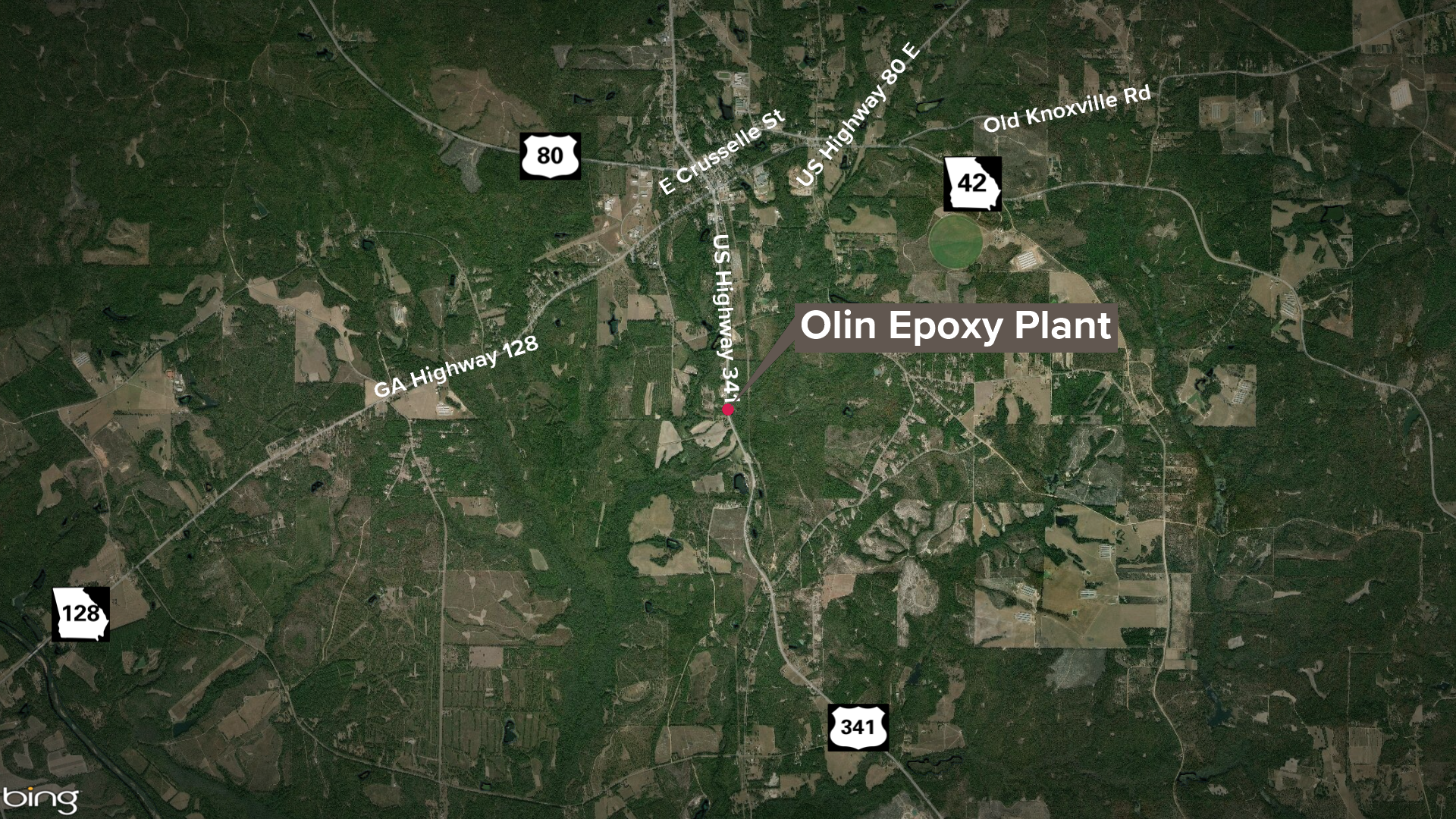
ROBERTA, Ga. — The Crawford County Fire Department is currently fighting a fire at the Olin Epoxy plant.
The county’s emergency management office sent a text alert to people in town warning about the fire, and they’re advising people to stay away from Industrial Parkway.
EMA Director Ricky Sharon says they’re asking for people in Roberta to shelter-in-place because the fire is releasing dangerous toxins into the air.
This is a breaking news story and will be updated as we learn more.
July 15, 2021
Olin Epoxy Fire
Shelter-in-place issued in Roberta due to chemical plant fire
The EMA director says a fire at the Olin Epoxy plant is releasing dangerous chemicals into the air
Author: 13WMAZ Staff Published: 12:27 PM EDT July 15, 2021 Updated: 12:27 PM EDT July 15, 2021
Watch video here:
ROBERTA, Ga. — The Crawford County Fire Department is currently fighting a fire at the Olin Epoxy plant.
The county’s emergency management office sent a text alert to people in town warning about the fire, and they’re advising people to stay away from Industrial Parkway.
EMA Director Ricky Sharon says they’re asking for people in Roberta to shelter-in-place because the fire is releasing dangerous toxins into the air.
This is a breaking news story and will be updated as we learn more.
July 2, 2021
Business Fraud
Nigerian Influencer “Hushpuppi” Funded Life Of Luxury With Complex Email Schemes, FBI Alleges
by Tyler DurdenThursday, Jul 01, 2021 – 05:45 AM
For Instagram “influencer” Hushpuppi, also referred to as the “Billionaire Gucci Master” Ramon Olorunwa Abbas, living a life of private jet setting and luxury on Instagram in front of his 2 million followers turned out to not only be his claim to fame, but also the straw that broke the camel’s back for his empire. While many looked on at his life of luxury in awe, questions started to arise about how he obtained, and maintained his wealth. The answer lied in the evolution of the often mocked “Nigerian email scam” that we have all become used to.

Hushpuppi always maintained the questions about his wealth were “the jealousy of so many haters”, a lengthy new Bloomberg profile notes. “As I turn a year older into my 30s today, I want to celebrate all of you out there,” the influencer said to his fans on his 37th birthday. “Those of you who mostly I have never met, spoken to or anything but have been a strong supporter of me through every situation until this point and still riding for me, I want you to know wherever you are that I celebrate and appreciate you today, today is OUR DAY!”
It was one of many posts he made flaunting his wealth and engaging with his followers who supported him while he jet-setted, beefed with celebrities online, and did his best to side-step questions about where, exactly, his success came from.
His captions to his photos would make his life of luxury look like the honest success of the son of a taxi driver and bread salesman from Nigeria. But of those who he likely didn’t celebrate or appreciate was the FBI, who is the driving force behind United States of America v. Ramon Olorunwa Abbas, which alleged in a California federal court that Abbas engaged in “conspiracy to launder money obtained from business email compromise frauds and other scams”.

For example, a small sliver of the cash he received as part of these schemes was $922,857.76 sent by a New York law firm that was supposed to be sending it to one of its clients. A paralegal at the firm received a fax from “someone in Abbas’ orbit” directing her to send the payment to a Chase bank account and initiated the transfer without even thinking twice. The firm didn’t even notice the cash had been misallocated until later in the month.
The transfer was part of a relatively sophisticated “business email compromise” scheme that Abbas and his co-conspirators implemented around the world, the FBI alleged.

Bloomberg, in their profile, described how the BEC scam works:
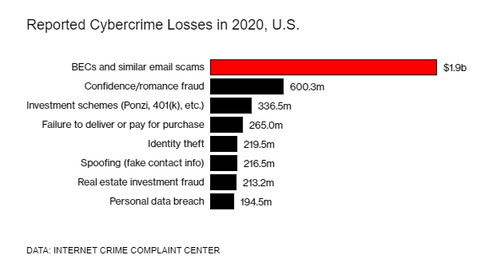
BEC attacks started appearing roughly a half-dozen years ago, escalating each year until they surpassed all other forms of internet fraud. The FBI reports there were almost 20,000 such scams against American businesses in 2020 alone, accounting for $1.8 billion in losses, though the variety of BEC crimes can make totals hard to pin down. Crane Hassold, the senior director of threat research at the cyberdefense company Agari Data Inc. and a former FBI analyst, likes to define a BEC as “a response-based impersonation attack that’s requesting something of value”—basically, posing as a legitimate business to trick people into giving away their money.
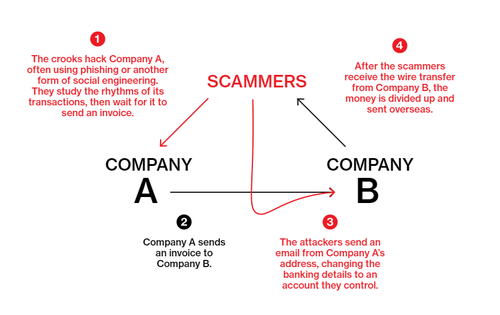
No matter the flavor, a BEC scam generally begins with someone hacking into a corporate email account often using social engineering tactics like phishing. Once inside, the perpetrators don’t steal anything, not at first. Instead they quietly begin forwarding copies of incoming and outgoing email to themselves. Then they wait. “They watch it for a number of weeks or months, looking for details of certain payments that are going out, understanding who their customers are, looking at communication patterns,” Hassold says. When they spot an invoice coming in or out, they “use that intelligence to insert themselves into an actual payment that is supposed to be due.”
Those who participate in the scheme are loosely networked and work together. There’s different roles for the scheme too: your hackers, your money mules, and even people tasked with controlling international bank accounts that can accept millions of dollars in transfers.
Crane Hassold, the senior director of threat research at the cyberdefense company Agari Data Inc. and a former FBI analyst, told Bloomberg: “These attacks are so realistic-looking, most people don’t give it a second thought. Because when you’re involved in payments like these, you see a lot of these emails every single day. And when it doesn’t raise any red flags, you are not going to go up the chain and do any confirmation. One would expect that when you get into larger and larger and larger amounts of money that are exchanging hands, that there would be some process that requires secondary authorization or something like that. But in many cases, that’s not what actually happens.”
He continued: “I think that most people think of BEC attacks as just basic, boring attacks, and most people don’t think it’s as big a problem as it actually is. When you look at the amount of money that is actually lost to ransomware, it’s a drop in the bucket compared to what’s lost in BEC attacks.”
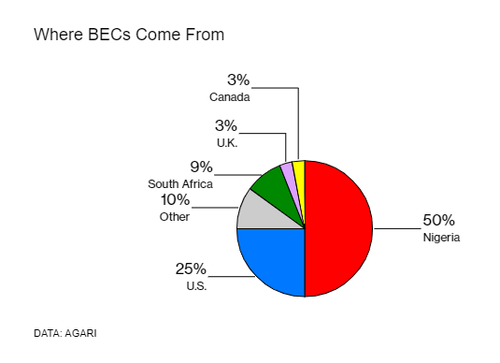
“A lot of the same concepts that go into these BEC attacks, criminals and scammers in West Africa have been doing for decades at this point. Those were all individually targeted social engineering attacks. And essentially what happened was, around 2015, cybercriminals started seeing that they could make more money targeting businesses than they could targeting individuals,” he continued.
People from the neighborhood where Abbas grew up in Nigeria “began to drift into online scamming in the early 2000s”, the report notes. But since no one would associate with them once they revealed themselves as Nigerian, the schemes evolved. “Scams evolved over a decade from money-order fraud to check-cashing scams to romance scams to BECs,” the report notes.
In terms of motivation, aside from the obvious, Abbas appeared to take exception with the system where he grew up, saying in one Snapchat video: “My mother is from the Niger Delta part of Nigeria, where Nigeria’s oil comes from. She has never benefited one dollar. One dollar! And she is over 60 years old.”
Olayinka Akanle, a sociology professor at the University of Ibadan who’s studied youth and cybercrime said: “Cybercrime is a metaphor for a more deep-seated and deep-rooted problem in Nigeria. When people face survival challenges, they innovate. And when they innovate, if there is no system to address their innovation in a very decisive way, it becomes the norm.”
He started to show off the money he was making on Instagram as far back as 2012. Several years later, one of his close associates, Samson Oyekunle, after moving to Houston in 2017, was arrested and charged with “participating in multiple BEC frauds” and was sentenced to 5 years in jail. Abbas had moved to Dubai by then and the walls were closing in him, too. With evidence mounting about how he was making his income, his time ran out in 2020.
When Dubai police raided his hotel room and arrested him in 2020, they were so proud of the takedown, they took a page out of Abbas’ book: they posted the raid on social media. https://platform.twitter.com/embed/Tweet.html?dnt=false&embedId=twitter-widget-0&features=eyJ0ZndfZXhwZXJpbWVudHNfY29va2llX2V4cGlyYXRpb24iOnsiYnVja2V0IjoxMjA5NjAwLCJ2ZXJzaW9uIjpudWxsfSwidGZ3X2hvcml6b25fdHdlZXRfZW1iZWRfOTU1NSI6eyJidWNrZXQiOiJodGUiLCJ2ZXJzaW9uIjpudWxsfSwidGZ3X3R3ZWV0X2VtYmVkX2NsaWNrYWJpbGl0eV8xMjEwMiI6eyJidWNrZXQiOiJjb250cm9sIiwidmVyc2lvbiI6bnVsbH19&frame=false&hideCard=false&hideThread=false&id=1276133837374926850&lang=en&origin=https%3A%2F%2Fwww.zerohedge.com%2Fmarkets%2Finstagram-influencer-hushpuppi-lived-his-life-luxury-nigerian-business-email-compromise&sessionId=c48311dd53bbc040a94232a7a2bddc6e70430d6f&siteScreenName=zerohedge&theme=light&widgetsVersion=82e1070%3A1619632193066&width=550px
You can read the entire Bloomberg feature on Hushpuppi here.
 Everchem Updates Archive
  Sign Up for Email Updates