Current Affairs
July 2, 2021
Business Fraud
Nigerian Influencer “Hushpuppi” Funded Life Of Luxury With Complex Email Schemes, FBI Alleges
by Tyler DurdenThursday, Jul 01, 2021 – 05:45 AM
For Instagram “influencer” Hushpuppi, also referred to as the “Billionaire Gucci Master” Ramon Olorunwa Abbas, living a life of private jet setting and luxury on Instagram in front of his 2 million followers turned out to not only be his claim to fame, but also the straw that broke the camel’s back for his empire. While many looked on at his life of luxury in awe, questions started to arise about how he obtained, and maintained his wealth. The answer lied in the evolution of the often mocked “Nigerian email scam” that we have all become used to.

Hushpuppi always maintained the questions about his wealth were “the jealousy of so many haters”, a lengthy new Bloomberg profile notes. “As I turn a year older into my 30s today, I want to celebrate all of you out there,” the influencer said to his fans on his 37th birthday. “Those of you who mostly I have never met, spoken to or anything but have been a strong supporter of me through every situation until this point and still riding for me, I want you to know wherever you are that I celebrate and appreciate you today, today is OUR DAY!”
It was one of many posts he made flaunting his wealth and engaging with his followers who supported him while he jet-setted, beefed with celebrities online, and did his best to side-step questions about where, exactly, his success came from.
His captions to his photos would make his life of luxury look like the honest success of the son of a taxi driver and bread salesman from Nigeria. But of those who he likely didn’t celebrate or appreciate was the FBI, who is the driving force behind United States of America v. Ramon Olorunwa Abbas, which alleged in a California federal court that Abbas engaged in “conspiracy to launder money obtained from business email compromise frauds and other scams”.

For example, a small sliver of the cash he received as part of these schemes was $922,857.76 sent by a New York law firm that was supposed to be sending it to one of its clients. A paralegal at the firm received a fax from “someone in Abbas’ orbit” directing her to send the payment to a Chase bank account and initiated the transfer without even thinking twice. The firm didn’t even notice the cash had been misallocated until later in the month.
The transfer was part of a relatively sophisticated “business email compromise” scheme that Abbas and his co-conspirators implemented around the world, the FBI alleged.

Bloomberg, in their profile, described how the BEC scam works:
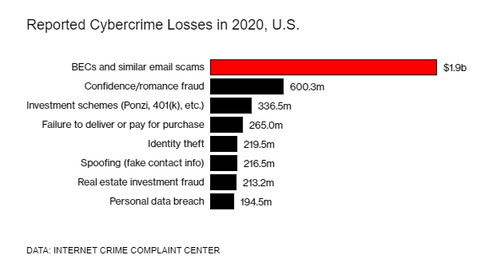
BEC attacks started appearing roughly a half-dozen years ago, escalating each year until they surpassed all other forms of internet fraud. The FBI reports there were almost 20,000 such scams against American businesses in 2020 alone, accounting for $1.8 billion in losses, though the variety of BEC crimes can make totals hard to pin down. Crane Hassold, the senior director of threat research at the cyberdefense company Agari Data Inc. and a former FBI analyst, likes to define a BEC as “a response-based impersonation attack that’s requesting something of value”—basically, posing as a legitimate business to trick people into giving away their money.
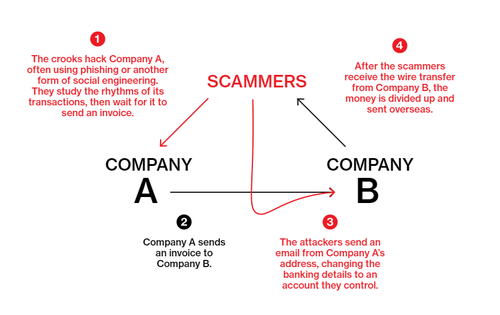
No matter the flavor, a BEC scam generally begins with someone hacking into a corporate email account often using social engineering tactics like phishing. Once inside, the perpetrators don’t steal anything, not at first. Instead they quietly begin forwarding copies of incoming and outgoing email to themselves. Then they wait. “They watch it for a number of weeks or months, looking for details of certain payments that are going out, understanding who their customers are, looking at communication patterns,” Hassold says. When they spot an invoice coming in or out, they “use that intelligence to insert themselves into an actual payment that is supposed to be due.”
Those who participate in the scheme are loosely networked and work together. There’s different roles for the scheme too: your hackers, your money mules, and even people tasked with controlling international bank accounts that can accept millions of dollars in transfers.
Crane Hassold, the senior director of threat research at the cyberdefense company Agari Data Inc. and a former FBI analyst, told Bloomberg: “These attacks are so realistic-looking, most people don’t give it a second thought. Because when you’re involved in payments like these, you see a lot of these emails every single day. And when it doesn’t raise any red flags, you are not going to go up the chain and do any confirmation. One would expect that when you get into larger and larger and larger amounts of money that are exchanging hands, that there would be some process that requires secondary authorization or something like that. But in many cases, that’s not what actually happens.”
He continued: “I think that most people think of BEC attacks as just basic, boring attacks, and most people don’t think it’s as big a problem as it actually is. When you look at the amount of money that is actually lost to ransomware, it’s a drop in the bucket compared to what’s lost in BEC attacks.”
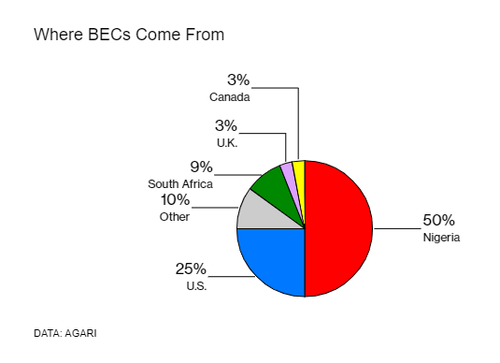
“A lot of the same concepts that go into these BEC attacks, criminals and scammers in West Africa have been doing for decades at this point. Those were all individually targeted social engineering attacks. And essentially what happened was, around 2015, cybercriminals started seeing that they could make more money targeting businesses than they could targeting individuals,” he continued.
People from the neighborhood where Abbas grew up in Nigeria “began to drift into online scamming in the early 2000s”, the report notes. But since no one would associate with them once they revealed themselves as Nigerian, the schemes evolved. “Scams evolved over a decade from money-order fraud to check-cashing scams to romance scams to BECs,” the report notes.
In terms of motivation, aside from the obvious, Abbas appeared to take exception with the system where he grew up, saying in one Snapchat video: “My mother is from the Niger Delta part of Nigeria, where Nigeria’s oil comes from. She has never benefited one dollar. One dollar! And she is over 60 years old.”
Olayinka Akanle, a sociology professor at the University of Ibadan who’s studied youth and cybercrime said: “Cybercrime is a metaphor for a more deep-seated and deep-rooted problem in Nigeria. When people face survival challenges, they innovate. And when they innovate, if there is no system to address their innovation in a very decisive way, it becomes the norm.”
He started to show off the money he was making on Instagram as far back as 2012. Several years later, one of his close associates, Samson Oyekunle, after moving to Houston in 2017, was arrested and charged with “participating in multiple BEC frauds” and was sentenced to 5 years in jail. Abbas had moved to Dubai by then and the walls were closing in him, too. With evidence mounting about how he was making his income, his time ran out in 2020.
When Dubai police raided his hotel room and arrested him in 2020, they were so proud of the takedown, they took a page out of Abbas’ book: they posted the raid on social media. https://platform.twitter.com/embed/Tweet.html?dnt=false&embedId=twitter-widget-0&features=eyJ0ZndfZXhwZXJpbWVudHNfY29va2llX2V4cGlyYXRpb24iOnsiYnVja2V0IjoxMjA5NjAwLCJ2ZXJzaW9uIjpudWxsfSwidGZ3X2hvcml6b25fdHdlZXRfZW1iZWRfOTU1NSI6eyJidWNrZXQiOiJodGUiLCJ2ZXJzaW9uIjpudWxsfSwidGZ3X3R3ZWV0X2VtYmVkX2NsaWNrYWJpbGl0eV8xMjEwMiI6eyJidWNrZXQiOiJjb250cm9sIiwidmVyc2lvbiI6bnVsbH19&frame=false&hideCard=false&hideThread=false&id=1276133837374926850&lang=en&origin=https%3A%2F%2Fwww.zerohedge.com%2Fmarkets%2Finstagram-influencer-hushpuppi-lived-his-life-luxury-nigerian-business-email-compromise&sessionId=c48311dd53bbc040a94232a7a2bddc6e70430d6f&siteScreenName=zerohedge&theme=light&widgetsVersion=82e1070%3A1619632193066&width=550px
You can read the entire Bloomberg feature on Hushpuppi here.
July 2, 2021
Driver Issues
Number Of US Truck Drivers Sidelined Due To Substance Abuse Violations Has Surpassed 60,000
by Tyler DurdenFriday, Jul 02, 2021 – 11:47 AM
By John Gallagher of FreightWavesBanned drivers matches shortfall in CDL holders needed to meet freight demand. (Photo: Jim Allen/FreightWaves)
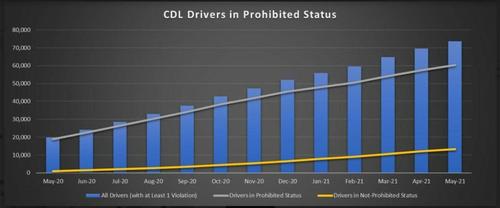
The number of U.S. truck drivers sidelined due to substance abuse violations has surpassed 60,000 and continues to climb by roughly 2,000-3,000 per month, according to federal data. The latest monthly report by the Drug and Alcohol Clearinghouse, administered by the Federal Motor Carrier Safety Administration since January 2020, revealed that 60,299 CDL holders have a drug or alcohol violation recorded in the clearinghouse as of June 1, up from 57,510 as of May 1 and up from 18,860 recorded in the clearinghouse as of May 1, 2020.
Drivers with at least one substance abuse violation are barred from operating a commercial truck until they complete a return-to-duty process, which includes providing a negative follow-up test result. The percentage of drivers who are completing the RTD process has steadily increased over the past year, however, from 5.2% as of May 1, 2020, to 22.1% as of May 1, 2021.
Marijuana consistently tops the list of substances identified in positive drug tests, far outpacing cocaine and methamphetamine, the second- and third-highest drug violations, respectively, among CDL holders.
The number of violations now recorded in the clearinghouse stands out for another reason: It’s coincidentally just a few hundred shy of an estimated number of drivers needed to fill a shortfall of commercial drivers to keep pace with freight demand.
“According to a recent estimate, the trucking industry needs an additional 60,800 truck drivers immediately — a deficit that is expected to grow to more than 160,000 by 2028,” testified American Trucking Associations President and CEO Chris Spear at a Capitol Hill hearing on freight mobility in May.
“In fact, when anticipated driver retirement numbers are combined with the expected growth in capacity, the trucking industry will need to hire roughly 1.1 million new drivers over the next decade, or an average of nearly 110,000 per year.”
Scopelitis Consulting Co-Director Sean Garney pointed out that the growing number of prohibited drivers is not a bad thing from a safety standpoint.
“The database is doing what it’s supposed to do, which is identify those who should not be driving,” Garney told FreightWaves. “Losing drivers due to positive drug tests may not necessarily be a good thing for truck capacity, but I think what many others in this industry also care about is safety.”
July 2, 2021
Driver Issues
Number Of US Truck Drivers Sidelined Due To Substance Abuse Violations Has Surpassed 60,000
by Tyler DurdenFriday, Jul 02, 2021 – 11:47 AM
By John Gallagher of FreightWavesBanned drivers matches shortfall in CDL holders needed to meet freight demand. (Photo: Jim Allen/FreightWaves)
The number of U.S. truck drivers sidelined due to substance abuse violations has surpassed 60,000 and continues to climb by roughly 2,000-3,000 per month, according to federal data. The latest monthly report by the Drug and Alcohol Clearinghouse, administered by the Federal Motor Carrier Safety Administration since January 2020, revealed that 60,299 CDL holders have a drug or alcohol violation recorded in the clearinghouse as of June 1, up from 57,510 as of May 1 and up from 18,860 recorded in the clearinghouse as of May 1, 2020.
Drivers with at least one substance abuse violation are barred from operating a commercial truck until they complete a return-to-duty process, which includes providing a negative follow-up test result. The percentage of drivers who are completing the RTD process has steadily increased over the past year, however, from 5.2% as of May 1, 2020, to 22.1% as of May 1, 2021.
Marijuana consistently tops the list of substances identified in positive drug tests, far outpacing cocaine and methamphetamine, the second- and third-highest drug violations, respectively, among CDL holders.
The number of violations now recorded in the clearinghouse stands out for another reason: It’s coincidentally just a few hundred shy of an estimated number of drivers needed to fill a shortfall of commercial drivers to keep pace with freight demand.
“According to a recent estimate, the trucking industry needs an additional 60,800 truck drivers immediately — a deficit that is expected to grow to more than 160,000 by 2028,” testified American Trucking Associations President and CEO Chris Spear at a Capitol Hill hearing on freight mobility in May.
“In fact, when anticipated driver retirement numbers are combined with the expected growth in capacity, the trucking industry will need to hire roughly 1.1 million new drivers over the next decade, or an average of nearly 110,000 per year.”
Scopelitis Consulting Co-Director Sean Garney pointed out that the growing number of prohibited drivers is not a bad thing from a safety standpoint.
“The database is doing what it’s supposed to do, which is identify those who should not be driving,” Garney told FreightWaves. “Losing drivers due to positive drug tests may not necessarily be a good thing for truck capacity, but I think what many others in this industry also care about is safety.”
June 29, 2021
Hurricane Ready?
Chemical, resin plants may be hurricane-ready, but markets are not
ICIS, ICIS Pricing, Uncategorised By Jeremy Pafford on 29th June 2021 in ICIS, ICIS Pricing, Uncategorised SHARE THIS STORY
Forecasters of this year’s hurricane season expect above-normal activity, and so far that seems on point with the naming this week of the Atlantic’s fourth tropical system.
The active start also should bring to mind the precarious state commodity chemical markets and their participants find themselves in right now. Should the Texas-Louisiana coast not navigate through this hurricane season unscathed, the Q4 2021 and early 2022 marketplace could see unprecedented volatility – yes, even worse than was experienced following February’s Gulf Coast freeze – due to severe supply and demand disruptions. Market dynamics are not in a position to tolerate hurricane disruptions as they have in previous years.
Put another way: Chemical and resin plants may not be more susceptible than normal to hurricane damage right now, but the markets they serve are.
The National Weather Service estimates based on historical data that Texas and Louisiana’s odds each year of being affected (brushed by or hit) by a hurricane – a tropical system with sustained winds greater than 75 miles per hour — at 1-in-3. About 20% of that Texas-Louisiana coastline (particularly south of the Corpus Christi, Texas area) is not dotted with chemical plants or refineries, so factoring that out leads to almost a 1-in-4 chance each year that a hurricane will strike a section of the Gulf Coast key to the chemical and/or energy supply chain. That aligns with data analysis here regarding odds of cities such as Freeport, Texas; Galveston, Texas; and Cameron, Louisiana being affected a hurricane.
Chemical plant and refinery operators are accustomed to those risk odds and are adapted to the challenges operating in a hurricane-risk environment. Gulf Coast refineries, crackers and chemical derivative plant weather the situation via orderly shutdowns ahead of the storm, assessment of any damages after it passes and then making relatively quick repairs to get back into operation. Historically the plants were back up and running within a couple of weeks, although particularly devastating windstorms such as hurricanes Katrina and Rita in 2005 led to multi-month outages. More recently, Hurricane Harvey in 2017 brought historic flooding to the Texas coast, while Louisiana in 2020 was subjected to five landfalling hurricanes. Refineries and chemical plant production were affected, but only for a short period – especially in comparison with winter weather events such as Winter Storm Uri’s arctic blast this past February.
As we have reached the soupy, sweaty summertime on the US Gulf Coast, there are no worries of another Uri coming through in the next couple of months. Hurricanes are a different matter, and the contention here is that should a major tropical weather event occur on the Texas-Louisiana coast this storm season, the net effect on chemical production and pricing would buck previous norms of short-term market blips and instead resemble what happened with February’s winter storm – or be worse. The reasons are threefold:
Logistics
The container shortage and dislocations, COVID-19 outbreaks at ports and the disjointed nature of the current ocean freight shipping environment have basically regionalised once global markets. A loss of production in the Gulf Coast due to a hurricane would not necessarily mean a cavalry of imports from Asia or Europe would be on the way to save the day – there may not be the ships or the product to do that, or the lead time in getting those imports over may be measured in months, not weeks.
Parts
As Al Greenwood explored excellently in his recent Insight article on ICIS News, repairing hurricane damage this season may not be as easy a task as in previous years due to manufacturing issues across supply chains and the disrupted logistics of moving needed parts. Such parts are not lying around on department store shelves. They need to be specially made, and that might be a problem being that backlogs of orders have reached a record high according to the Institute of Supply Management (ISM). In fact, backlogs for fabricated metal products and computer and electronic products all had their backlogs expand strongly in May, according to the ISM. Not a good sign if you need some petrochemical plant parts made on the fly. Thus, returns to operations could resemble more the 30-45 process seen with Winter Storm Uri than the 7-21 day process seen with typical Gulf Coast tropical weather over the last several years.
Markets at present
Current markets have no margin for error. Inventories are depleted due to the effects on production from February’s winter storm, last autumn’s hurricane strikes in Louisiana and plant shutdowns at the onset of the pandemic in March 2020. Meanwhile, demand for chemicals and resins has been strong, with consumer goods, construction and automotive sectors leading the way. Backlogs of orders are still being worked through, and getting to where inventories can be rebuilt is not expected until Q4. Every production unit matters right now, and an unexpected loss of several of them for an extended period would bring back February’s extreme supply tightness, with pricing momentum shooting skyward from a higher starting point than occurred with Uri.
The graph below from the ICIS Live Supply Disruption Tracker shows how unplanned outages from weather have left their marks on chemical markets in the last four years, with this particular chart focused on high-density polyethylene (HDPE) production.
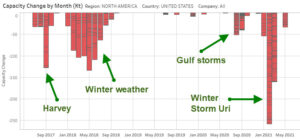
A couple of conclusions can be made from the data:
- Winter weather tends to wreak more havoc for longer than hurricanes do. (A short-lived ice storm in January 2018 on the Gulf Coast had long-lasting issues for a couple of plants in particular).
- As historic of a storm as Hurricane Harvey was in 2017 with its flooding rains, Winter Storm Uri’s flood of below-freezing temperatures was far more pervasive in its production destruction.

The ICIS Petrochemical Index (IPEX) basket of chemical prices for the US Gulf bears out the tenuous situation of the current market, as key materials such as paraxylene (PX), polyethylene (PE), polypropylene (PP) and polyvinyl chloride (PVC) have seen significant price inflation (they are just four of the 12 components of the IPEX, the methodology for which can be found here).
The US IPEX rose by 17.6% from February to May in large part due to the aftereffects of Uri-related production outages, which were pervasive and lasted 30-45 days for several plants. Those price increases were built on a foundation of several months’ worth of increases due to the resilient demand/tight supply seen amid the pandemic.
Should a hurricane cause significant damage to chemical plants on the Texas-Louisiana coast, the price shock could be enormous if repairs end up taking 30-45 days due to the challenges listed above. When February’s freeze hit, US spot propylene basically doubled overnight to then-shocking level of 125 cents/lb, or $2,756/tonne. For reference, the 10-year US spot propylene price average from 2011-2021 is just 49 cents/lb, or $1,080/tonne.

Spot propylene prices right now are in a range of 75-80 cents/lb. Double that and we are talking 150-160 cents/lb propylene – or up $3,527/tonne. Imagine the pricing effect and possible demand destruction that would cause for derivatives such as PP (used in automobiles and packaging), acrylic acid and acrylates (used in making paints, coatings and superabsorbent polymers for diapers) and propylene oxide (used in making polyols for polyurethanes, as well as in adhesive, paint and detergent formulations).
Chemical markets sit at a very dicey stage the COVID recovery. Make it through hurricane season without incident and the chemical industry has an excellent chance to balance supply and demand heading into 2022. But there is a legitimate chance a storm will knock the wind out of the market, and perhaps do much worse. Raw material scarcity and high-price volatility in chemical markets would have significant detrimental effects on supply chains and end products, adding fuel to mounting inflation fears and possibly even leading the way towards an economic downturn. It is not out of the realm of possibility.
In short, the chemical marketplace is not hurricane-ready. But while there is a 1-in-4 shot of a hurricane affecting a portion of the Texas-Louisiana coast home to chemical facilities, that also means there is a 3-in-4 chance of no hurricane effects at all. The market needs those odds to hold up.
June 29, 2021
Hurricane Ready?
Chemical, resin plants may be hurricane-ready, but markets are not
ICIS, ICIS Pricing, Uncategorised By Jeremy Pafford on 29th June 2021 in ICIS, ICIS Pricing, Uncategorised SHARE THIS STORY
Forecasters of this year’s hurricane season expect above-normal activity, and so far that seems on point with the naming this week of the Atlantic’s fourth tropical system.
The active start also should bring to mind the precarious state commodity chemical markets and their participants find themselves in right now. Should the Texas-Louisiana coast not navigate through this hurricane season unscathed, the Q4 2021 and early 2022 marketplace could see unprecedented volatility – yes, even worse than was experienced following February’s Gulf Coast freeze – due to severe supply and demand disruptions. Market dynamics are not in a position to tolerate hurricane disruptions as they have in previous years.
Put another way: Chemical and resin plants may not be more susceptible than normal to hurricane damage right now, but the markets they serve are.
The National Weather Service estimates based on historical data that Texas and Louisiana’s odds each year of being affected (brushed by or hit) by a hurricane – a tropical system with sustained winds greater than 75 miles per hour — at 1-in-3. About 20% of that Texas-Louisiana coastline (particularly south of the Corpus Christi, Texas area) is not dotted with chemical plants or refineries, so factoring that out leads to almost a 1-in-4 chance each year that a hurricane will strike a section of the Gulf Coast key to the chemical and/or energy supply chain. That aligns with data analysis here regarding odds of cities such as Freeport, Texas; Galveston, Texas; and Cameron, Louisiana being affected a hurricane.
Chemical plant and refinery operators are accustomed to those risk odds and are adapted to the challenges operating in a hurricane-risk environment. Gulf Coast refineries, crackers and chemical derivative plant weather the situation via orderly shutdowns ahead of the storm, assessment of any damages after it passes and then making relatively quick repairs to get back into operation. Historically the plants were back up and running within a couple of weeks, although particularly devastating windstorms such as hurricanes Katrina and Rita in 2005 led to multi-month outages. More recently, Hurricane Harvey in 2017 brought historic flooding to the Texas coast, while Louisiana in 2020 was subjected to five landfalling hurricanes. Refineries and chemical plant production were affected, but only for a short period – especially in comparison with winter weather events such as Winter Storm Uri’s arctic blast this past February.
As we have reached the soupy, sweaty summertime on the US Gulf Coast, there are no worries of another Uri coming through in the next couple of months. Hurricanes are a different matter, and the contention here is that should a major tropical weather event occur on the Texas-Louisiana coast this storm season, the net effect on chemical production and pricing would buck previous norms of short-term market blips and instead resemble what happened with February’s winter storm – or be worse. The reasons are threefold:
Logistics
The container shortage and dislocations, COVID-19 outbreaks at ports and the disjointed nature of the current ocean freight shipping environment have basically regionalised once global markets. A loss of production in the Gulf Coast due to a hurricane would not necessarily mean a cavalry of imports from Asia or Europe would be on the way to save the day – there may not be the ships or the product to do that, or the lead time in getting those imports over may be measured in months, not weeks.
Parts
As Al Greenwood explored excellently in his recent Insight article on ICIS News, repairing hurricane damage this season may not be as easy a task as in previous years due to manufacturing issues across supply chains and the disrupted logistics of moving needed parts. Such parts are not lying around on department store shelves. They need to be specially made, and that might be a problem being that backlogs of orders have reached a record high according to the Institute of Supply Management (ISM). In fact, backlogs for fabricated metal products and computer and electronic products all had their backlogs expand strongly in May, according to the ISM. Not a good sign if you need some petrochemical plant parts made on the fly. Thus, returns to operations could resemble more the 30-45 process seen with Winter Storm Uri than the 7-21 day process seen with typical Gulf Coast tropical weather over the last several years.
Markets at present
Current markets have no margin for error. Inventories are depleted due to the effects on production from February’s winter storm, last autumn’s hurricane strikes in Louisiana and plant shutdowns at the onset of the pandemic in March 2020. Meanwhile, demand for chemicals and resins has been strong, with consumer goods, construction and automotive sectors leading the way. Backlogs of orders are still being worked through, and getting to where inventories can be rebuilt is not expected until Q4. Every production unit matters right now, and an unexpected loss of several of them for an extended period would bring back February’s extreme supply tightness, with pricing momentum shooting skyward from a higher starting point than occurred with Uri.
The graph below from the ICIS Live Supply Disruption Tracker shows how unplanned outages from weather have left their marks on chemical markets in the last four years, with this particular chart focused on high-density polyethylene (HDPE) production.
A couple of conclusions can be made from the data:
- Winter weather tends to wreak more havoc for longer than hurricanes do. (A short-lived ice storm in January 2018 on the Gulf Coast had long-lasting issues for a couple of plants in particular).
- As historic of a storm as Hurricane Harvey was in 2017 with its flooding rains, Winter Storm Uri’s flood of below-freezing temperatures was far more pervasive in its production destruction.
The ICIS Petrochemical Index (IPEX) basket of chemical prices for the US Gulf bears out the tenuous situation of the current market, as key materials such as paraxylene (PX), polyethylene (PE), polypropylene (PP) and polyvinyl chloride (PVC) have seen significant price inflation (they are just four of the 12 components of the IPEX, the methodology for which can be found here).
The US IPEX rose by 17.6% from February to May in large part due to the aftereffects of Uri-related production outages, which were pervasive and lasted 30-45 days for several plants. Those price increases were built on a foundation of several months’ worth of increases due to the resilient demand/tight supply seen amid the pandemic.
Should a hurricane cause significant damage to chemical plants on the Texas-Louisiana coast, the price shock could be enormous if repairs end up taking 30-45 days due to the challenges listed above. When February’s freeze hit, US spot propylene basically doubled overnight to then-shocking level of 125 cents/lb, or $2,756/tonne. For reference, the 10-year US spot propylene price average from 2011-2021 is just 49 cents/lb, or $1,080/tonne.
Spot propylene prices right now are in a range of 75-80 cents/lb. Double that and we are talking 150-160 cents/lb propylene – or up $3,527/tonne. Imagine the pricing effect and possible demand destruction that would cause for derivatives such as PP (used in automobiles and packaging), acrylic acid and acrylates (used in making paints, coatings and superabsorbent polymers for diapers) and propylene oxide (used in making polyols for polyurethanes, as well as in adhesive, paint and detergent formulations).
Chemical markets sit at a very dicey stage the COVID recovery. Make it through hurricane season without incident and the chemical industry has an excellent chance to balance supply and demand heading into 2022. But there is a legitimate chance a storm will knock the wind out of the market, and perhaps do much worse. Raw material scarcity and high-price volatility in chemical markets would have significant detrimental effects on supply chains and end products, adding fuel to mounting inflation fears and possibly even leading the way towards an economic downturn. It is not out of the realm of possibility.
In short, the chemical marketplace is not hurricane-ready. But while there is a 1-in-4 shot of a hurricane affecting a portion of the Texas-Louisiana coast home to chemical facilities, that also means there is a 3-in-4 chance of no hurricane effects at all. The market needs those odds to hold up.
 Everchem Updates Archive
  Sign Up for Email Updates