Current Affairs
July 2, 2021
Driver Issues
Number Of US Truck Drivers Sidelined Due To Substance Abuse Violations Has Surpassed 60,000
by Tyler DurdenFriday, Jul 02, 2021 – 11:47 AM
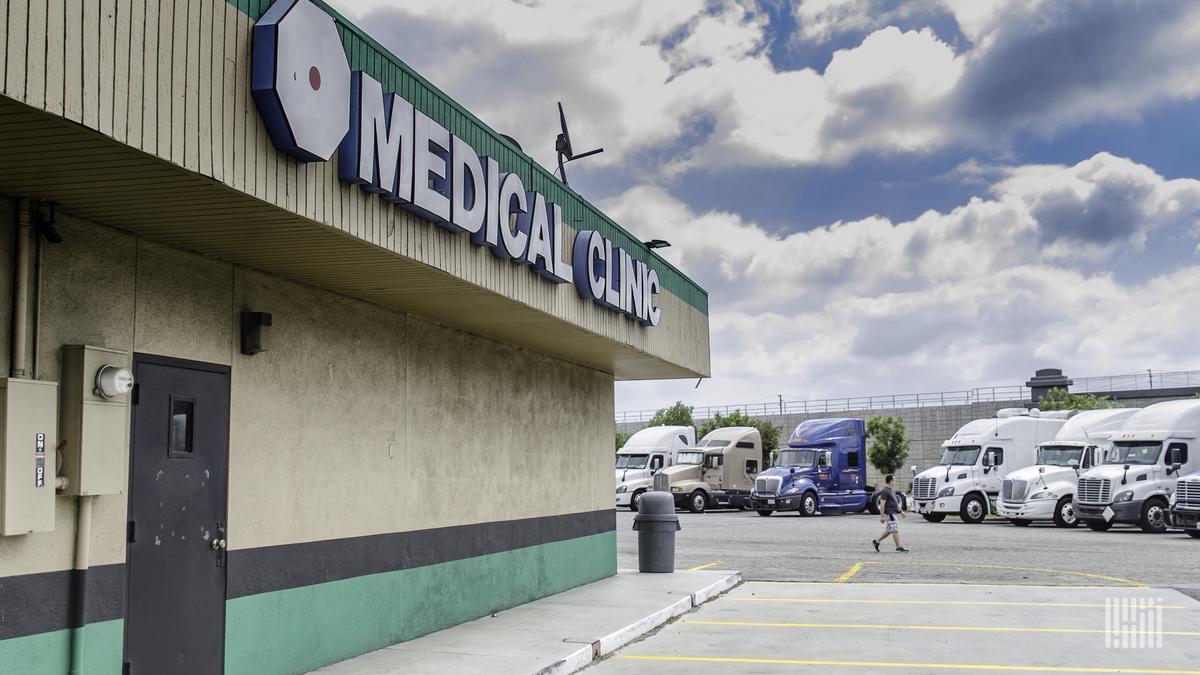
By John Gallagher of FreightWavesBanned drivers matches shortfall in CDL holders needed to meet freight demand. (Photo: Jim Allen/FreightWaves)
The number of U.S. truck drivers sidelined due to substance abuse violations has surpassed 60,000 and continues to climb by roughly 2,000-3,000 per month, according to federal data. The latest monthly report by the Drug and Alcohol Clearinghouse, administered by the Federal Motor Carrier Safety Administration since January 2020, revealed that 60,299 CDL holders have a drug or alcohol violation recorded in the clearinghouse as of June 1, up from 57,510 as of May 1 and up from 18,860 recorded in the clearinghouse as of May 1, 2020.
Drivers with at least one substance abuse violation are barred from operating a commercial truck until they complete a return-to-duty process, which includes providing a negative follow-up test result. The percentage of drivers who are completing the RTD process has steadily increased over the past year, however, from 5.2% as of May 1, 2020, to 22.1% as of May 1, 2021.
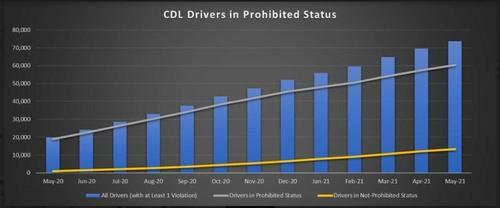
Marijuana consistently tops the list of substances identified in positive drug tests, far outpacing cocaine and methamphetamine, the second- and third-highest drug violations, respectively, among CDL holders.
The number of violations now recorded in the clearinghouse stands out for another reason: It’s coincidentally just a few hundred shy of an estimated number of drivers needed to fill a shortfall of commercial drivers to keep pace with freight demand.
“According to a recent estimate, the trucking industry needs an additional 60,800 truck drivers immediately — a deficit that is expected to grow to more than 160,000 by 2028,” testified American Trucking Associations President and CEO Chris Spear at a Capitol Hill hearing on freight mobility in May.
“In fact, when anticipated driver retirement numbers are combined with the expected growth in capacity, the trucking industry will need to hire roughly 1.1 million new drivers over the next decade, or an average of nearly 110,000 per year.”
Scopelitis Consulting Co-Director Sean Garney pointed out that the growing number of prohibited drivers is not a bad thing from a safety standpoint.
“The database is doing what it’s supposed to do, which is identify those who should not be driving,” Garney told FreightWaves. “Losing drivers due to positive drug tests may not necessarily be a good thing for truck capacity, but I think what many others in this industry also care about is safety.”
June 29, 2021
Hurricane Ready?
Chemical, resin plants may be hurricane-ready, but markets are not
ICIS, ICIS Pricing, Uncategorised By Jeremy Pafford on 29th June 2021 in ICIS, ICIS Pricing, Uncategorised SHARE THIS STORY
Forecasters of this year’s hurricane season expect above-normal activity, and so far that seems on point with the naming this week of the Atlantic’s fourth tropical system.
The active start also should bring to mind the precarious state commodity chemical markets and their participants find themselves in right now. Should the Texas-Louisiana coast not navigate through this hurricane season unscathed, the Q4 2021 and early 2022 marketplace could see unprecedented volatility – yes, even worse than was experienced following February’s Gulf Coast freeze – due to severe supply and demand disruptions. Market dynamics are not in a position to tolerate hurricane disruptions as they have in previous years.
Put another way: Chemical and resin plants may not be more susceptible than normal to hurricane damage right now, but the markets they serve are.
The National Weather Service estimates based on historical data that Texas and Louisiana’s odds each year of being affected (brushed by or hit) by a hurricane – a tropical system with sustained winds greater than 75 miles per hour — at 1-in-3. About 20% of that Texas-Louisiana coastline (particularly south of the Corpus Christi, Texas area) is not dotted with chemical plants or refineries, so factoring that out leads to almost a 1-in-4 chance each year that a hurricane will strike a section of the Gulf Coast key to the chemical and/or energy supply chain. That aligns with data analysis here regarding odds of cities such as Freeport, Texas; Galveston, Texas; and Cameron, Louisiana being affected a hurricane.
Chemical plant and refinery operators are accustomed to those risk odds and are adapted to the challenges operating in a hurricane-risk environment. Gulf Coast refineries, crackers and chemical derivative plant weather the situation via orderly shutdowns ahead of the storm, assessment of any damages after it passes and then making relatively quick repairs to get back into operation. Historically the plants were back up and running within a couple of weeks, although particularly devastating windstorms such as hurricanes Katrina and Rita in 2005 led to multi-month outages. More recently, Hurricane Harvey in 2017 brought historic flooding to the Texas coast, while Louisiana in 2020 was subjected to five landfalling hurricanes. Refineries and chemical plant production were affected, but only for a short period – especially in comparison with winter weather events such as Winter Storm Uri’s arctic blast this past February.
As we have reached the soupy, sweaty summertime on the US Gulf Coast, there are no worries of another Uri coming through in the next couple of months. Hurricanes are a different matter, and the contention here is that should a major tropical weather event occur on the Texas-Louisiana coast this storm season, the net effect on chemical production and pricing would buck previous norms of short-term market blips and instead resemble what happened with February’s winter storm – or be worse. The reasons are threefold:
Logistics
The container shortage and dislocations, COVID-19 outbreaks at ports and the disjointed nature of the current ocean freight shipping environment have basically regionalised once global markets. A loss of production in the Gulf Coast due to a hurricane would not necessarily mean a cavalry of imports from Asia or Europe would be on the way to save the day – there may not be the ships or the product to do that, or the lead time in getting those imports over may be measured in months, not weeks.
Parts
As Al Greenwood explored excellently in his recent Insight article on ICIS News, repairing hurricane damage this season may not be as easy a task as in previous years due to manufacturing issues across supply chains and the disrupted logistics of moving needed parts. Such parts are not lying around on department store shelves. They need to be specially made, and that might be a problem being that backlogs of orders have reached a record high according to the Institute of Supply Management (ISM). In fact, backlogs for fabricated metal products and computer and electronic products all had their backlogs expand strongly in May, according to the ISM. Not a good sign if you need some petrochemical plant parts made on the fly. Thus, returns to operations could resemble more the 30-45 process seen with Winter Storm Uri than the 7-21 day process seen with typical Gulf Coast tropical weather over the last several years.
Markets at present
Current markets have no margin for error. Inventories are depleted due to the effects on production from February’s winter storm, last autumn’s hurricane strikes in Louisiana and plant shutdowns at the onset of the pandemic in March 2020. Meanwhile, demand for chemicals and resins has been strong, with consumer goods, construction and automotive sectors leading the way. Backlogs of orders are still being worked through, and getting to where inventories can be rebuilt is not expected until Q4. Every production unit matters right now, and an unexpected loss of several of them for an extended period would bring back February’s extreme supply tightness, with pricing momentum shooting skyward from a higher starting point than occurred with Uri.
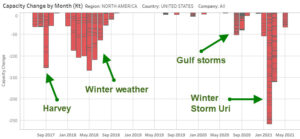
The graph below from the ICIS Live Supply Disruption Tracker shows how unplanned outages from weather have left their marks on chemical markets in the last four years, with this particular chart focused on high-density polyethylene (HDPE) production.
A couple of conclusions can be made from the data:
- Winter weather tends to wreak more havoc for longer than hurricanes do. (A short-lived ice storm in January 2018 on the Gulf Coast had long-lasting issues for a couple of plants in particular).
- As historic of a storm as Hurricane Harvey was in 2017 with its flooding rains, Winter Storm Uri’s flood of below-freezing temperatures was far more pervasive in its production destruction.

The ICIS Petrochemical Index (IPEX) basket of chemical prices for the US Gulf bears out the tenuous situation of the current market, as key materials such as paraxylene (PX), polyethylene (PE), polypropylene (PP) and polyvinyl chloride (PVC) have seen significant price inflation (they are just four of the 12 components of the IPEX, the methodology for which can be found here).
The US IPEX rose by 17.6% from February to May in large part due to the aftereffects of Uri-related production outages, which were pervasive and lasted 30-45 days for several plants. Those price increases were built on a foundation of several months’ worth of increases due to the resilient demand/tight supply seen amid the pandemic.
Should a hurricane cause significant damage to chemical plants on the Texas-Louisiana coast, the price shock could be enormous if repairs end up taking 30-45 days due to the challenges listed above. When February’s freeze hit, US spot propylene basically doubled overnight to then-shocking level of 125 cents/lb, or $2,756/tonne. For reference, the 10-year US spot propylene price average from 2011-2021 is just 49 cents/lb, or $1,080/tonne.

Spot propylene prices right now are in a range of 75-80 cents/lb. Double that and we are talking 150-160 cents/lb propylene – or up $3,527/tonne. Imagine the pricing effect and possible demand destruction that would cause for derivatives such as PP (used in automobiles and packaging), acrylic acid and acrylates (used in making paints, coatings and superabsorbent polymers for diapers) and propylene oxide (used in making polyols for polyurethanes, as well as in adhesive, paint and detergent formulations).
Chemical markets sit at a very dicey stage the COVID recovery. Make it through hurricane season without incident and the chemical industry has an excellent chance to balance supply and demand heading into 2022. But there is a legitimate chance a storm will knock the wind out of the market, and perhaps do much worse. Raw material scarcity and high-price volatility in chemical markets would have significant detrimental effects on supply chains and end products, adding fuel to mounting inflation fears and possibly even leading the way towards an economic downturn. It is not out of the realm of possibility.
In short, the chemical marketplace is not hurricane-ready. But while there is a 1-in-4 shot of a hurricane affecting a portion of the Texas-Louisiana coast home to chemical facilities, that also means there is a 3-in-4 chance of no hurricane effects at all. The market needs those odds to hold up.
June 29, 2021
Hurricane Ready?
Chemical, resin plants may be hurricane-ready, but markets are not
ICIS, ICIS Pricing, Uncategorised By Jeremy Pafford on 29th June 2021 in ICIS, ICIS Pricing, Uncategorised SHARE THIS STORY
Forecasters of this year’s hurricane season expect above-normal activity, and so far that seems on point with the naming this week of the Atlantic’s fourth tropical system.
The active start also should bring to mind the precarious state commodity chemical markets and their participants find themselves in right now. Should the Texas-Louisiana coast not navigate through this hurricane season unscathed, the Q4 2021 and early 2022 marketplace could see unprecedented volatility – yes, even worse than was experienced following February’s Gulf Coast freeze – due to severe supply and demand disruptions. Market dynamics are not in a position to tolerate hurricane disruptions as they have in previous years.
Put another way: Chemical and resin plants may not be more susceptible than normal to hurricane damage right now, but the markets they serve are.
The National Weather Service estimates based on historical data that Texas and Louisiana’s odds each year of being affected (brushed by or hit) by a hurricane – a tropical system with sustained winds greater than 75 miles per hour — at 1-in-3. About 20% of that Texas-Louisiana coastline (particularly south of the Corpus Christi, Texas area) is not dotted with chemical plants or refineries, so factoring that out leads to almost a 1-in-4 chance each year that a hurricane will strike a section of the Gulf Coast key to the chemical and/or energy supply chain. That aligns with data analysis here regarding odds of cities such as Freeport, Texas; Galveston, Texas; and Cameron, Louisiana being affected a hurricane.
Chemical plant and refinery operators are accustomed to those risk odds and are adapted to the challenges operating in a hurricane-risk environment. Gulf Coast refineries, crackers and chemical derivative plant weather the situation via orderly shutdowns ahead of the storm, assessment of any damages after it passes and then making relatively quick repairs to get back into operation. Historically the plants were back up and running within a couple of weeks, although particularly devastating windstorms such as hurricanes Katrina and Rita in 2005 led to multi-month outages. More recently, Hurricane Harvey in 2017 brought historic flooding to the Texas coast, while Louisiana in 2020 was subjected to five landfalling hurricanes. Refineries and chemical plant production were affected, but only for a short period – especially in comparison with winter weather events such as Winter Storm Uri’s arctic blast this past February.
As we have reached the soupy, sweaty summertime on the US Gulf Coast, there are no worries of another Uri coming through in the next couple of months. Hurricanes are a different matter, and the contention here is that should a major tropical weather event occur on the Texas-Louisiana coast this storm season, the net effect on chemical production and pricing would buck previous norms of short-term market blips and instead resemble what happened with February’s winter storm – or be worse. The reasons are threefold:
Logistics
The container shortage and dislocations, COVID-19 outbreaks at ports and the disjointed nature of the current ocean freight shipping environment have basically regionalised once global markets. A loss of production in the Gulf Coast due to a hurricane would not necessarily mean a cavalry of imports from Asia or Europe would be on the way to save the day – there may not be the ships or the product to do that, or the lead time in getting those imports over may be measured in months, not weeks.
Parts
As Al Greenwood explored excellently in his recent Insight article on ICIS News, repairing hurricane damage this season may not be as easy a task as in previous years due to manufacturing issues across supply chains and the disrupted logistics of moving needed parts. Such parts are not lying around on department store shelves. They need to be specially made, and that might be a problem being that backlogs of orders have reached a record high according to the Institute of Supply Management (ISM). In fact, backlogs for fabricated metal products and computer and electronic products all had their backlogs expand strongly in May, according to the ISM. Not a good sign if you need some petrochemical plant parts made on the fly. Thus, returns to operations could resemble more the 30-45 process seen with Winter Storm Uri than the 7-21 day process seen with typical Gulf Coast tropical weather over the last several years.
Markets at present
Current markets have no margin for error. Inventories are depleted due to the effects on production from February’s winter storm, last autumn’s hurricane strikes in Louisiana and plant shutdowns at the onset of the pandemic in March 2020. Meanwhile, demand for chemicals and resins has been strong, with consumer goods, construction and automotive sectors leading the way. Backlogs of orders are still being worked through, and getting to where inventories can be rebuilt is not expected until Q4. Every production unit matters right now, and an unexpected loss of several of them for an extended period would bring back February’s extreme supply tightness, with pricing momentum shooting skyward from a higher starting point than occurred with Uri.
The graph below from the ICIS Live Supply Disruption Tracker shows how unplanned outages from weather have left their marks on chemical markets in the last four years, with this particular chart focused on high-density polyethylene (HDPE) production.
A couple of conclusions can be made from the data:
- Winter weather tends to wreak more havoc for longer than hurricanes do. (A short-lived ice storm in January 2018 on the Gulf Coast had long-lasting issues for a couple of plants in particular).
- As historic of a storm as Hurricane Harvey was in 2017 with its flooding rains, Winter Storm Uri’s flood of below-freezing temperatures was far more pervasive in its production destruction.
The ICIS Petrochemical Index (IPEX) basket of chemical prices for the US Gulf bears out the tenuous situation of the current market, as key materials such as paraxylene (PX), polyethylene (PE), polypropylene (PP) and polyvinyl chloride (PVC) have seen significant price inflation (they are just four of the 12 components of the IPEX, the methodology for which can be found here).
The US IPEX rose by 17.6% from February to May in large part due to the aftereffects of Uri-related production outages, which were pervasive and lasted 30-45 days for several plants. Those price increases were built on a foundation of several months’ worth of increases due to the resilient demand/tight supply seen amid the pandemic.
Should a hurricane cause significant damage to chemical plants on the Texas-Louisiana coast, the price shock could be enormous if repairs end up taking 30-45 days due to the challenges listed above. When February’s freeze hit, US spot propylene basically doubled overnight to then-shocking level of 125 cents/lb, or $2,756/tonne. For reference, the 10-year US spot propylene price average from 2011-2021 is just 49 cents/lb, or $1,080/tonne.
Spot propylene prices right now are in a range of 75-80 cents/lb. Double that and we are talking 150-160 cents/lb propylene – or up $3,527/tonne. Imagine the pricing effect and possible demand destruction that would cause for derivatives such as PP (used in automobiles and packaging), acrylic acid and acrylates (used in making paints, coatings and superabsorbent polymers for diapers) and propylene oxide (used in making polyols for polyurethanes, as well as in adhesive, paint and detergent formulations).
Chemical markets sit at a very dicey stage the COVID recovery. Make it through hurricane season without incident and the chemical industry has an excellent chance to balance supply and demand heading into 2022. But there is a legitimate chance a storm will knock the wind out of the market, and perhaps do much worse. Raw material scarcity and high-price volatility in chemical markets would have significant detrimental effects on supply chains and end products, adding fuel to mounting inflation fears and possibly even leading the way towards an economic downturn. It is not out of the realm of possibility.
In short, the chemical marketplace is not hurricane-ready. But while there is a 1-in-4 shot of a hurricane affecting a portion of the Texas-Louisiana coast home to chemical facilities, that also means there is a 3-in-4 chance of no hurricane effects at all. The market needs those odds to hold up.
June 22, 2021
Chinese Propylene Oxide Update
Propylene oxide: from a gap of 467,000 tons to self-sufficiency is just around the corner
Echemi 2021-06-21
1. The current situation of world supply and demand: Asia has the largest production capacity and the highest proportion of consumption
In 2020, the world’s propylene oxide (PO) production capacity will be approximately 11.2 million tons per year, of which Asian production capacity accounts for approximately 45% of the world’s total production capacity, which is the region with the largest production capacity in the world; Western Europe accounts for approximately 24%; North America accounts for approximately 22%.
In 2020, the world’s propylene oxide consumption will be approximately 9.3 million tons. In terms of regions, Asia is the region with the largest consumption of propylene oxide in the world, with an annual consumption of 4.48 million tons, accounting for 48% of the world’s total consumption; consumption in Western Europe is 2.21 million tons, accounting for 24%; consumption in North America The volume is 1.87 million tons, accounting for 20%.
The main application areas of propylene oxide in the world include polyether polyol (PPG), propylene glycol, 1,4-butanediol and propylene glycol ether, etc. Among them, the largest consumption area is PPG, and there is little difference in consumption structure between regions. In 2020, the consumption of propylene oxide in this field is about 8.4 million tons, accounting for 75%; the consumption of propylene glycol to propylene oxide is about 1.55 million tons, accounting for 13.8%; the consumption of 1,4-butanediol to propylene oxide The volume is about 190,000 tons, accounting for 1.7%; the consumption of propylene oxide in other fields accounts for about 9.5%.
2. The status quo of domestic supply and demand: the gap between domestic supply and demand still exists
2.1. Production technology: traditional technology and advanced technology coexist
There are mainly 5 types of propylene oxide production process technologies, namely the traditional chlorohydrin method and the advanced co-oxidation method (propylene oxide/SM method, propylene oxide/TBA method), cumene oxidation method (CHP propylene oxide method) ), hydrogen peroxide oxidation method (HP propylene oxide method) and O2 direct oxidation method, of which chlorohydrin method and co-oxidation method are currently the most widely used technologies. In 2020, the chlorohydrin method will account for about 50% of the domestic propylene oxide production capacity, and the rest will be the co-oxidation method, HP propylene oxide method and CHP method.
2.2. Manufacturers: Centralized production capacity in East China
In 2020, there will be a total of 19 domestic propylene oxide producers (see Table 2 for details), of which 13 are located in Eastern China, and their production capacity will account for 69.3% of the country’s total production capacity. The province with the largest number of production companies is Shandong Province, with propylene oxide production capacity accounting for 47.2% of the national production capacity.
At present, domestic chlorohydrin propylene oxide production enterprises are mainly located in Shandong and Jiangsu provinces. The production cost of chlorohydrin propylene oxide is low, but the pollution problem limits the further development of this technology. Since 2014, Shandong has strictly restricted indicators such as COD discharge of industrial wastewater, and some chlorohydrin companies can only seek to relocate or suspend production.
Among the 4 companies using co-oxidation technology, Zhenli Chemical and CNOOC Shell used propylene oxide/SM technology, and the technologies were from Lyonder and Shell; Yantai Wanhua and Jinling Huntsman used propylene oxide/ MTBE technology, technology comes from Huntsman. Among the enterprises using HP propylene oxide process, Sinopec Changling’s 100,000-ton/year demonstration device is Sinopec’s own technology.
2.3. Consumer sector: Polyether polyol is the largest consumer sector
In 2020, China’s propylene oxide consumption will be about 2.99 million tons. The consumption is mainly concentrated in the fields of polyether polyols, propylene glycol and propylene glycol ethers. Among them, the consumption of polyether polyols accounts for 70%.
2.4. Supply-demand relationship: the gap between supply and demand still exists
In 2020, my country’s propylene oxide production capacity will be 3.29 million tons per year. Affected by the new crown pneumonia epidemic, the average operating rate of the installations will be 77%, and the output will drop by 330,000 tons year-on-year. In the same year, the domestic consumption of propylene oxide was 2.99 million tons, a year-on-year decrease of 10%. In 2020, the supply and demand gap of propylene oxide in my country is 467,000 tons. The supply and demand situation of my country’s propylene oxide from 2015 to 2020 is shown in Figure 2.
3. Domestic outlook: Production capacity is steadily increasing, and propylene oxide is expected to become self-sufficient in the future
3.1. Supply forecast: There are more new capacity, mainly HP propylene oxide method and propylene oxide/SM method
According to statistics, there are 24 propylene oxide projects under construction in China, with a total production capacity of approximately 6.15 million tons per year. The projects are mainly distributed in East China, South China and North China. The “Industrial Structure Adjustment Guidance Catalog” (2019) clearly proposes to “eliminate serious environmental pollution chlorohydrin production of propylene oxide technology”, so the proposed projects mainly adopt HP propylene oxide method and propylene oxide/SM method. .
Regardless of the elimination of the existing chlorohydrin process equipment, it is estimated that by 2025, the domestic production capacity of propylene oxide will reach 9.43 million tons per year. See Table 3 for details of my country’s propylene oxide projects under construction.
3.2. Consumption forecast: In the future, domestic consumption will still be dominated by polyether polyols
It is predicted that the domestic consumption of propylene oxide will continue to grow in the future, and the consumption will reach 4.05 million tons by 2025, with an average annual growth rate of 6.3% from 2020 to 2025.
Among the main downstream polyether polyols of propylene oxide, the production of basic soft and rigid foam polyethers is large, and it is expected that the future support for the consumption of propylene oxide will still be relatively large. In order to increase the added value of products, many polyether factories are undergoing structural transformation, increasing the development of high-activity, high-molecular-weight, and high-value-added polyethers. In recent years, the production capacity of POP and high-resilience polyethers has increased significantly, but the consumption of propylene oxide in the short term The amount will still be lower than the base polyether. my country currently has 18 new planned polyether polyol projects with a total production capacity of 2.97 million tons per year. If these projects are successfully put into production, it is estimated that by 2025, the consumption of propylene oxide will reach about 2.8 million tons.
Propylene glycol is mainly used to produce unsaturated resins. In 2020, affected by the global epidemic, consumption in this field has dropped by 6.7% year-on-year. It is expected that consumption will gradually recover in the next 5 years. It is estimated that by 2025, the consumption of propylene oxide in this field It will be around 450,000 tons.
Propylene glycol ether is the third largest consumption area of propylene oxide. It is estimated that by 2025, the consumption of propylene oxide in this area will be around 220,000 tons.
Propylene oxide accounts for a small proportion of the consumption of other downstream chemical products. In addition, flame retardants, cellulose and other products are affected by environmental governance inspections and are under-operated. In the future, the consumption of propylene oxide may show a downward trend.
3.2. Supply-demand relationship: a substantial increase in production capacity, self-sufficiency is just around the corner
With the completion and commissioning of new domestic propylene oxide projects, it is estimated that my country’s propylene oxide production capacity will reach 9.43 million tons per year in 2025, and the output will increase substantially. In terms of demand, driven by the fields of polyether polyol and propylene glycol, my country’s propylene oxide demand will reach 4.05 million tons in 2025, and my country’s propylene oxide will be self-sufficient.
4. Development suggestions
1. Domestic propylene oxide is in a rapid development stage, and the newly-built production capacity is mainly based on HP propylene oxide process and propylene oxide/SM process. With the completion and commissioning of the proposed projects under construction, my country’s propylene oxide production capacity is expected to meet domestic demand, and it is rich. The traditional chlorohydrin process will gradually be phased out. The industry needs to pay attention to the risk of overcapacity.
2. The domestic propylene oxide consumer market will continue to be concentrated in the East China market, dominated by Jiangsu and Shandong. The consumer areas are mainly downstream industries such as polyether polyols, propylene glycol and propylene glycol ethers. When companies deploy propylene oxide, they should also plan downstream products to reduce sales pressure.
June 22, 2021
Chinese Propylene Oxide Update
Propylene oxide: from a gap of 467,000 tons to self-sufficiency is just around the corner
Echemi 2021-06-21
1. The current situation of world supply and demand: Asia has the largest production capacity and the highest proportion of consumption
In 2020, the world’s propylene oxide (PO) production capacity will be approximately 11.2 million tons per year, of which Asian production capacity accounts for approximately 45% of the world’s total production capacity, which is the region with the largest production capacity in the world; Western Europe accounts for approximately 24%; North America accounts for approximately 22%.
In 2020, the world’s propylene oxide consumption will be approximately 9.3 million tons. In terms of regions, Asia is the region with the largest consumption of propylene oxide in the world, with an annual consumption of 4.48 million tons, accounting for 48% of the world’s total consumption; consumption in Western Europe is 2.21 million tons, accounting for 24%; consumption in North America The volume is 1.87 million tons, accounting for 20%.
The main application areas of propylene oxide in the world include polyether polyol (PPG), propylene glycol, 1,4-butanediol and propylene glycol ether, etc. Among them, the largest consumption area is PPG, and there is little difference in consumption structure between regions. In 2020, the consumption of propylene oxide in this field is about 8.4 million tons, accounting for 75%; the consumption of propylene glycol to propylene oxide is about 1.55 million tons, accounting for 13.8%; the consumption of 1,4-butanediol to propylene oxide The volume is about 190,000 tons, accounting for 1.7%; the consumption of propylene oxide in other fields accounts for about 9.5%.
2. The status quo of domestic supply and demand: the gap between domestic supply and demand still exists
2.1. Production technology: traditional technology and advanced technology coexist
There are mainly 5 types of propylene oxide production process technologies, namely the traditional chlorohydrin method and the advanced co-oxidation method (propylene oxide/SM method, propylene oxide/TBA method), cumene oxidation method (CHP propylene oxide method) ), hydrogen peroxide oxidation method (HP propylene oxide method) and O2 direct oxidation method, of which chlorohydrin method and co-oxidation method are currently the most widely used technologies. In 2020, the chlorohydrin method will account for about 50% of the domestic propylene oxide production capacity, and the rest will be the co-oxidation method, HP propylene oxide method and CHP method.
2.2. Manufacturers: Centralized production capacity in East China
In 2020, there will be a total of 19 domestic propylene oxide producers (see Table 2 for details), of which 13 are located in Eastern China, and their production capacity will account for 69.3% of the country’s total production capacity. The province with the largest number of production companies is Shandong Province, with propylene oxide production capacity accounting for 47.2% of the national production capacity.
At present, domestic chlorohydrin propylene oxide production enterprises are mainly located in Shandong and Jiangsu provinces. The production cost of chlorohydrin propylene oxide is low, but the pollution problem limits the further development of this technology. Since 2014, Shandong has strictly restricted indicators such as COD discharge of industrial wastewater, and some chlorohydrin companies can only seek to relocate or suspend production.
Among the 4 companies using co-oxidation technology, Zhenli Chemical and CNOOC Shell used propylene oxide/SM technology, and the technologies were from Lyonder and Shell; Yantai Wanhua and Jinling Huntsman used propylene oxide/ MTBE technology, technology comes from Huntsman. Among the enterprises using HP propylene oxide process, Sinopec Changling’s 100,000-ton/year demonstration device is Sinopec’s own technology.
2.3. Consumer sector: Polyether polyol is the largest consumer sector
In 2020, China’s propylene oxide consumption will be about 2.99 million tons. The consumption is mainly concentrated in the fields of polyether polyols, propylene glycol and propylene glycol ethers. Among them, the consumption of polyether polyols accounts for 70%.
2.4. Supply-demand relationship: the gap between supply and demand still exists
In 2020, my country’s propylene oxide production capacity will be 3.29 million tons per year. Affected by the new crown pneumonia epidemic, the average operating rate of the installations will be 77%, and the output will drop by 330,000 tons year-on-year. In the same year, the domestic consumption of propylene oxide was 2.99 million tons, a year-on-year decrease of 10%. In 2020, the supply and demand gap of propylene oxide in my country is 467,000 tons. The supply and demand situation of my country’s propylene oxide from 2015 to 2020 is shown in Figure 2.
3. Domestic outlook: Production capacity is steadily increasing, and propylene oxide is expected to become self-sufficient in the future
3.1. Supply forecast: There are more new capacity, mainly HP propylene oxide method and propylene oxide/SM method
According to statistics, there are 24 propylene oxide projects under construction in China, with a total production capacity of approximately 6.15 million tons per year. The projects are mainly distributed in East China, South China and North China. The “Industrial Structure Adjustment Guidance Catalog” (2019) clearly proposes to “eliminate serious environmental pollution chlorohydrin production of propylene oxide technology”, so the proposed projects mainly adopt HP propylene oxide method and propylene oxide/SM method. .
Regardless of the elimination of the existing chlorohydrin process equipment, it is estimated that by 2025, the domestic production capacity of propylene oxide will reach 9.43 million tons per year. See Table 3 for details of my country’s propylene oxide projects under construction.
3.2. Consumption forecast: In the future, domestic consumption will still be dominated by polyether polyols
It is predicted that the domestic consumption of propylene oxide will continue to grow in the future, and the consumption will reach 4.05 million tons by 2025, with an average annual growth rate of 6.3% from 2020 to 2025.
Among the main downstream polyether polyols of propylene oxide, the production of basic soft and rigid foam polyethers is large, and it is expected that the future support for the consumption of propylene oxide will still be relatively large. In order to increase the added value of products, many polyether factories are undergoing structural transformation, increasing the development of high-activity, high-molecular-weight, and high-value-added polyethers. In recent years, the production capacity of POP and high-resilience polyethers has increased significantly, but the consumption of propylene oxide in the short term The amount will still be lower than the base polyether. my country currently has 18 new planned polyether polyol projects with a total production capacity of 2.97 million tons per year. If these projects are successfully put into production, it is estimated that by 2025, the consumption of propylene oxide will reach about 2.8 million tons.
Propylene glycol is mainly used to produce unsaturated resins. In 2020, affected by the global epidemic, consumption in this field has dropped by 6.7% year-on-year. It is expected that consumption will gradually recover in the next 5 years. It is estimated that by 2025, the consumption of propylene oxide in this field It will be around 450,000 tons.
Propylene glycol ether is the third largest consumption area of propylene oxide. It is estimated that by 2025, the consumption of propylene oxide in this area will be around 220,000 tons.
Propylene oxide accounts for a small proportion of the consumption of other downstream chemical products. In addition, flame retardants, cellulose and other products are affected by environmental governance inspections and are under-operated. In the future, the consumption of propylene oxide may show a downward trend.
3.2. Supply-demand relationship: a substantial increase in production capacity, self-sufficiency is just around the corner
With the completion and commissioning of new domestic propylene oxide projects, it is estimated that my country’s propylene oxide production capacity will reach 9.43 million tons per year in 2025, and the output will increase substantially. In terms of demand, driven by the fields of polyether polyol and propylene glycol, my country’s propylene oxide demand will reach 4.05 million tons in 2025, and my country’s propylene oxide will be self-sufficient.
4. Development suggestions
1. Domestic propylene oxide is in a rapid development stage, and the newly-built production capacity is mainly based on HP propylene oxide process and propylene oxide/SM process. With the completion and commissioning of the proposed projects under construction, my country’s propylene oxide production capacity is expected to meet domestic demand, and it is rich. The traditional chlorohydrin process will gradually be phased out. The industry needs to pay attention to the risk of overcapacity.
2. The domestic propylene oxide consumer market will continue to be concentrated in the East China market, dominated by Jiangsu and Shandong. The consumer areas are mainly downstream industries such as polyether polyols, propylene glycol and propylene glycol ethers. When companies deploy propylene oxide, they should also plan downstream products to reduce sales pressure.
 Everchem Updates Archive
 Sign Up for Email Updates