Current Affairs
June 2, 2021
Ransomware is Rampant
JBS Shutters All US Meat Plants As Cyber Attack Jeopardizes Food Supply
by Tyler DurdenTuesday, Jun 01, 2021 – 07:18 PM
Update (2002 ET): The USDA has released an important update about the Biden administration’s steps to mitigate potential supply constraints and price surges following JBS’ ransomware attack.
As noted earlier today by the White House, USDA is aware of the ransomware attack against JBS, which is affecting the company’s operations, including its facilities in the United States. USDA continues to work closely with the White House, Department of Homeland Security, JBS USA and others to monitor this situation closely and offer help and assistance to mitigate any potential supply or price issues. As part of that effort, USDA has reached out to several major meat processors in the United States to ensure they are aware of the situation, encouraging them to accommodate additional capacity where possible, and to stress the importance of keeping supply moving.
USDA has also been in contact with several food, agriculture and retail organizations to underscore the importance of maintaining close communication and working together to ensure a stable, plentiful food supply. USDA will continue to encourage food and agriculture companies with operations in the United States to take necessary steps to protect their IT and supply chain infrastructure so that it is more durable, distributed and better able to withstand modern challenges, including cybersecurity threats and disruptions.
* * *
Update (1916 ET): Bloomberg News reports an official at the United Food & Commercial Workers has indicated all JBS’ US meat plants have been shuttered due to a ransomware attack over the weekend.
According to CBS News, JBS has halted operations at 13 of its processing facilities. A complete list of the plant closings is shown below.
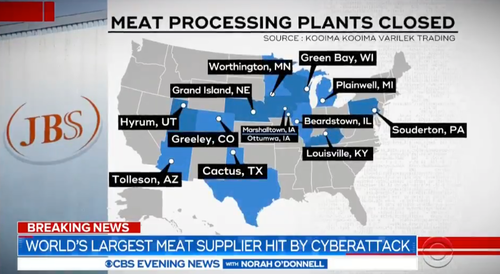
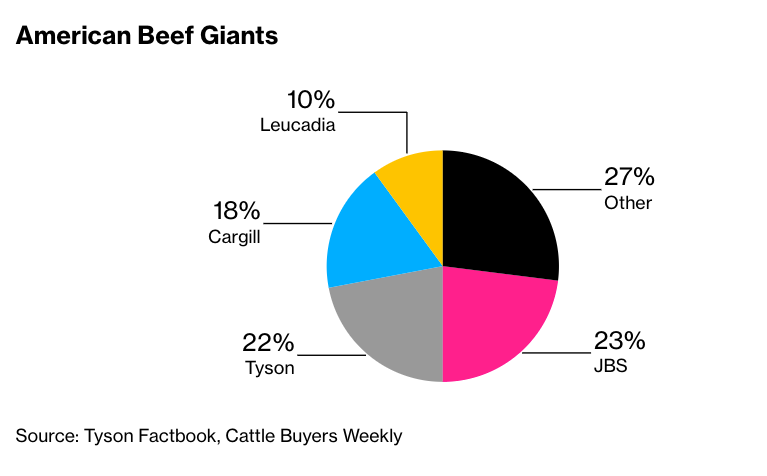
The JBS ransomware attack is a threat to the US food supply as the world’s largest beef company controls about a quarter of the US beef market. If JBS cannot slaughter cattle or hogs over a sustained period, or perhaps in a matter of days, shortages could develop, and prices may spike.
Take note of what happened three weeks ago during the Colonial Pipeline Co.’s ransomware attack resulted in shortages, soaring gas prices, and panic hoarding.
As millions of Americans sit down for dinner this evening, the news will fill them in on the JBS ransomware attack. Already, search trends for “meat shortage” are skyrocketing.

So when does panic hoarding begin?
* * *
Update (1425 ET): Americans across the country are increasing Googling “meat shortage” as the afternoon progresses following the news of the JBS ransomware attack.

* * *
Update (1409 ET): Reports continue to trickle out, this time with Bloomberg, JBS, the world’s largest meat supplier, has suspended operations at ten meat plants after a ransomware attack.
* * *
Update (1405 ET): The White House has confirmed JBS, the world’s largest meat supplier, was the victim of a “ransomware” attack over the weekend.
Headlines from Reuters, citing Biden administration officials, who spoke with JBS, indicate “Russia was the source of the attack.” White House officials have talked with the FBI’s cybercrime unit to assess whether the attack, which has shut down JBS’ five biggest beef plants in the U.S., will affect the nation’s supply.
Bloomberg said JBS’ five meat processing plants handle approximately 22,500 cattle per day. The result of halting these plants for an extended period could result in a decline of upwards of a quarter of America’s meat production.
As we noted earlier this morning, slaughter operations in Australia were also affected. Also, Canada’s largest beef plant was idled for a second day.
Readers need to focus on that a quarter of all beef capacity and about a fifth of all pork capacity in the U.S. has been affected due to the ransomware attack.
The timing of the attack comes after a long holiday weekend in the U.S. when tens of millions of Americans buy pounds of meat and have backyard barbeques. Supermarkets usually reload on supply the following week.
“Retailers and beef processors are coming from a long weekend and need to catch up with orders,” Steiner Consulting Group said in its Daily Livestock Report. “If they suddenly get a call saying that product may not deliver tomorrow or this week, it will create very significant challenges in keeping plants in operation and the retail case stocked up.”
Bloomberg points out JBS closed meat processing facilities in Utah, Texas, Wisconsin, and Nebraska and eliminated shifts at Iowa and Colorado shifts on Tuesday.
Visualizing JBS’ U.S. capacity is rather frightening, as this may suggest soaring meat prices and shortages could be next. Source: Bloomberg
In the last month, hackers mounted a ransomware attack spree in crippling supply chains of critical commodity-linked companies. Three weeks ago, Colonial Pipeline Co.’s ransomware attack resulted in shortages, soaring gas prices, and panic hoarding.
What do you think happens here if ransomware issues at JBS aren’t resolved promptly?
* * *
JBS USA, the world’s largest meat supplier, released a statement Sunday evening, saying it was the target of an “organized cybersecurity attack.”
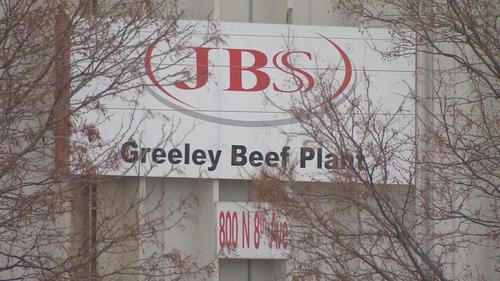
JBS, which has North America headquarters in Greeley, Colorado, said the cyber attack “affected some of the servers supporting its North American and Australian IT systems.”
“The company took immediate action, suspending all affected systems, notifying authorities and activating the company’s global network of IT professionals and third-party experts to resolve the situation,” the statement continued. “The company’s backup servers were not affected, and it is actively working with an Incident Response firm to restore its systems as soon as possible.”
Industry website Beef Central said the attack already impacted two shifts and halted processing at one of Canada’s largest meatpacking plants. Operations at all beef and lamb slaughterhouses in Australia ground to a halt, and some slaughtering and fabrication shifts have also been canceled in the U.S.
It’s still unknown how the attack might impact consumers or if a meat shortage would be sparked. There is still no word on a timeline of when the JBS’ systems will be completely restored.
Earlier in the month, hackers attacked the biggest U.S. gasoline pipeline operator, crippling East Coast energy infrastructure, which resulted in disrupted fuel flows, sending gasoline prices at the pump to multi-year highs. News of the hack led to panic hoarding by concerned folks.
This one-two punch of hacking incidents in the commodity industry shows that nothing is safe.
*This is an ongoing situation, and more updates will follow.
https://www.zerohedge.com/commodities/cyber-attack-hits-jbs-global-meat-processing-operations
May 28, 2021
Port Update
California’s Massive Container-Ship Traffic Jam Is Still Really Jammed
by Tyler DurdenFriday, May 28, 2021 – 06:30 AM
By Greg Miller of FreightWaves,
Peak shipping season is coming soon — and the “parking lot” of container ships stuck at anchor off the coast of California is still there, with Oakland surpassing Los Angeles/Long Beach as the epicenter of congestion.
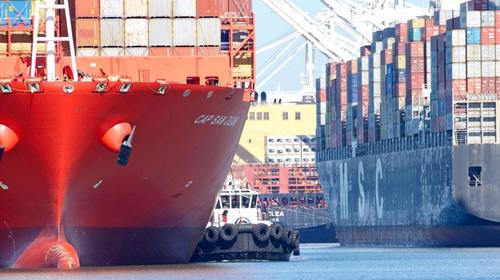
Shipping giant Maersk warned in a customer advisory on Wednesday that Los Angeles and Long Beach “remain strained with vessel wait times averaging between one to two weeks.” But it said “the situation is even more dire at the Port of Oakland, where wait times now extend up to three weeks.”
West Coast port delays are having severe fallout for liner schedules. Congestion in California equates to canceled voyages as ships can’t get back to Asia in time to load cargo. Even as U.S. import demand soars, the effective capacity in the trans-Pacific trade is being sharply curtailed by voyage cancellations.
For importers, that means even longer delays, even higher all-in freight rates and a cap on how much can be shipped at any price.
Maersk said that 20% of its capacity from Asia to the West Coast has been lost year to date as a result of operationally induced “blank” (canceled) sailings. It currently expects 16% of its Asia-West Coast capacity to be lost from now until the end of June and 13% to be lost from now until the end of August. “This unfortunately means Maersk may not be able to fully honor its original allocations for all customers,” the carrier admitted.
To put current cancellations in context, they are now running at the same percentage that carriers intentionally blanked in Q2 2020 to compensate for the sudden collapse of import demand when U.S. businesses were shuttered by nationwide lockdowns.
Deadline will be missed
Port of Los Angeles Executive Director Gene Seroka has repeatedly said that the San Pedro Bay anchorages need to be cleared before the traditional peak season surge begins. He has voiced a goal of June 1 for “few if any ships” at anchor.Port of LA’s Gene Seroka
That deadline, which is a week away, will not be met.
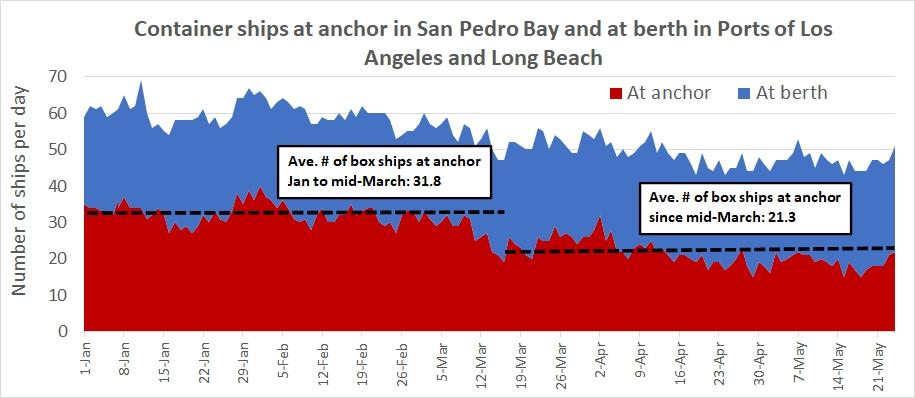
The daily number of ships stuck in San Pedro Bay is down from an average of 31.8 in January to mid-March to 21.3 from mid-March to Tuesday. However, the numbers have stubbornly refused to fall further. As of Tuesday, there were still 20 ships at anchor in San Pedro Bay.
Asked about his June 1 target for clear anchorages, Seroka told American Shipper, “Import volume continues to be heavy and consistent, more than we had anticipated earlier this year. Reduction in dwell times is leveling off and the subsequent decline in [ships at] anchorage has slowed. Our goal remains to clear as much of the at-anchorage situation as possible prior to late summer and the start of the traditional peak season.”
Unfortunately, the peak season is expected to begin sooner than usual this year. Time appears to be about to run out — which implies even more congestion.
According to Maersk, “Peak season is expected to start early this year as retailers prepare for a strong back-to-school season that will likely blend into the end-of-year holiday peak season that typically starts in August. This will unfortunately put more pressure on an already stretched network with the potential to cause further disruptions.”
Congestion woes in Oakland
As of Wednesday, there were around 10 container ships anchored in San Francisco Bay, off Oakland, according to Automatic Identification System (AIS) ship-positioning data from MarineTraffic. But that’s less than half the story. Off the coast, there were an additional 15 or more container ships drifting in the Pacific.Inner anchorage (left); ships drifting off coast (right). Maps by MarineTraffic; ship positions as of early Wednesday
The number of waiting ships has a different meaning for Oakland than for Los Angeles/Long Beach, as Oakland is a much smaller port. Oakland’s January-April import throughput was about one-tenth of the combined Los Angeles/Long Beach throughput.
Oakland has two berths temporarily out of commission. The ONE-operated NYK Delphinus suffered an engine room fire on May 14 and berthed in Oakland on May 18. AIS data showed the ship still at the berth on Wednesday. In addition, a berth at Oakland International Container Terminal has been unavailable for an extended period due to crane installations. That berth should come back online by the end of this month.
The bigger problem in Oakland, according to carriers Maersk and Hapag-Lloyd, is a shortage of available longshore labor. Maersk said in a client note last week, “Terminals are limited to two gangs per vessel on most ships due to the unavailability of the needed labor to cover the current demand.”
Hapag-Lloyd informed customers on Tuesday, “Massive import volumes combined with labor shortages are the biggest drivers of continued congestion and vessel operations delays [in Oakland].”
Asked about the labor shortfall, Andrew Hwang, the Port of Oakland’s manager of business development and international marketing, responded, “There is good news to report. It’s our understanding that the ILWU [longshore union] is preparing 300 new casuals to be added and another 150 ILWU members are being trained so that they can work skilled positions … needed to move cargo more efficiently. The new dockworkers and skilled labor are expected to be ready and able to join their colleagues this summer.”
Rough start for ZIM ‘fast’ service
One example of how Oakland congestion is affecting carriers and shippers involves ZIM. The Israeli carrier just introduced a new Asia-West Coast service called the Central China E-Commerce Express ZX3 that is designed to provide fast trans-Pacific service for time-sensitive cargo. It is scheduled to call in Oakland first, then Los Angeles.
It is not going as planned. The first ship, the 4,254-twenty-foot equivalent unit (TEU) Volans, was unable to get into Oakland on its inaugural call due to congestion and diverted to Los Angeles instead. A source told American Shipper that the vessel was quickly serviced in Los Angeles, with urgent cargo unloaded. On Wednesday, AIS data showed the Volans drifting with all the other ships off Oakland.
The new service is already so far behind schedule that the next ship in the string, the 4,250-TEU Navios Chrysalis, is due to arrive in Oakland just three days from now.
LA/LB congestion by the numbers
While the congestion is more extreme in Oakland, the anchorage situation off Los Angeles/Long Beach is more important from an overall import volume perspective.
American Shipper was provided the daily counts of container ships at anchor and at berth by the Marine Exchange of Southern California. The year-to-date numbers show the step-down in severity starting in mid-March and the persistence of the anchorage numbers since then.Chart by American Shipper based on data from Marine Exchange of Southern California
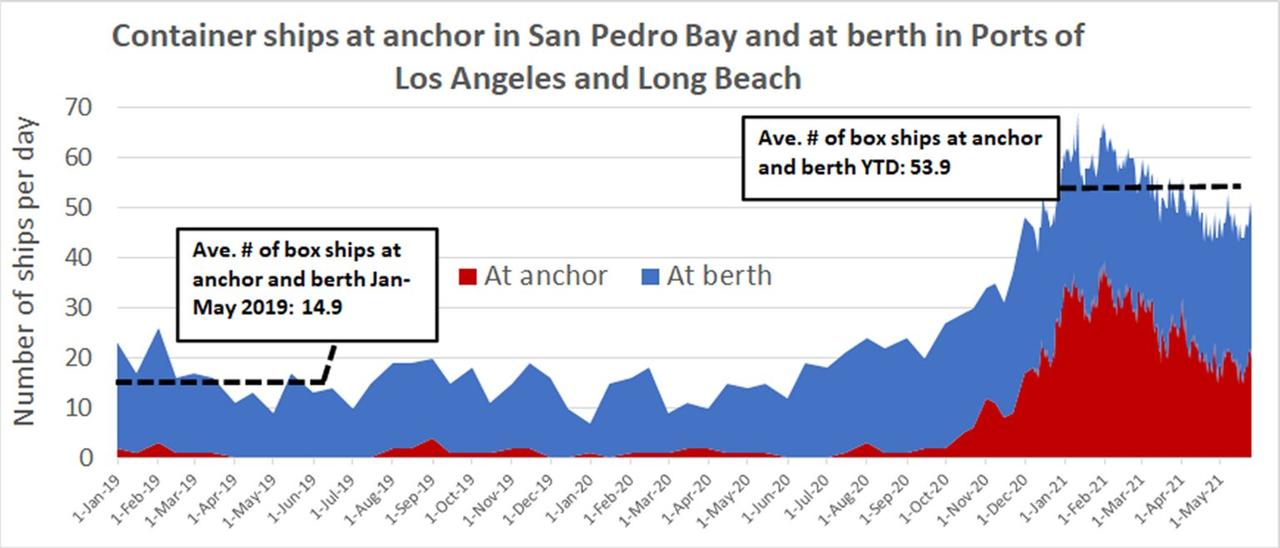
Looking further back, to the pre-COVID era, shows the extent of the current import surge. In January-May 2019, Los Angeles/Long Beach averaged 14.9 container ships per day, including those at berth and at anchor. Year to date in 2021, the average is 53.9 ships per day, 3.6 times pre-COVID levels.Chart by American Shipper based on data from Marine Exchange of Southern California; data from Dec. 2020 is daily, prior data is bimonthly
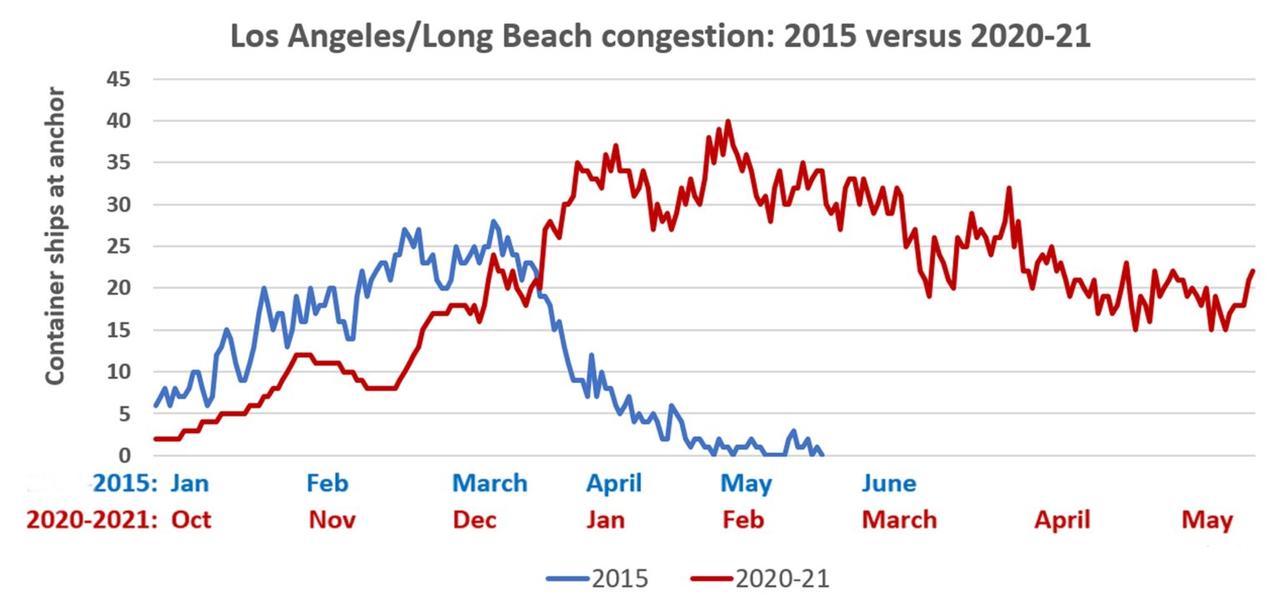
Looking even further back, the current congestion crisis can be compared to the last major disruption: the West Coast labor unrest that crippled port operations in January-April 2015.
American Shipper mapped the curves of ships at anchor during the 2015 incident against the current curve. Six years ago, the disruptions peaked three months after they began and came down quickly. The current crisis is already almost three times as long as the prior one, and the number of ships at anchor is still close to highs set back in 2015.Chart by American Shipper based on data from Marine Exchange of Southern California
Realistically, decreased import demand is the most important (if not only) factor that would allow the West Coast port system to dig itself out of its hole and thus allow carriers to add back canceled sailings.
But the data shows that import demand is still increasing.
FreightWaves’ SONAR platform features a proprietary index of shippers’ ocean bookings (SONAR: IOTI.USA) measured in twenty-foot equivalent units (10-day moving average) as of the scheduled date of overseas departure and indexed to January 2019.
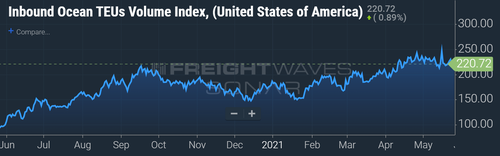
While these are bookings, not loadings, the index provides a directional indicator of U.S. import volumes in the future, when ships from various export destinations arrive at American ports. The index has been considerably higher in May than in April, implying that volumes hitting U.S. shores next month will be even greater than current levels.
https://www.zerohedge.com/markets/californias-massive-container-ship-traffic-jam-still-really-jammed
May 28, 2021
Port Update
California’s Massive Container-Ship Traffic Jam Is Still Really Jammed
by Tyler DurdenFriday, May 28, 2021 – 06:30 AM
By Greg Miller of FreightWaves,
Peak shipping season is coming soon — and the “parking lot” of container ships stuck at anchor off the coast of California is still there, with Oakland surpassing Los Angeles/Long Beach as the epicenter of congestion.
Shipping giant Maersk warned in a customer advisory on Wednesday that Los Angeles and Long Beach “remain strained with vessel wait times averaging between one to two weeks.” But it said “the situation is even more dire at the Port of Oakland, where wait times now extend up to three weeks.”
West Coast port delays are having severe fallout for liner schedules. Congestion in California equates to canceled voyages as ships can’t get back to Asia in time to load cargo. Even as U.S. import demand soars, the effective capacity in the trans-Pacific trade is being sharply curtailed by voyage cancellations.
For importers, that means even longer delays, even higher all-in freight rates and a cap on how much can be shipped at any price.
Maersk said that 20% of its capacity from Asia to the West Coast has been lost year to date as a result of operationally induced “blank” (canceled) sailings. It currently expects 16% of its Asia-West Coast capacity to be lost from now until the end of June and 13% to be lost from now until the end of August. “This unfortunately means Maersk may not be able to fully honor its original allocations for all customers,” the carrier admitted.
To put current cancellations in context, they are now running at the same percentage that carriers intentionally blanked in Q2 2020 to compensate for the sudden collapse of import demand when U.S. businesses were shuttered by nationwide lockdowns.
Deadline will be missed
Port of Los Angeles Executive Director Gene Seroka has repeatedly said that the San Pedro Bay anchorages need to be cleared before the traditional peak season surge begins. He has voiced a goal of June 1 for “few if any ships” at anchor.Port of LA’s Gene Seroka
That deadline, which is a week away, will not be met.
The daily number of ships stuck in San Pedro Bay is down from an average of 31.8 in January to mid-March to 21.3 from mid-March to Tuesday. However, the numbers have stubbornly refused to fall further. As of Tuesday, there were still 20 ships at anchor in San Pedro Bay.
Asked about his June 1 target for clear anchorages, Seroka told American Shipper, “Import volume continues to be heavy and consistent, more than we had anticipated earlier this year. Reduction in dwell times is leveling off and the subsequent decline in [ships at] anchorage has slowed. Our goal remains to clear as much of the at-anchorage situation as possible prior to late summer and the start of the traditional peak season.”
Unfortunately, the peak season is expected to begin sooner than usual this year. Time appears to be about to run out — which implies even more congestion.
According to Maersk, “Peak season is expected to start early this year as retailers prepare for a strong back-to-school season that will likely blend into the end-of-year holiday peak season that typically starts in August. This will unfortunately put more pressure on an already stretched network with the potential to cause further disruptions.”
Congestion woes in Oakland
As of Wednesday, there were around 10 container ships anchored in San Francisco Bay, off Oakland, according to Automatic Identification System (AIS) ship-positioning data from MarineTraffic. But that’s less than half the story. Off the coast, there were an additional 15 or more container ships drifting in the Pacific.Inner anchorage (left); ships drifting off coast (right). Maps by MarineTraffic; ship positions as of early Wednesday
The number of waiting ships has a different meaning for Oakland than for Los Angeles/Long Beach, as Oakland is a much smaller port. Oakland’s January-April import throughput was about one-tenth of the combined Los Angeles/Long Beach throughput.
Oakland has two berths temporarily out of commission. The ONE-operated NYK Delphinus suffered an engine room fire on May 14 and berthed in Oakland on May 18. AIS data showed the ship still at the berth on Wednesday. In addition, a berth at Oakland International Container Terminal has been unavailable for an extended period due to crane installations. That berth should come back online by the end of this month.
The bigger problem in Oakland, according to carriers Maersk and Hapag-Lloyd, is a shortage of available longshore labor. Maersk said in a client note last week, “Terminals are limited to two gangs per vessel on most ships due to the unavailability of the needed labor to cover the current demand.”
Hapag-Lloyd informed customers on Tuesday, “Massive import volumes combined with labor shortages are the biggest drivers of continued congestion and vessel operations delays [in Oakland].”
Asked about the labor shortfall, Andrew Hwang, the Port of Oakland’s manager of business development and international marketing, responded, “There is good news to report. It’s our understanding that the ILWU [longshore union] is preparing 300 new casuals to be added and another 150 ILWU members are being trained so that they can work skilled positions … needed to move cargo more efficiently. The new dockworkers and skilled labor are expected to be ready and able to join their colleagues this summer.”
Rough start for ZIM ‘fast’ service
One example of how Oakland congestion is affecting carriers and shippers involves ZIM. The Israeli carrier just introduced a new Asia-West Coast service called the Central China E-Commerce Express ZX3 that is designed to provide fast trans-Pacific service for time-sensitive cargo. It is scheduled to call in Oakland first, then Los Angeles.
It is not going as planned. The first ship, the 4,254-twenty-foot equivalent unit (TEU) Volans, was unable to get into Oakland on its inaugural call due to congestion and diverted to Los Angeles instead. A source told American Shipper that the vessel was quickly serviced in Los Angeles, with urgent cargo unloaded. On Wednesday, AIS data showed the Volans drifting with all the other ships off Oakland.
The new service is already so far behind schedule that the next ship in the string, the 4,250-TEU Navios Chrysalis, is due to arrive in Oakland just three days from now.
LA/LB congestion by the numbers
While the congestion is more extreme in Oakland, the anchorage situation off Los Angeles/Long Beach is more important from an overall import volume perspective.
American Shipper was provided the daily counts of container ships at anchor and at berth by the Marine Exchange of Southern California. The year-to-date numbers show the step-down in severity starting in mid-March and the persistence of the anchorage numbers since then.Chart by American Shipper based on data from Marine Exchange of Southern California
Looking further back, to the pre-COVID era, shows the extent of the current import surge. In January-May 2019, Los Angeles/Long Beach averaged 14.9 container ships per day, including those at berth and at anchor. Year to date in 2021, the average is 53.9 ships per day, 3.6 times pre-COVID levels.Chart by American Shipper based on data from Marine Exchange of Southern California; data from Dec. 2020 is daily, prior data is bimonthly
Looking even further back, the current congestion crisis can be compared to the last major disruption: the West Coast labor unrest that crippled port operations in January-April 2015.
American Shipper mapped the curves of ships at anchor during the 2015 incident against the current curve. Six years ago, the disruptions peaked three months after they began and came down quickly. The current crisis is already almost three times as long as the prior one, and the number of ships at anchor is still close to highs set back in 2015.Chart by American Shipper based on data from Marine Exchange of Southern California
Realistically, decreased import demand is the most important (if not only) factor that would allow the West Coast port system to dig itself out of its hole and thus allow carriers to add back canceled sailings.
But the data shows that import demand is still increasing.
FreightWaves’ SONAR platform features a proprietary index of shippers’ ocean bookings (SONAR: IOTI.USA) measured in twenty-foot equivalent units (10-day moving average) as of the scheduled date of overseas departure and indexed to January 2019.
While these are bookings, not loadings, the index provides a directional indicator of U.S. import volumes in the future, when ships from various export destinations arrive at American ports. The index has been considerably higher in May than in April, implying that volumes hitting U.S. shores next month will be even greater than current levels.
https://www.zerohedge.com/markets/californias-massive-container-ship-traffic-jam-still-really-jammed
May 24, 2021
Great Advice
Read Mitch Daniels’ Charge To Graduates: ‘The Biggest Risk Of All Is That We Stop Taking Risks’
Purdue University President Mitch Daniels warned that the pandemic snuffed out the American eagerness to take risks and move ahead boldly.
By May 18, 2021
Purdue University President Mitch Daniels made these remarks during the spring commencement May 15, 2021, on the West Lafayette campus.
This year, when I say I am happy to be here, I’m not just making small talk. If you’re like me, you’re happy to be anywhere after the year we’ve all been through. I wish we were over in Elliott Hall, celebrating your achievements individually as only Purdue does among schools our size. But this beats the virtual version we were forced to in 2020 and marks a long step back on the path to fully normal life.
As we’ve never done an outdoor commencement before, we may have gotten a few things wrong. For one thing, way out here on the 50-yard line, it feels like we’ve carried that social distance thing a little far. However well it goes, like everything about your senior year, it will be one for the history books. For all the trouble and downsides, there can be some real value in living through a time like that.
For decades to come, scholars and ordinary citizens alike will look back on your senior year, trying to identify its consequences, and imagine what lives so disrupted were like. As they do so, they will know more than we can now about the results of the choices today’s leaders made. They will reach judgments, with the benefit of hindsight, about the wisdom and maturity with which our nation handled the challenge of this particular pandemic.
Odds are, not all those judgments will be favorable. Time will tell.
An ability to comprehend and work with complex facts and data has always been part of a Purdue education. At least since the Industrial Age, that’s been an essential tool for a useful life of the kind at which Boilermakers excel.
But that’s never been nearly so true as today. Massive amounts of information are being collected, intentionally by us and silently by the machines we invent and use in daily life. Interpreting its meaning, and discovering patterns within it, is perhaps the most important skill in the economy of 2021. Our faculty has determined that data analysis, as we now call it, should be as universal a part of a Boilermaker education as English composition.
You’ll leave this stadium able to evaluate statistics and whether they are significant or meaningless. You’ll know better than to confuse correlation with causation. You’ll look at decisions critically, and holistically, understanding that any objective pursued too far eventually yields diminishing returns not worth their cost. That, just as medicines have side effects, almost all actions produce collateral consequences, often collateral damage.
It doesn’t stretch a point to say that we wouldn’t be meeting here today without those skills. Keeping Purdue open last fall, so that you could stay on schedule and graduate today, required the daily examination of COVID-19 infection rates and patterns of its spread on and around campus. Prior to that, the decision to reopen at all involved a reading of the available data, which showed that people your age were at far less risk from the virus than from a host of other dangers.
Starting soon, the decisions will be yours to make. In businesses you start or join, in causes in which you feel called to enlist, or in that most important of all organizations, the families I hope you will form. Wherever they are, the very essence of your coming leadership roles will lie in making hard choices. After weighing all the options, the competing priorities and the uncertainties that even the biggest databases cannot totally eliminate, others will look to you to choose.
The risk of failure, of a hit to one’s reputation, or just that the gains don’t outweigh the costs, all these can deter or even paralyze a person out of fulfilling the responsibility someone has entrusted to them. Should I make this investment, or husband my cash? Take that job offer, or stay where I’m comfortable? Engage in this debate, or sit silently? Choose this life partner, or play it safe?
This last year, many of your elders failed this fundamental test of leadership. They let their understandable human fear of uncertainty overcome their duty to balance all the interests for which they were responsible. They hid behind the advice of experts in one field but ignored the warnings of experts in other realms that they might do harm beyond the good they hoped to accomplish.
Sometimes they let what might be termed the mad pursuit of zero, in this case zero risk of anyone contracting the virus, block out other competing concerns, like the protection of mental health, the educational needs of small children, or the survival of small businesses. Pursuing one goal to the utter exclusion of all others is not to make a choice but to run from it. It’s not leadership; it’s abdication. I feel confident your Purdue preparation won’t let you fall prey to it.
But there’s a companion quality you’ll need to be the leaders you can be. That’s the willingness to take risks. Not reckless ones, but the risks that still remain after all the evidence has been considered.
Great societies before us tended to look backward for their inspiration, to locate their golden ages in the past. Here our eyes have always been forward. Now signs abound of Americans losing that eagerness to move ahead boldly.
Before the virus visited us, there were already troubling signs that fearfulness was beginning to erode the spirit of adventure, the willingness to take considered risks, on which this nation’s greatness was built and from which all progress originates. Rates of business startups, moving in pursuit of a better job, or the strongest of all bets on the future, having children, all have fallen sharply in recent years. And now there are warnings that the year 2020 may have weakened that spirit further.
As early as April of last year, researchers at the Federal Reserve of St. Louis documented the “belief-scarring effects” of COVID-19. Psychologists proved a long time ago that we humans tend to overestimate how common terrible events are. Because they are terrible, we are more sure to hear about them, and we trick ourselves into believing that they are far more likely than they really are.
Now we learn that such misconceptions can be long-lasting. The scarring effect is, the Fed’s economists tell us, “a persistent change in beliefs about the probability of an extreme, negative shock producing … long-lived responses to transitory events, especially extreme, unlikely ones.”
Fortunately, Boilermakers don’t scar easily. If Amelia Earhart had been intimidated by uncertainty, we wouldn’t know her name. If our recent board chair Keith Krach had stayed within the safe confines of a giant corporation’s career ladder, the world would not enjoy the huge efficiency breakthroughs of Ariba and Docusign. If Neil Armstrong, Gus Grissom and more than a score more Purdue astronauts had run from risk, humanity’s knowledge of its universe would be far short of its current boundaries.
In the most jarring book of recent years, the Israeli philosopher Yuval Harari predicts that humans your age will live to see the “last days of death,” when the species we call Homo sapiens becomes “godlings” and immortal. He sees this happening through one of the same technologies at which this university excels: either biological engineering, or cyborg engineering, of our organic beings, or simply the complete replacement of humans by super intelligent machines.
Immortality sounds good, until Harari points out the implications. One of them would be a total aversion to risk. As the author explains it, if you believe you can live forever, why would you ever take a chance of any kind?
I hope that the experiences of 2020 left you with an attitude not of fearfulness but of confidence. Confidence that we can tackle hard problems, and that hiding from them is rarely the best course. That given a careful examination of the available facts and a thoughtful calculation of relative risks, we can overcome even the biggest obstacles and be the masters of our fates and our futures.
As school started again at her campus, the provost of the University of Kansas sent a message to her students and colleagues that is relevant far beyond the present day or the recent pandemic. “In times of high anxiety,” she wrote, “it is human nature to crave certainty for the safety it provides. The problem with craving certainty is that it is a false hope; it is a craving that can never fully be met.”
She quoted the astronomer Carl Sagan: “The history of science teaches us that the most we can hope for is successive improvement in our understanding, learning from our mistakes … with the proviso that absolute certainty will always elude us.”
Maybe the great historian Jacques Barzun summed it up best: “The last degree of caution is cowardice.”
Certainty is an illusion. Perfect safety is a mirage. Zero is always unattainable, except in the case of absolute zero where, as you remember, all motion and life itself stop.
You are leaving here ready for leadership. Your academic records say so. The history of Purdue graduates says so. The character you demonstrated this last year, when your embrace of the Purdue Pledge enabled this place to stay open at all, clearly says so.
We expect, no, we know, that you will tackle leadership’s challenges as they present themselves to you. You’re taking with you the tools to weigh alternatives, balance priorities, assess relative risks. All you’ll need is the courage to act on the conclusions you reach.
Now take that readiness into a fearful, timid world crying for direction and boldness, where the biggest risk of all is that we stop taking risks at all. Hail Purdue, and each of you.
May 24, 2021
Great Advice
Read Mitch Daniels’ Charge To Graduates: ‘The Biggest Risk Of All Is That We Stop Taking Risks’
Purdue University President Mitch Daniels warned that the pandemic snuffed out the American eagerness to take risks and move ahead boldly.
By May 18, 2021
Purdue University President Mitch Daniels made these remarks during the spring commencement May 15, 2021, on the West Lafayette campus.
This year, when I say I am happy to be here, I’m not just making small talk. If you’re like me, you’re happy to be anywhere after the year we’ve all been through. I wish we were over in Elliott Hall, celebrating your achievements individually as only Purdue does among schools our size. But this beats the virtual version we were forced to in 2020 and marks a long step back on the path to fully normal life.
As we’ve never done an outdoor commencement before, we may have gotten a few things wrong. For one thing, way out here on the 50-yard line, it feels like we’ve carried that social distance thing a little far. However well it goes, like everything about your senior year, it will be one for the history books. For all the trouble and downsides, there can be some real value in living through a time like that.
For decades to come, scholars and ordinary citizens alike will look back on your senior year, trying to identify its consequences, and imagine what lives so disrupted were like. As they do so, they will know more than we can now about the results of the choices today’s leaders made. They will reach judgments, with the benefit of hindsight, about the wisdom and maturity with which our nation handled the challenge of this particular pandemic.
Odds are, not all those judgments will be favorable. Time will tell.
An ability to comprehend and work with complex facts and data has always been part of a Purdue education. At least since the Industrial Age, that’s been an essential tool for a useful life of the kind at which Boilermakers excel.
But that’s never been nearly so true as today. Massive amounts of information are being collected, intentionally by us and silently by the machines we invent and use in daily life. Interpreting its meaning, and discovering patterns within it, is perhaps the most important skill in the economy of 2021. Our faculty has determined that data analysis, as we now call it, should be as universal a part of a Boilermaker education as English composition.
You’ll leave this stadium able to evaluate statistics and whether they are significant or meaningless. You’ll know better than to confuse correlation with causation. You’ll look at decisions critically, and holistically, understanding that any objective pursued too far eventually yields diminishing returns not worth their cost. That, just as medicines have side effects, almost all actions produce collateral consequences, often collateral damage.
It doesn’t stretch a point to say that we wouldn’t be meeting here today without those skills. Keeping Purdue open last fall, so that you could stay on schedule and graduate today, required the daily examination of COVID-19 infection rates and patterns of its spread on and around campus. Prior to that, the decision to reopen at all involved a reading of the available data, which showed that people your age were at far less risk from the virus than from a host of other dangers.
Starting soon, the decisions will be yours to make. In businesses you start or join, in causes in which you feel called to enlist, or in that most important of all organizations, the families I hope you will form. Wherever they are, the very essence of your coming leadership roles will lie in making hard choices. After weighing all the options, the competing priorities and the uncertainties that even the biggest databases cannot totally eliminate, others will look to you to choose.
The risk of failure, of a hit to one’s reputation, or just that the gains don’t outweigh the costs, all these can deter or even paralyze a person out of fulfilling the responsibility someone has entrusted to them. Should I make this investment, or husband my cash? Take that job offer, or stay where I’m comfortable? Engage in this debate, or sit silently? Choose this life partner, or play it safe?
This last year, many of your elders failed this fundamental test of leadership. They let their understandable human fear of uncertainty overcome their duty to balance all the interests for which they were responsible. They hid behind the advice of experts in one field but ignored the warnings of experts in other realms that they might do harm beyond the good they hoped to accomplish.
Sometimes they let what might be termed the mad pursuit of zero, in this case zero risk of anyone contracting the virus, block out other competing concerns, like the protection of mental health, the educational needs of small children, or the survival of small businesses. Pursuing one goal to the utter exclusion of all others is not to make a choice but to run from it. It’s not leadership; it’s abdication. I feel confident your Purdue preparation won’t let you fall prey to it.
But there’s a companion quality you’ll need to be the leaders you can be. That’s the willingness to take risks. Not reckless ones, but the risks that still remain after all the evidence has been considered.
Great societies before us tended to look backward for their inspiration, to locate their golden ages in the past. Here our eyes have always been forward. Now signs abound of Americans losing that eagerness to move ahead boldly.
Before the virus visited us, there were already troubling signs that fearfulness was beginning to erode the spirit of adventure, the willingness to take considered risks, on which this nation’s greatness was built and from which all progress originates. Rates of business startups, moving in pursuit of a better job, or the strongest of all bets on the future, having children, all have fallen sharply in recent years. And now there are warnings that the year 2020 may have weakened that spirit further.
As early as April of last year, researchers at the Federal Reserve of St. Louis documented the “belief-scarring effects” of COVID-19. Psychologists proved a long time ago that we humans tend to overestimate how common terrible events are. Because they are terrible, we are more sure to hear about them, and we trick ourselves into believing that they are far more likely than they really are.
Now we learn that such misconceptions can be long-lasting. The scarring effect is, the Fed’s economists tell us, “a persistent change in beliefs about the probability of an extreme, negative shock producing … long-lived responses to transitory events, especially extreme, unlikely ones.”
Fortunately, Boilermakers don’t scar easily. If Amelia Earhart had been intimidated by uncertainty, we wouldn’t know her name. If our recent board chair Keith Krach had stayed within the safe confines of a giant corporation’s career ladder, the world would not enjoy the huge efficiency breakthroughs of Ariba and Docusign. If Neil Armstrong, Gus Grissom and more than a score more Purdue astronauts had run from risk, humanity’s knowledge of its universe would be far short of its current boundaries.
In the most jarring book of recent years, the Israeli philosopher Yuval Harari predicts that humans your age will live to see the “last days of death,” when the species we call Homo sapiens becomes “godlings” and immortal. He sees this happening through one of the same technologies at which this university excels: either biological engineering, or cyborg engineering, of our organic beings, or simply the complete replacement of humans by super intelligent machines.
Immortality sounds good, until Harari points out the implications. One of them would be a total aversion to risk. As the author explains it, if you believe you can live forever, why would you ever take a chance of any kind?
I hope that the experiences of 2020 left you with an attitude not of fearfulness but of confidence. Confidence that we can tackle hard problems, and that hiding from them is rarely the best course. That given a careful examination of the available facts and a thoughtful calculation of relative risks, we can overcome even the biggest obstacles and be the masters of our fates and our futures.
As school started again at her campus, the provost of the University of Kansas sent a message to her students and colleagues that is relevant far beyond the present day or the recent pandemic. “In times of high anxiety,” she wrote, “it is human nature to crave certainty for the safety it provides. The problem with craving certainty is that it is a false hope; it is a craving that can never fully be met.”
She quoted the astronomer Carl Sagan: “The history of science teaches us that the most we can hope for is successive improvement in our understanding, learning from our mistakes … with the proviso that absolute certainty will always elude us.”
Maybe the great historian Jacques Barzun summed it up best: “The last degree of caution is cowardice.”
Certainty is an illusion. Perfect safety is a mirage. Zero is always unattainable, except in the case of absolute zero where, as you remember, all motion and life itself stop.
You are leaving here ready for leadership. Your academic records say so. The history of Purdue graduates says so. The character you demonstrated this last year, when your embrace of the Purdue Pledge enabled this place to stay open at all, clearly says so.
We expect, no, we know, that you will tackle leadership’s challenges as they present themselves to you. You’re taking with you the tools to weigh alternatives, balance priorities, assess relative risks. All you’ll need is the courage to act on the conclusions you reach.
Now take that readiness into a fearful, timid world crying for direction and boldness, where the biggest risk of all is that we stop taking risks at all. Hail Purdue, and each of you.
 Everchem Updates Archive
  Sign Up for Email Updates