Current Affairs
May 20, 2021
Container Rates
Why Stratospheric Container Rates Could Rocket Even Higher
by Tyler DurdenThursday, May 20, 2021 – 11:35 AM
By Greg Miller of Freight Waves,
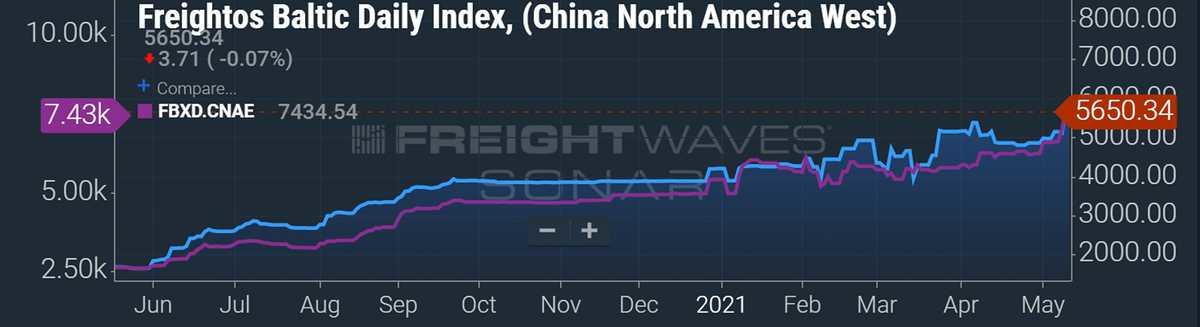
Spot ocean container rates are up triple digits year on year, ergo they must be near their peak. They’re so high they don’t have much more room to run. So goes a common belief in the container market, despite the fact that this premise has already been proven wrong, and that container rates could theoretically have a lot more room to run if the upper limit is defined the same way it is in non-containerized shipping.

One leading freight-forwarder executive told American Shipper in August 2020 after the initial spike, “I do not think there is room for growth beyond $4,000 [per forty-foot equivalent unit or FEU].” Nine months later, many all-in trans-Pacific rates including premium charges are more than double that — and rising sustainably. Importers commonly pay $8,000-$10,000 per FEU or more, including extra charges, sometimes a lot more.Spot rates do not include $3,000-$5,000 per FEU premiums now reportedly being paid by some shippers. FBXD.CNAE = China-East Coast
But why stop there?
Retail inventories-to-sales ratios are still at historic lows, stimulus checks are still supporting spending, and the traditional peak season is right around the corner. Meanwhile, U.S. households accumulated an enormous amount of excess savings during the pandemic (equivalent to 12% of GDP, according to Moody’s) that may now be unleashed.
What if the high-end case for U.S. import demand plays out over the rest of this year and exceeds vessel and equipment supply even more so than it does today?
A common response from shippers in online forums is that regulators will intervene if rates go too high. That’s not going to happen, at least in the U.S. During a presentation last week, Federal Maritime Commission (FMC) Chairman Daniel Maffei made clear that if high freight prices are being caused by market forces, there’s nothing the FMC can currently do about it.
How bulk shipping rates are capped
The current rate spike is unprecedented in the history of container shipping. The sector is in completely unchart(er)ed territory (one reason why rate predictions over the past nine months have been repeatedly wrong). However, there is an extensive history of precedents in non-containerized shipping — in crude tanker, gas carrier and dry bulk markets — that shed light on how high the maximum spot rate can go.
The freight rate of a spot cargo in bulk commodity shipping is elastic all the way up to the point where it erases the profit margin of the shipper. Rates for very large crude carriers (VLCCs, tankers that carry 2 million barrels of oil) topped $200,000 per day in October 2019 and March-April 2020. A liquefied natural gas carrier was booked at $350,000 per day in January.
An example of the upper limit being hit was recounted by Trygve Munthe, co-CEO of crude-tanker owner DHT. Referring to the rate peak in the second week of October 2019, he said, “When you get to that kind of freight level, you make it very hard for the refiners to make money. In that crazy week, we happened to be in Korea meeting with a lot of refiners, and they told us that at those freight levels, it just didn’t make sense for them. They said they would just pull back on their [refining] throughputs.”
Stifel analyst Ben Nolan explained the max-rate calculation for Capesizes (dry bulk ships with a capacity of around 180,000 deadweight tons) in a research note titled “How High Can You Go?” published last week.
“Turns out, at current commodity prices … the dry bulk market is nowhere close to its theoretical ceiling,” he wrote. “If demand exceeds supply, the primary upward constraint of ship freight cost is the point at which it absorbs the profit of the producer or shipper.”
He noted that the landed price of thermal coal in China last week was about $125 per ton and the producer breakeven was $60 per ton, meaning the transport costs could be as much as $65 per ton. Capesize rates were then around $13 per ton (the equivalent of $40,000 per day), meaning “freight rates would need to rise seven times or to around $300,000 per day before the economics are completely destroyed by freight costs.”
Applying bulk shipping rate cap to containers
In an interview on Friday, American Shipper asked Jefferies shipping analyst Randy Giveans how this max-spot-rate concept applies to container shipping.
The big difference with bulk commodity shipping is transparency on the cargo price and margins. “With tankers, you know the commodity you’re moving. You know the exact price of Brent. With floating storage economics, you can say the prompt month price is x, the price six or 12 months later is y, here’s the carry trade, so here’s what you can charge for a VLCC to operate in floating storage.
“It’s similar with dry bulk, although you’re not doing floating storage. You can still say: The delivered cost of iron ore in China is $150-$200 per ton, it costs maybe $30 or $40 per ton [to produce] in Brazil and $50 in Australia and Capesize [transport] rates are maybe $30 per ton from Brazil and $10-$12 from Australia, so there are still huge margins and rates from Brazil for iron-ore [shipping] could go up three times.”
Container shipping is much more opaque. “This is a lot harder [to calculate] for containerized goods because you don’t know exactly what’s in those boxes,” he said. “Is it large stuffed animals or is it iPhones and iPads with much higher value and lower weight?”
The key is how the total containerized transport cost, including ocean and land, relates to the margin of the goods. “Let’s say a pair of shoes costs $10 to produce and sells for $100-$200. You can fit a lot of shoes in a container. If the transport cost is $5-$10 per pair and then it rises to $20, who cares? There’s still a huge margin there,” he said.
On the other hand, there have been reported cases of certain imported goods already getting priced out by rising ocean spot rates. “There are goods with lower margins and we’ve heard of some retailers saying it’s too expensive for me to take the cargo,” acknowledged Giveans. “But I think there are a lot fewer items like that than there are items with margins [that can still handle even higher transport costs].”
The spot-rate equation also changes as importers pass along transport costs to consumers. “The cost of everything is going up. You’re seeing inflation of the cost of goods. Even the price of low-margin materials is going higher and part of that is the increased shipping cost is being passed along to the customers,” said Giveans.
To apply the bulk commodity shipping equation to container shipping: If you subtract all the volume covered by fixed-price contracts, the spot rate on the remaining trans-Pacific volume could theoretically increase to the extent that there is enough demand to fill that remaining volume with goods from shippers who will accept even higher rates, whether because their margin is high enough to absorb it or because of their ability to pass along costs to consumers. If some low-margin imports are priced out, higher-margin goods could supplant them and keep rates rising.
Differences between bulk and container shipping
In tanker and bulker shipping, the cycles over the decades have been characterized by long periods of below-breakeven rates or small profits, accentuated by repeated brief periods of extremely high rates.
Shippers offer spot bulk cargoes to the vessels in the vicinity and generally take the lowest freight bid. During rate spikes, if the lowest bid is extremely high, shippers pay it if they can still make a margin on the trade and refuse it if they can’t. They don’t begrudge the vessel interest for offering a high spot rate; they blame the temporary supply-demand imbalance.
In container shipping, the past decades have been overwhelmingly dominated by heavy losses for carriers, several of which would no longer exist if not for government rescues. Containerized cargo shippers do not have the same institutional memory of extreme rate spikes as bulk cargo shippers.
Containerized cargo shippers also have more contract versus spot business with carriers than in the crude and dry bulk trades, and thus, there is more risk of relationship damage with carriers during periods of extreme spot-rate highs. Unlike shippers in bulk commodity trades, container shippers are blaming carriers for taking advantage of the supply-demand imbalance, even though shippers benefited from the imbalance in the opposite direction for decades.
That relationship factor might, perhaps, keep liners from being as aggressive on pricing as they might otherwise be. “I could understand how a liner maybe doesn’t want to really put the screws on its customers,” Giveans said.
Can US regulators intervene?
Another difference between bulk commodity shipping and container shipping is that container shipping, unlike bulk shipping, is regulated, at least to some extent.
However, in the U.S., the FMC cannot intervene on high pricing unless it is deemed “unreasonable” from a market perspective or as the direct result of lack of competition via alliances. Maffei of the FMC addressed the current market crunch during a Port of Los Angeles presentation on Thursday.
“The fact is that we have an incredibly vibrant global freight system, and right now that system is at and beyond capacity,” he said.
“We have a pretty limited set of tools. … We can investigate the alliances and if necessary, challenge them in court if we feel they are creating unreasonably high costs because of the alliances. We have looked at that pretty extensively and will continue to do so. But so far, there’s just no evidence that the alliances themselves are engaging in any behavior that would allow us to take them to court.
“High price in and of itself is not a violation of the Shipping Act,” he continued. “We don’t set rates and we can’t dictate the levels of service. What we can do is continue to monitor carriers to make sure alliances, by their very existence, don’t mean that there will be an unreasonably diminished level of service or unreasonably increased cost.
“But the key is that when you’re at or beyond the capacity of the system, it’s very difficult to prove that if only this [carrier consolidation] didn’t exist, prices would be lower. Because the fact is that it’s simply supply and demand. If demand is high and supply remains fairly limited, then that [high prices] is what happens.
“One thing I am doing is talking to my former colleagues in Congress. Some have asked: Could we change the Shipping Act? And of course, they can change the Shipping Act. But in terms of our current act, a high price in and of itself is not a violation.”
American Shipper asked Peter Freidmann, a lobbyist at the Agriculture Transportation Coalition, which represents exporters of containerized goods, whether he had heard of any current proposals to reform the Shipping Act to in any way limit ocean freight pricing.
Freidmann responded: “I am not aware of any effort or proposal to control or establish freight rates, now, or at any time since the Shipping Acts were written. In the past, competition between carriers served to keep freight rates affordable, even if sometimes they were very high. But then, there were 20-plus carriers. Now, there are 10 major east-west carriers, and they are consolidated into three alliances. So, practically speaking, shippers are finding that there are really only three carriers left.”
Will Chinese regulators throttle liners?
If U.S. regulators cannot throttle trans-Pacific freight pricing, what about Chinese regulators?
Chinese officials called a meeting with ocean liners on Sept. 11, 2020. During a client call in early October, Jefferies analyst Andrew Lee recounted, “What we heard from the [people in the] meeting themselves was that it wasn’t [regulators saying], ‘You’ve got to cut the rates.’ It was, ‘Carriers are making a lot of money on the trans-Pacific at the moment. Let’s not push it much higher.’”
Trans-Pacific spot-rate indexes plateaued in the months after that meeting, lending some credence to the theory that liners were somehow bowing to Chinese pressure. However, the actual all-in rates including premiums did not plateau and today’s trans-Pacific spot-rate index levels are far higher than they were at the time of last September’s China meeting.
According to Giveans, “I think there certainly was [some fear of regulators] in the fall and winter, where some governments were pushing back and saying, ‘Don’t get too crazy’ because they felt their goods would have to be discounted because the shipping costs were so high.
“But I think because prices [to consumers] have continued to go up and because there’s still so much demand, that has been alleviated. This is a free market.”
https://www.zerohedge.com/economics/why-stratospheric-container-rates-could-rocket-even-higher
May 20, 2021
Container Rates
Why Stratospheric Container Rates Could Rocket Even Higher
by Tyler DurdenThursday, May 20, 2021 – 11:35 AM
By Greg Miller of Freight Waves,
Spot ocean container rates are up triple digits year on year, ergo they must be near their peak. They’re so high they don’t have much more room to run. So goes a common belief in the container market, despite the fact that this premise has already been proven wrong, and that container rates could theoretically have a lot more room to run if the upper limit is defined the same way it is in non-containerized shipping.
One leading freight-forwarder executive told American Shipper in August 2020 after the initial spike, “I do not think there is room for growth beyond $4,000 [per forty-foot equivalent unit or FEU].” Nine months later, many all-in trans-Pacific rates including premium charges are more than double that — and rising sustainably. Importers commonly pay $8,000-$10,000 per FEU or more, including extra charges, sometimes a lot more.Spot rates do not include $3,000-$5,000 per FEU premiums now reportedly being paid by some shippers. FBXD.CNAE = China-East Coast
But why stop there?
Retail inventories-to-sales ratios are still at historic lows, stimulus checks are still supporting spending, and the traditional peak season is right around the corner. Meanwhile, U.S. households accumulated an enormous amount of excess savings during the pandemic (equivalent to 12% of GDP, according to Moody’s) that may now be unleashed.
What if the high-end case for U.S. import demand plays out over the rest of this year and exceeds vessel and equipment supply even more so than it does today?
A common response from shippers in online forums is that regulators will intervene if rates go too high. That’s not going to happen, at least in the U.S. During a presentation last week, Federal Maritime Commission (FMC) Chairman Daniel Maffei made clear that if high freight prices are being caused by market forces, there’s nothing the FMC can currently do about it.
How bulk shipping rates are capped
The current rate spike is unprecedented in the history of container shipping. The sector is in completely unchart(er)ed territory (one reason why rate predictions over the past nine months have been repeatedly wrong). However, there is an extensive history of precedents in non-containerized shipping — in crude tanker, gas carrier and dry bulk markets — that shed light on how high the maximum spot rate can go.
The freight rate of a spot cargo in bulk commodity shipping is elastic all the way up to the point where it erases the profit margin of the shipper. Rates for very large crude carriers (VLCCs, tankers that carry 2 million barrels of oil) topped $200,000 per day in October 2019 and March-April 2020. A liquefied natural gas carrier was booked at $350,000 per day in January.
An example of the upper limit being hit was recounted by Trygve Munthe, co-CEO of crude-tanker owner DHT. Referring to the rate peak in the second week of October 2019, he said, “When you get to that kind of freight level, you make it very hard for the refiners to make money. In that crazy week, we happened to be in Korea meeting with a lot of refiners, and they told us that at those freight levels, it just didn’t make sense for them. They said they would just pull back on their [refining] throughputs.”
Stifel analyst Ben Nolan explained the max-rate calculation for Capesizes (dry bulk ships with a capacity of around 180,000 deadweight tons) in a research note titled “How High Can You Go?” published last week.
“Turns out, at current commodity prices … the dry bulk market is nowhere close to its theoretical ceiling,” he wrote. “If demand exceeds supply, the primary upward constraint of ship freight cost is the point at which it absorbs the profit of the producer or shipper.”
He noted that the landed price of thermal coal in China last week was about $125 per ton and the producer breakeven was $60 per ton, meaning the transport costs could be as much as $65 per ton. Capesize rates were then around $13 per ton (the equivalent of $40,000 per day), meaning “freight rates would need to rise seven times or to around $300,000 per day before the economics are completely destroyed by freight costs.”
Applying bulk shipping rate cap to containers
In an interview on Friday, American Shipper asked Jefferies shipping analyst Randy Giveans how this max-spot-rate concept applies to container shipping.
The big difference with bulk commodity shipping is transparency on the cargo price and margins. “With tankers, you know the commodity you’re moving. You know the exact price of Brent. With floating storage economics, you can say the prompt month price is x, the price six or 12 months later is y, here’s the carry trade, so here’s what you can charge for a VLCC to operate in floating storage.
“It’s similar with dry bulk, although you’re not doing floating storage. You can still say: The delivered cost of iron ore in China is $150-$200 per ton, it costs maybe $30 or $40 per ton [to produce] in Brazil and $50 in Australia and Capesize [transport] rates are maybe $30 per ton from Brazil and $10-$12 from Australia, so there are still huge margins and rates from Brazil for iron-ore [shipping] could go up three times.”
Container shipping is much more opaque. “This is a lot harder [to calculate] for containerized goods because you don’t know exactly what’s in those boxes,” he said. “Is it large stuffed animals or is it iPhones and iPads with much higher value and lower weight?”
The key is how the total containerized transport cost, including ocean and land, relates to the margin of the goods. “Let’s say a pair of shoes costs $10 to produce and sells for $100-$200. You can fit a lot of shoes in a container. If the transport cost is $5-$10 per pair and then it rises to $20, who cares? There’s still a huge margin there,” he said.
On the other hand, there have been reported cases of certain imported goods already getting priced out by rising ocean spot rates. “There are goods with lower margins and we’ve heard of some retailers saying it’s too expensive for me to take the cargo,” acknowledged Giveans. “But I think there are a lot fewer items like that than there are items with margins [that can still handle even higher transport costs].”
The spot-rate equation also changes as importers pass along transport costs to consumers. “The cost of everything is going up. You’re seeing inflation of the cost of goods. Even the price of low-margin materials is going higher and part of that is the increased shipping cost is being passed along to the customers,” said Giveans.
To apply the bulk commodity shipping equation to container shipping: If you subtract all the volume covered by fixed-price contracts, the spot rate on the remaining trans-Pacific volume could theoretically increase to the extent that there is enough demand to fill that remaining volume with goods from shippers who will accept even higher rates, whether because their margin is high enough to absorb it or because of their ability to pass along costs to consumers. If some low-margin imports are priced out, higher-margin goods could supplant them and keep rates rising.
Differences between bulk and container shipping
In tanker and bulker shipping, the cycles over the decades have been characterized by long periods of below-breakeven rates or small profits, accentuated by repeated brief periods of extremely high rates.
Shippers offer spot bulk cargoes to the vessels in the vicinity and generally take the lowest freight bid. During rate spikes, if the lowest bid is extremely high, shippers pay it if they can still make a margin on the trade and refuse it if they can’t. They don’t begrudge the vessel interest for offering a high spot rate; they blame the temporary supply-demand imbalance.
In container shipping, the past decades have been overwhelmingly dominated by heavy losses for carriers, several of which would no longer exist if not for government rescues. Containerized cargo shippers do not have the same institutional memory of extreme rate spikes as bulk cargo shippers.
Containerized cargo shippers also have more contract versus spot business with carriers than in the crude and dry bulk trades, and thus, there is more risk of relationship damage with carriers during periods of extreme spot-rate highs. Unlike shippers in bulk commodity trades, container shippers are blaming carriers for taking advantage of the supply-demand imbalance, even though shippers benefited from the imbalance in the opposite direction for decades.
That relationship factor might, perhaps, keep liners from being as aggressive on pricing as they might otherwise be. “I could understand how a liner maybe doesn’t want to really put the screws on its customers,” Giveans said.
Can US regulators intervene?
Another difference between bulk commodity shipping and container shipping is that container shipping, unlike bulk shipping, is regulated, at least to some extent.
However, in the U.S., the FMC cannot intervene on high pricing unless it is deemed “unreasonable” from a market perspective or as the direct result of lack of competition via alliances. Maffei of the FMC addressed the current market crunch during a Port of Los Angeles presentation on Thursday.
“The fact is that we have an incredibly vibrant global freight system, and right now that system is at and beyond capacity,” he said.
“We have a pretty limited set of tools. … We can investigate the alliances and if necessary, challenge them in court if we feel they are creating unreasonably high costs because of the alliances. We have looked at that pretty extensively and will continue to do so. But so far, there’s just no evidence that the alliances themselves are engaging in any behavior that would allow us to take them to court.
“High price in and of itself is not a violation of the Shipping Act,” he continued. “We don’t set rates and we can’t dictate the levels of service. What we can do is continue to monitor carriers to make sure alliances, by their very existence, don’t mean that there will be an unreasonably diminished level of service or unreasonably increased cost.
“But the key is that when you’re at or beyond the capacity of the system, it’s very difficult to prove that if only this [carrier consolidation] didn’t exist, prices would be lower. Because the fact is that it’s simply supply and demand. If demand is high and supply remains fairly limited, then that [high prices] is what happens.
“One thing I am doing is talking to my former colleagues in Congress. Some have asked: Could we change the Shipping Act? And of course, they can change the Shipping Act. But in terms of our current act, a high price in and of itself is not a violation.”
American Shipper asked Peter Freidmann, a lobbyist at the Agriculture Transportation Coalition, which represents exporters of containerized goods, whether he had heard of any current proposals to reform the Shipping Act to in any way limit ocean freight pricing.
Freidmann responded: “I am not aware of any effort or proposal to control or establish freight rates, now, or at any time since the Shipping Acts were written. In the past, competition between carriers served to keep freight rates affordable, even if sometimes they were very high. But then, there were 20-plus carriers. Now, there are 10 major east-west carriers, and they are consolidated into three alliances. So, practically speaking, shippers are finding that there are really only three carriers left.”
Will Chinese regulators throttle liners?
If U.S. regulators cannot throttle trans-Pacific freight pricing, what about Chinese regulators?
Chinese officials called a meeting with ocean liners on Sept. 11, 2020. During a client call in early October, Jefferies analyst Andrew Lee recounted, “What we heard from the [people in the] meeting themselves was that it wasn’t [regulators saying], ‘You’ve got to cut the rates.’ It was, ‘Carriers are making a lot of money on the trans-Pacific at the moment. Let’s not push it much higher.’”
Trans-Pacific spot-rate indexes plateaued in the months after that meeting, lending some credence to the theory that liners were somehow bowing to Chinese pressure. However, the actual all-in rates including premiums did not plateau and today’s trans-Pacific spot-rate index levels are far higher than they were at the time of last September’s China meeting.
According to Giveans, “I think there certainly was [some fear of regulators] in the fall and winter, where some governments were pushing back and saying, ‘Don’t get too crazy’ because they felt their goods would have to be discounted because the shipping costs were so high.
“But I think because prices [to consumers] have continued to go up and because there’s still so much demand, that has been alleviated. This is a free market.”
https://www.zerohedge.com/economics/why-stratospheric-container-rates-could-rocket-even-higher
May 17, 2021
Port of LA is Busy
Port Of LA Volumes Are “Off The Charts”
by Tyler DurdenMonday, May 17, 2021 – 06:10 PM
By Kim Link-Wills of Freight Waves,
The Port of Los Angeles continued its record-setting streak, posting the busiest April in its 114-year history.
“It’s truly been an unprecedented run here in LA,” Executive Director Gene Seroka said during a media briefing Thursday.
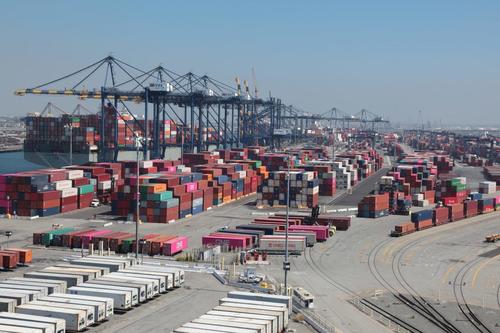
The Port of LA handled 946,966 twenty-foot equivalent units (TEUs) in April. “That’s a 37% spike compared to last year, when global trade dropped with the onset of the pandemic,” Seroka said. “This was by far the busiest April in the port’s 114-year history, outpacing the previous record set just back in 2019 by a hefty 29%.”
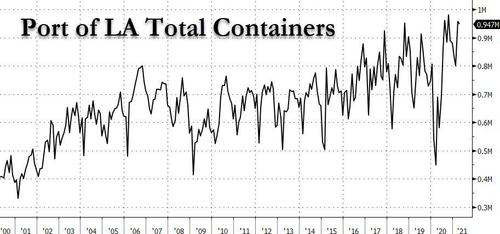
He said the port has recorded nine consecutive months of year-over-year volume increases following 11 straight months of declines. “Remarkably, we have continued to average 900,000 TEUs per month dating all the way back to last July.”
The port handled 89 container ships last month, up from 76 in April 2020. And those vessels are being handled efficiently, Seroka said. “We averaged 16 container vessels per day at berth last month. Please remember, before the surge our average was only about 10.”
Port congestion also has eased, according to Seroka.
“We’ve seen as few as 13 container vessels at anchor in the San Pedro Bay over recent days,” he said, noting there were 17 ships at anchor, with eight of them bound for the Port of LA, as of late morning Thursday.
“Another encouraging sign: Fewer ships are going straight to the holding area. We’ve dropped from 90% in February to 65% of vessels heading straight to anchor in the month of April. Average wait time is now 6.7 days after peaking out at 7.9 days in March,” Seroka said.
He noted that nine vessels were at anchor on April 30, representing an additional 132,000 TEUs that will be included in the May numbers.
Although congestion has eased, imports haven’t let up, Seroka said, reporting April import volume totaled 490,127 TEUs, a 32.4% year-over-year increase.
“Exports, however, continue to drag, with less than 115,000 TEUs on that side of the ledger, down 12%. Exports have now dropped 27 of the last 30 months here at Los Angeles,” he said.
“April’s import-export ratio was almost 4.3-to-1, which unfortunately is the highest gap we’ve seen yet,” Seroka said. “And the scramble for empties continues, with over 342,000 empty container units repositioned back to Asia in April. That’s just a few thousand TEUs shy of last month’s all-time record” and an 81.6% increase from April 2020.
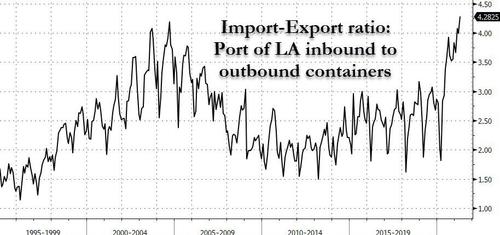
The figures for the first four months of 2021 are “off the charts,” he said. “We handled more than 3.5 million TEUs, a 42% increase compared to 2020.”
Seroka noted that total volume from Jan. 1 to April 30 was up 20% compared to the same period in “less-volatile” 2019.
https://www.zerohedge.com/markets/port-la-volumes-are-charts
May 17, 2021
Port of LA is Busy
Port Of LA Volumes Are “Off The Charts”
by Tyler DurdenMonday, May 17, 2021 – 06:10 PM
By Kim Link-Wills of Freight Waves,
The Port of Los Angeles continued its record-setting streak, posting the busiest April in its 114-year history.
“It’s truly been an unprecedented run here in LA,” Executive Director Gene Seroka said during a media briefing Thursday.
The Port of LA handled 946,966 twenty-foot equivalent units (TEUs) in April. “That’s a 37% spike compared to last year, when global trade dropped with the onset of the pandemic,” Seroka said. “This was by far the busiest April in the port’s 114-year history, outpacing the previous record set just back in 2019 by a hefty 29%.”
He said the port has recorded nine consecutive months of year-over-year volume increases following 11 straight months of declines. “Remarkably, we have continued to average 900,000 TEUs per month dating all the way back to last July.”
The port handled 89 container ships last month, up from 76 in April 2020. And those vessels are being handled efficiently, Seroka said. “We averaged 16 container vessels per day at berth last month. Please remember, before the surge our average was only about 10.”
Port congestion also has eased, according to Seroka.
“We’ve seen as few as 13 container vessels at anchor in the San Pedro Bay over recent days,” he said, noting there were 17 ships at anchor, with eight of them bound for the Port of LA, as of late morning Thursday.
“Another encouraging sign: Fewer ships are going straight to the holding area. We’ve dropped from 90% in February to 65% of vessels heading straight to anchor in the month of April. Average wait time is now 6.7 days after peaking out at 7.9 days in March,” Seroka said.
He noted that nine vessels were at anchor on April 30, representing an additional 132,000 TEUs that will be included in the May numbers.
Although congestion has eased, imports haven’t let up, Seroka said, reporting April import volume totaled 490,127 TEUs, a 32.4% year-over-year increase.
“Exports, however, continue to drag, with less than 115,000 TEUs on that side of the ledger, down 12%. Exports have now dropped 27 of the last 30 months here at Los Angeles,” he said.
“April’s import-export ratio was almost 4.3-to-1, which unfortunately is the highest gap we’ve seen yet,” Seroka said. “And the scramble for empties continues, with over 342,000 empty container units repositioned back to Asia in April. That’s just a few thousand TEUs shy of last month’s all-time record” and an 81.6% increase from April 2020.
The figures for the first four months of 2021 are “off the charts,” he said. “We handled more than 3.5 million TEUs, a 42% increase compared to 2020.”
Seroka noted that total volume from Jan. 1 to April 30 was up 20% compared to the same period in “less-volatile” 2019.
https://www.zerohedge.com/markets/port-la-volumes-are-charts
May 15, 2021
Brenntag Hit By Darkside
Darkside Retreats to the Dark
After announcing that its criminal infrastructure has been taken down due to U.S. law enforcement pressure, the Darkside ransomware gang says it’s retreating. But is it?
| Kim Zetter | 4 hr ago |

The Darkside gang began last Friday with a bang; but they may be ending their operations a week later with a whimper. Or they may be pulling another scam — this time to cheat affiliates out of their share of the ransom take.
After pulling in at least $9 million from two victims — $5 million paid by Colonial Pipeline on May 8 and about $4.4 million paid by the chemical distribution company Brenntag on May 11 — the developers behind the Darkside ransomware went offline.
Their dark web site — previously accessible only through the Tor browser — became unavailable on Thursday, and someone from a rival ransomware gang posted a message to a forum that was purportedly from the developer of the Darkside ransomware code. The message said the Darkside founders had lost access to the site where they hosted and published data stolen from ransomware victims who refused to pay, and they also lost access to the payment server and other infrastructure they need to collect payment and run their operations.
“A few hours ago, we lost access to the public part of our infrastructure, namely : Blog, Payment server, DOS servers,” reads a since-deleted message from a user called Darksupp, according to The Record, a publication of Recorded Future. The service provider that hosted the infrastructure told the Darkside operators that the sites and servers were taken down “at the request of law enfocement [sic] agencies.” Darksupp also said that cryptocurrency had been withdraw from the wallet they used to store payments from ransomware victims.
There’s reason to believe that at least some of this is true. Reuters and Bloomberg reported earlier this week that companies assisting Colonial Pipeline in their response to the incident worked with the FBI to get a hosting provider in New York to shut down a server that was storing data stolen from Colonial Pipeline before the thieves could transfer it to Russia, where the perpetrators are believed to be based.
And on Friday, Elliptic, a blockchain analytics company which also makes compliance tools for cryptocurrency businesses to monitor transactions, reported that it had identified the Bitcoin wallet used by the Darkside gang. The company said that on Thursday, the wallet — which still held $5 million in Bitcoin — was emptied.
Some have suggested this could be a ruse on the part of the Darkside gang to avoid sharing ransom proceeds with their affiliates who carried out the ransomware operation against Colonial Pipeline. Without knowing where the funds went, however, it’s difficult to know if the FBI seized it or if the Darkside gang emptied the wallet themselves.
The wallet, according to Elliptic, became active on March 4th and received 57 payments from 21 other Bitcoin wallets, totalling $17.5 million.
“Some of these payments directly match ransoms known to have been paid to DarkSide by other victims, such as 78.29 BTC (worth $4.4 million) sent by chemical distribution company Brenntag on May 11,” the company noted.
If authorities did seize $5 million in Bitcoin that was still sitting in the Darkside wallet, it’s only a fraction of what the criminal syndicate had already laundered out of the wallet since March.
According to Elliptic, about 18% of the wallet’s contents was sent to a small group of cryptocurrency exchanges, where Bitcoin is traded among buyers and sellers. “This information will provide law enforcement with critical leads to identify the perpetrators of these attacks,” the company noted. “An additional 4% has been sent to Hydra, the world’s largest darknet marketplace, servicing customers in Russia and neighboring countries.”
Hydra allows users to cash out their Bitcoin by converting it to cash or loading sums onto prepaid debit or gift cards.
In addition to Darkside’s retreat, another top ransomware group known as REvil has announced that it plans to stop advertising its ransomware service and instead “go private” by working with only a small group of trusted affiliates, The Record reported.
Some are cautioning that the moves by Darkside and REvil don’t mean their activity will stop; just that the operators plan to become less flashy in order to attract less law enforcement attention.
“I sincerely hope the Infosec community and media don’t lose their minds over thinking DarkSide is actually shutting down when it’s almost certainly a rebranding attempt to avoid the heat,” Robert M. Lee, CEO of the security firm Dragos wrote on Twitter on Friday.
 Everchem Updates Archive
  Sign Up for Email Updates