Current Affairs
June 14, 2021
Container Ship Consolidation
Top 10 Liners Control 85% Of The Container-Ship Market… And They’re Not Done Yet
by Tyler DurdenMonday, Jun 14, 2021 – 02:06 PM
By Greg Miller of FreightWaves,
The extreme consolidation within the container liner sector is the kind of thing owners of tankers and bulk carriers can only dream of. The latest data from Alphaliner highlights the extent of liner consolidation, how soon the rankings will change, and how newbuilding orders will render the carrier arena even more concentrated than it already is.
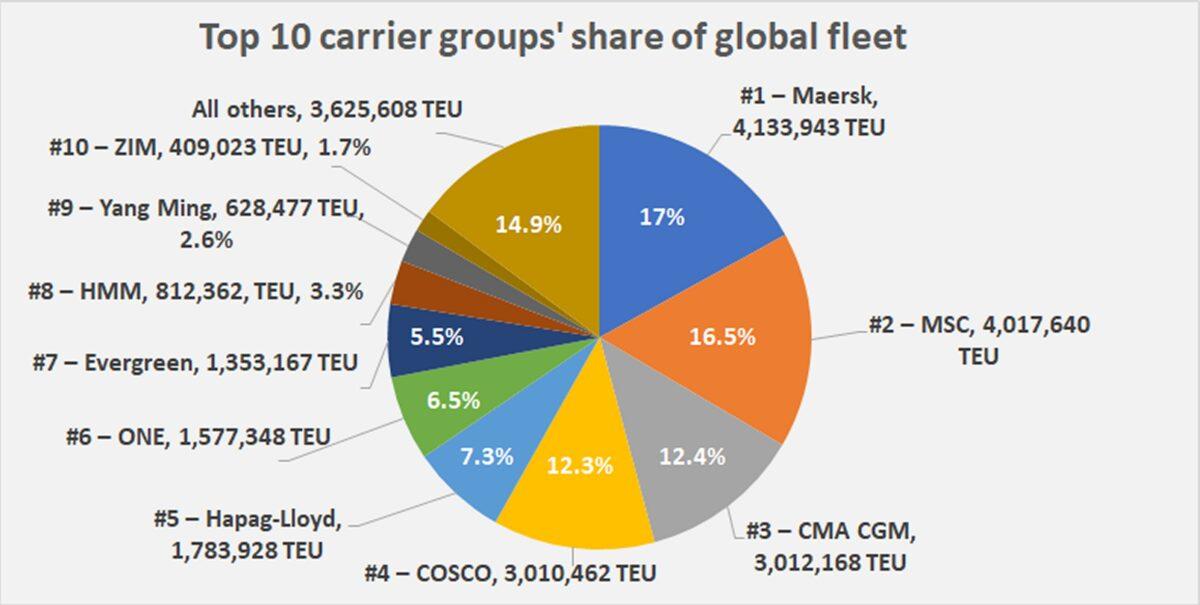
The top 10 carriers now operate 85% of global shipping capacity. Four groups — Maersk, MSC, CMA CGM and COSCO — control more than half of capacity (58%). The top seven, including Hapag-Lloyd, ONE and Evergreen, control 78%.TEU = twenty-foot equivalent unit (Chart: American Shipper based on data from Alphaliner)
This base level of fleet concentration is then greatly enhanced by the existence of three vessel-sharing alliances on the mainline East-West trades — 2M, the Ocean Alliance and THE Alliance — which count nine of the top 10 liner groups as members.
Big moves by MSC
The big mover at the top end of the liner rankings is MSC. The Switzerland-based carrier has been extremely active in the secondhand market, purchasing 49 vessels since August. It has also been busy in the charter market and very active in the newbuild market.
Including three secondhand ships it recently acquired, MSC just passed the 4 million-TEU (twenty-foot-equivalent unit) fleet milestone. Alphaliner noted that MSC’s fleet has increased 4% from the beginning of this year alone.
Including newbuilds on order, MSC effectively surpassed Maersk months ago to become the world’s largest carrier. Even in terms of ships on the water, it will take the crown soon. “The takeover could even happen before the end of the year, as MSC is to take delivery of four more 23,656-TEU ‘megamax’ newbuildings in the coming months,” said Alphaliner.
Newbuildings to hike carriers’ shares
When all newbuildings on order are delivered, MSC will pull far ahead of the pack. Although the sum of on-the-water tonnage and newbuild tonnage is not equivalent to future capacity (because there can be more orders in the interim, and ships can go on and off charter, be bought, sold, or scrapped), it does provide an indicator of future rankings.
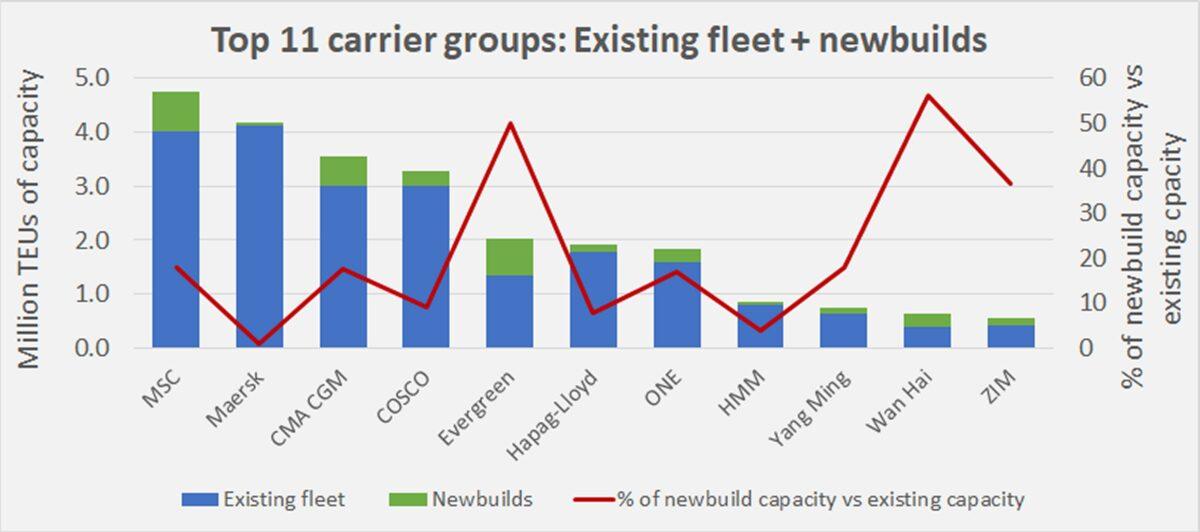
Maersk has the least on order of all the larger liner companies, with newbuild capacity of just 0.9% of on-the-water capacity. In sharp contrast, MSC’s orderbook is 18% of its operating fleet, according to Alphaliner data. The combined tonnage of existing ships and newbuilds for MSC is 4,742,400 TEUs, 14% and 34% above the same calculation for Maersk and CMA CGM, respectively.(Chart: American Shipper based on data from Alphaliner)
Beyond the “who has the biggest fleet” contest between Maersk and MSC, the broader and more important story is that the world’s top few carriers will be the overwhelming recipients of the new tonnage arriving in 2023-24 that was ordered starting in Q4 2020.
Among the other top players, the orderbook-to-fleet ratio of Wan Hai is 56%, Evergreen 50%, ZIM 37%, CMA CGM and Yang Ming 18%, ONE 17%, and COSCO 9%. These percentages will increase further as newbuilds ordered by non-operating owners are identified with their charterers over time.
A portion of this new capacity is replacement tonnage for older vessels, yet the newbuilding data implies that the top 10 liners’ capacity control will climb from its current 85% level in the direction of the 90s.
June 14, 2021
U.S. Vehicle Sales Top 19MM in April
June 14, 2021
U.S. Vehicle Sales Top 19MM in April
June 3, 2021
Container Ship Costs Spike
“People Are Panicking Now” – Container Ship Charter Rates “Have Gone Out Of Control”
by Tyler DurdenThursday, Jun 03, 2021 – 02:45 PM
By Greg Miller of American Shipper,
In a sign of just how frenzied the container market has become, a freight forwarder is reportedly paying $135,000 per day for a short-term charter of the S Santiago, a 15-year-old container ship with a capacity of 5,060 twenty-foot equivalent units (TEUs).
“Charter rates for short employment … have gone out of control,” said Alphaliner in its new weekly report.
“Depending on the sources, the ship would have obtained anything between $100,000 and $145,000 per day, an absolute historic high. The name of the charterer has not been fully confirmed, although it is believed to be a forwarder.”
An industry source speaking to American Shipper on condition of anonymity said the rate was $135,000 per day, the duration was 45-90 days (one round voyage with an option for a second) and the charterer was Chinese freight forwarder 3 Seas.
The source said that there is “more and more enquiry every day” with “people panicking now” amid “unprecedented times.”
Alphaliner said that “this colossal rate is substantially higher than the already whopping $70,000-$90,000 per day — depending on the final duration — agreed recently by Hapag-Lloyd for a two- to three-month employment of the 4,308-TEU CMA CGM Opal.”
The industry source told American Shipper that the S Santiago deal was concluded last week and that he wouldn’t be surprised if a new record were reached this week.
According to U.K.-based valuation and data provider VesselsValue, the 2006-built S Santiago is owned by Cyprus Sea Lines and is currently valued at $38.48 million.
To put the enormity of the charter deal in perspective, the shipowner will earn back one-sixth of the ship’s value in a single voyage — and one-third of the vessel’s value if the charterer takes the option for the second voyage.
What this means for cargo shippers
The historic S Santiago transaction is yet another big red flag for cargo shippers. Charter rates like this only make sense if freight rates are high enough for the charterer to turn a profit.
It also underscores just how tight vessel supply is.
Alphaliner reported that only 2.7% of the global container fleet was inactive as of May 24, totaling 660,662 TEUs. Of that, 70% (461,779 TEUs) was inactive due to ships being in the yards for repairs or maintenance.
And cargo shippers will not be getting any relief in the near or medium term from newbuild deliveries.
There has been a surge of orders recently, but those are for 2023-2024 deliveries. Clarksons Research Services estimates that fleet growth in 2022 will fall to 2.5% from 4.6% this year.
What this means for ship lessors
The S Santiago rate was so high because ship lessors, otherwise known as non-operating owners (NOOs), much prefer to put their tonnage on multiyear charters and lock in long-term profits.
“Those electing to accept short-term charters are likely doing so to capture fantasy rates near term,” said Fearnley Securities, referring to the “off the charts” S Santiago transaction.
According to Alphaliner, “The market has become one of long-term charters, with 43 of the 51 fixtures reported in the past two weeks concluded for durations of 24 months or over.” Of that total, three charters were for five years’ duration, nine were for four years, 10 for three years and the remainder for two years.
“The medium-term prospects remain bright for NOOs,” affirmed Alphaliner. Listed NOOs include Costamare, Danaos Corp., Seaspan owner Atlas Corp., Global Ship Lease, Navios Partners, Euroseas, Capital Product Partners and MPC Containers.
What this means for liners
The record-setting charter market implies medium-term downside risk for liner companies.
Today’s unprecedented freight income more than offsets stratospheric charter costs, but NOOs are forcing liner operators to accept longer durations to get the ships. If freight rates were to fall significantly by 2023-24, charter rates negotiated in 2021 will be much more painful to liners’ bottom lines.
ZIM offers the most extreme example, because unlike other liners, it charters its entire fleet and does not own vessels. As of Sept. 30, 2020, 71% of its capacity was chartered for a year or less. The company touted the advantage in its IPO prospectus, stating, “Short-term charter arrangements allow us to adjust our capacity quickly in anticipation of, or in response to, changing market conditions.”
But as ZIM has rapidly increased its fleet size to capture freight-rate upside, charter durations have ballooned. Its fleet size nearly doubled from 59 vessels in mid-May 2020 to 110 as of mid-May 2021.
According to Alphaliner, charters by ZIM over the past month include the 6,648-TEU Kobe for 44-48 months at $45,000 per day; an extension of its charter of the 9,784-TEU Santa Linea for 40 months at $42,500 per day starting in Q1 2022; and an extension of its charter of the 3,534-TEU Bach for 36-38 months at $31,250 per day.
During the latest quarterly conference call, ZIM CFO Xavier Destriau conceded a shift to longer durations out of necessity.
“We will continue to bring in vessels in order to capture [revenue] from new lines we are opening and to renew existing charters,” said Destriau. “We are not changing our strategy, which is to continue to rely on the charter market. What is changing is the allocation of short-term charters versus long-term charters due to the current market conditions, obviously.”
https://www.zerohedge.com/markets/container-ship-scores-charts-fantasy-charter-rate-135000day
June 3, 2021
Container Ship Costs Spike
“People Are Panicking Now” – Container Ship Charter Rates “Have Gone Out Of Control”
by Tyler DurdenThursday, Jun 03, 2021 – 02:45 PM
By Greg Miller of American Shipper,
In a sign of just how frenzied the container market has become, a freight forwarder is reportedly paying $135,000 per day for a short-term charter of the S Santiago, a 15-year-old container ship with a capacity of 5,060 twenty-foot equivalent units (TEUs).
“Charter rates for short employment … have gone out of control,” said Alphaliner in its new weekly report.
“Depending on the sources, the ship would have obtained anything between $100,000 and $145,000 per day, an absolute historic high. The name of the charterer has not been fully confirmed, although it is believed to be a forwarder.”
An industry source speaking to American Shipper on condition of anonymity said the rate was $135,000 per day, the duration was 45-90 days (one round voyage with an option for a second) and the charterer was Chinese freight forwarder 3 Seas.
The source said that there is “more and more enquiry every day” with “people panicking now” amid “unprecedented times.”
Alphaliner said that “this colossal rate is substantially higher than the already whopping $70,000-$90,000 per day — depending on the final duration — agreed recently by Hapag-Lloyd for a two- to three-month employment of the 4,308-TEU CMA CGM Opal.”
The industry source told American Shipper that the S Santiago deal was concluded last week and that he wouldn’t be surprised if a new record were reached this week.
According to U.K.-based valuation and data provider VesselsValue, the 2006-built S Santiago is owned by Cyprus Sea Lines and is currently valued at $38.48 million.
To put the enormity of the charter deal in perspective, the shipowner will earn back one-sixth of the ship’s value in a single voyage — and one-third of the vessel’s value if the charterer takes the option for the second voyage.
What this means for cargo shippers
The historic S Santiago transaction is yet another big red flag for cargo shippers. Charter rates like this only make sense if freight rates are high enough for the charterer to turn a profit.
It also underscores just how tight vessel supply is.
Alphaliner reported that only 2.7% of the global container fleet was inactive as of May 24, totaling 660,662 TEUs. Of that, 70% (461,779 TEUs) was inactive due to ships being in the yards for repairs or maintenance.
And cargo shippers will not be getting any relief in the near or medium term from newbuild deliveries.
There has been a surge of orders recently, but those are for 2023-2024 deliveries. Clarksons Research Services estimates that fleet growth in 2022 will fall to 2.5% from 4.6% this year.
What this means for ship lessors
The S Santiago rate was so high because ship lessors, otherwise known as non-operating owners (NOOs), much prefer to put their tonnage on multiyear charters and lock in long-term profits.
“Those electing to accept short-term charters are likely doing so to capture fantasy rates near term,” said Fearnley Securities, referring to the “off the charts” S Santiago transaction.
According to Alphaliner, “The market has become one of long-term charters, with 43 of the 51 fixtures reported in the past two weeks concluded for durations of 24 months or over.” Of that total, three charters were for five years’ duration, nine were for four years, 10 for three years and the remainder for two years.
“The medium-term prospects remain bright for NOOs,” affirmed Alphaliner. Listed NOOs include Costamare, Danaos Corp., Seaspan owner Atlas Corp., Global Ship Lease, Navios Partners, Euroseas, Capital Product Partners and MPC Containers.
What this means for liners
The record-setting charter market implies medium-term downside risk for liner companies.
Today’s unprecedented freight income more than offsets stratospheric charter costs, but NOOs are forcing liner operators to accept longer durations to get the ships. If freight rates were to fall significantly by 2023-24, charter rates negotiated in 2021 will be much more painful to liners’ bottom lines.
ZIM offers the most extreme example, because unlike other liners, it charters its entire fleet and does not own vessels. As of Sept. 30, 2020, 71% of its capacity was chartered for a year or less. The company touted the advantage in its IPO prospectus, stating, “Short-term charter arrangements allow us to adjust our capacity quickly in anticipation of, or in response to, changing market conditions.”
But as ZIM has rapidly increased its fleet size to capture freight-rate upside, charter durations have ballooned. Its fleet size nearly doubled from 59 vessels in mid-May 2020 to 110 as of mid-May 2021.
According to Alphaliner, charters by ZIM over the past month include the 6,648-TEU Kobe for 44-48 months at $45,000 per day; an extension of its charter of the 9,784-TEU Santa Linea for 40 months at $42,500 per day starting in Q1 2022; and an extension of its charter of the 3,534-TEU Bach for 36-38 months at $31,250 per day.
During the latest quarterly conference call, ZIM CFO Xavier Destriau conceded a shift to longer durations out of necessity.
“We will continue to bring in vessels in order to capture [revenue] from new lines we are opening and to renew existing charters,” said Destriau. “We are not changing our strategy, which is to continue to rely on the charter market. What is changing is the allocation of short-term charters versus long-term charters due to the current market conditions, obviously.”
https://www.zerohedge.com/markets/container-ship-scores-charts-fantasy-charter-rate-135000day
 Everchem Updates Archive
 Sign Up for Email Updates