
Current Affairs
May 2, 2021
Driver Shortage
$70,000 For A Part-Time Driver
by Tyler DurdenSunday, May 02, 2021 – 05:00 PM
By John Kingston of Freightwaves,
David Parker is the CEO of Covenant Logisticsand he was blunt with analysts who follow the company on its earnings call Tuesday.
“How do we get enough drivers?” he said in response to a question from Stephens analyst Jack Atkins. “I don’t know.”
Parker then gave an overview of the situation facing Covenant, and by extension other companies, in trying to recruit drivers. One problem: With rates so high, companies are encountering the fact that a driver doesn’t need to work a full schedule to pull in a decent salary.
“We’re finding out that just to get a driver, let’s say the numbers are $85,000 (per year),” Parker said, according to a transcript of the earnings call supplied by SeekingAlpha. “But a lot of these drivers are happy at $70,000. Now they’re not coming to work for me, unless it’s in the ($80,000s), because they’re happy making $70,000.”
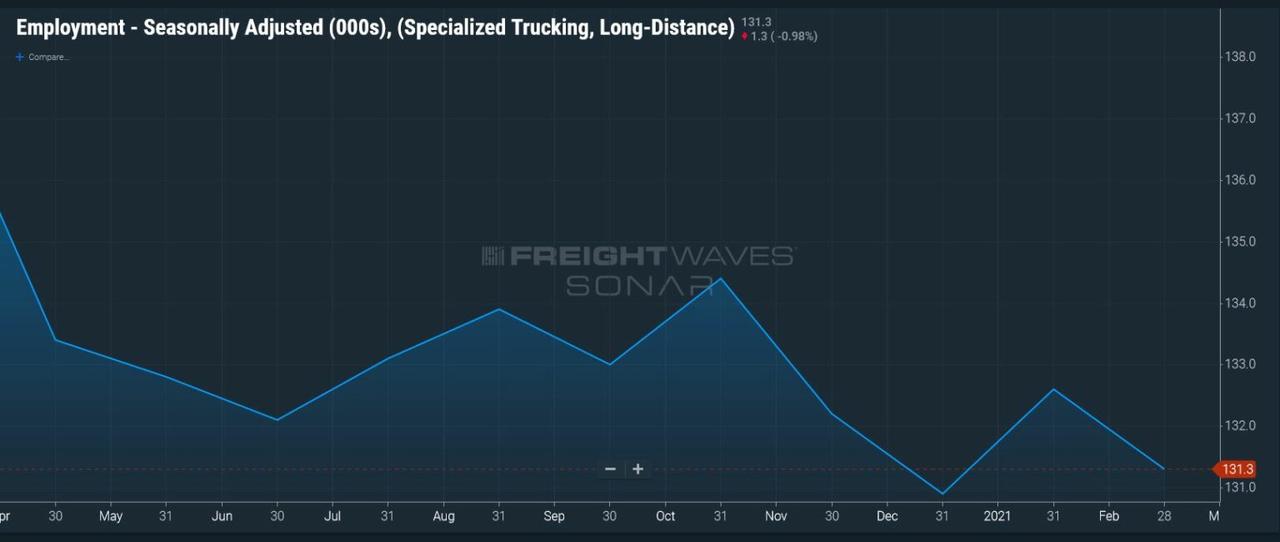
What’s happening, he said, is that drivers are looking at the fact that they can make $70,000 “and stay home a little more.”
The result is a tightening of capacity. Parker said utilization in the first quarter at Covenant was three or four percentage points less than it would have as a result of that development. “It’s an interesting dynamic that none of us have calculated,” he said.
To put the numbers in perspective, Todd Amen, the president of ATBS, which prepares taxes for mostly independent owner-operators, said in a recent interview with the FreightWaves Drilling Deep podcast that the average tax return his company prepared for drivers’ 2020 pay was $67,500. He also said his company prepared numerous 2020 returns with pay in excess of $100,000.
Parker was firm that this was not a situation likely to change soon. “There’s nothing out there that tells me that drivers are going to readily be available over the medium [term in] one to two years,” he said. “And that’s where I’m at.”
Paul Bunn, the company’s COO and senior executive vice president, echoed what other executives have said recently: Additional stimulus benefits are making the situation tighter. He said that while offering some hope that as the benefits roll off, “that might help a bit.”
But what the government giveth the government can sometimes taketh away. Bunn expressed another familiar sentiment in the industry today, that an infrastructure bill adding to demand for workers would create more difficulty to put drivers behind the wheel. Construction, Bunn said, is “a monster competitor of our industry” and if the bill is approved, “that’s going to be a big pull.”
Labor is going to be a “capacity constraint” through the economy, Bunn said, while conceding that trucking is not unique in that. And because of that labor squeeze, capacity in many fields is going to be limited. “The OEMs, the manufacturers are limited capacity,” Bunn said. “They’re not ramping up in a major, major way because of labor, because of commodity pricing, because of the costs.”
All that means is that capacity growth is going to be “reasonable,” Bunn said. “It’s not going to be crazy, people growing fleets [by] significant amounts.”
“It’s all you can do just to hold serve,” he added.
While the driver situation is tough, it didn’t notably hurt the first-quarter performance of Covenant. To open the call, Joey Hogan, Covenant’s co-president, highlighted some of the company’s first-quarter numbers: a 6% growth in operating revenue on a strategic reduction in the number of company tractors and the best first-quarter net income figure in its history.
Beyond the market for drivers, Parker said the freight market is “hot” and likely to stay that way.
“We are at 7%, 8% GDP growth, that goes to 5%, well, probably, or it could stay 7% or 8%,” he said. “But it’s still going to be numbers that you and I have never sensed or felt from a freight standpoint. And so I don’t see that letting up, I see that a solid couple of years of being in that kind of environment.”
Given that, Parker and other Covenant managers used the occasion of the earnings call to drive home with more detail a point the company made in its earnings statement a day earlier: It intends to get higher rates out of some of its Dedicated customers. While the company’s Expedited division saw its operating ratio improve to 91% from 102.3% a year earlier, the Dedicated division saw its OR remain above 100%.
The Dedicated division, Bunn said, has two types of customers. One is a group with high returns, “and we want more of those,” he said. “We’re going to go to the customers [where] we have that and say, ‘Can we have more of your business?’”
The other are customers that Bunn referred to as “commoditized.” Those customers are going to need to “value” the Dedicated service provides “or we’re going to give those trucks to somebody who’s in the first bucket.”
Trucks won’t just get “yanked” out, Bunn said. But “we’re not going to run Dedicated with a 98, 99 or 100 OR,” he added.
But even though Covenant, like other carriers, has leverage in negotiations given the tight market for capacity, it does need to be handled with a certain degree of aplomb, Hogan said. Hogan was talking about the company’s Expedited division when he said that in price negotiations, a company needs to be “respectful” as prices get up to “that line where they say, ‘Well, I’m going to grow my own [transportation].’”
Another possibility: rail. “When does the price push them to the rail?” he asked.
However, the Expedited division is “in a good spot for at least a couple of years,” Hogan said. That’s aided by the fact that inventories are “stupid low” across the supply chain, he added.
May 2, 2021
Driver Shortage
$70,000 For A Part-Time Driver
by Tyler DurdenSunday, May 02, 2021 – 05:00 PM
By John Kingston of Freightwaves,
David Parker is the CEO of Covenant Logisticsand he was blunt with analysts who follow the company on its earnings call Tuesday.
“How do we get enough drivers?” he said in response to a question from Stephens analyst Jack Atkins. “I don’t know.”
Parker then gave an overview of the situation facing Covenant, and by extension other companies, in trying to recruit drivers. One problem: With rates so high, companies are encountering the fact that a driver doesn’t need to work a full schedule to pull in a decent salary.
“We’re finding out that just to get a driver, let’s say the numbers are $85,000 (per year),” Parker said, according to a transcript of the earnings call supplied by SeekingAlpha. “But a lot of these drivers are happy at $70,000. Now they’re not coming to work for me, unless it’s in the ($80,000s), because they’re happy making $70,000.”
What’s happening, he said, is that drivers are looking at the fact that they can make $70,000 “and stay home a little more.”
The result is a tightening of capacity. Parker said utilization in the first quarter at Covenant was three or four percentage points less than it would have as a result of that development. “It’s an interesting dynamic that none of us have calculated,” he said.
To put the numbers in perspective, Todd Amen, the president of ATBS, which prepares taxes for mostly independent owner-operators, said in a recent interview with the FreightWaves Drilling Deep podcast that the average tax return his company prepared for drivers’ 2020 pay was $67,500. He also said his company prepared numerous 2020 returns with pay in excess of $100,000.
Parker was firm that this was not a situation likely to change soon. “There’s nothing out there that tells me that drivers are going to readily be available over the medium [term in] one to two years,” he said. “And that’s where I’m at.”
Paul Bunn, the company’s COO and senior executive vice president, echoed what other executives have said recently: Additional stimulus benefits are making the situation tighter. He said that while offering some hope that as the benefits roll off, “that might help a bit.”
But what the government giveth the government can sometimes taketh away. Bunn expressed another familiar sentiment in the industry today, that an infrastructure bill adding to demand for workers would create more difficulty to put drivers behind the wheel. Construction, Bunn said, is “a monster competitor of our industry” and if the bill is approved, “that’s going to be a big pull.”
Labor is going to be a “capacity constraint” through the economy, Bunn said, while conceding that trucking is not unique in that. And because of that labor squeeze, capacity in many fields is going to be limited. “The OEMs, the manufacturers are limited capacity,” Bunn said. “They’re not ramping up in a major, major way because of labor, because of commodity pricing, because of the costs.”
All that means is that capacity growth is going to be “reasonable,” Bunn said. “It’s not going to be crazy, people growing fleets [by] significant amounts.”
“It’s all you can do just to hold serve,” he added.
While the driver situation is tough, it didn’t notably hurt the first-quarter performance of Covenant. To open the call, Joey Hogan, Covenant’s co-president, highlighted some of the company’s first-quarter numbers: a 6% growth in operating revenue on a strategic reduction in the number of company tractors and the best first-quarter net income figure in its history.
Beyond the market for drivers, Parker said the freight market is “hot” and likely to stay that way.
“We are at 7%, 8% GDP growth, that goes to 5%, well, probably, or it could stay 7% or 8%,” he said. “But it’s still going to be numbers that you and I have never sensed or felt from a freight standpoint. And so I don’t see that letting up, I see that a solid couple of years of being in that kind of environment.”
Given that, Parker and other Covenant managers used the occasion of the earnings call to drive home with more detail a point the company made in its earnings statement a day earlier: It intends to get higher rates out of some of its Dedicated customers. While the company’s Expedited division saw its operating ratio improve to 91% from 102.3% a year earlier, the Dedicated division saw its OR remain above 100%.
The Dedicated division, Bunn said, has two types of customers. One is a group with high returns, “and we want more of those,” he said. “We’re going to go to the customers [where] we have that and say, ‘Can we have more of your business?’”
The other are customers that Bunn referred to as “commoditized.” Those customers are going to need to “value” the Dedicated service provides “or we’re going to give those trucks to somebody who’s in the first bucket.”
Trucks won’t just get “yanked” out, Bunn said. But “we’re not going to run Dedicated with a 98, 99 or 100 OR,” he added.
But even though Covenant, like other carriers, has leverage in negotiations given the tight market for capacity, it does need to be handled with a certain degree of aplomb, Hogan said. Hogan was talking about the company’s Expedited division when he said that in price negotiations, a company needs to be “respectful” as prices get up to “that line where they say, ‘Well, I’m going to grow my own [transportation].’”
Another possibility: rail. “When does the price push them to the rail?” he asked.
However, the Expedited division is “in a good spot for at least a couple of years,” Hogan said. That’s aided by the fact that inventories are “stupid low” across the supply chain, he added.
April 28, 2021
Anti-Dumping Duties on TDI in India
TDI imports: Finmin imposes anti-dumping from EU, US, Chinese Taipei, Japan and South Korea
K.R.Srivats New Delhi | Updated on April 28, 2021
DGTR had recommended imposition of definitive anti-dumping duty, this January
The Finance Ministry has imposed a definitive anti-dumping duty on imports of Toluene Diisocyanate (TDI), an organic chemical, from the Chinese Taipei, EU, Japan, South Korea and the US.
This revenue department move comes after the Designated Authority in the Directorate General of Trade Remedies (DGTR), in January this year, had recommended imposition of definitive anti-dumping duty on TDI imports from these countries.
Narmada Chematur Petrochemicals Ltd, the sole producer of TDI in the country, had filed the petition seeking anti-dumping duty on TDI imports from the Chinese Taipei, EU, Japan, South Korea and the US.
TDI usage
TDI is a clear liquid and is used in the production of flexible polyurethane foam, which is used for cushioning for a variety of consumer and commercial products, including bedding, furniture, automotive interiors, carpet underlay and packaging.
In the case of TDI produced by Covestro Deutschland AG and exported from EU, the anti-dumping duty has been pegged at $221.04 per tonne. For TDI produced by Borsod Chem Zrt, the anti dumping duty has been pegged at $102.05 per tonne. For all other producers from the EU, the anti-dumping duty has been pegged at $264.96 per tonne.
The revenue department has imposed an anti-dumping duty of $217.55 per tonne on TDI produced by Sadara Chemical Company, Saudi Arabia. For all other producers from Saudi Arabia, the anti dumping duty has been pegged at $344.33 per tonne.
For TDI imports from Chinese Taipei, the anti-dumping duty has been pegged at $274.39 per tonne. In the case of TDI imports from United Arab Emirates (UAE), the anti-dumping duty has been pegged at $368.20 per tonne.
The definitive anti-dumping duty will be valid for five years from the date of imposition of provisional anti-dumping duty, which happened to be December 2 last year, the revenue department has said.
April 28, 2021
Anti-Dumping Duties on TDI in India
TDI imports: Finmin imposes anti-dumping from EU, US, Chinese Taipei, Japan and South Korea
K.R.Srivats New Delhi | Updated on April 28, 2021
DGTR had recommended imposition of definitive anti-dumping duty, this January
The Finance Ministry has imposed a definitive anti-dumping duty on imports of Toluene Diisocyanate (TDI), an organic chemical, from the Chinese Taipei, EU, Japan, South Korea and the US.
This revenue department move comes after the Designated Authority in the Directorate General of Trade Remedies (DGTR), in January this year, had recommended imposition of definitive anti-dumping duty on TDI imports from these countries.
Narmada Chematur Petrochemicals Ltd, the sole producer of TDI in the country, had filed the petition seeking anti-dumping duty on TDI imports from the Chinese Taipei, EU, Japan, South Korea and the US.
TDI usage
TDI is a clear liquid and is used in the production of flexible polyurethane foam, which is used for cushioning for a variety of consumer and commercial products, including bedding, furniture, automotive interiors, carpet underlay and packaging.
In the case of TDI produced by Covestro Deutschland AG and exported from EU, the anti-dumping duty has been pegged at $221.04 per tonne. For TDI produced by Borsod Chem Zrt, the anti dumping duty has been pegged at $102.05 per tonne. For all other producers from the EU, the anti-dumping duty has been pegged at $264.96 per tonne.
The revenue department has imposed an anti-dumping duty of $217.55 per tonne on TDI produced by Sadara Chemical Company, Saudi Arabia. For all other producers from Saudi Arabia, the anti dumping duty has been pegged at $344.33 per tonne.
For TDI imports from Chinese Taipei, the anti-dumping duty has been pegged at $274.39 per tonne. In the case of TDI imports from United Arab Emirates (UAE), the anti-dumping duty has been pegged at $368.20 per tonne.
The definitive anti-dumping duty will be valid for five years from the date of imposition of provisional anti-dumping duty, which happened to be December 2 last year, the revenue department has said.
April 28, 2021
Composites Overview
4/28/2021 |
Playing hard-to-get
The global pandemic, shipping woes and winter storms have wreaked havoc on the composites supply chain. CW attempts to find out how widespread the problem is.
#editorial
Jeff Sloan Editor-in-Chief, CompositesWorld

Photo Credit: Getty Images
If you are reading this, there is a very good chance that you are involved in the composites industry somehow. And if you are involved in the composites industry somehow, there is a very good chance that you design or fabricate composite parts and structures and use polymer-based resin systems and fiber-based reinforcements. And if this is the case, then I don’t need to tell you that the supply of many of the resin and fiber materials used by the composites industry have been, over the last few months, in very short supply.
There are multiple reasons for these shortages, and there are multiple material types being affected, but it appears most of the most pain has been felt in the epoxy resin supply chain and the glass fiber supply chain. CW has already reported on the latter in a story you can find on p. 16 of the May 2021 issue, or on the CW website here: “Glass fiber supply chain struggles amid pandemic, economic recovery.” I also discussed the glass fiber supply situation in my March 2021 editorial.
Featured Content
Challenges of laser-assisted tape winding of thermoplastic composites Increasing demand for composite driveshafts leads to automated production Composite testing challenges, Part 1: Introduction to mechanical testing of composites
The resin shortage, however, has a different genesis. It was triggered primarily by Winter Storm Uri that afflicted Texas and other southern U.S. states in mid-February 2021. This fast-moving front brought sudden and unusual freezing temperatures as far south as Houston, Texas, which is home to a variety of petroleum-based processing facilities, including oil refineries and polymer manufacturing plants. The cold temperatures disrupted supply of water, natural gas and electricity, thus forcing the facility owners to declare force majeure and shut down.
Hexion (Columbus, Ohio, U.S.), which produces bisphenol-A (BPA, a key ingredient of epoxy) at two facilities in Texas, was forced to cease operations. Similarly, epoxy specialist Olin (Clayton, Miss., U.S.) was forced to shut down all operations at its facilities in Texas, Louisiana, Mississippi and Alabama. These and other shutdowns were consequential not just for the epoxy supply chain, but the vinyl ester supply chain as well, which requires epoxy.
To assess the impact of these widespread shortages, CW, working with Gardner Intelligence (CW and Gardner Intelligence are owned by Gardner Business Media), sent a supply chain survey to the CW audience in early April 2021. We received 144 responses, and from those, learned much about the state of resin and fiber supply. Some highlights:
- When asked which resin systems have been more difficult than usual to acquire in the last three months, 49% of those who responded listed vinyl ester; 49% also listed polyester and 36% listed epoxy.
- When asked which fiber types have been more difficult than usual to acquire in the last three months, 78% of those who responded listed glass fiber; 39% listed carbon fiber.
- The fiber formats in shortest supply, according to respondents, were roving (52%), chopped fiber (43%), woven fabrics (35%) and UD tape (20%).
- The core material in shortest supply was foam (53%).
- The reasons cited for the disruptions was balanced: Shipping delays, not weather-related (56%), high demand (48%), inclement weather (36%). Interestingly, we allowed respondents to list other reasons for disruptions, and “COVID-19” topped that list.
Significantly, we asked how supply chain disruptions have affected the ability to meet customer or contract obligations for delivery of finished parts. Responses here were on a 0-100 sliding scale — the bigger the number the greater the impact. Sixty-two percent of respondents fell in the 51-100 range, which indicates moderate to substantial impact on manufacturing operations.
We also asked respondents to look ahead and estimate when the supply situation would return to normal. The leader here was “unknown,” with 41%, followed by “more than 16 weeks from now,” at 28%. And when asked how concerned respondents were about how the supply disruptions would affect their operations, 55% were either moderately or extremely concerned.
Of course, when supplies tighten, there are options. The vast majority of respondents (65%) said they have communicated the problem to their customers. A large fraction (41%) also sought materials from other suppliers or used an alternative material (38%).
Signals from suppliers and anecdotal feedback we’ve received indicate that this tightening in the supply chain will continue into the summer and possibly the early fall as raw materials and staffing levels return to normal. If you have a story to share about your supply chain challenges, feel free to contact me at jeff@compositesworld.com. And keep an eye on your inbox for this survey — we will send it again soon to find if and how the supply situation is improving.
https://www.compositesworld.com/articles/playing-hard-to-get
 Everchem Updates Archive
  Sign Up for Email Updates