
Current Affairs
April 10, 2021
Inflation Pressure
Producer Prices Blow Out
by Wolf Richter • Apr 9, 2021 •
And companies have been reporting that they’re able to pass on those surging costs. So here we go with inflation.
By Wolf Richter for WOLF STREET.
Inflation that producers are experiencing is now blowing out. The surging input costs and the ability to pass on those higher input costs that have been reported by company executives as part of the services PMIs and manufacturing PMIs, and that owners of small businesses have told me about for months, have now solidly fired up the Producer Price Index for final demand, which in March jumped by 1.0% from February – double the rate that economists polled by Reuters had forecast – after having jumped 0.5% in February, and 1.3% in January. The PPI has now taken off, after hovering in fairly benign territory last year.
Compared to March last year, the PPI jumped by 4.2%, the sharpest year-over-year increase since 2011, according to the Bureau of Labor Statistics today. Note the surge over the past three months (data via YCharts):
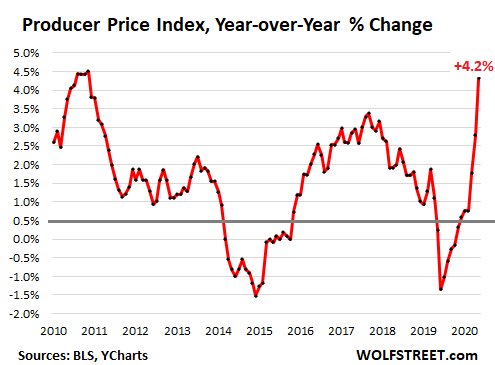
The “Base Effect” that I discussed yesterday can be blamed for only a portion of the year-over-year increase. A big part of the base effect is going to come in April.
The PPI hit a high in January 2020 with an index value of 119.2. In February and March last year, it dropped 0.5% from the prior month, and in April it plunged 1.1% to an index value of 116.7, driven by the collapse in fuel prices. And that was it in terms of declines. It has been rising ever since (data via YCharts):
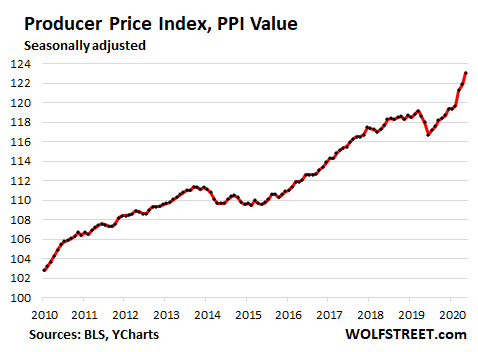
What might April look like? Today’s index value at 123.1 is already 5.5% higher than that of April last year. If the PPI rises 0.5% in April from today’s level, it would make for a 6% year-over-year increase, the highest since the index was started in November 2009. And this would include the full brunt of the base effect.
The index for prices of goods soared 1.7% in March from February, the biggest increase since the data series was started in 2009. Energy costs jumped 5.9% for the month. Within that, gasoline prices jumped 8.8%.
The index for prices of services jumped 0.7%, the third month in a row of increases. These services include wholesaling of machinery and vehicles, which soared 6.7% in March from February, confirming the giant jumps in wholesale prices for used vehicles that I reported on March 27 based on weekly auction data.
Excluding prices of foods, energy, and trade services, the index jumped 0.6% for the month and was up 3.1% year-over-year.
So here we go with inflation pressures building up in the pipeline. The producer price index measures inflation for companies – input cost increases. And these companies are now reporting in the PMIs that they’re able to pass on those price increases, ultimately to consumers.
Enjoy reading WOLF STREET and want to support it? Using ad blockers – I totally get why – but want to support the site? You can donate. I appreciate it immensely. Click on the beer and iced-tea mug to find out how:

Would you like to be notified via email when WOLF STREET publishes a new article? Sign up here.
April 10, 2021
Inflation Pressure
Producer Prices Blow Out
by Wolf Richter • Apr 9, 2021 •
And companies have been reporting that they’re able to pass on those surging costs. So here we go with inflation.
By Wolf Richter for WOLF STREET.
Inflation that producers are experiencing is now blowing out. The surging input costs and the ability to pass on those higher input costs that have been reported by company executives as part of the services PMIs and manufacturing PMIs, and that owners of small businesses have told me about for months, have now solidly fired up the Producer Price Index for final demand, which in March jumped by 1.0% from February – double the rate that economists polled by Reuters had forecast – after having jumped 0.5% in February, and 1.3% in January. The PPI has now taken off, after hovering in fairly benign territory last year.
Compared to March last year, the PPI jumped by 4.2%, the sharpest year-over-year increase since 2011, according to the Bureau of Labor Statistics today. Note the surge over the past three months (data via YCharts):
The “Base Effect” that I discussed yesterday can be blamed for only a portion of the year-over-year increase. A big part of the base effect is going to come in April.
The PPI hit a high in January 2020 with an index value of 119.2. In February and March last year, it dropped 0.5% from the prior month, and in April it plunged 1.1% to an index value of 116.7, driven by the collapse in fuel prices. And that was it in terms of declines. It has been rising ever since (data via YCharts):
What might April look like? Today’s index value at 123.1 is already 5.5% higher than that of April last year. If the PPI rises 0.5% in April from today’s level, it would make for a 6% year-over-year increase, the highest since the index was started in November 2009. And this would include the full brunt of the base effect.
The index for prices of goods soared 1.7% in March from February, the biggest increase since the data series was started in 2009. Energy costs jumped 5.9% for the month. Within that, gasoline prices jumped 8.8%.
The index for prices of services jumped 0.7%, the third month in a row of increases. These services include wholesaling of machinery and vehicles, which soared 6.7% in March from February, confirming the giant jumps in wholesale prices for used vehicles that I reported on March 27 based on weekly auction data.
Excluding prices of foods, energy, and trade services, the index jumped 0.6% for the month and was up 3.1% year-over-year.
So here we go with inflation pressures building up in the pipeline. The producer price index measures inflation for companies – input cost increases. And these companies are now reporting in the PMIs that they’re able to pass on those price increases, ultimately to consumers.
Enjoy reading WOLF STREET and want to support it? Using ad blockers – I totally get why – but want to support the site? You can donate. I appreciate it immensely. Click on the beer and iced-tea mug to find out how:
Would you like to be notified via email when WOLF STREET publishes a new article? Sign up here.
April 5, 2021
PFA Spring Meeting
Polyurethane Foam Association To Offer “Hybrid” Meeting Format
For Spring
The May 26-27 Meeting Will Be Held Live in St. Petersburg, FL And Streamed Online
LOUDON, TN (April 5, 2021)—The Polyurethane Foam Association’s Spring Meeting May 26-
27 will be conducted in a “hybrid” format, with both a live meeting at the Vinoy Renaissance in
St. Petersburg, FL, and a virtual portal for online participation. Registration details are available
at www.pfa.org/2021-spring-meeting.
PFA conducted a poll of members in early March, and respondents strongly favored the hybrid
approach, allowing members to choose in-person or online participation based on health
considerations and company travel policies.
The Vinoy Renaissance has reopened with limited capacity, and has protocols in place to
enhance safety, including mandatory masks in indoor public areas, social distancing, and
frequent sanitation.
“From the moment we opened the registration website, we had people signing up to come to the
live meeting,” noted Russ Batson, PFA’s Executive Director “Many people are eager to get back
to networking and attending conferences. I’ve had several people comment that the constrained
schedule of industry events last year made them realize how much they enjoy getting together
and interacting with colleagues and peers.”
“We wanted to provide our membership with as much flexibility as possible, because we’re still
in a very fluid situation,” said Chip Holton of NCFI Polyurethanes, PFA’s President. “We are
fortunate to have a long-standing relationship with a superb property in the Vinoy Renaissance,
which has taken exceptional measures to protect its guests. And we have the technology
available to connect other members who may not be there in person, but can participate and
contribute remotely.”
The meeting will feature an Industry Issues Session, which will cover topics including
isocyanates, auto industry trends, regulatory topics, and raw material/logistics challenges. A
Technical Program will feature presentations on new flexible foam formulations, manufacturing,
and recycling. A General Business Session will cover association business, celebrate PFA’s 40 th
Anniversary, and feature a keynote address from author Stephen Vogel.
Vogel is the author of Betrayal in Berlin: The True Story of the Cold War’s Most Audacious
Espionage Operation, published in 2019 by Custom House, a William Morrow imprint. He is a
veteran journalist who reported for The Washington Post for more than two decades. His
reporting about the war in Afghanistan was part of a package of Washington Post stories selected
as a finalist for the 2002 Pulitzer Prize.
The Polyurethane Foam Association is a trade association founded in 1980 to help educate foam
users, allied industries, and other stakeholders about flexible polyurethane foam (FPF). PFA
provides facts on environmental, health and safety issues and technical information on the
performance of FPF in consumer and industrial products. FPF is used as a key comfort
component in most upholstered furniture and mattress products, along with automotive seating,
carpet cushion, packaging, and numerous other applications. Learn more at www.pfa.org.
April 1, 2021
Furniture Production Update
Luxury furniture maker Wesley Hall suspends production due to foam shortage
By Robert Dalheim April 01, 2021 | 11:39 am EDT

HICKORY, N.C. – Luxury upholstery furniture maker Wesley Hall has suspended all production for the week of March 29 – April 2 due to the ongoing foam shortage. The company will also operate on a reduced schedule for the two weeks following April 2. Wesley expects the foam shortage to ease after the next three weeks. “Late last week, it became apparent that our foam and cushion supply was no longer in a position that would allow us to continue that strategy,” the company wrote in a letter to customers. “Our largest cushion supplier has been forced to close for two weeks, and our second largest supplier is currently working a very abbreviated schedule.”
“We believe that once we weather the next three weeks, we will begin to see improvement.” The shortage comes at an unfortunate time for Wesley and other furniture makers – many of whom have been seeing a sharp increase in demand. Residential furniture orders saw a 27 percent rise in December 2020 from the same month in 2019, and a 15 percent increase for entire year of 2020 over 2019. The shortage began early March.
The two chemicals used in foam production are primarily produced at plants in Texas and Louisiana. Many of these facilities were forced offline by the deep freeze that slammed the region late February. It has forced cutbacks for many furniture makers, including Craftmaster, Century Furniture, and Mississipp-based Affordable Furniture. High Point Furniture Industries announced it would raise all its prices by 6 percent.
Chemical manufacturer EverChem explains the shortage in a blog post. Here’s a snippet: “Because foam is light and bulky, it is not efficient to ship very far to the various end users such as furniture manufacturers, bedding, seating and other customers. Consequently the many foam plants are located close to the end use markets and are spread around North America. “Foam is made using a number of chemicals, but the main two are polyol and toluene diisocyanate (TDI). It takes roughly two parts of polyol and one part of TDI to make foam. Foam plants buy these raw materials and have them delivered by either railcars or tank trucks. A typical foam plant will have storage tanks that are big enough to offload a few railcars (180,000 lbs each) or tank trucks (45,000 lbs each). They don’t carry a large inventory of these raw materials, but depend upon a steady and timely supply of railcars and trucks in order to produce the foam for their customers.
See the full post here: https://everchem.com/flexible-foam-shortages-explained/
 Everchem Updates Archive
 Sign Up for Email Updates