Current Affairs
March 8, 2021
Nothing New Here
U.S. retailers see millions in sales delays amid shipping logjam

By Kim Bhasin, Jordyn Holman and Henry Ren Bloomberg Feb. 26, 2021 2:16 PM PT
Overwhelmed U.S. ports, elevated freight costs and accidents that sent goods plunging to the bottom of the ocean are causing headaches for U.S. retailers already reeling from the pandemic.
Corporations of all sizes are reporting logistics struggles, especially on trans-Pacific trade routes. Although they haven’t yet translated into widespread sticker shock for consumers, the ongoing shipping issues threaten to disrupt inventories of appliances, shoes, fitness equipment and more if they persist much longer.
“I don’t think we’re meeting everybody’s expectations today — and, frankly, we’re unlikely to. I doubt if anybody else is either, [if] importing products from Asia,” Crocs Inc. Chief Executive Andrew Rees said on an earnings call this week. “Getting it through Long Beach and other ports, getting shipped to customers, is really challenging right now. And that’s not an issue with production capacity; that’s just logistics.”
The supply strains, compounded by shortages of shipping containers, are starting to hit companies’ operations. Nautilus Inc., whose products include Bowflex fitness machines, said on a call this week that logistics issues delayed the launch of some of its new connected treadmills. Shoemaker Wolverine World Wide Inc. said $20 million in sales would shift from the first to the second quarter because of the backlogs. Steven Madden Ltd. said supply chain disruptions cut the footwear company’s first-quarter sales expectation by $30 million.
Retailers expect the problems to spill into the next quarter, though some say they think the worst is behind them.
Nautilus Chief Financial Officer Aina Konold said the company no longer needs to send purchase orders two or three quarters into the future. “We have gone back to issuing them closer to normal lead times of several weeks,” she said.
Lowe’s Cos. CEO Marvin Ellison said in an interview that appliances, in particular, are still having some challenges, but “we’ll have corrected it” over the next couple of months.
Outside of the usual shipping headaches, Tapestry Inc. brand Kate Spade had the misfortune of being involved in two separate cargo ship incidents in which containers full of goods went overboard in rough seas. CEO Joanne Crevoiserat said earlier this month that the losses will affect the brand’s spring deliveries. Mike George, CEO of QVC and HSN owner Qurate Retail Inc., said he has lost at least one big batch of vacuum cleaners to the ocean.
The logjams come as demand from American companies and consumers has remained strong enough to propel U.S. merchandise imports to a record high in January, even as exports remained sluggish. That divergence led the gap between the two — the goods trade deficit — to increase again and stay close to a record set in November.
All those inbound products are clogging the nation’s biggest ports, from Savannah, Ga., on the East Coast to Los Angeles — the biggest gateway for trade with Asia. The number of container ships waiting to enter the neighboring ports of L.A. and Long Beach stood at 27 late Thursday, with an average wait of more than a week. Parked in San Francisco Bay were about a dozen container vessels waiting to berth at the Port of Oakland, according to satellite tracking.
Economists at the nation’s central bank have taken note of the difficulties, and at least one doesn’t predict an end to them anytime soon. According to a paper published Friday by Julianne Dunn, an economic analyst at the Federal Reserve Bank of Cleveland, “it is likely that supply chain disruptions will continue to evolve for the foreseeable future.”
In the meantime, some companies are paying premiums to send goods by air, substituting products on shelves and trying to renegotiate arrangements with shippers. Steven Madden is shipping some goods by air but is “judicious” about the move, CEO Edward Rosenfeld said, because the cost of air freight is also up more than 100% compared with a year ago.
There’s been little relief recently on ocean freight. The Drewry Hong Kong-Los Angeles container-rate benchmark of spot rates has held steady over the last six weeks, averaging slightly more than $5,900 per 40-foot container — more than quadruple the level of a year earlier.
“The planning ability is absolutely key,” Under Armour Inc. CEO Patrik Frisk said in an interview earlier this month. “Anything you try to do on the fly, so to speak, is going to cost you dearly as it relates to transportation.”
March 7, 2021
Container Ship Values
Red-Hot Freight Market Sends Used Container-Ship Values Soaring
by Tyler DurdenSaturday, Mar 06, 2021 – 17:00
No one predicted that the global shipping container industry would be on fire in the last couple of quarters, considering China’s robust economic rebound following the virus-induced downturn. Container rates have soared since last spring as there are few signs of immediate cooling.
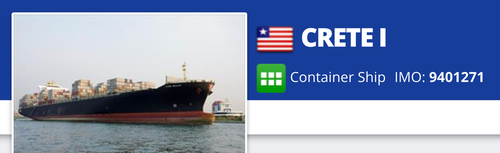
Container shipowners are capitalizing on the red hot ocean freight market by flipping older ships. Monaco-based International Maritime Enterprises sold its container ship Crete I for $46 million, more than four times its 2016 value ($11 million), according to Bloomberg, citing a new industry report via TradeWinds.
The market for second-hand ships is soaring as the sale of new vessels has sunk in the last couple of years. A typical container ship takes more than one year to build – so boosting new ship supply cannot be readily done – hence why demand increase and value explosions are being observed on the secondary markets.

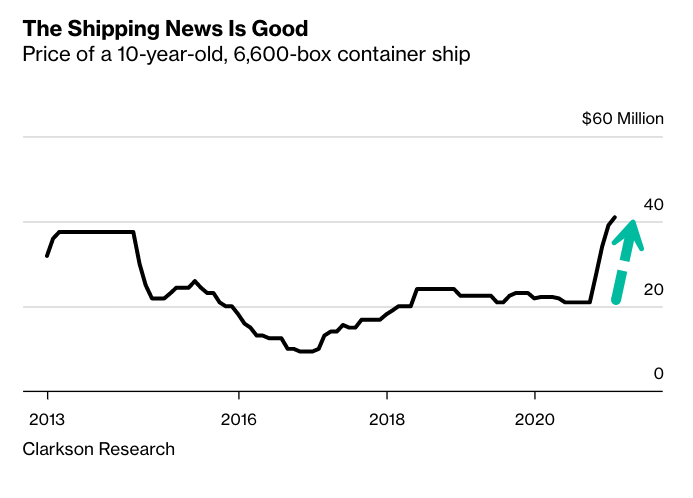
Clarkson Research Services Ltd. said a 10-year-old container ship with the capacity to haul 6,600 steel boxes fetches about $41 million today – that’s a considerable jump from its $9.5 million value back in 2016.Source: Bloomberg
“The recent price increases have happened far more quickly than previous sales and purchase cycles,” said Stephen Gordon, managing director at Clarkson Research. “Recent prices trends for 10-year-old vessels have more than doubled in less than six months, whereas in 2016-17 and 2004-2005 it took nearly 18 months for similar percentage price increases.”
“February was the second-highest activity on record for transactions measured in ship container capacity,” Gordon said.
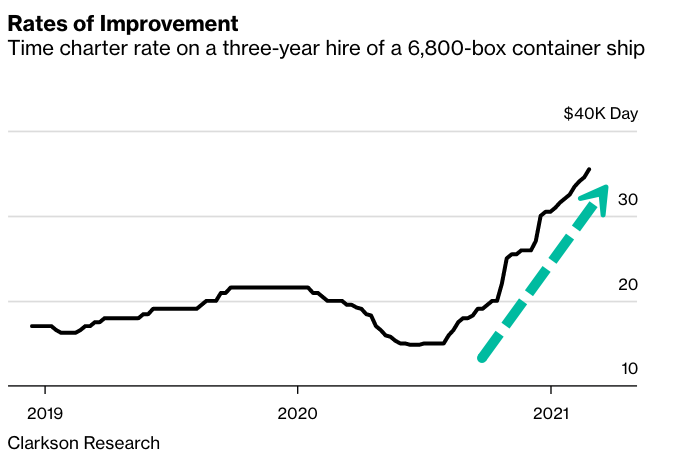
Time charter rates for a 6,800-box container ship have erupted. Source: Bloomberg
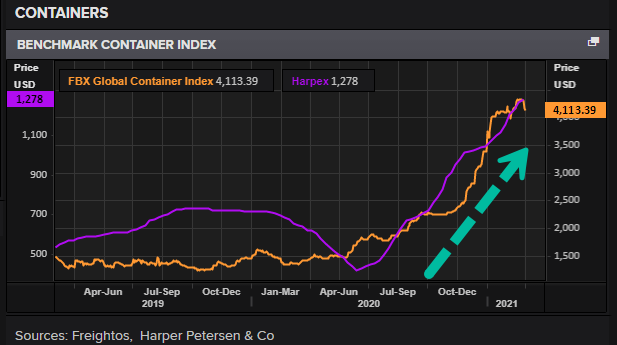
Container shipping data from Freightos and Harper Petersen & Co show container rates have been surging since April-June of 2020.Source: Reuters
Demand for freight containers and the heavy flows from China to the US East/West Coast has resulted in a shipping container shortage in Asia.
In September, we first noted that demand for ocean freight out of China was “leading to equipment shortages in Asia.”
“The surge in volumes is leading to equipment shortages in Asia. Some shippers are paying premiums on top of spiking rates to guarantee containers and space. The imbalance is also putting pressure on overwhelmed US ports and importers to process and return empty containers quickly.”
https://www.zerohedge.com/markets/red-hot-freight-market-sends-used-container-ship-values-soaring
March 7, 2021
Container Ship Values
Red-Hot Freight Market Sends Used Container-Ship Values Soaring
by Tyler DurdenSaturday, Mar 06, 2021 – 17:00
No one predicted that the global shipping container industry would be on fire in the last couple of quarters, considering China’s robust economic rebound following the virus-induced downturn. Container rates have soared since last spring as there are few signs of immediate cooling.
Container shipowners are capitalizing on the red hot ocean freight market by flipping older ships. Monaco-based International Maritime Enterprises sold its container ship Crete I for $46 million, more than four times its 2016 value ($11 million), according to Bloomberg, citing a new industry report via TradeWinds.
The market for second-hand ships is soaring as the sale of new vessels has sunk in the last couple of years. A typical container ship takes more than one year to build – so boosting new ship supply cannot be readily done – hence why demand increase and value explosions are being observed on the secondary markets.
Clarkson Research Services Ltd. said a 10-year-old container ship with the capacity to haul 6,600 steel boxes fetches about $41 million today – that’s a considerable jump from its $9.5 million value back in 2016.Source: Bloomberg
“The recent price increases have happened far more quickly than previous sales and purchase cycles,” said Stephen Gordon, managing director at Clarkson Research. “Recent prices trends for 10-year-old vessels have more than doubled in less than six months, whereas in 2016-17 and 2004-2005 it took nearly 18 months for similar percentage price increases.”
“February was the second-highest activity on record for transactions measured in ship container capacity,” Gordon said.
Time charter rates for a 6,800-box container ship have erupted. Source: Bloomberg
Container shipping data from Freightos and Harper Petersen & Co show container rates have been surging since April-June of 2020.Source: Reuters
Demand for freight containers and the heavy flows from China to the US East/West Coast has resulted in a shipping container shortage in Asia.
In September, we first noted that demand for ocean freight out of China was “leading to equipment shortages in Asia.”
“The surge in volumes is leading to equipment shortages in Asia. Some shippers are paying premiums on top of spiking rates to guarantee containers and space. The imbalance is also putting pressure on overwhelmed US ports and importers to process and return empty containers quickly.”
https://www.zerohedge.com/markets/red-hot-freight-market-sends-used-container-ship-values-soaring
March 5, 2021
Flexible Foam Shortages Explained
We’ve had a lot of questions about why there is a shortage of foam, so here’s a simple explanation. I hope it answers your questions!
Flexible Foam Production and Fabrication
Because foam is light and bulky, it is not efficient to ship very far to the various end users such as furniture manufacturers, bedding, seating and other customers. Consequently the many foam plants are located close to the end use markets and are spread around North America.
Foam is made using a number of chemicals, but the main two are polyol and toluene diisocyanate (TDI). It takes roughly two parts of polyol and one part of TDI to make foam. Foam plants buy these raw materials and have them delivered by either railcars or tank trucks. A typical foam plant will have storage tanks that are big enough to offload a few railcars (180,000 lbs each) or tank trucks (45,000 lbs each). They don’t carry a large inventory of these raw materials, but depend upon a steady and timely supply of railcars and trucks in order to produce the foam for their customers.
Polyol Supply
There are a few different grades of flexible foam polyol, but the most common is made from three primary raw materials–glycerine (the initiator), ethylene oxide (EO) and most of all, propylene oxide (PO). PO is by far the main ingredient.
There are a handful of large polyol producers with a few plants in the midwest but most are on the Gulf coast–close to the propylene oxide producers.
The Propylene Oxide Bottleneck
PO is produced by three companies in North America, LyondellBasell, Dow, and Indorama. There are five physical plant locations, with four in Texas and one in Louisiana.
When the pandemic hit last March there was a lot of uncertainty about future demand. The entire furniture-foam-polyol-PO chain of production slowed to a crawl.
No one predicted that the demand for bedding and furniture would increase while people were in lock down. The industry came back in June hoping to catch up for the lost production in that April May time frame. The industry tried to run at 120% rates to make up for the two lost months, but the PO plants can only run at 100%, so there was not enough to supply everyone what they wanted. PO production issues in the Fall curtailed polyol production even further to the point that the producers had to put together allocations for their customers. No one could get everything that they needed.
Then the winter storm hit the gulf coast in mid February. When a hurricane is expected, the petrochemical industry gets prepared and often shuts down their operations in advance, weathers the storm, then gets back up and running safely and in a relatively short time frame. This storm caught everyone unprepared and many plants lost power while they were still running. It’s a tribute to the industry and all the plant engineers and employees that there were no major accidents during this abrupt and unexpected shutdown. Lines in the plants froze. Power, steam, nitrogen, and hydrogen supplies were lost. All of the propylene oxide plants were shut down. It was almost like an unexpected Cat 5 hurricane hit all of Texas in the middle of the night.
Restarting those plants first requires the utilities and power. The damage can’t be assessed until services like steam and nitrogen are restored (and in many cases, they’re still down). Then all the lines need to be inspected and damage repaired. The plants will start at reduced rates and may take months to get back up to full rates. Meanwhile, the entire polyol inventory pipeline is empty and needs to be refilled.
There is still a lot of uncertainty about the timing for the restart of the foam industry. The situation literally changes every day as the companies assess the damage and work on repairs so the units can be restarted safely. We post daily updates here on the Urethane Blog, so check us out regularly for more information.
TDI
The TDI story is similar to propylene oxide except that there are only two domestic producers and two physical plant locations. Supply is supplemented by some imports. Those plants are located in Texas and Louisiana and were also affected by the winter storm.
Now you know why the wait time for a new chair is at least 16 weeks and may get even longer!
March 5, 2021
Flexible Foam Shortages Explained
We’ve had a lot of questions about why there is a shortage of foam, so here’s a simple explanation. I hope it answers your questions!
Flexible Foam Production and Fabrication
Because foam is light and bulky, it is not efficient to ship very far to the various end users such as furniture manufacturers, bedding, seating and other customers. Consequently the many foam plants are located close to the end use markets and are spread around North America.
Foam is made using a number of chemicals, but the main two are polyol and toluene diisocyanate (TDI). It takes roughly two parts of polyol and one part of TDI to make foam. Foam plants buy these raw materials and have them delivered by either railcars or tank trucks. A typical foam plant will have storage tanks that are big enough to offload a few railcars (180,000 lbs each) or tank trucks (45,000 lbs each). They don’t carry a large inventory of these raw materials, but depend upon a steady and timely supply of railcars and trucks in order to produce the foam for their customers.
Polyol Supply
There are a few different grades of flexible foam polyol, but the most common is made from three primary raw materials–glycerine (the initiator), ethylene oxide (EO) and most of all, propylene oxide (PO). PO is by far the main ingredient.
There are a handful of large polyol producers with a few plants in the midwest but most are on the Gulf coast–close to the propylene oxide producers.
The Propylene Oxide Bottleneck
PO is produced by three companies in North America, LyondellBasell, Dow, and Indorama. There are five physical plant locations, with four in Texas and one in Louisiana.
When the pandemic hit last March there was a lot of uncertainty about future demand. The entire furniture-foam-polyol-PO chain of production slowed to a crawl.
No one predicted that the demand for bedding and furniture would increase while people were in lock down. The industry came back in June hoping to catch up for the lost production in that April May time frame. The industry tried to run at 120% rates to make up for the two lost months, but the PO plants can only run at 100%, so there was not enough to supply everyone what they wanted. PO production issues in the Fall curtailed polyol production even further to the point that the producers had to put together allocations for their customers. No one could get everything that they needed.
Then the winter storm hit the gulf coast in mid February. When a hurricane is expected, the petrochemical industry gets prepared and often shuts down their operations in advance, weathers the storm, then gets back up and running safely and in a relatively short time frame. This storm caught everyone unprepared and many plants lost power while they were still running. It’s a tribute to the industry and all the plant engineers and employees that there were no major accidents during this abrupt and unexpected shutdown. Lines in the plants froze. Power, steam, nitrogen, and hydrogen supplies were lost. All of the propylene oxide plants were shut down. It was almost like an unexpected Cat 5 hurricane hit all of Texas in the middle of the night.
Restarting those plants first requires the utilities and power. The damage can’t be assessed until services like steam and nitrogen are restored (and in many cases, they’re still down). Then all the lines need to be inspected and damage repaired. The plants will start at reduced rates and may take months to get back up to full rates. Meanwhile, the entire polyol inventory pipeline is empty and needs to be refilled.
There is still a lot of uncertainty about the timing for the restart of the foam industry. The situation literally changes every day as the companies assess the damage and work on repairs so the units can be restarted safely. We post daily updates here on the Urethane Blog, so check us out regularly for more information.
TDI
The TDI story is similar to propylene oxide except that there are only two domestic producers and two physical plant locations. Supply is supplemented by some imports. Those plants are located in Texas and Louisiana and were also affected by the winter storm.
Now you know why the wait time for a new chair is at least 16 weeks and may get even longer!
 Everchem Updates Archive
  Sign Up for Email Updates