
Current Affairs
March 5, 2021
Today’s Petrochemical Update
MEGlobal restarts Texas MEG unit; TPC expects longer restart timeline
- Author
- Kristen Hays
- Editor
- Kshitiz Goliya
- Commodity
- Petrochemicals
Houston —
Efforts to restart petrochemical plants along the US Gulf Coast that shut down amid sustained sub-freezing temperatures in mid-February continued March 4, with downstream derivatives awaiting resumption of production of upstream feedstocks.
MEGlobal has restarted its 750,000 mt/year monoethylene glycol unit in Freeport, Texas, but more than 3 million mt/year of US MEG capacity remained shut, multiple market sources said March 4.
TPC Group expects to restart production units at its Houston petrochemical site the week of March 14, pending restarts of utilities and additional inspections slated for the week of March 8, spokeswoman Sara Cronin said in an email late March 3.
TPC had expected to restart utilities at the Houston site the week of Feb. 28, but found additional freeze-related issues that delayed that initial timeline, she said.
The freeze that affected much of the country reached the US Gulf Coast on Feb. 14, bringing bitter cold temperatures that lasted for more than 72 hours. The freeze prompted petrochemical shutdowns throughout Texas and in parts of Louisiana. The industrial infrastructure in the region was not built to withstand such sustained sub-freezing temperatures, and inspections have been deliberate to seek out any problems with exposed pipes that must be repaired.
“You need to go slow, to make sure there is no leakage on places which cannot be examined visually,” a market source said.
Here is a rundown of the fallout from the freeze:
FORCE MAJEURES
**Dow Chemical: Declared Feb. 19, on 2-ethylhexanol and butanol products from its Texas City, Texas complex
**Formosa Plastics USA: Declared Feb. 19 on US polyethylene
**BASF: Declared Feb. 19 on dioctyl terephthalate, or DOTP, a plasticizer, at its Pasadena, Texas, site
**Westlake Chemical: Declared Feb. 19 on US caustic soda, chlorine, PVC and vinyl chloride monomer (VCM); company has 2.9 million mt/year of US caustic soda capacity, more than 2 million mt/year of PVC capacity, 2.6 million mt/year of VCM; more than 2.26 million mt/year of chlorine capacity at five affected sites
**Formosa Plastics USA: Declared Feb. 18 on US PVC, 1.3 million mt/year of capacity at Point Comfort, Texas, and Baton Rouge, Louisiana, complexes.
**Dow Chemical: Declared Feb. 18 on multiple intermediate chemicals produced at plants in Deer Park, Freeport, Texas City and Bayport Texas, Hahnville, Louisiana, and Louisville, Kentucky; declaration includes VAM, methyl methacrylate (MMA), glacial methacrylic acid (GMAA), butyl methacrylate (BMA), glycidyl methacrylate (GMA), 2-ethylhexyl Acrylate (2EHA), butyl acrylate (BA), and others; Dow informed South American customers
**Celanese: Declared force majeure Feb. 18 on multiple intermediate chemicals normally sold to customers in the US, Europe and the Middle East, including acetic acid, VAM, ethyl acetate and ethylene vinyl acetate (EVA)
**Total: Declared Feb. 17 on polypropylene produced at its 1.15 million mt/year La Porte, Texas, facility
**Formosa Plastics USA: Declared Feb. 17 on all chlor-alkali products
**LyondellBasell: Declared Feb. 16 on styrene monomer
**Vestolit: Declared Feb. 16 on PVC produced at its Colombia and Mexico plants on lack of upstream vinyl chloride monomer feedstock from US suppliers; plants have a combined 1.8 million mt/year of capacity
**Olin: Declared Feb. 16 on US chlorine, caustic soda, ethylene dichloride, epoxy, hydrochloric acid and other products produced at its Freeport, Texas, complex; on Feb. 18 Olin expanded the declaration in a separate letter to customers to include products made system-wide
**MEGlobal: Declared Feb. 15 on MEG produced at its Freeport, Texas, site
**LyondellBasell: Declared Feb. 15 on US polyethylene
**Flint Hills Resources: Declared Feb. 15 on polypropylene produced at Longview, Texas
**OxyChem: Declared Feb. 15 on US chlorine, caustic soda, EDC, VCM and PVC.
**LyondellBasell: Declared Feb. 15 on US polypropylene
**INEOS Olefins and Polymers USA: Declared Feb. 15 on polypropylene
**OQ Chemicals: Declared Feb. 15 on US oxo-alcohols, aldehydes, acids and esters produced at its Bat City, Texas, operations
SHUTDOWNS
**Chevron Phillips Chemical: three crackers with a combined capacity of 1.36 million mt/year, Sweeny, Texas
**Westlake Chemical: 331,763 mt/year cracker, 249,475 mt/year chlorine, 274,423 mt/year caustic soda, 680,388 mt/year VCM, 680,388 mt/year PVC, Calvert City, Kentucky
**Eastman Chemical: 730,000 mt/year ethylene capacity, Longview, Texas
**INEOS: 1.89 million mt/year of ethylene capacity, Chocolate Bayou, Texas
**LyondellBasell: 2.29 million mt/year of ethylene capacity in La Porte and Corpus Christi, Texas
**Total: 1.15 million mt/year PP, La Porte, Texas
**Lotte Chemical: 700,000 mt/year MEG, 1 million mt/year joint-venture cracker, Lake Charles, Louisiana
**Braskem: 225,000 mt/year PP, Seadrift, Texas
**ExxonMobil: Cumulative 1.53 million mt/year from three units, HDPE and LLDPE capacity, Mont Belvieu, Texas
**Indorama Ventures: 1 million mt/year ethylene oxide/MEG unit, 238,135 mt/year propylene oxide unit, and 988,000 mt/year of MTBE capacity; Clear Lake, Texas, 435,000 mt/year EO, 358,000 mt/year MEG; Port Neches, Texas
**Olin: Freeport, Texas complex, with 3 million mt/year of caustic soda and 2.73 million mt/year of chlorine capacity; 748,000 mt/year of EDC
**OxyChem: Ingleside, Texas, 544,000 mt/year cracker; 248,000 mt/year chlor-alkali; 680,000 mt/year EDC; Deer Park and Pasadena, Texas, 1.27 million mt in PVC capacity; 1.79 million mt/year of VCM capacity; 580,000 mt/year chlor-alkali
**Shintech: Freeport, Texas: 1.45 million mt/year PVC
**Formosa Plastics USA: Point Comfort, Texas, including three crackers with a cumulative capacity of 2.76 million mt/year; 875,000 mt/year of high density polyethylene; 400,000 mt/year of low density PE; 465,000 mt/year of linear low density PE; 798,000 mt/year of PVC; 1 million mt/year of caustic soda and 910,000 mt/year of chlorine; 753,000 mt/year of VCM; 1.478 million mt/year of EDC; and a cumulative 1.17 million mt/year of MEG operated by sister company Nan Ya Plastics.
**Dow Chemical: Certain units offline within Dow sites along the US Gulf Coast, but the company did not specify. Dow’s Gulf Coast operations include two LDPE units with 552,000 mt/year and 186,000 mt/year HDPE; Dow’s Seadrift, Texas, complex includes 490,000 mt/year LLDPE and 390,000 mt/year HDPE; Dow told South American customers in a letter dated Feb. 16 that the company was assessing impact on PE production capacity “and we know that our ability to supply various products could be affected.”
**Dow Chemical: 998,000 mt/year cracker, Freeport, Texas
**TPC Group: Houston site, including 544,310 mt/year butadiene unit, when boilers lost steam
**CP Chem: Pasadena, Texas, 998,000 mt/year HDPE
**CP Chem: 853,000 mt/year cracker, Port Arthur, Texas
**Westlake Chemical: 632,000 mt/year cracker, Lake Charles, Louisiana
RESTARTS
**MEGlobal: 750,000 mt/year MEG plant, Freeport, Texas
**Formosa Plastics USA: restarting PP production at Point Comfort, Texas, complex; has two PP units with combined capacity of 1.7 million mt/year
**Shell: Restarting two crackers with a combined 961,000 mt/year of capacity, Deer Park, Texas
**OxyChem/Orbia: Restarting 550,000 mt/year cracker, Ingleside, Texas
**LyondellBasell: Restarting two crackers with a combined 1.93 million mt/year of capacity, Channelview, Texas
**CP Chem: Restarting two crackers with a combined 1.9 million mt/year of capacity, Cedar Bayou, Texas
**CP Chem: Restarting 853,000 mt/year cracker, Port Arthur, Texas
**Indorama Ventures: Restarting 235,867 mt/year cracker, Port Neches, Texas
**Dow Chemical: Restarting 680,000 mt/year cracker, Freeport, Texas
**Braskem: 360,000 mt/year PP Freeport, Texas; 400,000 mt/year PP, La Porte, Texas
**Motiva Chemicals: Restarted 635,000 mt/year mixed-feed cracker, Port Arthur, Texas
**Shell: Norco, Louisiana, restarted two crackers with a combined 1.4 million mt/year of capacity
**Baystar Polymers: Restarting 408,000 mt/year HDPE unit at Bayport, Texas
**Flint Hills Resources: Restarting 658,000 mt/year PDH unit, Houston
**Dow Chemical: Restarting 750,000 PDH, Freeport, Texas
**Braskem: Restarting 450,000 mt/year PP, La Porte, Texas
**Dow Chemical: Restarted 680,000 mt/year cracker in Orange, Texas
**ExxonMobil: Beaumont, Texas, restart activity begun; 826,000 mt/year cracker operational; 225,000 mt/year HDPE; 240,000 mt/year LDPE; 1.19 million mt/year LLDPE with some HDPE capacity
**ExxonMobil: Baytown, Texas, restart activity begun; three crackers with a combined capacity of 3.8 million mt/year; 800,000 mt/year PP
**Sasol: Restarted 380,000 mt/year EO/MEG, Lake Charles, Louisiana
**Formosa Plastics USA: Restarted 513,000 mt/year PVC, 653,000 mt/year VCM, Baton Rouge, Louisiana
**LyondellBasell: Lake Charles, Louisiana, joint-venture 470,000 mt/year LLDPE; 420,000 mt/year LDPE
PRICES
**March and April US spot ethylene prices held for a third consecutive day at 57 cents/lb FD Mont Belvieu and 52.75 cents/lb FD Mont Belvieu, respectively, as producers continued working to restart crackers. However, March and April FD Choctaw markers each rose a 1 cent/lb on the day to 57.50 cents/lb and 53.25 cents/lb, respectively.
**March spot propylene prices extended declines on the day March 4, falling 11 cents/lb to 55.25 cents/lb FD USG, while April propylene fell 10 cents/lb to 49.50 cents/lb FD USG after two of the three US PDH plants restarted post-freeze.
— Kristen Hays, kristen.hays@spglobal.com
https://www.spglobal.com/platts/en/products-services/electric-power/gas-and-power
March 5, 2021
Today’s Petrochemical Update
MEGlobal restarts Texas MEG unit; TPC expects longer restart timeline
- Author
- Kristen Hays
- Editor
- Kshitiz Goliya
- Commodity
- Petrochemicals
Houston —
Efforts to restart petrochemical plants along the US Gulf Coast that shut down amid sustained sub-freezing temperatures in mid-February continued March 4, with downstream derivatives awaiting resumption of production of upstream feedstocks.
MEGlobal has restarted its 750,000 mt/year monoethylene glycol unit in Freeport, Texas, but more than 3 million mt/year of US MEG capacity remained shut, multiple market sources said March 4.
TPC Group expects to restart production units at its Houston petrochemical site the week of March 14, pending restarts of utilities and additional inspections slated for the week of March 8, spokeswoman Sara Cronin said in an email late March 3.
TPC had expected to restart utilities at the Houston site the week of Feb. 28, but found additional freeze-related issues that delayed that initial timeline, she said.
The freeze that affected much of the country reached the US Gulf Coast on Feb. 14, bringing bitter cold temperatures that lasted for more than 72 hours. The freeze prompted petrochemical shutdowns throughout Texas and in parts of Louisiana. The industrial infrastructure in the region was not built to withstand such sustained sub-freezing temperatures, and inspections have been deliberate to seek out any problems with exposed pipes that must be repaired.
“You need to go slow, to make sure there is no leakage on places which cannot be examined visually,” a market source said.
Here is a rundown of the fallout from the freeze:
FORCE MAJEURES
**Dow Chemical: Declared Feb. 19, on 2-ethylhexanol and butanol products from its Texas City, Texas complex
**Formosa Plastics USA: Declared Feb. 19 on US polyethylene
**BASF: Declared Feb. 19 on dioctyl terephthalate, or DOTP, a plasticizer, at its Pasadena, Texas, site
**Westlake Chemical: Declared Feb. 19 on US caustic soda, chlorine, PVC and vinyl chloride monomer (VCM); company has 2.9 million mt/year of US caustic soda capacity, more than 2 million mt/year of PVC capacity, 2.6 million mt/year of VCM; more than 2.26 million mt/year of chlorine capacity at five affected sites
**Formosa Plastics USA: Declared Feb. 18 on US PVC, 1.3 million mt/year of capacity at Point Comfort, Texas, and Baton Rouge, Louisiana, complexes.
**Dow Chemical: Declared Feb. 18 on multiple intermediate chemicals produced at plants in Deer Park, Freeport, Texas City and Bayport Texas, Hahnville, Louisiana, and Louisville, Kentucky; declaration includes VAM, methyl methacrylate (MMA), glacial methacrylic acid (GMAA), butyl methacrylate (BMA), glycidyl methacrylate (GMA), 2-ethylhexyl Acrylate (2EHA), butyl acrylate (BA), and others; Dow informed South American customers
**Celanese: Declared force majeure Feb. 18 on multiple intermediate chemicals normally sold to customers in the US, Europe and the Middle East, including acetic acid, VAM, ethyl acetate and ethylene vinyl acetate (EVA)
**Total: Declared Feb. 17 on polypropylene produced at its 1.15 million mt/year La Porte, Texas, facility
**Formosa Plastics USA: Declared Feb. 17 on all chlor-alkali products
**LyondellBasell: Declared Feb. 16 on styrene monomer
**Vestolit: Declared Feb. 16 on PVC produced at its Colombia and Mexico plants on lack of upstream vinyl chloride monomer feedstock from US suppliers; plants have a combined 1.8 million mt/year of capacity
**Olin: Declared Feb. 16 on US chlorine, caustic soda, ethylene dichloride, epoxy, hydrochloric acid and other products produced at its Freeport, Texas, complex; on Feb. 18 Olin expanded the declaration in a separate letter to customers to include products made system-wide
**MEGlobal: Declared Feb. 15 on MEG produced at its Freeport, Texas, site
**LyondellBasell: Declared Feb. 15 on US polyethylene
**Flint Hills Resources: Declared Feb. 15 on polypropylene produced at Longview, Texas
**OxyChem: Declared Feb. 15 on US chlorine, caustic soda, EDC, VCM and PVC.
**LyondellBasell: Declared Feb. 15 on US polypropylene
**INEOS Olefins and Polymers USA: Declared Feb. 15 on polypropylene
**OQ Chemicals: Declared Feb. 15 on US oxo-alcohols, aldehydes, acids and esters produced at its Bat City, Texas, operations
SHUTDOWNS
**Chevron Phillips Chemical: three crackers with a combined capacity of 1.36 million mt/year, Sweeny, Texas
**Westlake Chemical: 331,763 mt/year cracker, 249,475 mt/year chlorine, 274,423 mt/year caustic soda, 680,388 mt/year VCM, 680,388 mt/year PVC, Calvert City, Kentucky
**Eastman Chemical: 730,000 mt/year ethylene capacity, Longview, Texas
**INEOS: 1.89 million mt/year of ethylene capacity, Chocolate Bayou, Texas
**LyondellBasell: 2.29 million mt/year of ethylene capacity in La Porte and Corpus Christi, Texas
**Total: 1.15 million mt/year PP, La Porte, Texas
**Lotte Chemical: 700,000 mt/year MEG, 1 million mt/year joint-venture cracker, Lake Charles, Louisiana
**Braskem: 225,000 mt/year PP, Seadrift, Texas
**ExxonMobil: Cumulative 1.53 million mt/year from three units, HDPE and LLDPE capacity, Mont Belvieu, Texas
**Indorama Ventures: 1 million mt/year ethylene oxide/MEG unit, 238,135 mt/year propylene oxide unit, and 988,000 mt/year of MTBE capacity; Clear Lake, Texas, 435,000 mt/year EO, 358,000 mt/year MEG; Port Neches, Texas
**Olin: Freeport, Texas complex, with 3 million mt/year of caustic soda and 2.73 million mt/year of chlorine capacity; 748,000 mt/year of EDC
**OxyChem: Ingleside, Texas, 544,000 mt/year cracker; 248,000 mt/year chlor-alkali; 680,000 mt/year EDC; Deer Park and Pasadena, Texas, 1.27 million mt in PVC capacity; 1.79 million mt/year of VCM capacity; 580,000 mt/year chlor-alkali
**Shintech: Freeport, Texas: 1.45 million mt/year PVC
**Formosa Plastics USA: Point Comfort, Texas, including three crackers with a cumulative capacity of 2.76 million mt/year; 875,000 mt/year of high density polyethylene; 400,000 mt/year of low density PE; 465,000 mt/year of linear low density PE; 798,000 mt/year of PVC; 1 million mt/year of caustic soda and 910,000 mt/year of chlorine; 753,000 mt/year of VCM; 1.478 million mt/year of EDC; and a cumulative 1.17 million mt/year of MEG operated by sister company Nan Ya Plastics.
**Dow Chemical: Certain units offline within Dow sites along the US Gulf Coast, but the company did not specify. Dow’s Gulf Coast operations include two LDPE units with 552,000 mt/year and 186,000 mt/year HDPE; Dow’s Seadrift, Texas, complex includes 490,000 mt/year LLDPE and 390,000 mt/year HDPE; Dow told South American customers in a letter dated Feb. 16 that the company was assessing impact on PE production capacity “and we know that our ability to supply various products could be affected.”
**Dow Chemical: 998,000 mt/year cracker, Freeport, Texas
**TPC Group: Houston site, including 544,310 mt/year butadiene unit, when boilers lost steam
**CP Chem: Pasadena, Texas, 998,000 mt/year HDPE
**CP Chem: 853,000 mt/year cracker, Port Arthur, Texas
**Westlake Chemical: 632,000 mt/year cracker, Lake Charles, Louisiana
RESTARTS
**MEGlobal: 750,000 mt/year MEG plant, Freeport, Texas
**Formosa Plastics USA: restarting PP production at Point Comfort, Texas, complex; has two PP units with combined capacity of 1.7 million mt/year
**Shell: Restarting two crackers with a combined 961,000 mt/year of capacity, Deer Park, Texas
**OxyChem/Orbia: Restarting 550,000 mt/year cracker, Ingleside, Texas
**LyondellBasell: Restarting two crackers with a combined 1.93 million mt/year of capacity, Channelview, Texas
**CP Chem: Restarting two crackers with a combined 1.9 million mt/year of capacity, Cedar Bayou, Texas
**CP Chem: Restarting 853,000 mt/year cracker, Port Arthur, Texas
**Indorama Ventures: Restarting 235,867 mt/year cracker, Port Neches, Texas
**Dow Chemical: Restarting 680,000 mt/year cracker, Freeport, Texas
**Braskem: 360,000 mt/year PP Freeport, Texas; 400,000 mt/year PP, La Porte, Texas
**Motiva Chemicals: Restarted 635,000 mt/year mixed-feed cracker, Port Arthur, Texas
**Shell: Norco, Louisiana, restarted two crackers with a combined 1.4 million mt/year of capacity
**Baystar Polymers: Restarting 408,000 mt/year HDPE unit at Bayport, Texas
**Flint Hills Resources: Restarting 658,000 mt/year PDH unit, Houston
**Dow Chemical: Restarting 750,000 PDH, Freeport, Texas
**Braskem: Restarting 450,000 mt/year PP, La Porte, Texas
**Dow Chemical: Restarted 680,000 mt/year cracker in Orange, Texas
**ExxonMobil: Beaumont, Texas, restart activity begun; 826,000 mt/year cracker operational; 225,000 mt/year HDPE; 240,000 mt/year LDPE; 1.19 million mt/year LLDPE with some HDPE capacity
**ExxonMobil: Baytown, Texas, restart activity begun; three crackers with a combined capacity of 3.8 million mt/year; 800,000 mt/year PP
**Sasol: Restarted 380,000 mt/year EO/MEG, Lake Charles, Louisiana
**Formosa Plastics USA: Restarted 513,000 mt/year PVC, 653,000 mt/year VCM, Baton Rouge, Louisiana
**LyondellBasell: Lake Charles, Louisiana, joint-venture 470,000 mt/year LLDPE; 420,000 mt/year LDPE
PRICES
**March and April US spot ethylene prices held for a third consecutive day at 57 cents/lb FD Mont Belvieu and 52.75 cents/lb FD Mont Belvieu, respectively, as producers continued working to restart crackers. However, March and April FD Choctaw markers each rose a 1 cent/lb on the day to 57.50 cents/lb and 53.25 cents/lb, respectively.
**March spot propylene prices extended declines on the day March 4, falling 11 cents/lb to 55.25 cents/lb FD USG, while April propylene fell 10 cents/lb to 49.50 cents/lb FD USG after two of the three US PDH plants restarted post-freeze.
— Kristen Hays, kristen.hays@spglobal.com
https://www.spglobal.com/platts/en/products-services/electric-power/gas-and-power
March 5, 2021
Crazy
Stunning Views Of Freight Train Derailment In California Desert
by Tyler DurdenThursday, Mar 04, 2021 – 20:00
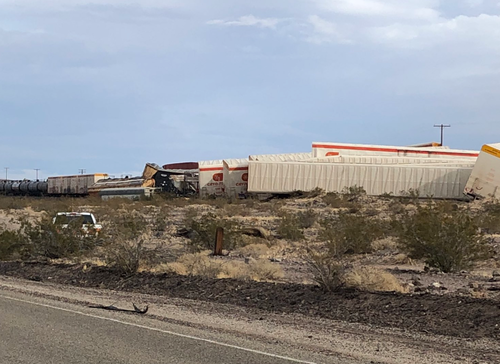
On Wednesday evening, a freight train derailment in the Southern California desert sent more than 40 railcars careening off the tracks into a mangled mess of metal.
San Bernardino County Fire (SBCF) tweeted pictures and a drone video of the train derailment. They said the incident occurred on the Burlington Northern Santa Fe Railway Company (BNSF Railway) rail network east of Ludlow, on Old National Trails Highway, or about 150 miles northeast of Los Angeles.
SBCF said, “BNSF cargo railcars, no injuries, no fire, Haz-Mat on scene. No impact to I-40.” Judging by the pictures released by the local police agency, a variety of cars were involved in the incident, including tanker cars, boxcars, and hoppers.
Mixed Freight Derailment
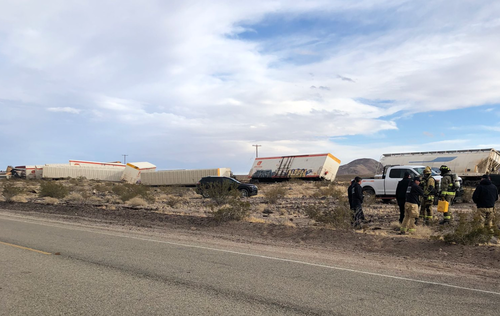
Tanker Cars And Other Cars Derailed
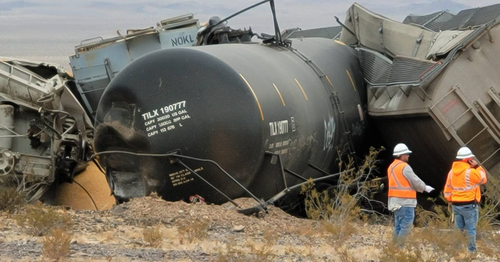
More Scenes Of The Incident
A drone video shows first responders in hazmat suits inspecting a tanker car.
The police drone captured stunning views of the mangled railcars.
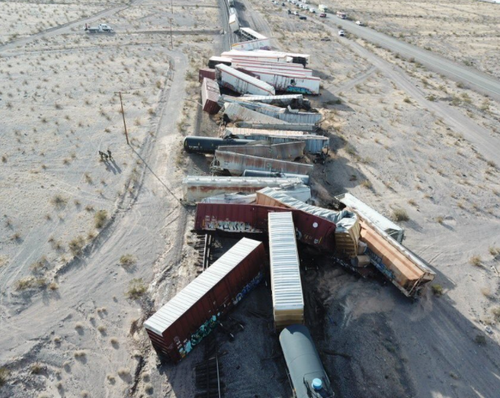
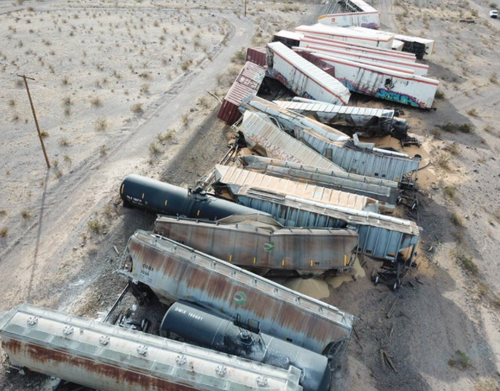
“Initial reports indicate 44 cars derailed, and one car carrying ethanol alcohol is leaking,” BNSF spokeswoman Lena Kent told NBC Los Angeles.
Investigators are still working the incident area to figure out how the derailment occurred.
March 5, 2021
Crazy
Stunning Views Of Freight Train Derailment In California Desert
by Tyler DurdenThursday, Mar 04, 2021 – 20:00
On Wednesday evening, a freight train derailment in the Southern California desert sent more than 40 railcars careening off the tracks into a mangled mess of metal.
San Bernardino County Fire (SBCF) tweeted pictures and a drone video of the train derailment. They said the incident occurred on the Burlington Northern Santa Fe Railway Company (BNSF Railway) rail network east of Ludlow, on Old National Trails Highway, or about 150 miles northeast of Los Angeles.
SBCF said, “BNSF cargo railcars, no injuries, no fire, Haz-Mat on scene. No impact to I-40.” Judging by the pictures released by the local police agency, a variety of cars were involved in the incident, including tanker cars, boxcars, and hoppers.
Mixed Freight Derailment
Tanker Cars And Other Cars Derailed
More Scenes Of The Incident
A drone video shows first responders in hazmat suits inspecting a tanker car.
The police drone captured stunning views of the mangled railcars.
“Initial reports indicate 44 cars derailed, and one car carrying ethanol alcohol is leaking,” BNSF spokeswoman Lena Kent told NBC Los Angeles.
Investigators are still working the incident area to figure out how the derailment occurred.
March 4, 2021
Running Out of Foam
Car seat foam shortage threatens to derail auto production, report says
Automakers continue to suffer through a semiconductor shortage, but there may be another issue brewing in the background: foam. Specifically, the foam that goes into millions of car seats we sit on every day when going for a drive. According to a report from Automotive News on Thursday, suppliers are “scrambling” to restart production following the devastating Texas winter storms last month.
The storms knocked power offline for millions of residents and produced water shortages statewide, and the state’s petrochemical plants didn’t go unscathed. Two sources spoke with the publication saying things are fine for now, but the problem may become serious in the coming weeks. One source cautioned this is a “threat” and not a “given,” depending on how the sector ramps up production again. But the semiconductor shortage has left automakers in a tough spot as they shut down plants across North America. A second supplier issue to hit the industry would compound the problem.
Stellantis, the merged automaker formed from Fiat Chrysler Automobiles and PSA Group, told Roadshow, “We are closely monitoring the situation. At this time, we do not expect an impact on our operations.” A GM spokesperson said, “GM continues to work closely with the supply base to mitigate the impacts caused by the significant winter weather that affected a large portion of the country the week of Feb. 15. We don’t anticipate any immediate production impacts.” Ford did not immediately return a request for comment on the report.
If the coronavirus pandemic taught us anything, these situations are mighty fluid. Last year, nearly every major automaker stopped vehicle production to slow the spread of COVID-19, and each carefully navigated their way to reopening their facilities. One of the report’s sources mentioned seat supplier production lines may start to run out of foam by this coming Monday; we’ll have to wait and see how the situation unfolds.
 Everchem Updates Archive
  Sign Up for Email Updates