
Current Affairs
March 5, 2021
Crazy
Stunning Views Of Freight Train Derailment In California Desert
by Tyler DurdenThursday, Mar 04, 2021 – 20:00
On Wednesday evening, a freight train derailment in the Southern California desert sent more than 40 railcars careening off the tracks into a mangled mess of metal.
San Bernardino County Fire (SBCF) tweeted pictures and a drone video of the train derailment. They said the incident occurred on the Burlington Northern Santa Fe Railway Company (BNSF Railway) rail network east of Ludlow, on Old National Trails Highway, or about 150 miles northeast of Los Angeles.
SBCF said, “BNSF cargo railcars, no injuries, no fire, Haz-Mat on scene. No impact to I-40.” Judging by the pictures released by the local police agency, a variety of cars were involved in the incident, including tanker cars, boxcars, and hoppers.
Mixed Freight Derailment
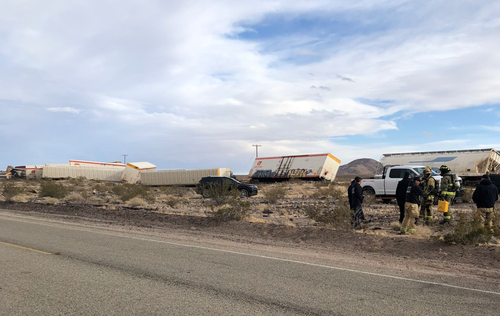
Tanker Cars And Other Cars Derailed
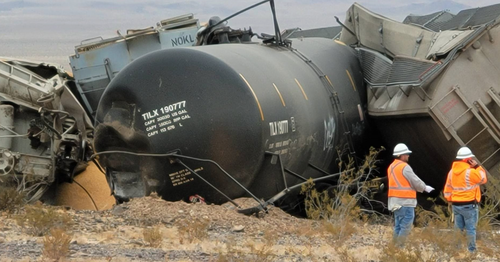
More Scenes Of The Incident
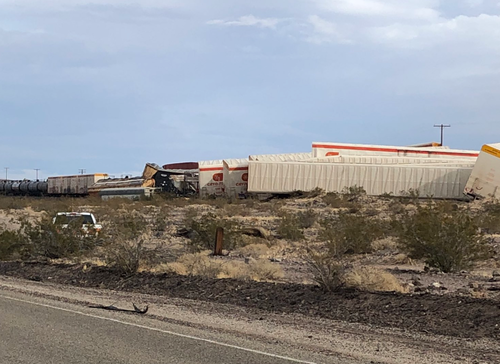
A drone video shows first responders in hazmat suits inspecting a tanker car.
The police drone captured stunning views of the mangled railcars.
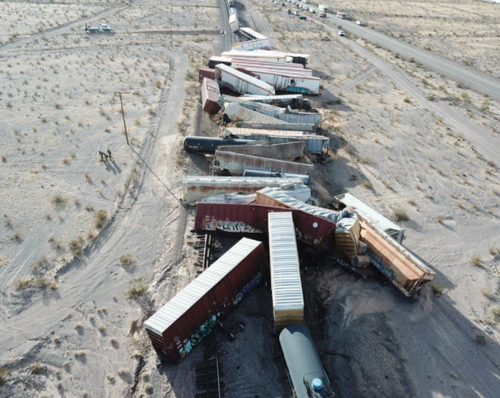
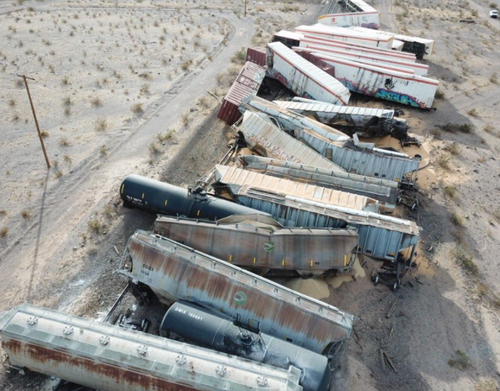
“Initial reports indicate 44 cars derailed, and one car carrying ethanol alcohol is leaking,” BNSF spokeswoman Lena Kent told NBC Los Angeles.
Investigators are still working the incident area to figure out how the derailment occurred.
March 5, 2021
Crazy
Stunning Views Of Freight Train Derailment In California Desert
by Tyler DurdenThursday, Mar 04, 2021 – 20:00
On Wednesday evening, a freight train derailment in the Southern California desert sent more than 40 railcars careening off the tracks into a mangled mess of metal.
San Bernardino County Fire (SBCF) tweeted pictures and a drone video of the train derailment. They said the incident occurred on the Burlington Northern Santa Fe Railway Company (BNSF Railway) rail network east of Ludlow, on Old National Trails Highway, or about 150 miles northeast of Los Angeles.
SBCF said, “BNSF cargo railcars, no injuries, no fire, Haz-Mat on scene. No impact to I-40.” Judging by the pictures released by the local police agency, a variety of cars were involved in the incident, including tanker cars, boxcars, and hoppers.
Mixed Freight Derailment
Tanker Cars And Other Cars Derailed
More Scenes Of The Incident
A drone video shows first responders in hazmat suits inspecting a tanker car.
The police drone captured stunning views of the mangled railcars.
“Initial reports indicate 44 cars derailed, and one car carrying ethanol alcohol is leaking,” BNSF spokeswoman Lena Kent told NBC Los Angeles.
Investigators are still working the incident area to figure out how the derailment occurred.
March 4, 2021
Running Out of Foam
Car seat foam shortage threatens to derail auto production, report says
Automakers continue to suffer through a semiconductor shortage, but there may be another issue brewing in the background: foam. Specifically, the foam that goes into millions of car seats we sit on every day when going for a drive. According to a report from Automotive News on Thursday, suppliers are “scrambling” to restart production following the devastating Texas winter storms last month.
The storms knocked power offline for millions of residents and produced water shortages statewide, and the state’s petrochemical plants didn’t go unscathed. Two sources spoke with the publication saying things are fine for now, but the problem may become serious in the coming weeks. One source cautioned this is a “threat” and not a “given,” depending on how the sector ramps up production again. But the semiconductor shortage has left automakers in a tough spot as they shut down plants across North America. A second supplier issue to hit the industry would compound the problem.
Stellantis, the merged automaker formed from Fiat Chrysler Automobiles and PSA Group, told Roadshow, “We are closely monitoring the situation. At this time, we do not expect an impact on our operations.” A GM spokesperson said, “GM continues to work closely with the supply base to mitigate the impacts caused by the significant winter weather that affected a large portion of the country the week of Feb. 15. We don’t anticipate any immediate production impacts.” Ford did not immediately return a request for comment on the report.
If the coronavirus pandemic taught us anything, these situations are mighty fluid. Last year, nearly every major automaker stopped vehicle production to slow the spread of COVID-19, and each carefully navigated their way to reopening their facilities. One of the report’s sources mentioned seat supplier production lines may start to run out of foam by this coming Monday; we’ll have to wait and see how the situation unfolds.
March 4, 2021
87% of Arrivals Late
Container chaos will take through to Q3 to resolve: TPM
Sam ChambersMarch 2, 20213 17,375 3 minutes read

Shippers have been told they’ll need to wait through to the second half of the year before any semblance of normality returns to container trade flows. The CEOs of three of the world’s leading global carriers – Ocean Network Express (ONE), Hapag-Lloyd and Maersk – have been speaking at TPM, the world’s top container shipping event, organised by the Journal of Commerce, during which they discussed the current supply chain logjam and potential routes out of the ongoing container crunch.
Jeremy Nixon, the CEO of Japanese carrier ONE, discussed issues relating to terminal productivity in North America, which lag Asian counterparts by up to 50% thanks to less working hours.
Splash has reported repeatedly on the record ship queues at ports on both North American coasts in recent weeks.
When quizzed as to when normal cargo flows would return on the transpacific, Nixon said that because of all the ships alongside or at anchor in North America: “We’re actually running out of ships in Asia.”

“Frankly we’ve probably got another three to four months to work this through,” Nixon said, adding: “Hopefully by the second half of 2021 we should see a more stabilised trade.”
Nixon told TPM attendees that liners and their clients need to get better at forecasting, at working out how booking patterns will change. ONE is developing its own predictive analytics looking at the movement of cargoes.
We’ve probably got another three to four months to work this through
Presenting from the port of Hamburg with one of his ships, the Philadelphia Express, in the background, Rolf Habben Jansen, the CEO of Hapag-Lloyd, told TPM delegates that today’s strong volumes would continue for “quite some time”.
Like Nixon, Habben Jansen talked about the tight availabilities of both boxes and ships at the moment, which combined with terminal delays have created a “perfect storm that everybody needs to work through”.
“We will get to some kind of normalcy hopefully within one or two quarters,” the Hapag-Lloyd boss said, going on to claim that the types of peaks seen in the market in recent months are not good for everyone, calling for a return to stability.
“By Q3 it ought to be more or less a normal situation again,” Habben Jansen predicted.
Vincent Clerc, the CEO Of A.P. Moller-Maersk Ocean & Logistics, the world’s largest containerline, said that global supply chains had never before experienced the stress tests of the past few months.
As with his liner counterparts, Clerc noted the underinvestment along the coastline of North America as a critical part of today’s backed-up box crisis.
While containerlines have been reaping enormous profits, Clerc said that for him and his Maersk colleagues it has not felt like a “big high-five moment” because of all the inconveniences clients were facing with delays and rolled cargoes.
Latest data from Sea-Intelligence showed that global schedule reliability dropped to a record low of 34.9% in January – or put another way, just one in three boxes was arriving on time last month – a period of time where shippers were paying record sums for their goods to be shipped.
For Asia-North America west coast, almost 87% of the arrivals were late last month, according to Sea-Intelligence analysis. And when they are late, they are on average more than 10 days late.
Clerc told TPM delegates that Maersk views the current unexpected surge in consumer demand as temporary. Clerc said Maersk is forecasting a return to a more normal base – similar to 2019 levels – during the course of 2021.
The pandemic has not changed Maersk’s long term view of the industry with “fairly subdued” long-term growth anticipated, Clerc said.
“I don’t think anyone expects the current level of shipments to be a new normal from which growth will accelerate,” Clerc said.
The Maersk CEO also told delegates that within five years he expects close to 100% of the liner’s business to be based on two-way binding contracts.
“It makes sense that we have a clear view on what we are going to do for each other,” Clerc said.
Splash will be bringing further news from TPM this week, including a report on what Bill Gates, the Microsoft co-founder, has to say. He is due to speak later today, promoting a new book entitled How to Avoid a Climate Disaster.

 Everchem Updates Archive
 Sign Up for Email Updates