Current Affairs
February 6, 2021
Shortages on the Horizon
BFM gives early warning on potential foam supply issues
Home / News / Articles / 2021 / February
The British Furniture Manufacturers Association (BFM) is issuing an early warning to the sector on the potential for further foam shortages later this year.
According to the trade body, two major producing plants are planning to carry out planned maintenance in Spring and Summer. A full report and analysis of the situation is due in the monthly BFM Price Report, which is issued to members.
Nick Garratt, MD of the BFM, said: “The TDI market [Toluene Diisocyanate] in Europe was tight throughout much of the second half of 2020, but in December supply began to improve as all three European TDI makers were operational.
“As markets enter Q2 this year, although stocks will have been built up in advance of the downtimes, with the downtime of two major suppliers there is the potential for short-term tightness to arise and the hope for buyers of foam is that outages do not extend, like last year, beyond the initially planned timeframe.
“Our members, having suffered supply shortages throughout 2020, have worked hard to maintain supply of customer orders in the face of an ongoing supply issue.
“We’ll be keeping a watching brief on the situation and ensuring that members receive timely alerts through our Price Reports, to keep informed of the situation.”
February 6, 2021
Shortages on the Horizon
BFM gives early warning on potential foam supply issues
Home / News / Articles / 2021 / February
The British Furniture Manufacturers Association (BFM) is issuing an early warning to the sector on the potential for further foam shortages later this year.
According to the trade body, two major producing plants are planning to carry out planned maintenance in Spring and Summer. A full report and analysis of the situation is due in the monthly BFM Price Report, which is issued to members.
Nick Garratt, MD of the BFM, said: “The TDI market [Toluene Diisocyanate] in Europe was tight throughout much of the second half of 2020, but in December supply began to improve as all three European TDI makers were operational.
“As markets enter Q2 this year, although stocks will have been built up in advance of the downtimes, with the downtime of two major suppliers there is the potential for short-term tightness to arise and the hope for buyers of foam is that outages do not extend, like last year, beyond the initially planned timeframe.
“Our members, having suffered supply shortages throughout 2020, have worked hard to maintain supply of customer orders in the face of an ongoing supply issue.
“We’ll be keeping a watching brief on the situation and ensuring that members receive timely alerts through our Price Reports, to keep informed of the situation.”
January 30, 2021
Another Freight Congestion Post
Trans-Pacific Trade Crashes Into Max-Capacity Ceiling
by Tyler DurdenFriday, Jan 29, 2021 – 12:20
By Greg Miller of FreightWaves,
It’s official: Container volumes in the Asia-U.S. trans-Pacific trade have hit their limit. Massive port congestion in the ports of Los Angeles and Long Beach is forcing ocean carriers to take extreme measures. Sailings are now being “blanked” (canceled) not because of lack of demand, but because of lack of tonnage as ships are stuck awaiting berths.
When ships fall behind schedule due to long waits in port, carriers normally add “recovery vessels” to take their place and keep weekly services going. There are no recovery vessels left. According to Hapag-Lloyd, “as our fleets are fully deployed and stretched beyond capacity, this is regretfully currently not an option.”
As a result, Hapag-Lloyd has blanked 19 sailings in February. “It is important to emphasize that vessels will not be idling at any time and we will perform as many voyages as possible,” stressed the carrier. Hapag-Lloyd is a member of THE Alliance along with Ocean Network Express (ONE), Yang Ming and HMM.
‘Need-to-get-back-on-schedule blanks’
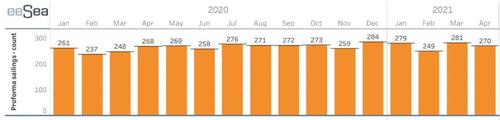
“Schedule reliability is horrible,” said Simon Sundboell, founder of eeSea, a company that analyzes ship schedules. “These are not ‘pull-out-capacity blanks.’ These are ‘need-to-get-back-on-schedule blanks,’” Sundboell told American Shipper.
Carriers usually blank sailings at this time of year due to lower exports during the Chinese New Year (CNY) holiday. Carriers initially opted to keep CNY sailings largely intact in order to clear the export pileup at Chinese ports. But the congestion in Los Angeles and Long Beach is leaving carriers short of ships. That means the pileup in Asia will take even longer to clear.
The eeSea platform provides complimentary access to real-time blank sailing data. The data as of Wednesday reveals an 11% dip in Asia-U.S. sailings in February versus January. This is despite continued high cargo demand.
During a webinar presented by freight forwarder Flexport on Tuesday, Seaintelligence Consulting CEO Lars Jensen explained, “When you have all the vessels stuck waiting outside ports, they cannot make the return journey so they cannot start the sailing they were supposed to do. The blank sailings now are not a choice. They are an operational necessity.”
No letup in San Pedro Bay traffic jam
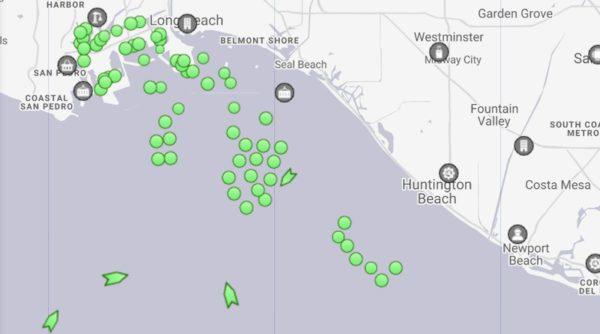
At any given time since the beginning of this year, there have been around 30 container ships stuck waiting at anchorages in San Pedro Bay offshore of the ports of Los Angeles and Long Beach.
The situation has not improved at all. According to the Marine Exchange of Southern California, there were 33 container ships at anchorages and 26 at berths on Wednesday. Including all ship types, there were 55 vessels at anchorages — a new record, with all Los Angeles/Long Beach anchorages full and all contingency anchorages off Huntington also full.San Pedro Bay container-ship positions Jan. 27 (Map: MarineTraffic)

On Monday, many of those vessels had to leave anchorage and go to sea due to extreme storm conditions. Winds gusted to 55 mph and swells reached 15 feet. Marine Exchange Executive Director Kip Louttit exclaimed that he “could not recall a more complex situation with this many vessels and this bad a wind and sea condition for such a sustained period of time.”
Port congestion is being caused by high inbound volumes combined with surging COVID cases among dockworkers. A spokesperson for the ILWU dockworkers union told American Shipper that number of its members testing positive had risen to 803 as of Monday, up 16% from 694 as of Jan. 17.
“They can’t service the ships fast enough, which has led to waiting times of 10-14 days or even more, depending on the terminal,” said Nerijus Poskus, global head of ocean freight at Flexport.
“As of last week, there were almost 300,000 TEUs [twenty-foot equivalent units] waiting to get offloaded,” Poskus added.
Jensen put it another way. “It is the equivalent of pulling five full trans-Pacific services out of action as long as you have these waiting times,” he said. “The impact is massive.”
Deteriorating reliability, rising rolls
As previously reported by American Shipper, global schedule reliability has collapsed to around 50% versus normal levels of 70%-80%. Getting a box delivered on time is no better than a coin toss. In reality, the chance is much worse. Schedule reliability data doesn’t take into account blank sailings. Nor does it take into account cargo that is “rolled” — pushed off to a subsequent voyage.
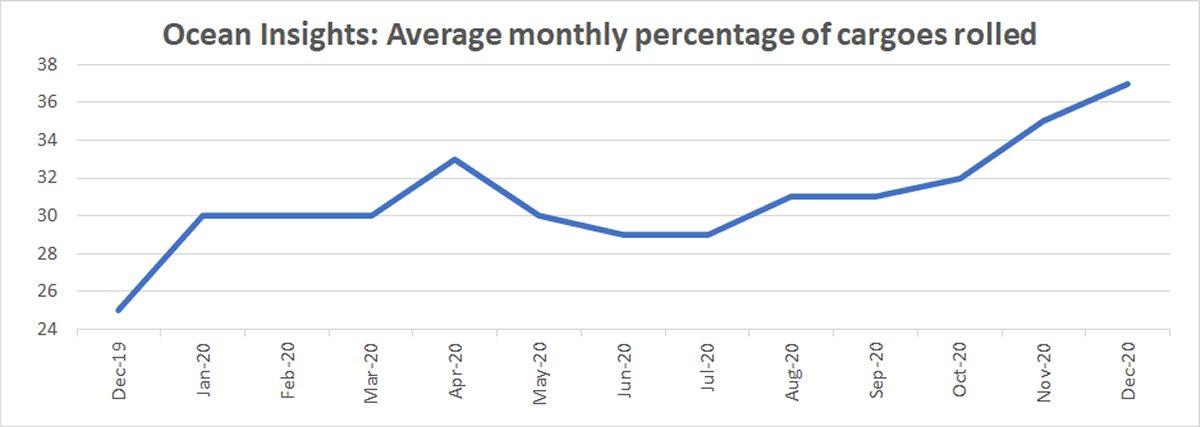
Data on cargo rolls by the world’s top liners at the world’s top ports is compiled by Ocean Insights. According to Ocean Insights data released last week, the share of shipments that did not sail aboard their originally scheduled vessels rose to 37% in December. That’s up sharply from 29% in July and 25% in December 2019.
One importer moving goods from China via Los Angeles wrote to American Shipper: “We’re seeing over 60 days of additional transit time now. The entire process used to take 28 days. Now containers shipped in November have still not reached their final destination.”
Add it all up and U.S. consumers should see escalating shortages of goods on the shelves. That, in turn, should fuel import demand even further into 2021.
Light at the end of the tunnel?
One of the central drivers of today’s capacity crunch is a shortfall of containers. Or rather, a shortfall of containers positioned in the right place.
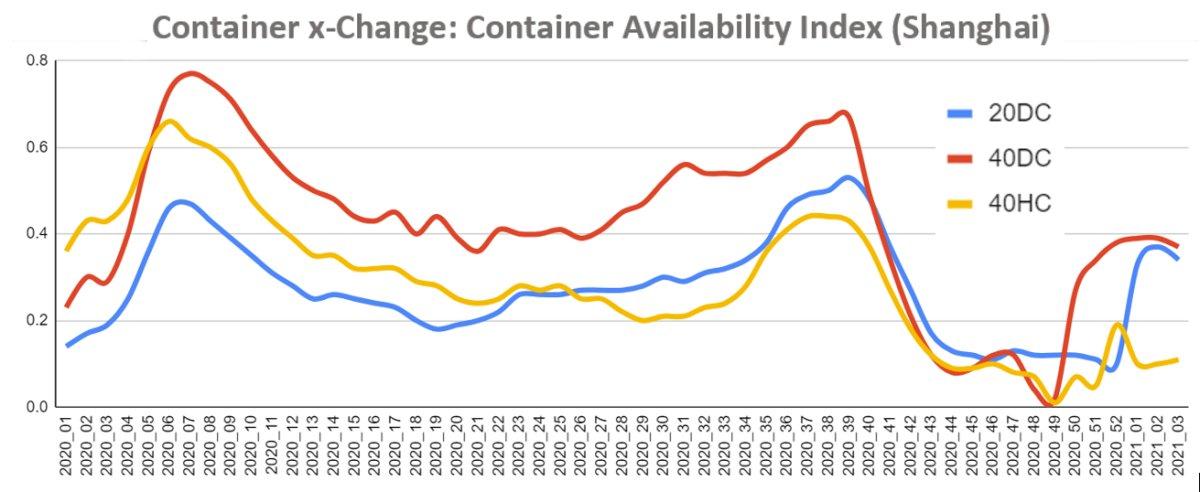
But there are some glimmers of hope. Data on container-equipment availability is tracked by the Container x-Change Container Availability Index. Availability of 40-foot high cubes (40HCs) remains extremely low. But availability of 20-foot dry cargo (20DC) and 40-foot standard dry cargo (40DC) units improved markedly this month.
The index “finally shows a positive trend,” asserted David Amezquita, head of data insights at Container xChange. The upcoming CNY period could “finally be the turning point,” added the company.
An index level below 0.5 is considered a shortage. In the third week of January, the index in Shanghai for 20DCs was up to 0.34 and for 40DCs to 0.37. The index for 40HCs was still a very low 0.11.(Chart: Container x-Change)

Getting back to normal
Jensen expressed confidence that the container-equipment challenge will be resolved fairly soon. Chinese factories have been busy churning out new boxes.
“What’s happening now is exactly the same scenario we saw in 2010 after the financial crisis. If you look at 2010, they went on a building spree. It took about three months from when the problem arose to when it was resolved. If we put that in the context we have now, this should be resolved by Chinese New Year.
“The wild card this time around is the port congestion because that ties up a significant part of the ability to reposition the empty containers back into balance. That could delay things somewhat,” acknowledged Jensen.
As more containers are manufactured, liners should simultaneously work to get sailings back on schedule. “It appears the carriers plan to use the post-Chinese New Year period to get their vessels back on schedule,” said Jensen. “If that works out and if we get the port congestion sorted out — which is a big if — we could get back to normal levels [of service reliability] within a few months. But that’s the optimistic view.”
https://www.zerohedge.com/markets/trans-pacific-trade-crashes-max-capacity-ceiling
January 30, 2021
Another Freight Congestion Post
Trans-Pacific Trade Crashes Into Max-Capacity Ceiling
by Tyler DurdenFriday, Jan 29, 2021 – 12:20
By Greg Miller of FreightWaves,
It’s official: Container volumes in the Asia-U.S. trans-Pacific trade have hit their limit. Massive port congestion in the ports of Los Angeles and Long Beach is forcing ocean carriers to take extreme measures. Sailings are now being “blanked” (canceled) not because of lack of demand, but because of lack of tonnage as ships are stuck awaiting berths.
When ships fall behind schedule due to long waits in port, carriers normally add “recovery vessels” to take their place and keep weekly services going. There are no recovery vessels left. According to Hapag-Lloyd, “as our fleets are fully deployed and stretched beyond capacity, this is regretfully currently not an option.”
As a result, Hapag-Lloyd has blanked 19 sailings in February. “It is important to emphasize that vessels will not be idling at any time and we will perform as many voyages as possible,” stressed the carrier. Hapag-Lloyd is a member of THE Alliance along with Ocean Network Express (ONE), Yang Ming and HMM.
‘Need-to-get-back-on-schedule blanks’
“Schedule reliability is horrible,” said Simon Sundboell, founder of eeSea, a company that analyzes ship schedules. “These are not ‘pull-out-capacity blanks.’ These are ‘need-to-get-back-on-schedule blanks,’” Sundboell told American Shipper.
Carriers usually blank sailings at this time of year due to lower exports during the Chinese New Year (CNY) holiday. Carriers initially opted to keep CNY sailings largely intact in order to clear the export pileup at Chinese ports. But the congestion in Los Angeles and Long Beach is leaving carriers short of ships. That means the pileup in Asia will take even longer to clear.
The eeSea platform provides complimentary access to real-time blank sailing data. The data as of Wednesday reveals an 11% dip in Asia-U.S. sailings in February versus January. This is despite continued high cargo demand.
During a webinar presented by freight forwarder Flexport on Tuesday, Seaintelligence Consulting CEO Lars Jensen explained, “When you have all the vessels stuck waiting outside ports, they cannot make the return journey so they cannot start the sailing they were supposed to do. The blank sailings now are not a choice. They are an operational necessity.”
No letup in San Pedro Bay traffic jam
At any given time since the beginning of this year, there have been around 30 container ships stuck waiting at anchorages in San Pedro Bay offshore of the ports of Los Angeles and Long Beach.
The situation has not improved at all. According to the Marine Exchange of Southern California, there were 33 container ships at anchorages and 26 at berths on Wednesday. Including all ship types, there were 55 vessels at anchorages — a new record, with all Los Angeles/Long Beach anchorages full and all contingency anchorages off Huntington also full.San Pedro Bay container-ship positions Jan. 27 (Map: MarineTraffic)
On Monday, many of those vessels had to leave anchorage and go to sea due to extreme storm conditions. Winds gusted to 55 mph and swells reached 15 feet. Marine Exchange Executive Director Kip Louttit exclaimed that he “could not recall a more complex situation with this many vessels and this bad a wind and sea condition for such a sustained period of time.”
Port congestion is being caused by high inbound volumes combined with surging COVID cases among dockworkers. A spokesperson for the ILWU dockworkers union told American Shipper that number of its members testing positive had risen to 803 as of Monday, up 16% from 694 as of Jan. 17.
“They can’t service the ships fast enough, which has led to waiting times of 10-14 days or even more, depending on the terminal,” said Nerijus Poskus, global head of ocean freight at Flexport.
“As of last week, there were almost 300,000 TEUs [twenty-foot equivalent units] waiting to get offloaded,” Poskus added.
Jensen put it another way. “It is the equivalent of pulling five full trans-Pacific services out of action as long as you have these waiting times,” he said. “The impact is massive.”
Deteriorating reliability, rising rolls
As previously reported by American Shipper, global schedule reliability has collapsed to around 50% versus normal levels of 70%-80%. Getting a box delivered on time is no better than a coin toss. In reality, the chance is much worse. Schedule reliability data doesn’t take into account blank sailings. Nor does it take into account cargo that is “rolled” — pushed off to a subsequent voyage.
Data on cargo rolls by the world’s top liners at the world’s top ports is compiled by Ocean Insights. According to Ocean Insights data released last week, the share of shipments that did not sail aboard their originally scheduled vessels rose to 37% in December. That’s up sharply from 29% in July and 25% in December 2019.
One importer moving goods from China via Los Angeles wrote to American Shipper: “We’re seeing over 60 days of additional transit time now. The entire process used to take 28 days. Now containers shipped in November have still not reached their final destination.”
Add it all up and U.S. consumers should see escalating shortages of goods on the shelves. That, in turn, should fuel import demand even further into 2021.
Light at the end of the tunnel?
One of the central drivers of today’s capacity crunch is a shortfall of containers. Or rather, a shortfall of containers positioned in the right place.
But there are some glimmers of hope. Data on container-equipment availability is tracked by the Container x-Change Container Availability Index. Availability of 40-foot high cubes (40HCs) remains extremely low. But availability of 20-foot dry cargo (20DC) and 40-foot standard dry cargo (40DC) units improved markedly this month.
The index “finally shows a positive trend,” asserted David Amezquita, head of data insights at Container xChange. The upcoming CNY period could “finally be the turning point,” added the company.
An index level below 0.5 is considered a shortage. In the third week of January, the index in Shanghai for 20DCs was up to 0.34 and for 40DCs to 0.37. The index for 40HCs was still a very low 0.11.(Chart: Container x-Change)
Getting back to normal
Jensen expressed confidence that the container-equipment challenge will be resolved fairly soon. Chinese factories have been busy churning out new boxes.
“What’s happening now is exactly the same scenario we saw in 2010 after the financial crisis. If you look at 2010, they went on a building spree. It took about three months from when the problem arose to when it was resolved. If we put that in the context we have now, this should be resolved by Chinese New Year.
“The wild card this time around is the port congestion because that ties up a significant part of the ability to reposition the empty containers back into balance. That could delay things somewhat,” acknowledged Jensen.
As more containers are manufactured, liners should simultaneously work to get sailings back on schedule. “It appears the carriers plan to use the post-Chinese New Year period to get their vessels back on schedule,” said Jensen. “If that works out and if we get the port congestion sorted out — which is a big if — we could get back to normal levels [of service reliability] within a few months. But that’s the optimistic view.”
https://www.zerohedge.com/markets/trans-pacific-trade-crashes-max-capacity-ceiling
January 26, 2021
Fuel Surcharges Are Back
Fuel prices up for 11th straight week, hit highest mark since March 2020
Overdrive StaffJan 20, 2021
Trucking news and briefs for Wednesday, Jan. 20, 2021:

Diesel fuel prices across the U.S. increased for the 11th straight week during the week ending Jan. 18, according to the Department of Energy’s weekly report.
According to DOE, the average price for a gallon of on-highway diesel is $2.696, up 2.6 cents from the previous week and up 32.4 cents from the 2020 low mark of $2.372 per gallon during the week ending Nov. 2.
Fuel prices are now at their highest point since the week ending March 16, 2020, when prices stood at $2.733 per gallon.
During the most recent week, prices increased in all regions, with the most significant increase being seen in New England, which saw a 6.4-cent increase.
California is home to the nation’s most expensive diesel at $3.448 per gallon, followed by the Central Atlantic region at $2.924 per gallon.
The cheapest fuel can be found in the Gulf Coast region at $2.461 per gallon, followed by the Rocky Mountain region at $2.603 per gallon.
 Everchem Updates Archive
  Sign Up for Email Updates