Current Affairs
September 21, 2020
Furniture Delays
Furniture, appliance shortage impacting East Texas retailers
Many customers are experiencing longer than normal wait times for orders on furniture and appliances due to the pandemic.

Author: Channing Curtis Published: 8:02 PM CDT September 17, 2020 Updated: 8:07 PM CDT September 17, 2020


TYLER, Texas — With so many of us at home more than usual, it’s easy to start thinking about buying some new furniture or replacing some of your older appliances, but if you’re hoping to get a new couch in the next few months, think again.
“You had factories being closed down for a large amount of time,” Brian Adams, Operations Manager at Adams Furniture and Appliances, said. “Factories started open back up, but they have to be spaced out for social distancing. So they’re working at a 50% workforce. And then all of a sudden, you had the demand just go through the roof. I mean, consumers got out. They were getting a stimulus money. They were getting extra unemployment money. So they had disposable income. And everybody went out and bought furniture. So that just put a huge kink. And so yes, right now, it is a struggle.”
Adams speaks with manufacturers weekly. He says the wait time on many items has drastically increased due to the coronavirus pandemic.
“There’s certain companies that usually we can order from them in two to three weeks and have the customers product on a special order and most of those companies right now are 12 to 14 weeks,” Adams said.
It isn’t just furniture that’s on back order right now. Adams says people rushing to the grocery stores at the beginning of the pandemic caused other shortages as well.
“A lot of people were going to the grocery store so freezers disappeared,” Adams said. “Matter of fact, we still can’t hardly get any freezers. We’ve hit a wall just on your basic washer and dryer, I mean, I was just on a call the other day if I place an order right now for that, it’s January.”
Adams says he tries to be upfront with customers about what’s going on and how long it takes for items to get in.
“We’ll have a customer come in the store right now and we’ll tell them, they’ll pick out a sofa and loveseat like, OK, if you ordered this right now we can have it in about let’s say it’s 10 weeks,” Adams said. “And they’re like, OK, well, we’ll think about it. I’m like, just remember, we’re quoting you 10 weeks if you order right now, if you wait another week, it might be 14 weeks because there’s companies all over the country placing orders daily, and it’s just backing up.”
While some manufacturers believe supply will be back to normal in January or February, Adams says it could be much longer than that.
“I think we’ve reached the point where most consumers now are understanding because obviously it’s not just the furniture business,” Adams said. “It’s not just the appliance business. It’s all over the map right now.”
September 15, 2020
Rail Traffic Rebounds
US Railroad Traffic Posts First Annual Jump Since The Start Of 2020
by Tyler Durden Tue, 09/15/2020 – 05:30
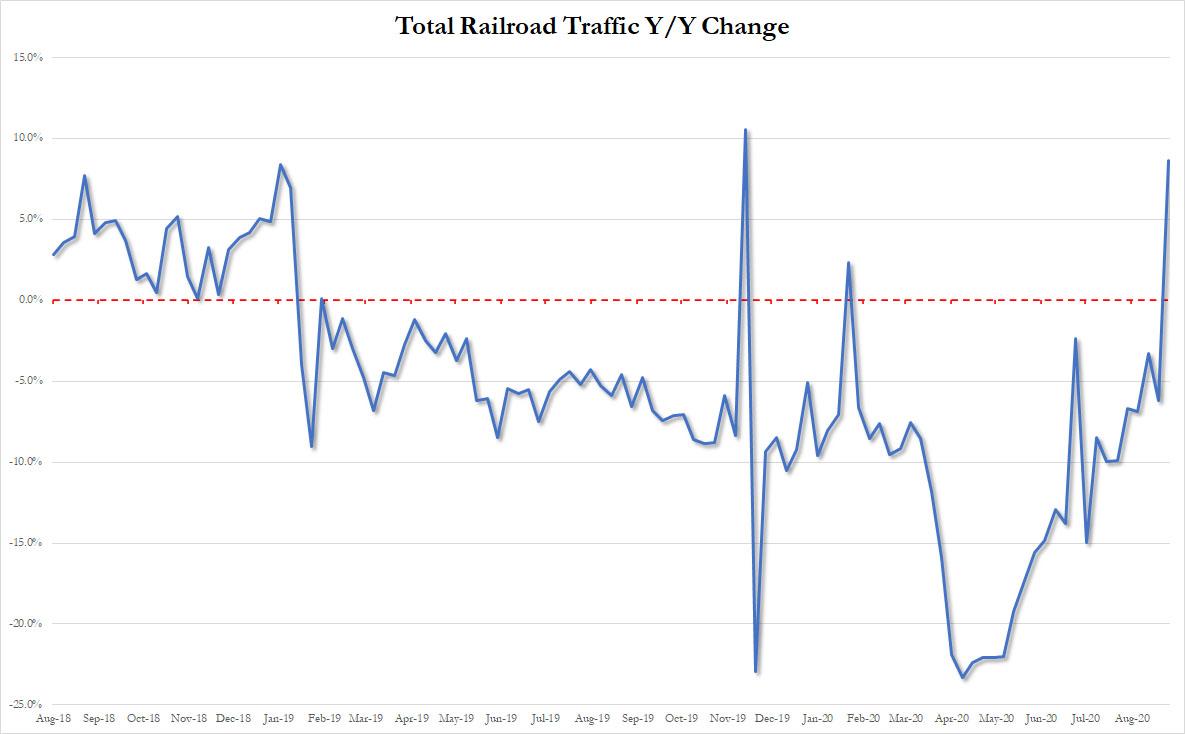
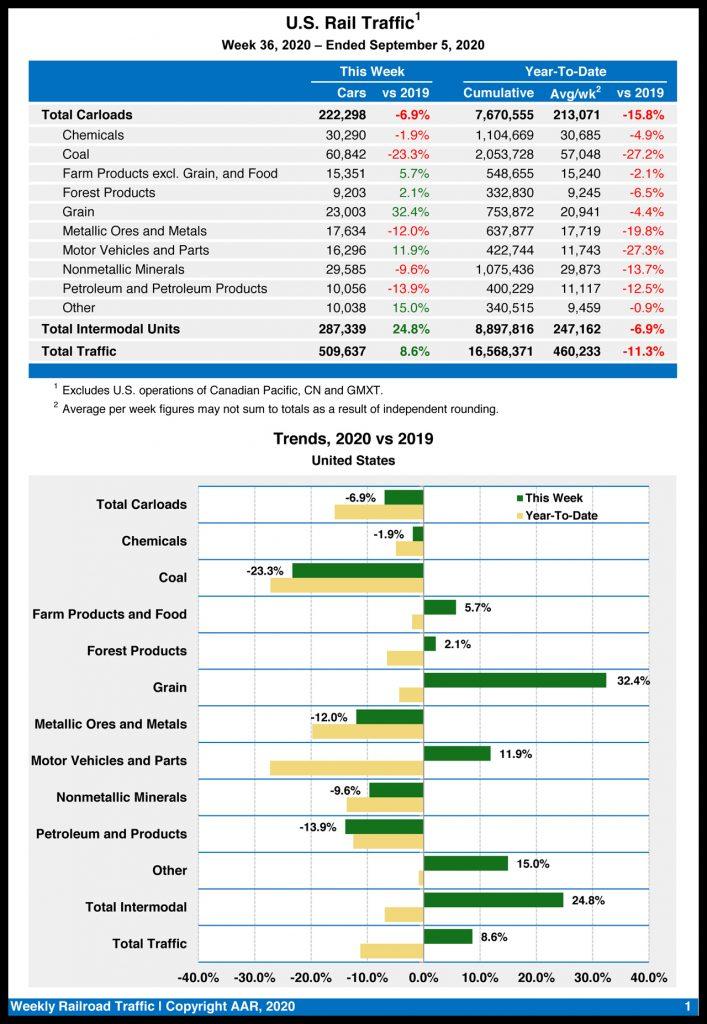
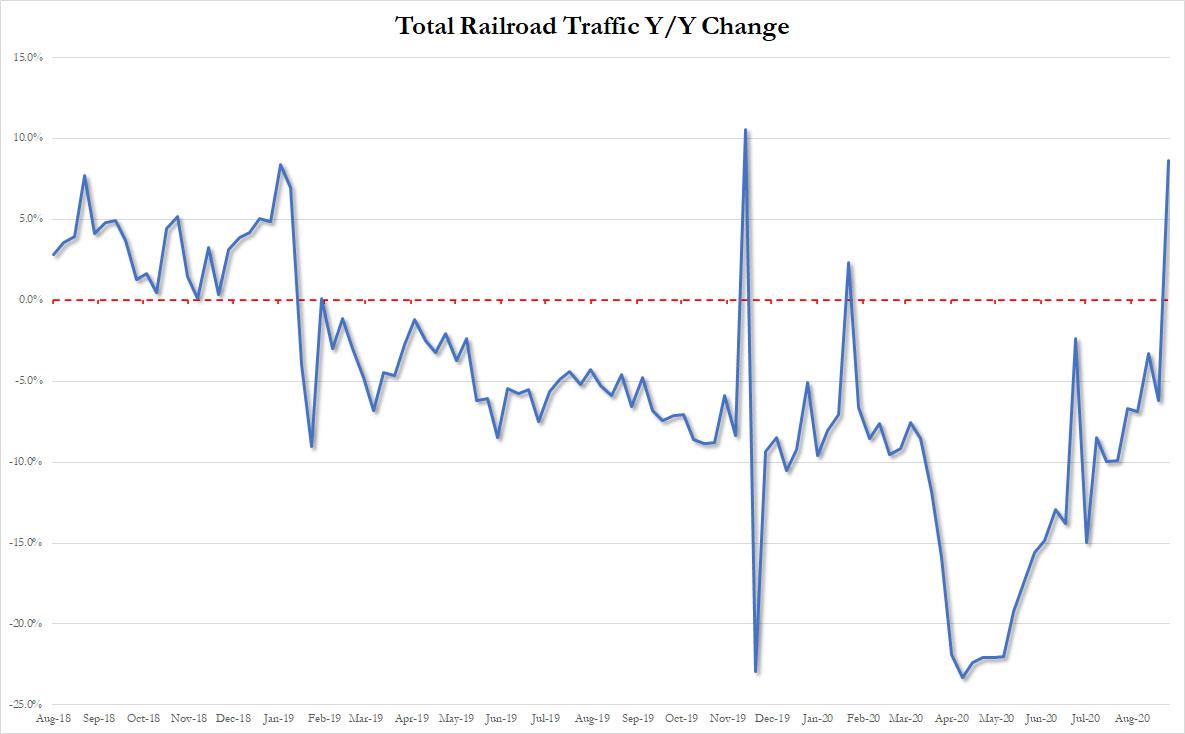
U.S. railroads just posted their first annual traffic gain in a very long time: according to Railway Age, for the week ending September 5, 2020, a surge of nearly 25% y/y in intermodal loadings more than offset a 7% decline in carload traffic, creating an overall annual gain of nearly 9%, the Association of American Railroads (AAR) reported Sept. 9.
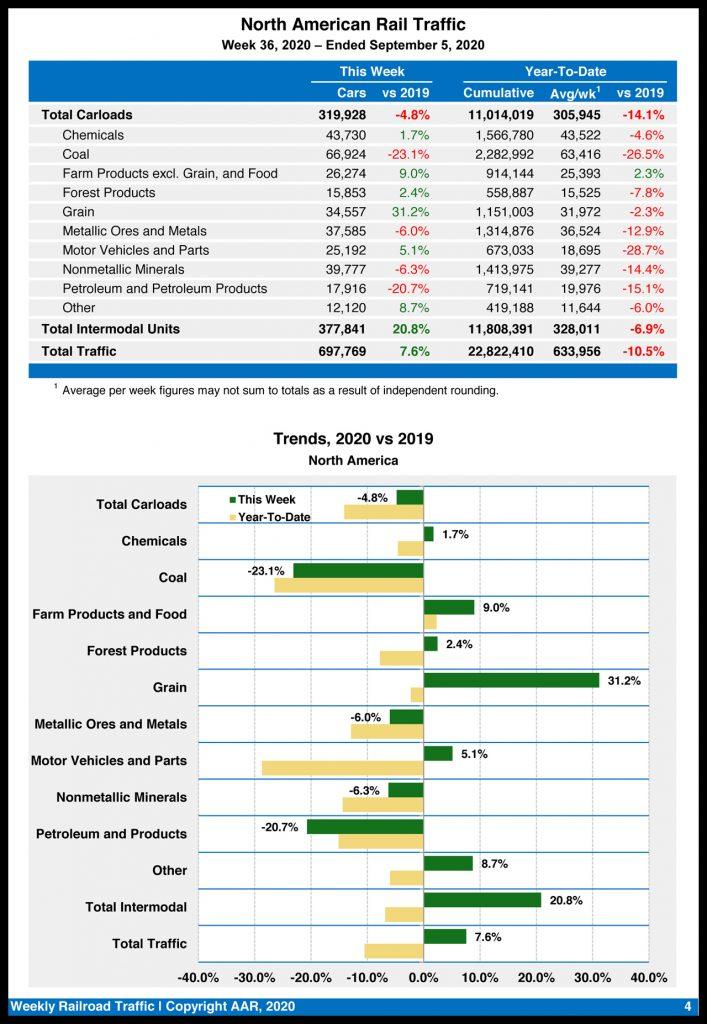
Canadian and Mexican intermodal volumes also rose, driving a North American gain of nearly 21%.
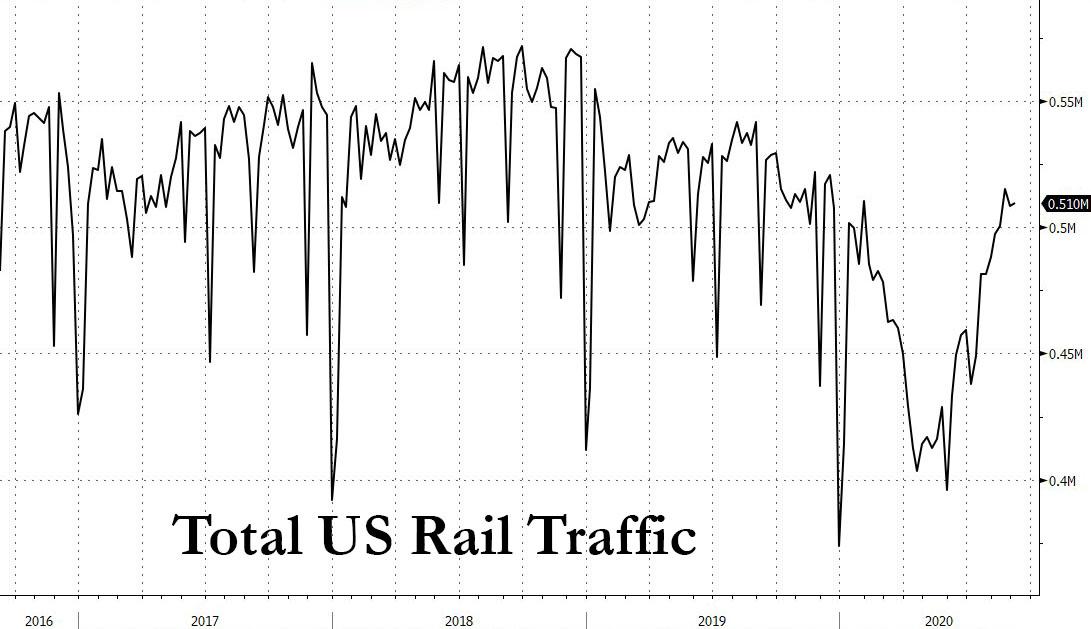
Total U.S. rail traffic for the week ending Sept. 5 was 509,637 carloads and intermodal units, up 8.6% compared with the same week last year.
It’s unclear what prompted the 32% Y/Y surge in grain traffic which was the primary driver behind the week’s jump in intermodal, it’s also unclear if the traffic jump is sustainable but as the chart below shows, we are now entering a period where simply due to the base effect, rail traffic will soon be consistently stronger compared to late 2019 and early 2020.
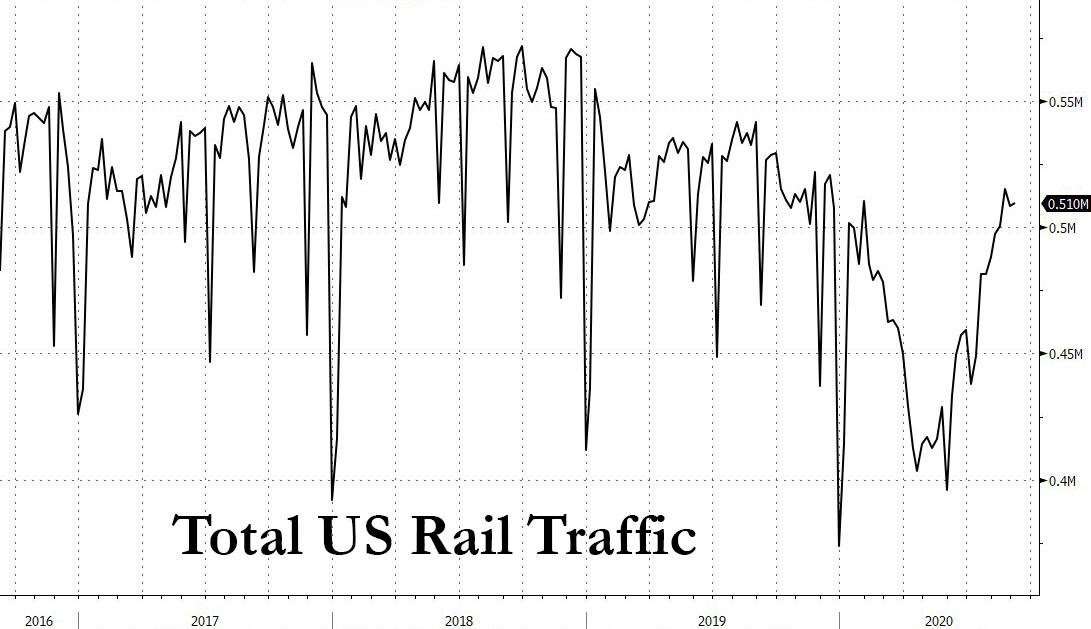
Total carloads were 222,298, down 6.9% compared with the same week in 2019, but weekly intermodal volume was 287,339 containers and trailers, up 24.8%.
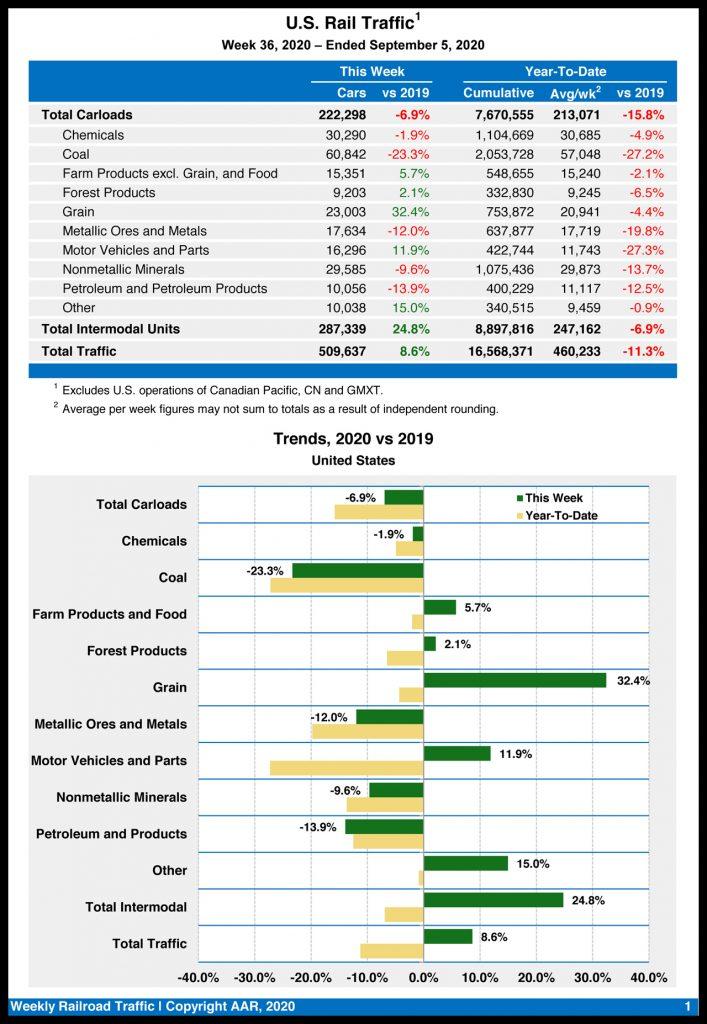
Five of the 10 carload commodity groups posted an increase compared with the same week in 2019. They included grain, up 5,630 carloads, to 23,003; motor vehicles and parts, up 1,729 carloads, to 16,296; and miscellaneous carloads, up 1,306 carloads, to 10,038. Commodity groups that posted decreases compared with the same week in 2019 included coal, down 18,495 carloads, to 60,842; nonmetallic minerals, down 3,159 carloads, to 29,585; and metallic ores and metals, down 2,396 carloads, to 17,634.
For the first 36 weeks of 2020, U.S. railroads reported cumulative volume of 7,670,555 carloads, down 15.8% from the same point last year; and 8,897,816 intermodal units, down 6.9% from last year. Total combined U.S. traffic for the first 36 weeks of 2020 was 16,568,371 carloads and intermodal units, a decrease of 11.3% compared to last year.
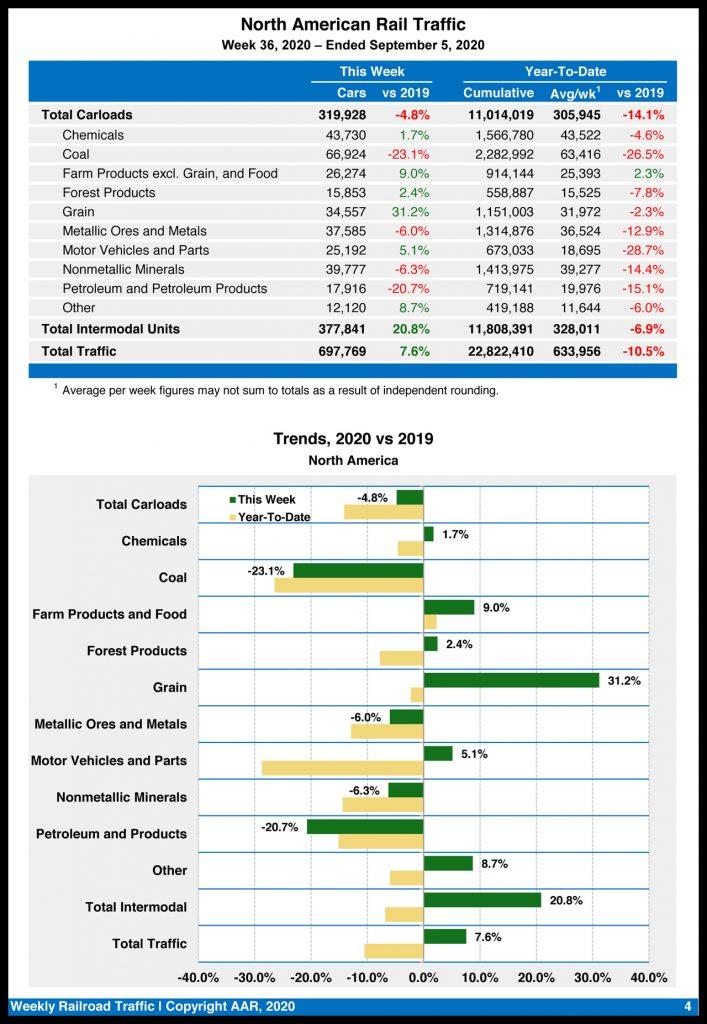
Total North American rail volume for the week on 12 reporting U.S., Canadian and Mexican railroads totaled 319,928 carloads, down 4.8% compared with the same week last year, and 377,841 intermodal units, up 20.8% compared with last year. Total combined weekly rail traffic in North America was 697,769 carloads and intermodal units, up 7.6%. North American rail volume for the first 36 weeks of 2020 was 22,822,410 carloads and intermodal units, down 10.5% compared with 2019.
Canadian railroads reported 78,580 carloads for the week, up 0.7%, and 73,558 intermodal units, up 11.3% compared with the same week in 2019. For the first 36 weeks of 2020, Canadian railroads reported cumulative rail traffic volume of 5,011,733 carloads, containers and trailers, down 8.2%.
Mexican railroads reported 19,050 carloads for the week, down 0.9% compared with the same week last year, and 16,944 intermodal units, up 4%. Cumulative volume on Mexican railroads for the first 36 weeks of 2020 was 1,242,306 carloads and intermodal containers and trailers, down 9.5% from the same point last year.
September 15, 2020
Rail Traffic Rebounds
US Railroad Traffic Posts First Annual Jump Since The Start Of 2020
by Tyler Durden Tue, 09/15/2020 – 05:30
U.S. railroads just posted their first annual traffic gain in a very long time: according to Railway Age, for the week ending September 5, 2020, a surge of nearly 25% y/y in intermodal loadings more than offset a 7% decline in carload traffic, creating an overall annual gain of nearly 9%, the Association of American Railroads (AAR) reported Sept. 9.
Canadian and Mexican intermodal volumes also rose, driving a North American gain of nearly 21%.
Total U.S. rail traffic for the week ending Sept. 5 was 509,637 carloads and intermodal units, up 8.6% compared with the same week last year.
It’s unclear what prompted the 32% Y/Y surge in grain traffic which was the primary driver behind the week’s jump in intermodal, it’s also unclear if the traffic jump is sustainable but as the chart below shows, we are now entering a period where simply due to the base effect, rail traffic will soon be consistently stronger compared to late 2019 and early 2020.
Total carloads were 222,298, down 6.9% compared with the same week in 2019, but weekly intermodal volume was 287,339 containers and trailers, up 24.8%.
Five of the 10 carload commodity groups posted an increase compared with the same week in 2019. They included grain, up 5,630 carloads, to 23,003; motor vehicles and parts, up 1,729 carloads, to 16,296; and miscellaneous carloads, up 1,306 carloads, to 10,038. Commodity groups that posted decreases compared with the same week in 2019 included coal, down 18,495 carloads, to 60,842; nonmetallic minerals, down 3,159 carloads, to 29,585; and metallic ores and metals, down 2,396 carloads, to 17,634.
For the first 36 weeks of 2020, U.S. railroads reported cumulative volume of 7,670,555 carloads, down 15.8% from the same point last year; and 8,897,816 intermodal units, down 6.9% from last year. Total combined U.S. traffic for the first 36 weeks of 2020 was 16,568,371 carloads and intermodal units, a decrease of 11.3% compared to last year.
Total North American rail volume for the week on 12 reporting U.S., Canadian and Mexican railroads totaled 319,928 carloads, down 4.8% compared with the same week last year, and 377,841 intermodal units, up 20.8% compared with last year. Total combined weekly rail traffic in North America was 697,769 carloads and intermodal units, up 7.6%. North American rail volume for the first 36 weeks of 2020 was 22,822,410 carloads and intermodal units, down 10.5% compared with 2019.
Canadian railroads reported 78,580 carloads for the week, up 0.7%, and 73,558 intermodal units, up 11.3% compared with the same week in 2019. For the first 36 weeks of 2020, Canadian railroads reported cumulative rail traffic volume of 5,011,733 carloads, containers and trailers, down 8.2%.
Mexican railroads reported 19,050 carloads for the week, down 0.9% compared with the same week last year, and 16,944 intermodal units, up 4%. Cumulative volume on Mexican railroads for the first 36 weeks of 2020 was 1,242,306 carloads and intermodal containers and trailers, down 9.5% from the same point last year.
September 14, 2020
Intermodal Shortage
“I’ve Never Seen Anything Like This”: Shippers Using West Coast Ports Can’t Book Rail On BNSF And Union Pacific
by Tyler Durden Sun, 09/13/2020 – 20:30
By Stas Margaronis of AJot Insights
A Northern California logistics consultant was unable to book containers on the Burlington Northern Santa Fe (BNSF) or Union Pacific (UP) railroads for the first week of September going to and from U.S. West Coast ports and Midwest destinations.
The consultant said, “I have been working in the industry for thirty years and I have never seen anything like this. It’s weird.”
The result is that importers of low value products being shipped by containers such as tee shirts would be at an economic disadvantage transporting containers by truck as opposed to by rail between U.S. West Coast ports and Midwest destinations, because of the higher cost.
The consultant explained that there is a huge shortage of rail capacity: “There are no rail cars and there are no chassis.”
The consultant, who is not identified, was contracted to research container rail bookings on the UP and BNSF to and from U.S. West Coast ports including:
- Los Angeles
- Long Beach
- Oakland
- Seattle
The result of the research was that: “The railroads will not take any bookings right now and so all the containers going to and from the West Coast to places such as Chicago and Memphis must go by truck.”
The consultant cited the following trucking rates per container as examples:
- Los Angeles/ Long Beach to Chicago: $7000.
- LA/LB to New Berlin, Wisconsin: $6,700.
- LA/LB to Nashville, Tennessee: $7,200.
- LA/LB to Dallas, Texas: $5000.
- LA/LB to Jacksonville, Florida: $8,800.
The consultant said that in the past it had been possible to truck a container coast-to-coast for $2,000: “But those days are gone.”
In addition, “In the good old days you could ship a container from the West Coast to Chicago or Memphis by rail for $1000 dollars.”
The research found one exception. It was possible to ship a container on a COSCO vessel to Shanghai from Memphis, Tennessee via the Port of Prince Rupert, British Columbia utilizing the Canadian National Railway.
The problem: “The travel time was over twenty-one days which is way too slow.”
However, rail intermodal moves are a complex affair, particularly when there is a significant freight imbalance as there is at the moment on the West Coast. A BNSF spokesman told AJOT, “The claim that we have a lack of railcar capacity for international shipments is inaccurate. BNSF is open for business and ready to receive all freight from ocean carriers at the West Coast ports. We have a railcar fleet in excess of demand and have sufficient locomotives, equipment and people across our network to handle current and additional volumes. As always, we are in constant communication with our customers and remain focused on meeting their shipment needs.”
And a UP spokeswoman referred AJOT to an August 26th statement by Kenny Rocker, executive vice president, Marketi:
“We continue to align our resources to handle the increase in demand and are excited to build on the positive momentum we’re seeing this month. And to specifically address the surge of intermodal demand, we are modifying our ingate windows at several intermodal terminals across our network to help manage gate and ramp fluidity. We continue to evaluate our terminal activity and will make any necessary adjustments to accommodate your needs and, at the same time, deliver the safe and reliable service you expect.”
On August 24th, the heads of the Surface Transportation Board (STB) and the Federal Railway Administration (FRA) sent identical letters to the heads of the leading U.S. railroads, including the Union Pacific (UP) and the Burlington Northern Santa Fe (BNSF) expressing concerns about the adequacy of U.S. railroad service and the adequacy of personnel to transport freight.

The letter, signed by Federal Railroad Administrator Ron Batory and Surface Transportation Board Chair Ann Begeman read as follows:
“Recently, however, we have been made aware of service issues, including missed industrial switches and excessively late or annulled trains due to crew availability issues. As you know, with both increasing intermodal and carload volumes and a projected robust harvest fast approaching, railroad employee availability, together with sufficient equipment resourcing, is essential for safe, fluid rail service in support of the nation’s economic recovery. Given the challenges related to changing demand patterns and operating conditions, increased communication and transparency with rail shippers is especially important to ensure they have the information needed to plan their businesses and meet their own customers’ needs.”
Jack Hedge, Executive Director, Utah Inland Port Authority and formerly with the Port of Los Angeles, told AJOT that U.S. West Coast ports are also losing business to the Port of Prince Rupert, British Columbia for containers transported by the Canadian National Railway to and from Chicago and U.S. Midwest destinations: “Imports and exports transiting through the Canadian Port of Prince Rupert and Chicago pay $500 to $1000 less per move than by transporting containers to and from the West Coast ports and Chicago on the UP and BNSF.”
In an August 27th analysis, Trains Magazine reporter Bill Stephens, contrasted responses of the BNSF and UP to spikes in summer imports at the Ports of Los Angeles and Long Beach:
“BNSF Railway and Union Pacific are facing the same problem: An unprecedented spike in intermodal traffic that wants to move out of Southern California to Texas, Chicago, and elsewhere in the Midwest … The onslaught of containers and trailers that began in June and continues today followed record declines in April [and] in May due to the economic impact of the coronavirus pandemic…”
Stephens first cited the response of BNSF:
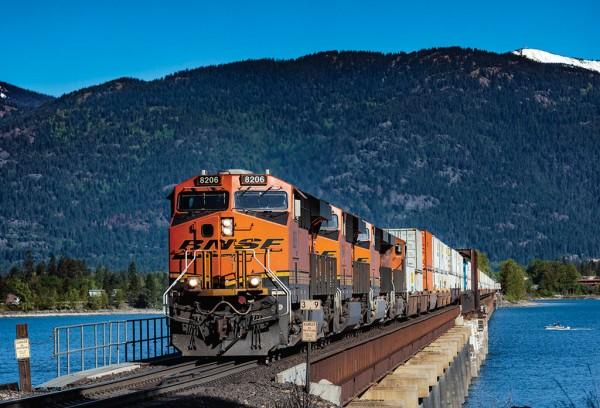
“As you can imagine, we quickly moved to position resources to be able to handle that increase.” BNSF Chief Operating Officer Katie Farmer told an Intermodal Association of North America webcast earlier this month. “BNSF recalled crews, fired up parked locomotives, and pulled miles of cars out of storage and sent them west as baretable trains. It added drayage support and parking spaces at its Los Angeles area terminals. And BNSF even flew terminal personnel from Chicago and elsewhere on the system to its terminals in Southern California …”
Stephens says UP did not move as fast: “UP took a much more measured approach, even as volume in June jumped 40% in Southern California from one week to the next. UP recalled crews and pulled locomotives and cars from storage, too. But UP did so at its own pace because railroads simply can’t handle such sudden swings in volume, UP Chief Operating Officer Jim Vena explained on the company’s earnings call in July.”
“ There was no way I was going to flow trains one way and have all the deadheads and extra costs. We took it on a systematic basis, and we’re fluid now,” Vena said …
Stephens added, “But UP also has used increasingly expensive surcharges in California – first $500 per container, then $1,500, and now a record $3,500, the Journal of Commerce reports – that tell potential low volume customers to hit the highway. This hurts UP’s partners, the intermodal marketing companies it relies on to fill its railroad-supplied containers.”
Stephens wondered about the different responses: “Why would BNSF move heaven and earth to capture volume while UP aimed to tightly manage its capacity?”
He says, “The most obvious answer is that UP’s response was straight out of the Precision Scheduled Railroading [PSR] playbook. Container traffic isn’t a high-margin business. Running empty trains, or repositioning empties, increases your costs and burns crews and locomotives while throwing your network out of balance.”
September 14, 2020
Intermodal Shortage
“I’ve Never Seen Anything Like This”: Shippers Using West Coast Ports Can’t Book Rail On BNSF And Union Pacific
by Tyler Durden Sun, 09/13/2020 – 20:30
By Stas Margaronis of AJot Insights
A Northern California logistics consultant was unable to book containers on the Burlington Northern Santa Fe (BNSF) or Union Pacific (UP) railroads for the first week of September going to and from U.S. West Coast ports and Midwest destinations.
The consultant said, “I have been working in the industry for thirty years and I have never seen anything like this. It’s weird.”
The result is that importers of low value products being shipped by containers such as tee shirts would be at an economic disadvantage transporting containers by truck as opposed to by rail between U.S. West Coast ports and Midwest destinations, because of the higher cost.
The consultant explained that there is a huge shortage of rail capacity: “There are no rail cars and there are no chassis.”
The consultant, who is not identified, was contracted to research container rail bookings on the UP and BNSF to and from U.S. West Coast ports including:
- Los Angeles
- Long Beach
- Oakland
- Seattle
The result of the research was that: “The railroads will not take any bookings right now and so all the containers going to and from the West Coast to places such as Chicago and Memphis must go by truck.”
The consultant cited the following trucking rates per container as examples:
- Los Angeles/ Long Beach to Chicago: $7000.
- LA/LB to New Berlin, Wisconsin: $6,700.
- LA/LB to Nashville, Tennessee: $7,200.
- LA/LB to Dallas, Texas: $5000.
- LA/LB to Jacksonville, Florida: $8,800.
The consultant said that in the past it had been possible to truck a container coast-to-coast for $2,000: “But those days are gone.”
In addition, “In the good old days you could ship a container from the West Coast to Chicago or Memphis by rail for $1000 dollars.”
The research found one exception. It was possible to ship a container on a COSCO vessel to Shanghai from Memphis, Tennessee via the Port of Prince Rupert, British Columbia utilizing the Canadian National Railway.
The problem: “The travel time was over twenty-one days which is way too slow.”
However, rail intermodal moves are a complex affair, particularly when there is a significant freight imbalance as there is at the moment on the West Coast. A BNSF spokesman told AJOT, “The claim that we have a lack of railcar capacity for international shipments is inaccurate. BNSF is open for business and ready to receive all freight from ocean carriers at the West Coast ports. We have a railcar fleet in excess of demand and have sufficient locomotives, equipment and people across our network to handle current and additional volumes. As always, we are in constant communication with our customers and remain focused on meeting their shipment needs.”
And a UP spokeswoman referred AJOT to an August 26th statement by Kenny Rocker, executive vice president, Marketi:
“We continue to align our resources to handle the increase in demand and are excited to build on the positive momentum we’re seeing this month. And to specifically address the surge of intermodal demand, we are modifying our ingate windows at several intermodal terminals across our network to help manage gate and ramp fluidity. We continue to evaluate our terminal activity and will make any necessary adjustments to accommodate your needs and, at the same time, deliver the safe and reliable service you expect.”
On August 24th, the heads of the Surface Transportation Board (STB) and the Federal Railway Administration (FRA) sent identical letters to the heads of the leading U.S. railroads, including the Union Pacific (UP) and the Burlington Northern Santa Fe (BNSF) expressing concerns about the adequacy of U.S. railroad service and the adequacy of personnel to transport freight.
The letter, signed by Federal Railroad Administrator Ron Batory and Surface Transportation Board Chair Ann Begeman read as follows:
“Recently, however, we have been made aware of service issues, including missed industrial switches and excessively late or annulled trains due to crew availability issues. As you know, with both increasing intermodal and carload volumes and a projected robust harvest fast approaching, railroad employee availability, together with sufficient equipment resourcing, is essential for safe, fluid rail service in support of the nation’s economic recovery. Given the challenges related to changing demand patterns and operating conditions, increased communication and transparency with rail shippers is especially important to ensure they have the information needed to plan their businesses and meet their own customers’ needs.”
Jack Hedge, Executive Director, Utah Inland Port Authority and formerly with the Port of Los Angeles, told AJOT that U.S. West Coast ports are also losing business to the Port of Prince Rupert, British Columbia for containers transported by the Canadian National Railway to and from Chicago and U.S. Midwest destinations: “Imports and exports transiting through the Canadian Port of Prince Rupert and Chicago pay $500 to $1000 less per move than by transporting containers to and from the West Coast ports and Chicago on the UP and BNSF.”
In an August 27th analysis, Trains Magazine reporter Bill Stephens, contrasted responses of the BNSF and UP to spikes in summer imports at the Ports of Los Angeles and Long Beach:
“BNSF Railway and Union Pacific are facing the same problem: An unprecedented spike in intermodal traffic that wants to move out of Southern California to Texas, Chicago, and elsewhere in the Midwest … The onslaught of containers and trailers that began in June and continues today followed record declines in April [and] in May due to the economic impact of the coronavirus pandemic…”
Stephens first cited the response of BNSF:
“As you can imagine, we quickly moved to position resources to be able to handle that increase.” BNSF Chief Operating Officer Katie Farmer told an Intermodal Association of North America webcast earlier this month. “BNSF recalled crews, fired up parked locomotives, and pulled miles of cars out of storage and sent them west as baretable trains. It added drayage support and parking spaces at its Los Angeles area terminals. And BNSF even flew terminal personnel from Chicago and elsewhere on the system to its terminals in Southern California …”
Stephens says UP did not move as fast: “UP took a much more measured approach, even as volume in June jumped 40% in Southern California from one week to the next. UP recalled crews and pulled locomotives and cars from storage, too. But UP did so at its own pace because railroads simply can’t handle such sudden swings in volume, UP Chief Operating Officer Jim Vena explained on the company’s earnings call in July.”
“ There was no way I was going to flow trains one way and have all the deadheads and extra costs. We took it on a systematic basis, and we’re fluid now,” Vena said …
Stephens added, “But UP also has used increasingly expensive surcharges in California – first $500 per container, then $1,500, and now a record $3,500, the Journal of Commerce reports – that tell potential low volume customers to hit the highway. This hurts UP’s partners, the intermodal marketing companies it relies on to fill its railroad-supplied containers.”
Stephens wondered about the different responses: “Why would BNSF move heaven and earth to capture volume while UP aimed to tightly manage its capacity?”
He says, “The most obvious answer is that UP’s response was straight out of the Precision Scheduled Railroading [PSR] playbook. Container traffic isn’t a high-margin business. Running empty trains, or repositioning empties, increases your costs and burns crews and locomotives while throwing your network out of balance.”
 Everchem Updates Archive
  Sign Up for Email Updates