
Current Affairs
August 19, 2024
Housing Update
Virginia Tech housing commentary June 2024
By Dakota Smith
August 16, 2024 | 10:03 am CDT

BLACKSBURG, Va. — The June 2024 housing report is a free service of Virginia Tech, Virginia Cooperative Extension, and the U.S. Forest Service.
Housing data, month-over-month and year-over-year, were mostly negative. On a month-over-month
Based on total and multi-family starts, total and multi-family permits, and housing completions, the results were positive.
Year-over-year, single-family starts, total and single-family completions, and total and single-family
construction spending was positive. The influence of increased mortgage rates is evident, as aggregate
costs have decreased affordability and the “lock-in” effect has obfuscated sales. New and existing house
sales continued their respective declines.
The August 15th Atlanta Fed GDPNow total residential investment spending forecast is -1.5% for Q3
2024. Quarterly log change for new private permanent site expenditures was projected at -6.1%; the
improvement spending forecast was -1.7%; and the manufactured/mobile home expenditures projection
was 5.1% (all: quarterly log change and at a seasonally adjusted annual rate).

“North American lumber markets over the near term are expected to remain depressed as the economy continues to adjust to inflationary pressures, elevated interest rates, labor shortages, and geo-political uncertainty, and as industry-wide lumber production continues to adjust to match demand,” says Richard Pozzebon, executive vice president and CEO; Interfor Corporation. “Interfor expects that lumber markets will continue to benefit over the mid-term from favorable underlying supply and demand fundamentals. Positive demand factors include the advanced age of the U.S. housing stock, a shortage of available housing, and various demographic factors. At the same time, growth in lumber supply is expected to be limited by extended capital project completion and ramp-up timelines, labor availability, and constrained global fiber availability.”
To read the full report, visit woodproducts.sbio
August 15, 2024
Primer on Not Getting Fooled by AI
Fake Images Are Everywhere Now—Here’s How To Spot Them
by Tyler Durden
Thursday, Aug 15, 2024 – 08:05 PM
Authored by Andria Pressel via The Epoch Times (emphasis ours),
As artificial intelligence (AI) continues to develop, it’s getting harder and harder to tell the difference between real photographs and AI-generated images.

AI can create everything from stunning landscapes to lifelike portraits in a matter of moments—and at first glance, they may appear perfectly legitimate.
In this age of misinformation, how can you discern if the images you’re seeing are real or fabricated?
Fortunately, there are subtle clues that can help us tell the difference, including inconsistencies in texture, anomalies in human features, and garbled writing. By understanding these telltale signs, you can better navigate digital information and assess the authenticity of the images you encounter.
1. Unnatural Hands and Limbs

Hands and limbs are surprisingly complex structures, and AI often struggles to accurately replicate them. Look for extra, oddly shaped, or misaligned fingers. They may also be positioned in an unusual way or have improper dimensions.
In the above image, the children’s hands and feet look unnatural, with misshapen fingers and toes as well as misaligned sandal straps.

2. Discrepancies in Details

AI has difficulty rendering small details, so you might also see objects and elements being subtly merged together in unnatural ways. These imperfections occur because AI relies on pattern recognition, which can fail when handling intricate or nuanced details.
So if you’re uncertain if a crowd photo is legitimate, take a look at the details. For example, background faces are often blurred or have soft, poorly defined characteristics.
In this AI-generated image, the man in the water has a blurry face and fingerless hands, while the young man on shore has a transparent leg that appears to merge into the background.

3. Overly Perfect Skin

Having an overly smooth face with very little texture is a sign of an AI-generated photo. Its lack of genuine texture and flaws can almost make the individual look comical.
In the above images, the girl on the left has extremely smooth skin and hair that blends in with her collar. The boy to the right also has skin that is too smooth.
4. Misalignments

AI can struggle with alignments, resulting in a disjointed or incoherent appearance because elements don’t align properly.
Objects may overlap in unnatural ways that defy spatial coherence.
Zoom in to spot inconsistencies, such as in the above image, where the lines of the wicker cut through the picnic items. The texture lines on the woven picnic basket and tray are misaligned.

5. Inconsistencies and Asymmetries in Small Details

Inconsistencies in minor things, such as glasses with mismatched lenses or frames, should be easy to notice.
Though they appear genuine at first glance, the following AI-generated photos from ThisPersonDoesNotExist.com have flaws that may be seen with closer examination.
The woman in the left image is wearing two completely different earrings.
The center image is betrayed as AI-generated by the left corner, where the man’s shirt blends with the background.
In the image on the far right, the endpieces of the glasses are mismatched.
6. Garbled Writing

AI-generated images often produce garbled or nonsensical text, with letters and words jumbled.
Take a close look at any writing or logos in the image to see if they are difficult to read or completely incoherent.
This image, produced by AI, depicts traffic on a crowded street. Upon closer inspection, you can see that the text on the roadside billboard is illegible.
7. Illogical Context

Read more here…
https://www.zerohedge.com/ai/fake-images-are-everywhere-now-heres-how-spot-them
August 14, 2024
Good News for Urethanes
Mortgage Refi Activity Jumps Most Since 2020 As Lenders See Gloom Ending
by Tyler Durden
Wednesday, Aug 14, 2024 – 03:25 PM
Mortgage lenders have endured a brutal 2.5-year period of the Federal Reserve’s interest rate hiking cycle, with a high rate environment pressuring refinance applications to multi-decade lows. However, those lenders who weathered the downturn—dodging widespread layoffs, industry consolidation, and scraped by on Ramen Noodles and Zyn pouches—are now seeing a serious surge in activity as mortgage rates slide on rising recession probabilities.
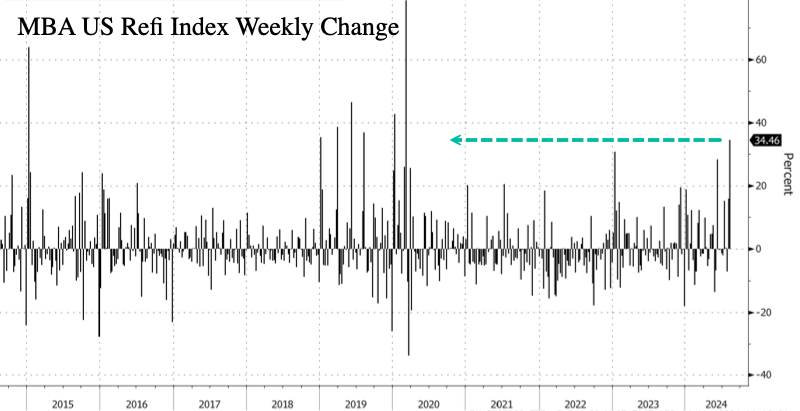
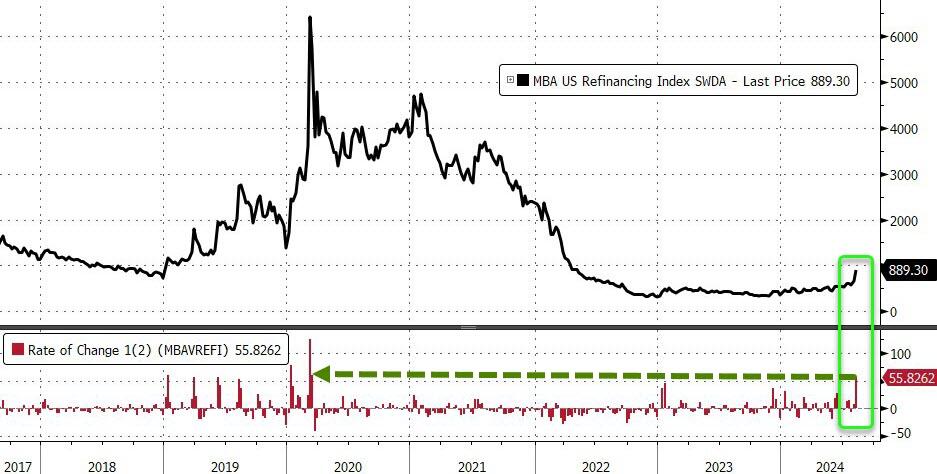
For the week ending August 9, the Mortgage Bankers Association’s refinancing index jumped a whopping 34.5% to a more than two-year high of 889.3.
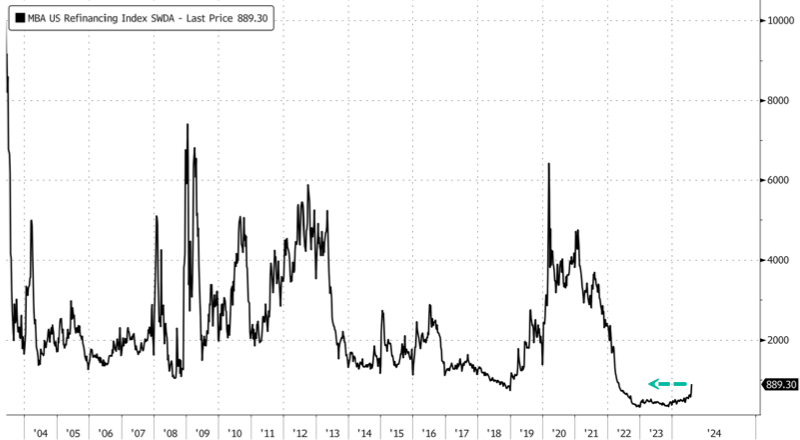
The refinancing index’s weekly change recorded the biggest weekly change since the first week of March 2020, a period in time when the Fed slammed interest rates to the zero lower bound in response to the China virus.
Even more impressive is the refinancing index’s two-week move, up 55% (though obviously off a very low ‘low’).
MBA mortgage applications to purchase a home increased by 2.8% in the same week, the largest advance since the first week of June.
Freddie Mac data shows the 30-year fixed mortgage rate has dropped to around 6.47%, the lowest since May 2023. While this is a far cry from the October 2023 high of 7.79%, it remains well above Covid levels of 2.68%.
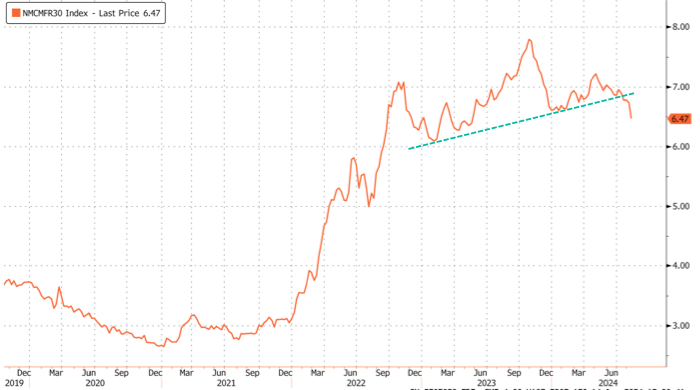
Despite the decline in mortgage rates, new costs of homeownership are dramatically higher than the average current mortgage cost. Until that gap closes (more), the housing market will remain drastically out of reach for most Americans in search of their dream.
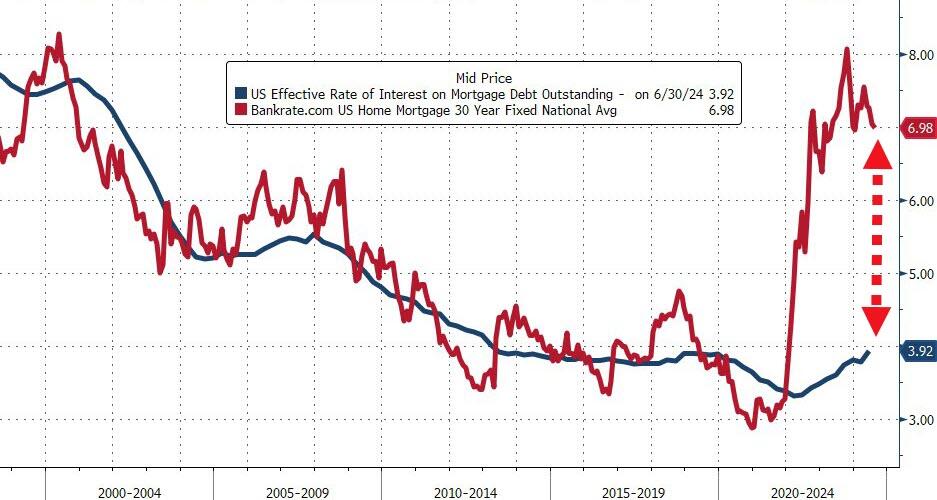
Mortgage rates track US government bonds relatively closely, and the yield on the 10-year Treasury note has fallen sub 4% on increasing recession odds amid the consumer downturn fears.
Although weaker consumer trends remain a major near-term headwind, Goldman forecasts three 25bps Fed rate cuts this year and four in 2025. With the cut cycle imminent, the refinancing index and mortgage applications will likely have further room to run.
Here’s the latest snapshot as of Wednesday, showing what traders expect the Fed’s move to be. Four 25bps cuts by the end of the year…
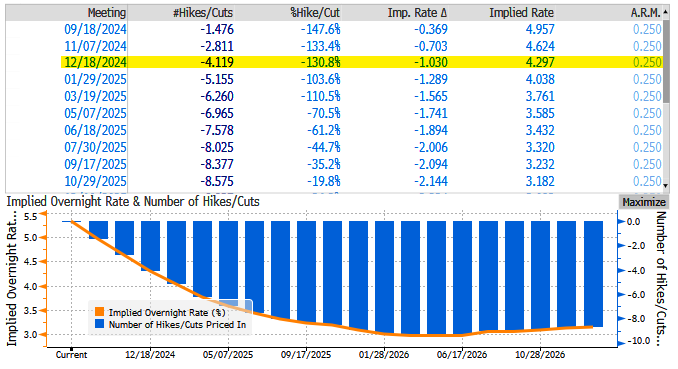
“We’ve experienced several head fakes regarding potential rate cuts during the Fed’s hiking cycle, as reflected in interest rate swaps over the last few years. But this time, it seems more concrete as recession risks build,” said Lewis Sogge, a senior loan officer at Freedom Mortgage Corporation.
Congratulations to all the millennial lenders who managed to weather the Fed’s interest rate hiking storm—you might have made it to the other side. What does this all mean? Simply put, your industry is highly cyclical.
https://www.zerohedge.com/markets/mortgage-refi-activity-jump-most-2020-lenders-see-gloom-ending
August 12, 2024
Trucking Improves
“The Worst Is Behind Us”: The US Trucking Industry Is Showing Signs Of A Resurrection
by Tyler Durden
Monday, Aug 12, 2024 – 06:55 AM
It has been a long ugly road for the trucking industry in the U.S. since Covid caused one of its deepest recessions in history.
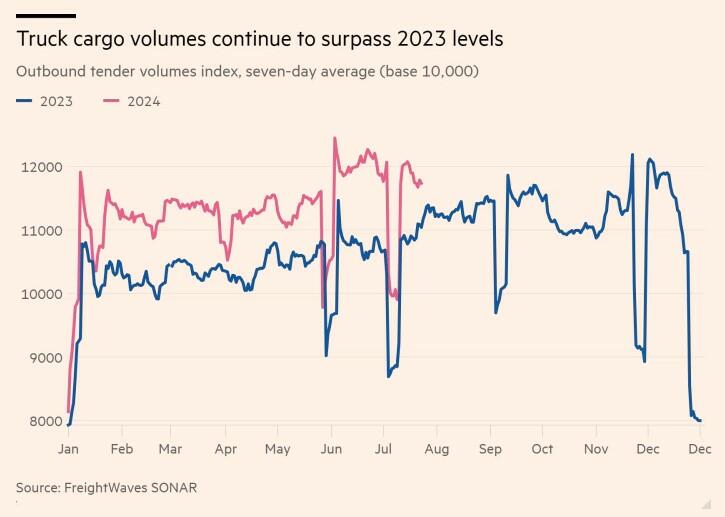
But now, it is showing “signs of life” as demand ticks higher and prices remain suppressed, according to the Financial Times. Requests for U.S. shipments increased by an average of 9% year-over-year in Q2 2024, the financial news site says.
Tender rejections, indicating carriers’ willingness to accept loads, rose by 1.3% compared to the same period last year, suggesting that truckload capacity is gradually tightening, according to FreightWaves.
Bob Costello, chief economist for the American Trucking Associations told FT: “I do think the worst is behind us.”
After a pandemic-driven surge in consumer products led to a spike in trucking demand, the industry faced a “freight recession” in 2022 as inflation curbed consumer spending, reducing cargo volumes and rates.
Michael Castagnetto, president of North American surface transportation for logistics firm CH Robinson, confirmed that “rates went into freefall” in 2022.
The FT reported that the excess trucks from the pandemic boom weren’t matched by demand, creating a capacity overhang still affecting companies.
For instance, US transporter JB Hunt missed earnings expectations for the fifth straight quarter on July 15, with a 24% drop in operating income compared to last year, citing underutilized assets and flat pricing as key factors for the low revenue.
On JB Hunt’s earnings call, its VP of Sales and Marketing said: “We still see oversupply across all modes with shippers having options on both mode and provider to move their freight. While capacity is not a top concern right now, there is an awareness that this will change at some point.”
Now, as consumer demand steadily rises, the trucking industry is optimistic about potential rate gains in 2025, especially if interest rates decrease, according to Avery Vise of FTR Transportation Intelligence. Vise predicts a more comfortable market for carriers by mid to late next year.
However, trucking firms still face challenges, particularly with rising costs and competition. Marginal costs, excluding fuel, increased over 6% in 2023, with insurance and maintenance costs up by a third due to high interest rates, new technology, and more truck-related accidents, according to FreightWaves.
Despite these pressures, many small carriers have survived thanks to cash reserves from the pandemic freight surge, though over 25,000 firms have already exited. Small carriers, which make up over 85% of the market, have grown due to easier access to commercial licenses and digital platforms that allow drivers to find and take on freight independently.
As supply decreases and demand grows, rate improvements are expected to follow, the report concludes.
https://www.zerohedge.com/markets/worst-behind-us-us-trucking-industry-showing-signs-resurrection
August 9, 2024
Logistics Issues
Massive explosion rocks Yang Ming boxship at berth in Ningbo
Bojan LepicAugust 9, 2024
1 28,070 1 minute read

An explosion occurred on the boxship YM Mobility at a container terminal in the Beilun Port area of Zhoushan Port.
The cause of the accident was initially determined to be an explosion of a container on the ship, and there were no reports of casualties.
According to timestamps from surveillance footage videos posted online, the explosion occurred around 1:46 pm on Friday. The video first showed a large amount of smoke coming from the ship followed by a huge blast which started a fire and scattered debris.
A video from a much further distance showed massive clouds of smoke rising after the explosion. The vessel was reportedly berthed at the Ningbo Phase 3 Terminal. Some reports suggest that the cargo that exploded was glycerin.
The Ningbo Maritime Search and Rescue Center has started an emergency plan and assigned patrol boats to the scene. Three fire tugboats and shore-based fire department forces were also deployed.
The YM Mobility is a Liberia-flagged, 2011-built containership owned by Taiwanese carrier Yang Ming. It has a container capacity of 6,589 teu.
splash247.com/massive-explosion-rocks-yang-ming-boxship-at-berth-in-ningbo/
 Everchem Updates Archive
  Sign Up for Email Updates


