Current Affairs
May 2, 2024
Alkyl Phosphate Esters Dumping Investigation to Begin in May
New Antidumping Duty and Countervailing Duty Petitions on Alkyl Phosphate Esters From China
Authors: Douglas J. Heffner,Richard Ferrin,Carrie Bethea Connolly
At a Glance
- ICL-IP America, Inc. filed both antidumping duty petitions and countervailing duty petitions on certain alkyl phosphate esters from China.
- Investigations related to these petitions could result in increased prices and/or decreased supply of alkyl phosphate esters.
- The U.S. Department of Commerce is expected to begin investigations on May 13, 2024.
On April 23, 2024, antidumping duty (AD) and countervailing duty (CVD) petitions were filed on certain alkyl phosphate esters from China. The petitions were filed by ICL-IP America, Inc., a subsidiary of the ICL Group (Petitioner). Alkyl phosphate esters are used as a flame retardant and as additives in a wide range of products.
The U.S. AD law imposes special tariffs to counteract imports that are sold in the United States at less than “normal value.” The U.S. CVD law imposes special tariffs to counteract imports that are sold in the United States with the benefit of foreign government subsidies. For AD/CVD duties to be imposed, the U.S. government must determine not only that dumping and/or subsidization is occurring, but also that there is “material injury” (or threat thereof) by reason of the dumped and/or subsidized imports. Importers are liable for any potential AD/CVD duties imposed. In addition, these investigations could impact purchasers by increasing prices and/or decreasing supply of alkyl phosphate esters.
Scope
Please note that this section was not written by our authors but is taken verbatim from the petition.
Alkyl phosphate esters based exclusively on side chains with a length of two or three carbon atoms (also includes chlorinated alkyl chains) and with a phosphorus content of at least 6.5% (per weight) and a viscosity between 1 and 2000 mPa.s (at 20-25 °C). Alkyl phosphate esters include Tris (2-chloroisopropyl) phosphate (TCPP), Tris(1,3-dichloroisopropyl) phosphate (TDCP), and Triethyl Phosphate (TEP). TCPP is also known as Tris (1-chloro-2-propyl) phosphate, Tris(1-chloropropan-2-yl) phosphate, Tris (monochloroisopropyl) phosphate (TMCP), and Tris(2-chloroisopropyl) phosphate (TCIP). It has the chemical formula C9H18Cl3O4P and the CAS Nos. 1244733-77-4 and 13674-84-5. It may also be identified as CAS No. 6145-73-9. TDCP is also known as Tris (1,3-dichloroisopropyl) phosphate, Tris (1,3-dichloro-2-propyl) phosphate, Chlorinated tris, tris {2-chloro-1-(chloromethyl ethyl} phosphate, TDCPP, and TDCIPP. It has the chemical formula C9H15Cl6O4P and the CAS No. 13674-87-8. TEP is also known as Phosphoric acid triethyl ester, phosphoric ester, flame retardant TEP, Tris(ethyl) phosphate, Triethoxyphosphine oxide, and Ethyl phosphate (neutral). It has the chemical formula (C2H5O)3PO and the CAS No. 78-40-0. Also included in this investigation are isomers of the foregoing products and blends including one or more alkyl phosphate esters where the alkyl phosphate esters account for 20 percent or more of the blend by weight.
Alkyl phosphate esters are classified under subheading 2919.90.5050, HTSUS. Imports may also be classified under subheadings 2919.90.5010 and 3824.99.5500, HTSUS. References to the HTSUS classification are provided for convenience and customs purposes, and the written description of the merchandise under investigation is dispositive regarding the scope of the investigation.
Estimated Dumping Margins
The Petitioners allege dumping margins in the range of 119.52 to 145.43% based on average unit values, or 78.36 to 99.4% based on actual U.S. transaction prices.
The Petitioners also allege significant subsidies, although the petitions do not quantify the alleged net subsidy margin.
Estimated Schedule of Investigations
The following is an estimated schedule of investigations by the U.S. Department of Commerce (DOC) and the U.S. International Trade Commission (ITC):
| April 23, 2024 | Petitions are filed. |
| May 13 2024 | DOC initiates investigations. |
| May 14, 2024 | ITC staff conference (estimated). |
| June 7, 2024 | Deadline for ITC preliminary injury determination. |
| July 17, 2024 | Deadline for DOC preliminary CVD determination, if deadline is NOT postponed. |
| September 20, 2024 | Deadline for DOC preliminary CVD determination, if deadline is fully postponed. |
| September 30, 2024 | Deadline for DOC preliminary AD determination, if deadline is NOT postponed. |
| November 19, 2024 | Deadline for DOC preliminary AD determination, if deadline is fully postponed. |
| April 3, 2025 | Deadline for DOC final AD and CVD determinations, if all deadlines are fully postponed. |
| May 19, 2025 | Deadline for ITC final injury determination, if all DOC deadlines are fully postponed. |
April 24, 2024
FTC Bans Noncompetes
FTC Announces Rule Banning Noncompetes
FTC’s final rule will generate over 8,500 new businesses each year, raise worker wages, lower health care costs, and boost innovation
Today, the Federal Trade Commission issued a final rule to promote competition by banning noncompetes nationwide, protecting the fundamental freedom of workers to change jobs, increasing innovation, and fostering new business formation.
“Noncompete clauses keep wages low, suppress new ideas, and rob the American economy of dynamism, including from the more than 8,500 new startups that would be created a year once noncompetes are banned,” said FTC Chair Lina M. Khan. “The FTC’s final rule to ban noncompetes will ensure Americans have the freedom to pursue a new job, start a new business, or bring a new idea to market.”
The FTC estimates that the final rule banning noncompetes will lead to new business formation growing by 2.7% per year, resulting in more than 8,500 additional new businesses created each year. The final rule is expected to result in higher earnings for workers, with estimated earnings increasing for the average worker by an additional $524 per year, and it is expected to lower health care costs by up to $194 billion over the next decade. In addition, the final rule is expected to help drive innovation, leading to an estimated average increase of 17,000 to 29,000 more patents each year for the next 10 years under the final rule.
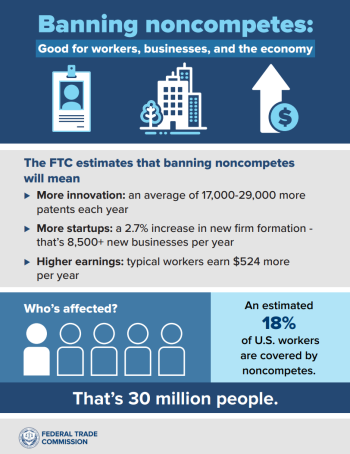
Noncompetes are a widespread and often exploitative practice imposing contractual conditions that prevent workers from taking a new job or starting a new business. Noncompetes often force workers to either stay in a job they want to leave or bear other significant harms and costs, such as being forced to switch to a lower-paying field, being forced to relocate, being forced to leave the workforce altogether, or being forced to defend against expensive litigation. An estimated 30 million workers—nearly one in five Americans—are subject to a noncompete.
Under the FTC’s new rule, existing noncompetes for the vast majority of workers will no longer be enforceable after the rule’s effective date. Existing noncompetes for senior executives – who represent less than 0.75% of workers – can remain in force under the FTC’s final rule, but employers are banned from entering into or attempting to enforce any new noncompetes, even if they involve senior executives. Employers will be required to provide notice to workers other than senior executives who are bound by an existing noncompete that they will not be enforcing any noncompetes against them.
In January 2023, the FTC issued a proposed rule which was subject to a 90-day public comment period. The FTC received more than 26,000 comments on the proposed rule, with over 25,000 comments in support of the FTC’s proposed ban on noncompetes. The comments informed the FTC’s final rulemaking process, with the FTC carefully reviewing each comment and making changes to the proposed rule in response to the public’s feedback.
In the final rule, the Commission has determined that it is an unfair method of competition, and therefore a violation of Section 5 of the FTC Act, for employers to enter into noncompetes with workers and to enforce certain noncompetes.
The Commission found that noncompetes tend to negatively affect competitive conditions in labor markets by inhibiting efficient matching between workers and employers. The Commission also found that noncompetes tend to negatively affect competitive conditions in product and service markets, inhibiting new business formation and innovation. There is also evidence that noncompetes lead to increased market concentration and higher prices for consumers.
Alternatives to Noncompetes
The Commission found that employers have several alternatives to noncompetes that still enable firms to protect their investments without having to enforce a noncompete.
Trade secret laws and non-disclosure agreements (NDAs) both provide employers with well-established means to protect proprietary and other sensitive information. Researchers estimate that over 95% of workers with a noncompete already have an NDA.
The Commission also finds that instead of using noncompetes to lock in workers, employers that wish to retain employees can compete on the merits for the worker’s labor services by improving wages and working conditions.
Changes from the NPRM
Under the final rule, existing noncompetes for senior executives can remain in force. Employers, however, are prohibited from entering into or enforcing new noncompetes with senior executives. The final rule defines senior executives as workers earning more than $151,164 annually and who are in policy-making positions.
Additionally, the Commission has eliminated a provision in the proposed rule that would have required employers to legally modify existing noncompetes by formally rescinding them. That change will help to streamline compliance.
Instead, under the final rule, employers will simply have to provide notice to workers bound to an existing noncompete that the noncompete agreement will not be enforced against them in the future. To aid employers’ compliance with this requirement, the Commission has included model language in the final rule that employers can use to communicate to workers.
The Commission vote to approve the issuance of the final rule was 3-2 with Commissioners Melissa Holyoak and Andrew N. Ferguson voting no. Commissioners’ written statements will follow at a later date.
The final rule will become effective 120 days after publication in the Federal Register.
Once the rule is effective, market participants can report information about a suspected violation of the rule to the Bureau of Competition by emailing noncompete@ftc.gov
.
The Federal Trade Commission develops policy initiatives on issues that affect competition, consumers, and the U.S. economy. The FTC will never demand money, make threats, tell you to transfer money, or promise you a prize. Follow the FTC on social media, read consumer alerts and the business blog, and sign up to get the latest FTC news and alerts.
April 2, 2024
U.S. Auto Sales

April 1, 2024
March Propylene Settles Up 3c/lb
Chemical Grade propylene settles up 3c/lb to $0.565/lb . . .
March 26, 2024
Durable Goods Rise
Durable Goods Orders Rebound In Feb From January Collapse, Defense Spending Slides
by Tyler Durden
Tuesday, Mar 26, 2024 – 08:38 AM
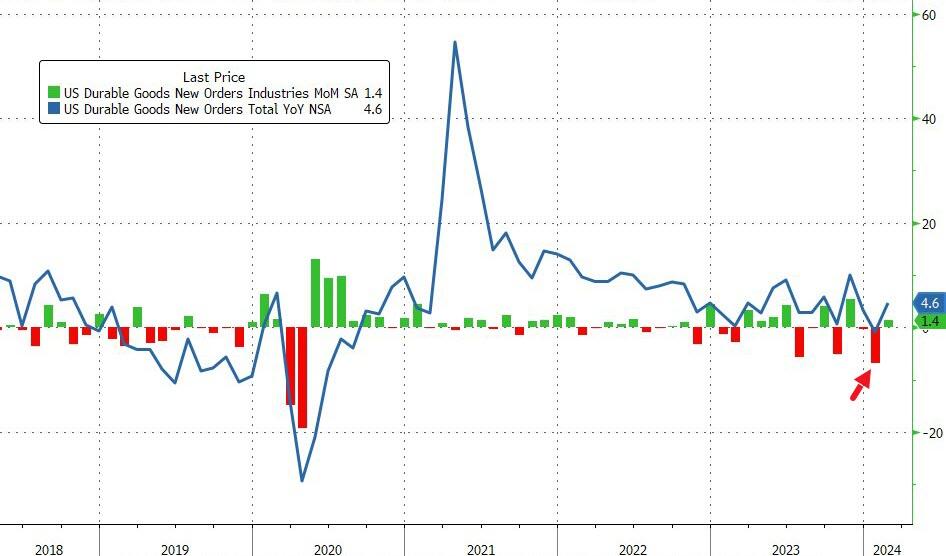
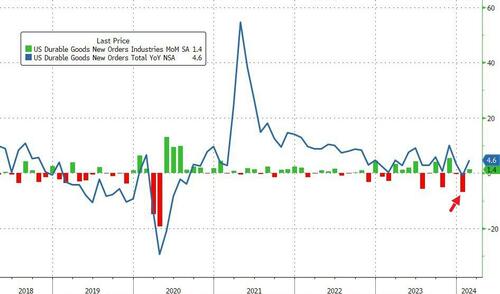
After crashing in January (driven by the collapse in Boeing orders), durable goods orders (preliminary) for February rose 1.4% MoM (better than the +1.0% MoM exp), and notably swinging from a downwardly revised 6.9% MoM plunge in January (from -6.2%)…
Source: Bloomberg
That dragged the headline orders up 4.6% YoY. Ex-Transports also beat, rising 0.5% MoM (vs +0.4% exp) and up 1.3% YoY.
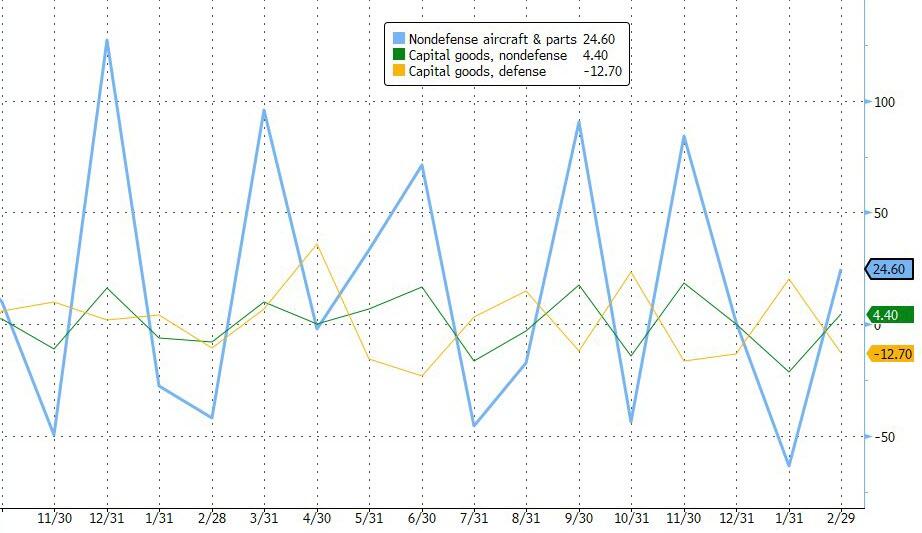
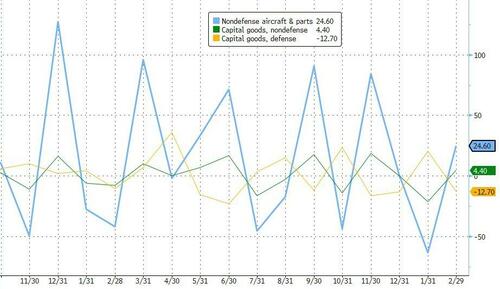
Non-defense aircraft orders jumped 24.6% MoM as it seems people are ordering Boeings again? Defense spending tumbled 12.7% MoM…
Source: Bloomberg
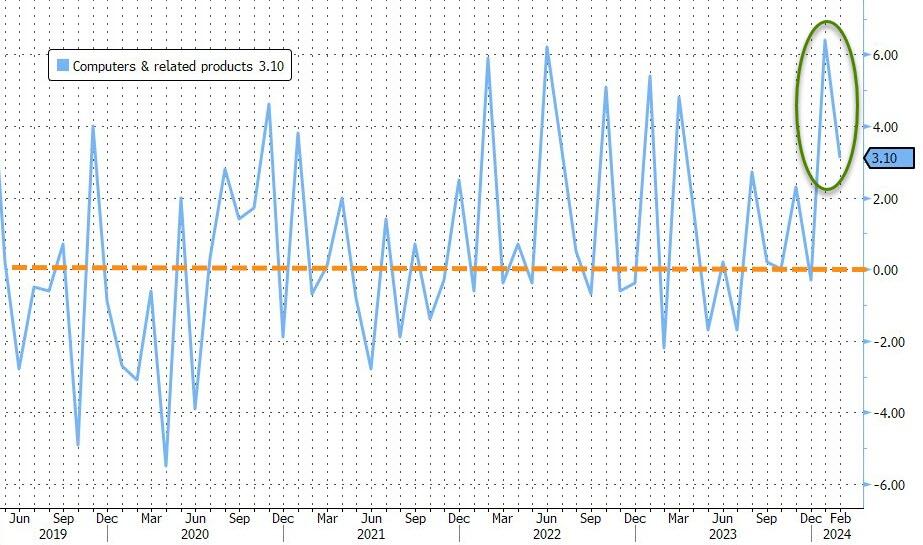
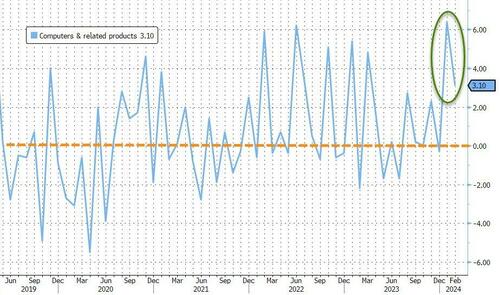
Computer & related products saw another big MoM rise as perhaps this is the AI cycle showing up in the data…
Source: Bloomberg
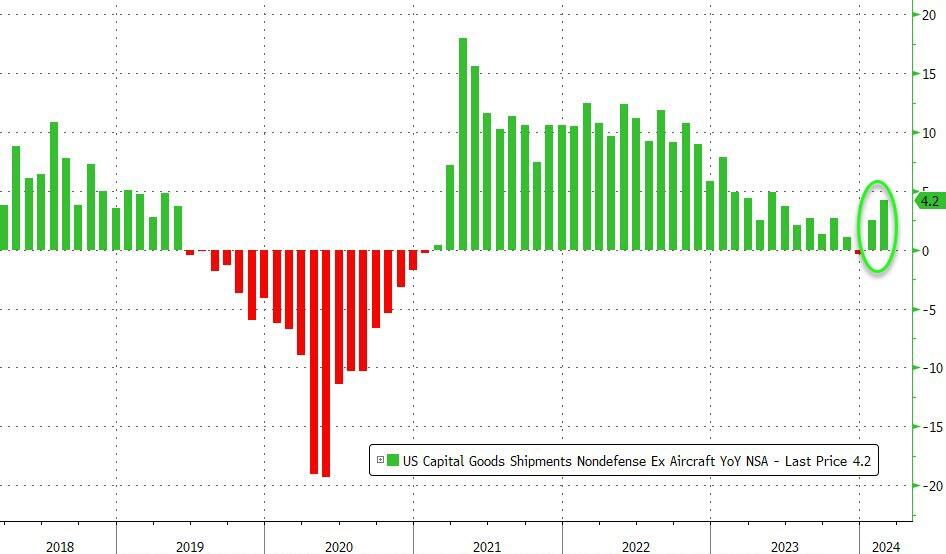
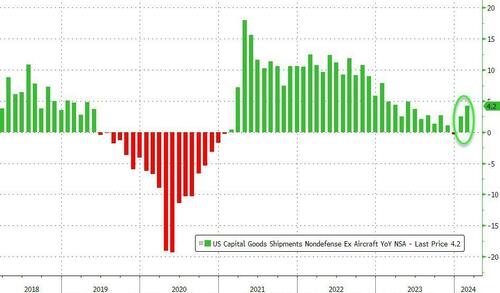
On the bright side, core capital goods shipments, a figure that is used to help calculate equipment investment in the government’s gross domestic product report, continued its strong bounce back from YoY contraction in December. However, on a seasonally-adjusted basis, core capital goods shipments fell 0.4% MoM
Source: Bloomberg
The YoY rebound is not exactly a signal that portends rate cuts!
 Everchem Updates Archive
  Sign Up for Email Updates