Current Affairs
September 13, 2022
Rail Deals Lining Up

Three More Unions Reach Tentative Agreements With Freight Railroads
by Tyler Durden
Monday, Sep 12, 2022 – 05:40 PM
By Noi Mahoney of FreightWaves
Three more railroad unions have reached tentative agreements with U.S. freight railroads on a new labor contract, announced the National Carriers’ Conference Committee (NCCC).
The tentative agreements announced Sunday include the Brotherhood of Maintenance of Way Employes Division of the International Brotherhood of Teamsters; the International Brotherhood of Boilermakers; and the International Association of Sheet Metal, Air, Rail and Transportation Workers-Mechanical Department.
“The tentative agreements … include a 24% wage increase during the five-year period from 2020 to 2024 — with a 14.1% wage increase effective immediately — and five annual $1,000 lump sum payments. Portions of the wage increases and lump sum payments are retroactive and will be paid out promptly upon ratification of the agreements by the unions’ membership,” said the NCCC, the group representing Class I railroads in the contract negotiations.
The tentative agreement also adds an additional paid day off that can be used as a personal day, vacation day or on the employee’s birthday.
The three unions represent more than 86,000 freight rail employees. Eight unions have accepted tentative deals they will be taking to their members for ratification. Altogether, there are over 140,000 employees at the bargaining table employed by the U.S. operations of Class I railroads.
A new labor deal has been in the works since January 2020, but the negotiations had failed to progress. A federal mediation board took up the negotiations but released the parties from those efforts earlier this summer.
Per the Railway Labor Act, the remaining unions would be able to legally stage a work stoppage or strike after a cooling-off period ends Sept. 16.
Unions respond to potential hazardous shipments embargo
The heads of two rail unions said Sunday that the freight railroads’ decision to begin delaying shipments of security-sensitive and hazardous material ahead of this week’s looming strike deadline is only an attempt to get shippers to increase pressure on Congress to intervene and block a work stoppage.
Several major Class I railroads said Friday they would begin curtailing shipments of hazardous materials and other chemicals in the event loads could be left unattended on a rail network. A strike or lockout is not allowed until Friday.
“This completely unnecessary attack on rail shippers by these highly profitable Class I railroads is no more than corporate extortion,” the heads of the unions that represent engineers and conductors — Jeremy Ferguson, president of the Sheet Metal, Air, Rail and Transportation Workers-Transportation Division union, and Dennis Pierce, president of the Brotherhood of Locomotive Engineers and Trainmen union — said in a joint statement.
“Our unions remain at the bargaining table and have given the rail carriers a proposal that we would be willing to submit to our members for ratification, but it is the rail carriers that refuse to reach an acceptable agreement. In fact, it was abundantly clear from our negotiations over the past few days that the railroads show no intentions of reaching an agreement with our unions, but they cannot legally lock out our members until the end of the cooling-off period. Instead, they are locking out their customers beginning on Monday and further harming the supply chain in an effort to provoke congressional action.”
https://www.zerohedge.com/economics/three-more-unions-reach-tentative-agreements-freight-railroads
September 12, 2022
Potential Rail Strike
US Railroads Enact “Contingency Plans,” Preparing For Labor Strike As Union Talks Fail
by Tyler Durden
Monday, Sep 12, 2022 – 08:45 AM
Railroads and labor unions worked through the weekend to make a deal. There were little signs of progress, and rail companies are now taking steps Monday to secure shipments of hazardous and security-sensitive materials “in light of the possibility of a rail labor strike,” the Association of American Railroads (AAR) wrote in a statement.
On Sunday, Norfolk Southern released a statement detailing it had “begun enacting its contingency plans for a controlled shut down of our network at 00:01 on Friday, Sept. 16.” The railroad said two labor unions are holding out on new contracts, “we still do not have a commitment not to strike and must act accordingly,” adding, “Our goal is to ensure that in the event of a work stoppage, crews, equipment, and freight safely reach their destinations with minimal disruption.”
Union Pacific and CSX also announced contingency plans for a possible work stoppage. BNSF told customers to call Congress so lawmakers on Capitol Hill can “intervene to prevent or quickly resolve the service disruption” if a labor strike materializes on Friday. The railroad also said: “We will begin to take steps to manage and secure the shipments of hazardous and security-sensitive materials as early as Monday.”
Rail freight networks are the arteries of the US economy.
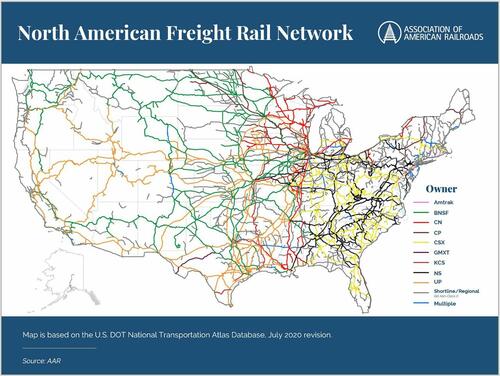
Two months ago, the Biden administration imposed a two-month cooling-off period is set to expire at 12:01 am ET on Sept. 16 — after that — President Biden didn’t have the power to prevent a strike among two labor unions that had yet hammered out a deal with railroads. Only Congress can intervene after the cooling period expires.
Bloomberg said the two unions include the Brotherhood of Locomotive Engineers and Trainmen and the International Association of Sheet Metal Air, Rail and Transportation Workers, accounting for more than 90,000 rail employees. Ten of the other unions have already struck a deal with railroads.
Association of American Railroads warned that a railroad strike could cost the US economy upwards of $2 billion per day, while disruption wouldn’t be good optics for the Biden administration ahead of the midterm elections in November.
Bloomberg Intelligence analyst Lee Klaskow pointed out that BNSF and Union Pacific account for 45% of Class I intermodal traffic, while CSX and Norfolk Southern has 31%.
According to government data, about 29% of all US freight moves on the rails. Half the cargo is bulk commodities, such as energy, food, chemicals, metals, and wood productions — the other half is shipping containers of consumer goods.
“Even a temporary interruption would create a devastating ripple effect” across US supply chains, American Bakers Association, a Washington-based trade group representing more than 300 companies, warned.
Even if there’s no strike, rail networks are already clogged. Shipping line Maersk recently suspended import bookings through Fort Worth, Texas, due to “severe congestion” in railyards.
Railroads are preparing for possible work stoppages at the end of the week if the two unions can’t formulate a deal. There’s the possibility Congress could intervene before the cooling period expires. If not, then expect a flare-up in snarled supply chains.
September 12, 2022
Potential Rail Strike
US Railroads Enact “Contingency Plans,” Preparing For Labor Strike As Union Talks Fail
by Tyler Durden
Monday, Sep 12, 2022 – 08:45 AM
Railroads and labor unions worked through the weekend to make a deal. There were little signs of progress, and rail companies are now taking steps Monday to secure shipments of hazardous and security-sensitive materials “in light of the possibility of a rail labor strike,” the Association of American Railroads (AAR) wrote in a statement.
On Sunday, Norfolk Southern released a statement detailing it had “begun enacting its contingency plans for a controlled shut down of our network at 00:01 on Friday, Sept. 16.” The railroad said two labor unions are holding out on new contracts, “we still do not have a commitment not to strike and must act accordingly,” adding, “Our goal is to ensure that in the event of a work stoppage, crews, equipment, and freight safely reach their destinations with minimal disruption.”
Union Pacific and CSX also announced contingency plans for a possible work stoppage. BNSF told customers to call Congress so lawmakers on Capitol Hill can “intervene to prevent or quickly resolve the service disruption” if a labor strike materializes on Friday. The railroad also said: “We will begin to take steps to manage and secure the shipments of hazardous and security-sensitive materials as early as Monday.”
Rail freight networks are the arteries of the US economy.
Two months ago, the Biden administration imposed a two-month cooling-off period is set to expire at 12:01 am ET on Sept. 16 — after that — President Biden didn’t have the power to prevent a strike among two labor unions that had yet hammered out a deal with railroads. Only Congress can intervene after the cooling period expires.
Bloomberg said the two unions include the Brotherhood of Locomotive Engineers and Trainmen and the International Association of Sheet Metal Air, Rail and Transportation Workers, accounting for more than 90,000 rail employees. Ten of the other unions have already struck a deal with railroads.
Association of American Railroads warned that a railroad strike could cost the US economy upwards of $2 billion per day, while disruption wouldn’t be good optics for the Biden administration ahead of the midterm elections in November.
Bloomberg Intelligence analyst Lee Klaskow pointed out that BNSF and Union Pacific account for 45% of Class I intermodal traffic, while CSX and Norfolk Southern has 31%.
According to government data, about 29% of all US freight moves on the rails. Half the cargo is bulk commodities, such as energy, food, chemicals, metals, and wood productions — the other half is shipping containers of consumer goods.
“Even a temporary interruption would create a devastating ripple effect” across US supply chains, American Bakers Association, a Washington-based trade group representing more than 300 companies, warned.
Even if there’s no strike, rail networks are already clogged. Shipping line Maersk recently suspended import bookings through Fort Worth, Texas, due to “severe congestion” in railyards.
Railroads are preparing for possible work stoppages at the end of the week if the two unions can’t formulate a deal. There’s the possibility Congress could intervene before the cooling period expires. If not, then expect a flare-up in snarled supply chains.
September 9, 2022
Quiet First Half of Hurricane Season
Quiet Start To US Hurricane Season Takes Heat Out Of Oil Prices: Kemp
by Tyler DurdenFriday, Sep 09, 2022 – 12:10 PM
By John Kemp, Senior Market Analyst at Reuters
The Atlantic hurricane season is nearing its halfway point and so far no hurricanes have made landfall on the coast of the United States, contributing to the recent downward pressure on oil and fuel prices.
The Atlantic season lasts from June 1 to Nov. 30, with half of the storms usually occurring before Sept. 12, based on records compiled by the U.S. National Oceanic and Atmospheric Administration (NOAA).
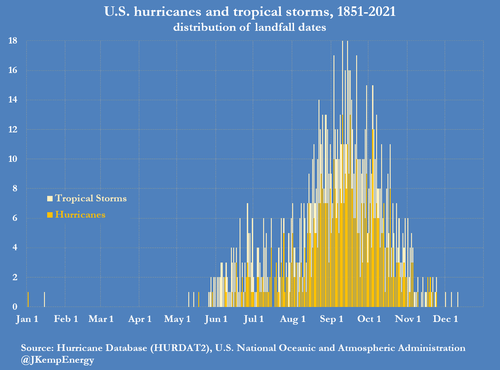
On average, four hurricanes made landfall somewhere on the Atlantic or Gulf Coasts of the United States by Sept. 12 each year between 1851 and 2021 (“Hurricane database”, HURDAT2, NOAA).
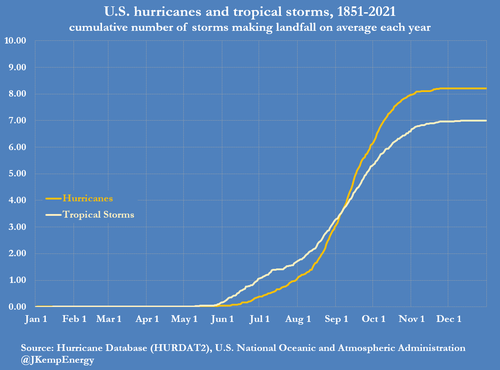
But this year the start of the hurricane season has been the quietest for 25 years. There were no Atlantic hurricanes in the month of August for the first time since 1997 and only the third time since 1950 (“Quiet start to hurricane season“, Wall Street Journal, Sept. 7).
No hurricanes have made landfall on the Atlantic or Gulf Coasts so far in 2022, ensuring crude and fuel production has continued uninterrupted and helping ease concerns about the low level of inventories.

Hurricanes tracking through the oilfields of the western Gulf or making landfall near the refining centres of Texas and Louisiana have the potential to interrupt offshore crude production and onshore gasoline and diesel refining. Severe storms in these areas often create a short-term spike in crude and fuel prices and traders anticipate potential moves by bidding up futures contracts for deliveries in September and October.
In May, NOAA forecast this year would see an above-average number of hurricanes and tropical storms, based in part on La Niña conditions in the Pacific (“NOAA predicts above-normal Atlantic hurricane season”, May 24). The agency reiterated this forecast as recently as the start of August (“NOAA still expects above-normal Atlantic hurricane season”, Aug. 4).
The possibility of hurricanes disrupting oilfield output or gasoline and diesel refining was especially worrisome given sanctions on Russia’s oil and diesel exports and the low level of oil inventories especially diesel stocks.
Hurricane risk likely contributed to rapidly rising prices for crude and abnormally high refining margins for gasoline and especially diesel through the end of July.
But the forecast storms have not materialized.
Falling Prices
Half the hurricane season still lies ahead so there is plenty of time for significant damage to offshore platforms and onshore refineries. In statistical terms, however, the risk is now much lower than it seemed between June and early August, which has likely taken some of the heat out of crude and fuel prices.
Prices for gasoline, in particular, have been falling much faster than for crude in recent weeks as the risks to the refining system have dropped.
Gasoline pump prices, including taxes, were at a premium of $1.58 per gallon ($66 per barrel) to Brent crude on Sept. 5 compared with $2.35 per gallon ($99 per barrel) in the middle of June.
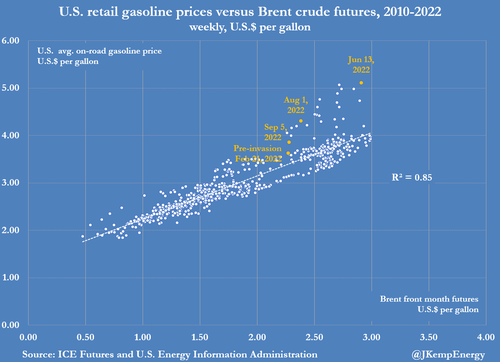
The gasoline premium has fallen close to its lowest levels since Russia invaded Ukraine in late February and is broadly similar to the premium a year ago, as some hurricane risk has evaporated. Premiums have narrowed even though gasoline inventories at the end of August were 14 million barrels (6%) below the pre-pandemic five-year average for 2015-2019.
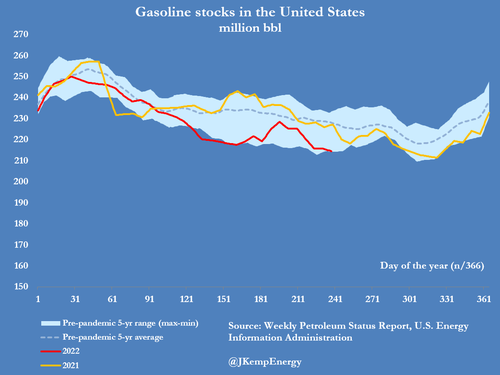
Diesel prices have remained firmer, in part because inventories remain much lower and manufacturing and freight activity has proved more resilient than expected a couple of months ago.
Distillate fuel oil inventories near the end of August were 32 million barrels (22%) below the pre-pandemic five-year seasonal average.

As a result, on-road diesel prices were at a premium of $2.80 per gallon ($118 per barrel) to Brent on Sept. 5 which was little changed from $3.10 per gallon ($130 per barrel) in the middle of June.
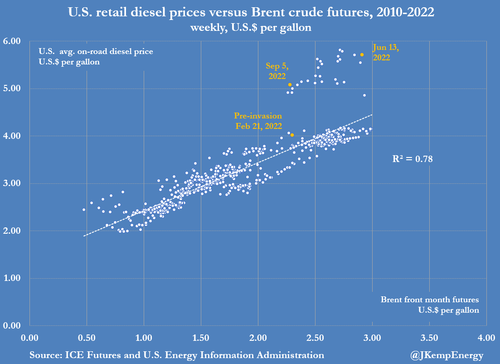
But it is likely that diesel prices would have moved even higher if the hurricane season had been much more active so far.
The quiet start to the season has removed one source of production risk while high prices and a slowing economy have started to dampen consumption.
The combined impact has been a significant reduction in the risk of fuel shortages with prices retreating from their mid-year highs.
https://www.zerohedge.com/commodities/quiet-start-us-hurricane-season-takes-heat-out-oil-prices-kemp
September 9, 2022
Quiet First Half of Hurricane Season
Quiet Start To US Hurricane Season Takes Heat Out Of Oil Prices: Kemp
by Tyler DurdenFriday, Sep 09, 2022 – 12:10 PM
By John Kemp, Senior Market Analyst at Reuters
The Atlantic hurricane season is nearing its halfway point and so far no hurricanes have made landfall on the coast of the United States, contributing to the recent downward pressure on oil and fuel prices.
The Atlantic season lasts from June 1 to Nov. 30, with half of the storms usually occurring before Sept. 12, based on records compiled by the U.S. National Oceanic and Atmospheric Administration (NOAA).
On average, four hurricanes made landfall somewhere on the Atlantic or Gulf Coasts of the United States by Sept. 12 each year between 1851 and 2021 (“Hurricane database”, HURDAT2, NOAA).
But this year the start of the hurricane season has been the quietest for 25 years. There were no Atlantic hurricanes in the month of August for the first time since 1997 and only the third time since 1950 (“Quiet start to hurricane season“, Wall Street Journal, Sept. 7).
No hurricanes have made landfall on the Atlantic or Gulf Coasts so far in 2022, ensuring crude and fuel production has continued uninterrupted and helping ease concerns about the low level of inventories.
Hurricanes tracking through the oilfields of the western Gulf or making landfall near the refining centres of Texas and Louisiana have the potential to interrupt offshore crude production and onshore gasoline and diesel refining. Severe storms in these areas often create a short-term spike in crude and fuel prices and traders anticipate potential moves by bidding up futures contracts for deliveries in September and October.
In May, NOAA forecast this year would see an above-average number of hurricanes and tropical storms, based in part on La Niña conditions in the Pacific (“NOAA predicts above-normal Atlantic hurricane season”, May 24). The agency reiterated this forecast as recently as the start of August (“NOAA still expects above-normal Atlantic hurricane season”, Aug. 4).
The possibility of hurricanes disrupting oilfield output or gasoline and diesel refining was especially worrisome given sanctions on Russia’s oil and diesel exports and the low level of oil inventories especially diesel stocks.
Hurricane risk likely contributed to rapidly rising prices for crude and abnormally high refining margins for gasoline and especially diesel through the end of July.
But the forecast storms have not materialized.
Falling Prices
Half the hurricane season still lies ahead so there is plenty of time for significant damage to offshore platforms and onshore refineries. In statistical terms, however, the risk is now much lower than it seemed between June and early August, which has likely taken some of the heat out of crude and fuel prices.
Prices for gasoline, in particular, have been falling much faster than for crude in recent weeks as the risks to the refining system have dropped.
Gasoline pump prices, including taxes, were at a premium of $1.58 per gallon ($66 per barrel) to Brent crude on Sept. 5 compared with $2.35 per gallon ($99 per barrel) in the middle of June.
The gasoline premium has fallen close to its lowest levels since Russia invaded Ukraine in late February and is broadly similar to the premium a year ago, as some hurricane risk has evaporated. Premiums have narrowed even though gasoline inventories at the end of August were 14 million barrels (6%) below the pre-pandemic five-year average for 2015-2019.
Diesel prices have remained firmer, in part because inventories remain much lower and manufacturing and freight activity has proved more resilient than expected a couple of months ago.
Distillate fuel oil inventories near the end of August were 32 million barrels (22%) below the pre-pandemic five-year seasonal average.
As a result, on-road diesel prices were at a premium of $2.80 per gallon ($118 per barrel) to Brent on Sept. 5 which was little changed from $3.10 per gallon ($130 per barrel) in the middle of June.
But it is likely that diesel prices would have moved even higher if the hurricane season had been much more active so far.
The quiet start to the season has removed one source of production risk while high prices and a slowing economy have started to dampen consumption.
The combined impact has been a significant reduction in the risk of fuel shortages with prices retreating from their mid-year highs.
https://www.zerohedge.com/commodities/quiet-start-us-hurricane-season-takes-heat-out-oil-prices-kemp
 Everchem Updates Archive
 Sign Up for Email Updates