Current Affairs
June 6, 2022
Congestion Eases
Ports get ‘much needed respite’ as container-ship traffic jam eases
Ship queues down off Southern California, Virginia and Charleston
Greg Miller Follow on Twitter Wednesday, June 1, 2022 3 minutes read

Listen to this article 0:00 / 4:11 BeyondWords
It could be the relative calm before the peak-season, post-Shanghai-lockdown storm. Or it could be the final unwinding of COVID-era congestion as inflation takes hold. What happens next is still highly uncertain. But as of now, U.S. port queue numbers remain down from highs.
“This appears to be a much needed respite for some ports that have seen significant delays over the course of the year to date,” said S&P Global Commodity Insights.
“Congestion is easing in [some] areas,” said Flexport. It advised importers to “take advantage of currently available space.”
There were only 25 container ships waiting to berth in the ports of Los Angeles and Long Beach on Friday, according to data from the Marine Exchange of Southern California. That’s the lowest tally since July 28, 2021. As of Wednesday, there were 28 ships waiting. Current numbers are far below the all-time high of 109 ships waiting on Jan. 9.

The reduction in the Los Angeles/Long Beach ship queue is partially due to cargo being redirected to East Coast ports. Yet even East Coast ports are down from peaks.
In late February, ship-position data from MarineTraffic showed 70 container ships waiting offshore of East and Gulf Coast ports. By mid-May, the count had fallen to 45.
As of Wednesday, it had climbed back up to 58. Traffic jams off Virginia and Charleston, South Carolina, are down. The biggest queues now are off New York/New Jersey — 17 container ships — and Savannah, Georgia, where 25 vessels are waiting. Savannah’s numbers are the main driver of the recent East Coast uptick in recent days; Hapag-Lloyd reported only seven ships at anchor there on Friday.

A temporary reprieve?
Inbound arrivals could soon increase, according to Sea-Intelligence. If so, port congestion improvements are temporary.
Sea-Intelligence said that offered trans-Pacific capacity jumped 21% from 535,200 twenty-foot equivalent units for departures in the week of May 15-21 to 646,500 TEUs this week.
Ships departing overseas ports this week will arrive by the end of June. Last year, the queue numbers in Los Angeles/Long Beach fell through the third week of June, then reversed, heading back up thereafter.
Asia-West Coast freight rates appear to have stabilized at high levels, at least temporarily, after significant recent declines. The Drewry Shanghai-Los Angeles assessment was at $8,720 per forty-foot equivalent unit last week. The Freightos Baltic Daily Index (FBX) assessment for that route (which includes premiums) was at $10,762 per FEU as of Tuesday.

Freight futures traded against the FBX show expectations for rebounding rates.
Peter Stallion of brokerage Freight Investor Services wrote in a market update on Wednesday: “Trans-Pacific westbound has seen a severe erosion of freight rates. [But] forward market sentiment, rather than carrying down any further significant price decreases, has flattened out the curve.”
The calendar-year 2023 futures contract for Asia-West Coast is now trading above the current price, at $11,500 per FEU. That contract price “held steady through the month [of May],” said Stallion.
“This is a drastic change since the start of the year, and indeed through most of 2021,” when current prices were at a premium to forward contract prices.
June 4, 2022
Lumber Prices
Lumber Prices Crash 50% As Fed Tightens
by Tyler DurdenFriday, Jun 03, 2022 – 08:40 PM
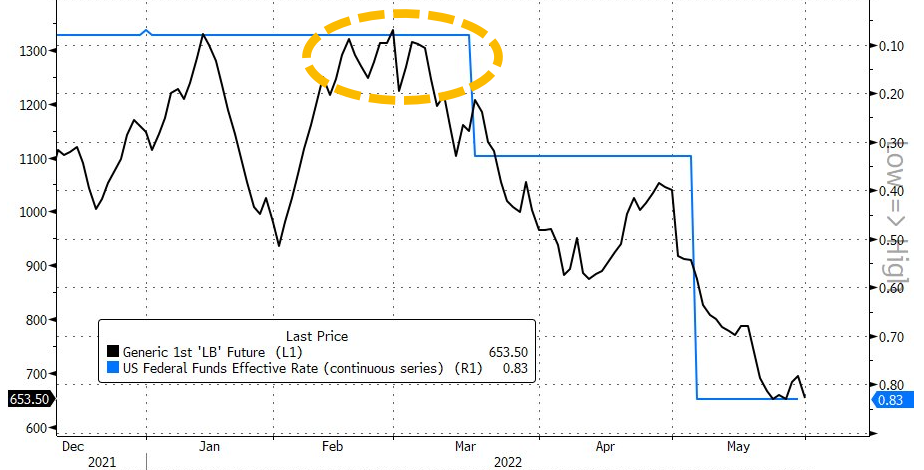
Lumber prices have been halved since the Federal Reserve embarked on its most aggressive interest rate tightening campaign in decades as the pandemic boom in housing slows.
Lumber contracts trading on the CME crashed to $653 per thousand board feet, down 51% from a high in late February of $1,336. The decline in wood prices occurred about two weeks before the Fed began hiking interest rates in mid-March.
The Fed is expected to continue raising rates this summer. Interest rate probabilities show the Fed could hike by 50bps at three of the next FOMC meetings to suppress consumption and get inflation under control ahead of the midterm elections. However, that’s going to be a challenging task, which may cause a hard landing in the economy.
Fed Chair Jerome Powell’s pursuit of finding the neutral rate has already unleashed a rate shock in the housing market, with the 30-year fixed-rate mortgage shooting up more than 200bps this year, from 320 bps to 557 bps. This has crushed activity for refinancing houses (remodeling) and sent mortgage applications (home construction) plunging, a sign the housing market is cooling.
Signs of a slowdown in construction are already materializing: “Buyers don’t have the same mentality of having to go out and buy 10 when they only need five,” Ash Boeckholt, co-founder and chief revenue officer at online wood-products marketplace MaterialsXchange, told WSJ.
A monthly survey from John Burns Real Estate Consulting of building-products dealers shows only 12% had tight lumber inventories in April, down 61% from last year. Lumber is a leading indicator and suggests higher prices and soaring interest rates have helped fix shortages that were stoked during the pandemic lockdowns of easy money and robust demand for housing.
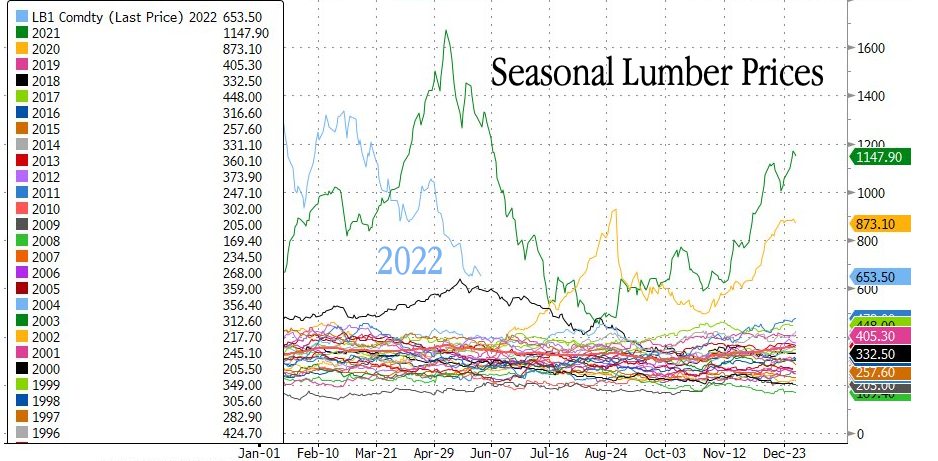
Lumber is still double the price of the three-decade trend of $359. Matthew Saunders, who leads John Burns Real Estate Consulting, said that prices are expected to stay above pre-pandemic levels despite improving supply chains and falling demand for wood.
“We believe that they will trade above long-term averages for the balance of the year. However, in the short term, lumber is down more than 50% from the most recent peak. The market is trying to determine where the new price equilibrium compared to slowing demand and increased supply,” Josh Goodman, vice president of inventory and purchasing at Sherwood Lumber, told GlobeSt.com.
Another sign lumber demand is declining is directly from one of the largest wood producers in North America, Canfor Corp, who reduced operating schedules at sawmills in Western Canada. Since March, Canfor has operated sawmills at 80% of production capacity.
On the retail side, traders and analysts have noticed slumping demand for lumber at Home Depot and Lowe’s as consumers shift away from home-improvement projects to spending money on vacations.
The Fed will frontload interest rate hikes this summer which could pressure lumber prices even lower. Perhaps, if some readers have been waiting to build a deck or fence and didn’t want to pay crazy COVID prices, now could be the time to build (despite paying high labor costs).
https://www.zerohedge.com/commodities/lumber-prices-crash-50-fed-tightens
June 4, 2022
Lumber Prices
Lumber Prices Crash 50% As Fed Tightens
by Tyler DurdenFriday, Jun 03, 2022 – 08:40 PM
Lumber prices have been halved since the Federal Reserve embarked on its most aggressive interest rate tightening campaign in decades as the pandemic boom in housing slows.
Lumber contracts trading on the CME crashed to $653 per thousand board feet, down 51% from a high in late February of $1,336. The decline in wood prices occurred about two weeks before the Fed began hiking interest rates in mid-March.
The Fed is expected to continue raising rates this summer. Interest rate probabilities show the Fed could hike by 50bps at three of the next FOMC meetings to suppress consumption and get inflation under control ahead of the midterm elections. However, that’s going to be a challenging task, which may cause a hard landing in the economy.
Fed Chair Jerome Powell’s pursuit of finding the neutral rate has already unleashed a rate shock in the housing market, with the 30-year fixed-rate mortgage shooting up more than 200bps this year, from 320 bps to 557 bps. This has crushed activity for refinancing houses (remodeling) and sent mortgage applications (home construction) plunging, a sign the housing market is cooling.
Signs of a slowdown in construction are already materializing: “Buyers don’t have the same mentality of having to go out and buy 10 when they only need five,” Ash Boeckholt, co-founder and chief revenue officer at online wood-products marketplace MaterialsXchange, told WSJ.
A monthly survey from John Burns Real Estate Consulting of building-products dealers shows only 12% had tight lumber inventories in April, down 61% from last year. Lumber is a leading indicator and suggests higher prices and soaring interest rates have helped fix shortages that were stoked during the pandemic lockdowns of easy money and robust demand for housing.
Lumber is still double the price of the three-decade trend of $359. Matthew Saunders, who leads John Burns Real Estate Consulting, said that prices are expected to stay above pre-pandemic levels despite improving supply chains and falling demand for wood.
“We believe that they will trade above long-term averages for the balance of the year. However, in the short term, lumber is down more than 50% from the most recent peak. The market is trying to determine where the new price equilibrium compared to slowing demand and increased supply,” Josh Goodman, vice president of inventory and purchasing at Sherwood Lumber, told GlobeSt.com.
Another sign lumber demand is declining is directly from one of the largest wood producers in North America, Canfor Corp, who reduced operating schedules at sawmills in Western Canada. Since March, Canfor has operated sawmills at 80% of production capacity.
On the retail side, traders and analysts have noticed slumping demand for lumber at Home Depot and Lowe’s as consumers shift away from home-improvement projects to spending money on vacations.
The Fed will frontload interest rate hikes this summer which could pressure lumber prices even lower. Perhaps, if some readers have been waiting to build a deck or fence and didn’t want to pay crazy COVID prices, now could be the time to build (despite paying high labor costs).
https://www.zerohedge.com/commodities/lumber-prices-crash-50-fed-tightens
June 1, 2022
Memorial Day Mattress Update
Slowing sales for mattress retailers ‘on par with Great Recession’ – Wedbush
Jun. 01, 2022 3:25 PM ETPurple Innovation, Inc. (PRPL), SNBR, TPXBy: Kevin P. Curran, SA News Editor7 Comments
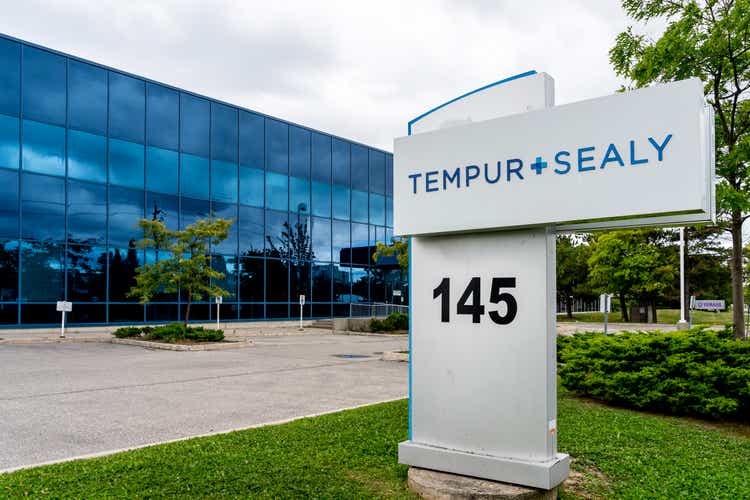
Lagging sales for mattress retailers over the Memorial Day holiday point to a rough rest of the year, according to Wedbush analyst Seth Basham.
In a research note authored on Wednesday, the analyst reported that recent sales checks came back negative while demand generally continues to wane. Basham added that advertisement and promotional activity did not pay off as many of the retailers had hoped.
“Our analysis found incremental promotional intensity with outsized discounting on the low-end and in the Direct-to-Consumer Bed-In-Box (BiB) channel while Tempur-Pedic (TPX-O) increased its promotional intensity on lower-end mattress and base bundles,” he wrote in a research note on Wednesday. “As sales trends for this key period often set the tone for the entire summer season, the soft performance over the Memorial Weekend suggests continued sharp [mid-single digit to high-single digit] unit declines through the summer in the absence of incremental discounting to spur demand—this level of unit decline is on par with the Great Recession.”
On top of that bearish comparison, Basham noted that increased commodity costs and supply chain problems present only added issues for these retail chains as they are likely forced into further promotional activity and price cuts due to waning demand. In particular, his team expects increased clearance-type sales around the July 4 and Labor Day holidays.
“In sum, it appears to be too early for a turn in fundamentals or mattress industry stocks,” he concluded.
June 1, 2022
Memorial Day Mattress Update
Slowing sales for mattress retailers ‘on par with Great Recession’ – Wedbush
Jun. 01, 2022 3:25 PM ETPurple Innovation, Inc. (PRPL), SNBR, TPXBy: Kevin P. Curran, SA News Editor7 Comments
Lagging sales for mattress retailers over the Memorial Day holiday point to a rough rest of the year, according to Wedbush analyst Seth Basham.
In a research note authored on Wednesday, the analyst reported that recent sales checks came back negative while demand generally continues to wane. Basham added that advertisement and promotional activity did not pay off as many of the retailers had hoped.
“Our analysis found incremental promotional intensity with outsized discounting on the low-end and in the Direct-to-Consumer Bed-In-Box (BiB) channel while Tempur-Pedic (TPX-O) increased its promotional intensity on lower-end mattress and base bundles,” he wrote in a research note on Wednesday. “As sales trends for this key period often set the tone for the entire summer season, the soft performance over the Memorial Weekend suggests continued sharp [mid-single digit to high-single digit] unit declines through the summer in the absence of incremental discounting to spur demand—this level of unit decline is on par with the Great Recession.”
On top of that bearish comparison, Basham noted that increased commodity costs and supply chain problems present only added issues for these retail chains as they are likely forced into further promotional activity and price cuts due to waning demand. In particular, his team expects increased clearance-type sales around the July 4 and Labor Day holidays.
“In sum, it appears to be too early for a turn in fundamentals or mattress industry stocks,” he concluded.
 Everchem Updates Archive
  Sign Up for Email Updates