The Urethane Blog
December 10, 2023
“Winter Is Coming” For Leveraged Companies
by Tyler Durden
Friday, Dec 08, 2023 – 12:45 PM
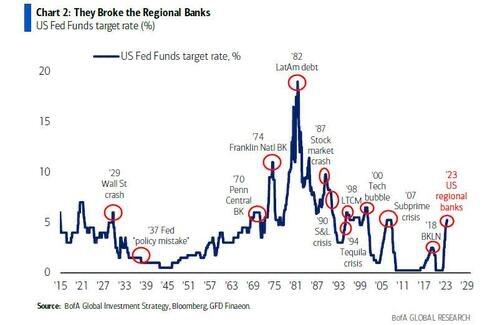
Earlier in the year, as regional banks faced a domino effect of failures, Bank of America strategist Michael Hartnett pointed out that every Fed tightening cycle has historically resulted in a crisis.
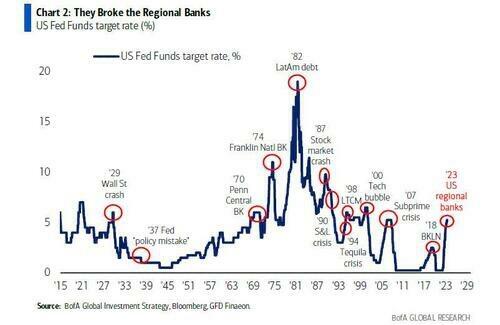
Given that the Federal Reserve hasn’t allowed a real credit cycle since the early 2000s, prolonged monetary tightening suggests that “winter is coming” for leveraged companies.
“The whole market and companies have been living in this la la land, this fake world of wealth of quantitative easing where you can borrow at 1% or 2%, you can buy anything, you can make lots of mistakes and you’re not going to get called out,” said Paul Horvath, chief executive officer at investment firm Orchard Global.
Horvath, speaking at the Milken Institute’s Middle East and Africa Summit in Abu Dhabi this week, was quoted by Bloomberg. He warned: “Winter is coming, and I don’t think people have enough parkas.”
The asset manager head said financial markets are holding up well so far, given the high rates. He noted corporates are levered up due to private equity firms buying up companies with cheap money, adding a global financial crisis might not be in the cards – but expects there will still be stress.
Bloomberg pointed out there were record levels of dealmaking during the pandemic era of cheap money. This led to a surge in private equity buyouts, backed by leveraged finance and the debt load placed on the target company. A large amount of that debt for junk-rated firms is coming due as large maturity walls approach.
Also speaking at the event was SLR Capital Partners co-founder Michael Gross, who said there is no easy solution for companies needing to refinance this debt.
“It’s going to take more than public markets coming back,” Gross said, adding, “It’s going to probably require private equity sponsors to find unique solutions like putting in more equity or finding preferred investors to step into the capital structures.”
Gross said managing portfolio companies with outdated debt structures will also face challenges for private credit funds.
He explained that funds were structured in a world of “perfection” based on an era of low interest rates, but that has all changed.
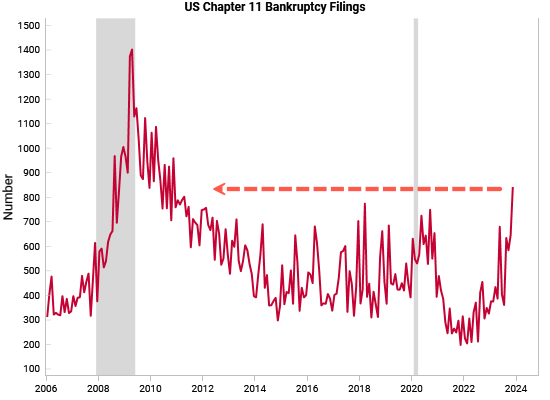
A higher for the longer environment with mounting macroeconomic headwinds only means over-leveraged firms are increasingly falling into distressed
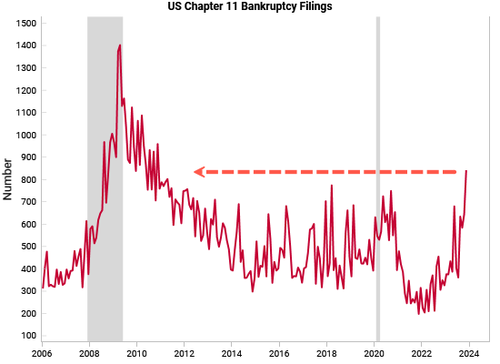
The impact of this tightening cycle could be worse than the Great Recession – unless the Fed reverses course.
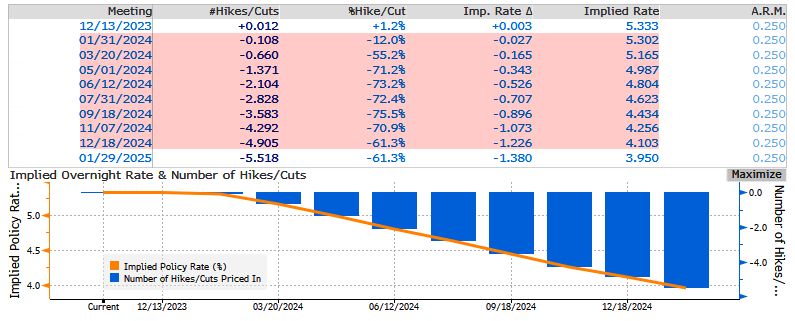
Rate traders are already pricing more than 100bps of rate cuts for 2024.
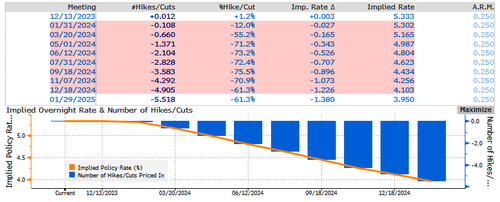
Meanwhile, Anne Walsh, chief investment officer of Guggenheim Partners Investment Management, said the US economy “hasn’t had a real corporate credit cycle since the early 2000s,” indicating a “purge is about to happen.”
https://www.zerohedge.com/markets/winter-coming-leveraged-companies
December 7, 2023
December 5, 2023
Woodbridge and TM Automotive Seating Systems Enter into a Joint Venture
MISSISSAUGA, Ontario, Canada & TROY, Mich., Dec. 5, 2023 – Today, Woodbridge announced it has entered into a joint venture (JV) with TM Automotive Seating Systems. The JV, to be called TMWB Foam Private Limited, will focus on delivering innovative seating systems to commercial vehicle manufacturers and buses.
“We are pleased to partner with TM Automotive Seating Systems to further strengthen our competitive position within the country,” said Bill Drury, Vice President and General Manager, Asia. “This JV combines Woodbridge’s expertise within the foam industry and TM Automotive Seating Systems’ knowledge of the Indian market to provide both companies an opportunity for growth in the commercial vehicle market.”
The JV will be located in Pune, Maharashtra, India.
About Woodbridge
With corporate headquarters in Mississauga, Ontario, Canada, and automotive headquarters in Troy, Michigan, USA, Woodbridge has more than 7,000 teammates in over 40 locations across nine countries. The company offers material technologies for automotive, commercial, recreational, packaging, healthcare, and building product applications. We provide a full complement of services, including prototyping, consulting, technical support, chemical R&D, and accredited laboratory testing.
December 6, 2023
Polyurethane Foam Association Elects New Officers, Names
Additions To Executive Committee for 2024
Philipe Knaub Takes Reins As President

LOUDON, TN (December 5, 2023)—The Polyurethane Foam Association (PFA) has named its
officers and Executive Committee for 2024. The slate of officers and committee members was
approved by attendees at the General Business Meeting on November 2, 2023 in Toronto.
Officers include:
Philippe Knaub, FXI, President
Rob Heller, Future Foam, 1st Vice President
Cam McLaughlin, Elite Comfort Solutions, 2nd Vice President
Hamdy Khalil, The Woodbridge Group, Treasurer
Bill Gollnitz, Immediate Past President.
Additional PFA Executive Committee members include:
Frank Donato of VPC
Karl Gust, BASF
Scott Skolnekovich, Covestro
Susan Kilpatrick, Evonik
Rob Einterz, Monument Chemical
Robert Smith, Wanhua
Barry Gabelman, Chemfoam.
Knaub takes over the presidency from Chip Holton of NCFI Polyurethanes, who had served in
the position since 2015.
Knaub is Senior Vice President and Chief Technology Officer of FXI, a
position he has held since 2016. He supervises all research and development projects, reporting
to the company’s Chief Executive Officer. He is accountable for all aspects of R&D and product
development, including project portfolio management, discovery, scale ups and
commercialization of new polyurethane foams.
Knaub earned a Ph.D. in Polymer Science from the Institut National des Sciences Appliquées de
Lyon. He holds multiple patents in polyol composition.
“PFA is a vital organization in the flexible polyurethane foam industry,” Knaub said. “I look
forward to working with my colleagues in the industry to further PFA’s programs in advocacy
and education.”
The Polyurethane Foam Association is a trade association founded in 1980 to help educate foam
users, allied industries and other stakeholders. PFA provides facts on environmental, health and
safety issues and technical information on the performance of flexible polyurethane foam (FPF)
in consumer and industrial products. FPF is used as a key comfort component in most
upholstered furniture and mattress products, along with automotive seating, carpet cushion,
packaging, and numerous other applications.
To learn more, visit www.pfa.org.
December 6, 2023
Brenntag reshuffles business amid calls for full break-up
By Tristan Veyet and Matteo Allievi
December 5, 20237:40 AM ESTUpdated 2 days ago

Dec 5 (Reuters) – German chemicals distributor Brenntag (BNRGn.DE) said on Tuesday it would reorganise its business into two independent divisions from 2024 as it faces pressure from activist investors to break up the company.
The group’s shares were down 1.6% at 1012 GMT. Analysts had expected a muted share price reaction after no clear split was announced.
In the reshuffle, Brenntag’s essentials unit, a wholesale business for process chemicals, and the specialties arm, which provides services to industries such as nutrition and household products, will each have their own legal structure and leadership.
Brenntag said ahead of its Capital Markets Day event that the structural changes would give the company more options and make it ready for the next strategic steps by 2026, but did not specify what those steps might be.
“Split between two divisions is one option but there could be also other options,” CEO Christian Kohlpaintner said during a press conference.
Brenntag’s management has faced increasing pressure for a break-up of its businesses and a spin-off of the specialties unit from activist investors who have argued the separation would boost the company’s shares.
“There is really no catalyst to buy the shares unless Brenntag announces a clear split of the two divisions before 2026,” Alster analyst Thomas Wissler said.
Brenntag is the latest in a series of old and famous German companies, such as Bayer (BAYGn.DE) and Thyssenkrupp (TKAG.DE), that have been targeted by activist investors to divest part of their business to improve profitability.
As part of the reorganisation, Brenntag will transfer all pharmaceutical activities from the essentials arm to the specialties unit, while moving water treatment and finished lubricants businesses along with some semi-speciality products in the opposite direction.
As a result, the specialties division will account for 30% of the group’s gross profits, while essentials will make up the rest.
Brenntag said it aimed to grow its organic earnings before interests, taxes and amortisation by 7-9% per year until 2027, with 5-7% growth in essentials and 7-9% growth in specialties.
($1 = 0.9240 euros)
(This story has been corrected to attribute descriptions of divisions to correct business units, in paragraph 3)
Reporting by Tristan Veyet and Matteo Allievi in Gdansk; editing by Milla Nissi and Sharon Singleton
November 30, 2023
The Evolution of Chlorohydrination Process for Manufacturing PO
PUdaily | Updated: November 30, 2023
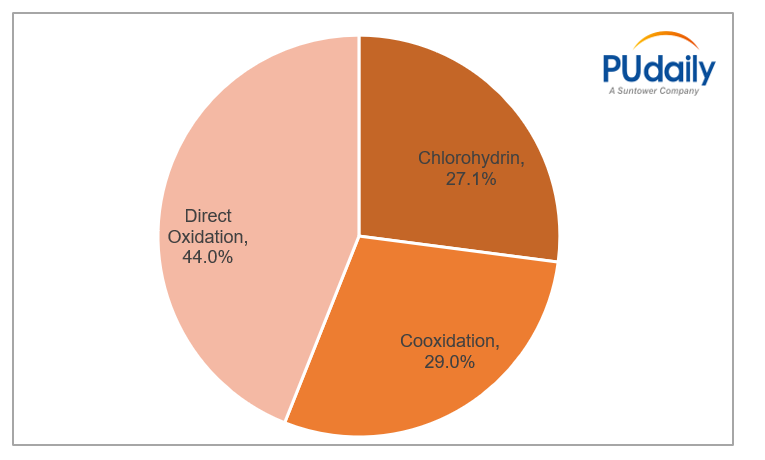
On July 14, the National Development and Reform Commission issued the National Industrial Restructuring Guidance Catalogue (2023 Edition) to seek public comments. In the new edition of the Catalogue, PO projects using chlorohydrination process based on calcium saponification are included in the eliminated category for the petrochemical and chemical industries (such projects are required to be eliminated by December 31, 2025). Restrictions on PO projects using chlorohydrination process can be traced back to the National Industrial Restructuring Guidance Catalogue (2011 edition).By the end of 2022, the share of PO projects using chlorohydrination process in China had decreased to 27.1%.
In chlorohydrination process, PO is manufactured using propylene and chlorine as the raw materials through chlorohydrination, saponification and rectification. Firstly, excess propylene is added to the mixture of water and chlorine to produce chloropropanol through chlorohydrination. The remaining propylene as well as hydrogen chloride and some organic chlorides (such as dichloropropane) produced in the reaction are discharged from the top of the reactor. and the hydrogen chloride and organic chlorides are removed through condensation for recovering the propylene. The chloropropanol solution containing 4% hydrochloric acid was discharged from the bottom of the reactor. Secondly, saponifier is added (caustic soda, instead of lime milk used in the traditional chlorohydrination process, is used in modified chlorohydrination process) to saponify chloropropanol for making crude PO. Thirdly, crude PO is transferred to the rectification column for separation and refining. The chlorohydrination process is composed of chlorohydrination, saponification and rectification.
As a mature technology, chlorohydrination process features production of a single product, easy operation of the facilities, low purity requirement for propylene and low building costs for the facilities. But it consumes a large amount of lime, chlorine and water, and results in a large amount of waste water and residue, which not only pollute the environment, but also cause corrosion to the equipment. Over the past decades, many firms at home and abroad have refined the process in different ways, represented by
1. Dow Chemical: The company replaces lime milk (Ca(OH)2) with electrolyte NaOH (mass fraction between 10% and 20%) in the saponification to significantly reduce the mass concentration of propanediol and dichloropropane in the saponified waste liquid and thus obtain relatively pure saline solution (NaCl and H2O). The saline solution is refined to make it saturated one, which is then transferred to the electrolytic bath for electrolysis that produces chlorine, hydrogen and sodium hydroxide. The chlorine is used as a raw material for the chlorohydrination process, and the sodium hydroxide is again used in the saponification. The recycling makes the process more economical. This refinement dramatically reduces the amount of waste water and residues (mainly composed of CaCl2) produced from saponification and as a result reduces the pollution of soil and water sources. However, the electrolytic process is energy-intensive.
2.ABB Lummus Global: The company comes up with the concept of closed-loop circulation, in which Cl2 and NaOH react with isobutanol to produce butyl hypochlorate as the chlorohydrating agent to reduce the use of Cl2; butyl hypochlorate react with propylene in the organic solvent to produce isobutanol and chloropropanol;and chloropropanol is saponified with the electrolyte to manufacture propylene oxide. Compared with the traditional chlorohydrination process, this refined process greatly reduces industrial wastewater, waste gases and residues. With a high mass concentration, the saline solution produced from saponification can be transferred to the electrolytic plant for electrolysis. The produced Cl2 and NaOH can be reused. But the process also has drawbacks, including large consumption of isobatyalcohol and high building costs for the facility.
A domestic firm has also developed its own environmentally friendly process for manufacturing PO, in which the recovered lime milk is saponified with the waste water and CaCl2 in the residual liquid. This process has been industrialized, producing significant social, environmental and economic benefits.
 Everchem Updates Archive
 Sign Up for Email Updates