
The Urethane Blog
November 20, 2023
Hennecke Inc. looks back on a remarkable Open
House event
Hennecke Inc, the U.S. headquarters of the global Hennecke
GROUP, hosted a highly successful Open House event with
more than 100 visitors from across the country in October. The
event focused on innovation and customer-driven solutions in
polyurethane processing as well as a commitment to a
sustainable future. Customers and partners were offered a
unique opportunity to learn first-hand how Hennecke’s diverse
innovations can drive the success of their own businesses.
The successful Open House was a testament to Hennecke’s North American
subsidiary’s customer-centric approach and commitment to helping them
succeed with customized solutions. “We remain focused on our mission to
provide best-in-class solutions and lead the way in innovation and customer
satisfaction,” said Lutz Heidrich, president of Hennecke’s North American
business unit. “Our success and progress would not be possible without the
partnership and trust of our customers. We are committed to help companies
succeed with our solutions,” added Heidrich.
During the Open House, visitors had the opportunity to learn about various
innovative solutions such as the NEXT-GEN high-pressure metering
machines that offer a wide range of applications to increase customer
efficiencies using digitalization and precision. Hennecke Inc. also offers
solutions that are specially adapted for the North American market such as
the new ECOPLUS MK2 which will be available with Allen-Bradley-based
automation in Q1 of 2024. Another highlight was Hennecke’s mixhead
technology of the MT-E and MT-A series. Visitors were able to explore the
mode of operation and specific advantages using AR technology. The NEXT-
GEN lineup was one of the largest development projects in Hennecke’s
history. Attendees were also able to see firsthand the performance scope of
the new HX pump generation.
In the field of systems technology, Hennecke Inc. is an innovation driver in
the field of tank farm solutions and raw material handling. Hennecke’s
specialists presented unique selling points and advantages and discussed
the profitability of large-scale production facilities using sample calculations.
In addition, the revolutionary FOAMWARE control system for slabstock and
molded foam lines was demonstrated. The attendees were informed about
the increasing importance of blowing agents in PU production and the latest
technological developments in this field. Attendees also had the opportunity
to see live demonstrations of innovative production technologies such as
laser cutting and 3-D printing, and virtual glasses used for assisting
customers remotely saving both time and money.
When it comes to absolute focus on the customer, however, the portfolio in
the field of machine and systems engineering is only part of the measures
that Hennecke Inc. combines under one roof. The modern company
headquarters also includes a customer trial laboratory, a mixhead and pump
repair and training area and a state-of-the-art spare parts warehouse which
utilizes a VLM to store over $2.5 million in inventory.
In addition to these innovations, the open house highlighted Hennecke’s
commitment to sustainability and the steps the company has taken to reduce
its own, as well as its customers’, carbon footprint to ensure a more
sustainable future for all. The customer feedback was very positive: “It was
great to meet the welcoming team of Hennecke Inc. at the Open House. The
machines on display and numerous presentations were impressive and very
informative. It was immediately clear to us that the event will prove very
useful for several current projects.” Says Vinnie Bonaddio of Rogers Foam
Cooperation in Somerville (MA).
www.hennecke.com
California reaches mattress recycling milestone
Since the launch of the Bye Bye Mattress campaign in California, the state has recycled 10 million mattresses.

Photo courtesy of the Mattress Recycling Council
Posted by Bob Gaetjens | November 14, 2023
More than 10 million mattresses have been recycled in California since the Mattress Recycling Council (MRC) launched the Bye Bye Mattress program in the state.
The organization, which has operations in several states, reached that milestone nationally in March 2022.
If laid end-to-end, that is enough mattresses to stretch from California’s coastline to the middle of the Indian Ocean. As a result, recyclers have diverted more than 380 million pounds of steel, foam, fiber and wood from landfills and made them available for use in new products such as carpet padding, construction rebar and mulch.
“By reducing the demand to use virgin materials in other products, mattress recycling is contributing to California’s other important environmental goals—saving water, conserving energy and preventing greenhouse gas (GHG) emissions,” MRC Chief Operating Officer Mike O’Donnell says. “We have the data to prove it too. A recent analysis of our California program’s environmental footprint from collection to recycling shows that each mattress recycled saves 500 gallons of water, conserves enough energy to power a house for three days and reduces greenhouse gas emissions equivalent to driving 60 fewer miles.”
MRC’s Bye Bye Mattress is a statewide network of collection sites and events serving urban and rural communities across California that is made possible through collaborations with solid waste providers and nonprofit organizations. A growing number of waste haulers collecting bulky items at the curb are also recycling mattresses through the program.
Mattresses are transported from participating collection locations to regional recyclers, where they are dismantled into their different component parts. Mattress retailers, hotels, dormitories, nursing homes, military bases and other types of businesses also are working with MRC to have their old mattresses collected and recycled by the program.
“We are proud of what we have accomplished in California, but we know there are opportunities for the program to innovate and evolve,” O’Donnell says. “This is why we are supporting the industry’s broader efforts to encourage circular design and sustainability initiatives.”
The MRC undertakes research to improve collection, transportation and recycling processes. This includes providing research firms and educational institutions up to $100,000 in funding for projects aimed at discovering new uses for mattress materials. To date, MRC has awarded funds to more than 30 projects and is seeing some promising outcomes.
“One day, recycled mattress materials may help [electric vehicle] batteries hold longer charges or be used to make shoe soles or clean up oil spills,” O’Donnell says. “We need innovators to create new uses for polyurethane foam, quilt panels, cotton and mixed fibers.”
In addition to Bye Bye Mattress, MRC’s other California activities include offering mattress manufacturing facilities in the state an environmental certification program known as the Sleep Products Sustainability Program (SP2), which encourages conservation and resource efficiency.
“All these accomplishments are possible because MRC has the support of the mattress industry, mattress retailers, the solid waste industry and state agencies that provide oversight and guidance for our programs,” O’Donnell says. “We are also grateful to the international community of mattress recyclers and product stewardship organizations for sharing their best practices, collaborating on research projects and their commitment to sustainability.”
The MRC is an Alexandria, Virginia-based nonprofit organization that operates recycling programs in states that have passed mattress recycling laws, including California, Connecticut and Rhode Island. MRC was founded by the bedding industry and recycles nearly 2 million mattresses each year.
https://www.recyclingtoday.com/news/mattress-recycling-council-bye-bye-california-milestone/
November 19, 2023
The Best and Worst U.S. Airports of 2023
The Journal’s ranking of the 50 largest U.S. airports finds fliers in the West have lots to brag about, while New Yorkers settle for ‘works in progress’

There’s enough that’s easy about traveling through Phoenix Sky Harbor International Airport to land it first among the 20 largest airports in this year’s rankings.
By Dawn Gilbertson| Photographs by Adam Riding for The Wall Street Journal
Nov. 14, 2023 9:00 pm ET
PHOENIX—Searing heat. Erratic sports teams. An unending influx of Californians.
Residents of this desert city have plenty of gripes. One thing you’ll hear few complaints about: the airport. Phoenix Sky Harbor International Airport is a breeze to get to. It offers a solid lineup of airlines and flights. And travelers rarely fret about flight delays and cancellations given the never-have-to-look-at-the-forecast weather.
It’s a combination that helped land the airport atop The Wall Street Journal’s annual ranking of the country’s busiest airports—again. Sky Harbor took the crown in 2019, before a pandemic pause in the rankings.
Top Five Large U.S. Airports
| Overall Rank | Airport | Overall Score |
|---|---|---|
| 1 | Phoenix (PHX) | 63.4 |
| 2 | Minneapolis (MSP) | 63.2 |
| 3 | Los Angeles (LAX) | 62.9 |
| 4 | Atlanta (ATL) | 62.7 |
| 5 | Detroit (DTW) | 61.4 |
Click to see where every airport landed in the full ranking.
Source: 2023 WSJ Airport Rankings
Minneapolis-St. Paul International Airport finished a hair behind Phoenix among the 20 busiest U.S. airports on this year’s list. Los Angeles International Airport took third, just behind them.
The Journal’s report card ranks the 50 largest U.S. airports on 30 measures divided into two categories important to travelers: The first group measures reliability, the second value and convenience.
Each accounted for half of an airport’s overall score, with 10 reliability measures, from Transportation Security Administration waits to time on the tarmac, carrying the most weight overall. After all, the thing we care most about in our travels is getting there on time.
New this year as a measure of customer satisfaction: a survey of travelers done by Dynata for the Journal on amenities that airports get right and wrong, from food and drink to bathrooms to parking.
(See the full results of this year’s large-airport and midsize-airport rankings.)
Good, not great
No airport had a perfect score or anything close to it, a sign of the never-ending stresses on these complex, 24-hour businesses. Sky Harbor, my second home as a Phoenix resident, scored 63.4 out of 100. That wouldn’t earn report-card bonuses in any household.
Top Five Midsize U.S. Airports
| Overall Rank | Airport | Overall Score |
|---|---|---|
| 1 | San Jose (SJC) | 71.2 |
| 2 | San Antonio (SAT) | 70.4 |
| 3 | Sacramento (SMF) | 70.0 |
| 4 | Indianapolis (IND) | 69.9 |
| 5 | Houston (HOU) | 69.0 |
Click to see where every airport landed in the full ranking.
Source: WSJ Airport Rankings
San Jose Mineta International Airport in California, the winner in the midsize category, topped all airports with a score of 71.2. San Antonio finished second (70.4), followed by last year’s midsize winner, Sacramento (70).
San Jose shined in reliability, as well as value and convenience. The Silicon Valley airport prides itself on its short walks—you can still walk to the rental-car center—short security lines, on-time performance and therapy dog and cat programs. Earlier this year it introduced a new tagline: Fly Simple.
“We’ve worked really hard to concentrate on the things that we can control,” says Scott Wintner, deputy director.
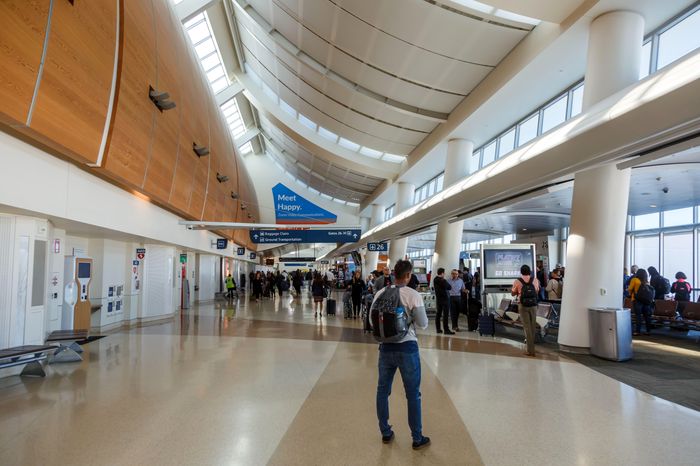
San Jose Mineta International Airport topped the list of 30 midsize airports. Photo: Markus Mainka/Alamy
The worst-performing large airports won’t surprise anyone, especially given the nonstop headlines on congestion issues in the Northeast: Newark Liberty International Airport and New York’s John F. Kennedy. Dallas/Fort Worth International finished third-worst in our scorecard, dragged down by measures of reliability like heavy arrival and departure delays.
Rick Cotton, executive director of the Port Authority of New York and New Jersey, which oversees the region’s airports, describes Newark and JFK as “works in progress.” Newark’s redesigned Terminal A opened this year, and the Port Authority plans to overhaul the airport’s other two terminals. JFK is also in the midst of a revamp that will cost billions of dollars and take years to complete.
“We’re committed to a trajectory where Newark and JFK are world-class,” Cotton says.
Phoenix, where American and Southwest carry nearly three out of four passengers, was solidly reliable. It also performed well on money matters like airfares and Uber costs to downtown, plus amenities including baggage claim and car-rental facilities, though it fared poorly in rental-car costs on the November weekend we priced.


American and Southwest combine to fly by far the most passengers in and out of PHX.
Sky Harbor had among the fewest flight cancellations of any large airport, shorter delays than most and far shorter time on the tarmac awaiting takeoff or getting to the gate. The average taxi-out time—the time from when a plane leaves the gate until takeoff—was under 15 minutes, compared with 26 minutes at JFK.
Weather helps a lot, of course. Airport director Chad Makovsky also credits the takeoff and landing choreography the airport, airlines, FAA and others have worked to perfect over the years. It’s essential, given the airport’s compact size.
The Sky’s the Limit
Phoenix Sky Harbor International Airport finished first in the WSJ Airport Rankings. Below are some of its highlights and new features.
Sources: WSJ Airport survey; the airport
The city-owned airport near downtown Phoenix sits on 3,400 acres and has just three runways. That compares with 17,000 acres and seven runways at Dallas/Fort Worth, where Makovsky came from in 2021. PHX passenger traffic, fueled by the region’s explosive growth, is up nearly 10% from a year ago and about 4% from 2019 through September.
“We have to be very efficient,” he says.
Upgrades go live
Sky Harbor completed some major projects in the past 18 months that are already a hit with travelers, Makovsky says. Nearly 75% of the airport’s passengers are local. Contrast that with an airport like Charlotte, N.C., where 70% of the passengers are connecting.
In December, a couple months before metro Phoenix hosted the Super Bowl, the airport extended its PHX Sky Train service 2.5 miles to the rental-car center. Travelers previously had to schlep bags to the curb and board a shuttle bus that wound through clogged airport roadways. The airport’s bus fleet went from 120 to a dozen backup buses.
“Being able to connect from any of our terminals to the rental-car center in like five minutes is pretty cool compared to what we used to have,” Makovsky says.


Fliers appreciate features like the airport’s Sky Train and sun-blocking windows.
The airport opened a new concourse, for
Southwest Airlines, in summer 2022. It’s now coming to life as restaurants and bars start to open. A Bobby Flay outlet opened in the food court and a Guy Fieri sit-down restaurant is on the menu by the end of next year. Also on tap: a PGA Tour store with a simulator of the infamous 16th hole at the Phoenix Open. A Chase Sapphire Reserve lounge is due to boost the airport’s weak lounge lineup by next spring.
Makovsky says the new gates in Terminal 4, the airport’s busiest, provide a glimpse into PHX’s future as it builds another concourse in neighboring Terminal 3 and renovates existing concourses in Terminal 4. Many areas of Terminal 4, which opened 33 years ago, are showing their age.
The walkway to the new gates is significantly wider than other concourses at the airport, so there’s less passenger congestion. (Some passengers ding that area for the lack of moving walkways.) The gate areas are larger and windows have dynamic tinting so passengers can look out at the mountains even in the glare of the afternoon sun.
“At the end of the day, we’re trying to keep the stress down for customers,” Makovsky says.
Some fliers have suggested that Sky Harbor could have better signage, shorter walks and more long-haul international flights. (American and
British Airways offer nonstops to London and Condor has seasonal flights to Frankfurt.)
Richard Factor can’t find any fault with the airport. The inventor moved from New York to Sedona, Ariz., a tourist hot spot two hours north of Phoenix, about a decade ago. He and his wife travel frequently.
“The experience there compared to what it used to be back East is so much more pleasant that sometimes I think the airport itself should have a tip jar,” he says.

PHX ranked third in baggage-claim facilities in the traveler survey, trailing only New York’s LaGuardia and Minneapolis-St. Paul. The survey, done by Dynata for the Journal, is on amenities that airports get right and wrong, from food and drink to bathrooms and parking.
(See the full results of this year’s large-airport and midsize-airport rankings.)
—Jacob Passy, Allison Pohle and Kevin McAllister contributed to this article.
—Sign up for the WSJ Travel newsletter for more tips and insights from Dawn Gilbertson and the rest of the Journal’s travel team.
Write to Dawn Gilbertson at dawn.gilbertson@wsj.com
https://www.wsj.com/lifestyle/travel/best-worst-airports-2023-rankings-96d6b945
November 15, 2023
Carpenter Signs Agreement to Purchase NCFI’s Consumer Products Division

Carpenter Signs Agreement to Purchase NCFI’s Consumer Products Division
Carpenter Co., the world’s largest vertically integrated manufacturer of polyurethane foams, has signed an agreement to acquire the flexible foam assets of NCFI’s Consumer Products Division. The Division, based in Mount Airy, North Carolina, features scientifically-engineered foams for the furniture, mattress, aircraft, aerospace, marine, medical industries, and several additional market segments.
Brad Beauchamp, CEO of Carpenter Co., said, “We are excited to bring the world class products and people of NCFI to Carpenter. This acquisition will further our integration and growth of the Engineered Foams business that we acquired from Recticel earlier this year. The Mt. Airy location and the diverse set of products made therein will complement our current business portfolio.”
The NCFI Consumer Products Division site in Mount Airy will complement Carpenter’s existing operations in Conover, North Carolina, as well as provide additional capacity to make select foam grades offered by the former Recticel Engineered Foams business. Moreover, NCFI’s commitment to sustainability and innovation supports Carpenter’s vision: to be admired for creating products and delivering solutions that help make the world more comfortable, safer, and healthier.
November 14, 2023
Polyurethane Foam Association Fall Meeting Addresses
Sustainability, Industry Innovation
Gollnitz and Khalil Inducted Into Flexible Polyurethane Foam Hall Of Fame

TORONTO, ONTARIO (November 14, 2023)— Sustainability was at the forefront of the
Polyurethane Foam Association’s Fall
Meeting recently in Toronto.
Top industry executives, EHS specialists,
scientists, marketers, and regulatory analysts
met at the Omni King Edward Hotel for
networking sessions and presentations
covering everything from European end-of-
life requirements to irradiation of
polyurethane foam to yield 3-D printing
resins.
PFA’s Industry Issues Session provided
updates on key markets in the flexible foam
industry, including bedding and carpet
cushion. Additional presentations addressed
legal and regulatory developments,
isocyanate research projects, trade
remedies, and more.
In the Technical Program on the following day, presentations covered foam making equipment
and process controls, biocontent and recycling of automotive foam in Europe, inclusion of lignin
and soy polyols into foam formulations, upcycling of EOL foam into 3-D printing resins, and the
Virginia Tech/Arizona State closed loop recycling project.

Awards: Bill Gollnitz of Plastomer Corporation (L) and Dr. Hamdy
Khalil of Woodbridge Group (R) were inducted into the Flexible
Polyurethane Foam Hall of Fame.
Chip Holton of NCFI
Polyurethanes (Center) was presented with PFA’s Lifetime
Achievement Award.
Chip Holton of NCFI Polyurethanes, PFA’s President, recognized new PFA members including
Reticulatus, Ingenieria Del Poliuretano Flexible, S.L., and PCC Rokita. He noted that since the
lifting of pandemic restrictions, 23 new companies have joined PFA.
“PFA continues to be a very effective voice for the flexible polyurethane foam industry,” Holton
noted. “PFA frequently reminds us that industry advocacy is much stronger as a group rather
than as individual companies; PFA also provides an exceptional forum for the exchange of
knowledge and critical industry information.”
As a highlight of the meeting, two long-term veterans of the industry were inducted into the
Flexible Polyurethane Foam Hall of Fame. The Hall of Fame was established to honor the
leaders and innovators. It serves as an information source for future industry members and
researchers regarding the contributions of individuals and companies who have led the growth
and betterment of the flexible polyurethane foam industry in North America.
Bill Gollnitz, Technical Director of Plastomer Corporation, and Dr. Hamdy Khali, Senior
Technology Advisor for Advanced Technologies and Innovation at Woodbridge Foam
Corporation, became the latest inductees, making a total of 35 individuals and companies
honored.
Gollnitz has more than 51 years’ experience in the flexible polyurethane foam industry. For
nearly 30 years, he has been Technical Director at Plastomer Corporation. Prior to that, he held
group management positions at ARCO Chemical Company and Olin Chemical. He began his
career in the foam industry with Firestone Foam, working as a special assistant to Firestone
President Bob Hay, a founding member of PFA and also a member of the Flexible Polyurethane
Foam Hall of Fame.
He has a deep understanding of how chemistry, manufacturing and suppliers can work together
to advance the polyurethanes industry, and developed a reputation for being able to oversee the
construction of flexible foam manufacturing plants from concept to full scale production. He is a
Past President of PFA, and currently serves on PFA’s Executive and Technical Committees.
“Every time there’s a threat to the industry, be it technical or regulatory, PFA has met it head on.
And I’m sure that’s going to continue in the future,” Gollnitz said in his acceptance speech. He
also expressed gratitude for the education tools PFA has developed to attract young professionals
to the industry, and to assist in continuing education of those who have made flexible foam their
careers.
Dr. Khalil pioneered the introduction and commercialization of renewable materials into the
polyurethane chemistry used in interior automotive parts manufacturing. Under his guidance,
Woodbridge became one of the early adopters of green technologies using biobased polyols.
Khalil also played a leading role in ongoing efforts to harmonize OEM specifications for VOC
emissions from plastics in auto interiors.
He served on the Board of Directors of the Ontario Bio Auto Council, and the Center for
Research and Innovation in the Bio Economy (CRiBE). He acted as an advisor to the National
Research Council of Canada on renewable and sustainable materials technology. Dr. Khalil
received the Outstanding Leadership from the Center For the Polyurethane Industry (CPI), and
the Technical Leadership Award from The Nano Division of the Technical Association for the
Pulp and Paper Industry (TAPPI). He was selected to the Advisory Panel For Arbora Nano for
the Advancement of Lignocellulosic Products. Dr. Khalil received the “Le Sueur Memorial
Award” from the Society of Chemical Industry for Outstanding Industrial Contribution.
His passion is in mentoring a new generation of scientists and engineers.
“Polyurethane is the most versatile polymeric system, and it has been serving humanity in more
applications than any other material known to mankind,” Khalil noted. “However, we have many
challenges. Our industry needs to be aggressive in innovation and building partnerships with
institutions and universities. There is much yet to discover about the potential of polyurethanes.”
After the Hall of Fame inductions, outgoing PFA President Holton was presented with PFA’s
Lifetime Achievement Award.
“All of us in the association appreciate Chip’s leadership over the last seven years,” said Russ
Batson, PFA Executive Director. “Chip has the unique ability to analyze a challenge and focus
everyone on the critical elements, so that we can decide on the most sensible pathways forward.”
Dr. Mojgan Nejad won the Dr. Herman Stone Technical Excellence Award. Her presentation,
“Sustainable PU Flexible Foams: Utilizing Renewable Materials from Biomass and Soy,” was
voted best by those attending the Technical Program. The award is named for Dr. Herman T.
Stone, who served as PFA’s first Technical Director. In 2007, Dr. Stone was inducted into the
Flexible Polyurethane Foam Hall of Fame.
The Polyurethane Foam Association is a trade association founded in 1980 to help educate foam
users, allied industries and other stakeholders. PFA provides facts on environmental, health and
safety issues and technical information on the performance of flexible polyurethane foam (FPF)
in consumer and industrial products. FPF is used as a key comfort component in most
upholstered furniture and mattress products, along with automotive seating, carpet cushion,
packaging, and numerous other applications.
To learn more, visit www.pfa.org.
 Everchem Updates Archive
 Sign Up for Email Updates