The Urethane Blog
January 12, 2023
PRESS RELEASE: January 9, 2023 (Santa Fe Springs, California)
American Polymers Corp.
Polycoat Products (a Division of American Polymers)
Chemco Systems, Inc (a wholly owned company of American Polymers)
SuperSkinSystems (a Division of American Polymers)

Laxmi “Lax” Gupta built one of the largest family-owned systems houses in the United States under
his leadership over his 50-year career in the polyurethanes industry. He ran a family and customer
centric business enterprise and focused on innovation through Research and Development leading
to high performance products produced under the strictest quality control procedures. He left an
enduring legacy which will be continued by his wife Urmila Gupta and his three children, Dr. Shalesh
Gupta, Dr. Anjula Gupta and Dr. Sandeep Gupta, who are actively involved in managing all his
businesses. Many other family members and now the third generation, Lax’s grandchildren, have
started to enter the businesses as well.
The owners of American Polymers Corp. would like to announce appointments of Ashish
Dhuldhoya as the new President of Polycoat Products and of Dev Kumar and Dr. Mahesh Kotnis, as
Executive Vice Presidents of American Polymers Corp.
Executive Leadership Team consisting of the owners, Ashish Dhuldhoya, Dev Kumar, and Dr. Mahesh
Kotnis will oversee the management of all group companies, including American Polymers, under
the current ownership.
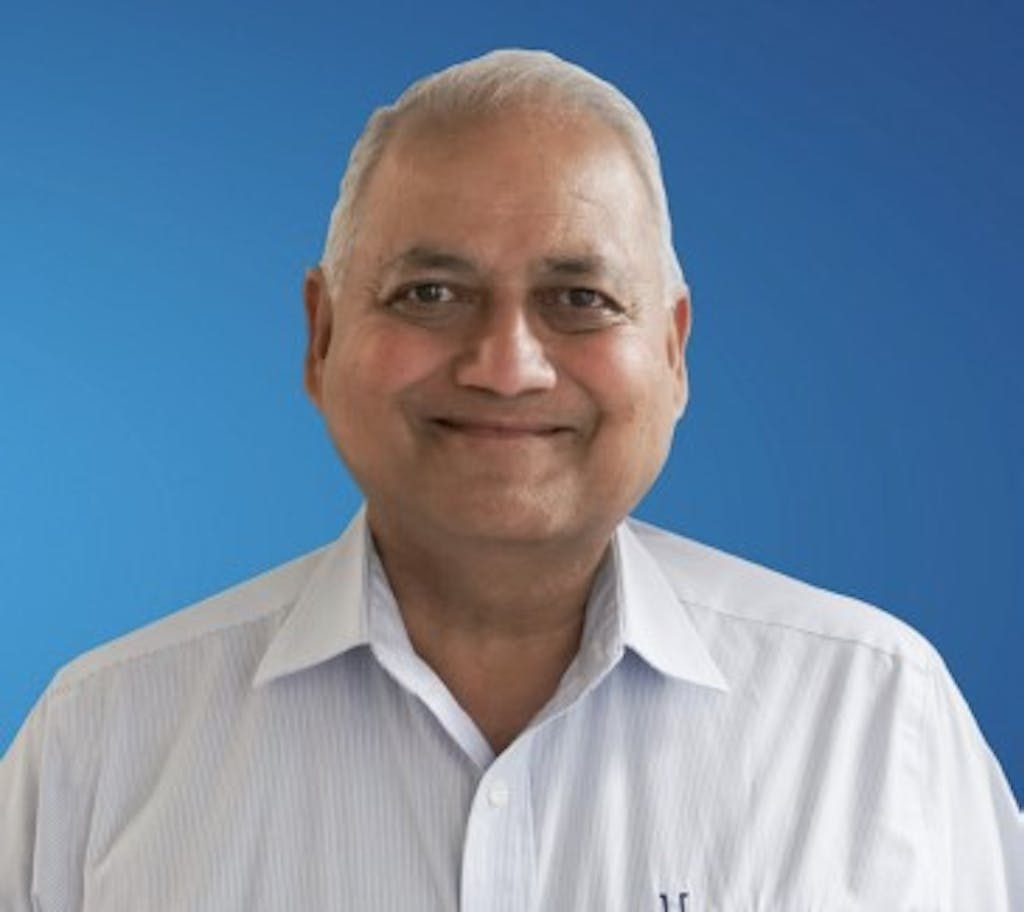
Ashish Dhuldhoya has proven to be an innovative and effective leader for the
past 35 years. Coming from India with a B.S. in Chemical Engineering from LD
College of Engineering, Ashish started as a plant operator at Polycoat in 1987.
In 1999, when Polycoat faced a pivotal moment, Ashish stepped in and
engineered a plan that put the company back on a growth path and has
continued to grow the company ever since. His strategic thinking and strong
leadership have made him an invaluable asset to American Polymers.

Dev Kumar holds a master’s degree in Industrial and Production Engineering
from Indian Institute of Technology, Roorkee. Prior to joining Polycoat
Products in 1998, Dev held various leadership roles in Engineers India Ltd
(formerly Bechtel India) for 28 years and was responsible for many large
complex projects involving grass root refineries, gas processing, fertilizer, and
naphtha cracker plants. At Polycoat, Dev was responsible for modernization
and expansion of Santa Fe Springs facility and then for strategic planning and
M&A.

Prior to joining American Polymers as Executive Vice President, Dr. Kotnis
worked in various senior leadership roles in multinational companies such as
Huntsman, Ciba Specialty Chemicals, and ICI Americas over the last 30 years. He
has a proven track record of building profitable businesses and high-performing
teams which have delivered consistent above-market growth in diverse
economic conditions. Dr. Kotnis holds a Ph.D. from the University of
Massachusetts at Amherst in Polymer Science & Engineering.
The ownership of American Polymers is committed to making investments in human and plant
assets to keep the aggressive growth trajectory of American Polymers through organic and inorganic
growth. We recently completed acquisitions and successful integrations of two new companies
namely, SuperSkinSystems and ChemCo Systems. We are proud to share that our team has
completed projects to set up new plants for manufacturing of aromatic and aliphatic polyesters in
Arlington, Texas. In addition, plans and implementation of a low-free TDI plant are underway, with
planned completion sometime in 2024.
January 12, 2023
The Great Unwind: Busiest US Container Ports Went From Swamped To Eerily Quiet
by Tyler Durden
Thursday, Jan 12, 2023 – 10:59 AM
Container volumes at the twin ports of Los Angeles and Long Beach, California, are seeing steep declines versus one year ago, signaling a downturn in imported goods might suggest continued sinking economic activity.
The twin ports are the busiest container port complex in the country, responsible for 40% of all containerized flow, and are a major artery feeding overseas goods into the Heartland through rail and trucking networks.
Gene Seroka, the executive director of the Port of Los Angeles, told Bloomberg the days of more than 100 container ships waiting in queue and massive container backlogs are all but over.
Imports are sliding as major US retailers such as Walmart, Target, and Costco pull back on orders because of high inventories. Management of these retailers noted on recent earnings calls that consumer demand for big-ticket items such as electronics and furniture has waned because of elevated inflation and interest rates, leaving them with an abundance of supply in warehouses.
US retail sales tumbled in November, the Commerce Department said last month, as consumers buy staple items to survive the inflation storm rather than buying televisions and computers.
Last month, Seroka said, “We are seeing a nationwide slowing of imports.”
The latest charts show West Coast transport networks are slowing.
The first chart shows easing congestion at the largest containerized ports and slumping congestion on rail networks.
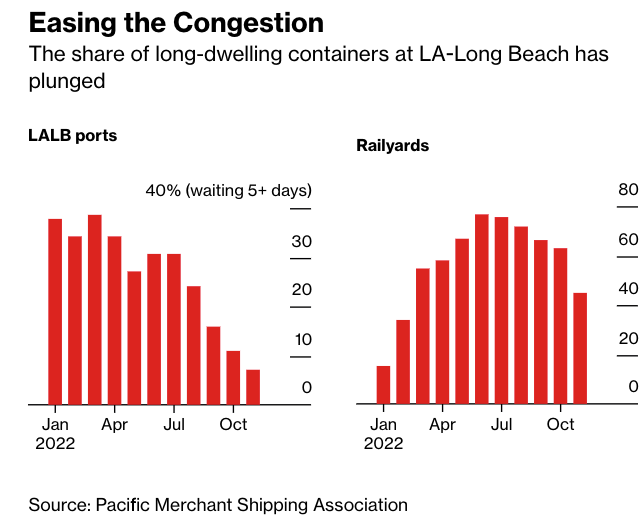
Seroka noted in the Bloomberg interview that easing backlogs meant processing containers through the twin ports has increased in speed.
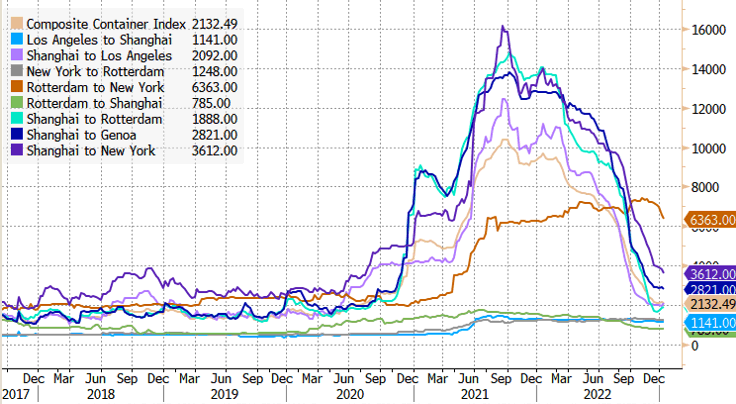
Next are container rates for major shipping lines that have plunged — some are nearing pre-pandemic levels.
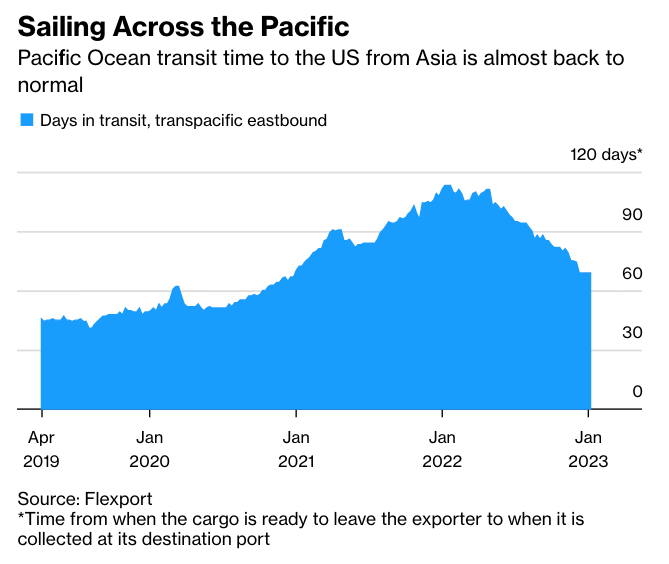
Transit times for vessels from Asia to the US are normalizing.
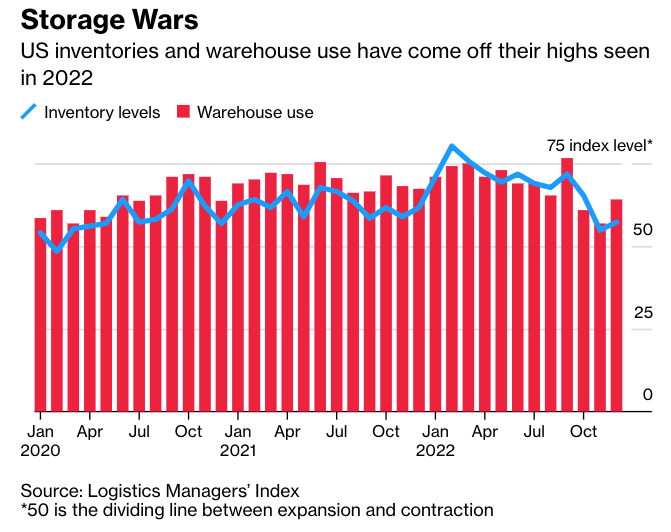
Inventory levels at warehouses are coming off a peak.
Separately, in a note on Wednesday, Goldman Sachs’ Patrick Creuset told clients, “demand destruction allowed for an unwinding of supply chain bottlenecks” across the air and sea networks. He expects this “will come to an end during 1Q23, with volumes returning to modest growth through the rest of the year.”
Creuset pointed out, “a record order book of containerships about to be delivered from 1Q23 through 2H24, and belly capacity set to gradually return in air cargo.” The good news is that seaborne transport capacity is about to be expanded.
And according to Morgan Stanley’s Ravi Shank, he expects retailers’ 12-15 month de-stocking cycle could reach a bottom and begin to normalize by the midpoint of the year, and it could even lead to an upcycle in the second half.
So the good news is the shipping downturn has cleared out supply chain snarls at some of the largest US containerized ports. It seems like retailers are at an inflection point, and once de-stocking is complete, they will increase overseas orders, which might not occur until the second half.
We ask why retailers would want to increase goods on hand if the IMF and World Bank are slashing global growth estimates and warning about recession.
https://www.zerohedge.com/markets/great-unwind-busiest-us-container-ports-went-swamped-eerily-quiet
January 12, 2023
Spandex market may embrace a good start after LNY holiday
| The COVID-19 pandemic infection peak has been passed in fabric manufacturing bases in Zhejiang and Jiangsu. The worry of production resumption after the Lunar New Year’s (LNY) holiday has been mitigated. Buyers were active in purchasing spandex after the New Year’s Day. Price of PTMEG and MMDI stabilized and slightly rallied. Spandex market witnesses better supply, demand and cost. A good start after the Lunar New Year’s holiday may be deserved anticipation. In terms of price, the price of spandex 40D has been close to the historic bottom. Current price of spandex 40D has been higher than the low level in Sep 2,022. According to the data from CCFGroup, price of spandex 40D was at 32,000yuan/mt now, mainly discussed at 31,000-33,000yuan/mt. The discounts of some varieties have been canceled after inventory dropped substantially. Price of some medium-to-high end spandex 40D was at 33,000-36,000yuan/mt. 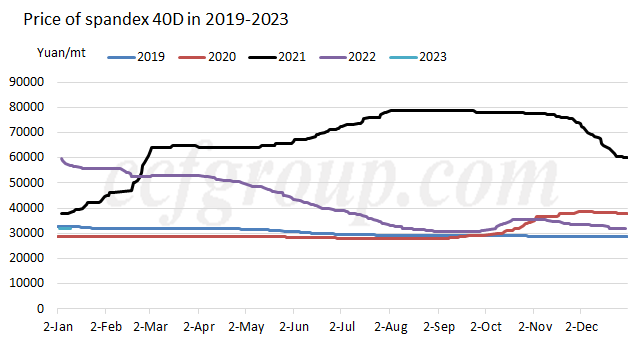 As for the feedstock cost, price of major feedstock PTMEG, BDO and MMDI all bottomed out. That meant the cost of spandex market climbed up. With rising price of BDO and in expectation of better demand, price of some PTMEG was required to rise by 2,000yuan/mt over Dec. Under the cost pressure, the discussion was in stagnation and the actual price increment was smaller at 500-1,000yuan/mt. Price of MMDI also rebounded. Wanhua Chemical updated liquid MMDI Jan nominations at 20,500yuan/mt, up by 500yuan/mt on the month. 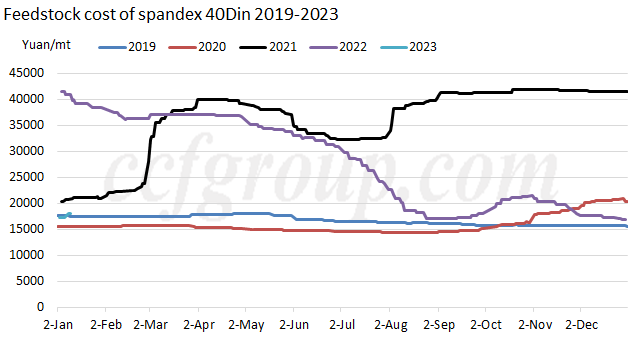 From the angle of supply, the operating rate of spandex plants rose by 15 percentage points to 72% now from 57% before the New Year’s Day holiday, which was mainly driven by better sales in Jan, but it was still low compared with the same period in recent five years. More leading companies resumed operation from earlier production curtailment or suspension. Some big spandex plants will further ramp Looking at the inventory, the inventory of spandex was rapidly transferred to medium-to-downstream market. The inventory of spandex suppliers has reduced to 27 days, the second lowest during the corresponding period in recent five years. Some buyers were active in restocking even before the Lunar New Year’s Day holiday. Stocks fell rapidly in plants who cut or suspended much production before. Sellers reduced discounts. Some suppliers even controlled the volume of orders, worrying price of major feedstock to increase in Feb. Some fabric mills may continue replenishing after recouping some capital. The spandex inventory can guarantee the production for 15 days in some downstream plants, longer for near one month. The logistics will gradually suspend from this weekend affected by Spring Festival holiday. Spandex market witnesses better supply and demand at the beginning of 2023. The operating rate of spandex plants increases but some plants still control the run rate. The price of MMDI and PTMEG bottoms out. Many market players are optimistic about the sales and price of spandex after the Lunar New Year’s holiday. Supported by the factors such as supply, cost and demand, price of spandex may be hard to reduce but easy to increase before and after the Lunar New Year’s holiday. However, cautious mindset is held toward the spandex market at the end of Q1 2023. After the capacity expansion peak in 2022-2023, spandex market will see apparent oversupply. The increase of demand may be hard to chase up that of supply, which will restrict the rebounding range of spandex price. |
http://www.ccfgroup.com/newscenter/newsview.php?Class_ID=D00000&Info_ID=2023011230066
January 12, 2023
Univar gains amid report about interest from PE firms Apollo, Platinum
Jan. 11, 2023 3:17 PM ETUnivar Solutions Inc. (UNVR)APO, BNTGFBy: Joshua Fineman, SA News Editor1 Comment

Univar Solutions Inc. (NYSE:UNVR) rose 3.4% amid a report that private equity firms including Apollo Global (APO) and Platinum Equity may be interested in a takeover of the US chemical distributor.
The PE firms are evaluating offers and potential buyers are holding discussions with Univar (UNVR) this month, according to traders, who cited a Bloomberg report. The talks are early and Univar hasn’t decided if it will sell itself.
The report comes after Brenntag (OTCPK:BNTGF) last Monday said it ended talks to acquire rival chemical distributor Univar (UNVR).
Univar indicated last Monday that it will continue talks relating to other indications of interest that have been received with respect to a potential transaction. Univar (UNVR) is said to have received takeover interest from multiple strategic buyers valuing the company at around $40/share, according to a Street Insider report at the time.
In late November activist Engine Capital, which disclosed it had a ~1% stake in Univar, said the company should start a competitive sales process that invites additional parties to bid for Univar besides Brenntag.
Engine Capital highlighted a letter it sent to Univar’s board in October and estimated that Univar (UNVR) may be worth $38-$44/share in a takeover.
January 11, 2023
BASF breaks ground on MDI capacity expansion project at Geismar site
January 11, 2023 11:46 ET | Source: BASF Corporation
GEISMAR, La., Jan. 11, 2023 (GLOBE NEWSWIRE) — BASF has broken ground on the third and final phase of the methylene diphenyl diisocyanate (MDI) expansion project at its Verbund site in Geismar, Louisiana, announced in July 2022. The company will increase production capacity to approximately 600,000 metric tons per year by the middle of the decade to support the ongoing growth of its North American MDI customers.
The investment for this final expansion phase, which takes place from 2022 to 2025, amounts to $780 million. Including the first and second phases, the investment volume totals around $1 billion, making the MDI expansion project BASF’s largest wholly owned investment in North America.
“BASF already ranks among the largest and most forward-looking chemical companies in the United States,” said Michael Heinz, Chairman and Chief Executive Officer, BASF Corporation. “Through this investment, we demonstrate our commitment to meeting the needs of our customers while strengthening our foundation for continued growth in the important U.S. market.”
BASF welcomed Clay Schexnayder, Speaker of the House for the Louisiana State Legislature for a ceremonial ‘tilling-of-the soil’ to officially mark the groundbreaking of the final phase of the expansion.
“We are committed to continuing the success story together with our North American MDI customers,” said Stefan Doerr, Senior Vice President, Monomers North America. “BASF is investing to support our customers in various industries with significant growth potential in MDI applications, including transportation, automotive, footwear and furniture.”
Kicked off in 2018, the expansion project follows a staggered approach. First, a new MDI synthesis unit was put in operation in October of 2020. The second phase, which started operations in 2021, expanded several existing upstream units. The third and final phase will add new upstream units and a splitter. Leveraging state-of-the-art technology, the expansion will showcase the highest safety standards combined with advanced digitalization in its operations.
 Everchem Updates Archive
 Sign Up for Email Updates