
The Urethane Blog
January 11, 2023
‘Surge finally over,’ US imports back near pre-pandemic levels
Descartes: December 2022 imports just 1.3% above December 2019 imports
· Tuesday, January 10, 2023

Listen to this article
0:00 / 3:50BeyondWords
The “new normal” is looking a lot like the old normal as U.S. imports continue to fall. Volumes began declining sharply in September and were already close to 2019 levels by the end of last year. They’re expected to pull even with pre-COVID numbers this month and next.
The “pandemic-driven surge [is] finally over,” said the National Retail Federation (NRF).
The NRF publishes the monthly Port Tracker report together with Hackett Associates. “Import patterns appear to be returning to what was normal prior to 2020,” said Hackett Associates founder Ben Hackett.
Port Tracker covers 12 U.S. ports. While final counts are not in yet, it estimated the ports it covers handled 1.88 million twenty-foot equivalent units in December, down 10.1% year on year.
Port Tracker forecasts that import volumes in January and February will be roughly even with pre-COVID levels then will bounce back above them again in March-May.
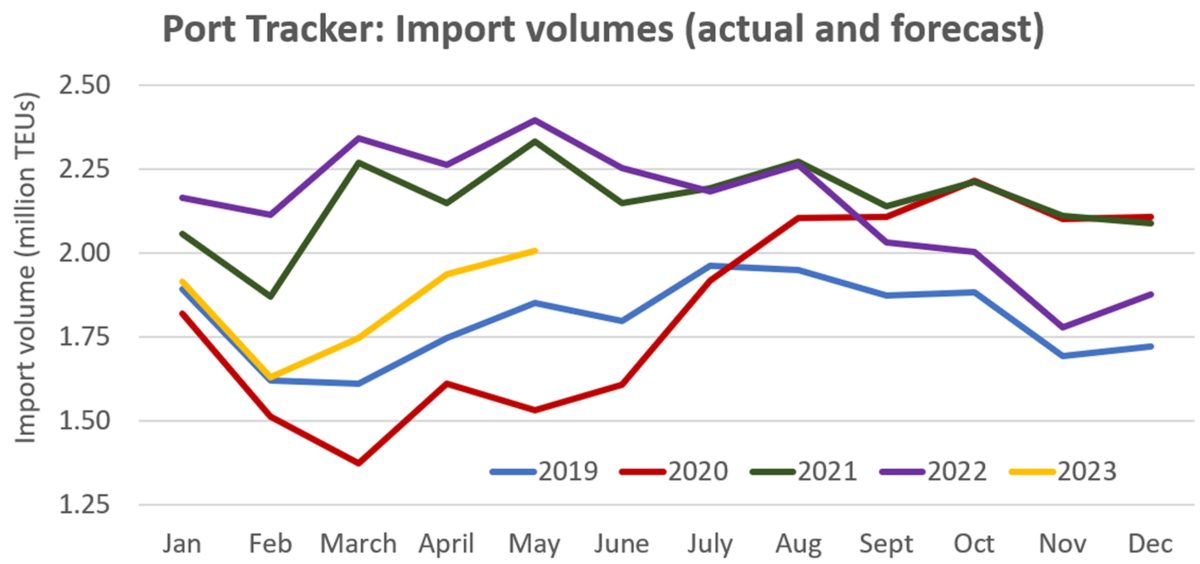
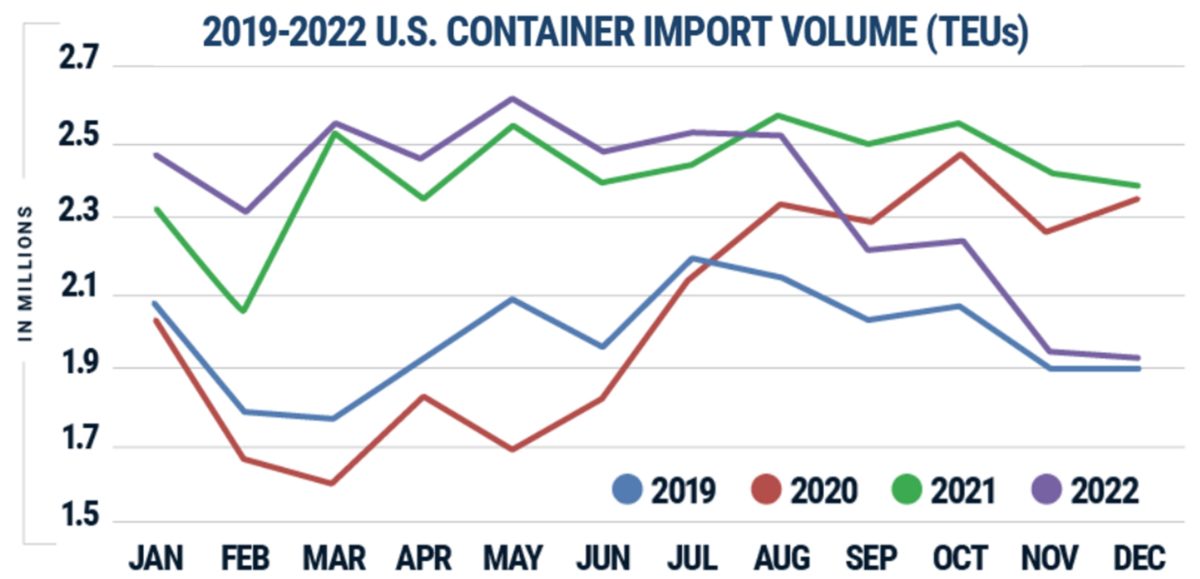
Another data provider, Descartes, reported imports for all U.S. ports totaled 1,929,032 TEUs in December, just 1.3% higher than imports in December 2019, pre-COVID.
Last month’s imports were down 19.3% year on year and down 1.3% versus November, according to Descartes.
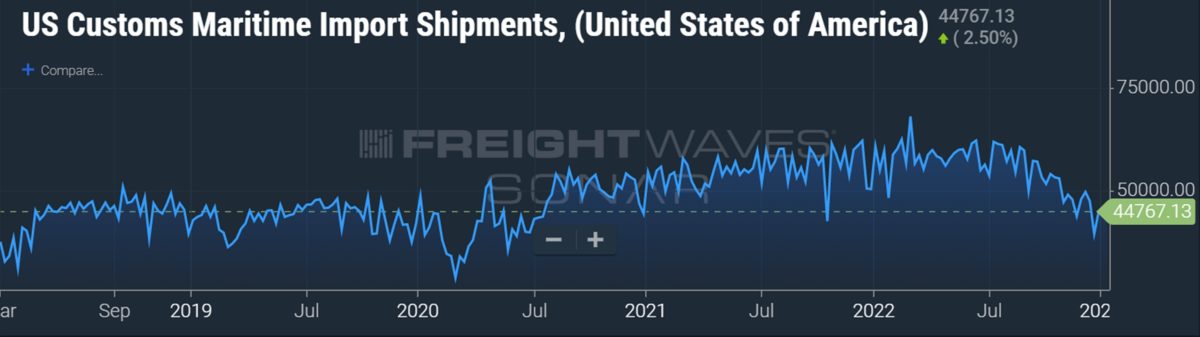
A FreightWaves SONAR dataset on U.S. Customs import shipments likewise shows a reversion to pre-pandemic conditions. Shipments are now back to 2019 levels.
Not all back to normal
Countrywide volumes are close to pre-boom levels, but there are still some big differences.
Ocean schedules have improved, but delays remain higher than they used to be. In the first week of January, the Flexport Ocean Timeliness Indicator for the Asia-U.S. route was still 25% higher than three years ago.
The coastal mix is also much different. Ports on the East and Gulf coasts continue to handle significantly higher volumes than before the pandemic. Volumes on the West Coast are much lower than they used to be.
A new West Coast dockworker labor contract has still not been signed, over seven months after the last one expired.
“The continuing labor uncertainty could be a significant reason why import volumes are not shifting back to major California ports despite their improving situation,” said Chris Jones, executive vice president of industry and services at Descartes.
The COVID-19 situation in China presents another ongoing complication for supply chains. “COVID infection is widespread and given that the Chinese population has little to no immunity, the impact of COVID on manufacturing supply chains could continue for quite some time,” noted Jones.
There could also be another inventory effect ahead — this time in the opposite direction. In 2022, importers brought in too much; at some point in 2023, they may find they have too little.
“People … will see that underlying consumer demand is actually relatively healthy and all of a sudden, they’ll become concerned that their inventories are a bit on the low end and we’ll possibly see a bounce-back,” said Hapag-Lloyd CEO Rolf Habben Jansen last year.
Hackett predicted, “As inflation eases and consumer spending returns, we project that growth will slowly return going into the second half of the year.”
January 10, 2023
Mattress Firm pulls IPO plans amid recessionary fears
Jan. 10, 2023 4:20 PM ETSteinhoff International Holdings N.V. (STHHF)WMT, AMZN, TPX, SNBR, SSB, W, PRPL, MFRMBy: Val Kennedy, SA News Editor

Mattress Firm (MFRM) has pulled plans for an initial public offering as retailers brace for a possible recession later this year.
The mattress retailer first filed for the IPO in January 2022, indicating it was looking to raise $100M, a number that was likely a placeholder and subject to change. Shares were expected to trade on NYSE under the symbol MFRM.
The IPO would have marked a return to the public markets for Mattress Firm, which was taken private by Steinhoff International (OTC:STHHF) in 2016 for $3.8B. The retailer ended up filing for bankruptcy in 2018, but emerged a month later. It shuttered around 700 stores as part of its reorganization.
As of the end of September 2021, Mattress Firm still had 2,353 retail stores, according to its IPO filing. The company also sells mattresses and bedding through its e-commerce sites mattressfirm.com and sleep.com. In addition to reselling brands made by mattress makers such as Tempur Sealy (TPX) and Serta Simmons (SSB), Mattress Firm also sells products under its private labels, Tulo and Sleepy’s.
Mattress Firm has been facing increased competition from mattress sellers Casper, Purple (PRPL) and Sleep Number (SNBR), along with online furniture retailers such as Wayfair (W), Amazon (AMZN) and Walmart (WMT). Mattress maker and retailer Casper was taken private by Durational Capital in January of last year.
On Tuesday, Wedbush said that it sees Mattress Firm as an acquisition candidate in the wake of the IPO withdrawal, with Tempur Sealy as a possible bidder.
January 10, 2023

January 10, 2023
January 10, 2023
Imports: Mattresses and other bedding products
Total Imports Compared to the same month a year ago
-32.62%
Compared to last month
-6.75%
Total All Imports Compared to the same month a year ago
-1.24%
Compared to last month
-9.38%
RankAmong U.S. Imports
118
Rank 2021
107
U.S. imports of Mattresses and other bedding products totaled $348.83 million in November, a change of -32.62 percent from the same month one year ago. The change from one month ago was -6.75 percent. Among more than 1,260 commodity classifications, Mattresses and other bedding products ranked No. 118 in November. It had ranked No. 107 for the same month last year.
While Mattresses and other bedding products ranked No. 118 in November by value, it ranked No. 95 by tonnage. The top three U.S. markets by value for Mattresses and other bedding products imports in November were (1) China, (2) Mexico, and (3) Indonesia. Among the nation’s more than 450 airports, seaports and border crossings, the top three by value were (1) Oil, (2) Passenger vehicles, and (3) Cell phones, related equipment.
 Everchem Updates Archive
 Sign Up for Email Updates