
The Urethane Blog
August 22, 2021
The pillow was once viewed as a mystical implement with roles that extended far beyond providing a comfortable perch for our sleeping heads. (junrong/Shutterstock) Mind & Body
The Mystical Origins of the Pillow
For much of human history, pillows had much grander role than just cradling our sleeping heads By Tatiana Denning August 22, 2021 Updated: August 22, 2021 biggersmallerPrint
“We are such stuff as dreams are made on; and our little life is rounded with a sleep.” – William Shakespeare, “The Tempest”
A good night’s sleep is imperative to both our mental and physical well-being, and allows for the regeneration of both mind and body.
Sleep hygiene, including things such as a regular bedtime and proper sleeping environment, goes a long way toward a good night’s rest. A cool, dark, quiet room, a comfortable bed, and a supportive pillow can all help ensure you get adequate sleep.
While the pillow may seem to be a simple concept, and a common item we take for granted, it hasn’t always been the soft, fluffy nighttime companion we’re accustomed to today. In fact, what ancient societies used for a pillow would give most of us pause.
The First Pillow
The first pillow is believed to have originated in ancient Mesopotamia (today’s Iraq) around the year 7,000 B.C., making the pillow about 9,000 years old (not counting ancient civilizations we may have long forgotten).
This pillow was made of stone, and was used not for comfort or support, but rather for purely utilitarian purposes. It raised the head off the ground to help keep insects and other critters from climbing into a person’s hair, mouth, ears, and nose.
With time, ancient civilizations came to believe that the pillow could also provide support for the head. Stone was thought to be the best way to provide support, and so continued to be used for this reason. Stone was also immune to insects and bugs, unlike various softer materials. But carved stone was expensive, which meant that only the wealthy could afford to own a purpose-built pillow. As such, the pillow came to be viewed as a status symbol in ancient times.
Ancient China
More is probably known about the use of the pillow in ancient China than in any other culture.
The hard pillow maintained its popularity in ancient China. While the people of ancient China had the knowledge and ability to create a soft pillow, most looked down on it, believing a soft pillow robbed the body of its essential energy and vitality.
The ancient Chinese believed the proper pillow, as well as the proper furniture, could also rectify a person’s behavior and personality. While people today desire comfort, the ancient Chinese valued improving one’s moral character over a life of ease. This is one reason ancient Chinese pillows and furniture were made of hard materials.
The hard pillow was believed to have a variety of other benefits. It served to not only support the head and neck, but helped maintain the complex hairstyles of the time while sleeping, increase blood circulation, and improve one’s intellect. According to renowned auction house Christie’s, the ancient Chinese pillow also was used to keep one cool while sleeping, “Poet Zhang Lei of the Northern Song dynasty wrote: ‘Pillow made by Gong is strong and blue; an old friend gave it to me to beat the heat; it cools down the room like a breeze; keeping my head cool while I sleep’.”
A variety of materials were used to make pillows in ancient China, including porcelain, jade, pottery, bamboo, wood, and bronze. It was said that the material a person rested their head upon would influence their health, therefore, one should choose wisely.
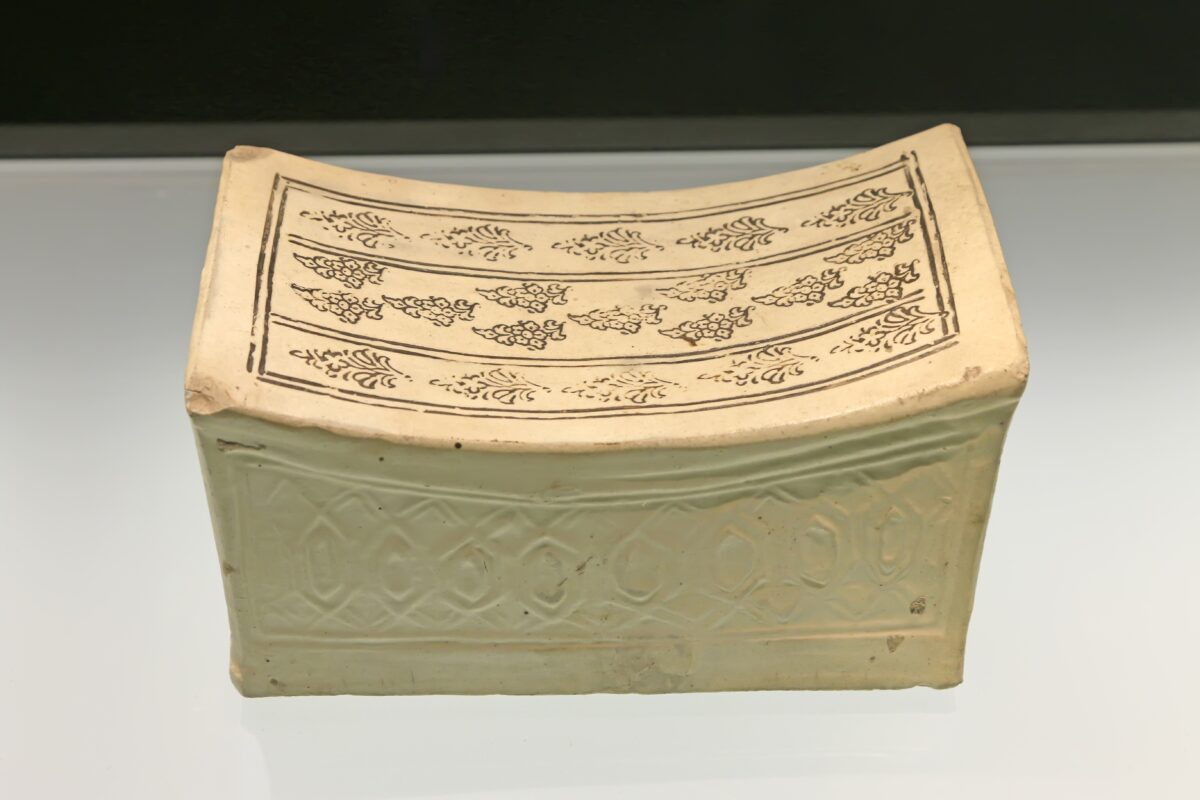
Perhaps no material was more popular for pillow making in ancient China than ceramic. According to Christie’s, ceramic reached the height of its popularity during the Tang (618–907 A.D) and Song (960–1279 A.D) dynasties, before eventually being replaced by Western-style stuffed pillows. These pillows were often ornately shaped and decorated, and just like in Mesopotamia, were reserved for the wealthy and viewed as a symbol of status and prosperity. Butterflies, flowers, and children at play were just a few of the auspicious images commonly used on pillows, while inscriptions of Buddhist, Daoist, or Confucius teachings were often put on pillows to help improve one’s moral character.
The hard pillow was also said to ward off evil spirits, something the soft pillow couldn’t do. The lion, tiger, and Chinese dragon, in particular, were said to be effective at keeping evil spirits away.
“Lions were regarded as auspicious creatures with sufficient ferocity, strength, and spiritual energy to ward off evil spirits,” according to Christie’s. Many pillows were either made in the shape of these animals, or bore images of them.
While the hard pillow was viewed most favorably, there were pillows made of other materials for use in special circumstances. One such pillow was the medicinal pillow. According to Taiwan Today, this pillow was made of various herbs wrapped in silk cloth; it was used to improve hearing, keep the eyes sharp, return gray hair to its original color, regrow lost teeth, and cure a variety of diseases.
Due to its close proximity to the head, the pillow was also said to help promote and guide dreams. The ancient Chinese believed dreams had significant meaning, and they were taken as omens of what was to come.
“There was no sharp dichotomy in the division between the two states of spirit and matter in Chinese popular thought,” according to the Victoria and Albert Museum in London. “Ghosts, spirits, and visions in dreams were part of the material world and deemed to be interchangeable with life. Thus the pillow could be a material object of great importance, which mediated between the conscious and unconscious, between reality and the illusionary.”
Today, these beautifully created ancient pillows are sought by collectors, fetching prices in the tens of thousands of dollars.
Ancient Egypt
While less is known about the pillow, or headrest, of ancient Egypt, we do know it served more than just a pragmatic purpose for the ancient Egyptians as well. Most of what is known comes from the discovery of headrests in ancient tombs.
The people of ancient Egypt considered the head to be the spiritual and life center, and as such, they viewed the head as the most sacred part of the body. The pillow served to both support and, perhaps more importantly, protect the head in both life and death.
Like in Mesopotamia, pillows were typically made of stone, but blocks of wood, ceramic, and ivory were sometimes used as well. They were more narrow than ancient Chinese pillows, which supported both the head and the neck, and typically offered support only to the head—thus the name “headrest.”
Religious and magical beliefs were woven throughout ancient Egyptian society, and pillows, as well as other objects, were decorated with images meant to serve as both protection and decoration. One commonly engraved image, according to Pennsylvania’s Glencairn Museum, was that of Bes, “a protective deity whose role involved the protection of the home, mothers and children, and sleeping people.”
It was believed that a sleeping person was particularly vulnerable to evil spirits, and the fearsome image of Bes provided protection from nighttime evils.
The ancient Egyptians placed tremendous importance on the afterlife, so much so that Tutankhamun, the boy king, was buried with eight headrests. Funerary texts contained hundreds of magical spells meant to help guide the dead safely into the afterlife.
“A handful of these spells make explicit reference to the headrest and compare it with the sun’s rising in the horizon. Coffin Text 232 reads: “A spell for the head-rest. May your head be raised, may your brow be made to live, may you speak for your own body, may you be a god, may you always be a god,” the Glencairn Museum states.
While beliefs may have changed, some parts of Africa still use these ancient-style headrests in their daily lives and find them quite enjoyable.
Ancient Greece and Rome
Even less is known about the pillows of ancient Greece and Rome.
What we do know is that the ancient Greeks and Romans eventually developed a penchant for luxury, comfort, and self-indulgence, abandoning the idea that the hard pillow had any physical or mental benefits. With their focus on comfort, they created the predecessor to today’s soft pillow.
The pillow used by everyday citizens of this time period was made of materials such as cotton, straw, or reeds, with pillows made of soft down and feathers being reserved for the wealthy. The pillow was viewed as a symbol of decadence, and people of this era are often pictured reclining on four or five luxurious pillows, even as they dined, often overindulging in food and wine.
According to Jason Linn in his UC–Santa Barbara dissertation on nighttime in ancient Rome, “Luxury pampered these people so greatly that even under dire circumstances they permitted their guards not only to sleep, but also to do so comfortably.”
The Spartans, however, held a different philosophy, and led austere lives without seeking comfort. Linn asks, “How could anyone sleep under such uncomfortable conditions?” The answer, “Doing so led to obedience, perseverance, and victories.” Linn goes on to quote William Arrowsmith, saying “luxury makes a man lose his specific function.”
As time marched on, reaching Europe’s Middle Ages, the soft pillow fell out of common use, and it was seen only as a status symbol. Men viewed the pillow as a sign of weakness, and at one point, only the king and pregnant women were allowed to lay their heads on a pillow at night.
By the 16th century, the pillow had come back into favor, but due to regular infestation by things such as mold, insects, and vermin, it was cumbersome to care for, with the contents of the pillow having to be changed regularly in order to maintain its cleanliness. Later on, pillows came to be used for kneeling in church, or as a place to rest holy texts. In some places, this is still done.
Modern Day
With the advent of the Industrial Revolution, people’s way of life began to change across much of the world.
As technology continued to evolve, so did the story of the pillow. With the mass production capabilities of the Industrial Revolution, and the increase in the availability of cotton, the pillow was no longer only for the elite. The average person could now afford to own one, and the pillow gradually became common in every home.
As the Industrial Revolution brought material prosperity, society followed the pattern of the ancient Greeks and Romans: People sought out more comfort, ultimately ushering in a revolution of the soft pillow.
Today, pillows come in a variety of shapes, sizes, material types, and firmness levels. The types of pillows seem to be endless, with everything from gel, memory foam, down, feathers, down-alternative, cotton, innerspring, wool, latex, microbeads, kapok, buckwheat, and water available. That’s quite a list! Pillows can even be customized and personalized according to a person’s preference.
While the comforts of modern-day pillows may make our nights more comfortable, perhaps the ancients were onto something. I’m not inclined toward a return to a stone or ceramic pillow (though you can make your own version), but perhaps we should remember that sometimes a little discomfort in life isn’t such a bad thing.
From the perspective of the ancient Chinese, seeking comfort is rarely the best path. After all, when we endure a little hardship, we become more resilient. And amid life’s turmoils, if we can look within for the lesson, we’ll come out the better for having gone through it.
It seems even the pillow has a lesson to teach. Tatiana DenningD.O.
https://www.theepochtimes.com/the-mystical-origins-of-the-pillow_3949673.html
August 22, 2021
The pillow was once viewed as a mystical implement with roles that extended far beyond providing a comfortable perch for our sleeping heads. (junrong/Shutterstock) Mind & Body
The Mystical Origins of the Pillow
For much of human history, pillows had much grander role than just cradling our sleeping heads By Tatiana Denning August 22, 2021 Updated: August 22, 2021 biggersmallerPrint
“We are such stuff as dreams are made on; and our little life is rounded with a sleep.” – William Shakespeare, “The Tempest”
A good night’s sleep is imperative to both our mental and physical well-being, and allows for the regeneration of both mind and body.
Sleep hygiene, including things such as a regular bedtime and proper sleeping environment, goes a long way toward a good night’s rest. A cool, dark, quiet room, a comfortable bed, and a supportive pillow can all help ensure you get adequate sleep.
While the pillow may seem to be a simple concept, and a common item we take for granted, it hasn’t always been the soft, fluffy nighttime companion we’re accustomed to today. In fact, what ancient societies used for a pillow would give most of us pause.
The First Pillow
The first pillow is believed to have originated in ancient Mesopotamia (today’s Iraq) around the year 7,000 B.C., making the pillow about 9,000 years old (not counting ancient civilizations we may have long forgotten).
This pillow was made of stone, and was used not for comfort or support, but rather for purely utilitarian purposes. It raised the head off the ground to help keep insects and other critters from climbing into a person’s hair, mouth, ears, and nose.
With time, ancient civilizations came to believe that the pillow could also provide support for the head. Stone was thought to be the best way to provide support, and so continued to be used for this reason. Stone was also immune to insects and bugs, unlike various softer materials. But carved stone was expensive, which meant that only the wealthy could afford to own a purpose-built pillow. As such, the pillow came to be viewed as a status symbol in ancient times.
Ancient China
More is probably known about the use of the pillow in ancient China than in any other culture.
The hard pillow maintained its popularity in ancient China. While the people of ancient China had the knowledge and ability to create a soft pillow, most looked down on it, believing a soft pillow robbed the body of its essential energy and vitality.
The ancient Chinese believed the proper pillow, as well as the proper furniture, could also rectify a person’s behavior and personality. While people today desire comfort, the ancient Chinese valued improving one’s moral character over a life of ease. This is one reason ancient Chinese pillows and furniture were made of hard materials.
The hard pillow was believed to have a variety of other benefits. It served to not only support the head and neck, but helped maintain the complex hairstyles of the time while sleeping, increase blood circulation, and improve one’s intellect. According to renowned auction house Christie’s, the ancient Chinese pillow also was used to keep one cool while sleeping, “Poet Zhang Lei of the Northern Song dynasty wrote: ‘Pillow made by Gong is strong and blue; an old friend gave it to me to beat the heat; it cools down the room like a breeze; keeping my head cool while I sleep’.”
A variety of materials were used to make pillows in ancient China, including porcelain, jade, pottery, bamboo, wood, and bronze. It was said that the material a person rested their head upon would influence their health, therefore, one should choose wisely.
Perhaps no material was more popular for pillow making in ancient China than ceramic. According to Christie’s, ceramic reached the height of its popularity during the Tang (618–907 A.D) and Song (960–1279 A.D) dynasties, before eventually being replaced by Western-style stuffed pillows. These pillows were often ornately shaped and decorated, and just like in Mesopotamia, were reserved for the wealthy and viewed as a symbol of status and prosperity. Butterflies, flowers, and children at play were just a few of the auspicious images commonly used on pillows, while inscriptions of Buddhist, Daoist, or Confucius teachings were often put on pillows to help improve one’s moral character.
The hard pillow was also said to ward off evil spirits, something the soft pillow couldn’t do. The lion, tiger, and Chinese dragon, in particular, were said to be effective at keeping evil spirits away.
“Lions were regarded as auspicious creatures with sufficient ferocity, strength, and spiritual energy to ward off evil spirits,” according to Christie’s. Many pillows were either made in the shape of these animals, or bore images of them.
While the hard pillow was viewed most favorably, there were pillows made of other materials for use in special circumstances. One such pillow was the medicinal pillow. According to Taiwan Today, this pillow was made of various herbs wrapped in silk cloth; it was used to improve hearing, keep the eyes sharp, return gray hair to its original color, regrow lost teeth, and cure a variety of diseases.
Due to its close proximity to the head, the pillow was also said to help promote and guide dreams. The ancient Chinese believed dreams had significant meaning, and they were taken as omens of what was to come.
“There was no sharp dichotomy in the division between the two states of spirit and matter in Chinese popular thought,” according to the Victoria and Albert Museum in London. “Ghosts, spirits, and visions in dreams were part of the material world and deemed to be interchangeable with life. Thus the pillow could be a material object of great importance, which mediated between the conscious and unconscious, between reality and the illusionary.”
Today, these beautifully created ancient pillows are sought by collectors, fetching prices in the tens of thousands of dollars.
Ancient Egypt
While less is known about the pillow, or headrest, of ancient Egypt, we do know it served more than just a pragmatic purpose for the ancient Egyptians as well. Most of what is known comes from the discovery of headrests in ancient tombs.
The people of ancient Egypt considered the head to be the spiritual and life center, and as such, they viewed the head as the most sacred part of the body. The pillow served to both support and, perhaps more importantly, protect the head in both life and death.
Like in Mesopotamia, pillows were typically made of stone, but blocks of wood, ceramic, and ivory were sometimes used as well. They were more narrow than ancient Chinese pillows, which supported both the head and the neck, and typically offered support only to the head—thus the name “headrest.”
Religious and magical beliefs were woven throughout ancient Egyptian society, and pillows, as well as other objects, were decorated with images meant to serve as both protection and decoration. One commonly engraved image, according to Pennsylvania’s Glencairn Museum, was that of Bes, “a protective deity whose role involved the protection of the home, mothers and children, and sleeping people.”
It was believed that a sleeping person was particularly vulnerable to evil spirits, and the fearsome image of Bes provided protection from nighttime evils.
The ancient Egyptians placed tremendous importance on the afterlife, so much so that Tutankhamun, the boy king, was buried with eight headrests. Funerary texts contained hundreds of magical spells meant to help guide the dead safely into the afterlife.
“A handful of these spells make explicit reference to the headrest and compare it with the sun’s rising in the horizon. Coffin Text 232 reads: “A spell for the head-rest. May your head be raised, may your brow be made to live, may you speak for your own body, may you be a god, may you always be a god,” the Glencairn Museum states.
While beliefs may have changed, some parts of Africa still use these ancient-style headrests in their daily lives and find them quite enjoyable.
Ancient Greece and Rome
Even less is known about the pillows of ancient Greece and Rome.
What we do know is that the ancient Greeks and Romans eventually developed a penchant for luxury, comfort, and self-indulgence, abandoning the idea that the hard pillow had any physical or mental benefits. With their focus on comfort, they created the predecessor to today’s soft pillow.
The pillow used by everyday citizens of this time period was made of materials such as cotton, straw, or reeds, with pillows made of soft down and feathers being reserved for the wealthy. The pillow was viewed as a symbol of decadence, and people of this era are often pictured reclining on four or five luxurious pillows, even as they dined, often overindulging in food and wine.
According to Jason Linn in his UC–Santa Barbara dissertation on nighttime in ancient Rome, “Luxury pampered these people so greatly that even under dire circumstances they permitted their guards not only to sleep, but also to do so comfortably.”
The Spartans, however, held a different philosophy, and led austere lives without seeking comfort. Linn asks, “How could anyone sleep under such uncomfortable conditions?” The answer, “Doing so led to obedience, perseverance, and victories.” Linn goes on to quote William Arrowsmith, saying “luxury makes a man lose his specific function.”
As time marched on, reaching Europe’s Middle Ages, the soft pillow fell out of common use, and it was seen only as a status symbol. Men viewed the pillow as a sign of weakness, and at one point, only the king and pregnant women were allowed to lay their heads on a pillow at night.
By the 16th century, the pillow had come back into favor, but due to regular infestation by things such as mold, insects, and vermin, it was cumbersome to care for, with the contents of the pillow having to be changed regularly in order to maintain its cleanliness. Later on, pillows came to be used for kneeling in church, or as a place to rest holy texts. In some places, this is still done.
Modern Day
With the advent of the Industrial Revolution, people’s way of life began to change across much of the world.
As technology continued to evolve, so did the story of the pillow. With the mass production capabilities of the Industrial Revolution, and the increase in the availability of cotton, the pillow was no longer only for the elite. The average person could now afford to own one, and the pillow gradually became common in every home.
As the Industrial Revolution brought material prosperity, society followed the pattern of the ancient Greeks and Romans: People sought out more comfort, ultimately ushering in a revolution of the soft pillow.
Today, pillows come in a variety of shapes, sizes, material types, and firmness levels. The types of pillows seem to be endless, with everything from gel, memory foam, down, feathers, down-alternative, cotton, innerspring, wool, latex, microbeads, kapok, buckwheat, and water available. That’s quite a list! Pillows can even be customized and personalized according to a person’s preference.
While the comforts of modern-day pillows may make our nights more comfortable, perhaps the ancients were onto something. I’m not inclined toward a return to a stone or ceramic pillow (though you can make your own version), but perhaps we should remember that sometimes a little discomfort in life isn’t such a bad thing.
From the perspective of the ancient Chinese, seeking comfort is rarely the best path. After all, when we endure a little hardship, we become more resilient. And amid life’s turmoils, if we can look within for the lesson, we’ll come out the better for having gone through it.
It seems even the pillow has a lesson to teach. Tatiana DenningD.O.
https://www.theepochtimes.com/the-mystical-origins-of-the-pillow_3949673.html
August 20, 2021
The fines are hefty for non-compliance and ignorance of the rules that no one in government informs you about is no excuse . . .

A sign of the EPA at its building in Washington on Sept. 21, 2017. (Pablo Martinez Monsivais/AP Photo) US News
Environmental Protection Agency’s Reporting on Chemicals Questioned
By Nathan Worcester August 19, 2021 Updated: August 19, 2021 biggersmallerPrint
The Environmental Protection Agency (EPA) has moved to change the way it gathers data on commercial chemicals under the Toxic Substances Control Act (TSCA), prompting concerns from some environmental activists at a time when the agency is already under scrutiny after whistleblowers’ allegations that it’s fast-tracking dangerous chemicals because of industry pressure.
Three Democratic congressional committee heads have written to the agency seeking a response to the claims.
The TSCA, signed into law by President Gerald Ford in 1976, was most recently revised in 2016 through the bipartisan Frank R. Lautenberg Chemical Safety for the 21st Century Act, the House version of which passed 398-1. While the original TSCA had grandfathered in more than 60,000 chemicals that were already on the market, the Lautenberg Act mandated that the EPA assess the safety of chemicals already being sold.
The TSCA’s Chemical Data Reporting (CDR) rule requires manufacturers, including importers, to report information every four years on chemicals produced and used in commerce.
The changes to the CDR, discussed at a public webinar on July 27, would introduce Tiered Data Reporting (TDR) for chemicals. The EPA’s presentation states that the CDR would collect fewer data from manufacturers, while TDR would introduce three sequential datasets for chemicals identified for prioritization: a dataset for prioritization candidates, a dataset for prioritized chemicals, and a risk evaluation/risk management dataset for those chemicals.
The first two datasets would require reports three months after the date of listing, while the final dataset would require a report four to six months after listing.
“EPA is seeking to ensure that data collection strategies using more of the authorities available to EPA provide timely, relevant, and specific information tailored to better meet the agency’s basic chemical data needs related to TSCA, while minimizing the burden on industry stakeholders,” an EPA spokesperson told The Epoch Times in an email.
“By collecting specific data in a timely sequence that is relevant to the current needs of EPA, the agency is ensuring that it has the information necessary to fulfill its mission under TSCA and protect human health and the environment without unduly burdening the information providers.”
On Aug. 5, the EPA met with representatives from the Environmental Defense Fund (EDF) to discuss EDF’s concerns with the tiered data collection strategy. According to the EPA’s summary of that meeting, the EDF expressed concerns that the new rule would decrease the amount of information gathered about individual chemicals.
In a donor appeal sent Aug. 13, the EDF wrote that the proposed changes “would significantly reduce what we know about thousands of chemicals in use today, even though this information is crucial for EPA to do its job.”
A spokesperson from the EDF declined to comment on the Chemical Data Reporting rules change or the EDF’s appeal to its supporters.
“While the planned rule would reduce the CDR data collected per chemical, if proposed and finalized, it would not reduce the number of chemicals for which CDR reporting is required, and through the TDR would add additional reporting requirements for selected chemicals,” an EPA spokesperson said in an email.
According to an EPA spokesperson, the proposed TDR rule is still under development, “informed by feedback from the public meeting and comments received.”
The move comes alongside recent allegations from four EPA whistleblowers of corruption in the EPA’s Office of Chemical Safety and Pollution Prevention, which administers the TSCA. As reported in The Intercept, the whistleblowers offered “detailed evidence of pressure within the agency to minimize or remove evidence of potential adverse effects of the chemicals, including neurological effects, birth defects, and cancer.”
Democratic leaders of the House Committee on Energy and Commerce drafted a letter to the head of the EPA, Michael S. Regan, requesting a response to the allegations.
“The Committee has a longstanding interest in ensuring EPA’s implementation of TSCA is based on sound science,” wrote Energy and Commerce Committee Chairman Frank Pallone, Jr. (D-N.J.), Oversight and Investigations Subcommittee Chair Diana DeGette (D-Colo.), and Environment and Climate Change Subcommittee Chairman Paul Tonko (D-N.Y.). “We also firmly believe EPA’s scientific staff must be able to perform their work of protecting human health and the environment free from inappropriate interference and retaliation.
“The allegations made by the four whistleblowers are troubling, and, if true, raise serious concerns about EPA’s implementation of TSCA and about protections for EPA employees.”
The EPA spokesperson didn’t immediately respond to a request for comment on the whistleblowers’ allegations, while Republican and Democratic lawmakers didn’t immediately respond to requests for comment on the proposed TSCA changes or the whistleblowers’ allegations.
August 20, 2021
The fines are hefty for non-compliance and ignorance of the rules that no one in government informs you about is no excuse . . .
A sign of the EPA at its building in Washington on Sept. 21, 2017. (Pablo Martinez Monsivais/AP Photo) US News
Environmental Protection Agency’s Reporting on Chemicals Questioned
By Nathan Worcester August 19, 2021 Updated: August 19, 2021 biggersmallerPrint
The Environmental Protection Agency (EPA) has moved to change the way it gathers data on commercial chemicals under the Toxic Substances Control Act (TSCA), prompting concerns from some environmental activists at a time when the agency is already under scrutiny after whistleblowers’ allegations that it’s fast-tracking dangerous chemicals because of industry pressure.
Three Democratic congressional committee heads have written to the agency seeking a response to the claims.
The TSCA, signed into law by President Gerald Ford in 1976, was most recently revised in 2016 through the bipartisan Frank R. Lautenberg Chemical Safety for the 21st Century Act, the House version of which passed 398-1. While the original TSCA had grandfathered in more than 60,000 chemicals that were already on the market, the Lautenberg Act mandated that the EPA assess the safety of chemicals already being sold.
The TSCA’s Chemical Data Reporting (CDR) rule requires manufacturers, including importers, to report information every four years on chemicals produced and used in commerce.
The changes to the CDR, discussed at a public webinar on July 27, would introduce Tiered Data Reporting (TDR) for chemicals. The EPA’s presentation states that the CDR would collect fewer data from manufacturers, while TDR would introduce three sequential datasets for chemicals identified for prioritization: a dataset for prioritization candidates, a dataset for prioritized chemicals, and a risk evaluation/risk management dataset for those chemicals.
The first two datasets would require reports three months after the date of listing, while the final dataset would require a report four to six months after listing.
“EPA is seeking to ensure that data collection strategies using more of the authorities available to EPA provide timely, relevant, and specific information tailored to better meet the agency’s basic chemical data needs related to TSCA, while minimizing the burden on industry stakeholders,” an EPA spokesperson told The Epoch Times in an email.
“By collecting specific data in a timely sequence that is relevant to the current needs of EPA, the agency is ensuring that it has the information necessary to fulfill its mission under TSCA and protect human health and the environment without unduly burdening the information providers.”
On Aug. 5, the EPA met with representatives from the Environmental Defense Fund (EDF) to discuss EDF’s concerns with the tiered data collection strategy. According to the EPA’s summary of that meeting, the EDF expressed concerns that the new rule would decrease the amount of information gathered about individual chemicals.
In a donor appeal sent Aug. 13, the EDF wrote that the proposed changes “would significantly reduce what we know about thousands of chemicals in use today, even though this information is crucial for EPA to do its job.”
A spokesperson from the EDF declined to comment on the Chemical Data Reporting rules change or the EDF’s appeal to its supporters.
“While the planned rule would reduce the CDR data collected per chemical, if proposed and finalized, it would not reduce the number of chemicals for which CDR reporting is required, and through the TDR would add additional reporting requirements for selected chemicals,” an EPA spokesperson said in an email.
According to an EPA spokesperson, the proposed TDR rule is still under development, “informed by feedback from the public meeting and comments received.”
The move comes alongside recent allegations from four EPA whistleblowers of corruption in the EPA’s Office of Chemical Safety and Pollution Prevention, which administers the TSCA. As reported in The Intercept, the whistleblowers offered “detailed evidence of pressure within the agency to minimize or remove evidence of potential adverse effects of the chemicals, including neurological effects, birth defects, and cancer.”
Democratic leaders of the House Committee on Energy and Commerce drafted a letter to the head of the EPA, Michael S. Regan, requesting a response to the allegations.
“The Committee has a longstanding interest in ensuring EPA’s implementation of TSCA is based on sound science,” wrote Energy and Commerce Committee Chairman Frank Pallone, Jr. (D-N.J.), Oversight and Investigations Subcommittee Chair Diana DeGette (D-Colo.), and Environment and Climate Change Subcommittee Chairman Paul Tonko (D-N.Y.). “We also firmly believe EPA’s scientific staff must be able to perform their work of protecting human health and the environment free from inappropriate interference and retaliation.
“The allegations made by the four whistleblowers are troubling, and, if true, raise serious concerns about EPA’s implementation of TSCA and about protections for EPA employees.”
The EPA spokesperson didn’t immediately respond to a request for comment on the whistleblowers’ allegations, while Republican and Democratic lawmakers didn’t immediately respond to requests for comment on the proposed TSCA changes or the whistleblowers’ allegations.
August 19, 2021
Shipping container rates to remain elevated into 2022 as US demand outpaces capacity
Author: Adam Yanelli
2021/07/20
HOUSTON (ICIS)–Shipping container rates have spiked by as much as three or four times since the onset of the pandemic and are likely to remain elevated beyond the Lunar New Year in 2022 as the global demand for goods continues to outpace available capacity.
And even when the demand starts to ease, participants on a webinar hosted by online freight shipping marketplace and platform provider Freightos said that container rates are unlikely to return to their previous levels.
“I have been in this business for 20 years, and $4,500 was the previous high I had seen for a container from Asia to the US West Coast before the pandemic,” said panellist Robert Khachatryan, founder and COO of shipping forwarder Freight Right Global Logistics.
“I think that will be the new floor,” he added. “Maybe even above $5,000. I think that could become the new market rate.”
HOW WE GOT HERE
While most chemicals are liquids and are shipped in tankers, polymers such as polyethylene (PE) and polypropylene (PP), which are shipped in pellets, are moved by container ships.
Container ships also carry a wider scope of cargoes, including consumer products like electrical appliances and automobiles, so demand for that space has risen as economies reopened after lockdown measures because of the pandemic.
The spread of the coronavirus pandemic – and the lockdown measures initiated to help mitigate it – led to a surge in demand for goods.
Consumers who were able to work from home found themselves with extra money since they were limited in how they could spend it.
Judah Levine, research lead at Freightos, said volumes began to increase, peaked in October and have remained elevated.
Container shipping has a peak season for goods from Asia to the US – from about July to October – but the added demand kept volumes above typical peak season levels.
“The impact was that all of these containers overwhelmed the capacity of the ports to process them,” Levine said.
He added that the port backlogs essentially sucked up all of the available capacity in ships and containers.
“All of the world’s container ships are active right now,” Levine said, explaining that shipowners typically have extra capacity that they can bring online for peak times. “In the current situation, there is no extra capacity, which is putting pressure all along the supply chain.”
Source: Freightos – fbx.freightos.com
Rates began to spike in Q4 2020, driven by the shortage of containers, and after some easing, shot up again when the Ever Given became lodged in the Suez Canal.
Rates continued rising recently when an outbreak of COVID-19 infections at the port of Yantian, one of China’s busiest container ports, led to lengthy delays at the port and added additional strain to the network.
IMPACT IN LATIN AMERICA
The increases in container rates have been particularly hard on Latin American markets, where resin producers have seen eroded margins because of the increased costs, which they have been unable to pass through to customers in many cases.
A market participant that imports polyvinyl chloride (PVC) from China to South America told ICIS it was quoted rates for end-July of $6,900/20-foot container from India to Argentina.
A 20-foot container from China to Argentina was quoted $9,000-12,000.
“The freight rates that you have mentioned align with what we are seeing in the market as well,” the market participant said.
“Spot rates are around $9,000-10,000/container, and even then, availability is not confirmed. Freight rates from Europe to US East Coast is also at similar levels,” the market participant said.
DEMAND TO REMAIN ELEVATED ON RESTOCKING
The panellists agreed that because of the various supply chain issues experienced this year, many businesses are running with limited inventory.
Efforts to restock barren warehouses are likely to keep demand elevated beyond this year’s peak season.
Source: US Federal Reserve
Khachatryan said that because of delays in receiving goods this year, some importers and exporters are ordering and scheduling shipments earlier than before.
He said he is seeing Christmas related items already being shipped when previously they would not be on a vessel until August or September.
“Next year we expect to see customers start ordering even earlier,” he said.
Ruthie Amaru, Freightos CEO, said it is more important than ever to look for different options for sourcing goods and to be flexible with the modes of transportation.
For example, while it would have never been cost effective prior to the pandemic to ship goods via air freight, now that container rates have spiked the gap has narrowed.
Add to that demurrage charges (a charge payable to the shipowner for failure to load or unload a ship within the agreed time frame) and the gap between rail and air could make more sense.
LIQUID TANKERS DIRECT OPPOSITE TO CONTAINERS
While container ships are facing severe shortages and price spikes, the liquid chemical tanker market is facing the opposite extreme with quite a slowdown in activity, particularly since the winter storm in February that shut much US Gulf Coast production.
“No one clearly knows what is going to happen for liquid tankers, and the more we think it is coming back, the more it is being pushed further and further away,” said one shipping broker.
After the winter storm, chemical production was at a low, and exports of product from the US slipped further.
For the remainder of Q3 and into Q4, the biggest factor that could cause a similar outcome is hurricanes. While chemical production slowly rebuilds and product becomes more available, even one significant hurricane can cause severe disruptions and declines in the tanker market.
“Other than a hurricane, I don’t think anything else can be bring this to a worse place than where we are currently,” the broker added.
Focus story by Adam Yanelli and Anna Matherne
 Everchem Updates Archive
  Sign Up for Email Updates