
The Urethane Blog
March 10, 2025
Sadara, Oasis Pioneers Sign Long-Term Supply Agreement on MDI
PUdaily | Updated: March 5, 2025
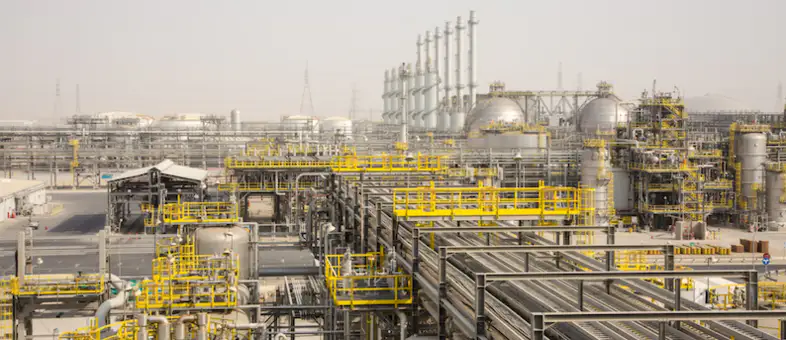

JUBAIL INDUSTRIAL CITY, Saudi Arabia, Jan. 15, 2025 – In alignment with the Kingdom’s vision to enable the downstream industry, Sadara Chemical Company (Sadara) and Oasis Pioneers Industrial Co. Ltd (Oasis Pioneers), have signed a long-term supply agreement for Methylenediphenyl Diisocyanate (MDI) amid the presence of Sadara CEO Fayez Al Sharef and Oasis Pioneers Chairman Khaled Juffali. Under the agreement, Sadara will supply MDI – a critical raw material used in high-performance applications – to Oasis Pioneers, who in turn will establish and operate a state-of-the-art MDI distillation and manufacturing facility, to produce advanced polyurethane solutions at PlasChem Park in Jubail Industrial City.
This partnership represents a significant milestone in advancing Saudi Arabia’s downstream sector, a vital component of the Kingdom’s National Industrial Strategy. The project seeks to advance innovation in applications such as thermal insulation, automotive parts, and construction materials. This will in turn drive industrial growth and sustainable development across the Kingdom.
Sadara CEO Fayez Al Sharef expressed his enthusiasm at the agreement, emphasizing its significance for the downstream sector through the introduction of high-performance products and applications that will support the local market and boost the national economy. Oasis Pioneers’ Chairman Khaled Juffali said: “I am proud and excited to reach this milestone alongside the Oasis Pioneers team and our partners at Sadara. Recognizing this project as a vital part of the Kingdom’s National Industrial Strategy is exciting but also brings enormous responsibility. For the benefit of our country, region, partners, employees, and shareholders, my team and I will continue working to deliver a new national champion in our industrial sector successfully.”
This project will serve as a groundbreaking and transformative addition to the Kingdom’s manufacturing sector. It will strengthen production capabilities and replace imported products with the locally-produced unique specialty chemicals.
Sadara’s innovative product portfolio — introducing the first of its kind in the Kingdom — has positioned the company as a catalyst for attracting diverse investments to PlasChem Park. These strategic investments span key sectors: chemicals for oil and gas, building materials, paints, coatings, and personal and household care products. Creation of these new value chains will drive growth and innovation within the Kingdom’s manufacturing landscape.

By Karen M. Koenig | March 4, 2025 | 11:25 am CST
HIGH POINT, N.C. — New residential furniture orders rose 1% in December compared to the same period in 2023, according to the February issue of Furniture Insights, reversing the previous month’s decline. Approximately two-thirds of respondents reporting increased orders in December compared to the year prior.
However, compared to November 2024, December new orders dropped 15%, although that could include some seasonality due to the December holiday break, said noted Mark Laferriere, assurance partner at Smith Leonard, the accounting and consulting firm that produces the monthly report. New orders were also down for the year to date, by 1%.
December shipments were down 2% compared to 2023 figures, and also down 7% with November 2024. Year to date through December 2024, shipments were down 6% compared to 2023. Backlogs were down 8% compared to December 2023, but up 2% from November 2024 “as current shipments outpaced new orders during the last month.”
“Receivable levels were down 7% from November 2024, and down 3% from December 2023, both of which are materially in line with the respective shipment trends, given normal timing differences with collections,” Laferriere noted. “Inventories were consistent with November 2024 and down 2% from December 2023, which are in line with prior periods and current operational
levels,” he added.
On a seasonally adjusted basis, sales at furniture and home furnishings stores were down 1.7% in January compared to the previous month but up 3.7% from January 2024, according to the January Furniture Insights.
Tariffs, both existing and potential, continue to impact American business and spending, making projections difficult, Laferriere said. “While the housing data was mixed, consumer confidence really took a hit this month, so it will be interesting to see whether this is the start of an enduring trend or hopefully just a temporary blip that will reverse itself once much the current uncertainty is resolved.”
He added, “The Home Furnishings Sentiment Index published by Furniture Today was similarly mixed, but reflected long-term optimism for the industry, which is consistent with what we’ve heard from many we’ve spoken to recently.
“And the furniture industry does seem to be gaining a little momentum based upon recent industry reports, year-over-year retail data, as well as our own survey’s modest increase in new orders this month. However, it remains to be seen the extent these economic policies will have on the 2025 outlook for the industry and beyond.”

February 28, 2025
Bobby Dalheim // Senior Editor of Case Goods and Global Sourcing // February 27, 2025
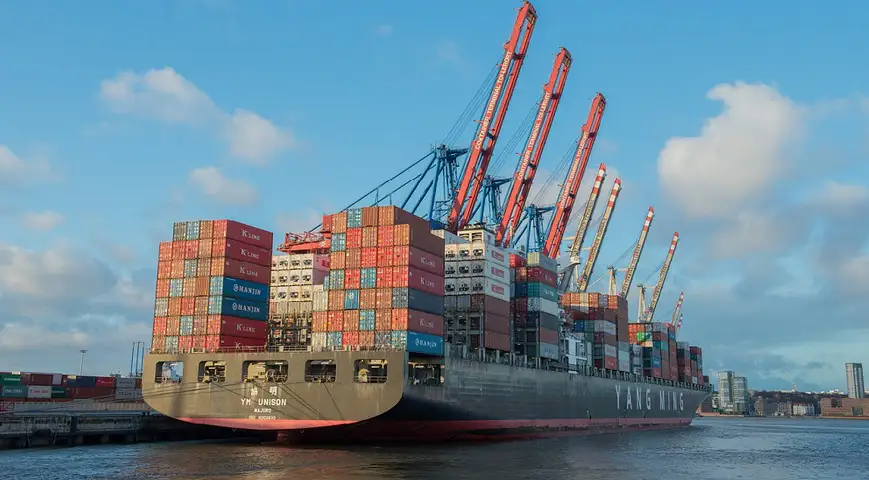
LONDON – Spot ocean container rates fell 6% this week on average across all trade routes and have now fallen 21% in the past three weeks, according to rate tracker Drewry. Average rates now sit at $2,629 per 40-foot container, the lowest average since last May.
Drops in rates from China to the U.S. have been more substantial. Rates from Shanghai to Los Angeles fell 11% this week to $3,477 and follow drops of 11% and 7% in the two weeks prior. Likewise, Shanghai to New York saw rates drop 10% this week to $4,593, which again follows declines of 13% and 5%. Doing the math, that’s a 29% drop to Los Angeles and a 28% drop to New York in three weeks.
Drewry expects rates to continue to fall over the coming weeks as more shipping capacity comes online.
Container blog LinerLytica gave more specifics in an update, also highlighting Washington’s newly proposed fees on Chinese ships:
“The proposed levy on Chinese ships calling at U.S. ports could trigger moves to switch out Chinese-built ships from U.S. trades that would cause widespread disruptions over the coming month,” it wrote. “Chinese carriers would be most affected by the levies, and their potential exodus would create a void in the market as they account for 17% of U.S. container imports from the Far East. These uncertainties add to the current challenges that carriers are facing, with freight rates continuing to slide and carriers unable to maintain capacity discipline in the midst of the roll-out of new Alliance services.
“Forward schedules show capacity increases across the board in March and unless carriers reverse course soon, freight rate hikes will continue to prove elusive.”
February 28, 2025
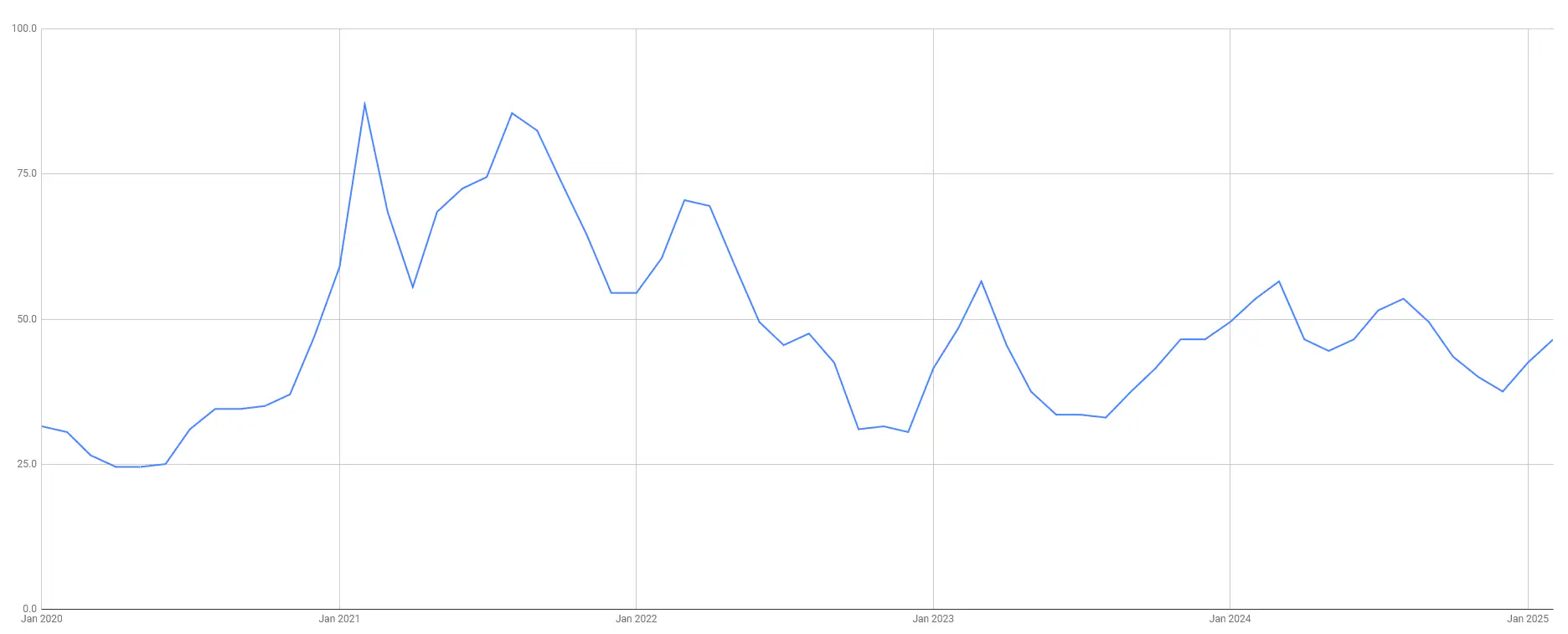
Chemical Grade Propylene is $0.465/lb in February
February 26, 2025
China Announces Export Controls on Five Critical Minerals
Proactive intelligence Alert
February 12, 2025
On February 4, 2025, China announced it would restrict exports of five critical minerals: tungsten, tellurium, bismuth, indium, and molybdenum. Industries dependent on these metals, including defense, renewable energy, electronics, and manufacturing, may experience supply chain disruptions, including delays, price increases, and supply bottlenecks, due to China’s leading role in their production.
 | Tungsten | Artillery shells, armor plating, cutting tools, engine parts, airplane balancing weights. |
 | Tellurium | Solar panels, thermoelectric devices, infrared optics, steel alloys, and rechargeable batteries. |
 | Bismuth | Medical treatments, lead-free solder, cosmetics, flame retardants, and ammunition. |
 | Indium | Phone screens, TV displays, fiber-optic technology, semiconductors, and solar panels. |
 | Molybdenum | Missile components, nuclear reactors, steel alloys, lubricants, and high-temperature electronics. |
Background
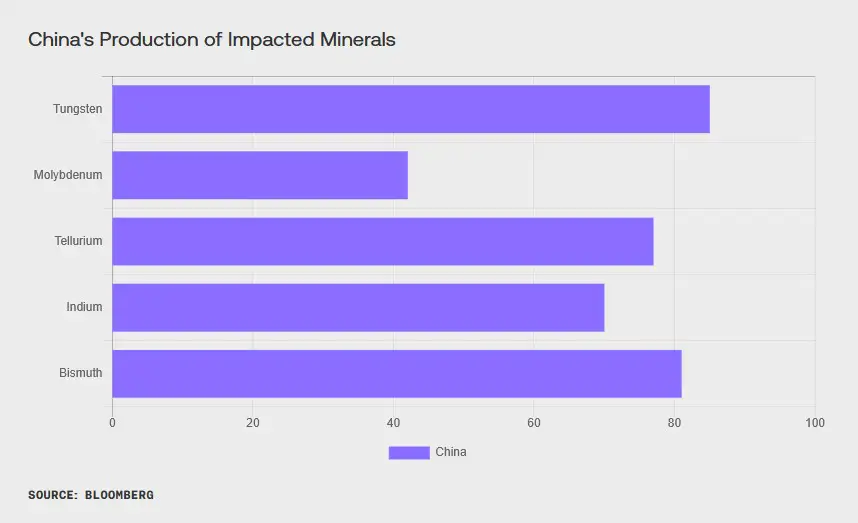
China’s new export controls require licenses to export 20 tungsten, tellurium, bismuth, indium and molybdenum-related products to “safeguard national security interests.” China is the global leader of the rare earths industry overall, dominating about 69% of the world’s production and 90% of the world’s mining. China is the top producer of all five recently restricted metals.
China’s Production of Impacted Minerals
Source: Bloomberg
In recent years, China restricted the exports of several other critical minerals. In July 2023, China announced export restrictions on certain gallium and germanium products, metals essential in chip manufacturing, citing national security concerns. Following the announcement, prices for gallium and germanium surged, with gallium prices increasing by nearly 20% in the United States and Europe.
In August 2024, China announced restrictions on antimony, a metal used in defense technology. From August 2024 to December 2024, antimony shipments from China to the United States dropped 97% while prices rose 200%. In December 2024, China banned the export of gallium, germanium, and antimony to the United States entirely.
The scope of China’s export restrictions on the five minerals also includes a ban on the technology to process and refine the materials for their critical uses. This factor pressures rival economies to develop independent supply chains and creates short-term bottlenecks that could disrupt industries relying on these materials.
Exiger Insights
Although China’s recent restrictions do not single out exports to any particular country, the announcement followed the United States’ recent imposition of a 10% tariff on Chinese imports. It is not clear whether U.S. imports of the impacted minerals will qualify for licenses given China’s national security concerns and the minerals’ heavy use in U.S. defense and technology.
Anticipated Disruptions
Stakeholders should prepare for:
- Supply delays: The new licensing requirements may slow down the export process, leading to delays in receiving essential materials.
- Material shortages: Given China’s substantial share in the production of these metals, global shortages are possible until alternative sources are identified.
- Increased costs: Supply constraints may drive up prices for these metals, affecting production costs across impacted industries.
Recommendations
Stakeholders are advised to:
- Assess supply chain exposure: Identify dependencies on the restricted metals and evaluate the potential impact on operations.
- Explore alternative suppliers: Investigate other global sources for these metals or suitable substitutes to diversify supply chains.
- Communicate with customers: Proactively inform clients about potential delays or changes in product availability and manage expectations accordingly.
https://www.exiger.com/perspectives/critical-minerals-export-controls
China export curbs push European bismuth prices to highest since 2008
By Anushree Ashish Mukherjee and Ashitha Shivaprasad
February 21, 20254:39 AM ESTUpdated 5 days ago
- Summary
- China produced more than 80% of world’s bismuth last year – USGS
- Alternative producers include Korea, Japan and Laos
Feb 21 (Reuters) – Bismuth prices in Europe have soared to their highest in nearly 17 years after China’s plan to impose export curbs raised fears of curtailed supply for the metal used in medication, cosmetics and atomic research.
Earlier this month, China said it would implement export controls on five critical metals — tungsten, tellurium, molybdenum, bismuth, and indium — in retaliation to new tariffs imposed by U.S. President Donald Trump.
From $6 per lb previously, bismuth prices have surged to between $12 and $18 in the European spot market this week, the highest level since May 2008.
Traders expect to see higher bismuth prices.
China produced roughly 13,000 tons, or over 80% of the world’s supply, of bismuth last year, according to the U.S. Geological Survey (USGS).
The rest comes from countries, including Japan, South Korea and Laos. However, traders say the availability from other nations was limited compared to China.
“We have received many inquiries from both our EU and our U.S. customers,” a trader based in Europe said, adding that U.S. consumers would be more vulnerable if the China-U.S. trade war escalates.
The U.S. has been heavily reliant on imports since it stopped production of primary refined bismuth in 1997, according to the USGS.
If the U.S. was completely cut off from Chinese bismuth supplies, production outside China would have to grow by 22% to meet demand, said Jost Wubbeke, Managing Partner at Sinolytics.
“It is hard to find cheap and stable alternative supplies, especially when everyone’s trying to find new sources at the same time.”
As trade tensions escalate, China is expected to further leverage its dominance in critical minerals to retaliate.
 Everchem Updates Archive
 Sign Up for Email Updates