
The Urethane Blog
January 20, 2025
Housing starts end 2024 on an up note
By Larry Adams
January 17, 2025 | 10:32 am CST

Photo By NAHB
WASHINGTON — The National Association of Home Builders is reporting that housing starts in 2024 ended on an “up note.”
The association representing more than 140,000 members said the positive results were fueled by solid demand, single-family construction moved higher in December despite several headwinds facing the industry, including high mortgage rates, elevated financing costs for builders and a lack of buildable lots.
Overall housing starts increased 15.8% in December to a seasonally adjusted annual rate of 1.50 million units, according to a report from the U.S. Department of Housing and Urban Development and the U.S. Census Bureau. This is the highest rate since February 2024.
The December reading of 1.50 million starts is the number of housing units builders would begin if development kept this pace for the next 12 months. Within this overall number, single-family starts increased 3.3% to a 1.05 million seasonally adjusted annual rate. The multifamily sector, which includes apartment buildings and condos, increased 61.5% to a 449,000 pace.
Total housing starts for 2024 were 1.36 million, a 3.9% decline from the 1.42 million total from 2023. Single-family starts in 2024 totaled 1.01 million, up 6.5% from the previous year. Multifamily starts ended the year down 25% from 2023.
“Single-family home building increased 6.5% for 2024, as builders added more supply in a market continuing to face a housing affordability crisis due to elevated mortgage interest rates and higher construction costs,” said Carl Harris, chairman of the National Association of Home Builders (NAHB) and a custom home builder from Wichita, Kan. “Nonetheless, the industry expects to see a slight gain for single-family home building in 2025 because of a persistent housing shortage and ongoing solid economic conditions.”
“While December was a solid month for apartment starts, the sector ended 2024 down 25% in terms of total starts,” said NAHB Chief Economist Robert Dietz. “In December, and on a three-month moving average basis, there were 1.7 apartments completing construction for every one apartment starting construction. Multifamily construction will stabilize later in 2025 as more deals pencil out, with the industry supported by a low national unemployment rate.”
Looking at regional housing starts data for 2024, combined single-family and multifamily starts were 9.1% higher in the Northeast, 0.1% lower in the Midwest, 5.2% lower in the South and 7.7% lower in the West.
Overall permits decreased 0.7% to a 1.48-million-unit annualized rate in December and were down 3.1% compared to December 2023. Single-family permits increased 1.6% to a 992,000-unit rate but were down 2.5% in December compared to the previous year. Multifamily permits decreased 5.0% to a 491,000 pace.
Looking at regional permit data for 2024, permits were 1.5% higher in the Northeast, 3.5% higher in the Midwest, 3.1% lower in the South and 6.6% lower in the West.
Total permits for 2024 were 1.47 million, a 2.6% decline from the 1.51 million total from 2023. Single-family permits in 2024 totaled 981,000 up 6.6% from the previous year, a positive sign for 2025.
The number of single-family homes under construction was down 5.3% from a year ago, at 641,000 homes. The number of apartments under construction was down 21% from a year ago, at 790,000. The count of apartments under construction peaked in July 2023 at 1.02 million and has been trending lower since that time.
https://www.woodworkingnetwork.com/news/woodworking-industry-news/housing-starts-end-2024-note
January 15, 2025
China Propylene Oxide & Polyols Market in January
PUdaily | Updated: January 14, 2025
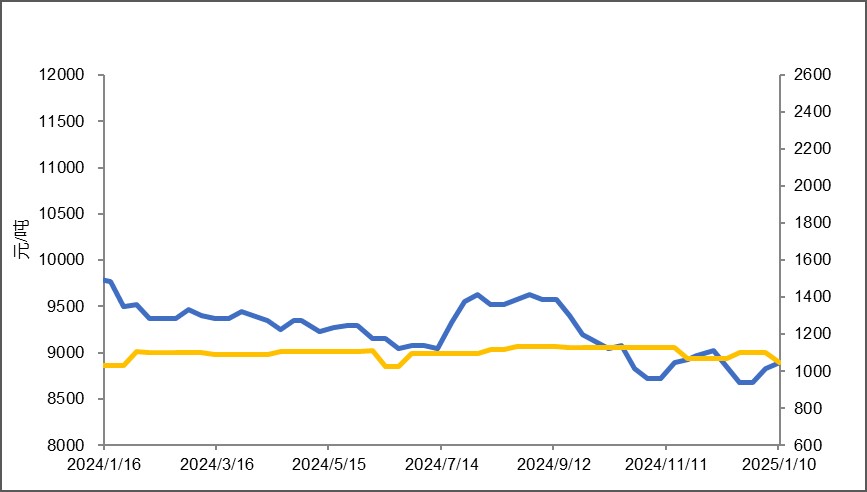
In January 2025, due to the production of new facilities at Befar Group and Wanhua Chemical, these two suppliers in Shandong showed stronger intentions to clear inventory and cut prices by CNY 300/tonne. PO prices in East China dropped by CNY 100/tonne as a result. The price difference between the North and the South widened, leading to slightly varied sales performance. Meanwhile, recent import prices for PO have been continuously decreasing, with the latest offer at USD 990/tonne.
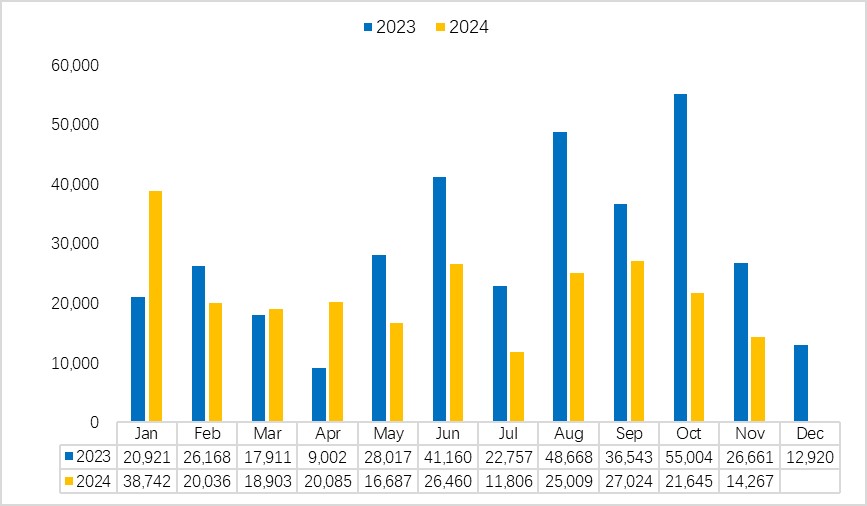
In terms of import, China’s import volume of PO has been declining in recent years and the annual import volume for 2024 is estimated to total 250 kT, marking a more than 20% decrease compared to the previous year.
As Chinese New Year approaches, downstream manufacturers are increasing purchases at relatively low prices, while the growth in new orders has been muted. Suppliers may maintain willingness to sell and negotiate. With ongoing inventory reduction, the market is projected to fluctuate slightly in the near future.
Prices for flexible slabstock polyols have moved down due to reduced costs. However, the drop in polyols prices is less than in PO prices, resulting in increased profits for polyols producers. Acrylonitrile prices have risen from CNY 9,400/tonne to CNY 10,500/tonne, causing a shrink in profits for polymer polyols. It is expected that the acrylonitrile market will remain high next week. Owing to limited supply increases and low inventories, coupled with the pre-holiday restocking blitz, the market is likely to keep resilient.
January 12, 2025
Commercial Chapter 11 Filings Increase 20 Percent in Calendar Year 2024
Commercial Chapter 11 Filings Increase 20 Percent in Calendar Year 2024
Total Bankruptcy Filings Up 14 Percent
NEW YORK/ALEXANDRIA – Jan. 3, 2025 — Commercial chapter 11 filings increased 20 percent in calendar year 2024 to 7,879 from 6,583 filings the previous year, according to data provided by Epiq AACER, the leading provider of U.S. bankruptcy filing data. Overall commercial filings increased 17 percent to 30,009 from the 25,731 registered the previous year.
Small business subchapter V elections within chapter 11 also experienced a substantial increase in calendar year 2024, as the 2,381 filings represented a 32 percent increase from the 1,808 recorded in 2023. Note that the pace of subchapter V and consumer chapter 13 filing increases slowed after enhanced debt limits for both filing categories expired on June 21, 2024.
Total bankruptcy filings in calendar year 2024 were 508,758, a 14 percent increase from the 445,286 registered during calendar year 2023. While representing a substantial year-over-year increase, total bankruptcy filings remain lower than the pre-pandemic total of 757,816 recorded in CY2019.
“As anticipated, we saw a steady increase in bankruptcy filings throughout 2024 and expect that growth trend to continue throughout 2025,” said Michael Hunter, Vice President of Epiq AACER. “If the current trend continues, new bankruptcy filings will return to pre-pandemic normalized volumes over the next 24-30 months. Modest rises in household debt and elevated delinquency rates reveal the stress households are experiencing and are reflected in the steady increased bankruptcy filing trends.”
Overall consumer filing totals for calendar year 2024 were 478,749, representing a 14 percent increase from the 419,555 consumer filings the previous year. Consumer chapter 7 filings increased 19 percent to 288,968 in CY 2024 from the previous year’s total of 242,919. The 188,934 consumer chapter 13 bankruptcy filings during calendar year 2024 registered a 7 percent increase over 2023’s total of 175,977.
“The continued increase in bankruptcies over the past year reflects the growing list of economic challenges faced by consumers and businesses,” said ABI Executive Director Amy Quackenboss. “Rising interest rates, inflation, increasing geopolitical tensions and shifts in post-pandemic consumer spending have more struggling businesses and families turning to bankruptcy for a financial fresh start from their growing debt loads.”
Total bankruptcy filings were 38,121 in December 2024, an 11 percent increase from the December 2023 total of 34,486. The consumer bankruptcy filing total of 35,793 also represented an 11 percent increase from the 32,391 consumer filings in December 2023. Consumer chapter 7 filings were 21,918 in December 2024, up 17 percent from the 18,718 chapter 7 filings in December 2023, while consumer chapter 13s only increased 1 percent to 13,804 in December from 13,629 the previous year.
Overall commercial filings also increased 11 percent in December 2024, as the 2,328 filings were up from the 2,095 commercial filings registered in December 2023. The 553 commercial chapter 11 filings in December represented an 8 percent increase from the 510 chapter 11 filings in December 2023. Subchapter V elections within chapter 11 increased slightly, as the 188 filings in December 2024 were up 2 percent over the 185 filings recorded in December 2023.
ABI has partnered with Epiq AACER to provide the most current bankruptcy filing data for analysts, researchers, and members of the news media. Epiq AACER is the leading provider of data, technology, and services for companies operating in the business of bankruptcy. Its Bankruptcy Analytics subscription service provides on-demand access to the industry’s most dynamic bankruptcy data, updated daily. Learn more at https://bankruptcy.epiqglobal.com/analytics.
About Epiq
Epiq, a global technology-enabled services leader to the legal industry and corporations, takes on large-scale, increasingly complex tasks for corporate counsel, law firms, and business professionals with efficiency, clarity, and confidence. Clients rely on Epiq to streamline the administration of business operations, class action, and mass tort, court reporting, eDiscovery, regulatory, compliance, restructuring, and bankruptcy matters. Epiq subject-matter experts and technologies create efficiency through expertise and deliver confidence to high-performing clients around the world. Learn more at www.epiqglobal.com.
About ABI
ABI is the largest multi-disciplinary, nonpartisan organization dedicated to research and education on matters related to insolvency. ABI was founded in 1982 to provide Congress and the public with unbiased analysis of bankruptcy issues. The ABI membership includes nearly 10,000 attorneys, accountants, bankers, judges, professors, lenders, turnaround specialists and other bankruptcy professionals, providing a forum for the exchange of ideas and information. For additional information on ABI, visit www.abi.org. For additional conference information, visit http://www.abi.org/calendar-of-events.
Friday, January 3, 2025
Article Tags:
January 9, 2025
Longshoremen reach tentative agreement with ports, shippers, averting a potential strike
By PAUL WISEMAN Updated 11:03 PM EST, January 8, 2025
U.S. longshoremen reached a contract agreement with ports and shippers Wednesday, averting a potential strike that could have damaged the American economy.
The International Longshoremen’s Association union and the U.S. Maritime Alliance of ports and shipping companies said they had reached a tentative agreement for a six-year contract, a week ahead of a Jan. 15 deadline.
In a joint statement, the two sides said the agreement protects union jobs and allows ports on the East and Gulf coasts to modernize with new technology, “making them safer and more efficient, and creating the capacity they need to keep our supply chains strong.’’
They said they were not releasing details of the agreement publicly to give union members a chance to review and approve the document. The ratification process is likely to take weeks.
In a statement Wednesday night, President Joe Biden said the tentative agreement “shows that labor and management can come together to benefit workers and their employers.”
“I applaud the dockworkers’ union for delivering a strong contract,” Biden added. “Their members kept our ports open during the pandemic, as we worked together to unsnarl global supply chains. Thank you to the carriers and port operators who play an essential role in our nation’s economy.”
The 45,000 longshoremen staged a three-day strike in October. They suspended the walkout after agreeing to a 62% pay increase over six years that would have sent hourly wages at the top of the pay scale from $39 to $63. But that truce was contingent upon reaching an agreement by Jan. 15 over automation: The union worried that machines — especially semi-automated cranes — would replace human workers.
According to a source familiar with the talks who requested anonymity because the details had not been made public, the agreement would give the ports more leeway to introduce modernizing technology. But in a concession to the union, they would have to hire new workers when they do, and full automation is off the table.
Wednesday’s agreement came a day after the two sides resumed negotiations. “This is a win-win agreement that creates ILA jobs, supports American consumers and businesses, and keeps the American economy the key hub of the global marketplace,” they said in the statement.
A strike would have shut down ports along the East and Gulf coasts and would have begun damaging the economy if it lasted much more than a week, economists said.
Automation has long been a contentious issue at U.S. ports. Longshoremen worry that machines — such as semi-automated cranes that don’t need their own individual operators — will supplant human workers. Even if the ports agree to protect existing jobs as they modernize, they could need fewer workers as they get more efficient, meaning the port workforce and the union could shrink over time.
Port operators and shipping companies argue that U.S. ports are falling behind more automated ports such as those in Rotterdam, Dubai and Singapore.
President-elect Donald Trump had weighed in for the union.
After meeting union president Harold Daggett at his Mar-a-Lago club in Palm Beach, Florida, Trump posted on social media last month that additional automation of ports would hurt workers: “The amount of money saved is nowhere near the distress, hurt and harm it causes for American workers, in this case, our Longshoremen.’’ Trump added that he knows “just about everything there is to know about’’ automation.
https://apnews.com/article/ports-strike-longshoremen-unions-labor-91894cf33e3f63762e29cfb55270f0e1
January 7, 2025
EPA finds formaldehyde an ‘unreasonable risk,’ industry says evaluation flawed
By Larry Adams
January 6, 2025 | 7:16 am CST

WASHINGTON, D.C. — The U.S. Environmental Protection Agency (EPA) released Jan. 2 the final risk evaluation for formaldehyde conducted under the Toxic Substances Control Act (TSCA). EPA has determined that formaldehyde presents an unreasonable risk of injury to human health, specifically to workers and consumers, under its conditions of use (COUs).
The American Chemical Council, on the other hand, said the EPA’s evaluation process was flawed and was not based on the best available science. The ACC warned that the EPA’s Final TSCA Risk Evaluation for Formaldehyde potentially jeopardizes domestic production and critical American industries.
According to the EPA, studies in people demonstrate that exposure to formaldehyde for a short periods, such as for 15 minutes (called an acute exposure) cause sensory irritation such as eye and respiratory inflammation. Sensory irritation effects go away when exposure stops. Inhaling formaldehyde for longer ‘chronic’ periods can reduce lung function and increase asthma and allergy-related conditions, and cancer. Skin contact with products containing formaldehyde can also cause allergic reactions. Formaldehyde is not expected to persist in water or soils based on its physical and chemical properties; therefore, it is not expected in groundwater or surface water used for drinking water.
EPA’s risk evaluation focused on formaldehyde sources involved in the manufacturing, processing, distribution in commerce, use, and disposal of formaldehyde and formaldehyde-containing products and articles that are subject to TSCA. These may include composite wood furniture or other articles, plastics, paints, adhesives, and sealants. The highest releases of formaldehyde from articles occur when new.
EPA assessed human exposure for 63 TSCA conditions of use of formaldehyde. Of these, 58 conditions of use (50 occupational and 8 consumer) significantly contribute to the unreasonable risk determination. Workers who are in workplaces where formaldehyde is used are at the most risk from formaldehyde exposure, particularly if workers are not wearing personal protective equipment. Workers may be exposed to formaldehyde in air during manufacturing, processing, or use of formaldehyde and products and articles containing formaldehyde. Workers can also be exposed to formaldehyde by making skin contact with formaldehyde-containing materials. Most of the risk to workers is because of acute inhalation and dermal exposures. Cancer risk to workers under many conditions of use also supports the risk determination.
EPA also found some risk from chronic exposure to ambient air for people living near facilities that release formaldehyde. EPA did not determine that ambient air contributes significantly to the unreasonable risk determination.
Industry objects
The American Chemistry Council’s Formaldehyde Panel issued the following statement on the U.S. Environmental Protection Agency’s (EPA) completion of the final risk evaluation for formaldehyde under the Toxic Substances Control Act (TSCA):
“While ACC acknowledges EPA made several important adjustments in the final risk evaluation, concerns remain about the agency’s continued disregard for statutory requirements on scientific quality, peer reviews, and engagement with public and interagency comments. TSCA requires that EPA reviews and regulates a chemical based on the best available science. This risk evaluation relies on a flawed assessment by EPA’s Integrated Risk Information System (IRIS) program – a program that has never been authorized by Congress, lacks transparency, and is out of step with the best available science and methods. EPA should go back to the scientific drawing board on formaldehyde instead of pursuing unaccountable lame duck actions that threaten the U.S. economy and key sectors that support health, safety and national security.
“Government agencies like Department of Defense, Department of Agriculture, the Centers for Disease Control and Prevention, and the Small Business Administration and EPA-selected expert peer reviewers have raised concerns about the shortened timeline, scientific shortcomings, and potential devastating effects of a flawed TSCA risk evaluation. Ignoring these concerns could result in overly restrictive regulation of this building block chemistry, handicapping America’s economy and creating reliance on overseas production.
“Despite minor improvements, EPA’s final evaluation concludes that virtually all conditions of use contribute to ‘unreasonable risk’ under TSCA. This includes 58 of 63 subcategories of formaldehyde uses, including subjecting all manufacturing, import, processing, distribution in commerce, recycling, disposal, and industrial use of formaldehyde and formaldehyde-derived products to potential bans or difficult-to-meet standards for some uses.
“EPA’s suggested starting place for workplace limits continue to be inconsistent with the best available science and ignore practices that are already in place to protect workers, including the use of personal protective equipment. These workplace limits are significantly lower than the recently updated European Union occupational limits.
“Any assessment of formaldehyde must begin with the best available science. Formaldehyde is a natural part of our world and, through decades of responsible innovation and regulation, is essential to critical applications for housing, agriculture, transportation, healthcare, and national security. Formaldehyde technologies have broad roles in the economy, supporting over 1.5 million jobs and $1.6 trillion in manufacturing shipments and other economic output in 2023 in the United States.
“Effective implementation of the TSCA program has been plagued with challenges, and the final risk evaluation does not meet EPA’s requirement to use the best available science. If EPA continues on its current path during the two-year risk management phase, formaldehyde manufacturing and many of its downstream uses could be severely restricted or potentially banned in the United States.
“Formaldehyde is integral to modern life, and businesses and families rely on the important products it enables. Without robust formaldehyde manufacturing in the United States, we could face increased product prices, reduced economic output, and a loss of the U.S.’s competitive edge. In the coming months, we will collaborate with formaldehyde users to engage the next Administration and safeguard access to this essential chemical building block.”
It’s interesting how the ACC defends formaldehyde and yet promotes MDI for certain end-uses.
 Everchem Updates Archive
 Sign Up for Email Updates