
Technology
May 17, 2021
Wind Turbine Blade Recycling Project
Home/Environment/New Technology for Full Recyclability of Wind Turbine Blades Environment
New Technology for Full Recyclability of Wind Turbine Blades
Energy Industry Review4 hours agoLast Updated: May 17, 2021 30 4 minutes read
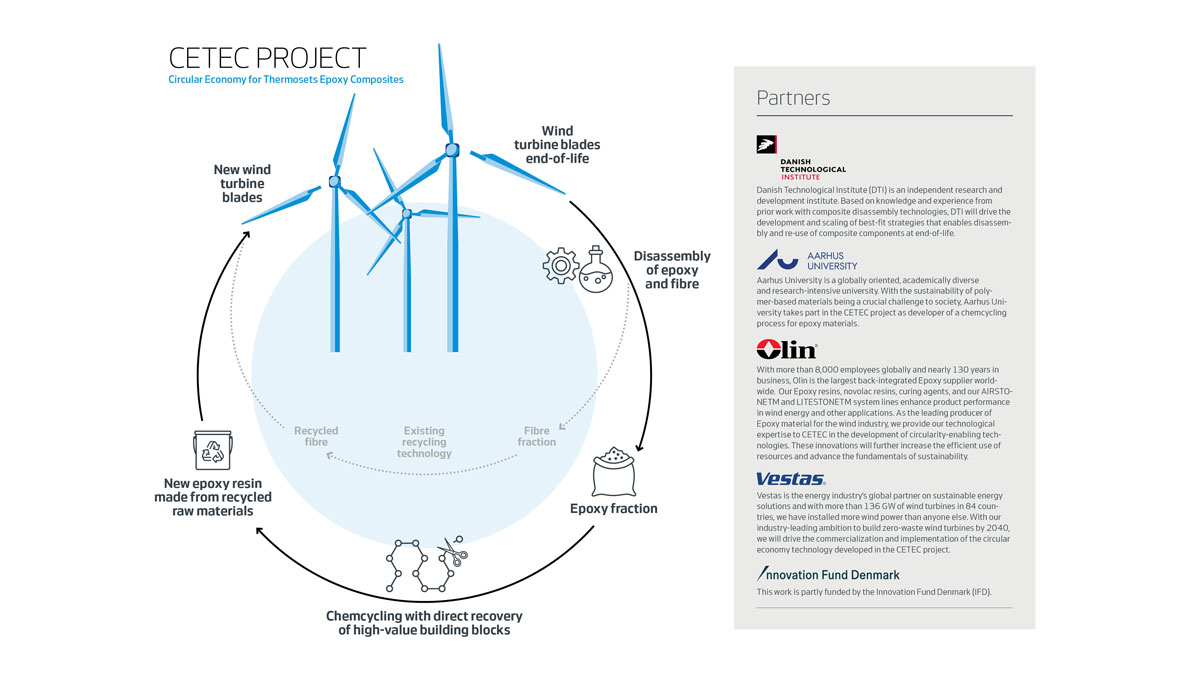
A coalition of industry and academic leaders have developed a new technology to enable circularity for thermoset composites, the material used to make wind turbine blades. The new technology delivers the final technological step on the journey towards a fully recyclable wind turbine value chain. To enable the adoption of this new technology, and to advance a circular economy across the wind industry, a new initiative entitled CETEC (Circular Economy for Thermosets Epoxy Composites) has been established. Within three years, CETEC is aiming to present a fully scoped solution ready for industrial adoption, based on commercialisation of the novel circularity technology.
Partly funded by Innovation Fund Denmark (IFD), CETEC is spearheaded by Vestas, the global leader in sustainable energy solutions, and involves both industrial and academic leaders including Olin, the world leading producer of Epoxy, the Danish Technological Institute (DTI), and Aarhus University.
Developed by DreamWind, an innovation initiative driven by the same partners, the new technology consists of a two-step process. Firstly, thermoset composites are disassembled into fibre and epoxy. Secondly, through a novel chemcycling process, the epoxy is further broken up into base components similar to virgin materials. These materials can then be reintroduced into the manufacturing of new turbine blades, constituting a new circularity pathway for epoxy resin.
Wind turbines are 85-90 percent recyclable, with turbine blades material constituting the remaining percentage that cannot be recycled, due to the nature of thermoset composites. CETEC is aiming to close this recycling gap and enable a significant step forward in the elimination of waste across the wind energy industry.
“As global commitments to a net-zero future increase, it’s absolutely crucial to ensure the wind industry can scale sustainably, which includes Vestas fulfilling our ambition to produce zero-waste turbines by 2040. Leveraging this new technological breakthrough in chemcycling epoxy resin, the CETEC project will be a significant milestone in Vestas’ journey towards achieving this goal, and in enabling a future where landfill is no longer required in blade decommissioning,” said Allan Korsgaard Poulsen, Head of Sustainability and Advanced Materials, Vestas Innovation and Concepts.
“The key characteristic of composite materials is their unique combination of low weight and high strength. This is governed by the strong bonding of two different materials – fibre and epoxy. The dilemma is that this strong bond is also the feature that renders these materials difficult to recycle. Therefore, the development of CETEC’s novel technology, enabling disassembly of the composite at end-of-life, is a gamechanger, that will allow us to capture the value represented by each material stream in a new circular value chain”, said Simon Frølich, Team Manager, PhD, Danish Technological Institute.
“Chemcycling of epoxy-based materials would allow deconstructing these highly stable polymer chains into molecular building blocks. These building blocks are easily processable and can be utilised to produce new epoxy, which will have the same quality as the original material. Avoiding the loss of valuable molecular complexity in such a way is a highly desirable concept and an important step to sustainable materials,” said Prof. Dr. Troels Skrydstrup, Aarhus University.
CETEC’s solution will address the lack of available recycling technology for epoxy resins. This would in turn create the possibility to introduce new recycling solutions to the wind industry. This holds significant potential for commercial value capture, particularly in markets where regulation around waste management for manufacturing industries is tightening to serve a broader sustainability agenda. When fully developed, the solution may also have an impact for other industries that rely on thermoset composite in production, such as automotive and aviation.
“As the leading Epoxy producer and global supplier for the wind industry, Olin is proud to provide our technological expertise to this important sustainability project,” said Leif Ole Meyer, TS&D Leader EMEAI at Olin. “To develop technologies which close an existing gap of thermosets by creating a circularity is yet another example of putting our Resource Efficiency sustainability goal into action. This innovation will help the industry to minimize consumption of virgin material sources and increase the reuse and recycling of materials.”
About Danish Technological Institute
Danish Technological Institute (DTI) is an independent research and development institute. It takes an innovative approach to improving the competitiveness of business and industry, society and public life. With more than 12,000 customers in 65 countries, they develop new knowledge through research and development activities in close corporation with Danish and international companies and research institutes.
About Aarhus University
Aarhus University is a globally oriented, academically diverse, and research-intensive university. Aarhus University ranks among the top 100 universities in the world on several of the most important international ranking lists, out of over 17,000 universities worldwide. Around 12 per cent of AU’s 40.000 students are international, representing over 120 nationalities. Aarhus University offers state-of-the-art facilities and laboratories having a strong tradition of multidisciplinary research for instance in one of its 42 major research centres. The university’s goal is to contribute towards solving the complex global challenges facing the world. The university therefore strives to combine the high level of academic standards of its researchers with collaboration across disciplinary boundaries to combine research in new ways and solve challenges in close contact with the world around us.
About Olin
With over 8,000 employees globally and almost 130 years in business, Olin Corporation is the world’s chlor-alkali leader, including epoxy products and chlorinated organics. Olin’s regional headquarters for Europe, Middle East, Africa, and India is based in Zug, Switzerland. The company employs over 650 professionals in its European offices, research, and innovation centres, and manufacturing locations in Baltringen, Rheinmunster and Stade, Germany, Pisticci, Italy, and Terneuzen, Netherlands. Olin is committed to exceeding customer expectations through operational and commercial excellence, innovation capabilities and quality people who serve their valued customers.
About Vestas
Vestas is the energy industry’s global partner on sustainable energy solutions. They design, manufacture, install, and service onshore and offshore wind turbines across the globe, and with more than 136 GW of wind turbines in 84 countries, Vestas has installed more wind power than anyone else. Through its industry-leading smart data capabilities and unparalleled more than 117 GW of wind turbines under service, Vestas uses data to interpret, forecast, and exploit wind resources and deliver best-in-class wind power solutions. Together with their customers, Vestas’ more than 29,000 employees are bringing the world sustainable energy solutions to power a bright future.
April 8, 2021
Mattress Recycling
Covestro pilots chemicals recycling process to close loop on used mattress foam
Article by Adam Duckett
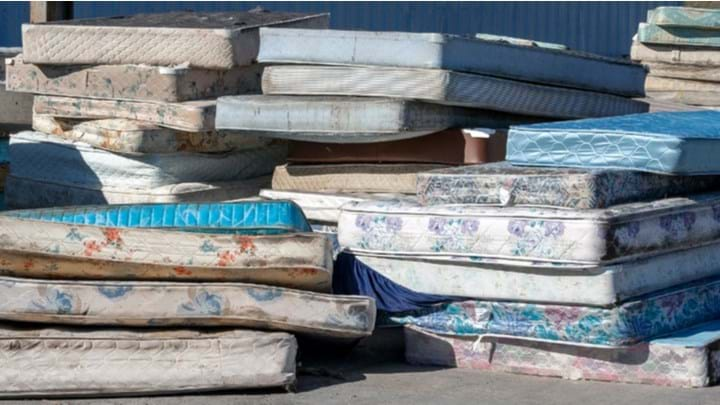
Around 30m mattresses are discarded in the EU each year
COVESTRO has begun to pilot a chemical process to recycle the foam from used mattresses. If successful, the initiative will recover two key raw materials that will be used to produce fresh foams.
Around 30m mattresses are discarded in the EU each year, and according to data from the trade body EUROPUR around 90% of the mattresses produced in the EU each year contain 2–15 kg of polyurethane foam. A key challenge with recovering polyurethane from used mattresses is that it decomposes at elevated temperatures so cannot be melted to make new products as is common with other recycled plastics.
Covestro is developing a chemical recycling process to recover two raw materials used to produce polyurethane foam: polyol and toluene diamine (TDA), which is the precursor to toluene diisocyanate (TDI). It has begun operating a pilot plant to recover polyols at its site in Leverkusen, Germany. It then plans to pilot a chemical process to recover TDA, from Q3 this year.
A spokesperson for Covestro said: “We need to optimise the process and develop the products in an industrial simulative environment. Nevertheless, if these trials are successful, Covestro intends to build an industrial plant which allows customers to buy materials in significant quantities, within the next couple of years.”
The recycling process starts with the collection of used mattresses, which are dismantled and the foam parts separated out. Some contain additives and fillers that hamper reprocessing. This separation is made more efficient using a sorting technology that relies on algorithms to identify the different types of foam.
Asked for more detail on the process, the spokesperson said: “The key steps for this innovative recycling are the intelligent sorting technology that we have developed together with our partners, Redwave and Recticel. And our own patented recycling technology, starting with a chemolysis step to dissolve the foam flakes, followed by purification steps and the hydrolysis to TDA, that needs to be further converted to the isocyanate.”
Speaking to the media last week, Sucheta Govil, COO at Covestro, said the company is committed to becoming fully circular, though declined to give a target date, saying it would be dependent on changes throughout the supply chain and in consumer behaviour.
“The circular economy is a global guiding principle. There iareno two ways about that…because all these challenges require a fundamental rethink. Production, consumption, and value creation must change significantly. The option to continue to think in a linear fashion does not exist any longer. Linear patters of consumption must be overcome, waste must be avoided wherever possible.”
“The plastics industry and the people who are in this business are equipped with the knowledge of these materials and processes. I would say we have a responsibility – and the ability – with our technologies to significantly support the transition to the much-needed circular economy.”
Separately, chemicals firm Dow is also working to recycle polyurethane from used mattresses but is focussed only on recovering polyols. Working with partners in France it aims to recycle up to 200,000 mattresses a year, producing polyols for reuse in mattress foams. Its chemicals recycling process is expected to produce recycled polyols for commercial re-use in the first half of this year.
April 8, 2021
Mattress Recycling
Covestro pilots chemicals recycling process to close loop on used mattress foam
Article by Adam Duckett
Around 30m mattresses are discarded in the EU each year
COVESTRO has begun to pilot a chemical process to recycle the foam from used mattresses. If successful, the initiative will recover two key raw materials that will be used to produce fresh foams.
Around 30m mattresses are discarded in the EU each year, and according to data from the trade body EUROPUR around 90% of the mattresses produced in the EU each year contain 2–15 kg of polyurethane foam. A key challenge with recovering polyurethane from used mattresses is that it decomposes at elevated temperatures so cannot be melted to make new products as is common with other recycled plastics.
Covestro is developing a chemical recycling process to recover two raw materials used to produce polyurethane foam: polyol and toluene diamine (TDA), which is the precursor to toluene diisocyanate (TDI). It has begun operating a pilot plant to recover polyols at its site in Leverkusen, Germany. It then plans to pilot a chemical process to recover TDA, from Q3 this year.
A spokesperson for Covestro said: “We need to optimise the process and develop the products in an industrial simulative environment. Nevertheless, if these trials are successful, Covestro intends to build an industrial plant which allows customers to buy materials in significant quantities, within the next couple of years.”
The recycling process starts with the collection of used mattresses, which are dismantled and the foam parts separated out. Some contain additives and fillers that hamper reprocessing. This separation is made more efficient using a sorting technology that relies on algorithms to identify the different types of foam.
Asked for more detail on the process, the spokesperson said: “The key steps for this innovative recycling are the intelligent sorting technology that we have developed together with our partners, Redwave and Recticel. And our own patented recycling technology, starting with a chemolysis step to dissolve the foam flakes, followed by purification steps and the hydrolysis to TDA, that needs to be further converted to the isocyanate.”
Speaking to the media last week, Sucheta Govil, COO at Covestro, said the company is committed to becoming fully circular, though declined to give a target date, saying it would be dependent on changes throughout the supply chain and in consumer behaviour.
“The circular economy is a global guiding principle. There iareno two ways about that…because all these challenges require a fundamental rethink. Production, consumption, and value creation must change significantly. The option to continue to think in a linear fashion does not exist any longer. Linear patters of consumption must be overcome, waste must be avoided wherever possible.”
“The plastics industry and the people who are in this business are equipped with the knowledge of these materials and processes. I would say we have a responsibility – and the ability – with our technologies to significantly support the transition to the much-needed circular economy.”
Separately, chemicals firm Dow is also working to recycle polyurethane from used mattresses but is focussed only on recovering polyols. Working with partners in France it aims to recycle up to 200,000 mattresses a year, producing polyols for reuse in mattress foams. Its chemicals recycling process is expected to produce recycled polyols for commercial re-use in the first half of this year.
March 25, 2021
Covestro Recycling Project
Closing the loop for polyurethane mattresses
Covestro: a pioneer in foam recycling and cycle design
- Innovative process for recovering both core raw materials
- New pilot plant for chemical recycling put into operation
- Trailblazer for industrial recycling
- Co-shaping the circular economy in cooperation with value chain
Covestro has developed an innovative process for the chemical recycling of polyurethane (PU) flexible foam from used mattresses. It builds on its participation in the PUReSmart project, which is coordinated by Recticel company.
On average, mattresses contain 15 to 20 kilograms of foam, which results in a large amount of waste at the end of their useful life. The foam is primarily made of two important raw materials. While other chemical recycling approaches mainly focus on processing one of them, the Covestro process now enables the recovery of both raw materials.
Covestro has also recently started operating a pilot plant for flexible foam recycling at its Leverkusen site to confirm the positive laboratory results achieved to date. The first phase is to focus on recycling one of the raw materials, before the recovery of the second component is also to be piloted from summer this year. Covestro´s goal here is to industrialize chemical recycling processes for used flexible foams and ultimately to remarket both recovered raw materials.
Closing material loops
“The development of this innovative recycling technology and the investment in the pilot plant are further milestones in realizing our vision of fully aligning Covestro to the circular economy,” says CEO Dr. Markus Steilemann. “In doing so, we want to replace fossil resources in production, steadily further reduce the carbon footprint of our materials and create new solutions for dealing with plastic waste. Chemical recycling is particularly promising for this, and must be developed further and used more intensively overall. Above all, it should finally be put on an equal legal basis with other recycling methods.”
In cooperation with the companies Recticel and Redwave – a division of Wolfgang Binder GmbH – and as part of the PUReSmart research project, Covestro has also developed an intelligent sorting solution for separating the different PU foams from post-consumer mattresses. The software uses algorithms to correctly identify the different foam types, which facilitates an effective recycling process. This development is another element of Covestro’s digitalization strategy, combined with the new opportunities it entails for the chemicals and plastics industry.
Co-creation of a circular ecosystem
“Based on our competencies and experiences, we also want to take part in shaping the emerging value creation cycle,” says Daniel Meyer, Global Head of the Polyurethanes segment at Covestro. “To accomplish this, we rely on international cooperation with partners and also develop innovative business models. The aim is to generate new sustainable business opportunities with our customers, other partners and for ourselves.”
The project is an important step forward in taking the development of the circular economy at Covestro to entirely new heights. The increased use of used materials further contributes to solving the societal challenge of sustainable disposal of such waste and to achieving the European Union´s goals for the circular economy and for climate and environmental protection.
https://www.covestro.com/press/closing-the-loop-for-polyurethane-mattresses-public/
March 25, 2021
Covestro Recycling Project
Closing the loop for polyurethane mattresses
Covestro: a pioneer in foam recycling and cycle design
- Innovative process for recovering both core raw materials
- New pilot plant for chemical recycling put into operation
- Trailblazer for industrial recycling
- Co-shaping the circular economy in cooperation with value chain
Covestro has developed an innovative process for the chemical recycling of polyurethane (PU) flexible foam from used mattresses. It builds on its participation in the PUReSmart project, which is coordinated by Recticel company.
On average, mattresses contain 15 to 20 kilograms of foam, which results in a large amount of waste at the end of their useful life. The foam is primarily made of two important raw materials. While other chemical recycling approaches mainly focus on processing one of them, the Covestro process now enables the recovery of both raw materials.
Covestro has also recently started operating a pilot plant for flexible foam recycling at its Leverkusen site to confirm the positive laboratory results achieved to date. The first phase is to focus on recycling one of the raw materials, before the recovery of the second component is also to be piloted from summer this year. Covestro´s goal here is to industrialize chemical recycling processes for used flexible foams and ultimately to remarket both recovered raw materials.
Closing material loops
“The development of this innovative recycling technology and the investment in the pilot plant are further milestones in realizing our vision of fully aligning Covestro to the circular economy,” says CEO Dr. Markus Steilemann. “In doing so, we want to replace fossil resources in production, steadily further reduce the carbon footprint of our materials and create new solutions for dealing with plastic waste. Chemical recycling is particularly promising for this, and must be developed further and used more intensively overall. Above all, it should finally be put on an equal legal basis with other recycling methods.”
In cooperation with the companies Recticel and Redwave – a division of Wolfgang Binder GmbH – and as part of the PUReSmart research project, Covestro has also developed an intelligent sorting solution for separating the different PU foams from post-consumer mattresses. The software uses algorithms to correctly identify the different foam types, which facilitates an effective recycling process. This development is another element of Covestro’s digitalization strategy, combined with the new opportunities it entails for the chemicals and plastics industry.
Co-creation of a circular ecosystem
“Based on our competencies and experiences, we also want to take part in shaping the emerging value creation cycle,” says Daniel Meyer, Global Head of the Polyurethanes segment at Covestro. “To accomplish this, we rely on international cooperation with partners and also develop innovative business models. The aim is to generate new sustainable business opportunities with our customers, other partners and for ourselves.”
The project is an important step forward in taking the development of the circular economy at Covestro to entirely new heights. The increased use of used materials further contributes to solving the societal challenge of sustainable disposal of such waste and to achieving the European Union´s goals for the circular economy and for climate and environmental protection.
https://www.covestro.com/press/closing-the-loop-for-polyurethane-mattresses-public/
 Everchem Updates Archive
  Sign Up for Email Updates