
Technology
July 16, 2020
Serta Simmons’ Antiviral Mattress
Serta Simmons Bedding Developing U.S.′ First Antiviral Mattress
today
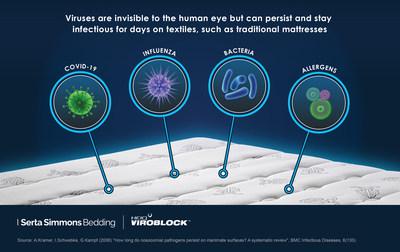
ATLANTA, July 16, 2020 /PRNewswire/ — Serta Simmons Bedding (SSB) announced today that it is partnering with Switzerland-based HeiQ Group, a leader in textile innovation, to create the U.S. market’s first antiviral mattress.
The agreement gives SSB exclusive access within the U.S. bedding category to HeiQ Viroblock™ technology, which has previously been approved by the European Medical Device Directive for antiviral use in medical personal protective equipment such as N95 equivalent masks, and registered as an antiviral active by the German EPA. HeiQ Viroblock™ was recently independently tested as 99.99% effective in 30 minutes against SARS-CoV-2 by a leading Australian infection and immunity research institute. SSB plans to pursue any necessary approvals for its line of Serta and Beautyrest HeiQ Viroblock mattresses with the U.S. Food & Drug Administration and Environmental Protection Agency.
If approved, SSB plans to utilize HeiQ Viroblock across much of its industry-leading portfolio of brands, which includes Serta, Beautyrest and Tuft & Needle.
“We know that our partners in the hospitality and healthcare industries are doing everything they can to help provide the cleanest environment and reassure their guests,” said David Swift, chairman and CEO of Serta Simmons Bedding. “Antiviral and antibacterial mattresses will be an enormous asset in that effort.”
SSB, the largest provider of mattresses to the hospitality industry, has already received early interest to acquire HeiQ Viroblock-treated mattresses from several of the world’s largest hotel brands to bolster cleanliness and safety initiatives. Elie Khoury, EVP operations resources at Aimbridge Hospitality, the global leader in hotel management services said, “As the largest third-party manager we are proactively searching for the best opportunities to add value for our owners and enhance the experience for our guests. We are currently testing the new antiviral bedding and accessories from Serta Simmons and eager to understand the impact in helping our properties deliver the highest level of safety and cleanliness for guests.”
Here’s why HeiQ Viroblock represents such a breakthrough for the mattress industry: Virus particles and bacteria are invisible to the human eye (SARS-CoV-2 is only 90 nanometers large) and they easily pass through sheets. They can persist and stay infectious for days on textiles, such as traditional mattresses. HeiQ’s Viroblock technology solves that problem by using microsilver technology that attracts virus particles, combined with vesicle technology that breaks down the viral membrane within seconds. Tests conducted at the Peter Doherty Institute for Infection and Immunity showed that COVID-19-causing virus samples concentrated on fabric treated with HeiQ Viroblock were 99.99% reduced.
In accelerated aging tests, textiles infused with HeiQ Viroblock demonstrated the ability to retain their antiviral qualities for three years, and antibacterial qualities for 20 years.
Serta Simmons Bedding has been active in the fight against COVID-19 in other ways as well. In March, it announced it was donating 10,000 mattresses to hospitals in areas hard hit by the pandemic. A few weeks later it launched a platform in conjunction with Relief Bed International to facilitate further donations.
About Serta Simmons Bedding LLC
Serta Simmons Bedding, LLC is one of the largest manufacturers, marketers and suppliers of mattresses in North America. Based in Atlanta, SSB owns and manages two of the best-selling bedding brands in the mattress industry: Serta®, which has five other independent licensees, and Beautyrest®. The brands are distributed through national, hospitality, and regional and independent retail channels throughout North America. SSB also owns Simmons® and Tuft & Needle® direct-to-consumer mattress brands. SSB operates 27 plants in the U.S. and Canada. For more information about SSB and its brands, visit www.sertasimmons.com.
About HeiQ
Founded in 2005 as a spin-off from the Swiss Federal Institute of Technology Zurich (ETH), HeiQ is a leader in textile innovation creating some of the most effective, durable and high-performance textile technologies on the market today. HeiQ’s purpose is to improve the lives of billions of people by perfecting an everyday product: Textiles. Combining three areas of expertise – scientific research, specialty materials manufacturing and consumer ingredient branding – HeiQ is the ideal innovation partner to create differentiating and sustainable textile products and capture the added value at the point of sale. With a total capacity of 35,000 tons per year HeiQ manufactures in the USA, Switzerland and Australia serving its chemical specialties in over 60 countries worldwide. www.heiq.com
HeiQ & HeiQ Viroblock are trademark(s) or registered trademark(s) of HeiQ Materials AG.
View original content to download multimedia: http://www.prnewswire.com/news-releases/serta-simmons-bedding-developing-us-first-antiviral-mattress-301094461.html
SOURCE Serta Simmons Bedding, LLC
https://apnews.com/PR%20Newswire/7429fe85bf53e1fa936b550ad42e113c
July 16, 2020
Serta Simmons’ Antiviral Mattress
Serta Simmons Bedding Developing U.S.′ First Antiviral Mattress
today
ATLANTA, July 16, 2020 /PRNewswire/ — Serta Simmons Bedding (SSB) announced today that it is partnering with Switzerland-based HeiQ Group, a leader in textile innovation, to create the U.S. market’s first antiviral mattress.
The agreement gives SSB exclusive access within the U.S. bedding category to HeiQ Viroblock™ technology, which has previously been approved by the European Medical Device Directive for antiviral use in medical personal protective equipment such as N95 equivalent masks, and registered as an antiviral active by the German EPA. HeiQ Viroblock™ was recently independently tested as 99.99% effective in 30 minutes against SARS-CoV-2 by a leading Australian infection and immunity research institute. SSB plans to pursue any necessary approvals for its line of Serta and Beautyrest HeiQ Viroblock mattresses with the U.S. Food & Drug Administration and Environmental Protection Agency.
If approved, SSB plans to utilize HeiQ Viroblock across much of its industry-leading portfolio of brands, which includes Serta, Beautyrest and Tuft & Needle.
“We know that our partners in the hospitality and healthcare industries are doing everything they can to help provide the cleanest environment and reassure their guests,” said David Swift, chairman and CEO of Serta Simmons Bedding. “Antiviral and antibacterial mattresses will be an enormous asset in that effort.”
SSB, the largest provider of mattresses to the hospitality industry, has already received early interest to acquire HeiQ Viroblock-treated mattresses from several of the world’s largest hotel brands to bolster cleanliness and safety initiatives. Elie Khoury, EVP operations resources at Aimbridge Hospitality, the global leader in hotel management services said, “As the largest third-party manager we are proactively searching for the best opportunities to add value for our owners and enhance the experience for our guests. We are currently testing the new antiviral bedding and accessories from Serta Simmons and eager to understand the impact in helping our properties deliver the highest level of safety and cleanliness for guests.”
Here’s why HeiQ Viroblock represents such a breakthrough for the mattress industry: Virus particles and bacteria are invisible to the human eye (SARS-CoV-2 is only 90 nanometers large) and they easily pass through sheets. They can persist and stay infectious for days on textiles, such as traditional mattresses. HeiQ’s Viroblock technology solves that problem by using microsilver technology that attracts virus particles, combined with vesicle technology that breaks down the viral membrane within seconds. Tests conducted at the Peter Doherty Institute for Infection and Immunity showed that COVID-19-causing virus samples concentrated on fabric treated with HeiQ Viroblock were 99.99% reduced.
In accelerated aging tests, textiles infused with HeiQ Viroblock demonstrated the ability to retain their antiviral qualities for three years, and antibacterial qualities for 20 years.
Serta Simmons Bedding has been active in the fight against COVID-19 in other ways as well. In March, it announced it was donating 10,000 mattresses to hospitals in areas hard hit by the pandemic. A few weeks later it launched a platform in conjunction with Relief Bed International to facilitate further donations.
About Serta Simmons Bedding LLC
Serta Simmons Bedding, LLC is one of the largest manufacturers, marketers and suppliers of mattresses in North America. Based in Atlanta, SSB owns and manages two of the best-selling bedding brands in the mattress industry: Serta®, which has five other independent licensees, and Beautyrest®. The brands are distributed through national, hospitality, and regional and independent retail channels throughout North America. SSB also owns Simmons® and Tuft & Needle® direct-to-consumer mattress brands. SSB operates 27 plants in the U.S. and Canada. For more information about SSB and its brands, visit www.sertasimmons.com.
About HeiQ
Founded in 2005 as a spin-off from the Swiss Federal Institute of Technology Zurich (ETH), HeiQ is a leader in textile innovation creating some of the most effective, durable and high-performance textile technologies on the market today. HeiQ’s purpose is to improve the lives of billions of people by perfecting an everyday product: Textiles. Combining three areas of expertise – scientific research, specialty materials manufacturing and consumer ingredient branding – HeiQ is the ideal innovation partner to create differentiating and sustainable textile products and capture the added value at the point of sale. With a total capacity of 35,000 tons per year HeiQ manufactures in the USA, Switzerland and Australia serving its chemical specialties in over 60 countries worldwide. www.heiq.com
HeiQ & HeiQ Viroblock are trademark(s) or registered trademark(s) of HeiQ Materials AG.
View original content to download multimedia: http://www.prnewswire.com/news-releases/serta-simmons-bedding-developing-us-first-antiviral-mattress-301094461.html
SOURCE Serta Simmons Bedding, LLC
https://apnews.com/PR%20Newswire/7429fe85bf53e1fa936b550ad42e113c
July 7, 2020
BASF Recycling Project
BASF advances chemical polyurethane recycling
by Craig Bettenhausen
July 4, 2020 | APPEARED IN VOLUME 98, ISSUE 26
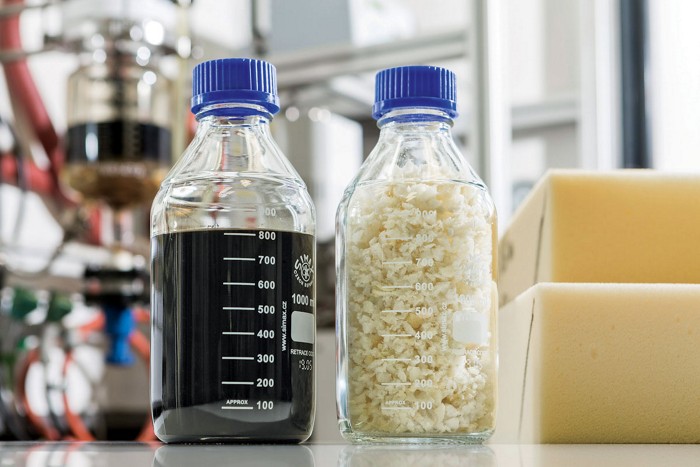 Credit: BASF BASF plans to convert polyurethane foam mattresses back into the polyol (brown bottle, left) from which they’re made.
In a lab in Brandenburg, Germany, BASF researchers are turning polyurethane mattress foam back into its polyol starting materials. It’s easy to sort mattresses out of waste streams but not to recycle them. That combination makes mattresses an attractive target for BASF’s drive toward circular supply chains, says technical project manager Arno Volkmann. The firm expects to have pilot quantities of recycled polyol later this year. BASF says it is also working to recover diisocyanate, the other major foam component.
July 7, 2020
BASF Recycling Project
BASF advances chemical polyurethane recycling
by Craig Bettenhausen
July 4, 2020 | APPEARED IN VOLUME 98, ISSUE 26
Credit: BASF BASF plans to convert polyurethane foam mattresses back into the polyol (brown bottle, left) from which they’re made.
In a lab in Brandenburg, Germany, BASF researchers are turning polyurethane mattress foam back into its polyol starting materials. It’s easy to sort mattresses out of waste streams but not to recycle them. That combination makes mattresses an attractive target for BASF’s drive toward circular supply chains, says technical project manager Arno Volkmann. The firm expects to have pilot quantities of recycled polyol later this year. BASF says it is also working to recover diisocyanate, the other major foam component.
June 24, 2020
Space Junk
Nothing to do with anything, but interesting . . .
Foam ‘spider webs’ from tiny satellites could help clean up space junk
By Mike Wall a day ago
The foam could even serve as a building material on Mars, if all goes according to plan.
A little foam-spewing spacecraft could make a big dent in the space-junk problem in the coming years.
The Russian startup StartRocket is developing a “Foam Debris Catcher,” a small, autonomous satellite that would snag and de-orbit space debris using sticky polymer foam.
“It’s like a spider web,” StartRocket founder Vlad Sitnikov told Space.com.
Earth orbit is cluttered with about 129 million pieces of debris, 34,000 of which are at least 4 inches (10 centimeters) wide, according to European Space Agency estimates. These objects are hurtling through space at tremendous speeds — 17,500 mph (28,200 km/h) in low-Earth orbit, for example — so even the tiny shards could seriously damage a satellite or spacecraft.
And the space-junk threat is rising, experts say, because we’re putting a lot more stuff into orbit than we used to — and the numbers are poised to go through the roof. Humanity has launched fewer than 10,000 satellites since the dawn of the space age in 1957. But SpaceX has secured permission to loft 12,000 craft just for its Starlink internet-satellite constellation and has applied for approval to launch up to 30,000 more.
A crowded orbital environment increases the risk of collisions. And just a few smashups involving satellites — be they operational or defunct — could spawn enormous new swarms of debris, potentially instigating a nightmare collision cascade known as the Kessler Syndrome.
If we don’t take action soon, Sitnikov said, “we will be in jail. We will be in a prison made by debris.”
StartRocket wants the barrel-shaped Foam Debris Catcher to help keep us out of jail. The 110-lb. (50 kilograms) satellite would extrude lattices of foam when it gets close to debris clouds, trapping lots of junk. Atmospheric drag would then work on the encased debris, sending it down to its death in Earth’s atmosphere.
StartRocket isn’t alone in developing debris-mitigation tech. For example, some groups are working on systems that would harpoon space junk or snare it using net-launching guns. And others have devised friction-increasing “drag sails” that satellites could deploy near the ends of their lives, ensuring speedy destruction.
StartRocket has made progress on the foam but still needs to finalize the formula, said project leader Aleksei Fedorov, a chemical engineer.
Nailing down the formula and testing it here on Earth is the first big milestone for the company to meet, Sitnikov and Fedorov said. The second milestone, targeted for 2022, is the launch of a cubesat that will extrude a test sample in Earth orbit, to make sure that the foam behaves as planned in the space environment. If that goes well, StartRocket will work toward lofting its first functional Foam Debris Catcher, potentially as early as 2023.
Development work in these early stages has been supported by Kaspersky, a Russian cybersecurity company owned by billionaire Eugene Kaspersky.
“The solution being developed by StartRocket is an interesting example of how technology is changing and can be used to reduce space debris,” Andrew Winton, vice president of marketing at Kaspersky, said in a statement. “We will watch the company’s development and product progression with great interest and look forward to supporting the cause in the coming years.”
But StartRocket — which made news in 2018 for a controversial plan, now on hold, to create advertisements in space using formation-flying satellites — is also looking to the masses to help fund the space-junk project going forward.
“We believe in the people — we’re going to ask people to give us money,” Sitnikov told Forbes. “It’s like Greenpeace — maybe we’ll be the second Greenpeace!”
The sticky-foam tech could also find uses far beyond Earth orbit, if everything goes according to plan. For example, Fedorov and Sitnikov envision the stuff, or something like it, eventually being employed as a cheap and efficient building material on Mars.
A barrel could be sent to the Martian surface instead of huge metallic habitats. The barrel would expel a big half-sphere of foam, and “astronauts can use just a knife to make the building, the habitat,” Sitnikov said.
- Space junk explained: How orbital debris threatens future of spaceflight (infographic)
- This space junk removal experiment will harpoon & net debris in orbit
- Latest news about space junk and orbital debris
Mike Wall is the author of “Out There” (Grand Central Publishing, 2018; illustrated by Karl Tate), a book about the search for alien life. Follow him on Twitter @michaeldwall. Follow us on Twitter @Spacedotcom or Facebook.
 Everchem Updates Archive
  Sign Up for Email Updates