
Technology

July 18, 2018

Tesla Uses Acoustic Foam Inside Their Tires

DIY

Tesla owner cuts open Model X tire to reveal acoustic foam used for noise reduction


A video uploaded on YouTube showcases Tesla’s use foam-lined tires to ensure that its vehicles are as silent as they can be on the road. As it turns out, however, inexperienced tire centers can find it quite difficult to repair Tesla’s tires of choice due to their noise-reducing components.

Acoustically insulated tires were introduced as a result of vehicles generally getting quieter. With the advent of electric cars thanks to trendsetters like Tesla, something as neglected as the noise produced by non-insulated tires become points for improvement. Thus, sound insulating tires started getting more popular. Continental’s ContiSilent tires, which are used in some of Tesla’s electric cars, for one, features insulation that reduces cabin noise by up to 9 dB(A), depending on the type of vehicle and road surface.

The video, uploaded by popular YouTube channel What’s Inside, featured a collaboration with the streaming service’s tech teardown specialist, JerryRigEverything. Dan, the host of What’s Inside, noted that he recently attempted to have his Tesla Model X’s tire repaired in a Discount Tire Center after it got punctured by a nail. To his surprise, the tire center informed him that they do not fix Model X tires, since Tesla uses proprietary components that could be damaged.

Thus, the collaboration with JerryRigEverything. Zack, the host of the YouTube tech channel has made a name for himself from his teardowns of popular tech products (he also tore down a Tesla Powerbank before). The two YouTubers opted to pierce the sidewall of the Model X at first, before opening it up fully with an angle grinder. As could be seen in the video, the insides of the Model X’s Pirelli tires featured a thick strip of foam running around the tire. This strip of foam, as noted by Elon Musk in a tweet last year, could be described as an “internal acoustic foam,” which is designed to minimize road noise.

Tesla’s vehicles are fully-electric, which meansthat they are incredibly silent on the road. This also means that every sound in any of the car’s components, including its tires, could be heard audibly inside the cabin. This was recently mentioned by Elon Musk in a conversation with Consumer Reports about the Model 3, with the CEO stating that Tesla opted to change some of the vehicle’s interior materials after they were found to cause extra noise. Tesla’s 2012 Model S initially came equipped with Continental’s ExtremeContact DW tires, which are pretty silent on their own. As noted in anecdotes from the Tesla community, later tires, which included the sound-reducing technology, were far more silent and provided more comfort.

As noted by the What’s Inside host, however, Tesla’s noise-canceling tires could ultimately be viewed as difficulties by some tire repair centers. Nevertheless, patching up a Tesla’s tire is actually quite simple, as all that needs to be done is to peel off the acoustic foam before covering up any punctures or holes. Once the tire’s puncture is fixed, a simple layer of adhesive to the peeled off parts of the foam should set it back in place.


Tesla owner cuts open Model X tire to reveal acoustic foam used for noise reduction
July 18, 2018

Tesla Uses Acoustic Foam Inside Their Tires

DIY

Tesla owner cuts open Model X tire to reveal acoustic foam used for noise reduction


A video uploaded on YouTube showcases Tesla’s use foam-lined tires to ensure that its vehicles are as silent as they can be on the road. As it turns out, however, inexperienced tire centers can find it quite difficult to repair Tesla’s tires of choice due to their noise-reducing components.

Acoustically insulated tires were introduced as a result of vehicles generally getting quieter. With the advent of electric cars thanks to trendsetters like Tesla, something as neglected as the noise produced by non-insulated tires become points for improvement. Thus, sound insulating tires started getting more popular. Continental’s ContiSilent tires, which are used in some of Tesla’s electric cars, for one, features insulation that reduces cabin noise by up to 9 dB(A), depending on the type of vehicle and road surface.

The video, uploaded by popular YouTube channel What’s Inside, featured a collaboration with the streaming service’s tech teardown specialist, JerryRigEverything. Dan, the host of What’s Inside, noted that he recently attempted to have his Tesla Model X’s tire repaired in a Discount Tire Center after it got punctured by a nail. To his surprise, the tire center informed him that they do not fix Model X tires, since Tesla uses proprietary components that could be damaged.

Thus, the collaboration with JerryRigEverything. Zack, the host of the YouTube tech channel has made a name for himself from his teardowns of popular tech products (he also tore down a Tesla Powerbank before). The two YouTubers opted to pierce the sidewall of the Model X at first, before opening it up fully with an angle grinder. As could be seen in the video, the insides of the Model X’s Pirelli tires featured a thick strip of foam running around the tire. This strip of foam, as noted by Elon Musk in a tweet last year, could be described as an “internal acoustic foam,” which is designed to minimize road noise.

Tesla’s vehicles are fully-electric, which meansthat they are incredibly silent on the road. This also means that every sound in any of the car’s components, including its tires, could be heard audibly inside the cabin. This was recently mentioned by Elon Musk in a conversation with Consumer Reports about the Model 3, with the CEO stating that Tesla opted to change some of the vehicle’s interior materials after they were found to cause extra noise. Tesla’s 2012 Model S initially came equipped with Continental’s ExtremeContact DW tires, which are pretty silent on their own. As noted in anecdotes from the Tesla community, later tires, which included the sound-reducing technology, were far more silent and provided more comfort.

As noted by the What’s Inside host, however, Tesla’s noise-canceling tires could ultimately be viewed as difficulties by some tire repair centers. Nevertheless, patching up a Tesla’s tire is actually quite simple, as all that needs to be done is to peel off the acoustic foam before covering up any punctures or holes. Once the tire’s puncture is fixed, a simple layer of adhesive to the peeled off parts of the foam should set it back in place.


Tesla owner cuts open Model X tire to reveal acoustic foam used for noise reduction

July 9, 2018

Chinese Propylene Oxide Production Process Forecast

Is the Chlorohydrination Process Declining?

2018-07-09    [Source:PUdaily]

share:

PUdaily, Shanghai– With the deepening of the environmental inspection campaign of revisiting the previously inspected provinces, which was launched in May, the first round of special “revisit” inspection is coming to an end. Plus the introduction of environmental tax at the beginning of the year, 2018 is a milestone year for the chemical industry when environmental rectification is carried out.

Although the inspection has not had significant negative impact on upstream PO production, the new Environmental Protection Comprehensive Directory (2017 Edition) classified PO as high-pollution products (except for PO produced by direct oxidation process). Today, PUdaily would like to talk about the challenges faced by chlorohydrination process and the corresponding possible solutions.

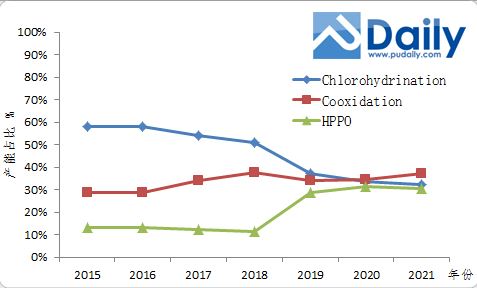
At present, the domestic PO facilities using chlorohydrination process account for 54% of the total PO production capacity. In the next few years, facilities using chlorohydrination process are expected to account for 33-37% of the total capacity (Fig. 1). From 2018 to 2021, more units using cooxidation process and direct oxidation proccess will be built. It is expected that four HPPO facilities and one or two PO/SM facilities will be built in 2019 alone. If all the units are put into production as planned, the additional capacity will amount to more than 1 million tons per year. This will undoubtedly have a great impact on PO producers using the traditional chlorohydrination process.

Fig.1 three PO production processes’ share of the total capacity over the next 3 years

Note: the forecast is based on the data collected by PUdaily

How to improve the process to solve pollution while maintaining the advantage of low cost is a problem faced by all PO producers adopting the chlorohydrination process.


As is known to all, the problem of “three wastes” is the main factor that makes the chlorohydrination process less competitive than the cooxidation process and the direct oxidation process. The large amounts of waste water, waste gas and waste residue make the chlorohydrination process an environmentally unfriendly process. However, thanks to the efforts of many PO manufacturers many new technologies and solutions emerge, providing new approaches to solve the problem.

1) Waste gas

The waste gases produced in the chlorohydrination process mainly include chlorohydrination tail gas and other tail gases (including tail gases produced in saponification, distillation and caustic washing systems). The main components of chlorohydrination tail gas are propane, propylene, oxygen, nitrogen and water. Of which oxygen has an amount of 40vol%, and propane and propylene has a combined amount of 20vol%. In order to avoid the safety hazards such as explosion caused by conventional oxidation treatment, the main treatment method in the industry is to mix the waste gas with a large amount of air and then pump them into the combustion furnace. In the combustion furnace, propylene and propane are combusted as fuels. The tail gases discharged from the furnace are mainly carbon dioxide and nitrogen, which completely meet the environmental standards in the testing.

Tail gases from other apparatus include propylene, propane, epoxy propane, dichloropropane, nitrogen, oxygen and water. All these tail gases will be pumped into the water scrubber after nitrogen blanketting. Propylene oxide and propylene dichloride dissolve in the water. Other water-insoluble gases are recovered for additional chlorohydrination. Propylene oxide dissolved in the water is recovered using the distillation column, thus increasing the output of the chemical. Other wastewater in which organics are dissolved is discharged into the sewage-treatment plant.

2) Waste water

45 tons of high-salinity wastewater are produced when producing 1 ton of propylene oxide. In China, this waste water is generally discharged into the wastewater treatment plant for treatment. However, the problem of high salinity (the content of calcium chloride is 4%) in the waste water has drawn the attention of domestic environmental authorities. For example, Shandong Department of Environmental Protection has proposed a technical specification aiming at restricting the discharge of high-salinity wastewater into inland rivers. In response, some enterprises discharge such waste water into the sea after it is treated to meet the standards. It is reported that desired results are achieved.

3) Waste residue


For 1 ton of propylene oxide produced, 1.2-2.0 m³ of saponification waste residue will be produced. The waste residue, fly ash and attle can be used as raw materials to make standard bricks for building use, whose quality is even better than that of clay bricks. Presently, the production of solid clay bricks has been banned because of its heavy consumption of land resources. It is expected that there is a broad market for the bricks made using waste residue. In addition, the waste residue will probably be widely used in construction, roads building and other fields.

Here, we would like to express our gratitude to all the researchers who are devoted to studying the problem of “three wastes” produced in chlorohydrination process. It is their sustained efforts that have made it possible to improve this process.

At the same time, PUdaily holds that although the more environmental-friendly cooxidation process and direct oxidation proccess are the trend, considering the many limiting factors, the chlorohydrination process will not be eliminated in the short term. Manufacturers adopting this process should not stop their efforts in research and innovation, but actively solve the problems of safety and “three wastes”. But it must be admitted that the additional costs incurred may make the advantage of low price disappear. PUdaily will keep an eye on the developments of PO production processes. Also, we hope the researchers will make further progress in improving the chlorohydrination process, ensuring environmental protection and costs controlling.

http://www.pudaily.com/News/NewsView.aspx?nid=72590

July 9, 2018

Chinese Propylene Oxide Production Process Forecast

Is the Chlorohydrination Process Declining?

2018-07-09    [Source:PUdaily]

share:

PUdaily, Shanghai– With the deepening of the environmental inspection campaign of revisiting the previously inspected provinces, which was launched in May, the first round of special “revisit” inspection is coming to an end. Plus the introduction of environmental tax at the beginning of the year, 2018 is a milestone year for the chemical industry when environmental rectification is carried out.

Although the inspection has not had significant negative impact on upstream PO production, the new Environmental Protection Comprehensive Directory (2017 Edition) classified PO as high-pollution products (except for PO produced by direct oxidation process). Today, PUdaily would like to talk about the challenges faced by chlorohydrination process and the corresponding possible solutions.

At present, the domestic PO facilities using chlorohydrination process account for 54% of the total PO production capacity. In the next few years, facilities using chlorohydrination process are expected to account for 33-37% of the total capacity (Fig. 1). From 2018 to 2021, more units using cooxidation process and direct oxidation proccess will be built. It is expected that four HPPO facilities and one or two PO/SM facilities will be built in 2019 alone. If all the units are put into production as planned, the additional capacity will amount to more than 1 million tons per year. This will undoubtedly have a great impact on PO producers using the traditional chlorohydrination process.

Fig.1 three PO production processes’ share of the total capacity over the next 3 years

Note: the forecast is based on the data collected by PUdaily

How to improve the process to solve pollution while maintaining the advantage of low cost is a problem faced by all PO producers adopting the chlorohydrination process.


As is known to all, the problem of “three wastes” is the main factor that makes the chlorohydrination process less competitive than the cooxidation process and the direct oxidation process. The large amounts of waste water, waste gas and waste residue make the chlorohydrination process an environmentally unfriendly process. However, thanks to the efforts of many PO manufacturers many new technologies and solutions emerge, providing new approaches to solve the problem.

1) Waste gas

The waste gases produced in the chlorohydrination process mainly include chlorohydrination tail gas and other tail gases (including tail gases produced in saponification, distillation and caustic washing systems). The main components of chlorohydrination tail gas are propane, propylene, oxygen, nitrogen and water. Of which oxygen has an amount of 40vol%, and propane and propylene has a combined amount of 20vol%. In order to avoid the safety hazards such as explosion caused by conventional oxidation treatment, the main treatment method in the industry is to mix the waste gas with a large amount of air and then pump them into the combustion furnace. In the combustion furnace, propylene and propane are combusted as fuels. The tail gases discharged from the furnace are mainly carbon dioxide and nitrogen, which completely meet the environmental standards in the testing.

Tail gases from other apparatus include propylene, propane, epoxy propane, dichloropropane, nitrogen, oxygen and water. All these tail gases will be pumped into the water scrubber after nitrogen blanketting. Propylene oxide and propylene dichloride dissolve in the water. Other water-insoluble gases are recovered for additional chlorohydrination. Propylene oxide dissolved in the water is recovered using the distillation column, thus increasing the output of the chemical. Other wastewater in which organics are dissolved is discharged into the sewage-treatment plant.

2) Waste water

45 tons of high-salinity wastewater are produced when producing 1 ton of propylene oxide. In China, this waste water is generally discharged into the wastewater treatment plant for treatment. However, the problem of high salinity (the content of calcium chloride is 4%) in the waste water has drawn the attention of domestic environmental authorities. For example, Shandong Department of Environmental Protection has proposed a technical specification aiming at restricting the discharge of high-salinity wastewater into inland rivers. In response, some enterprises discharge such waste water into the sea after it is treated to meet the standards. It is reported that desired results are achieved.

3) Waste residue


For 1 ton of propylene oxide produced, 1.2-2.0 m³ of saponification waste residue will be produced. The waste residue, fly ash and attle can be used as raw materials to make standard bricks for building use, whose quality is even better than that of clay bricks. Presently, the production of solid clay bricks has been banned because of its heavy consumption of land resources. It is expected that there is a broad market for the bricks made using waste residue. In addition, the waste residue will probably be widely used in construction, roads building and other fields.

Here, we would like to express our gratitude to all the researchers who are devoted to studying the problem of “three wastes” produced in chlorohydrination process. It is their sustained efforts that have made it possible to improve this process.

At the same time, PUdaily holds that although the more environmental-friendly cooxidation process and direct oxidation proccess are the trend, considering the many limiting factors, the chlorohydrination process will not be eliminated in the short term. Manufacturers adopting this process should not stop their efforts in research and innovation, but actively solve the problems of safety and “three wastes”. But it must be admitted that the additional costs incurred may make the advantage of low price disappear. PUdaily will keep an eye on the developments of PO production processes. Also, we hope the researchers will make further progress in improving the chlorohydrination process, ensuring environmental protection and costs controlling.

http://www.pudaily.com/News/NewsView.aspx?nid=72590

June 20, 2018

New Technology from Dow

Dow Collaborates with Vending Machine Manufacturer to Refresh Sustainability of Refrigerated Beverage Machines

Low-Global-Warming Polyurethane Foam Insulation Helps Meet ENERGY STAR® version 4.0, upcoming HFC regulations


MIDLAND, Mich. – June 20, 2018 – As a trusted supplier to high-quality vending machine manufacturers for over 25 years, The Dow Chemical Company created a brand new low-global-warming-potential polyurethane foam insulation solution that also delivers weight reduction and improves thermal insulation. The insulation will help a cold-drink vending machine manufacturer meet the more stringent ENERGY STAR® version 4.0 with a solution that will be compliant with global blowing agent regulations.


The custom formulated polyurethane insulation solution’s excellent mechanical properties, good flow, and superior curing profile delivered a 15 percent weight reduction and 10 percent thermal insulation improvement over the incumbent low-global-warming-potential system, helping ensure the cold-drink vending machines meet the qualifications for ENERGY STAR version 4.0.  Compared to competitive solutions using hydrofluorocarbon foam blowing agents, Dow’s solution delivers the same or better performance with a global warming potential 99.9 percent lower, providing a more sustainable solution that will be compliant with upcoming global regulations on foam blowing agents.


“We know how challenging it can be for companies and brand owners to keep up with U.S. Department of Energy standards, SNAP regulations, and end-user requirements,” said Robert York, market manager for Dow Polyurethanes. “Dow is fully committed to staying ahead of these changes, and bringing more sustainable, SNAP compliant formulations to the marketplace for our customers.”


Polyurethane rigid foam is one of the best insulation materials available to help achieve energy efficiency targets, reduce costs and mitigate greenhouse gas emissions. For companies and brand owners impacted by SNAP regulations, Dow has developed polyurethane-based solutions that will fully comply with all applicable regulations once they become law.


With decades of technical experience, Dow is proud to offer solutions to meet the specific needs of each customer and help manufacturers meet increasingly demanding energy standards in the commercial appliance industry.


About Dow Polyurethanes

Dow Polyurethanes develops and delivers a broad portfolio of technologies and customized solutions to customers in a variety of industries under its DurableScience, ComfortScience and InsulationScience category brands. Applications range from industrial and infrastructure solutions, to consumer comfort solutions in flooring, furniture bedding and footwear, to automotive solutions for vehicle interior, and energy-efficient insulation materials. The business manufactures and sells key chemical components as well as fully-formulated polyurethane systems for rigid, semi-rigid and flexible foams, and coatings, adhesives, sealants, elastomers and composites. Dow is the world’s largest producer of propylene oxide (PO), propylene glycol (PG), and polyether polyols, and is a leading producer of quality aromatic isocyanates, such as MDI. Striving to meet the specific needs of its customers in their local geographic regions, Dow Polyurethanes operates a global network of production sites and systems houses, as well as innovation and service centers. The business has an ongoing initiative to lead the industry in providing high-performance products that meet critical market needs and contribute to a more comfortable, healthier and resilient society. For more information, visit www.dowpolyurethanes.com and follow us on Twitter and LinkedIn.