Technology

June 20, 2018

New Technology from Dow

Dow Collaborates with Vending Machine Manufacturer to Refresh Sustainability of Refrigerated Beverage Machines

Low-Global-Warming Polyurethane Foam Insulation Helps Meet ENERGY STAR® version 4.0, upcoming HFC regulations


MIDLAND, Mich. – June 20, 2018 – As a trusted supplier to high-quality vending machine manufacturers for over 25 years, The Dow Chemical Company created a brand new low-global-warming-potential polyurethane foam insulation solution that also delivers weight reduction and improves thermal insulation. The insulation will help a cold-drink vending machine manufacturer meet the more stringent ENERGY STAR® version 4.0 with a solution that will be compliant with global blowing agent regulations.


The custom formulated polyurethane insulation solution’s excellent mechanical properties, good flow, and superior curing profile delivered a 15 percent weight reduction and 10 percent thermal insulation improvement over the incumbent low-global-warming-potential system, helping ensure the cold-drink vending machines meet the qualifications for ENERGY STAR version 4.0.  Compared to competitive solutions using hydrofluorocarbon foam blowing agents, Dow’s solution delivers the same or better performance with a global warming potential 99.9 percent lower, providing a more sustainable solution that will be compliant with upcoming global regulations on foam blowing agents.


“We know how challenging it can be for companies and brand owners to keep up with U.S. Department of Energy standards, SNAP regulations, and end-user requirements,” said Robert York, market manager for Dow Polyurethanes. “Dow is fully committed to staying ahead of these changes, and bringing more sustainable, SNAP compliant formulations to the marketplace for our customers.”


Polyurethane rigid foam is one of the best insulation materials available to help achieve energy efficiency targets, reduce costs and mitigate greenhouse gas emissions. For companies and brand owners impacted by SNAP regulations, Dow has developed polyurethane-based solutions that will fully comply with all applicable regulations once they become law.


With decades of technical experience, Dow is proud to offer solutions to meet the specific needs of each customer and help manufacturers meet increasingly demanding energy standards in the commercial appliance industry.


About Dow Polyurethanes

Dow Polyurethanes develops and delivers a broad portfolio of technologies and customized solutions to customers in a variety of industries under its DurableScience, ComfortScience and InsulationScience category brands. Applications range from industrial and infrastructure solutions, to consumer comfort solutions in flooring, furniture bedding and footwear, to automotive solutions for vehicle interior, and energy-efficient insulation materials. The business manufactures and sells key chemical components as well as fully-formulated polyurethane systems for rigid, semi-rigid and flexible foams, and coatings, adhesives, sealants, elastomers and composites. Dow is the world’s largest producer of propylene oxide (PO), propylene glycol (PG), and polyether polyols, and is a leading producer of quality aromatic isocyanates, such as MDI. Striving to meet the specific needs of its customers in their local geographic regions, Dow Polyurethanes operates a global network of production sites and systems houses, as well as innovation and service centers. The business has an ongoing initiative to lead the industry in providing high-performance products that meet critical market needs and contribute to a more comfortable, healthier and resilient society. For more information, visit www.dowpolyurethanes.com and follow us on Twitter and LinkedIn.


June 5, 2018

Underwater Epoxy Product

A special formula for epoxy resins has been developed at TU Wien, which can be used for fibre-reinforced composites in aerospace, shipbuilding and automotive manufacturing, or even for underwater renovation. This is achieved merely by irradiating any part of the resin with light.

Within seconds the new material can be completely transformed. Initially, the material is transparent and either in liquid or paste form; then, when any part of it is irradiated with the appropriate , the entire  begins to solidify and takes on a dark colour. The special epoxy resin formula that makes this possible has been patented by TU Wien. Now, researchers have even successfully carried out the process underwater. This means that the new epoxy resin can be used for jobs that, up until now, had been very difficult to carry out, such as filling underwater cracks in bridge pillars or dams, or repairing pipes during ongoing operation.

As a further novelty, the special formula can be applied in combination with carbon fibres and carbon fibre mats. Many possibilities arise for applications in aerospace engineering, wind turbines, shipbuilding or automotive industry—in every field where highest mechanical properties need to be combined with lightweight design.

Ordinary material with an extraordinary addition

Epoxy resins are standard materials that are used in the industrial sector for many different purposes, such as insulating electronic components or securing mechanical parts. The research group headed up by Professor Robert Liska (Institute of Applied Synthetic Chemistry, TU Wien) develops additives that are added to ordinary epoxy resin in order to adjust its properties and enable targeted curing at the touch of a button.

“We are developing special compounds in which light triggers a chemical reaction”, explains Robert Liska. “This can be a bright flash of visible light, but we also have compounds which only react to UV light.” At the point where the light strikes the resin, a reaction is started that releases heat. This heat spreads and initiates a chemical cascade elsewhere until all the resin has been cured.

“The key advantage of this method is that it isn’t necessary to illuminate the entire resin as with other light-curing materials”, explains Liska. “It’s sufficient to irradiate any part of the resin with light. The rest then cures even if it’s situated deep in a dark crack that you want to fill.”

Partner companies from industry have enquired whether this process would also be possible in presence of “dark” fillers or fibres as self-curing  would be extremely useful for some of these more difficult applications. “On the surface, this idea contradicts all theories”, thinks Liska. “The light has a very low penetration depth into the material because it is strongly absorbed by the carbon fibres”, still experiments at TU Wien impressively showed the working process.

Also the efficient underwater curing contradicts the theory. “Initially we didn’t think it would be possible. One would first expect that the water would chemically react with the components of the resin, and also that it would remove the heat required to sustain the reaction.” Surprisingly, however, it was still possible for the light-triggered self-curing process to take place underwater.

Carbon fibre mats can be used with the new epoxy resin. Credit: Vienna University of Technology

“A key reason for this is that the chemical reaction brings the water to the boil”, explains Robert Liska. “A thin protective layer of water vapour then forms between the hardening resin and the surrounding water.”

Researchers are now looking for further users from industry to explore the potential of this special resin. Besides the application of glass- and carbon fibre-reinforced composites in aerospace, shipbuilding and automotive manufacturing, the restoration of buildings is a particularly interesting area. For example, you could fill cracks in buildings that are built in water with viscous resin and then cure them with a flash of light. The maintenance of pipelines is another job that is often difficult to carry out – the use of the new resin could also be suitable here. “There are many possibilities and we are hoping for some interesting new ideas”, says Robert Liska.

https://www.pddnet.com/news/2018/06/underwater-adhesive

June 5, 2018

Underwater Epoxy Product

A special formula for epoxy resins has been developed at TU Wien, which can be used for fibre-reinforced composites in aerospace, shipbuilding and automotive manufacturing, or even for underwater renovation. This is achieved merely by irradiating any part of the resin with light.

Within seconds the new material can be completely transformed. Initially, the material is transparent and either in liquid or paste form; then, when any part of it is irradiated with the appropriate , the entire  begins to solidify and takes on a dark colour. The special epoxy resin formula that makes this possible has been patented by TU Wien. Now, researchers have even successfully carried out the process underwater. This means that the new epoxy resin can be used for jobs that, up until now, had been very difficult to carry out, such as filling underwater cracks in bridge pillars or dams, or repairing pipes during ongoing operation.

As a further novelty, the special formula can be applied in combination with carbon fibres and carbon fibre mats. Many possibilities arise for applications in aerospace engineering, wind turbines, shipbuilding or automotive industry—in every field where highest mechanical properties need to be combined with lightweight design.

Ordinary material with an extraordinary addition

Epoxy resins are standard materials that are used in the industrial sector for many different purposes, such as insulating electronic components or securing mechanical parts. The research group headed up by Professor Robert Liska (Institute of Applied Synthetic Chemistry, TU Wien) develops additives that are added to ordinary epoxy resin in order to adjust its properties and enable targeted curing at the touch of a button.

“We are developing special compounds in which light triggers a chemical reaction”, explains Robert Liska. “This can be a bright flash of visible light, but we also have compounds which only react to UV light.” At the point where the light strikes the resin, a reaction is started that releases heat. This heat spreads and initiates a chemical cascade elsewhere until all the resin has been cured.

“The key advantage of this method is that it isn’t necessary to illuminate the entire resin as with other light-curing materials”, explains Liska. “It’s sufficient to irradiate any part of the resin with light. The rest then cures even if it’s situated deep in a dark crack that you want to fill.”

Partner companies from industry have enquired whether this process would also be possible in presence of “dark” fillers or fibres as self-curing  would be extremely useful for some of these more difficult applications. “On the surface, this idea contradicts all theories”, thinks Liska. “The light has a very low penetration depth into the material because it is strongly absorbed by the carbon fibres”, still experiments at TU Wien impressively showed the working process.

Also the efficient underwater curing contradicts the theory. “Initially we didn’t think it would be possible. One would first expect that the water would chemically react with the components of the resin, and also that it would remove the heat required to sustain the reaction.” Surprisingly, however, it was still possible for the light-triggered self-curing process to take place underwater.

Carbon fibre mats can be used with the new epoxy resin. Credit: Vienna University of Technology

“A key reason for this is that the chemical reaction brings the water to the boil”, explains Robert Liska. “A thin protective layer of water vapour then forms between the hardening resin and the surrounding water.”

Researchers are now looking for further users from industry to explore the potential of this special resin. Besides the application of glass- and carbon fibre-reinforced composites in aerospace, shipbuilding and automotive manufacturing, the restoration of buildings is a particularly interesting area. For example, you could fill cracks in buildings that are built in water with viscous resin and then cure them with a flash of light. The maintenance of pipelines is another job that is often difficult to carry out – the use of the new resin could also be suitable here. “There are many possibilities and we are hoping for some interesting new ideas”, says Robert Liska.

https://www.pddnet.com/news/2018/06/underwater-adhesive

May 16, 2018

Reefer Insulation Primer

Both Composites and Foam Have Roles in Reefer Insulation

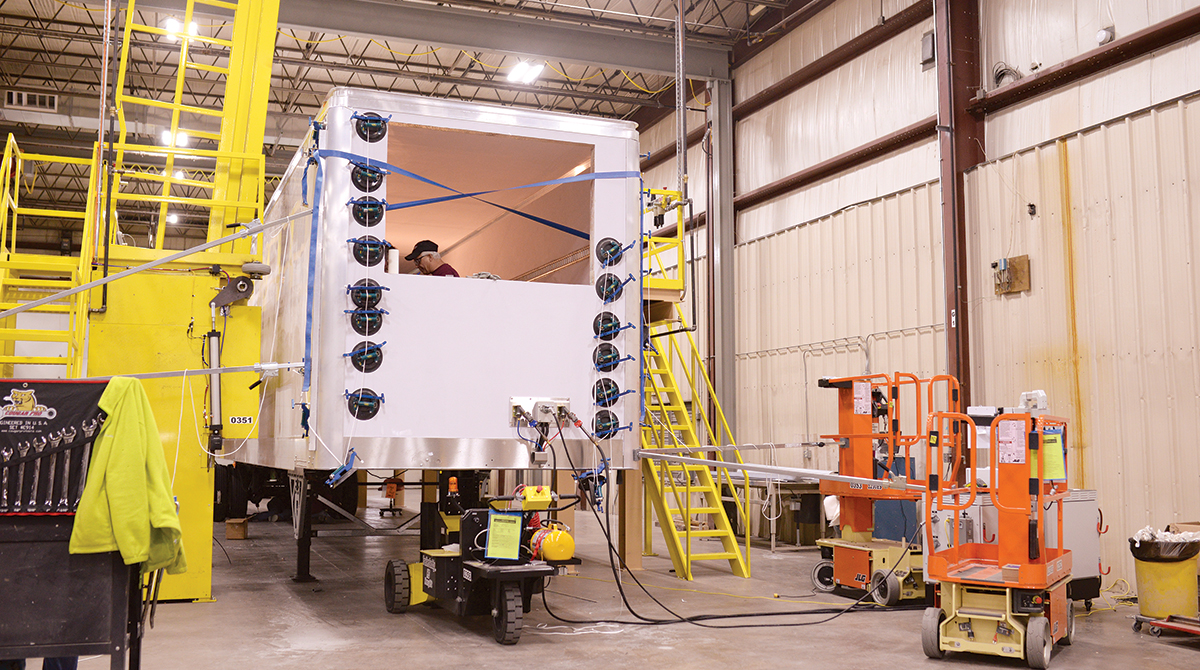
Wabash trailer Wabash refrigerated trailer under construction. (Wabash National)

http://www.ttnews.com/articles/both-composites-and-foam-have-roles-reefer-insulation

May 16, 2018

Reefer Insulation Primer

Both Composites and Foam Have Roles in Reefer Insulation

Wabash trailer Wabash refrigerated trailer under construction. (Wabash National)

http://www.ttnews.com/articles/both-composites-and-foam-have-roles-reefer-insulation