
Asian Markets
December 15, 2024
Tosoh to Expand Production Capacity to Meet Growing Demand for High-Performance Paint Hardeners
NEWS RELEASE
December 3, 2024
Tosoh to Expand Production Capacity to Meet Growing Demand for High-Performance Paint Hardeners
Tokyo, Japan—Tosoh Corporation plans to increase its production capacity for hexamethylene diisocyanate (HDI) derivatives at its Nanyo Complex in Shunan City, Yamaguchi Prefecture. The company markets its HDI derivatives under the Coronate brand.
HDI derivatives are advanced functional polyurethanes widely used as paint hardeners and are integral products in the company’s Specialty business portfolio. They are valued for their superb resistance to yellowing and weathering, which makes them essential as high-performance hardeners in automotive and architectural exterior coatings.
Tosoh’s expansion of its production capacity for HDI derivatives responds to the robust growth of the global coatings market, propelled by steady demand in developed economies, increasing demand in emerging markets amid heightened motorization, and rising demand in worldwide markets amid elevated infrastructure investments. Industry projections indicate growing demand for HDI derivatives.
The increase to HDI derivatives production capacity is thus a strategic move by Tosoh to position itself to capitalize on growing demand for and to ensure the stable supply of HDI derivatives. The company intends to significantly expand the scale of its business in HDI derivatives to increase corporate profitability. Tosoh, meanwhile, is committed to meeting the evolving needs of its customers and thus contributes to advancements in coating technologies for diverse industries.

November 18, 2024
MDI Capacity Expansion
Kumho Mitsui Chemicals Begins Operations at New MDI Production Facilities
2024.10.23
Mitsui Chemicals, Inc
Mitsui Chemicals, Inc. (Tokyo: 4183; President & CEO: HASHIMOTO Osamu) announced that affiliate Kumho Mitsui Chemicals Inc. (Seoul, South Korea; CEO: PARK Chan-Koo) has commenced operations late September at additional production facilities for methylene diphenyl diisocyanate (MDI).
 Kumho Mitsui Chemicals’ Yeosu Plant
■Overview
| 1.Product | Methylene diphenyl diisocyanate (MDI) |
|---|---|
| 2.Location | Yeosu, Jeonnam, South Korea |
| 3.Capacity increase | 200,000 tons/year (410,000 tons/year → 610,000 tons/year) |
MDI is a key raw material for polyurethane, a signature material used in numerous fields such as auto parts, bedding and furniture, insulation for homes and fridges, elastic fibers, and various adhesives. Demand for MDI is projected to grow at an annual rate of 6 percent going forward on account of policy measures around the globe to improve residential insulation as a means of global warming suppression, as well as due to the heightened demand accompanying economic growth.
Kumho Mitsui Chemicals manufactures and sells high-performance monomeric MDI and modified MDI used for making auto parts, elastic fibers and synthetic leather, as well as commodity polymeric MDI used for making insulation materials. The newly implemented capacity increase is intended to accommodate increased demand growth for high-performance MDI – employed primarily in electric vehicles for the purposes of noise, vibration and harshness (NVH) mitigation – as well as the existing demand growth for insulation materials.
In addition to expanding its production facilities, Kumho Mitsui Chemicals will install recycling facilities that can reuse the by-products created during the manufacturing process as raw materials. This will not only aid in significant cost rationalization by improving self-sufficiency for raw materials but will also reduce wastewater emissions from the plant and greenhouse gas emissions from the overall supply chain.
Kumho Mitsui Chemicals is aiming to become a global leader for MDI. With the capacity increase provided by these cutting-edge new facilities, Mitsui Chemicals will pursue both expansion of the MDI business – which is projected for continued growth moving forward – and further improvements to the performance of its MDI products.
■Overview of Kumho Mitsui Chemicals
| 1. Establishment | March 1989 |
|---|---|
| 2. Capital | 35 billion won |
| 3. Ownership | Mitsui Chemicals, Inc.: 50% Kumho Petrochemical Co., Ltd.: 50% |
| 4. HQ & plant location | Headquarters: Seoul, South Korea Plant: Yeosu, Jeonnam, South Korea |
| 5. Business | Production and sale of MDI |
https://jp.mitsuichemicals.com/en/release/2024/2024_1023/index.htm
November 13, 2024
Evonik Expands in China
Evonik breaks ground on specialty amine production in Nanjing
Shanghai, China/Essen, Germany. Evonik has officially broken ground on its plant expansion for specialty amines in Nanjing, during a ceremony attended by Nanjing government delegates on November 8.
- Strategic double-digit million euro investment boosts production and access to raw materials, fueling regional and global growth
- Plant expansion highlights commitment to polyurethane and epoxy markets, enhancing competitiveness
- New facility supports the introduction of new specialty amines to commercial scale starting 2026
Shanghai, China/Essen, Germany. Evonik has officially broken ground on its plant expansion for specialty amines in Nanjing, during a ceremony attended by Nanjing government delegates on November 8. This milestone underscores Evonik’s commitment to the development of the polyurethane and epoxy curing agent markets. The expansion at the existing production site strengthens Evonik’s presence in China, a vital region for the company’s global operations.
The expansion represents a strategic investment in the double-digit million euro range, allowing Evonik to enhance its amine portfolio by accessing cost-effective raw materials. By increasing production in China, Evonik strengthens its competitiveness and improves market efficiency, optimizing its production network. This expansion supports future market growth and aligns with Evonik’s global amine strategy to further differentiate its product offerings.
“The groundbreaking of our new specialty amines plant is testament to Evonik’s strategic focus on expanding our capabilities in Asia and our confidence in its potential. China’s role as a competitive production hub is pivotal for both our regional and global business strategies,” said, Dr. Claudine Mollenkopf, Head of Evonik’s Specialty Additives division. “This investment not only strengthens our position in the polyurethane and epoxy markets, but also highlights our commitment to sustainable growth and innovation.”
The Nanjing plant runs on green electricity and specializes in producing amine-based additives crucial for industries such as construction, automotive, and furnishings. These additives play a significant role as catalysts during polyurethane foam formation. Innovative catalysts also reduce odor and VOC emissions. In November 2023, Evonik signed a Letter of Intent with the Nanjing authorities to expand the plant with construction to be completed in 2026.
“The amine expansion project is key to our business, enabling us to continue serving our customers in the automotive, construction, furniture and consumer goods markets with high-performance amine-based additives,” said Roberto Vila-Keller, Head of the Comfort & Insulation business line. “By expanding our production capabilities in China, bolstering our other sites in Japan and Singapore, we are even better positioned to meet the increasing demand for sustainable polyurethane additives across the region.”
Evonik’s cooperation with the Nanjing government continues to flourish, as demonstrated by the successful groundbreaking ceremony attended by local government officials. This expansion aligns with Evonik’s strategy to enhance competitiveness by leveraging cost-efficient production locations in China.
October 29, 2024
Chinese Propylene Oxide Production Update
The Potential Ban of PO Chlorohydrin and its Impact in China
By Tobias Spyra
6 min read | Jul 03, 2024
The potential ban of PO chlorohydrin and its impact on China’s polyether polyol production
By Tobias Spyra, Director, Research and Analysis
Propylene oxide (PO) is a key ingredient in producing polyether polyols and propylene glycols and is a key component of many surfactants and detergents. The Chinese ‘National Development and Reform Commission’ has recently made headlines by amending its ‘National Restructuring Guidance Catalogue’ to gather industry and university feedback on the potential ban of certain chemicals or production routes. The 2023 edition called for PO production using the “first generation” technology of chlorohydrination to be banned going forward in China. It is not the first time this move has been raised, and it indicates that PO chlorohydrin in China has been shrinking in production and nameplate capacity.
Transition from Peak Production to Advanced Technologies in Propylene Oxide Manufacturing
Despite these regulations being discussed since 2011, PO production via chlorohydrination peaked in 2017 at over 2 million metric tons in China. This proves that the guidance distributed by these journals takes time to digest and still takes longer to be acted upon by industrial participants. The other main contributor was that the peak of chlorohydrination production resulted from prior large investments in this sector, with the inauguration of projects coinciding at a time when the industry was supposed to move away from this production route.
Moving on from this peak in production, the rationalization of older and smaller assets paved the way for investment in new technologies, particularly the Propylene Oxide-Styrene Monomer (POSM) process—where both PO and styrene monomer are produced—and the Hydrogen Peroxide to Propylene Oxide (HPPO) process.
Process of Chlorohydrination
The process of chlorohydrination is three steps. Chlorination forms intermediate propylene chlorohydrin and hydrochloric acid by-products; this is followed by rectification or distillation, which allows the mixture to be purified and by-products separated using their various boiling points. The final step, saponification, involves caustic soda or lime milk treatment to generate the final PO product and a salt by-product.
One advantage of the PO chlorohydrin process is that PO is derived without any major co-product compared to the POSM or Propylene Oxide-Tertiary Butyl Alcohol processes (PO TBA), with the latter generating tertiary butyl alcohol (TBA) as a by-product. These production methods have been the subject of major investments in China and the United States. Another advantage that chlorohydrination has over more modern technologies is that it can use lower-purity propylene.
Even with these potential advantages, the process is much more complex due to the large amounts of chlorine, wastewater and base (caustic or lime) required. Over time, the nature of these components also leads to extensive equipment corrosion, requiring regular replacement and, hence, cost.
While attempts have been made to alter the reactants used, such as replacing lime milk with sodium hydroxide (NaOH) to reduce waste liquid through recycling steps, alterations have been too time/energy-intensive to warrant mass adoption. Dow Chemicals and Lummus are just two companies that tried to optimize this process to contain contaminated water, off-gases, and residues and curtail energy consumption. Yet the capital expenditure (CAPEX) of these adjustments is simply too high for many participants who might already be at their marginal limit.
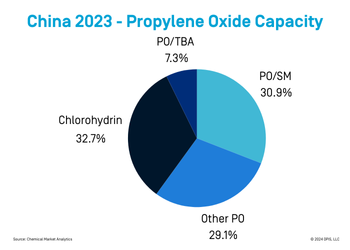
With the Chinese government encouraging environmentally friendly production, closing older, smaller chlorohydrination assets has been considered ahead of rationalization waves that come through the market. However, this movement towards environmentally friendly routes could be overestimated, as production capacity via this route has decreased to 1.6 million metric tons in 2023. Although this accounts for 26% of Chinese production, with Chinese operating rates dropping to 50 % in recent years, the continuation of chlorohydrination as a prominent pathway is in doubt.
Shift in PO Production Methods
Companies are increasingly adopting new methods and phasing out the chlorohydrination process, with many licensing technologies such as POSM from firms like Repsol. In other cases, joint ventures have been formed, such as Shell and CNOOC’s partnership at the petrochemical complex in Huizhou, Guangdong Province, China, another POSM asset.
Hence, PO production is expected to decline further in China. Rationalization could possibly extend to other regions, as evidenced by Dow closing capacities in Freeport in 2022 and 2025. This will increase the market share for different methods of PO production. Despite the downtrend in capacity, the PO market remains oversupplied, affecting the polyurethane industry and upstream chlorine and caustic soda (chlor-alkai) sectors.
Gain comprehensive analysis into long-term outlooks:
Of the global polyether polyols markets
Another indicator of the declining interest in chlorohydrination is the derivative exports from China, primarily polyether polyols and propylene glycol. For polyether polyols production, the impact is minimal since the chlorohydrin route mainly serves propylene glycol production or PO itself. Larger companies and state-owned manufacturers have transitioned away from chlorohydrination for polyether polyols, reducing the impact on overall production, regional consumption, and global trade. Additionally, investments in polyether polyols and expansions in China occurred after the PO overbuild, leading to polyols capacity being built without upstream integration due to the existing feedstock abundance. Thus, the impact of the supply chain is minimal.
Technological Shifts and Global Implications
It is important to note that beyond advancements in PO technology or upstream integration, Chinese and Asian producers have increasingly focused on exporting their excess capacity. Adopting more environmentally friendly production methods—including reducing wastewater and CO2 emissions—has become a significant advantage for marketing their products globally. This trend is expected to continue and strengthen with compounding economies of scale.
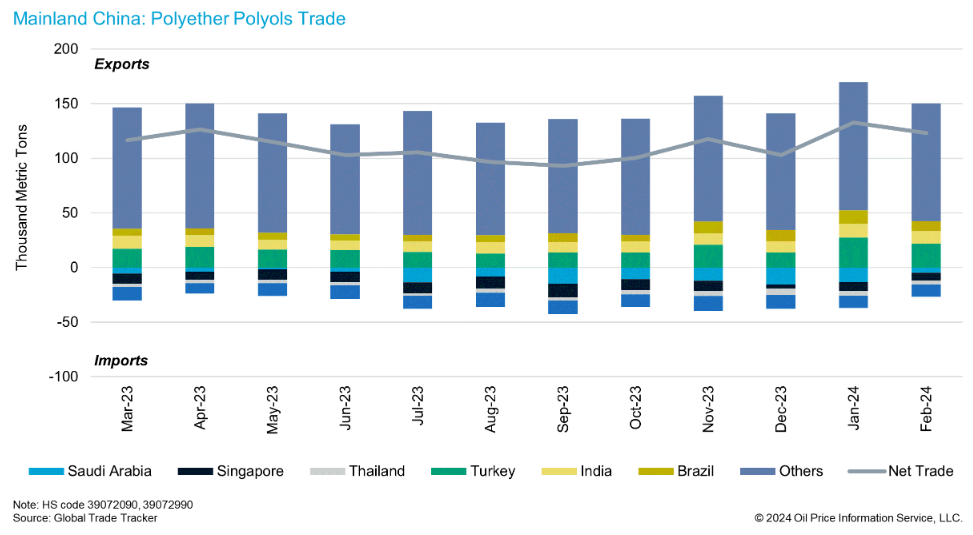
China maintained a balanced import and export market before the COVID-19 pandemic, with net trade at 500 kilotons on each side. Since 2019, exports have nearly tripled to 1.5 million metric tons, turning all eyes to the country as the world’s preeminent production source moving into the future.
Larger companies and state-owned PO manufacturers have switched technologies or built new complexes while closing chlorohydrin routes. This is expected to have a limited impact on polyether polyols production, regional consumption, or global trade. The path forward for Chinese and Asian players is to export excess capacity to the rest of the world. Offering an environmentally friendlier route, with lower water and CO2 emissions, will help promote these products in the global market. This trend is expected to strengthen due to economies of scale.
The impact of such technological shifts on PO and polyol production in other regions should also be considered. Dow has closed PO chlorohydrin capacity in the United States and will do so again in 2025, affecting the local market. LyondellBasell, a major PO producer integrated into propylene glycols, has published a strategic review of its European assets, which may suggest further divestments or idling of capacity linked to the PO chain.
September 3, 2024
China Introduces a VOC Tax
Unveiling New VOC Tax Policy: Challenges and Opportunities of Green Transformation in PU
PUdaily | Updated: September 3, 2024
On July 31, 2024, Wang Dongwei, vice minister at China’s Ministry of Finance, announced an important decision at a press conference held by the State Council Information Office that volatile organic compounds (VOCs) will be included in the scope of environmental protection tax. This decision not only signifies a further improvement in China’s tax system but also marks a significant leap in the process of ecological civilization construction.
Background of the Policy
As China’s economy has transitioned to a stage of high-quality development, environmental protection and ecological civilization construction have been increasingly emphasized. VOCs are precursors to fine particulate matter (PM2.5) and ozone (O3) among other secondary pollutants, posing a serious threat to air quality and human health. Therefore, the inclusion of VOCs in the tax scope has become inevitable for environmental governance and pollution control.
Looking back, China’s VOCs control has undergone a gradual deepening process from the formulation of laws to policy promotion. China’s new Air Pollution Prevention and Control Law, which took effect in 2016, first explicitly defined the legal responsibility for VOCs prevention and control. The subsequent introduction of governance measures such as the 13th Five-Year VOC Prevention and Control Work Plan and the Three-Year Action Plan to Win the Blue Sky Defense War, has continuously promoted VOC governance efforts. In January 2024, the Central Committee of the Communist Party of China and the State Council issued guidelines to comprehensively promote the development of a Beautiful China, which clearly stated the need to expedite the inclusion of VOCs in the tax scope, laying a solid foundation for the Ministry of Finance’s policy decision.
As a major source of VOCs, the polyurethane industry mainly generates them from reaction kettles, storage tanks, pipelines, finished product storage and some other production processes. The VOCs in polyurethane include unreacted isocyanates, polyols, solvents (such as DMF, DMAc, etc.), additives, and various by-products. These compounds not only easily form photochemical smog in the atmosphere, affecting air quality but may also pose health risks through respiratory pathways, skin contact, among others.
To further reduce VOC emissions in polyurethane, VOCs emission characteristics in each process have been preliminarily analyzed so as to implement targeted emission reduction measures. The methods include reducing by-products by optimizing reaction conditions, improving production processes to achieve solvent-free or low-solvent manufacturing, and perfecting waste gas collection and treatment systems.
The Impact of VOC Tax on the Polyurethane Industry
1. Deep Economic Impact and Restructuring
Reshaping Cost Structures: The introduction of tax on VOCs will compel polyurethane companies to revisit their cost structures. Apart from direct tax expenditures, businesses need to consider the indirect costs associated with upgrading, maintaining, and managing environmental protection facilities. These cost increases will have a profound impact on business strategies and financial status, prompting companies to seek more economically efficient solutions.
Rebuilding Market Competitiveness: The prices of polyurethane-related products may be adjusted accordingly with rising costs. This will change consumers’ perceptions of value, thus affecting market demand structures. Those who successfully achieve green transformation and reduce VOC emissions will become more competitive in the market.
2. Driving Forces and Challenges of Technological Innovation
Breakthroughs in Green Manufacturing: Businesses need to increase R&D investments in green manufacturing to address the challenges of VOC taxes, including exploring new catalysts, optimizing reaction routes, and developing recyclable or biodegradable materials. Breakthrough technologies will deliver significant environmental and economic benefits.
Upgrading Waste Gas Treatment Technologies: Existing waste gas treatment technologies may struggle to meet stricter environmental standards. Therefore, businesses need to focus on the latest developments in waste gas treatment technologies domestically and internationally, actively introducing and grasping advanced technologies. Furthermore, strengthening independent R&D capabilities and developing more efficient, cost-effective waste gas treatment technologies are crucial.
3. Far-reaching Changes and Opportunities in Industry Chain
Supply Chain Integration and Green Transformation: The introduction of VOC tax will prompt businesses in the polyurethane supply chain to enhance cooperation. Raw material suppliers need to provide more eco-friendly materials to support downstream manufacturers’ green transformation, while downstream manufacturers may demand higher environmental performance from products to improve their brand image and meet customer requirements. The supply chain integration will push the industry towards a green and sustainable future.
Enhancing Industry Standards and Aligning with International Standards: With increasingly stringent environmental policies and the implementation of environmental taxes, relevant standards and specifications in the polyurethane industry will be gradually enhanced, helping regulate market order, raising the industry level and promoting fair competition. Aligning with international environmental standards will also provide strong support for polyurethane businesses’ global expansion.
Strategies for the Polyurethane Industry
1. Strengthening Internal Management for Enhanced Environmental Performance
Building and improving environmental management systems, reinforcing the daily operation and meticulous maintenance of environmental facilities are crucial to support the high-quality development. Through fine-tuned management strategies, businesses can effectively control energy and material consumption, significantly reducing the emission of pollutants like VOCs, thereby contributing to environmental protection. Sustainability training for employees, integrating green concepts into each employee’s mindset to enhance their social responsibility and participation, is essential for paving the way for green roads. These measures not only showcase businesses’ environmental responsibility but also serve as key drivers for transitioning towards a better and more sustainable future.
2. Increasing R&D Investment to Promote Technological Innovation
Increasing R&D efforts in green manufacturing and air pollution control technologies, actively incorporating advanced technological achievements are strategic focuses. Beyond the industrial sphere, businesses can deepen collaborations with universities and research institutes to facilitate the conversion of research outcomes into practical applications, jointly advancing technological upgrades and industrial advancements.
3. Monitoring Policy Changes and Flexibly Adjusting Business Strategies
Businesses should closely monitor changes in national environmental and tax policies, stay informed about policy requirements and demand changes. Based on this information, flexibly adjusting business strategies and development directions ensures their sustained growth and market adaptability. For instance, adapting product structures, exploring emerging markets, or intensifying communication and collaboration with government entities based on policy trends.
4. Actively Engaging in Industry Self-Regulation and Cooperation
Polyurethane businesses should actively engage in self-regulation and enhance collaboration with industry peers. By jointly formulating industry standards and regulations, sharing technologies and experiences, they can promote industry transformation and sustainable development.
In conclusion, the impact of VOC tax on the polyurethane industry is diverse and far-reaching. Market participants need to adopt an open innovation approach to embrace challenges and opportunities actively. Green transformation and sustainable development can be achieved through initiatives such as strengthening internal management, promoting technological innovation, flexibly adjusting business strategies, and actively engaging in industry self-regulation and cooperation.
 Everchem Updates Archive
  Sign Up for Email Updates