
Asian Markets
August 9, 2024
Logistics Issues
Massive explosion rocks Yang Ming boxship at berth in Ningbo
Bojan LepicAugust 9, 2024
1 28,070 1 minute read

An explosion occurred on the boxship YM Mobility at a container terminal in the Beilun Port area of Zhoushan Port.
The cause of the accident was initially determined to be an explosion of a container on the ship, and there were no reports of casualties.
According to timestamps from surveillance footage videos posted online, the explosion occurred around 1:46 pm on Friday. The video first showed a large amount of smoke coming from the ship followed by a huge blast which started a fire and scattered debris.
A video from a much further distance showed massive clouds of smoke rising after the explosion. The vessel was reportedly berthed at the Ningbo Phase 3 Terminal. Some reports suggest that the cargo that exploded was glycerin.
The Ningbo Maritime Search and Rescue Center has started an emergency plan and assigned patrol boats to the scene. Three fire tugboats and shore-based fire department forces were also deployed.
The YM Mobility is a Liberia-flagged, 2011-built containership owned by Taiwanese carrier Yang Ming. It has a container capacity of 6,589 teu.
splash247.com/massive-explosion-rocks-yang-ming-boxship-at-berth-in-ningbo/
July 22, 2024
Castor News
India continues to dominate castor seed production

New Delhi – Castor seed production in India is projected to be about 2.054MT in 2023-24, according to Indian Agribusiness Systems, who carried out a crop survey for the Solvent Extraction Association of India (SEA). Castor oil is an important source material for biobased polyols.
The growth in India’s castor yield is the result of a key crop improvement project launched by SEA in 2017. “This year, the project was expanded to nine districts of Gujarat and two districts of Rajasthan, creating nearly 600 new model farms,” SEA president Ajay Jhunjhunwala, told the recent Global Castor Conference in Ahmedabad.
The castor model farm programme has led to substantial increases in average productivity. More than 30,000 farmers have been trained in sustainable practices since the programme started. The typical yield of the model farms is now 4416kg/hectare, compared to 3500kg/hectare when the programme started.
“Castor is a cash cow for India as it is an export-oriented commodity, contributing a foreign exchange of about $1.3bn to the country,” Shailesh Baldha, chairman of the Castor Promotion Council said at the conference.
SEA has also launched the World Castor Sustainability Forum. This focuses on developing a sustainable and traceable supply chain for castor, as well as improving social, economic and environmental performance.
https://www.utech-polyurethane.com/news/india-continues-dominate-castor-seed-production
July 8, 2024
Chinese Energy
China’s Rapid Renewables Rollout Hits Grid Limits
by Tyler Durden
Monday, Jul 08, 2024 – 02:45 AM
By John Kemp, senior energy analyst at Reuters
China’s record-breaking deployment of wind and solar capacity has worsened regional power imbalances, forcing the country to idle increasing amounts of renewable generation when it overwhelms local consumption.
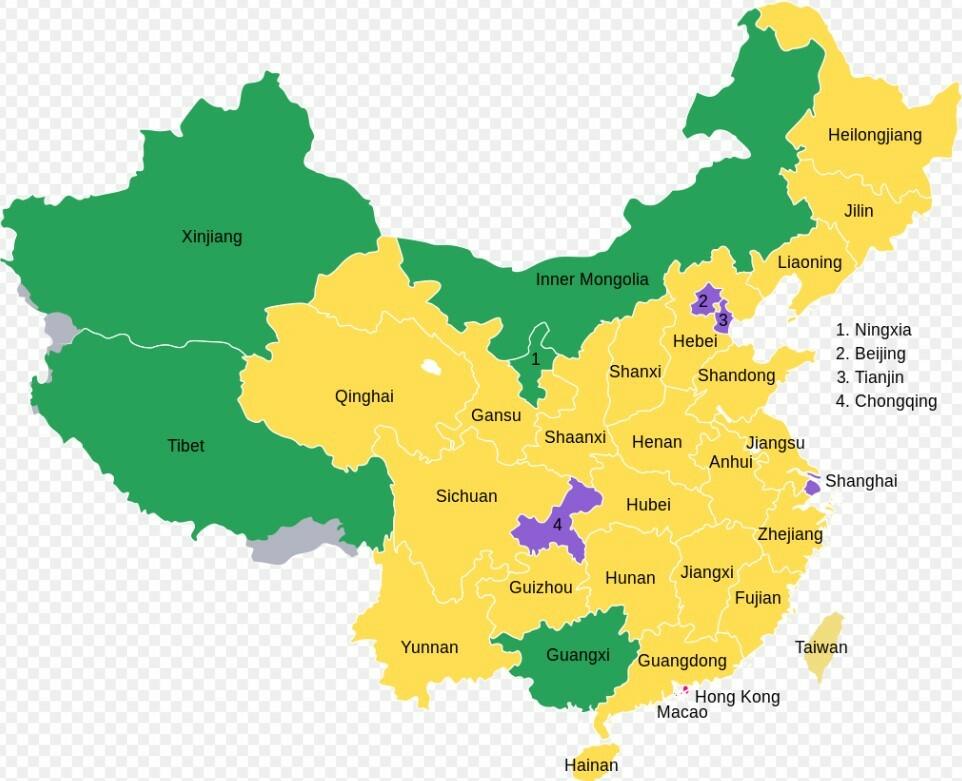
New government regulations aim to reduce the amount of renewable generation that has to be abandoned by increasing long-distance transmission links and better coordinating generation plans across provinces.
Since the end of 2018, China’s total generating capacity has increased by 1.137 billion kilowatts (kW), compound annual growth of 9%, according to data from the National Bureau of statistics (NBS).
Thermal capacity, mainly from coal-fired plants but some from gas-fired generators, rose by 257 million kW or 4% per year (“China statistical yearbook”, NBS, 2023).
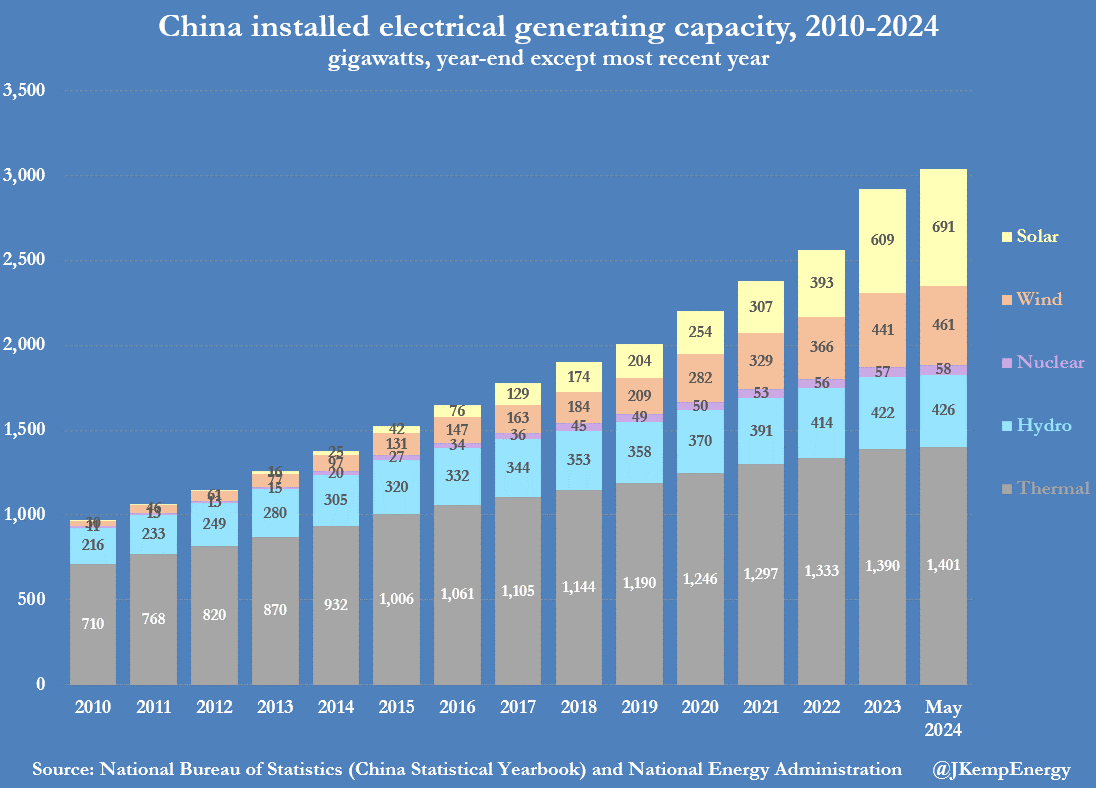
Most capacity additions, however, have come from what the government calls “new energy sources” – wind farms (277 million kW, 19% per year) and solar generators (517 million kW, 29% per year). Increased penetration of intermittent renewables is making it harder to manage a nationwide transmission system that was already struggling with large regional imbalances between generation and load.
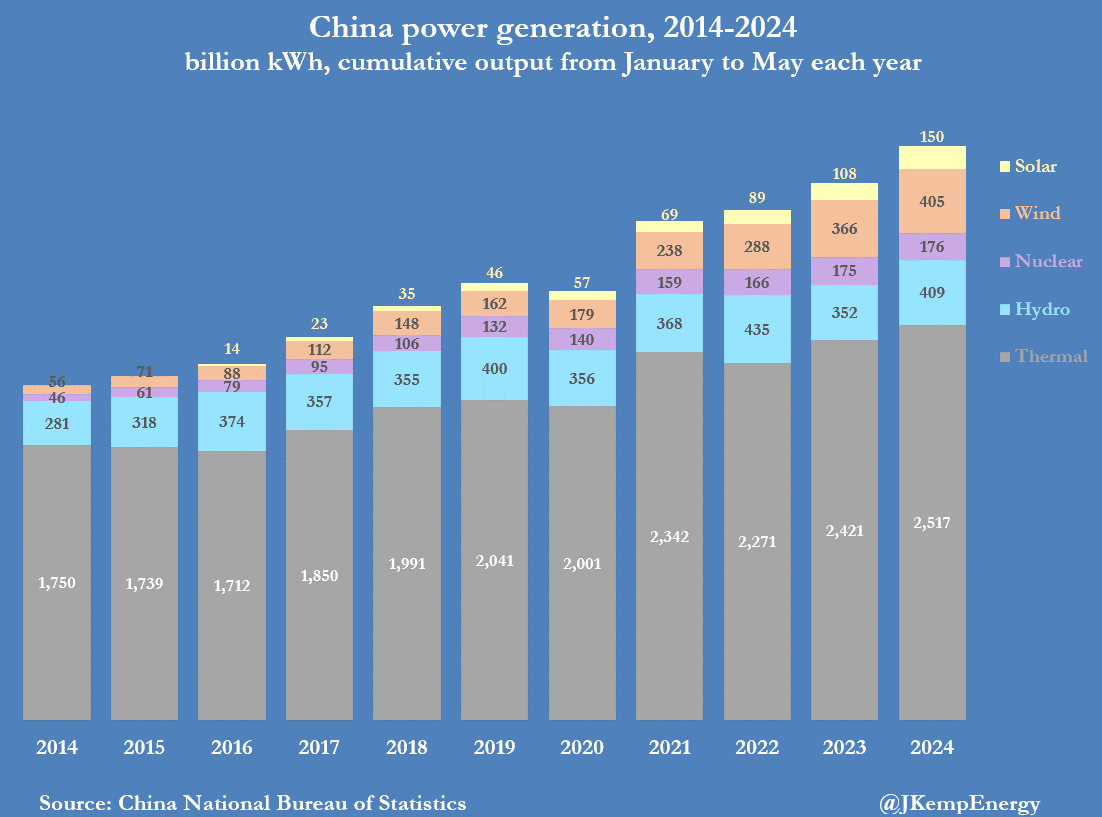
The solution to variable wind and solar output is to smooth out fluctuations across a larger number of generators spread over much larger areas of the country, which will require more transmission and better scheduling.
Long-Distance Transmission
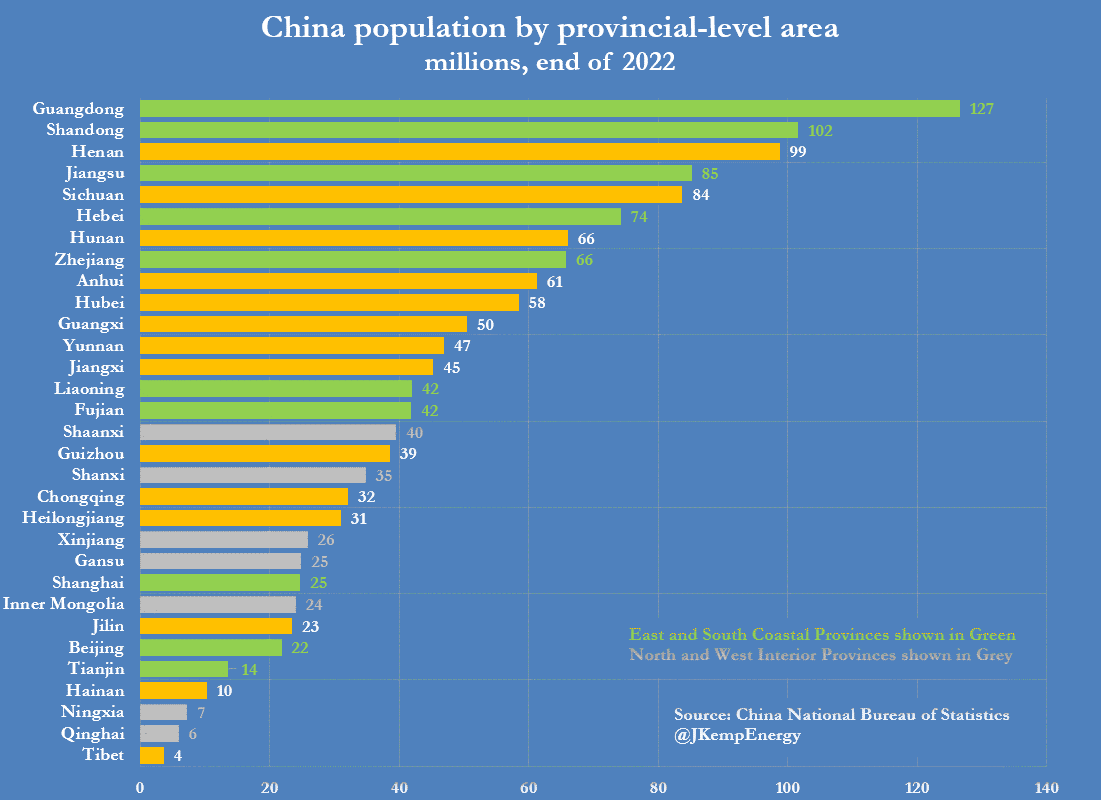
For decades, the country has been characterized by massive west-to-east electricity transfers from interior areas with surplus generation to the massive load centres on the east and south coasts. Ten provincial-level areas in the east and south (Liaoning, Hebei, Beijing, Tianjin, Shandong, Jiangsu, Shanghai, Zhejiang, Fujian and Guangdong) accounted for 50% of national consumption but only 40% of generation in 2022.
By contrast, six remote and sparsely populated northern and western areas (Inner Mongolia, Xinjiang, Shanxi, Shaanxi, Gansu and Ningxia) accounted for 18% of consumption but 25% of generation.
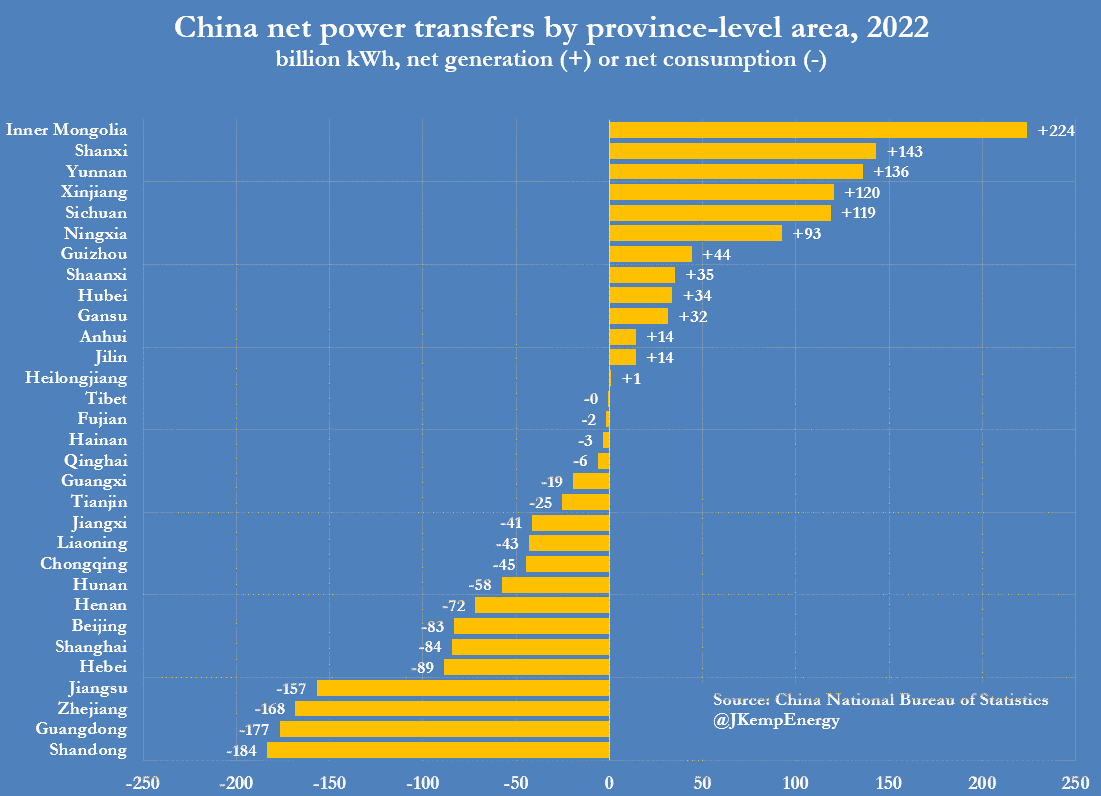
Chartbook: China regional electricity transfers
In response, China’s State Grid Corporation has constructed a network of ultra-high voltage transmission lines to move power thousands of kilometres from surplus areas in the west and north to deficit areas in the east and south.
In the process, China has become the world leader in ultra-high voltage transmission to move electricity over long distances while minimising line losses and is exporting its expertise around the world.
Inner Asia’s Energy Abundance
China’s northern and western areas are some of the least populated and poorest parts of the country, but rich in energy resources, traditionally coal but now increasingly gas and renewables.
The north and west contains the country’s most important coal deposits and has become a major centre of pit-head generation, with some electricity used locally by heavy industry, and the rest transmitted east and south.
Inner Mongolia, Shanxi, Shaanxi and Xinjiang alone accounted for 81% of coal mine production and 25% of all thermal generation in 2022, according to data from the NBS.
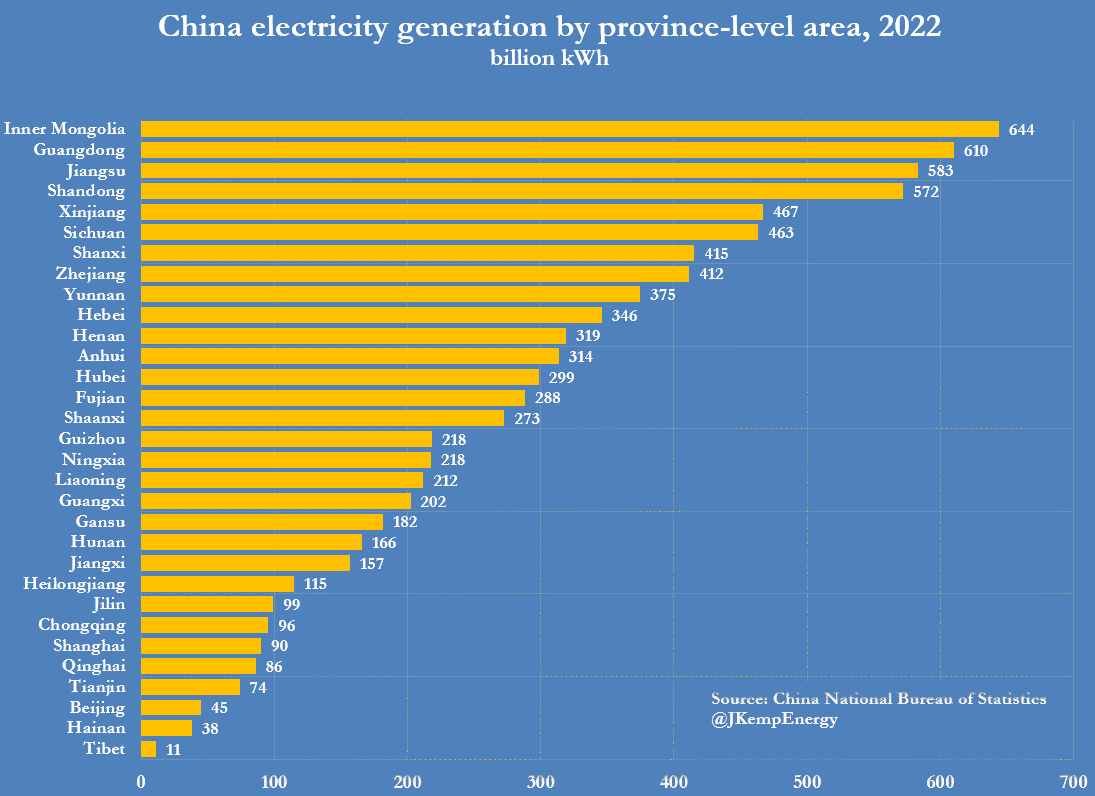
In a quirk of fate, the arid and windswept northern and western plains and deserts are also the best sites for giant wind farms and solar parks.
Inner Mongolia, Shanxi, Shaanxi and Xinjiang together with neighbouring Gansu, Ningxia and Qinghai accounted for 42% of all wind and solar generation last year.
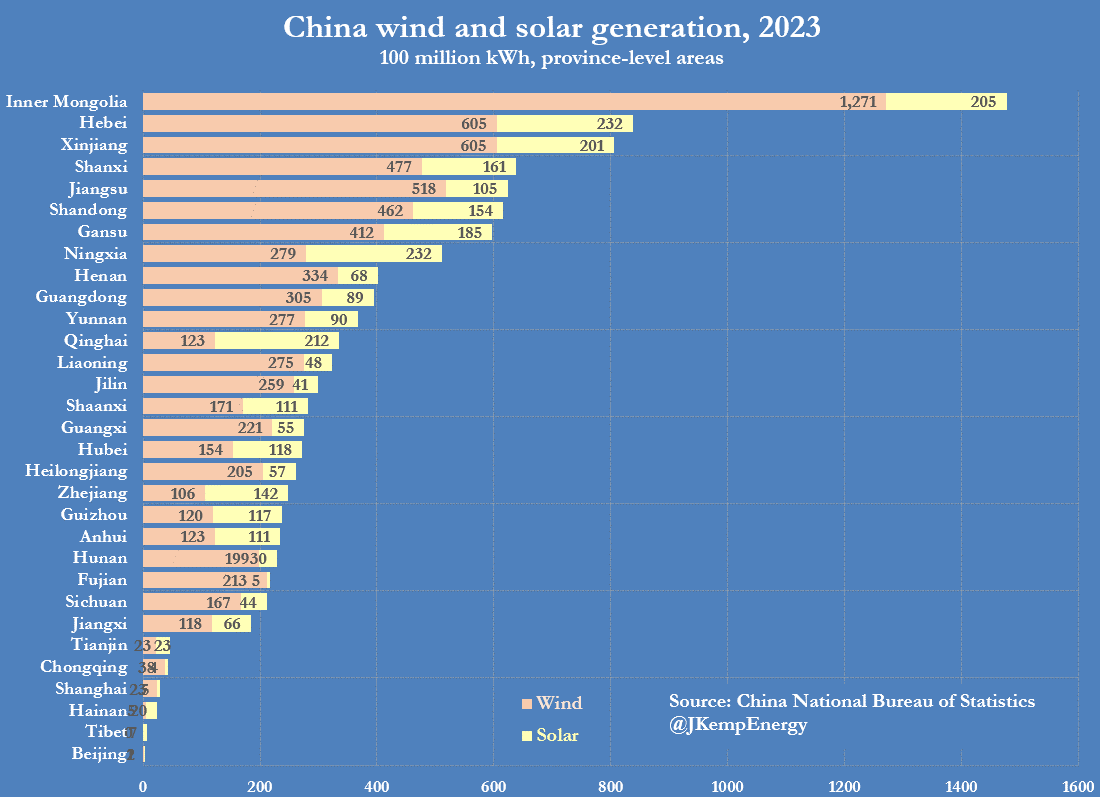
But the addition of so much wind and solar generation in a region already saturated with coal-fired power threatens to overwhelm the transmission system.
During peak periods of wind and solar generation, there is not enough population and industry in these areas to absorb all the output, and not enough long-distance transmission capacity to move the surplus east and south.
More Transmission And Planning
In 2016, the national utilisation rate for new energy sources fell to a record low of 84%, prompting the central government to launch a “Clean Energy Absorption Action Plan” to reduce the waste of renewable resources. The plan focused on improvements in local distribution, long-distance inter-provincial transmission, and energy trading to reduce the curtailment of new energy generation.
By 2023, the utilisation rate for wind power had climbed to a remarkable 97.3% and solar had reached 98%, according to the state-run news agency Xinhua.
With rapid deployment of renewable capacity, however, the problem of abandonment is re-emerging, with wind utilisation down to 96.1% and solar down to 96% in the first five months of 2024. Sliding utilisation has prompted an alert from the National New Energy Consumption Monitoring and Early Warning Center (“Solving the pain points and difficulties of new energy consumption”, Xinhua, July 1, 2024).
The response is likely to be similar, with renewed emphasis on integrating renewables at local level and more transmission capacity to move surplus power across provincial boundaries. In the last two years, central government policy statements have repeatedly focused on the need for better coordination of transmission and generation between provinces.
Creating A Truly National System
In a sign of the importance attached to the issue, the Communist Party’s Politburo held a group study session on new energy technology and energy security on February 29, 2024. The session, bringing together top central and regional leaders, included a discussion on boosting “the grid’s capacity capability to integrate, distribute and regulate clean energy.”
President Xi Jinping stressed need for “coordinated development of the energy sector” (“Xi stresses high-quality development of new energy”, CPC International Department, March 2, 2024).
In many ways, China’s long-distance ultra-high voltage transmission system is an extraordinary engineering achievement, likely to be copied in other parts of the world as more and more renewables are connected to grids. It has enabled a remarkable penetration of intermittent renewables, as well as hydroelectric generation, into the national power system while maintaining or improving reliability. As a result, wind and solar producers supplied 15% of all generation in the first five months of 2024, up from 7% in the same period in 2019.
In some ways, however, China is still struggling to forge a truly integrated nationwide system from fragmented provincial-level utilities that pursue their own priorities. If government plans to achieve even higher renewables penetration are to be achieved, there will have to be much closer links and more coordination between different types of generators and across far wider areas.
https://www.zerohedge.com/markets/chinas-rapid-renewables-rollout-hits-grid-limits
May 2, 2024
Alkyl Phosphate Esters Dumping Investigation to Begin in May
New Antidumping Duty and Countervailing Duty Petitions on Alkyl Phosphate Esters From China
Authors: Douglas J. Heffner,Richard Ferrin,Carrie Bethea Connolly
At a Glance
- ICL-IP America, Inc. filed both antidumping duty petitions and countervailing duty petitions on certain alkyl phosphate esters from China.
- Investigations related to these petitions could result in increased prices and/or decreased supply of alkyl phosphate esters.
- The U.S. Department of Commerce is expected to begin investigations on May 13, 2024.
On April 23, 2024, antidumping duty (AD) and countervailing duty (CVD) petitions were filed on certain alkyl phosphate esters from China. The petitions were filed by ICL-IP America, Inc., a subsidiary of the ICL Group (Petitioner). Alkyl phosphate esters are used as a flame retardant and as additives in a wide range of products.
The U.S. AD law imposes special tariffs to counteract imports that are sold in the United States at less than “normal value.” The U.S. CVD law imposes special tariffs to counteract imports that are sold in the United States with the benefit of foreign government subsidies. For AD/CVD duties to be imposed, the U.S. government must determine not only that dumping and/or subsidization is occurring, but also that there is “material injury” (or threat thereof) by reason of the dumped and/or subsidized imports. Importers are liable for any potential AD/CVD duties imposed. In addition, these investigations could impact purchasers by increasing prices and/or decreasing supply of alkyl phosphate esters.
Scope
Please note that this section was not written by our authors but is taken verbatim from the petition.
Alkyl phosphate esters based exclusively on side chains with a length of two or three carbon atoms (also includes chlorinated alkyl chains) and with a phosphorus content of at least 6.5% (per weight) and a viscosity between 1 and 2000 mPa.s (at 20-25 °C). Alkyl phosphate esters include Tris (2-chloroisopropyl) phosphate (TCPP), Tris(1,3-dichloroisopropyl) phosphate (TDCP), and Triethyl Phosphate (TEP). TCPP is also known as Tris (1-chloro-2-propyl) phosphate, Tris(1-chloropropan-2-yl) phosphate, Tris (monochloroisopropyl) phosphate (TMCP), and Tris(2-chloroisopropyl) phosphate (TCIP). It has the chemical formula C9H18Cl3O4P and the CAS Nos. 1244733-77-4 and 13674-84-5. It may also be identified as CAS No. 6145-73-9. TDCP is also known as Tris (1,3-dichloroisopropyl) phosphate, Tris (1,3-dichloro-2-propyl) phosphate, Chlorinated tris, tris {2-chloro-1-(chloromethyl ethyl} phosphate, TDCPP, and TDCIPP. It has the chemical formula C9H15Cl6O4P and the CAS No. 13674-87-8. TEP is also known as Phosphoric acid triethyl ester, phosphoric ester, flame retardant TEP, Tris(ethyl) phosphate, Triethoxyphosphine oxide, and Ethyl phosphate (neutral). It has the chemical formula (C2H5O)3PO and the CAS No. 78-40-0. Also included in this investigation are isomers of the foregoing products and blends including one or more alkyl phosphate esters where the alkyl phosphate esters account for 20 percent or more of the blend by weight.
Alkyl phosphate esters are classified under subheading 2919.90.5050, HTSUS. Imports may also be classified under subheadings 2919.90.5010 and 3824.99.5500, HTSUS. References to the HTSUS classification are provided for convenience and customs purposes, and the written description of the merchandise under investigation is dispositive regarding the scope of the investigation.
Estimated Dumping Margins
The Petitioners allege dumping margins in the range of 119.52 to 145.43% based on average unit values, or 78.36 to 99.4% based on actual U.S. transaction prices.
The Petitioners also allege significant subsidies, although the petitions do not quantify the alleged net subsidy margin.
Estimated Schedule of Investigations
The following is an estimated schedule of investigations by the U.S. Department of Commerce (DOC) and the U.S. International Trade Commission (ITC):
| April 23, 2024 | Petitions are filed. |
| May 13 2024 | DOC initiates investigations. |
| May 14, 2024 | ITC staff conference (estimated). |
| June 7, 2024 | Deadline for ITC preliminary injury determination. |
| July 17, 2024 | Deadline for DOC preliminary CVD determination, if deadline is NOT postponed. |
| September 20, 2024 | Deadline for DOC preliminary CVD determination, if deadline is fully postponed. |
| September 30, 2024 | Deadline for DOC preliminary AD determination, if deadline is NOT postponed. |
| November 19, 2024 | Deadline for DOC preliminary AD determination, if deadline is fully postponed. |
| April 3, 2025 | Deadline for DOC final AD and CVD determinations, if all deadlines are fully postponed. |
| May 19, 2025 | Deadline for ITC final injury determination, if all DOC deadlines are fully postponed. |
April 29, 2024
Wanhua TDI Expansion Plans
Wanhua Chemical’s TDI Expansion to Lead Global Production
PUdaily | Updated: April 25, 2024

Wanhua Chemical, a significant player in the chemical industry, recently announced key developments in its TDI (toluene diisocyanate) production capacity expansion plans. The company’s official website disclosed the Environmental Impact Assessment Reports for two crucial projects.
On April 18, the Phase II Expansion Project of TDI, with a capacity of 360,000 tons per year, was unveiled by Wanhua Chemical (Fujian) Co., Ltd. This expansion project marks a notable step forward in the company’s strategic growth initiatives.
Shortly thereafter, on April 23, Wanhua Chemical’s official website released the Environmental Impact Assessment Report for the Phase I Technological Improvement and Capacity Expansion Project of TDI, also with a capacity of 360,000 tons per year.
The Phase I project involves significant upgrades to existing TDI production units, including nitration, acid concentration, hydrogenation, phosgenation, and refining units. These enhancements will boost the production capacity from 250,000 tons per year to 360,000 tons per year.
Meanwhile, the Phase II Expansion Project of TDI by Wanhua Chemical (Fujian) Co., Ltd. is poised to have a notable impact. Situated in the Jiangyin Industrial Concentration Zone in Fuzhou, Fujian Province, this project covers an area of 49,065 square meters. It encompasses the construction of advanced process units, including nitration, hydrogenation, and phosgenation units, alongside auxiliary and public engineering units. Once operational, the facility will produce 360,000 tons of TDI annually.
Together, these expansion projects will increase Wanhua Chemical’s TDI production capacity by 470,000 tons. With a total TDI production capacity of 1.42 million tons per year, Wanhua Chemical is poised to solidify its position as a significant player in the global chemical industry landscape.
 Everchem Updates Archive
  Sign Up for Email Updates


