
Current Affairs
July 3, 2025
Tariff Update
US container import tariffs averaging 21%, says Maersk
Levies less than half prior to China-U.S. tariff pause
· Thursday, July 03, 2025

Key Takeaways:
Importers are paying an effective 21% tariff on all containerized imports entering the United States, the world’s second-largest ocean line said.
That’s less than half the rate of the peak average earlier this year, Maersk said Wednesday in a market update.
“On average, companies are currently paying an effective average tariff rate of approximately 21% relative to container load on all U.S. imports, according to Maersk’s container-weighted effective average tariff rate metric,” the company said. “At its peak, shortly after April 2, the average effective rate was 54%.”
China and the U.S. announced a 90-day pause in their escalating tariff fight April 9. That pause ends July 9, and some extend to next month, but it’s unclear how many new trade agreements Washington will complete by then, or whether tariffs will return to previous levels.
Washington has come to basic terms on trade deals with China, Vietnam, and Great Britain.
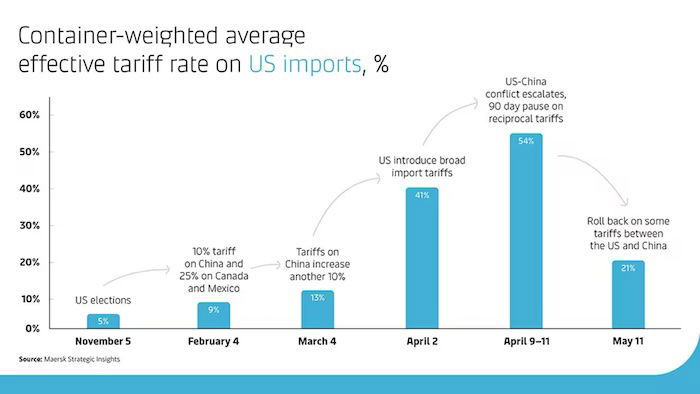
“Visibility has worsened and trade barriers have increased since the U.S. formally announced its tariff package to the world on April 2,” Denmark-based Maersk (OTC: AMKBY) said. “For now, most country-specific import tariffs are paused while long-term deals are being negotiated, with deadlines coming up in July and August. However, there are still trade tariffs impacting how companies move their cargo, particularly between the U.S. and China.”
Ocean container rates from China to U.S. West Coast ports have fallen sharply in recent weeks on weaker demand following an initial surge as liner operators rushed to restore vessel capacity during the tariff pause.
At the same time, the SONAR Inbound Ocean TEU Volume Index as of July 3 was 2307.46, compared to a high mark of 2693.35 in June, 2021.
Some U.S. companies in apparel and fashion have shifted their sourcing, and have reached “single-digit” dependency on Chinese manufacturing, said Maersk Chief Commercial Officer Karsten Kildahl, in the update.
“[O]ther commodities like home improvements have a significantly higher level of Chinese manufacturing due to the nature of the goods. This is not just a short-term tactical reaction to escalating geopolitical tensions, but rather a long-term strategic move to future-proof supply chains and remain resilient.”
Global container demand grew 6.1% in the first quarter, comparable to previous quarters. Maersk said preliminary second quarter figures will reveal a high degree of volatility triggered by tariff announcements.
The company in May said global container demand would be within a wide range of –1% to 4% for all of 2025.
The company added that tensions in the Middle East continue to make the Red Sea-Suez Canal an elevated security risk.
Maersk said its Gemini services with Hapag-Lloyd (OTC: HLAGF) had a 90.9% schedule reliability in May, above its 90% forecast.
July 1, 2025
We’re Here to Help
ECHA to assess implementation of diisocyanate risk management measures

Helsinki, Finland – The European Chemicals Agency (ECHA) is to assess the implementation of risk management measures for a number of restricted chemicals in the workplace. These include diisocyanates.
As part of REF-15, its next EU-level enforcement project, inspectors will check the safe use information in safety data sheets. They will also look at whether the recommended risk management measures are implemented in the workplace, and check that companies authorised to use substances of very high concern are applying the correct conditions. It will also cover the use of restricted hazardous substances with special conditions, including diisocyanates.
ECHA said the project will improve worker safety, and strengthen enforcement by enhancing collaboration between the different authorities responsible for occupational safety and health legislations. The inspections are slated to take place in 2027, with the report expected to be published in 2028.
Trade association Isopa said it “fully supports” the objective to ensure worker safety. “Safety training is considered the most effective and feasible measure to mitigate the risks of working with diisocyanates,” it said. “In alignment with the Reach restriction on diisocyanates, our industry has taken significant efforts to ensure the availability and dissemination of safety training to ensure the responsible use of these substances.”
Isopa described its industry-wide training efforts as a considerable achievement. “[They reflect] our collective dedication to workplace safety,” it said. “Over a million workers have already been trained through coordinated industry work, demonstrating a strong commitment to implementing effective risk management practices.”
June 29, 2025
China Tariff Update
US, China agree on deal for tariffs, rare-earth magnets
China’s exports to the US will have a minimum 30% tariff rate, White House officials say
· Friday, June 27, 2025

The U.S. and China have agreed on a trade deal that would reduce tariffs and expedite shipments of rare-earth metals.
United States Treasury Secretary Scott Bessent said on Friday that U.S. tariffs on Chinese imports will now start at 30%, while China’s duty rate on goods from the U.S. will be at 10%. The 20% fentanyl levy on China will also stay in place.
In April, the Trump administration hit Chinese imports with a 145% tariff rate. China retaliated by slapping a 125% tariff on goods imported from the U.S.
“Now our tariffs are at 30% on them, we’re at 10%,” Bessent said on Fox Business. “We’re collecting a substantial tariff income.”
President Donald Trump announced the agreement with China on Thursday during a news conference that “We just signed with China yesterday,” without further explanation.
China’s Commerce Ministry confirmed that both nations have reached a framework for a deal in a statement on Friday.
“China will review and approve export applications for controlled items that meet the required criteria, while the United States will lift a series of restrictive measures previously imposed on China,” the country’s Ministry of Commerce said in a statement to China Daily News.
U.S. levies on Chinese goods stood at an average of 51.1% for most imports before Thursday’s trade deal was announced, while China’s duties on American products were at 32.6%, according to the Peterson Institute for International Economics.
Bessent also said China has agreed to remove its restrictions on exports of rare-earth metals.
On April 4, China began restricting exports of rare-earth magnets to the U.S., which are used in high-tech products such as computer chips and electric vehicle batteries.
“We have an agreement with them that will make magnets flow to everyone who had received them before on a regular basis,” Bessent said.
June 26, 2025
Mattress Imports Update

U.S. imports of Mattresses and other bedding products increased 1.69 percent through April to $1.27 billion
The category ranked 146 through April among the roughly 1,265 import commodity groupings as classified by Census. It ranked No. 136 for the last full year with a total value of $4.07 billion, a $158.85 million, 3.75 percent decreased from the 2023 total.
Through April of this year the leading sources were No. 1 China, No. 2 Indonesia, No. 3 India, No. 4 Mexico and No. 5 Pakistan. The leading sources were No. 1 Port of Los Angeles, No. 2 Port of Newark, No. 3 Port of Savannah, GA, No. 4 Port of Long Beach and No. 5 Port of Virginia.
In the last previous full year, the leading sources were No. 1 China, No. 2 Mexico, No. 3 India, No. 4 Indonesia and No. 5 Pakistan. The leading sources were No. 1 Port of Los Angeles, No. 2 Port of Newark, No. 3 Port of Savannah, GA, No. 4 Port of Long Beach and No. 5 Port of Virginia.
Looking at specific airports, seaports and border crossings, the top five through the first four months of the year were:
Highlights for the top five ports:
- Port of Los Angeles rose 15.59 percent compared to last year to $371.18 million.
- Port of Newark rose 16.95 percent compared to last year to $172.41 million.
- Port of Savannah, GA rose 2.92 percent compared to last year to $129.25 million.
- Port of Long Beach fell 4.48 percent compared to last year to $92.97 million.
- Port of Virginia rose 3.44 percent compared to last year to $74.73 million.
There are several hundred airports, seaports and border crossings that handle international trade; they are, in turn, part of the roughly four dozen U.S. Customs districts.
Highlights for the top five foreign sources:
- U.S. imports from No. 1 China increased $3.99 million, 0.6 percent, (52.38 percent market share).
- U.S. imports from No. 2 Indonesia increased $64.23 million, 72.8 percent, (12.01 percent market share).
- U.S. imports from No. 3 India increased $2.22 million, 2.22 percent, (8.07 percent market share).
- U.S. imports from No. 4 Mexico decreased $48.87 million, 38.61 percent, (6.12 percent market share).
- U.S. imports from No. 5 Pakistan decreased $6.3 million, 12.42 percent, (3.5 percent market share).
All totaled, 82.08 percent of all these Mattresses and other bedding products imports to the United States were shipped from the top five sources through April of this year. That is equal to $1.04 billion of the $1.27 billion total.
All totaled, 66.22 percent of all these Mattresses and other bedding products imports to the United States were shipped to the top five Ports through April of this year. That is equal to $840.54 million of the $1.27 billion total.

June 19, 2025
Housing Starts Fall in May

 Everchem Updates Archive
  Sign Up for Email Updates