
Current Affairs
July 21, 2025
Dave Barry vs AI
Death by AI
One man’s struggle with his mortality.
Jul 18, 2025
I found out about my death the way everybody finds out everything: from Google.
What happened was, I Googled my name (“Dave Barry”) and what popped up was something called “Google AI Overview.” This is a summary of the search results created by Artificial Intelligence, the revolutionary world-changing computer tool that has made it possible for college students to cheat more efficiently than ever before.
The Google AI Overview for my name consisted of some basic biographical information about me, along with a list of questions under the heading “People also ask.” This was the first question:

As you might imagine I was curious to find out what happened to me, so I clicked on that question. This was the answer:
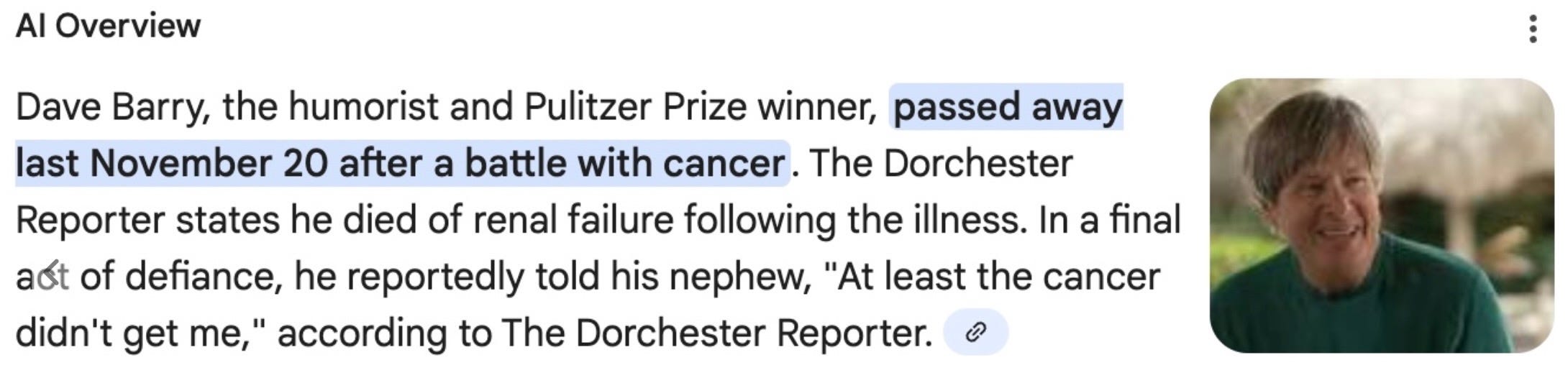
Give Google AI credit for what it got right: That is, in fact, a picture of me, and I did, in fact, win a Pulitzer Prize (trust me, I’m just as shocked as you are). But to the best of my knowledge, I did not pass away last November 20. That is not just my opinion. In recent months I have been examined by two different licensed physicians, and if I had been dead, I’m pretty sure at least one of them would have mentioned it. (“Dave, your pulse is zero, and your blood pressure is zero over zero. I’m going to try your other arm, but frankly at this point I’m concerned.”)
Fortunately, Google AI Overview has a mechanism whereby if you have an issue with something, you can submit feedback. So I submitted this:
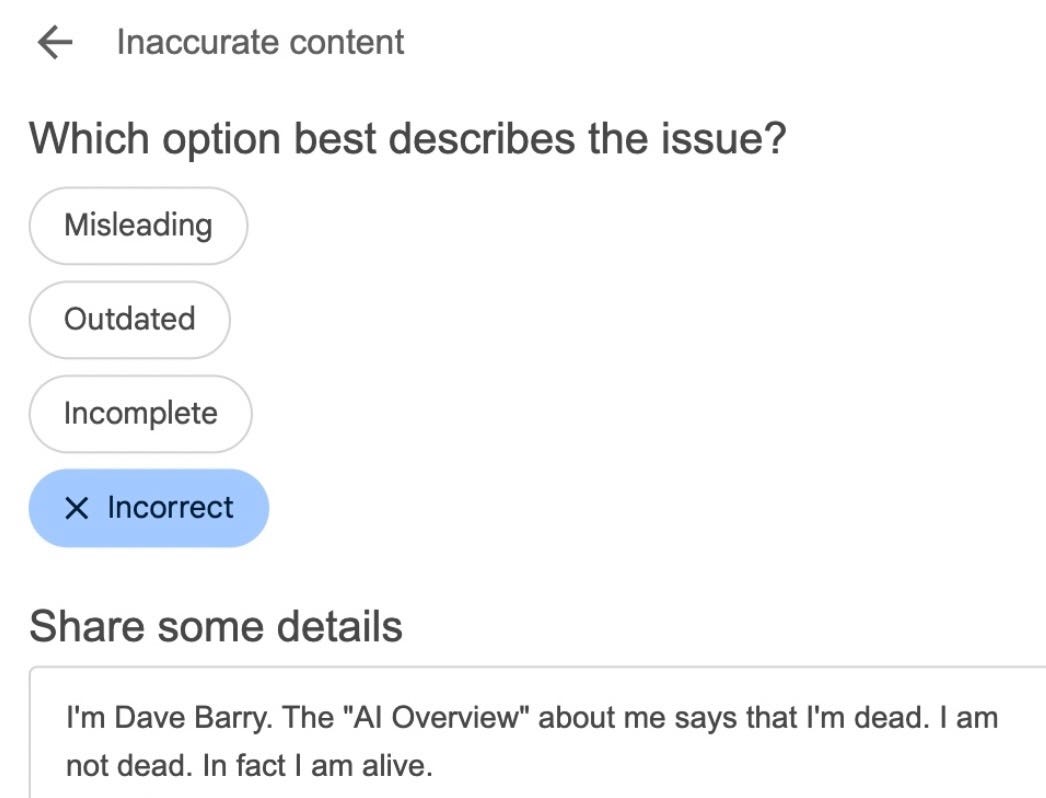
I’ll be honest: When I submitted this feedback, I did not expect much in the way of a response. Google is a huge company with a vast network of computers processing more than a billion trilobites of data every second, which is all the more impressive when we consider the fact that a trilobite is a marine creature that became extinct 250 million years ago, which I think we can all agree is a good thing because it looked like a giant cockroach with way too many legs:

Getty Images
So I didn’t expect that Google, what with all it has on its plate, would have time to respond to my issue about not being dead. But I was wrong. Shortly after I submitted my feedback, the “People also ask” part of my AI Overview was changed. That was the good news. The bad news was, it was changed to this:
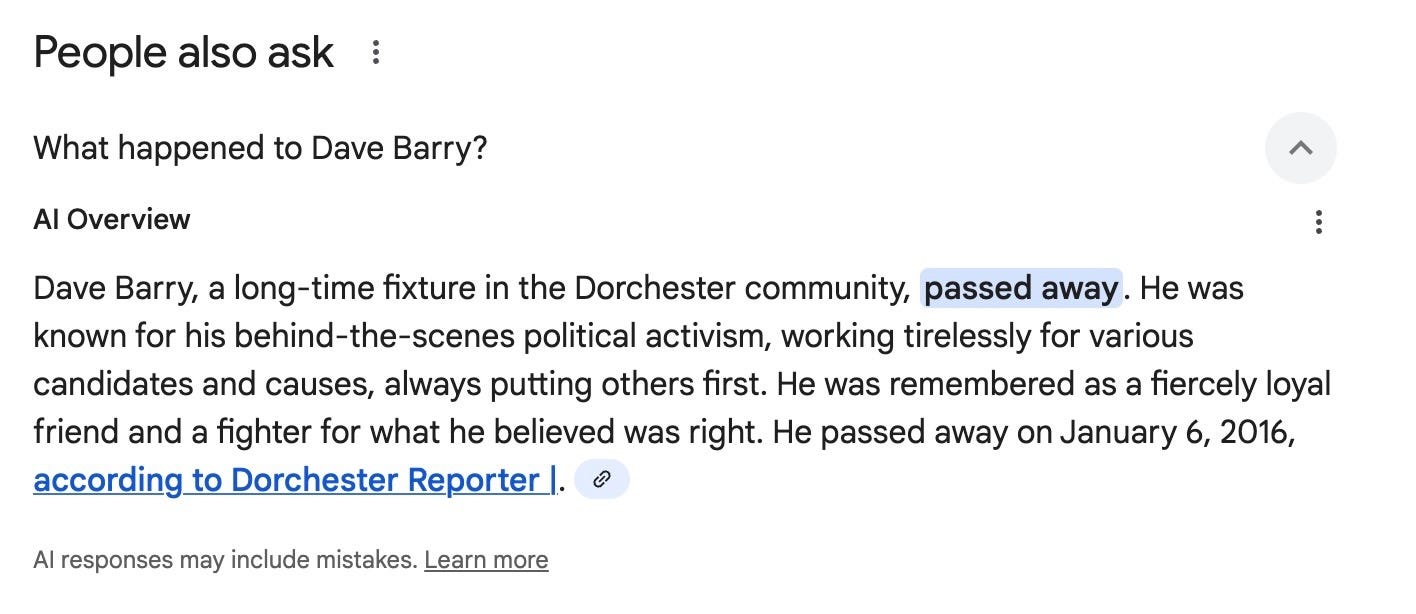
Yes. Google AI Overview kept the only statement I objected to — specifically, that I was dead — and removed the accurate statements. It apparently replaced these with information about a completely different Dave Barry, a political activist from Dorchester who died in 2016.
For the record, it sounds as though that Dave Barry was a much better person than I am. He fought for what he believed was right, whereas the only principle I ever have really stood for, over the course of my journalism career, is that Americans should not be required to use low-flow toilets. I’m confident that the late Dave Barry from Dorchester would not have wanted to be mistaken for me.
So I started to write another feedback message to Google AI Overview. While I was doing this, a little box popped up on my screen asking me if I wanted to chat about my issue. So I did that. Here’s a transcript of the chat (I am not making this up):
GOOGLE AI: What can I help with? A brief explanation is all I need.
ME: I’m Dave Barry. The Google AI Overview for me says that I’m dead, and that when I was alive I was a political activist in Dorchester. Neither of these things is true. I am not dead, and I am not a political activist in Dorchester.
GOOGLE AI: Sorry, I didn’t understand your question. Can you try rephrasing it? Short phrases work best.
ME: I’m Dave Barry. I am alive. Google AI says I am dead. I am not dead. Google AI also says I was a political activist in Dorchester. I was not. I still am not.
GOOGLE AI: Apologies, I’m still having trouble understanding you. Let’s give it one more try. Please describe your issue in the text box below.
ME: My issue is that Google AI says I am dead, but I am not.
Google AI responded to that with this:
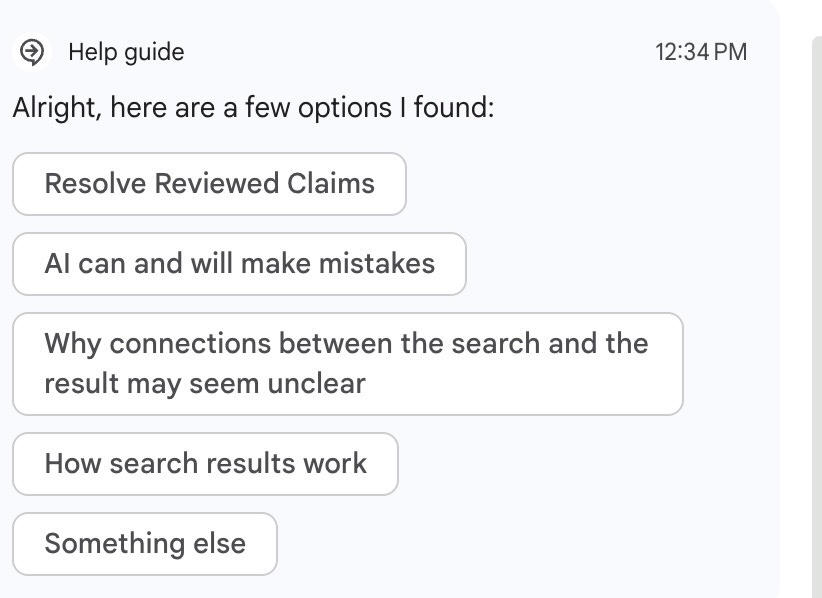
That’s when I gave up on the chat. It was like trying to communicate with a toaster. Actually, it was worse than that. I bet if I stood in front of a toaster and shouted “I’M NOT DEAD” at it enough times, eventually it would respond “Oh! I get it now! You’re not dead!” Whereas Google AI seemed incapable of grasping this point.
Nevertheless I gave it one last shot. I submitted the following updated feedback to Google AI Overview:
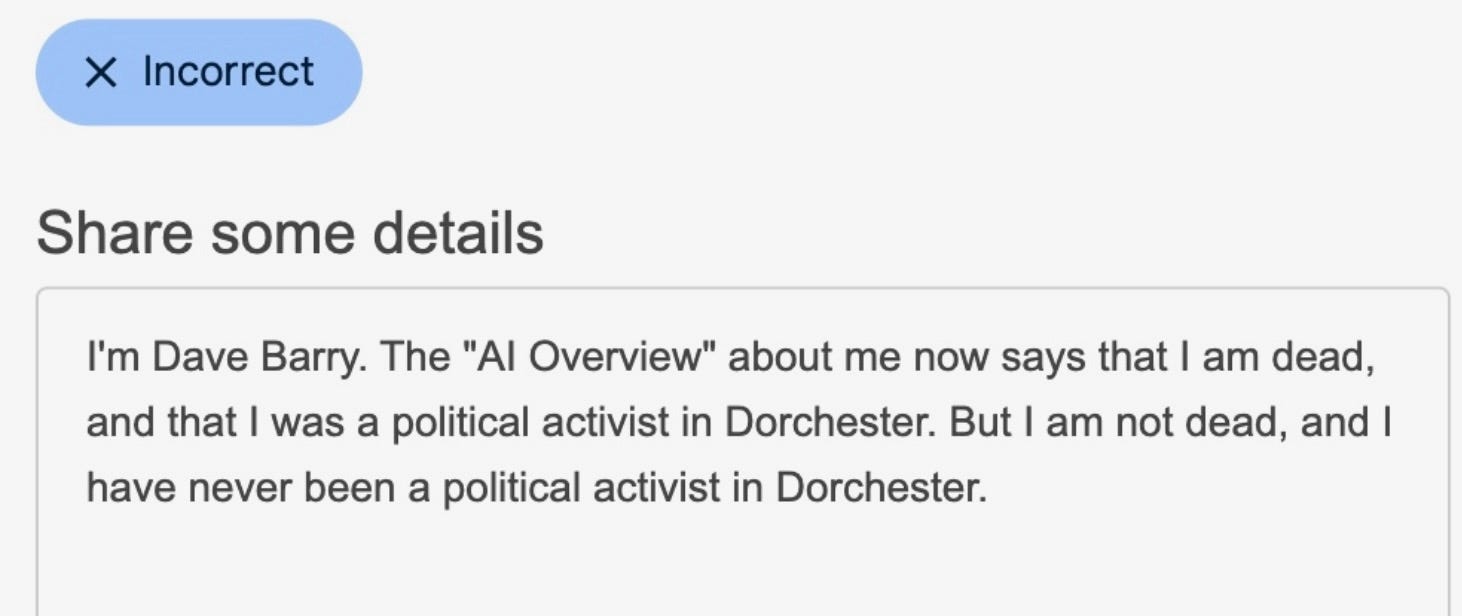
At that point I didn’t have much hope. But as the old saying goes, “Just when you least expect it, the unexpected happens.” And sure enough, the next day the Google AI Overview about me had been changed again:
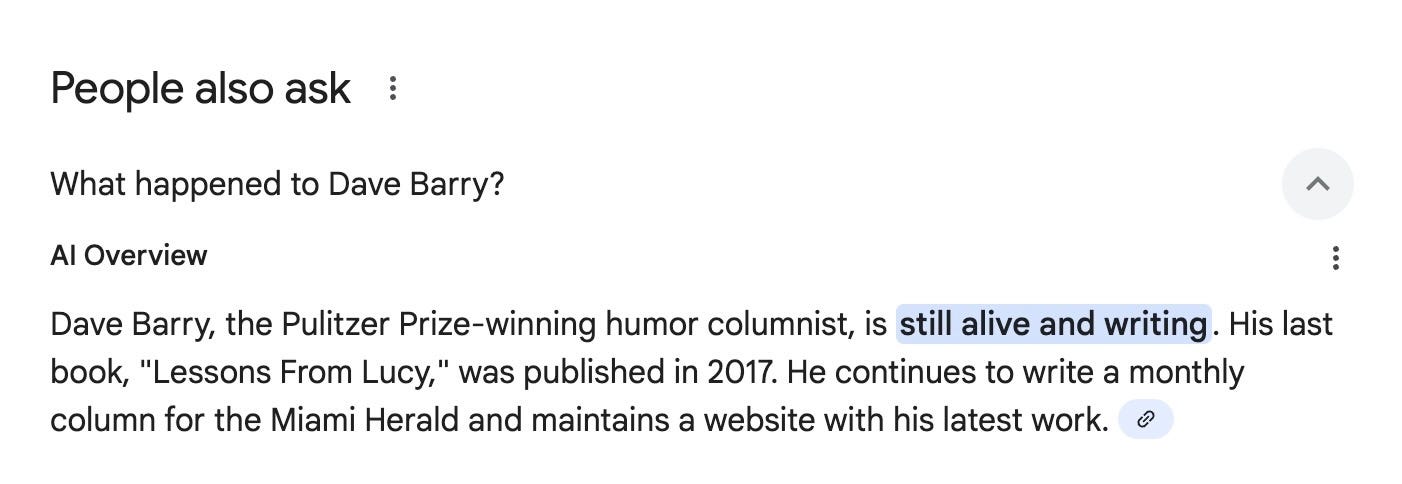
For the record, the second and third sentences are inaccurate: I’ve had two books1 published since Lessons from Lucy (which was published in 2018, not 2017) and I haven’t written a regular column for the Miami Herald in 20 years, and when I did it was weekly, not monthly. But I didn’t want to get nitpicky just because the answer was still mostly wrong. The important thing was, Google AI had decided that I was no longer dead, and for that I was grateful.
I felt pretty good about this for nearly two days. Then yesterday morning I checked my Google AI overview again to see if anything new had happened to me, and saw this:
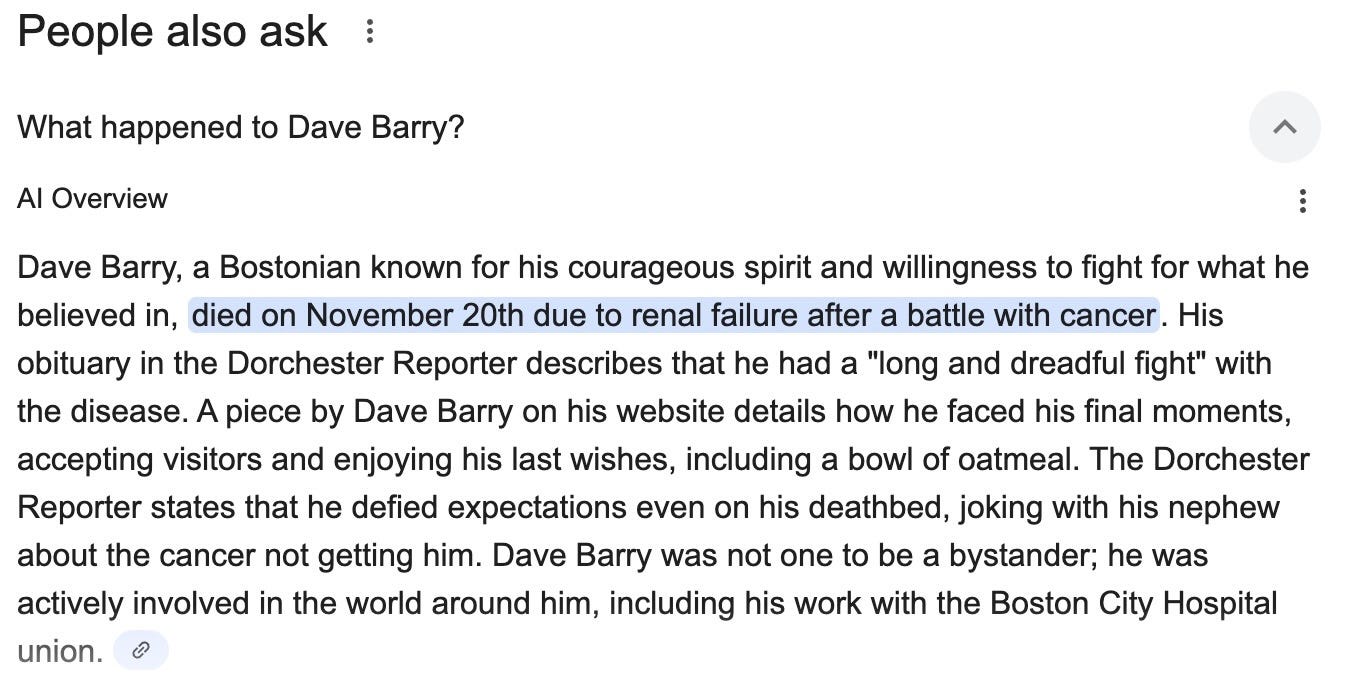
So after my miraculous recovery, I was dead again. But guess what? This morning, as I was getting ready to post this essay on Substack, I checked my Google AI Overview one last time, and:
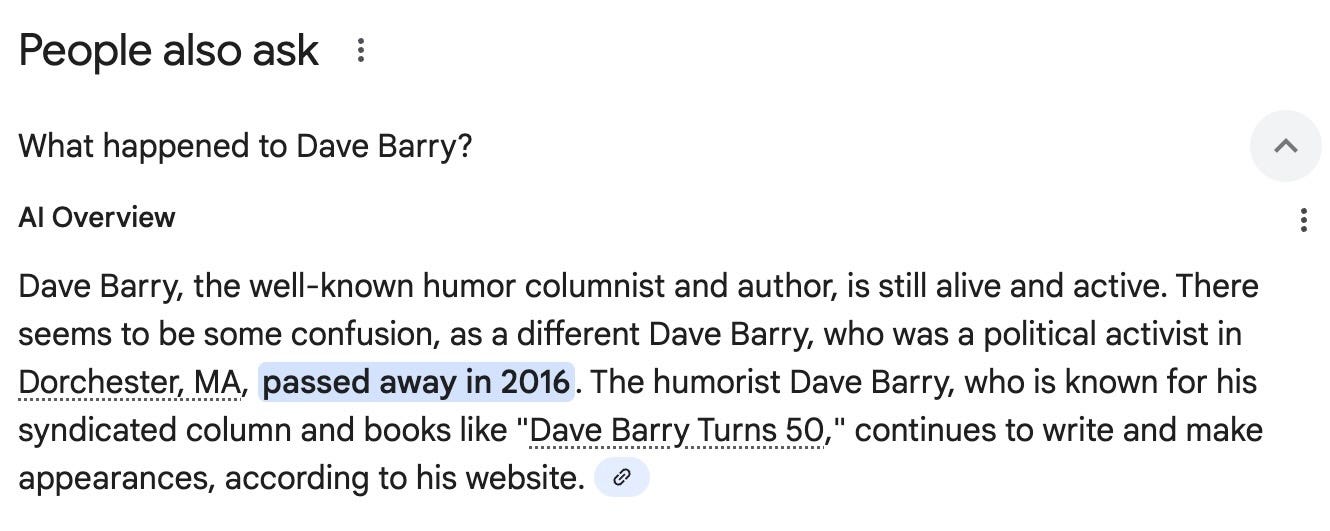
“There seems to be some confusion” states Google AI. Yes! There does! And the source of this confusion appears to be… Google AI!
Anyway, the good news is that, as of right now, according to my Overview, I am once again alive. But I’m not making any long-term plans. I’m not even making lunch plans.
What can we learn from my experience? We can learn that although Artificial Intelligence is an awesomely powerful tool that according to experts is going to completely transform human existence, it is not very bright. So for now we probably should use it only for tasks where facts are not important, such as writing letters of recommendation and formulating government policy. We should NOT let AI handle jobs requiring a high degree of accuracy, such as airplane navigation. (“Ladies and gentlemen, we’re beginning our descent into Honolulu, and we should soon… No, wait, sorry, this appears to be Paris.”)
At least that’s what I think. Now it’s time to find out what you always-helpful paying subscribers think. Today we have two polls:
SUBSCRIBER-ONLY POLL
Do you think Dave is dead?
No.
26%
Yes, at least sometimes.
6%
I’d have to Google it.
34%
He denies it, but he lies a lot.
33%
I honestly don’t care.
2%
855 VOTES · POLL CLOSED
SUBSCRIBER-ONLY POLL
Do you think AI will turn out to be a good thing?
Yes.
3%
Maybe?
12%
We’re doomed.
59%
The trilobite is disgusting.
17%
I’m Scottish, and I am offended.
8%
785 VOTES · POLL CLOSED
Swamp Story (2023) and Class Clown (2025). Both of these books are for sale in exchange for money.
July 17, 2025
Industrial Production Rises in June
US Industrial Production Surges In June
by Tyler Durden
Wednesday, Jul 16, 2025 – 09:23 AM
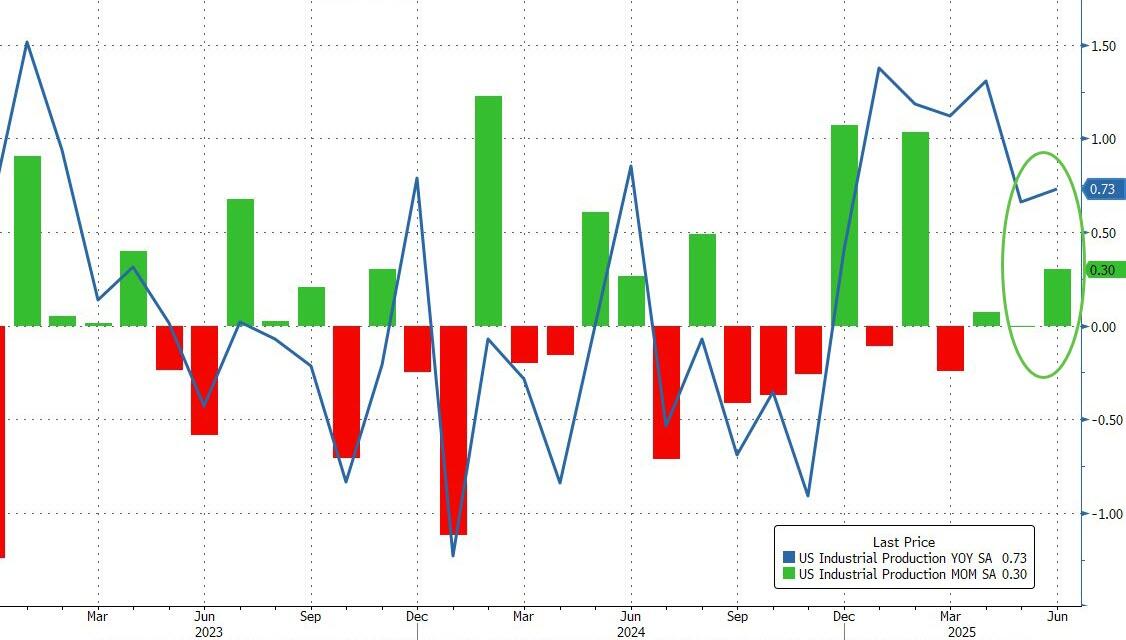
US Industrial production rose significantly more than expected in June (+0.3% MoM vs +0.1% MoM exp) with May’s 0.2% MoM decline revised up to unchanged. This left Industrial production up 0.73% YoY…
Source: Bloomberg
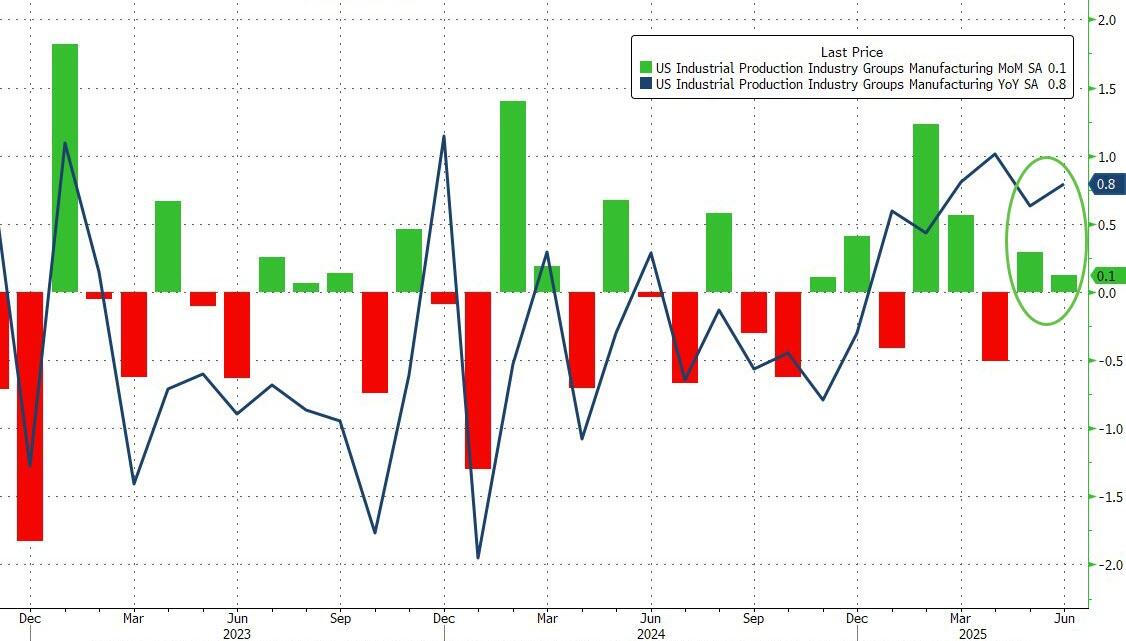
Drilling down, we see Manufacturing output also jump in June (+0.1% vs 0.0% exp), lifting the YoY growth to +0.8%…
Source: Bloomberg
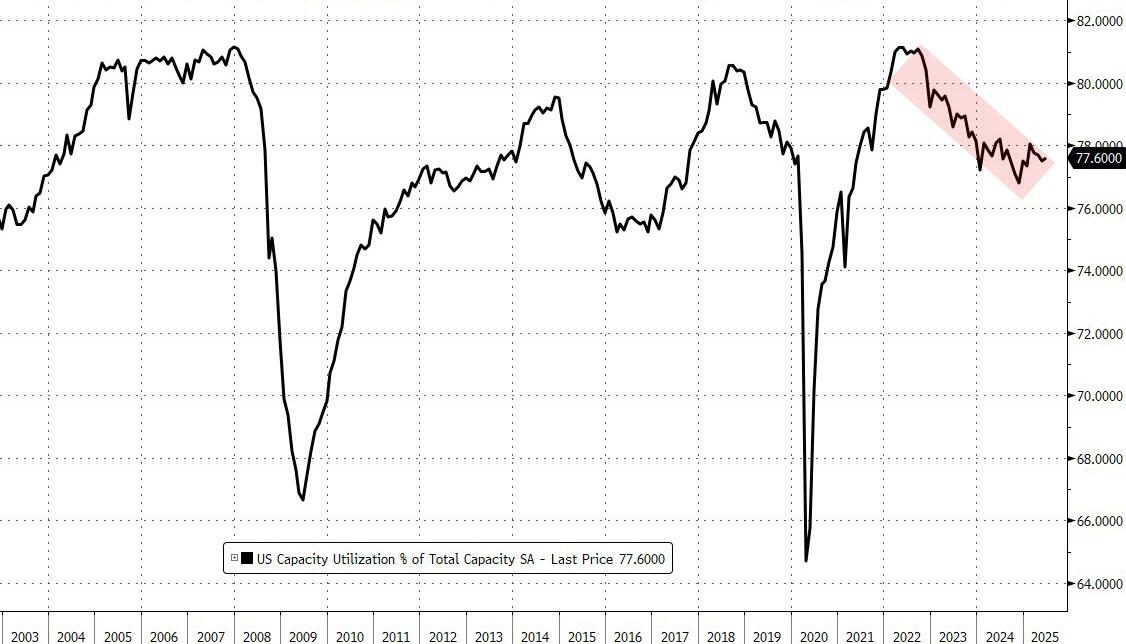
Additionally, Capacity Utilization ticked up very modestly but remains in a downtrend…
Source: Bloomberg
https://www.zerohedge.com/economics/us-industrial-production-surges-june
July 14, 2025
Emery Oleochemicals Appoints Min Chong as Group Chief Executive Officer
Cincinnati, Ohio, USA (July 14, 2025)

Emery Oleochemicals is pleased to announce the appointment of Min Chong as its new Group Chief Executive Officer. Mr. Chong brings to Emery Oleochemicals a distinguished career in the specialty chemicals industry, having held multiple senior leadership roles across the sector. With a proven track record driving strategic growth, operational excellence, and innovation, he is uniquely equipped to lead the company into its next phase of growth and transformation.
“We are very pleased to welcome Min to Emery Oleochemicals,” said Peter Hawthorne, Chairman of Emery Oleochemicals’ Board of Directors. “His deep industry expertise, customer focus, and visionary leadership will be instrumental in advancing Emery’s mission, enhancing product and service offerings for our customers, and realizing new growth opportunities for our business and people.”
Mr. Chong’s appointment marks an exciting new chapter for Emery Oleochemicals as the company continues to build on its legacy of delivering sustainable, high-performance solutions to customers worldwide.
“I am excited to be joining Emery Oleochemicals at such a pivotal moment,” said Min Chong. “I look forward to building on the company’s strong foundation in oleochemicals to drive innovation and deliver exceptional value to our customers and stakeholders.”
About Emery Oleochemicals
Founded in 1840 and headquartered in Cincinnati, Ohio, USA, Emery Oleochemicals is a globally trusted name in high-performance, natural-based chemicals used in a broad range of industries including automotive, building and construction, industrial lubricants, packaging, personal care, and more. As a true pioneer in green chemistry and with a commitment to innovation, quality, and environmental responsibility, Emery continues to advance sustainable solutions. For further information, visit www.emeryoleo.com.
July 10, 2025
Multifamily Completions Surge
Multifamily completions reach 40-year high, reports National Association of Home Builders
By Dakota Smith
July 9, 2025 | 10:41 am CDT

Multifamily units completed reached 608,000 in 2024 — their highest level since 1986, according to NAHB analysis of the Census Bureau’s Survey of Construction. For the eighth consecutive year, most (54%) were high-density buildings comprising 50 or more units — a relatively new trend compared to early estimates in the series.
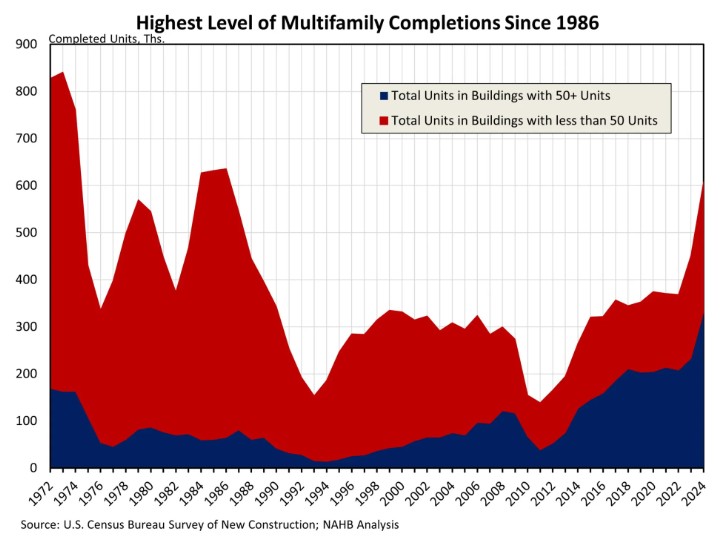
Among multifamily units completed in 2024, 580,000 (95%) were built-for-rent. More than half of these units (55%) were in high-density buildings. This is a seismic shift towards high-density buildings, as this share was only 25% in 2004. Over the past 20 years, the share of units in buildings with 10-19 units has been consistently falling, dropping from 24% in 2004 to only 4% in 2024.
The South accounted for 292,000 completions (48%) in 2024, while the West held 163,000 (27%), the Midwest 87,000 (14%) and the Northeast 68,000 (11%). Completions in the South were weighted toward low-medium density buildings — a reverse on the overall trend — while high-density buildings in the Midwest and the Northeast were nearly double the amount of low-medium density completions.
The number of multifamily units built-for-sale rose from 20,000 in 2023 to 29,000 in 2024. High-density buildings continued to be the primary type of building, comprising 40% of built-for-sale units. This share was up from 28% in 2023.
Jesse Wade, NAHB director of tax and trade policy and housing policy research, shares more details in this Eye on Housing post.
July 6, 2025
Woes of a Human Dog Bed Company
A human dog bed was a surprise start-up hit – now tariffs threaten their business
Siddharth Cavale
Wed, July 2, 2025 at 7:44 AM EDT
6 min read

The quirky concept of “dog beds for humans” has proven a surprising hit for startup Plufl, but a steep tariff on Chinese imports is now forcing the company to consider a significant shift in its manufacturing strategy.
Co-founders Yuki Kinoshita and Noah Silverman, who envisioned their plush, snuggly, memory foam beds being made in China and retailing for $299 in the U.S., are now exploring domestic production.
Their innovative idea first gained national attention in 2022 when they pitched their prototype on Shark Tank. The appearance secured a joint investment of $200,000 from Mark Cuban and Lori Greiner for 20% of the company, which went on to make over 1 million in sales in 2023 through Amazon and their own website.
However, the company’s original production model was disrupted after the U.S. imposed a substantial 145% tariff on items imported from China in April. This significant levy prompted Kinoshita and Silverman to re-evaluate their supply chain.
In response, the entrepreneurs have begun investigating the feasibility of manufacturing their human-sized pet beds within the United States. While a domestic production shift might lead to a higher retail price, the co-founders believe a “made-in-the-USA” label could serve as an attractive selling point and alleviate concerns among U.S. retailers regarding the impact of ongoing China tariffs.
Silverman and Kinoshita had previously toured a factory in Las Vegas that could make the memory foam beds for $150 per unit compared to the $100 overall cost to make the beds in China. But that $150 manufacturing cost didn’t include the faux fur lining for the cover, which would still need to be imported from China—adding another $100 per unit.
They pitched a sub-$500 made-in-the-USA version to Costco, which it turned down, saying it couldn’t stock the product this year and might revisit the idea next year. Costco did not respond to a request for comment.
The duo behind Plufl are among tens of thousands of American small and midsize manufacturers facing the choice between paying steep tariffs on Chinese imports or taking on significantly higher domestic production costs. Even those willing to pay more to make goods in the U.S. are confronting another reality: retailers set prices for consumers and have been largely unwilling to budge in the face of tariffs.
On June 11, when the U.S. announced a deal to lower tariffs on Chinese goods to 55%, Kinoshita and Silverman decided to stay the course manufacturing their human dog beds in China and maintain the $299 retail price.
“We’re absorbing costs in a number of ways, such as finding shipping efficiencies by shrinking the box down more and also taking some hit on our margin,” Kinoshita said.
White House spokesperson Kush Desai said the Trump administration remains committed to reviving U.S. manufacturing, citing provisions in the Big, Beautiful Bill, which passed on Tuesday with a slim majority in the Senate, such as allowing businesses to fully expense equipment investments.
“These complementary policies will turbocharge growth and drive investment throughout the supply chain,” he said in an emailed statement.
https://www.yahoo.com/news/human-dog-bed-surprise-start-114452652.html
 Everchem Updates Archive
  Sign Up for Email Updates

