
Current Affairs
September 19, 2024
Formaldehyde Issues
Industry decries EPA’s formaldehyde analysis
By Larry Adams
September 17, 2024 | 12:57 pm CDT

In August, the Environmental Protection Agency released the finalized IRIS Toxicological Review of Formaldehyde that addressed the potential cancer and noncancer human health effects from inhalation exposure to formaldehyde.
Industry groups have questioned the methodology of the assessment, what they call “regulatory overreach,” and worry that the assessment will lead to additional regulations.
The assessment specifically focuses on the following health effects: sensory irritation; pulmonary function; immune system effects, focusing on allergic conditions and asthma; respiratory tract pathology; nervous system effects; reproductive and developmental toxicity; and cancer. For cancer, the assessment focuses on cancers of the upper respiratory tract (including nasopharyngeal
cancer, sinonasal cancer, cancers of the oropharynx/hypopharynx, and laryngeal cancer in humans) and of the lymphohematopoietic system (including Hodgkin lymphoma, multiple myeloma, myeloid leukemia, and lymphatic leukemia in humans).
Among the EPA’s findings were:
- Inhaled formaldehyde can cause health effects in humans, most notably respiratory effects. Children and those with respiratory disease appear to be most susceptible.
- Formaldehyde is carcinogenic to humans by the inhalation route of exposure.
Industry groups were quick to question the assessment. The National Association of Manufacturers, in an online policy post said The formaldehyde analysis risks “creat[ing] an unachievable standard and a de facto ban” on an essential manufacturing material
NAM added that the assessment maintains the formaldehyde threshold of 11 parts per billion proposed by the agency in 2022. That’s 30 times lower than Europe’s recently updated worker-exposure limit of 300 parts per billion and “lower than what can be found in homes or even background levels for outdoor air,” the NAM told the EPA.
The American Chemistry Council’s (ACC) Formaldehyde Panel issued the following statement on the IRIS Assessment of Formaldehyde:
“As required under the Toxic Substances Control Act (TSCA), any assessment of formaldehyde must begin with the best available science. This assessment fails that test and is therefore unfit for regulatory decision-making. EPA’s final assessment fails to reflect fundamental criticism from multiple peer review bodies or public comments provided by hundreds of experts, stakeholders, and other agencies. The Agency is on a path to ignore applicable scientific standards and procedural requirements, and issue unscientific and legally unsound regulatory actions based on this flawed assessment under TSCA and other laws later this year.
“If EPA continues on its current path, formaldehyde manufacturing and many of its downstream uses could be severely restricted or potentially banned in the U.S., with an overwhelmingly negative impact on the environment, human health, national security, and the economy.”
Groups with direct ties to the wood products industry also argued against the assessment. The Decorative Hardwoods Association (DHA) recently joined allies in a letter to members of Congress opposing the use of IRIS risk assessments in regulatory determinations. “Despite all of the comments and criticisms of the underlying assessment, the final assessment retains most of EPA’s original conclusions and no changes to the IRIS values,” wrote Keith Christman, president of the DHA, in a recent post
The Environmental Protection Agency’s final formaldehyde analysis does not mandate any new restrictions on industry, but may lead to a final risk evaluation that will.
Fighting IRIS
Congressman Glenn Grothman (R-WI) and Senator John Kennedy (R-LA) introduced the No Industrial Restrictions in Secret Act (No IRIS Act) to “reduce undue red tape” imposed by the EPA’S Integrated Risk Information System (IRIS). This bill is supported by the American Chemistry Council and a variety of other groups.
For instance, on September 9, the DHA, the Kitchen Cabinet Manufacturers Association (KCMA), and the Composite Panel Association joined 50 other national associations in supporting the No Industrial Restrictions in Secret (NO IRIS) Act of 2024 (S. 3724/H.R. 7284).
The bill seeks to prohibit EPA from using Integrated Risk Information System (IRIS) assessments for regulatory decisions. The IRIS program, which the congressman said “lacks Congressional authorization,” has previously influenced some of EPA’s chemical use restrictions. CPA supports this legislation to limit the potential for the formaldehyde IRIS assessment to be used to negatively impact the manufacturing and use of composite panels. Although the bill’s passage this year is unlikely, it helps raise awareness of the issue in Congress, according to the CPA.
Background
The EPA established the IRIS program in 1985 to gather data on how chemicals impact human health, however, it was never authorized by Congress.
IRIS has relied on flawed scientific data, disregarded relevant information, and dismissed public input. Despite the program’s inherent flaws, it creates chemical threshold assessments that have had devastating consequences for private industries.
“There needs to be a change in the way EPA conducts its business around scientific integrity and accountability in the way in which the federal government conducts chemical risk evaluations,” Grothman said.
September 16, 2024
Floods Distrupt Borsodchem

2024 09 16T090703Z 1 LYNXMPEK8F07J RTROPTP 4 EUROPE WEATHER CENTRALEUROPE FLOODS CZECH
·6 hours ago
Central Europe factories and retailers shut in flood-hit areas
By Jan Lopatka
PRAGUE (Reuters) -Factories and stores across central Europe shut down production lines and closed their doors on Monday due to flooding that has killed at least 10 people, forced tens of thousands to evacuate and submerged towns from Poland to Romania.
In Ostrava – an industrial city of 290,000 people in northeast Czech Republic – the BorsodChem chemical plant was shut, a spokesperson for the company, partially owned by China’s Wanhua Chemical Group, said.
The OKK Koksovny coking plant – one of the largest producers of foundry coke in Europe – stopped chemicals production but was continuing to keep coking batteries heated to minimum levels, spokesman Jindrich Vanek said.
“There is water that has started rising and there must be a breach of the flood barriers,” he said. “We are without electricity and we are heating our batteries with coking gas, keeping them at technological minimum.”
Czech soft drinks maker Kofola CeskoSlovensko said it was pumping water out of its production facilities in Krnov, some 70 km (44 miles) from Ostrava, and would have a better view on the length of the outage early next week.
The company said it was premature to estimate damage and that it could cover supplies of most products from other plants.
Border areas between the Czech Republic and Poland were hit hard over the weekend, following days of heavy rain. Some bridges collapsed and homes were destroyed, while villages and towns in eastern Romania were submerged.
While rivers in the Czech-Polish border area were starting to recede on Monday, flooding was widening to more areas and leaving bigger cities in both countries on alert.
Veolia Energie has shut its Trebovice electricity and heating plant, which has cut hot water and heating supplies to large parts of Ostrava following flood damage, the company said in a statement.
“At the moment, the supply of heat and hot water in Ostrava is interrupted,” the company said. “The key technologies remained undamaged and therefore if the situation develops favourably we estimate the restoration of supplies in a few days.”
TRANSPORT PROBLEMS
An economist for Czech bank Ceska Sporitelna predicted industry in general would take a hit.
“Industry will receive a negative impulse of one or two percentage points, while the construction sector will receive a positive impulse… thanks to the reconstruction of damaged buildings and infrastructure,” Ceska Sporitelna Chief Economist David Navratil wrote.
The Czech Confederation of Industry said some companies not directly affected by the flooding still had to stop production in hard-hit regions because or problems transporting materials by rail.
Belgian firm Umicore said both its battery materials site in the Polish city of Nysa and its automotive catalysts facility in Nowa Ruda had been secured with limited impact from the floods.
Power utility Tauron said six of its hydroelectric plants in southern Poland were not working due to the floods.
More than 60,000 people were left without power on Monday morning, its press service said.
Polish retailer Zabka said around 80 outlets were currently closed, mainly in the area around the southwest town of Klodzko. The shops were closed due to flooding, lack of electricity or evacuation ordered by the emergency services, its press service told Reuters via email on Monday.
The retailer, owned by private equity fund CVC Capital Partners, added that it had provided water, provisions and transport support to its franchisees and was gathering information on their needs.
(Reporting by Tymon Miller and Michal Aleksandrowicz in Gdansk and Jan Lopatka in Prague; Writing by Michael Kahn; Editing by Alex Richardson)
https://business.express/central-europe-factories-and-retailers-shut-in-flood-hit-areas/
September 10, 2024
East Coast Shipping Strike
Customs broker urges importers to delay their shipments to avoid East Coast strike
Bobby Dalheim //Senior Editor of Case Goods and Global Sourcing//September 9, 2024
NORFOLK, Va. – With a potentially massive strike looming over East Coast ports in early October, one customs broker and logistics provider is suggesting importers delay their shipments.

“Leading up to the U.S./Canada East and Gulf Coast labor contract expiration on Sept. 30, there is a lot of uncertainty throughout the market,” said Rachel Shames, vice president of pricing and procurement for CV International, in a blog post. CV is a member of the American Home Furnishings Alliance and often does business with furniture importers.
“There’s been no progress in labor negotiations over recent months, and it seems likely that a labor disruption will occur effective Oct. 1,” she said. “It’s also possible we will see port work slowdowns begin before the official contract expiration date. The duration of any disruption or strike is unknown; hopefully any action will last only a few days, if that long.”
As such, Shames says shippers should be prepared for delays in the coming weeks.
“If shipments can be delayed until later in October or November, it would be a good idea to consider postponing until the market settles,” she said.
Container rates to both U.S. coasts have been dropping steadily for the past six or so weeks but remain volatile. An increase in West Coast rates is expected as East Coast importers begin to shift away from the East Coast in anticipation of the strike.
“Levels have been softening gradually since July, but we expect West Coast rates will increase as of Sept.15,” Shames said. “East and Gulf Coast from Asia may continue to decline, but with the potential for major congestion, we could see extra charges announced. There is still a wide range of rates in the market: FAK levels remain relatively strong compared with fixed contract rates, but carriers are still offering special spot deals for specific sailings (although many of those sailings are filling up fast, and cargo booked on those low deals is likely to roll).”
As of early September, both parties involved in the strike – the International Longshoremen’s Assn., which represents 85,000 dockworkers, and the U.S. Maritime Alliance (USMX) – still indicate that a successful negotiation is far off. The primary issue of contention seems to be automation, as the ILA has alleged that certain ports are using an auto gate system, which allegedly violates the current contract.
“The ILA most definitely will hit the streets on Oct. 1 if we don’t get the contract we deserve,” said ILA President Harold Daggett in a recently surfaced video. “Mark my words, we’ll shut them down.”
In a press release dated Sept. 5, the USMX said the ILA continues to “strongly signal it has already made the decision to call a strike” and that it hopes the ILA “reopens dialogue.” The ILA issued a letter to its members as a response, calling the USMX release “propaganda” and explaining its stance in detail.
September 9, 2024
Gulf Storm This Week
Oil Rises As Major US Refineries In Path Of Strengthening Gulf Storm
by Tyler Durden
Monday, Sep 09, 2024 – 08:45 AM
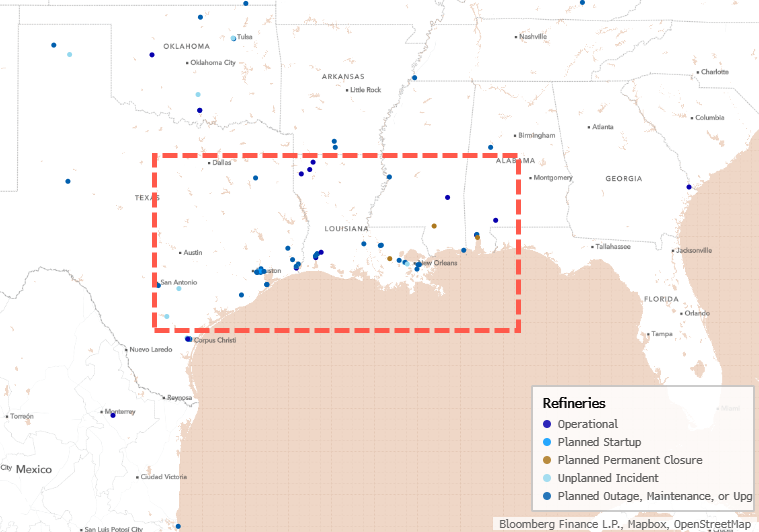
Oil and gasoline futures moved higher early Monday as the National Hurricane Center tracked a potential tropical system that threatened parts of the US Gulf Coast later this week. The storm could slam into the upper Texas and Louisiana coasts, accounting for about 60% of US refining capacity.
Potential Tropical Cyclone Six, or Invest 91L, churns in the southwestern Gulf of Mexico early Monday and is forecasted to become a hurricane before it reaches the northwestern US Gulf Coast late Wednesday. The storm emerges right on time, at the peak of the Atlantic hurricane season. It is interesting to note that this hurricane season has been very quiet.
“While it is too soon to pinpoint the exact location and magnitude of impacts, the potential for life-threatening storm surge and damage winds are increasing for portions of the Upper Texas and Louisiana coastlines beginning Tuesday night,” the NHC wrote in its latest update.
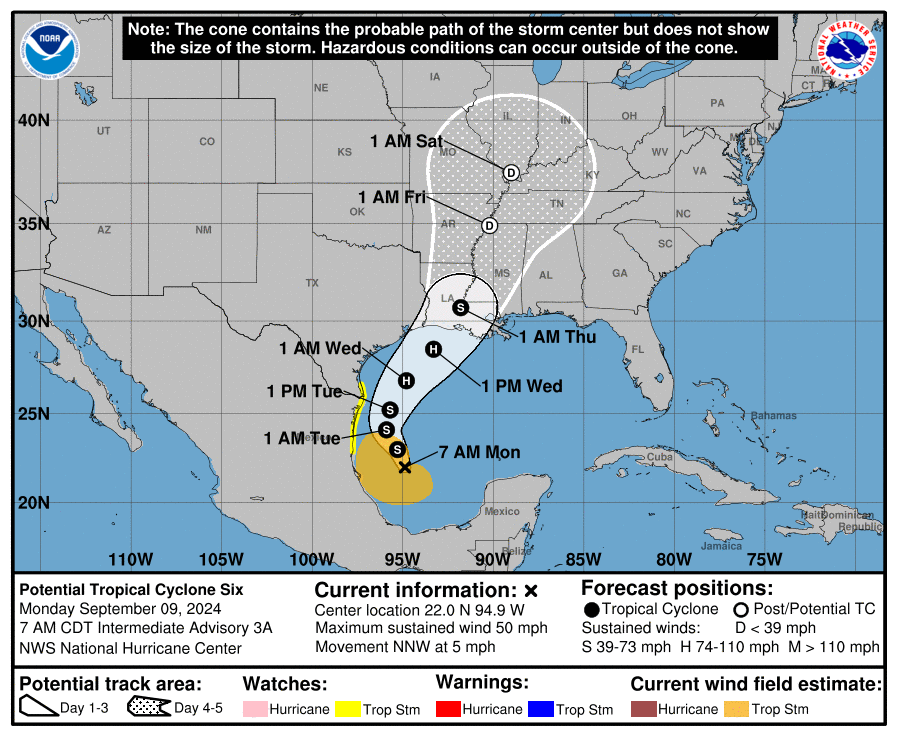
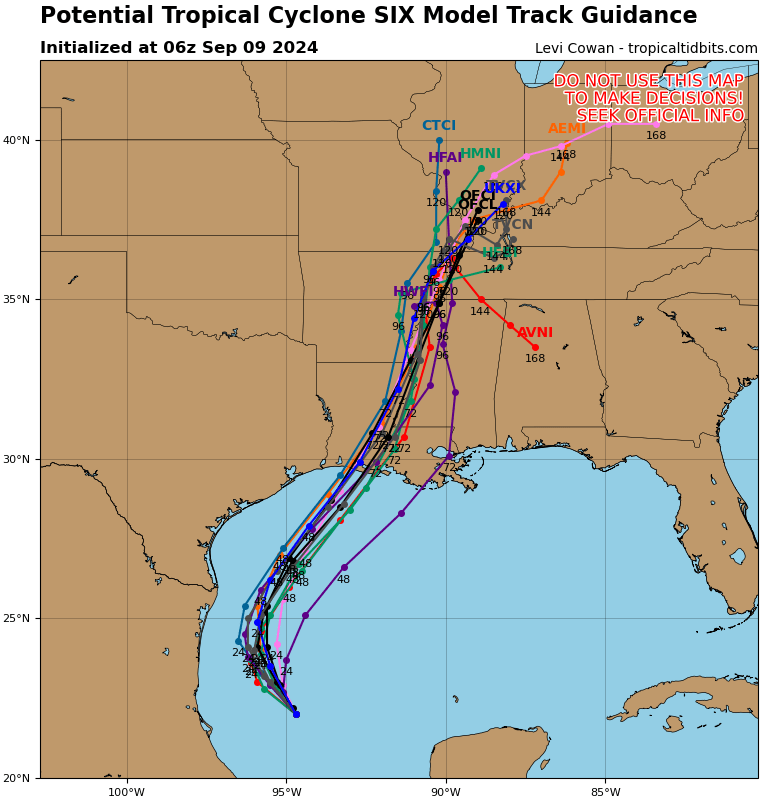
The latest hurricane trajectory models show strong consensus that the tropical system could make landfall along the Louisiana coast.
This area of the Gulf Coast is home to approximately 60% of US refining capacity. Bloomberg data shows several refineries are in the storm’s cone of uncertainty.
“A small recovery in prices is underway this morning, inspired by hurricane warnings that might threaten the US Gulf Coast, but the wider conversation remains on where demand will come from and what OPEC+ can do,” PVM analyst John Evans told Reuters.
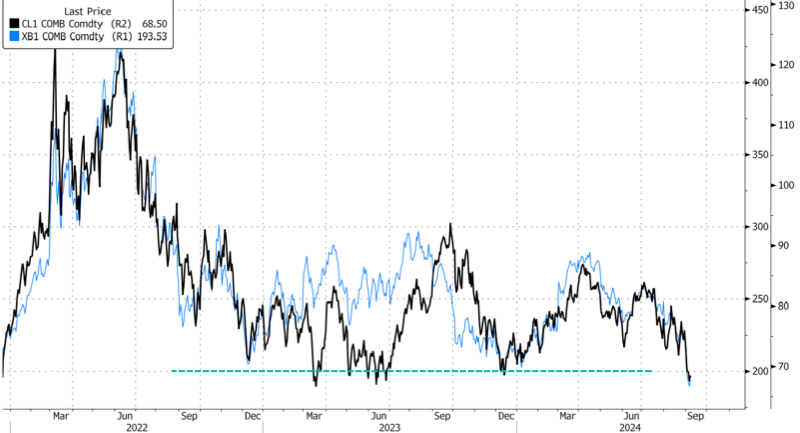
In recent weeks, Goldman’s commodity analyst—now without “supercycle” permeable Jeff Currie—Daan Struyven slashed his expected range for Brent oil prices by $5 to $70-$85 per barrel, citing weaker Chinese oil demand, high inventories, and rising US shale production. The biggest driver for the cut is his belief that “OPEC will raise production in Q4…”
Morgan Stanley has also recently revised its oil price forecasts downward, reflecting expectations of increased supply from OPEC and non-OPEC producers amid signs of weakening global demand. The bank now anticipates that while the crude oil market will remain tight through the third quarter, it will begin to stabilize in the fourth quarter and potentially move into a surplus by 2025.
Morgan Stanley has cut its forecast for the fourth quarter to $80 per barrel, down from $85, and now expects prices to gradually decline to $75 per barrel by the end of 2025, slightly lower than their previous estimate of $76.
None of this is new to the market, where sentiment is ultra-bear…
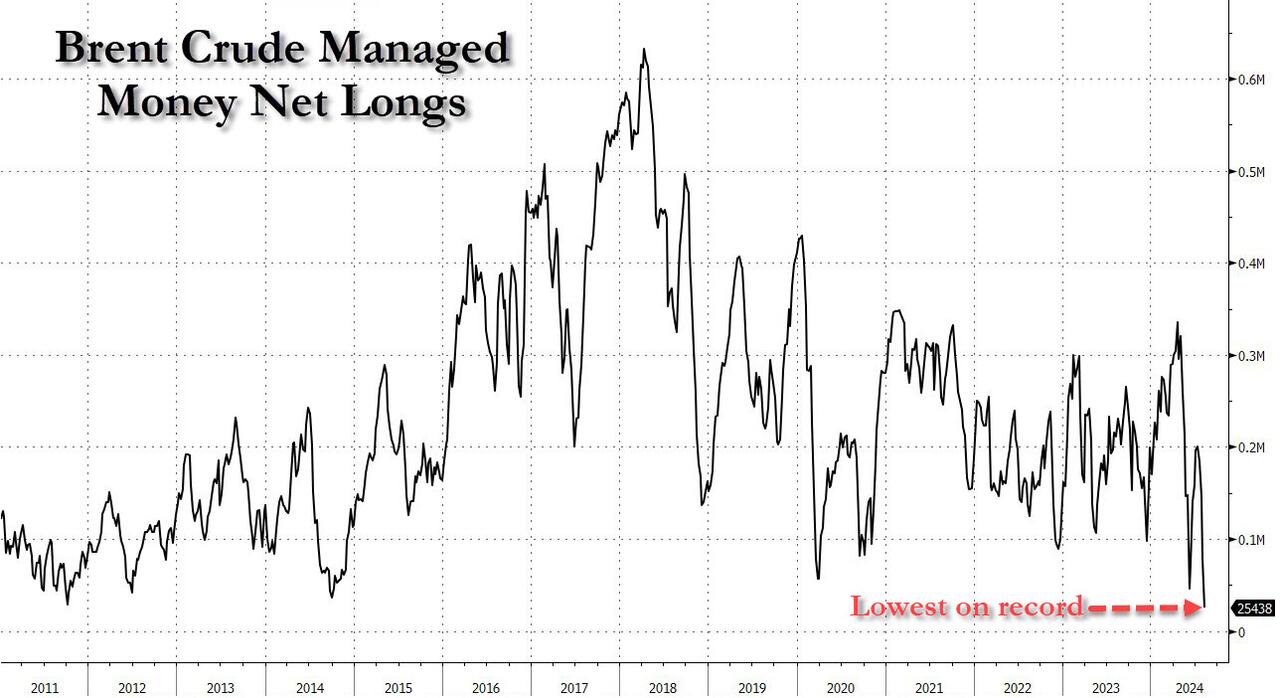
However, a tropical system that supercharges in the Gulf of Mexico’s warm waters and knocks out a few refineries could easily send energy prices back up.
https://www.zerohedge.com/commodities/oil-rises-major-us-refineries-path-strengthening-gulf-storm
September 9, 2024
Acoustic Foam for Tires
Henkel and 4JET revolutionize silent tire production for EVs

Share LinkedIn Twitter Facebook Email

L-R: Dr. Armin Kraus, co-CEO at 4JET, Imke Vogel, Market Segment Head Automotive Components Europe at Henkel, Dr. Jan Flohre, Head of Laser Process Development at 4JET and Dr. Rainer Schönfeld, Global Market Strategy Head Automotive Components at Henkel.
As EVs lack engine noise, tire rolling sound becomes more noticeable, often perceived as intrusive and unpleasant. To combat this, manufacturers have been equipping EVs with “Silent Tires,” featuring acoustic polyurethane foam linings. However, this solution has presented logistical and cost challenges, increasing tire production expenses by up to 25%.
The new Laser-Fit process, developed by Henkel and 4JET, promises to streamline production and reduce costs. This method involves creating acoustic foam directly inside the tire from liquid materials at the end of the production line, eliminating complex logistics and manual steps.
“Our new to market Loctite Laser-Fit acoustic foam achieves its sound absorption effect through a large inner surface and a pore design specifically tailored for tire noise suppression,” said Dr. Rainer Schönfeld, Global Market Strategy Head in Henkel’s Automotive Component business unit.
The process utilizes a patented laser activation technique to remove the foam’s air-impermeable skin, allowing for effective sound absorption. This innovation not only simplifies production but also offers manufacturers greater flexibility in foam design and reduces waste.
“This revolutionary direct-foam-to-tire technology represents our joint commitment to innovation and sustainability,” said George Kazantzis, Global Head of Henkel’s Automotive Components business unit. “By eliminating the transportation of pre-fabricated foam and reducing cutting waste, we will enable our customers to lower their carbon footprint.”
The partners developed this technology in record time, showcasing the innovative strength of German SMEs. Dr. Armin Kraus, co-CEO of the 4JET Group, praised the collaboration: “In Henkel, we have found the ideal development partner for this innovation… From the idea to the finished application in record time.”
The complete solution will be presented at RubberTech24 in Shanghai this month, marking, the companies hope, a significant advancement in EV tire technology.
www.electrichybridvehicletechnology.com/news/henkel-and-4jet-revolutionize-silent-tire-production-for-evs.html
 Everchem Updates Archive
  Sign Up for Email Updates


