
The Urethane Blog
July 21, 2026
List of Transactions; Lots of PE money!

6/30/26 Remaining 80%
stake in Biotelliga Corteva, Inc. $90.0M –
- Corteva, Inc. has acquired the remaining 80% stake it did not already own in
Biotelliga, a New Zealand–based agricultural biotechnology company focused on
developing safe and sustainable solutions for managing crop pests and diseases. - Corteva intends to continue operating the business out of New Zealand, leveraging
Biotelliga’s microbial library to expand its lineup of bio-pesticides and sustainable
farming products.
6/30/26 Creative Engineers Oklo Inc. – –
- Oklo Inc. has acquired Creative Engineers (“CEI”), a Pennsylvania-based chemical
process engineering company, with a specialized focus on alkali metals, performance
metals, and specialty chemical systems. - Brings CEI’s specialized capabilities in liquid -metal systems, component
development, fabrication, manufacturing, and applied R&D into Oklo’s team,
strengthening technical areas directly relevant to sodium handling, thermal systems,
and Oklo’s sodium -cooled, Aurora powerhouse technology. - Oklo’s Aurora powerhouse is a sodium -cooled fast reactor designed to use liquid-
metal cooling, passive safety characteristics, and natural circulation to support decay
heat removal after shutdown, making sodium systems expertise directly relevant to
Oklo’s planned deployment pathway.
6/26/26 Shengnova Advanced
Materials JV
SI Group;
Shengxiao Group – –
- SI Group, a Texas-based manufacturer of performance additives, process solutions,
and chemical intermediates, and Shengxiao Group, a China-based producer of liquid
crystal polymer monomers and specialty chemicals have announced the formation of
Shengnova Advanced Materials JV. The JV combines Shengxiao Group’s biphenol
manufacturing assets and regional market access with SI Group’s proprietary
technology and global biphenol expertise. By bringing these capabilities together, the
JV is designed to increase supply of biphenol in China. - Biphenol is an important monomer used in liquid crystal polymers,
polyphenylenesulfone, and other applications. The JV positions both partners to
support growing demand across sectors including electronics, automotive, and
medical, where high-performance materials are essential to next-generation
applications.
6/25/26 Advanced Medical
Solutions
H.B. Fuller
Company $943M 12.9x
- H.B. Fuller Company has agreed to acquire Advanced Medical Solutions (“AMS”), a
United Kingdom–based manufacturer of a range of products for the surgical, wound
care, and wound-closure markets. - The acquisition will extend H.B. Fuller’s capabilities across tissue bonding adhesives,
tapes and dressings, and formulated biosurgicals. - “This transaction is a rare opportunity to advance the evolution of our portfolio.” said
Celeste Mastin, President and CEO of H.B. Fuller. “We have long been clear that
medical is a core strategic growth market for H.B. Fuller given its durable demand
trends, high regulatory-based entry barriers, and margin profile. Accordingly, we
have thoroughly analyzed this structurally scarce market to identify the most
attractive assets and growth opportunities.“ - H.B. Fuller expects to capture approximately $55 million in combined run-rate
revenue and cost synergies by 2031, including the elimination of public company
costs, rationalization of certain overlapping expenses, and sourcing savings. AMS is
expected to increase H.B. Fuller’s annual revenues by approximately $300 million
(3.15x EV / Revenue), while driving positive mix shift, creating significant revenue
growth and EBITDA compounding opportunities. - EBITDA multiple is based on current consensus forecast for 2026 AMS EBITDA.
6/24/26 Anviplas Spain GreenDot Global
(Agilyx ASA) – –
- GreenDot Global has acquired Anviplas Spain, a Spain-based LDPE film recycling
specialist. Anviplas processes post-commercial and post-industrial films with an
annual recycling capacity of 30,000 tons. - The transaction marks GreenDot’s entry into Spain, one of Europe’s largest and most
strategically important plastics markets, and represents another important step in
Agilyx’s strategy to build a leading pan-European platform for high-quality recycled
plastics. - Anviplas has approximately 70 employees and is expected to generate revenue of
EUR 25 million in 2026.
SECOND
Announced
Date Target Acquirer Value EBITDA
Mult. Details
6/24/26 GFF S.r.l. Ambienta SGR – –
- Ambienta SGR has made an investment in GFF S.r.l., an Italy-based developer and
producer of natural flavors for the food and beverage industry. GFF serves more than
250 small and medium-sized food & beverage producers with custom-developed
flavors, extracts and essential oils for sweet, savory, beverage and nutraceutical
applications. - Ambienta will aim to capitalize on the continued transition from synthetic to natural
flavors.
6/19/26 Synthomer a.s.
(Synthomer plc)
Mutares SE & Co.
KGaA $27.5M –
- Mutares SE & Co. KGaA has agreed to acquire Synthomer a.s., a Czech Republic-
based producer of acrylic acids and acrylic esters for the European merchant market. - Represents a strategic platform investment for Mutares’ Chemicals & Materials
segment. According to Mutares, the transaction is fully aligned with Mutares’ strategy
of acquiring businesses with significant operational improvement potential from
special situations, and provides a clear path towards substantial value creation. - The acquired business has 300 employees and generates revenue of approximately
$125 million (0.22x EV / Revenue).
6/19/26
VanDeMark
Chemical
(SK Capital
Partners)
Valiant Energy
Management – –
- Valiant Energy Management has acquired VanDeMark Chemical, a New York–based
producer of phosgene derivatives and specialty chemical intermediates serving
customers across the defense, pharmaceutical, agricultural, industrial,
biotechnology, and specialty chemical sectors. - As part of the acquisition, Valiant intends to maintain and grow operations at the
Lockport, New York facility while pursuing opportunities to enhance manufacturing
capabilities, develop new products, strengthen customer relationships, and expand
the business over time.
6/18/26
Chemical Company
of Malaysia Berhad
(Batu Kawan Berhad)
TMK Chemical
Bhd. $227M –
- TMK Chemical Bhd. has agreed to acquire Chemical Company of Malaysia Berhad
(“CCM”), a Malaysia-based company that operates two main business units: chlor-
alkali and Polychem. The chlor-alkali division specializes in the production of caustic
soda, potassium hydroxide, and a wide array of chlor-alkali-based products and
derivatives. The Polychem unit focuses on manufacturing polymer coatings and
inorganic water treatment derivatives, catering to both domestic and regional
markets.
- Expands TMK Chemical’s scale, broadens its product portfolio and diversifies
earnings.
6/18/26
Semiconductor
chemicals business
of Heraeus Epurio
Brewer Science – –
- Brewer Science has agreed to acquire the semiconductor chemicals business of
Heraeus Epurio. The transaction will include the Heraeus Epurio semiconductor
chemicals production site in Dayton, Ohio, along with the associated sales and
support personnel in Asia. - Expands Brewer Science’s advanced materials portfolio and strengthens its ability to
support semiconductor customers with highly specialized, ultrapure chemical
solutions critical to advanced lithography and microdevice fabrication.
6/17/26 ClarityChem
Rochester
Midland
Corporation
(Peak Rock
Capital)
- –
- Rochester Midland Corporation has acquired ClarityChem, a New York–based
provider of custom integrated commercial, institutional, and industrial water and
process treatment solutions. - Jordan Campbell, Senior Managing Director of Peak Rock Capital, said, “The
acquisition of ClarityChem accelerates Rochester Midland’s growth and industry
position within water treatment. This partnership enables Rochester Midland to
expand its service presence and capabilities for its valued customer base.”
Announced
Date Target Acquirer Value EBITDA
Mult. Details
6/16/26 Huntsman
Corporation Olin Corporation $4.8B 13.1x
- Olin Corporation and Huntsman Corporation have agreed to combine in an all-stock
merger of equals to create a leading North American chemicals company. The
combined organization, which will be renamed OlinHuntsman Corporation following
the close of the transaction, will benefit from enhanced scale, scope and expanded
chlorine optionality, enabling it to create value across markets and cycles. The
vertical integration of Olin and Huntsman’s complementary upstream and
downstream businesses brings together cost-advantaged North American assets and
feedstocks with differentiated formulations and high-value advanced materials. - Olin and Huntsman have identified more than $300 million of cost synergies and
integration benefits, with the vast majority realized within 24 months and all expected
by the end of year three. These synergies will be driven by purchasing and raw
material integration, optimization of operations and SG&A savings. The companies
have also identified an additional $100 million of raw material integration benefits
starting in 2031. In addition to the $400M+ synergies, OlinHuntsman expects to realize
approximately $125 million of cash tax benefits through the acceleration of Net
Operating Losses. - Under the terms of the agreement, Huntsman shareholders will receive 0.5476
shares in Olin for every one share of Huntsman. Upon completion of the transaction,
Olin shareholders will own approximately 54.5% and Huntsman shareholders will
own approximately 45.5% of the combined company. - Upon closing of the transaction, current Olin President and CEO, Ken Lane, will serve
as CEO of OlinHuntsman. Current Chairman, President and CEO of Huntsman, Peter
Huntsman, will serve as non-executive Chairman of OlinHuntsman’s Board of
Directors. Current Huntsman Executive Vice President and CFO, Phil Lister, will serve
as the CFO of the combined company. - EBITDA multiple was calculated using Olin management adjusted Huntsman
projections for 2026 Adjusted EBITDA.
6/12/26 Bio–Dex
Laboratories
HASA (Wind Point
Advisors) – –
- HASA has acquired Bio–Dex Laboratories, an Arizona-based manufacturer of
professional-grade swimming pool and spa maintenance chemicals. - Represents a strategic addition to HASA’s growing portfolio of ancillary products,
further enhancing its ability to serve pool service professionals with a comprehensive
suite of solutions.
6/10/26 Beverage Flavors
International
FlavorSum
(Warburg Pincus) – –
- FlavorSum has acquired Beverage Flavors International (“BFI”), an Illinois-based
manufacturer of proprietary beverage flavor bases and sweetener solutions. BFI
provides complete, ready-to-use flavor bases for both carbonated beverages and still
fruit-flavored drinks and supports bottling operations internationally. - Expands FlavorSum’s beverage systems capabilities.
6/10/26 Wise Coatings
Premium Service
Brands
(Susquehanna
Private Capital)
- –
- Premium Service Brands has acquired Wise Coatings, a Florida-based manufacturer
of premium floor coating solutions for residential and commercial applications,
including garages, basements, patios, warehouses, showrooms, and other concrete
surfaces. - Marks a milestone in Premium Service Brands’ growth strategy and reinforces the
company’s commitment to building a comprehensive home services platform.
6/9/26 KKT Innovation
Labs Capsum Inc. – –
- Capsum Inc. has acquired KKT Innovation Labs, a Florida-based provider of cosmetic
chemistry and product development services for the clean beauty industry. - Strengthens Capsum’s ability to serve brands globally while accelerating growth in
the United States market.
6/8/26 Perlon GmbH Wuxi Yinda Nylon – –
- Wuxi Yinda Nylon has acquired Perlon GmbH, a Germany-based producer of synthetic
monofilaments with four divisions: Paper Machine Clothing, Technical Brushes,
Advanced Technical Textiles, and Dental & Personal Care. Its filaments are used in a
broad range of end products, including cleaning articles, tennis racket strings, fishing
lines, toothbrushes, nail polish brushes and other cosmetic products. - Perlon ran into financial difficulties in 2025 and the Augsburg Local Court opened
insolvency proceedings under self-administration on October 1st. Wuxi Xingda Nylon
prevailed in an international investor process.
6/5/26 Eurofragance Givaudan SA – –
- Givaudan SA has agreed to acquire Eurofragance, a Spain-based fragrance creation
house specializing in the design and production of fine fragrances, as well as
fragrances for personal and home care products. - Marks an important milestone in Givaudan’s 2030 strategy, aiming to expand its
presence and capabilities across local and regional markets to drive sustained
6/2/26
Qemetica’s salt
business in Poland
and Germany
K+S Group EUR 380M 7.0x
- K+S Group has agreed to acquire Qemetica’s salt business in Poland and Germany.
The two Qemetica sites focus on the production of specialty salts for water softening
and the food industry. - K+S CEO Dr. Christian H. Meyer stated, “The acquisition of Qemetica’s two evaporated
salt sites offers us an opportunity to further expand our salt business in Central and
Eastern Europe.” - The acquired business generates revenue of approximately EUR 125 million (3.05x EV
/ Revenue).
6/1/26 HKO (Compagnie de
Saint-Gobain S.A.) DUBAG Group – –
- DUBAG Group has acquired HKO, a Germany-based manufacturer of technical textile
components for high-temperature insulation mainly for automotive and industrial
applications. - Represents an opportunity for DUBAG Group to further develop a niche industrial
business with specialized technological expertise and an established customer base. - HKO generated revenue of EUR 45 million in 2025 and has 220 employees.
6/1/26
Draslovka Holding’s
eFUME business
(BPD Partners;
Oaktree Capital)
Detia Degesch
Group – –
- Detia Degesch Group has acquired Draslovka Holding’s eFUME business, based in
Prague. The acquired business produces eco-friendly, fast-acting post-harvest
fumigant used for agricultural biosecurity and produce; mainly for the fresh fruit
industry. - According to Detia Degesch, the acquisition is “specifically expanding its product and
service portfolio in the international market and laying the foundation for sustainable
growth and innovative solutions for customers worldwide.”
6/1/26
OCI Nitrogen B.V.
(50% stake from
OCI N.V.)
AGROFERT EUR 110M –
- AGROFERT has acquired a 50% stake in OCI Nitrogen B.V. (“OCIN”), a Netherlands-
based producer of ammonia for mineral fertilizers and melamine production. - Following completion of the transaction, AGROFERT will assume operational control
of OCIN, including majority board representation, while OCI will retain a 50%
economic interest together with customary joint venture protection rights. - The agreement also includes a put/call option for the remaining 50% stake,
exercisable by either OCI or AGROFERT from two years after close of the transaction,
through a pre-agreed 7.0x multiple applied to the average pro-forma adjusted
EBITDA of the preceding two years.
5/29/26
90% stake in the
Food Ingredients
Business of
International Flavors
& Fragrances Inc.
CVC Capital
Partners $4.2B 9.8x
- CVC Capital Partners has agreed to acquire a 90% stake in the Food Ingredients
Business of International Flavors & Fragrances Inc. (“IFF”). IFF’s Food Ingredients
business is a globally recognized leader in texturants, emulsifiers, plant-based
solutions, and other specialty ingredients serving multinational food and beverage
customers. - As part of the transaction, IFF has chosen to retain an approximately 10% minority
equity interest in the business, or approximately $200 million, permitting continued
collaboration and cooperation between IFF and Food Ingredients and allowing IFF
and its shareholders to participate in future value creation under its new ownership. - The transaction marks a significant step in IFF’s portfolio transformation and is
expected to strengthen the company’s focus on its innovation -driven businesses:
Taste, Scent, and Health & Biosciences. - IFF’s Food Ingredients business generated revenue of approximately $3.1 billion
(1.35x EV / Revenue) in 2025.
5/29/26
Polymer Adhesives
(DalFort Capital
Partners)
DiversiTech
Corporation
(Partners Group
Holding)
- –
- DiversiTech Corporation has acquired Polymer Adhesives, a Texas-based
manufacturer of high-performance duct sealants, adhesives, and fire-stopping
materials. - Expands DiversiTech’s presence in adhesives, sealants, and fire-stopping materials,
particularly within HVAC-related applications. Polymer Adhesives’ expertise in duct
sealants and specialty adhesive formulations complements DiversiTech’s established
HVAC product portfolio and strengthens its ability to serve contractors, distributors,
and industrial customers.
5/29/26
Soda Aromatic Co.,
Ltd. JV (Mitsui & Co.,
Ltd.; Toray
Industries, Inc.)
Samyang
Corporation
Japan, Inc.
(Samyang
Corporation)
$258M –
- Samyang Corporation Japan, Inc. has acquired Soda Aromatic Co., Ltd., a Japan-
based JV that manufactures flavors, fragrances, and related products. - Samyang will acquire 66% of shares from Toray and 34% of shares from Mitsui. Toray
has positioned enhancing capital efficiency and sustainable value creation through
portfolio optimization as key management priorities under its Medium-Term
Management Program, IGNITION 2028. According to Toray, the transaction reflects
its efforts to enhance capital efficiency and corporate value by allocating
management resources from a best-owner perspective. Toray states that it will
continue to allocate its management resources to deepen growth and create value.
Announced
Date Target Acquirer Value EBITDA
Mult. Details
5/28/26 CORMETECH Inc. Johnson Matthey $360M 10.3x
- Johnson Matthey has agreed to acquire CORMETECH Inc., a North Carolina–based
manufacturer of selective catalytic reduction catalysts providing emissions control for
stationary power generation and industrial applications. - Enhances Johnson Matthey’s Clean Air Solutions business and position in the United
States power generation market, which is benefiting from the rapid expansion in data
center construction. - An additional earn-out consideration of up to a total of $100 million may be payable in
cash during calendar years 2028 and 2029, conditional on CORMETECH achieving
certain financial performance targets. - CORMETECH generated 2025 revenue of $129 million (2.79x EV / Revenue) and has
approximately 350 employees.
5/20/26 BASF’s silicates
business
PQ LLC
(Cerberus Capital
Management;
Koch Minerals &
Trading, LLC)
- –
- PQ LLC has agreed to acquire BASF’s silicates business. Under the terms of the
agreement, PQ will acquire the sodium silicates business and the associated activities
at BASF’s Düsseldorf/Holthausen site. PQ expects to continue and further develop
the business under its ownership ensuring business continuity for customers and
partners. - “BASF’s silicates business is an excellent strategic fit for our existing silicate
network,” said Al Beninati, President and CEO of PQ. “The site’s central geographic
location, highly skilled workforce, existing long-term partnerships with key
customers and world-class facility provide an excellent foundation for further growth
of the business. This acquisition will further enable PQ to serve our global customers
with reliable quality and cost-effective solutions.”
5/14/26
Several of Chevron’s
downstream assets
in Southeast Asia
and Australia
ENEOS Holdings $2.2B –
- ENEOS Holdings has agreed to acquire several of Chevron’s downstream assets in
Southeast Asia and Australia. The acquisition includes the downstream fuels and
lubricants marketing businesses in Singapore, Malaysia, the Philippines, Australia,
Vietnam and Indonesia. - Through this acquisition, ENEOS aims to expand its fuel and lubricants supply and
sales operations in the region and to increase earnings opportunities by enhancing its
trading capabilities and acquiring overseas assets.
5/14/26
European runway
de-icer business of
Perstorp Holding AB
Addcon (Esseco
Industrial
(Esseco Group))
- –
- Addcon has acquired the European runway de-icer business of Perstorp Holding AB,
a producer of biodegradable, non-toxic chemical solutions for the removal of ice and
snow from runways and airport infrastructure. - Strengthens Esseco’s presence in the European airport de-icing market. The
transaction represents a strategic step in the European de-icing sector and enables
Addcon to consolidate and expand its presence across major airports in Germany,
Austria and Switzerland, while further strengthening its position in Eastern Europe
and the Baltic markets.
5/13/26 Capitol Plastics
Recycling
Triumvirate
Environmental
(Berkshire
Partners LLC)
- –
- Triumvirate Environmental has acquired Capitol Plastics Recycling, a North Carolina–
based industrial plastics recycler offering sortation, compaction, size reduction, and
pelletizing services. - Represents a strategic opportunity for Triumvirate Environmental to further enhance
its service offerings and geographic reach while positioning Capitol Plastics Recycling
Inc. for continued growth under experienced environmental industry leadership.
5/13/26 Incendin
(STRACO)
Fremman
Limited – –
- Fremman Limited has agreed to acquire Incendin, a Belgium-based manufacturer of
fire-fighting agents, flame-retardants and fire-resistant coatings. - Fremman will aim to strengthen Incendin’s market position, accelerate the transition
to fluor-free technologies, and support the expansion of Incendin’s product portfolio
and international scale-up, with a particular focus on the United States.
5/11/26 Tergent Limhamnshus
Industri – –
- Limhamnshus Industri has acquired Tergent, a Sweden-based developer of
environmentally friendly chemical products for agriculture, green spaces,
remediation, and home and garden, with offerings for both professional users and
consumers. - Strengthens and broadens Limhamnshus Industri’s product portfolio within
agriculture, public green environments, sanitation, and home and garden care.
Announced
Date Target Acquirer Value EBITDA
Mult. Details
5/8/26
Vasu Chemicals’
Water Treatment
business
Dorf Ketal
Chemicals LLC – –
- Dorf Ketal Chemicals LLC has acquired Vasu Chemicals’ Water Treatment business,
an India-based provider of industrial water treatment solutions, offering a
comprehensive portfolio of specialty chemicals, process solutions and integrated
dosing systems for water treatment plants and industrial applications. - “The acquisition represents a strategic step for Dorf-Ketal to expand into adjacent,
high-value specialty chemical applications, strengthen its integrated solutions
offerings, deepen customer engagement, and create a scalable platform for
expansion into water treatment solutions.” said Sudhir Menon, Chairman and
Managing Director of Dorf-Ketal.
5/7/26 FMC India
(FMC Corporation)
Crystal Crop
Protection
(International
Finance
Corporation;
Everstone Capital
Asia Pte Ltd)
$252M –
- Crystal Crop Protection has agreed to acquire FMC India, an India-based producer of
diamides, active ingredients, and biologicals. - In July 2025, FMC announced its decision to divest the company’s crop protection
commercial business in India, enabling FMC to participate in the Indian market
through a new go-to-market approach while deploying resources to its highest-
growth opportunities globally.
- Through this transaction, Crystal Crop Protection Limited will acquire FMC India’s
commercial operations in the crop protection field, including a license to FMC’s
brands sold in India. Crystal Crop Protection Limited will also receive a preferred
supply agreement for certain FMC active ingredients and formulated products, as
well as preferred access to FMC’s pipeline of active ingredients in India for the crop
protection field.
5/6/26
Real Aromi Flavours
Division of Illva
Saronno
GFF – –
- GFF has acquired the Real Aromi Flavours Division of Illva Saronno, an Italy-based
producer of natural extracts from spices and botanical ingredients. - Further grows GFF’s footprint in the Italian natural extracts industry.
5/6/26 Cygyc Biocon WVT (Siparex) – –
- WVT has acquired Cygyc Biocon, a Spain-based producer of enzyme-based,
sustainable solutions for cleaning, disinfection, agriculture, animal feed, and food. - Strengthens WVT’s position as a provider of sustainable hygiene solutions, expanding
its capabilities across detergents, disinfection, food and agricultural markets.
5/6/26 Azomures
(Ameropa)
Romgaz EUR 69.0M –
- Romgaz has agreed to acquire Azomures, a Romania-based fertilizer producer.
Romgaz will acquire Azomures’ operational business as a functioning entity, with its
assets, activities and ongoing operations continuing without interruption. Azomures
has repeatedly reduced or stopped its activity in recent years due to high natural gas
prices. - The purpose of the transaction is to diversify Romgaz’s activity, capitalize on natural
gas in industrial activities with high added value and to create the premises for
continuing the plant activity.
5/4/26
Fox River
Resources
Corporation
(Global Strategic
Management Inc.)
Avenir Minerals
(Agnico Eagle
Mines Limited)
$65.5M –
- Avenir Minerals has agreed to acquire all the shares it does not already own in Fox
River Resources Corporation, a Canada-based company that holds a 100% interest in
the Martison Phosphate Project near Hearst, Ontario. Planned as a vertically
integrated operation, the project harnesses a high-grade, large-scale igneous
phosphate deposit capable of providing a secure domestic supply of phosphate
fertilizers as well as purified phosphoric acid for the LFP battery industry. - Represents Avenir Minerals’ first platform level entry into a critical minerals asset.
5/3/26
Phoenix Flavors &
Fragrances Inc.
(SK Capital Partners)
Klabin-Turpaz,
Inc. (Turpaz
Industries Ltd.)
$100M 14.5x
- Klabin-Turpaz, Inc. has acquired Phoenix Flavors & Fragrances Inc., a New Jersey–
based developer and manufacturer of fragrance and flavor extracts. - Karen Cohen Khazon, CEO of Turpaz Industries, said, “The acquisition of Phoenix
marks an important strategic step for Turpaz and significantly strengthens our
presence in North America – one of the most important flavor and fragrance markets
in the world. By integrating Phoenix with our existing U.S. Klabin operations, we are
creating a full-scale operational platform in the U.S., spanning development,
production, marketing and sales, in both the fragrance and flavor sectors, that we
believe will support our continued growth in the region.“ - Phoenix generated revenue of $36.8 million (2.7x EV / Revenue) in 2025 and has 76
employees.
Announced
Date Target Acquirer Value EBITDA
Mult. Details
5/1/26
Calabrian sulfur
dioxide and related
sulfur derivatives
business of INEOS
Enterprises (INEOS
Inovyn INEOS AG))
Ecovyst Inc. $190M 8.0x
- Ecovyst Inc. has agreed to acquire the Calabrian sulfur dioxide and related sulfur
derivatives business of INEOS Enterprises. Through its manufacturing facilities in
Port Neches, Texas and Timmins, Ontario, Canada, Calabrian is a leading producer of
sulfur dioxide and related sulfur derivatives in North America, serving key end uses
including mining, water treatment and specialty chemical production. - Expands Ecovyst’s existing product and service offering through further expansion
into the sulfur dioxide, sodium bisulfite, sodium thiosulfate and sodium metabisulfite
product groups.
5/14/26 Tate & Lyle plc Ingredion
Incorporated $5.1B 9.3x
- Ingredion Incorporated has announced a recommended all-cash offer for the
acquisition of Tate & Lyle PLC, a United Kingdom–based producer specialty
ingredients and solutions which reduce sugar, calories and fat, add fiber and protein,
and provide texture and stability to food and drink in categories including beverages,
dairy, bakery, snacks, soups, sauces, and dressings. - According to Ingredion, “The Acquisition represents a compelling opportunity to bring
together two complementary businesses with a shared commitment to innovation,
customer partnership and scientific excellence. Together, the combined group will be
better positioned to help customers address evolving consumer needs by delivering
products that are nutritious and affordable, with the taste, texture and quality that
consumers expect. By combining complementary ingredient portfolios, technical
expertise and geographic supply networks, the Acquisition will accelerate Ingredion’s
ongoing transformation and enhance its ability to support customers as they address
the trends reshaping the global food and beverage industry.“ - Tate & Lyle generated revenue of approximately $2.7 billion (1.89x EV / Revenue) for
the period ending March 31, 2026.
5/1/26
Polyvinyl chloride
and vinyl chloride
monomer production
site in Wilhelmshaven,
Germany (Vynova
Wilhelmshaven
GmbH)
Westlake Vinnolit
GmbH & Co. KG
(Westlake
Corporation)
- –
- Westlake Vinnolit GmbH & Co. KG has agreed to acquire a PVC and vinyl chloride
monomer production site in Wilhelmshaven, Germany. The Wilhelmshaven plant,
which was previously in insolvency administration, has the capacity to produce
380,000 metric tons of PVC per year. - “This acquisition strengthens our Performance & Essential Materials business by
expanding our global chlorovinyls manufacturing footprint and complements our
existing chlorovinyl production facilities in Europe and North America,” said Jean –
Marc Gilson, President and CEO of Westlake.
4/30/26
DOMO Engineered
Materials
(DOMO Group)
Lone Star Funds – –
- Lone Star Funds has agreed to acquire DOMO Engineered Materials (“DOMO EM”), a
Belgium-based producer of polyamide-based engineered materials and its leading
TECHNYL® brand supports a wide range of high-performance applications in the
automotive, electrical and electronics, building and construction, consumer goods
and industrial sectors. - The acquisition of DOMO EM follows the completion of Lone Star’s acquisition of
RadiciGroup’s High Performance Polymers and Specialty Chemicals business areas.
The DOMO EM and RadiciGroup businesses will be combined and will then benefit
from a broad and complementary product portfolio, expanded geographic reach and
enhanced capabilities, providing the platform with industrial resiliency and new
growth opportunities.
4/29/26
Treatt plc
(72.10% stake from
Schroder Investment
Management Limited)
Döhler Finance
Management $233M 11.9x
- Döhler Finance Management has agreed to acquire the remaining 72.10% stake in
Treatt plc it did not already own. Treatt plc is a United Kingdom–based manufacturer
of various natural extracts for the beverage, flavor, and fragrance markets. - Döhler has worked with Treatt for years as a strategic supplier and customer. Döhler
believes the acquisition offers strategic and operational benefits including highly
complementary portfolios and geographic reach, ability to deliver a stronger
customer proposition supported by a strong U.S. footprint, enhanced innovation
capabilities, and a scaled global platform with strategic flexibility. - Treatt generated revenue of approximately $170 million (1.37x EV / Revenue) for the
period ending March 31, 2026.
Announced
Date Target Acquirer Value EBITDA
Mult. Details
4/28/26 dsm-firmenich’s
Action Pin business
AP Marensin
S.A.S.U. – –
- AP Marensin S.A.S.U. has acquired dsm-firmenich’s Action Pin business, based in
France. Action Pin produces plant extracts and pine derivatives, with a portfolio of
over 250 substances for use across perfumery, cosmetics, detergents, nutraceuticals,
adhesives, rubber, inks, and plant protection products. - Secures AP Marensin’s position in plant-based and pine-derived specialty ingredients
at a moment when demand for naturally sourced, sustainably produced raw
materials is accelerating across multiple end markets. - Action Pin generated revenue of EUR 50 million in 2025 and has 110 employees.
4/21/26
Isolatek
International
(SK Capital Partners)
Catchment
Capital – –
- Catchment Capital has agreed to acquire Isolatek International, a New Jersey–based
manufacturer and supplier of passive fireproofing technologies for data center,
advanced manufacturing, institutional, and commercial applications. Isolatek’s
portfolio consists of UL-certified technologies and comprises both intumescent and
cementitious-based offerings to meet customer needs across a variety of structural
projects. - Rohan Bhargava, Investment Partner at Catchment, stated, “ Isolatek is well
positioned to benefit from attractive secular growth drivers, including the structural
shift towards intumescent technologies.”
4/21/26 Asúa Products
Global Polymer
Solutions
(Investindustrial)
- –
- Global Polymer Solutions has acquired Asúa Products, a Spain-based manufacturer
of tailor-made one-packs of calcium zinc heat stabilizers and other additives for PVC
applications, with a strong presence in Europe and the Americas. - Asúa’s complementary product portfolio strengthens Global Polymer Solution’s
positioning as a one-stop European solutions provider for the thermoplastics
industry, alongside Delta Tecnic, Ultrabatch, Masterbatch, Eurocolor and Polytechs. - Asúa Products employs approximately 90 people.
4/21/26
INOVYN Produzione
Italia SpA (INEOS
Inovyn (INEOS AG))
Esseco Industrial
(Esseco Group) – –
- Esseco Industrial has agreed to acquire INOVYN Produzione Italia SpA, which
operates the Rosignano and Tavazzano sites in Italy. The Rosignano and Tavazzano
sites in Italy produce essential chemicals that underpin critical sectors, including
pharmaceuticals, energy, water treatment, food, defense and construction. The site
at Rosignano is Italy’s largest domestic chlor -alkali plant, producing caustic soda and
chlorine, which employs over 160 people. Tavazzano produces sodium hypochlorite
and employs 25 people. - “This acquisition will allow us to further strengthen our chlor -alkali division, Altair
Chemical, doubling our production capacity and expanding our presence in the
European market across both sodium and potassium derivatives. Through targeted
optimization projects, the production sites will be progressively integrated and
specialized, improving overall efficiency to better serve both domestic and
international customers. The Tavazzano site will also take on the role of a logistics
hub for Northern Italy,” said Francesco Nulli, CEO of Esseco Group and Chairman of
Esseco Industrial.
4/21/26 50/50 fire-protected
wood products JV
Hexion
(American
Securities);
CitroTech
- –
- Hexion, an Ohio-based producer of adhesives and performance materials and
CitroTech, a Colorado-based specialty chemical company delivering environmentally-
safe fire inhibitor solutions have formed a 50/50 fire-protected wood products JV.
- Through this partnership, the companies will deploy next-generation fire-retardant
solutions for the lumber and building materials industry, helping plywood, oriented
strand board, and engineered wood manufacturers integrate built-in fire resistance
more effectively and at a global scale. - According to a joint statement, the collaboration combines CitroTech’s patented,
science-backed fire-retardant chemistry—the only formulation recognized under the
Environmental Protection Agency’s Safer Choice program —with Hexion’s
understanding of wood product manufacturing, trusted relationships across the
industry, and proven ability to scale complex technologies for commercial adoption.
Announced
Date Target Acquirer Value EBITDA
Mult. Details
4/20/26
GreenDot
Global S.à.r.l.
(19.1% stake from
Circular Resources
Sàrl)
Agilyx ASA; Lafor
2 S.à R.L. – –
- Agilyx ASA and Lafor 2 S.à R.L. have agreed to acquire a 19.1% stake in GreenDot
Global S.à.r.l., a Luxembourg-based platform for sourcing, sorting, and supplying
plastic waste for recycling. - Under the agreement, Lafor and Agilyx will jointly acquire all shares in GreenDot
currently held by Circular Resources (19.1%). Following the transaction, Agilyx’s
shareholding will increase from 46% to 50.1%, while Lafor’s shareholding will
increase from 34.9% to 49.9%. Agilyx CEO Ranjeet Bhatia will serve as Chairman of
GreenDot. - The transaction has received the required support of 2/3rds of the voting bonds under
Agilyx’s EUR 40,000,000 Subordinated Convertible Bonds 2025/2028. - GreenDot is expected to generate approximately EUR 375 million in revenue and over
EUR 22 million in EBITDA in 2026.
4/20/26
Braskem S.A.
(Controlling stake
from Novonor)
IG4 – –
- IG4 has agreed to acquire a controlling stake in Braskem S.A., a Brazil-based
polymer producer. - Under the terms of the agreement, IG4-advised fund FIP will acquire 226.3 million
common shares and 47.3 million preferred class A shares from Novonor’s NSP
Investimentos, representing approximately 50.1% of Braskem’s voting capital and
34.3% of its total share capital. - Braskem’s current capital structure has Novonor as the largest shareholder with a
38.8% stake, but 50.1% of voting capital. Petrobras owns 36.1%, with 47% of the voting
rights. - The deal involves no cash payment. In exchange for the acquired shares, the buyer
will deliver to NSP Investimentos debentures from two series of NSP’s own second
bond issuance – roughly 547.3 million debentures from the first series and 273.6
million from the second – in a structure that effectively converts Novonor’s debt
obligations into the equity being transferred. For each share acquired, the buyer will
deliver two first-series debentures and one second-series debenture.
4/17/26
Akzo Nobel
Pakistan Limited
(ICI Omicron B.V.
(Akzo Nobel N.V.))
IGI Investments
(Private) Limited
(IGI Holdings
Limited)
$58.2M 14.0x
- IGI Investments (Private) Limited has agreed to acquire Akzo Nobel Pakistan Limited,
a Pakistan-based producer of paints and coatings. - The divestment marks the latest phase of AkzoNobel’s ongoing strategic portfolio
review, which is designed to refocus the company’s capital and capabilities on leading
positions in key global markets. Akzo Nobel Pakistan Limited is mainly a Decorative
Paints business. - IGI Investments aims to expand Akzo Nobel Pakistan’s position in the domestic
market.
4/16/26
Shriram Polytech
(50% stake from
DCM Shriram)
Teknor Apex B.V.
(Teknor Apex
Company)
$11.2M –
- Teknor Apex B.V. has agreed to acquire a 50% stake in Shriram Polytech, an India-
based PVC compounding business. - This partnership represents a significant milestone in DCM Shriram’s strategy to
strengthen and grow its advanced materials Polymer compounds portfolio, and
expand and develop its global partnerships in high-growth sectors. By combining
Shriram Polytech’s strong domestic presence and manufacturing capability deep
expertise in vinyl compounds with Teknor Apex’s global formulation capabilities, the
joint venture aims to deliver high-performance and technically advanced, sustainable
specialty polymer solutions for diverse industrial applications.
4/15/26 Ozark Materials
(Ingevity Corporation) PPG Industries $65.0M –
- PPG Industries has acquired Ozark Materials, an Alabama-based provider of
pavement marking solutions including waterborne traffic paints, thermoplastic
pavement markings and glass beads. - Ozark Materials will become part of PPG’s Traffic Solutions business.
- “This acquisition strengthens our business by enhancing our ability to serve
customers throughout North America with high-quality pavement marking
solutions,” said Tom Maziarz, PPG Vice President, Traffic Solutions. “Ozark Materials
has strong operational capabilities and a team with deep industry experience. We
look forward to integrating the business into PPG.” - This transaction advances PPG’s long -term strategy to expand its pavement marking
business and bolster its ability to deliver innovative solutions for a broad range of
public- and private-sector customers. - Ozark Materials has approximately 130 employees.
Announced
Date Target Acquirer Value EBITDA
Mult. Details
4/15/26
Green hydrogen
platform in Lubmin,
Germany (Lhyfe SA)
KGAL GmbH & Co
KG; PtX
Development
- –
- KGAL GmbH & Co KG and PtX Development have acquired Lhyfe SA’s green hydrogen
platform in Lubmin, Germany. The deal enables the potential expansion of the plant’s
capacity up to 1,700 megawatts. At full capacity, the project could achieve an annual
hydrogen output of up to 160,000 tons. - Following the acquisition, KGAL, PtX Development and Lhyfe will jointly advance the
project into its next development phase. The focus will be on further technical and
commercial development, engaging with potential hydrogen offtakers and preparing
the project for implementation.
4/9/26 Majority stake
in Plastchem Parcom Capital – –
- Parcom Capital has acquired a majority stake in Plastchem, a Netherlands-based
producer of rigid and flexible PVC compounds. - In 2025, Plastchem further strengthened its sustainability credentials by launching a
dedicated PVC recycling plant, enabling the integration of recycled materials into its
product portfolio. - The acquisition marks a strategic step for Parcom to expand its footprint in the
European PVC compounding market with a strong emphasis on sustainability and
circular production.
4/2/26
Majority of the assets
of the Intrepid South
Ranch from Intrepid
Potash, Inc.
Hydrosource
Logistics $70.0M –
- Hydrosource Logistics has acquired the majority of the assets of the Intrepid South
Ranch, a 49,561 acre ranch located in New Mexico. The transferred assets include
21,793 acres of owned land, 27,858 acres associated with federal grazing leases;
water rights located on the ranch; and various other assets and interests. - The deal is part of a strategic streamlining for Intrepid, which noted that the ranch
was not in alignment with its focus on fertilizer production, and cited growing trends
of asset consolidation in the Delaware Basin that rationalized the sale. The funds
gained through this sale will now enable the company to boost its potash and Trio®
production; to capitalize on growth opportunities that align with its core business.
4/1/26 Earth Science
Laboratories
SePRO
(Stanley Capital;
Goldman Sachs)
- –
- SePRO has acquired Earth Science Laboratories (“ESL”), an Arkansas-based
manufacturer of municipal, industrial, and aquatic water treatment products for
controlling algae and cyanobacteria, and invasive species such as quagga and zebra
mussels; agricultural adjuvants, micronutrients, algaecides, and fungicides; and
recreational water treatments for pools and spas. - The addition of ESL expands SePRO’s portfolio of science-led treatment solutions,
strengthening support for the water managers, municipalities, and communities
responsible for keeping water systems clean.
4/1/26
Grupa Azoty
Polyolefins
(Grupa Azoty)
Orlen EUR 276M –
- Orlen has agreed to acquire Grupa Azoty Polyolefins (“GAP”), a Poland-based
producer of polypropylene homopolymers and copolymers. Orlen previously held
17.3% of GAP. - Orlen will also provide financing totaling EUR 314.8 million, necessary for the
completion of GAP’s restructuring, the companies said in stock market filings. - The Transaction reflects ORLEN’s 2035 Strategy regarding selective investments in
the polymer and petrochemical value chain.
4/1/26 Assets of DOMO
Caproleuna GmbH
LEUNA –
Polyamid GmbH
(InfraLeuna
GmbH; LEUNA-
Harze GmbH)
- –
- LEUNA – Polyamid GmbH has acquired the assets of DOMO Caproleuna GmbH, a
Germany-based manufacturer of nylon and intermediates. The DOMO Caproleuna
GmbH assets were acquired through an insolvency administrator. - InfraLeuna and LEUNA-Harze stated they are “fully aware of the importance of the
site, its employees, and the reliable supply to customers. Both companies share a
clear interest in jointly creating the foundation for a long-term, stable, and successful
future – in the interest of the workforce, customers, and suppliers.“ - More than 430 jobs will be preserved through the acquisition.
Courtesy of:
PNC Chemicals & Plastics Quarterly Newsletter – July 2026
PNC.com
July 20, 2026
Brief Analysis of China’s TDI Imports and Exports in H1 2026
July 20, 2026 1 min read
In the first half of 2026, China’s TDI exports maintained rapid growth, reaching approximately 332,100 tonnes, up 24.2% year on year. Imports totaled around 2,180 tonnes, an increase of 144.9% year on year. Overall, China’s TDI trade remained heavily export-oriented, with imports accounting for only a small share. Export volume was approximately 152 times the import volume.
1. TDI Imports
Unit: tonnes
 China imported approximately 310 tonnes of TDI in June, up 588.9% month on month and 113.8% year on year. The increase was mainly attributable to shipments from Japan, Saudi Arabia and Germany. Japan was the largest overseas source during the month, supplying 150 tonnes.
From January to June 2026, China imported approximately 2,180 tonnes of TDI, up 144.9% from 890 tonnes in the same period of 2025. However, around 750 tonnes were recorded with China as the trading partner, which may have involved re-imports, bonded-zone transfers or returned shipments. Therefore, imports originating from overseas suppliers were lower than the headline figure.
2. TDI Exports
Unit: tonnes
 China exported approximately 56,600 tonnes of TDI in June, up 22.5% month on month and 17.7% year on year. Brazil remained the largest export destination, receiving around 7,111 tonnes, followed by Belgium, India, Vietnam and Türkiye.
From January to June 2026, China’s TDI exports totaled approximately 332,100 tonnes, an increase of about 64,800 tonnes from 267,300 tonnes in the same period of 2025, representing year-on-year growth of 24.2%. Brazil ranked first with around 29,600 tonnes, followed by Vietnam, Belgium, India and Indonesia. The top ten markets accounted for approximately 54.7% of total exports, while all other markets represented 45.3%, indicating a relatively diversified export destination mix.
https://www.pudaily.com/news/65812/brief-analysis-of-chinas-tdi-imports-and-exports-in-h1-2026
July 20, 2026
Multifamily surge lifts overall starts despite single-family decline
By Dakota Smith
July 17, 2026 | 9:31 am CDT

WASHINGTON, D.C. — Strong multifamily growth pushed overall housing starts higher in June, while single-family production remained sluggish as elevated mortgage rates, rising construction costs and persistent labor shortages continued to weigh on the market.
Overall housing starts increased 19% in June to a seasonally adjusted annual rate of 1.43 million units, according to a report from the U.S. Department of Housing and Urban Development and the U.S. Census Bureau.
The June reading of 1.43 million starts is the number of housing units builders would begin if development kept this pace for the next 12 months. Within this overall number, single-family starts decreased 0.2% to an 895,000 seasonally adjusted annual rate and are down 3.2% compared to June 2025. The multifamily sector, which includes apartment buildings and condos, increased 76.2% to an annualized 532,000 pace and are up 17.2% compared to June 2025.
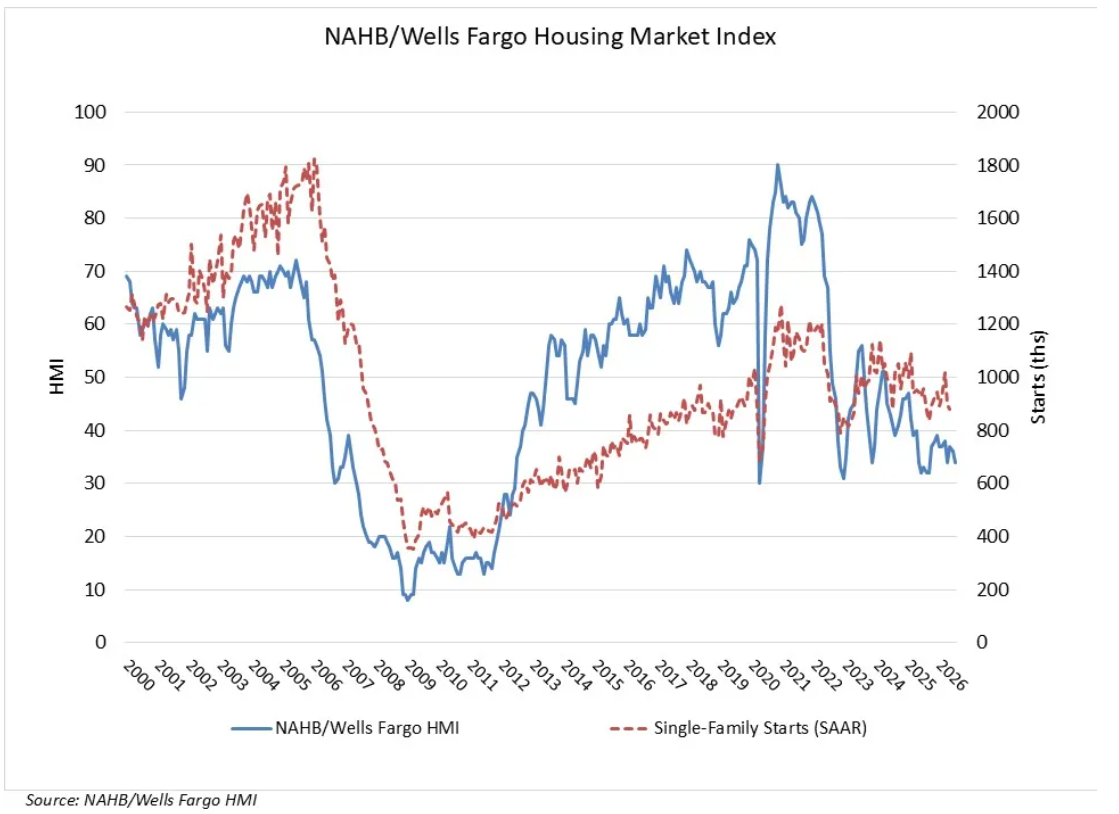
“Single-family housing starts fell in June as elevated mortgage rates and higher construction financing costs continued to weaken builder confidence and housing demand,” said Bill Owens, chairman of the National Association of Home Builders (NAHB) and a home builder and remodeler from Worthington, Ohio. “The newly enacted housing bill includes key provisions to help builders increase supply, including streamlined regulations and incentives for local zoning reforms, but it will take time for these measures to take effect.”
“Builders continue to face a difficult cost environment,” said Danushka Nanayakkara-Skillington, NAHB’s assistant vice president for forecasting and analysis. “Higher long-term Treasury yields have kept mortgage rates elevated, while rising building material prices, transportation costs and insurance expenses are making new construction more expensive. The monthly decline underscores the ongoing challenges facing residential construction despite a persistent shortage of available homes.”
On a regional and year-to-date basis, combined single-family and multifamily starts were 4.5% higher in the Northeast, 1.2% higher in the Midwest, 1.7% higher in the South and 4.4% lower in the West.
Overall permits decreased 3% to a 1.37-million-unit annualized rate in June. Single-family permits decreased 2.4% to an 871,000-unit rate and are down 0.2% compared to June 2025. Multifamily permits decreased 4.2% to an annualized 496,000 pace and are down 5.7% compared to June 2025.
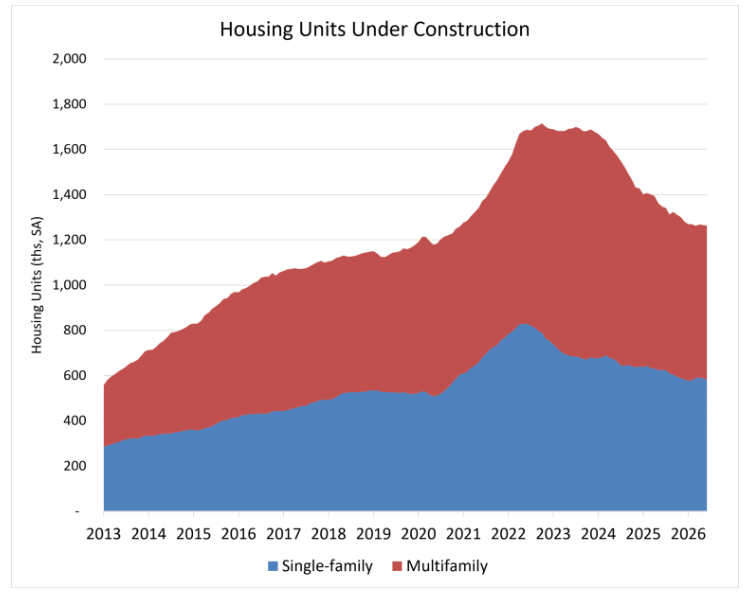
The number of single-family homes under construction is at 582,000 units, while number of apartments under construction is at 682,000 units.
July 19, 2026
PTTGC Consolidates Full Ownership of GC Polyols Following Mothball Decision
July 16, 2026 1 min read
PTT Global Chemical Public Company Limited, or PTTGC, has completed the acquisition of the remaining shares in GC Polyols Co., Ltd. and decided to temporarily shut down the company’s polyol production facility in Thailand.
PTTGC increased its ownership in GC Polyols from 82.1% to 100%, with the transaction completed on July 8, 2026. Before the restructuring, Japan’s Sanyo Chemical Industries held a 14.9% stake, while Toyota Tsusho owned the remaining 3%.
Following the acquisition, PTTGC approved a restructuring plan that includes mothballing the GC Polyols plant in response to weak market conditions. The company cited severe global polyol overcapacity, particularly following significant capacity additions in China, which have pushed average industry operating rates down to around 60%.
The facility is located in the Hemaraj Eastern Industrial Estate in Rayong Province, within Thailand’s Eastern Economic Corridor. It began commercial operations around 2020 and has a total annual production capacity of 180,000 tonnes, comprising 130,000 tonnes of polyether polyols, 30,000 tonnes of polymer polyols and 20,000 tonnes of premixed polyols.
The plant supplies polyurethane raw materials used in household appliances, automotive applications, electrical and electronic products, packaging, footwear and construction.
PTTGC reportedly recorded an additional provision of THB 1.8 billion in the second quarter of 2026, following asset impairment charges of approximately THB 5–6 billion recognized between the fourth quarter of 2025 and the first quarter of 2026. As a result, the current book value of GC Polyols is expected to be close to zero.
The temporary shutdown is expected to generate annual maintenance costs of around THB 50 million. However, the move could help reduce annual losses by approximately THB 200 million from 2026 onward, compared with losses of nearly THB 1 billion recorded last year.
The removal of 180,000 tonnes per year of Thai polyol capacity could ease some regional supply pressure in Southeast Asia, although the plant has been mothballed rather than permanently closed.
July 16, 2026
OUTLOOK: US chems prepare for more tariffs under shifting trade regime
Al Greenwood
16-Jul-2026

HOUSTON (ICIS)–Within days, the US is expected to continue imposing new tariffs on imports from dozens of trading partners, leaving the chemical industry facing continued uncertainty over where duties will ultimately settle.
It already imposed 25% tariffs on imports from Brazil. These and others would be imposed under Sections 301 and 232. They are intended to replace temporary duties imposed under Section 122, which will expire on 24 July.
Looking ahead, the chemical industry could get a respite from a proposed board of trade between the US and China. The board could exclude some imports from tariffs, but it is still under discussion.
The one trade policy that remains stable is the US-Canada-Mexico Agreement (USMCA), which remains in force while it undergoes annual joint reviews.
NEW TARIFFS COULD TAKE EFFECT ON 24 JULY
Many trade lawyers expect the US will impose tariffs on the 60 countries and regions by 24 July. This is the expiration date of the global 10% tariffs that the US imposed under Section 122.
The new tariffs are the result of an investigation that the US conducted under Section 301, a statute intended to address unfair trade practices.
The probe investigated allegations that the countries imported products and intermediates made from forced labor.
The following table shows the proposed tariffs that could take effect by 24 July.
| Economy | Tariff |
| Algeria | 12.5% |
| Angola | 12.5% |
| Argentina | 10.0% |
| Australia | 12.5% |
| Bahrain | 12.5% |
| Bangladesh | 10.0% |
| Brazil | 12.5% |
| Cambodia | 10.0% |
| Canada | 10.0% |
| Chile | 12.5% |
| China | 12.5% |
| Colombia | 12.5% |
| Costa Rica | 12.5% |
| Dominican Republic | 12.5% |
| Ecuador | 10.0% |
| Egypt | 12.5% |
| El Salvador | 10.0% |
| EU | 10.0% |
| Guatemala | 10.0% |
| Guyana | 12.5% |
| Honduras | 12.5% |
| Hong Kong | 12.5% |
| India | 12.5% |
| Indonesia | 10.0% |
| Iraq | 12.5% |
| Israel | 12.5% |
| Japan | 12.5% |
| Jordan | 12.5% |
| Kazakhstan | 12.5% |
| Kuwait | 12.5% |
| Libya | 12.5% |
| Malaysia | 10.0% |
| Mexico | 10.0% |
| Morocco | 12.5% |
| New Zealand | 12.5% |
| Nicaragua | 12.5% |
| Nigeria | 12.5% |
| Norway | 12.5% |
| Oman | 12.5% |
| Pakistan | 10.0% |
| Peru | 12.5% |
| Philippines | 12.5% |
| Qatar | 12.5% |
| Russia | 12.5% |
| S Korea | 12.5% |
| Saudi Arabia | 12.5% |
| Singapore | 12.5% |
| South Africa | 12.5% |
| Sri Lanka | 12.5% |
| Switzerland | 12.5% |
| Taiwan | 10.0% |
| Thailand | 12.5% |
| The Bahamas | 12.5% |
| Trinidad and Tobago | 12.5% |
| Turkey | 12.5% |
| UAE | 12.5% |
| UK | 10.0% |
| Uruguay | 12.5% |
| Venezuela | 12.5% |
| Vietnam | 12.5% |
Source: US Trade Representative
MORE SECTION 301 TARIFFS COULD TAKE EFFECT
Under a separate Section 301 investigation, the US has imposed tariffs of 25% on imports from Brazil. If the US moves forward on the other proposed tariffs, then Brazilian imports covered by both actions could face cumulative duties of 37.5%.
Another Section 301 probe is investigating allegations that 16 governments relied on excess manufacturing capacity to obtain an unfair trade advantage. The US has yet to propose tariffs.
The following table lists the governments under investigation.
| Economy |
| Bangladesh |
| Cambodia |
| China |
| EU |
| India |
| Indonesia |
| Japan |
| Malaysia |
| Mexico |
| Norway |
| South Korea |
| Singapore |
| Switzerland |
| Taiwan |
| Thailand |
| Vietnam |
Source; USTR
The US is conducting other Section 301 investigations against the following countries:
| Economy | Tariff | Description |
| China | Pending | Compliance with 2020 trade deal |
| Vietnam | Pending | Intellectual property protection and enforcement |
| Germany | Pending | Germany’s payments for pharmaceuticals |
Source; USTR
MORE TARIFFS POSSIBLE UNDER SECTION 232
The US is investigating imports of entire product categories under Section 232. Unlike Section 301, which targets alleged unfair trade practices by specific governments, Section 232 focuses on whether imports of particular products threaten national security.
The following table lists pending Section 232 investigations:
| Unmanned aircraft systems | 1-Jul-25 | pending |
| Wind turbines | 13-Aug-25 | pending |
| Robotics and industrial machinery | 2-Sep-25 | pending |
| PPE, medical consumables, medical equipment | 2-Sep-25 | pending |
| Anthracite coal | 29-Jun-26 | pending |
Source: Bureau of Industry and Security (BIS), Federal Register
Over the years, the US has expanded or restricted the scope of existing Section 232 tariffs. In the case of steel, this resulted in an indirect tariff on imports of products like fluorochemicals because the duty covered the containers in which they were shipped.
The following table lists completed Section 232 investigations. In some cases, the investigations concluded with tariffs. In others, they led to further discussions but no tariffs. They are all subject to revisions that could expand their scope or change their rates.
| Product | Investigation Started | Rate |
| Autos and auto parts | Completed | 25% |
| Copper products | Completed | 50% |
| Steel | Completed | 50% |
| Aluminium | Completed | 50% |
| Softwood lumber | Completed | 10% |
| Upholstered furniture | Completed | 25%, 30% on 1 Jan ’27 |
| Kitchen cabinets, vanities | Completed | 25%, 50% on 1 Jan ’27 |
| Medium duty trucks | Completed | 25% |
| Heavy duty trucks | Completed | 25% |
| Buses | Completed | 10% |
| Critical minerals | Completed | No tariffs |
| Semiconductors | Completed | 25% on few imports, may be expanded |
| Patented pharma, APIs | Completed | 100% |
| Commercial aircraft | Completed | No tariffs |
| Jet engines | Completed | No tariffs |
Source: BIS
US MOVES FORWARD ON PROPOSED BOARD OF TRADE WITH CHINA
While most current trade actions point toward higher tariffs, industry groups also see a possible avenue for relief through a proposed US-China board of trade.
The US conducted hearings earlier in July about such a board. It would identify non-sensitive sectors for purchase commitments and lower tariffs.
The US has a surplus of more than $33 billion in chemicals and a smaller one with China, according to the American Chemistry Council (ACC), a trade group. It made its comments in a hearing the US held earlier in July about the board.
The ACC highlighted three ways that the board could improve trade for the chemical industry:
- The US still imports chemicals and other materials that are not available in the US, the ACC said. Those imports are critical, with each $1 in imports supporting more than $7 of US chemical export, the ACC said. “These inputs should be strong candidates for tariff relief, particularly where they support US exports and do not implicate sensitive end uses.”
- China has relied on what the ACC alleged are nonmarket practices to build excess chemical capacity. This has led to a global glut of many commodity chemicals. Before nonsensitive imports can qualify for tariff relief, they cannot receive unfair subsidies or benefit from other nonmarket practices.
- China can reduce duties and remove non-tariff barriers to US exports of plastics and chemicals.
The Plastics Industry Association (PLASTICS) cautioned that the US should not treat the sector as a single, homogeneous category because different subsectors have different trade balances with China.
Plastic resins have maintained a surplus, machinery has shifted to a deficit, molds have experienced a growing deficit and plastic products have maintained a long-standing deficit.
Some products compete directly with US producers, others complement local production and some are no longer made in the US, PLASTICS said.
Like the ACC, PLASTICS stressed the importance of market access, because some of the nation’s trade deficit could be caused by trade barriers erected by China.
USMCA REMAINS IN FORCE WHILE SUBJECT TO ANNUAL REVIEWS
While US tariff policy will remain in flux, one major trade deal continues to provide stability: the US-Mexico-Canada Agreement (USMCA).
The trade agreement went into effect in 2020 and was subject to a joint review earlier this month.
Under the joint review process, the three countries could extend the USMCA for another 16 years. If they do not reach consensus, the USMCA will be subject to another joint review the following year.
The three countries did not unanimously agree to an extension. As a result, the USMCA will remain in force while the three countries conduct annual joint reviews, according to the law firm White & Case.
“All current USMCA rights and obligations, including preferential tariffs, rules of origin, investment protections, and dispute settlement mechanisms, remain fully operative,” the law firm said.
That means imports from Canada and Mexico will remain exempt from tariffs if they comply with the USMCA.
The annual reviews will continue until the countries agree to extend the USMCA, the current 16-year term expires on 1 July 2036, or one of the countries withdraws from the trade deal.
Any country can withdraw from the USMCA by providing six months’ notice.
The USMCA is important to the chemical industry because Canada and Mexico are the two largest trading partners of the US.
Its continuity will be the exception to an otherwise tumultuous year for trade policy.
Insight by Al Greenwood
 Everchem Updates Archive
  Sign Up for Email Updates