
Technology
November 25, 2019
PFA Fall Meeting Highlights
FOR IMMEDIATE RELEASE
Polyurethane Foam Association Fall Meeting Provides Forum For
Issues Discussion, Technical Advances
Jake Barnhardt Inducted Into The Flexible Polyurethane Foam Hall Of Fame
LOUISVILLE, KY (November 19, 2019)—The Polyurethane Foam
Association (PFA) recently concluded its fall meeting, which
spotlighted key regulatory issues and new technical developments.
PFA’s two-day meeting in early November was attended by more than
150 executives from foam manufacturers, chemical suppliers, and other
companies supporting the industry. Attendees saw presentations on
key industry issues including recycling, flammability, and regulatory
developments.
Keynote speaker, Dr. Sharon Kerrick of the University of Louisville
Business School, shared insights on how established companies in
mature industries continue to innovate. She was joined by executives
fromby Yum! Brands and Brown-Forman, both of which are
headquartered in Louisville.
In addition, a Technical Program featured presentations on innovations
and best practices on topics ranging from bismuth catalysts, additives to
minimize compression set, pour line technologies, plant security, and a
recent CertiPUR ® evaluation of VOC emissions from foam in Europe.
Jane Kniss of Evonik won the Herman Stone Technical Excellence
Award, as her technical presentation was voted best by those attending
the Technical Program. “The quality of the technical presentations was
exceptional this year,” noted Bill Gollnitz, Past President of PFA and
Moderator for the Technical Program. “Congratulations to Jane for
standing out in a prestigious field.”
Copies of the technical proceedings are included in registration fees for all attendees, and will
soon be made available for order at www.pfa.org.)
PFA also recognized three individuals for outstanding accomplishments in the flexible
polyurethane foam industry. Van Delk of Dow Chemical and Tom Robitaille of Lonza were honored with Lifetime
Achievement Awards, while Jacob “Jake” Barnhardt, Jr., longtime President of NCFI
Polyurethanes, was inducted into the Flexible Polyurethane Foam Hall of Fame.

Barnhardt
Barnhardt began his more than 50-year career in the industry in 1964, when he became part of
the management team of the newly-formed North Carolina Foam Industries, now NCFI
Polyurethanes. NCFI perfected the “one shot” flexible foam manufacturing process that is the
industry standard today, and expanded its business to include technologies that found their way
into far-flung applications including the Space Shuttle. Barnhardt was at the first meeting that led
to the creation of PFA, and was a long-time supporter of the organization.

Robitaille
Robitaille’s 36-year career in the flexible polyurethane
foam industry included numerous technical achievements, including patents in the application of
lasers and for novel uses of antimicrobial compounds for commercial and industrial use. Many of
his applications can be found in common household items and footwear.

Delk
Delk spent more than 33 years at Dow, working as a Technical Service Manager. He was widely
recognized among Dow customers for his technical expertise among Dow customers, and as a
teacher and a mentor within the company.
“PFA is focused not only on the future, but it also recognizes the contributions of people who
have led the industry to where it is today,” said Chip Holton of NCFI Polyurethanes, PFA’s
President.
The Polyurethane Foam Association is a trade association founded in 1980 to help educate foam
users, allied industries and other stakeholders. PFA provides facts on environmental, health and
safety issues and technical information on the performance of FPF in consumer and industrial
products. FPF is used as a key comfort component in most upholstered furniture and mattress
products, along with automotive seating, carpet cushion, packaging, and numerous other
applications.
www.pfa.org
November 18, 2019
UPS and CVS Partner on Drone Delivery
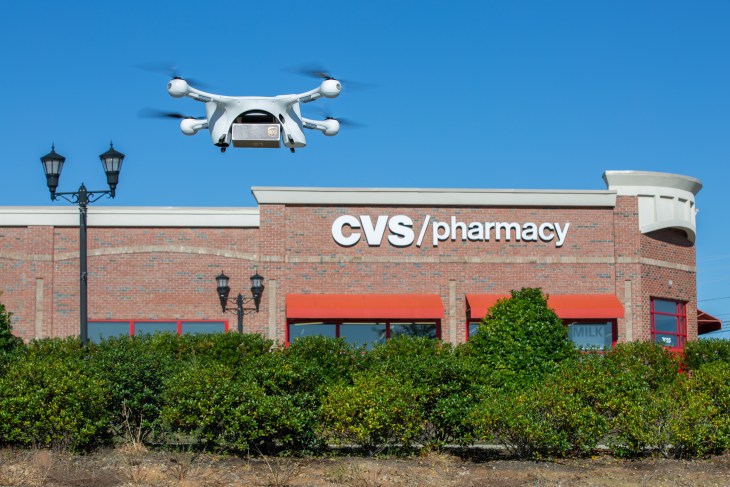
UPS is rolling along with its drone delivery program, working with partner CVS Pharmacy to deliver prescription drugs to customer doorsteps via its newly deployed commercial drones. UPS delivered medications to two paying customers on November 1 using the Matternet M2 drone system that the logistics company is using in partnership with Matternet ..
UPS received approval last month from the FAA to fly its fleet of commercial drones in service of customers, and now it plans to iterate its drone delivery program “in the coming months,” with the aim of ensuring that it can deploy UAVs in a commercial capacity at increasing scale. It also launched “UPS Flight Forward,” a dedicated division focused on autonomous drone delivery.
For these early deliveries, drones were loaded with prescriptions filled by pharmacists at a CVS location in Cary, NC. Once a UPS employee loaded the cargo onto the drones, they flew autonomously from the store location to nearby customer homes, dropping off the packages from a hover height of around 20 feet above these locations. One of the customers has mobility challenges that would make travel to a CVS store for prescription pickup difficult, UPS points out.
This isn’t the first time UPS has deployed drones in a healthcare industry setting: The company has been working with Mattternet and WakeMed Hospital in Raleigh, doing commercial deliveries of medical samples in a B2B setting.
UPS and CVS deliver prescription medicine via drone to US residential customers for the first time
November 18, 2019
UPS and CVS Partner on Drone Delivery
UPS and CVS deliver prescription medicine via drone to US residential customers for the first time
UPS is rolling along with its drone delivery program, working with partner CVS Pharmacy to deliver prescription drugs to customer doorsteps via its newly deployed commercial drones. UPS delivered medications to two paying customers on November 1 using the Matternet M2 drone system that the logistics company is using in partnership with Matternet ..
UPS received approval last month from the FAA to fly its fleet of commercial drones in service of customers, and now it plans to iterate its drone delivery program “in the coming months,” with the aim of ensuring that it can deploy UAVs in a commercial capacity at increasing scale. It also launched “UPS Flight Forward,” a dedicated division focused on autonomous drone delivery.
For these early deliveries, drones were loaded with prescriptions filled by pharmacists at a CVS location in Cary, NC. Once a UPS employee loaded the cargo onto the drones, they flew autonomously from the store location to nearby customer homes, dropping off the packages from a hover height of around 20 feet above these locations. One of the customers has mobility challenges that would make travel to a CVS store for prescription pickup difficult, UPS points out.
This isn’t the first time UPS has deployed drones in a healthcare industry setting: The company has been working with Mattternet and WakeMed Hospital in Raleigh, doing commercial deliveries of medical samples in a B2B setting.
UPS and CVS deliver prescription medicine via drone to US residential customers for the first time
October 24, 2019
Lanxess Uses AI for Prepolymer Development
By Mary Page Bailey | Lanxess launches AI-assisted formulation development for Urethane Systems
Lanxess AG (Cologne, Germany; www.lanxess.com) is broadening its use of artificial intelligence (AI) in product development. The specialty chemicals company has launched a project aimed at expanding its range of prepolymers. The goal is to offer customers tailor-made polyurethane systems with even shorter lead times, including for entirely new applications with different requirements. The Urethane Systems business unit is using the potential of AI and has brought materials AI company Citrine Informatics on board as a project partner.
In an initial project phase, Lanxess enlarged its database of prepolymer-based formulations. Lanxess data specialists and process experts used the Citrine Platform for artificial intelligence to add further data points to the company’s formulation database. This involved linking existing empirical measurement data with the knowledge of the process experts and a chemistry-aware algorithm to calculate additional measurement values. This meant that only a few real-life measurements were required to verify the figures determined with AI.
In a next step, data and process experts at Lanxess will check how reliably optimal formulations can be predicted with the aid of AI to meet customer-specific requirements for product characteristics. “If the next tests are successful, we will be able to fulfill customer requests even more quickly and effectively. Our existing knowledge of formulations shall be enhanced by AI-assisted formulation design – in other words, systems that are not yet part of our portfolio but for which artificial intelligence will enable us to know instantly whether we can manufacture them and how,” says Markus Eckert, head of the Urethane Systems business unit at Lanxess.
So far, chemists have largely had to rely on their specialist expertise and years of experience when researching new formulations with defined product characteristics such as hardness, tensile strength and viscosity. AI is expected to become an important tool to help them broaden their knowledge and significantly reduce the amount of tests required.
Lanxess already has some experience in using AI. In a pilot project with Citrine Informatics, the specialty chemicals company is using AI to optimize glass fibers as a way of further enhancing the properties of Lanxess high-performance plastics. It is anticipated that AI will cut development times for the necessary formulations by more than half. Customers will receive even better, tailor-made products within shorter time frames.
For Jörg Hellwig, Head of the Lanxess Digitalization Initiative, the partnership between Citrine and the Lanxess Urethane Systems business unit demonstrates the growing role of digitalization in product development. “Most employees who are already using artificial intelligence cannot imagine ever going back to the old methods of working. The use of digital technologies is increasingly becoming standard procedure at Lanxess,” says Hellwig.
https://www.chemengonline.com/lanxess-launches-ai-assisted-formulation-development-for-urethane-systems/?printmode=1
October 24, 2019
Lanxess Uses AI for Prepolymer Development
By Mary Page Bailey | Lanxess launches AI-assisted formulation development for Urethane Systems
Lanxess AG (Cologne, Germany; www.lanxess.com) is broadening its use of artificial intelligence (AI) in product development. The specialty chemicals company has launched a project aimed at expanding its range of prepolymers. The goal is to offer customers tailor-made polyurethane systems with even shorter lead times, including for entirely new applications with different requirements. The Urethane Systems business unit is using the potential of AI and has brought materials AI company Citrine Informatics on board as a project partner.
In an initial project phase, Lanxess enlarged its database of prepolymer-based formulations. Lanxess data specialists and process experts used the Citrine Platform for artificial intelligence to add further data points to the company’s formulation database. This involved linking existing empirical measurement data with the knowledge of the process experts and a chemistry-aware algorithm to calculate additional measurement values. This meant that only a few real-life measurements were required to verify the figures determined with AI.
In a next step, data and process experts at Lanxess will check how reliably optimal formulations can be predicted with the aid of AI to meet customer-specific requirements for product characteristics. “If the next tests are successful, we will be able to fulfill customer requests even more quickly and effectively. Our existing knowledge of formulations shall be enhanced by AI-assisted formulation design – in other words, systems that are not yet part of our portfolio but for which artificial intelligence will enable us to know instantly whether we can manufacture them and how,” says Markus Eckert, head of the Urethane Systems business unit at Lanxess.
So far, chemists have largely had to rely on their specialist expertise and years of experience when researching new formulations with defined product characteristics such as hardness, tensile strength and viscosity. AI is expected to become an important tool to help them broaden their knowledge and significantly reduce the amount of tests required.
Lanxess already has some experience in using AI. In a pilot project with Citrine Informatics, the specialty chemicals company is using AI to optimize glass fibers as a way of further enhancing the properties of Lanxess high-performance plastics. It is anticipated that AI will cut development times for the necessary formulations by more than half. Customers will receive even better, tailor-made products within shorter time frames.
For Jörg Hellwig, Head of the Lanxess Digitalization Initiative, the partnership between Citrine and the Lanxess Urethane Systems business unit demonstrates the growing role of digitalization in product development. “Most employees who are already using artificial intelligence cannot imagine ever going back to the old methods of working. The use of digital technologies is increasingly becoming standard procedure at Lanxess,” says Hellwig.
https://www.chemengonline.com/lanxess-launches-ai-assisted-formulation-development-for-urethane-systems/?printmode=1
 Everchem Updates Archive
  Sign Up for Email Updates