
Technology
October 10, 2019
CPI Innovation Winner
The 2019 Polyurethane Innovation Award Winner Is…
Congratulations to Carbon and their partnership with Riddell on the SpeedFlex Precision Diamond football helmet for being crowned the winner of the 2019 Polyurethane Innovation Award!
Carbon and Riddell partnered to produce the first-ever, digitally printed liner for the SpeedFlex Precision Diamond football helmet. To make this groundbreaking product, Carbon used athlete data Riddell gathered in their proprietary database of 5 million head impacts to create next-gen head protection. The resulting Diamond helmet liner is printed to be precisely contoured to the athlete’s head. Using Carbon’s pioneering DLS™ technology, the liner was created using light and oxygen, and incorporates intricate, custom lattice structures with custom energy absorbing materials also developed by Carbon. Carbon and Riddell’s partnership and innovation will help keep our young athletes safe.
WWW.CPITECHNICALCONFERENCE.ORG
October 2, 2019
Battery Technology
Is This The End Of The Lithium-Ion Battery?
Authored by Tsvetana Paraskova via OilPrice.com,
Researchers have been in a race to find ways to improve lithium-ion batteries. They are also looking to develop alternatives to the lithium-ion battery that would be lower cost and more sustainable to manufacture. And they may just have found one.
Aluminum-based batteries would be cheaper to make, because aluminum is the third most abundant element in the Earth’s crust after oxygen and silicon. Aluminum is also light-weight and could be ideal for use in batteries.
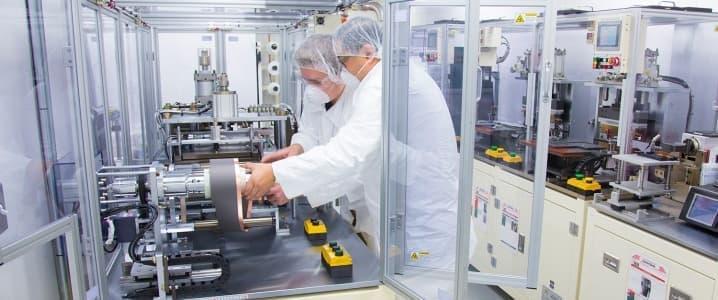
Yet, for years scientists have stumbled in the research about aluminum batteries because they have yet to crack the code of what materials to use for the anode and cathode of the battery so that it could enable efficient energy storage with enough energy content.
Now scientists from Sweden and Slovenia say they have found a way to have efficient aluminum batteries with lower environmental impact and lower production costs.
Researchers from Sweden’s Chalmers University of Technology and the National Institute of Chemistry in Slovenia came up with a new concept for an aluminum battery design that promises twice the energy density compared to previous aluminum battery versions.
Compared to the lithium-ion batteries today, the new concept could lead to “markedly lower production costs” of aluminum batteries, the scientists say.
Another advantage is that there already exists an established industry for aluminum manufacturing and recycling. With lithium-ion batteries, recycling is one major issue as few economically feasible technologies for battery recycling currently exist.
The Swedish and Slovenian researchers have come up with a new concept to design aluminum batteries that theoretically overcomes previous challenges with low energy density in today’s aluminum batteries.
The new concept, described in an article in the journal Energy Storage Materials, upends the previous designs of the aluminum battery. So far, designs have used the aluminum as the negative electrode—the anode, while the positive electrode—the cathode—was made of graphite. But graphite doesn’t have enough energy content to be useful in a battery cell.
In the new concept, however, the researchers replaced graphite with an organic, nano-structured cathode made of the carbon-based molecule anthraquinone. This organic material in the cathode enables storage of positive charge-carriers from the electrolyte—the solution in which ions move between the electrodes—which enables higher energy density in the battery.
“Because the new cathode material makes it possible to use a more appropriate charge-carrier, the batteries can make better usage of aluminum’s potential,” Chalmers researcher Niklas Lindahl said in a statement.
“The material costs and environmental impacts that we envisage from our new concept are much lower than what we see today, making them feasible for large scale usage, such as solar cell parks, or storage of wind energy, for example,” Patrik Johansson, Professor at the Department of Physics at Chalmers, notes.
There are currently no commercially available aluminum batteries, but now the question scientists are asking is whether they can one day replace lithium-ion batteries.
“Of course, we hope that they can. But above all, they can be complementary, ensuring that lithium-ion batteries are only used where strictly necessary,” Johansson says.
According to the scientist, the team still has much work to do with the electrolyte and charging mechanisms, but they believe that aluminum is generally “a significantly better charge carrier than lithium, since it is multivalent – which means every ion ‘compensates’ for several electrons.”
“Furthermore, the batteries have the potential to be significantly less environmentally harmful,” Johansson added.
The Swedish-Slovenian team of scientists is not the only one working on aluminum battery breakthroughs. A team at UNSW Sydney said last December that they had found a new way to design rechargeable aluminum batteries by using a large organic chemical compound as the part of the battery that stores energy, which was a fundamental challenge before that.
“Developing batteries using aluminum has received a lot of expectation for delivering high energy to price ratios,” Dr Dong Jun Kim of UNSW’s School of Chemistry said.
https://www.zerohedge.com/energy/end-lithium-ion-battery
October 2, 2019
Battery Technology
Is This The End Of The Lithium-Ion Battery?
Authored by Tsvetana Paraskova via OilPrice.com,
Researchers have been in a race to find ways to improve lithium-ion batteries. They are also looking to develop alternatives to the lithium-ion battery that would be lower cost and more sustainable to manufacture. And they may just have found one.
Aluminum-based batteries would be cheaper to make, because aluminum is the third most abundant element in the Earth’s crust after oxygen and silicon. Aluminum is also light-weight and could be ideal for use in batteries.
Yet, for years scientists have stumbled in the research about aluminum batteries because they have yet to crack the code of what materials to use for the anode and cathode of the battery so that it could enable efficient energy storage with enough energy content.
Now scientists from Sweden and Slovenia say they have found a way to have efficient aluminum batteries with lower environmental impact and lower production costs.
Researchers from Sweden’s Chalmers University of Technology and the National Institute of Chemistry in Slovenia came up with a new concept for an aluminum battery design that promises twice the energy density compared to previous aluminum battery versions.
Compared to the lithium-ion batteries today, the new concept could lead to “markedly lower production costs” of aluminum batteries, the scientists say.
Another advantage is that there already exists an established industry for aluminum manufacturing and recycling. With lithium-ion batteries, recycling is one major issue as few economically feasible technologies for battery recycling currently exist.
The Swedish and Slovenian researchers have come up with a new concept to design aluminum batteries that theoretically overcomes previous challenges with low energy density in today’s aluminum batteries.
The new concept, described in an article in the journal Energy Storage Materials, upends the previous designs of the aluminum battery. So far, designs have used the aluminum as the negative electrode—the anode, while the positive electrode—the cathode—was made of graphite. But graphite doesn’t have enough energy content to be useful in a battery cell.
In the new concept, however, the researchers replaced graphite with an organic, nano-structured cathode made of the carbon-based molecule anthraquinone. This organic material in the cathode enables storage of positive charge-carriers from the electrolyte—the solution in which ions move between the electrodes—which enables higher energy density in the battery.
“Because the new cathode material makes it possible to use a more appropriate charge-carrier, the batteries can make better usage of aluminum’s potential,” Chalmers researcher Niklas Lindahl said in a statement.
“The material costs and environmental impacts that we envisage from our new concept are much lower than what we see today, making them feasible for large scale usage, such as solar cell parks, or storage of wind energy, for example,” Patrik Johansson, Professor at the Department of Physics at Chalmers, notes.
There are currently no commercially available aluminum batteries, but now the question scientists are asking is whether they can one day replace lithium-ion batteries.
“Of course, we hope that they can. But above all, they can be complementary, ensuring that lithium-ion batteries are only used where strictly necessary,” Johansson says.
According to the scientist, the team still has much work to do with the electrolyte and charging mechanisms, but they believe that aluminum is generally “a significantly better charge carrier than lithium, since it is multivalent – which means every ion ‘compensates’ for several electrons.”
“Furthermore, the batteries have the potential to be significantly less environmentally harmful,” Johansson added.
The Swedish-Slovenian team of scientists is not the only one working on aluminum battery breakthroughs. A team at UNSW Sydney said last December that they had found a new way to design rechargeable aluminum batteries by using a large organic chemical compound as the part of the battery that stores energy, which was a fundamental challenge before that.
“Developing batteries using aluminum has received a lot of expectation for delivering high energy to price ratios,” Dr Dong Jun Kim of UNSW’s School of Chemistry said.
https://www.zerohedge.com/energy/end-lithium-ion-battery
September 6, 2019
FoamPartner Develops Low Emission Foams
FoamPartner: Ether-based PU foams with low emission levels
FoamPartner Hall 10 Stand 504
The Swiss company FoamPartner Fritz Nauer AG has developed a foam product family, which is characterised by very low emission levels for use in automotive headliners with high demands on processability and design. The new ether-based foam technology is said to combine high surface quality with lowest volatile organic compounds (VOC) and fogging (FOG) values. The company will present the new products at Foam Expo Europe 2019 from 10 – 12 September 2019 in Stuttgart, Germany.

Thanks to their homogenous and fine-pore cell structure, OBoSky foams deliver uniform surfaces, ideal in particular for high-quality automotive headliners (Source: Getty Images/algre)
According to the manufacturer, the foams sold under the OBoSky brand name benefit from a patented ether prepolymer technology to combine the advantages of ester-based polyurethane foams with those of ether-based materials. The result is a family of hydrolytically stable, low-emission and low-odour foams with good processability and a very homogenous cell structure. The technology is especially targeted to demanding automotive headliners. However, thanks to their high elongation and good resilience, the foams also have an ideal fit in further automotive interior applications requiring a pleasant soft feel, said the company.
“Vehicles off the shelf are history. Besides looking for an environmentally friendly as possible drive system, consumers today have a keen eye for a stylish interior design using materials that ensure a healthy climate in the passenger compartment,” said Klaus Hellmold, Vice President Global Business Unit Automotive Rolls at FoamPartner. “With our OBoSky foams for headliners, we have set new standards in efficient processing and environmental compatibility.”

In tests according to VDA 278 and VDA 270, the new PU foams stay clearly below the VOC and FOG levels specified by Daimler’s DBL 5450 soft foam standard (Source: FoamPartner)
The headliner foam grades are said to feature a very uniform structure with fine pores, providing surfaces that can easily be laminated in flame and adhesion processes while also lending themselves to finishing textiles of low surface weight. The ether-based prepolymer technology of the materials is said to ensure very good hydrolytic resistance and long-term high mechanical properties as well as to lead to significantly lower levels in VOC and FOG vs. merely ester-based foams. In VOC and FOG tests according to VDA 278 and VDA 270, OBoSky is said to show values clearly below the limits specified in DBL 5450, the supply regulation of Daimler AG for flexible foams based on polyurethane.
The products are available in rolls and various net densities as well as with or without flame protecting finish according to FMVSS 302. The manufacturing process enables a block foam length of 120 m, which results in 50 % fewer bonding seams compared to common 60 m blocks in the market. This means customers can save costs in their end-product fabrication, said the company.
https://www.gupta-verlag.com/news/technology/23180/foampartner-ether-based-pu-foams-with-low-emission-levels
September 6, 2019
FoamPartner Develops Low Emission Foams
FoamPartner: Ether-based PU foams with low emission levels
FoamPartner Hall 10 Stand 504
The Swiss company FoamPartner Fritz Nauer AG has developed a foam product family, which is characterised by very low emission levels for use in automotive headliners with high demands on processability and design. The new ether-based foam technology is said to combine high surface quality with lowest volatile organic compounds (VOC) and fogging (FOG) values. The company will present the new products at Foam Expo Europe 2019 from 10 – 12 September 2019 in Stuttgart, Germany.
Thanks to their homogenous and fine-pore cell structure, OBoSky foams deliver uniform surfaces, ideal in particular for high-quality automotive headliners (Source: Getty Images/algre)
According to the manufacturer, the foams sold under the OBoSky brand name benefit from a patented ether prepolymer technology to combine the advantages of ester-based polyurethane foams with those of ether-based materials. The result is a family of hydrolytically stable, low-emission and low-odour foams with good processability and a very homogenous cell structure. The technology is especially targeted to demanding automotive headliners. However, thanks to their high elongation and good resilience, the foams also have an ideal fit in further automotive interior applications requiring a pleasant soft feel, said the company.
“Vehicles off the shelf are history. Besides looking for an environmentally friendly as possible drive system, consumers today have a keen eye for a stylish interior design using materials that ensure a healthy climate in the passenger compartment,” said Klaus Hellmold, Vice President Global Business Unit Automotive Rolls at FoamPartner. “With our OBoSky foams for headliners, we have set new standards in efficient processing and environmental compatibility.”
In tests according to VDA 278 and VDA 270, the new PU foams stay clearly below the VOC and FOG levels specified by Daimler’s DBL 5450 soft foam standard (Source: FoamPartner)
The headliner foam grades are said to feature a very uniform structure with fine pores, providing surfaces that can easily be laminated in flame and adhesion processes while also lending themselves to finishing textiles of low surface weight. The ether-based prepolymer technology of the materials is said to ensure very good hydrolytic resistance and long-term high mechanical properties as well as to lead to significantly lower levels in VOC and FOG vs. merely ester-based foams. In VOC and FOG tests according to VDA 278 and VDA 270, OBoSky is said to show values clearly below the limits specified in DBL 5450, the supply regulation of Daimler AG for flexible foams based on polyurethane.
The products are available in rolls and various net densities as well as with or without flame protecting finish according to FMVSS 302. The manufacturing process enables a block foam length of 120 m, which results in 50 % fewer bonding seams compared to common 60 m blocks in the market. This means customers can save costs in their end-product fabrication, said the company.
https://www.gupta-verlag.com/news/technology/23180/foampartner-ether-based-pu-foams-with-low-emission-levels
 Everchem Updates Archive
  Sign Up for Email Updates