Technology

October 22, 2019

Steel Foam Fortified with Epoxy

This Steel Foam Could Make Airplane Wings Better

Because high-grade aluminum just won’t cut it.

Composite metal foam

Afsaneh Rabiei
  • High-grade aluminum has been the standard material of choice for airplane wings for years.
  • A new study suggests that a newer material, a metal foam made out of steel and epoxy glue, could be even stronger and more effective.
  • The material is still just in testing, but from bug build to erosion, it appears to offer an upgrade on what aluminum can provide.

Airplane wings are made out of a specific type of aluminum, an alloy that offers a combination of lightness and strength comparable to steel that makes for easy flying. But scientists from North Carolina State University are investigating what might be an even better material: a combination of epoxy resin and what’s known as steel composite metal foam, or CMF.

“We call our hybrid material ‘infused CMF,’” says Afsaneh Rabiei, corresponding author of a paper on the work and a professor of mechanical and aerospace engineering at NC State, in a press statement. “And while infused CMF is about the same weight as aluminum, it is tougher and has other characteristics that make it more appealing from a flight performance, safety and fuel efficiency standpoint.”

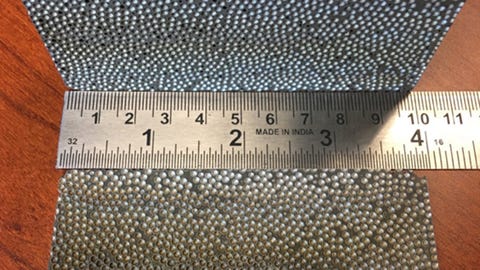
Metal foam resembles any other type of foam, with hollow gas-filled spherical pores taking up much of the volume. The only difference is its cellular structure is made out of metal.

The foam used here was a steel-steel CMF, meaning both its hollow pores and matrix were made of steel. Steel-steel CMF is a sturdy material, capable of withstanding .50 caliber rounds, temperatures as high as 800 degrees Celsius, and even explosive incendiary devices as close as 18 inches away.

“In short, we found that steel-CMF offers much more protection than all other existing armor materials while lowering the weight remarkably,” Rabiei said in 2018, after he conducted a study looking at explosives. “We can provide as much protection as existing steel armor at a fraction of the weight—or provide much more protection at the same weight.”

The NC State team makes the material by immersing the steel-steel CMF within a hydrophobic epoxy resin and then using vacuum forces to draw the resin into both the hollow spheres and smaller pores. Approximately 88 percent of the CMF’s pores end up filled with the epoxy resin, which acts as a hardening glue on the material.

The researchers tested their material against aerospace-grade aluminum in three categories: “contact angle, which determines how quickly water streams off of a material; insect adhesion, or how well bug parts stuck to the material; and particle wear, or how well the material stands up to erosion,” they say in their press statement.

Contact angle with water is crucial for planes as they fly through inclement weather. Water buildup on wings can weigh a plane down and lower a wing’s ability to perform overall. Testing showed the infused CMF had a contact angle 130 percent higher than its competition, a noticeable improvement.

Like water, insect residue is one of those inevitable parts of flying that can build up over time. It’s measured in two different ways: There’s the sheer height of the dead insect residue as it piles up on the wing, and how far the inspects have spread over the wing. The steel-steel CMF was able to outperform standard wings on both measures, with 60 percent less in maximum height, and by 30 percent in terms of surface area.

And then there’s the condition that eventually affects every material: erosion. The team blasted the CMF with grit to better understand out how it could handle erosion. While the grit blast did increase the material’s roughness, it had a contact angle 50 percent better than aluminum.

“Aluminum is currently the material of choice for making the leading edge of fixed-wing and rotary-wing aircraft wings,” Rabiei says. “Our results suggest that infused CMF may be a valuable replacement, offering better performance at the same weight.

“By the same token, the results suggest that we could use different materials for the matrix or spheres to create a combination that performs as well as conventional aluminum at a fraction of the weight. Either way, you’re improving performance and fuel efficiency.”

https://www.popularmechanics.com/flight/a29535891/steel-foam-airplane-wings/

October 22, 2019

Steel Foam Fortified with Epoxy

This Steel Foam Could Make Airplane Wings Better

Because high-grade aluminum just won’t cut it.

Composite metal foam

Afsaneh Rabiei
  • High-grade aluminum has been the standard material of choice for airplane wings for years.
  • A new study suggests that a newer material, a metal foam made out of steel and epoxy glue, could be even stronger and more effective.
  • The material is still just in testing, but from bug build to erosion, it appears to offer an upgrade on what aluminum can provide.

Airplane wings are made out of a specific type of aluminum, an alloy that offers a combination of lightness and strength comparable to steel that makes for easy flying. But scientists from North Carolina State University are investigating what might be an even better material: a combination of epoxy resin and what’s known as steel composite metal foam, or CMF.

“We call our hybrid material ‘infused CMF,’” says Afsaneh Rabiei, corresponding author of a paper on the work and a professor of mechanical and aerospace engineering at NC State, in a press statement. “And while infused CMF is about the same weight as aluminum, it is tougher and has other characteristics that make it more appealing from a flight performance, safety and fuel efficiency standpoint.”

Metal foam resembles any other type of foam, with hollow gas-filled spherical pores taking up much of the volume. The only difference is its cellular structure is made out of metal.

The foam used here was a steel-steel CMF, meaning both its hollow pores and matrix were made of steel. Steel-steel CMF is a sturdy material, capable of withstanding .50 caliber rounds, temperatures as high as 800 degrees Celsius, and even explosive incendiary devices as close as 18 inches away.

“In short, we found that steel-CMF offers much more protection than all other existing armor materials while lowering the weight remarkably,” Rabiei said in 2018, after he conducted a study looking at explosives. “We can provide as much protection as existing steel armor at a fraction of the weight—or provide much more protection at the same weight.”

The NC State team makes the material by immersing the steel-steel CMF within a hydrophobic epoxy resin and then using vacuum forces to draw the resin into both the hollow spheres and smaller pores. Approximately 88 percent of the CMF’s pores end up filled with the epoxy resin, which acts as a hardening glue on the material.

The researchers tested their material against aerospace-grade aluminum in three categories: “contact angle, which determines how quickly water streams off of a material; insect adhesion, or how well bug parts stuck to the material; and particle wear, or how well the material stands up to erosion,” they say in their press statement.

Contact angle with water is crucial for planes as they fly through inclement weather. Water buildup on wings can weigh a plane down and lower a wing’s ability to perform overall. Testing showed the infused CMF had a contact angle 130 percent higher than its competition, a noticeable improvement.

Like water, insect residue is one of those inevitable parts of flying that can build up over time. It’s measured in two different ways: There’s the sheer height of the dead insect residue as it piles up on the wing, and how far the inspects have spread over the wing. The steel-steel CMF was able to outperform standard wings on both measures, with 60 percent less in maximum height, and by 30 percent in terms of surface area.

And then there’s the condition that eventually affects every material: erosion. The team blasted the CMF with grit to better understand out how it could handle erosion. While the grit blast did increase the material’s roughness, it had a contact angle 50 percent better than aluminum.

“Aluminum is currently the material of choice for making the leading edge of fixed-wing and rotary-wing aircraft wings,” Rabiei says. “Our results suggest that infused CMF may be a valuable replacement, offering better performance at the same weight.

“By the same token, the results suggest that we could use different materials for the matrix or spheres to create a combination that performs as well as conventional aluminum at a fraction of the weight. Either way, you’re improving performance and fuel efficiency.”

https://www.popularmechanics.com/flight/a29535891/steel-foam-airplane-wings/

October 14, 2019

Dow Propane DeHydrogenation Expansion

US Dow to retrofit Louisiana cracker for on-purpose propylene

Author: Stefan Baumgarten

2019/08/20

HOUSTON  (ICIS)–Dow will retrofit proprietary fluidised catalytic dehydrogenation (FCDh) technology into one of its mixed-feed crackers in Plaquemine, Louisiana, to produce on-purpose propylene, the US-based chemicals major said on Tuesday.

The retrofit will enable production of more than 100,000 tonnes/year of additional on-purpose propylene at full run-rate, further back-integrating Dow’s derivative facilities to cost-advantaged propylene while also maintaining the unit’s current ethylene production capacity, the company said.

The project is expected to begin producing on-purpose propylene by the end of 2021.

Dow said the retrofit would enable it to meet growing demand for its businesses serving consumer, infrastructure and packaging end-markets, while also remaining within its stated near-term capital expenditure targets, it said.

In 2016, Dow expanded the ethylene capacity of this same cracker by more than 225,000 tonnes/year and added the ability to crack ethane, while maintaining the flexibility to crack propane, butane and naphtha.

Dow and other US cracker operators are consuming more ethane instead of heavier feed slates, resulting in a reduction of co-product production, including propylene.

This reduction in propylene has created a supply/demand gap in the US that requires additional on-purpose propylene sources to meet the needs of downstream derivatives, Dow said.

FCDh technology is seen as one of the most economical propane dehydrogenation (PDH) technologies available today.

It can be used to construct a stand-alone PDH facility or can be integrated with existing crackers to provide “plug and play” capabilities for a variety of plant configurations, Dow said.

“Deploying FCDh technology supports Dow’s continued focus on delivering low-risk, low-cost and high-return projects while reducing the energy intensity and carbon footprint associated with conventional technologies,” said Keith Cleason, vice president of Dow’s Olefins, Aromatics & Alternatives business.

https://www.icis.com/explore/resources/news/2019/08/20/10406189/us-dow-to-retrofit-louisiana-cracker-for-on-purpose-propylene?utm_source=dlvr.it&utm_medium=twitter

October 14, 2019

Dow Propane DeHydrogenation Expansion

US Dow to retrofit Louisiana cracker for on-purpose propylene

Author: Stefan Baumgarten

2019/08/20

HOUSTON  (ICIS)–Dow will retrofit proprietary fluidised catalytic dehydrogenation (FCDh) technology into one of its mixed-feed crackers in Plaquemine, Louisiana, to produce on-purpose propylene, the US-based chemicals major said on Tuesday.

The retrofit will enable production of more than 100,000 tonnes/year of additional on-purpose propylene at full run-rate, further back-integrating Dow’s derivative facilities to cost-advantaged propylene while also maintaining the unit’s current ethylene production capacity, the company said.

The project is expected to begin producing on-purpose propylene by the end of 2021.

Dow said the retrofit would enable it to meet growing demand for its businesses serving consumer, infrastructure and packaging end-markets, while also remaining within its stated near-term capital expenditure targets, it said.

In 2016, Dow expanded the ethylene capacity of this same cracker by more than 225,000 tonnes/year and added the ability to crack ethane, while maintaining the flexibility to crack propane, butane and naphtha.

Dow and other US cracker operators are consuming more ethane instead of heavier feed slates, resulting in a reduction of co-product production, including propylene.

This reduction in propylene has created a supply/demand gap in the US that requires additional on-purpose propylene sources to meet the needs of downstream derivatives, Dow said.

FCDh technology is seen as one of the most economical propane dehydrogenation (PDH) technologies available today.

It can be used to construct a stand-alone PDH facility or can be integrated with existing crackers to provide “plug and play” capabilities for a variety of plant configurations, Dow said.

“Deploying FCDh technology supports Dow’s continued focus on delivering low-risk, low-cost and high-return projects while reducing the energy intensity and carbon footprint associated with conventional technologies,” said Keith Cleason, vice president of Dow’s Olefins, Aromatics & Alternatives business.

https://www.icis.com/explore/resources/news/2019/08/20/10406189/us-dow-to-retrofit-louisiana-cracker-for-on-purpose-propylene?utm_source=dlvr.it&utm_medium=twitter

October 10, 2019

CPI Innovation Winner

The 2019 Polyurethane Innovation Award Winner Is… 

Congratulations to Carbon and their partnership with Riddell on the SpeedFlex Precision Diamond football helmet for being crowned the winner of the 2019 Polyurethane Innovation Award!

Carbon and Riddell partnered to produce the first-ever, digitally printed liner for the SpeedFlex Precision Diamond football helmet. To make this groundbreaking product, Carbon used athlete data Riddell gathered in their proprietary database of 5 million head impacts to create next-gen head protection. The resulting Diamond helmet liner is printed to be precisely contoured to the athlete’s head. Using Carbon’s pioneering DLS™ technology, the liner was created using light and oxygen, and incorporates intricate, custom lattice structures with custom energy absorbing materials also developed by Carbon. Carbon and Riddell’s partnership and innovation will help keep our young athletes safe.

WWW.CPITECHNICALCONFERENCE.ORG