
Technology

April 10, 2018

Accella Introduces Water Extended Tire Fill

Tire Flatproofing Technology for a Cleaner, Friendlier Planet

22 Mar, 2018

Recently featured in Access International Magazine.

Tires are an integral part of moving industry, and our economy, forward – and they’re absolutely fundamental to a functioning international infrastructure.  Global transportation, of course, wouldn’t be possible without them, nor would the operation of Off-the-Road (OTR) heavy equipment vehicles that facilitate construction, agribusiness, and other essential avenues of commercial development.  But discarded tires, unfortunately, take a heavy toll on the health of our Planet – and that’s why Accella has been committed to engineering polyurethane tire fill products that are environmentally supportive.

Each year, according to the World Business Council for Sustainable Development (WBCSD), an estimated one billion tire carcasses are discarded internationally – clogging landfills around the globe and creating an environmental pollutant that can last for generations.  The U.S. alone generates more than 290 million tires annually, and this “tire trash” is only added to the stockpiles already in our global landfills.  Not only are thrown out tires non bio-degradable, but they are widely considered to be one of most toxic and problematic sources of waste due to the alarming levels of fossil fuels and other raw materials used in their production.

In the tire afterlife, the need for additional landfill square footage to accommodate tire waste can promote mosquito infestation, which, in turn, breeds vector-borne disease.  Moreover, solid tire waste is also highly flammable and at risk of fire danger, which can take days, weeks, months or even years to extinguish.  According to the EPA, “tire fires often become major hazardous incidents affecting entire communities—frequently requiring neighborhood evacuations and long, drawn-out fire extinguishing operations. These fires threaten pollution of the air, soil, and water.”  The EPA further notes that “states, municipalities, and private companies have spent millions of dollars cleaning up tire fires across the country.”  Unfortunately, using water or foam often are futile in trying to extinguish the fires.

Essentially, this issue is a major negative side effect of tire waste.  And, to this end, tire manufacturers, distributors and the retail channel are continually searching for answers to identify an environmentally sound way of disposing scrap tires and creating a sustainable use of natural resources in tire production.

Accella Tire Fill Systems has made it our mission to develop innovative, cost-effective flatproofing tire solutions to the industrial and OTR equipment marketplace that serve the transportation needs of our rapidly evolving global economy, while also simultaneously reducing the environmental, health and economical effects of tire operations and scrap tire disposal.

__________________________________________

Our branded TyrFil™ flatproofing technology offers a patented polyurethane tire filling solution (commonly referred to as foam fill) that leads the industry.

__________________________________________

 TyrFil™ can be easily pumped into any pneumatic tire to replace air with a resilient, synthetic elastomer core that virtually eliminates flats, to ensure a smoother ride for operators and vastly reduce tire wear, tear and denigration. On the sustainable front, TyrFil™ flatproofing helps to drastically ease environmental strain by helping to keep whole tire and scrap tire waste – and the unwanted emissions and carbon footprint they create – out of domestic and international landfills.

One such example is our TyrFil™ EcoFil line.  Specially engineered, this water-based formula utilizes water in lieu of an oil foundation to successfully flatproof tires.  Because water is readily available and abundant, TyrFil™ EcoFil (available in two different formulations – TyrFil™ EcoFlex with a 15 Shore-A durometer and TyrFil™ EcoFil with a 28 Shore-A durometer) is low-cost, environmentally friendly and safe to use.  TyrFil™ EcoFil differs from standard oil-based flatproofing material in that it is made from a proprietary blend of renewable resources making it a more environmentally responsible product.  It also has a 50% reduced dependency on aromatic oils, is 100% virgin polymer, and utilizes zero fillers.

To learn more about TyrFil™ EcoFil and the advantages of Accella Recycling Technology, please check out this recent feature article about Accella’s sustainable offerings in the global publication Access International. Visit www.khl.com/magazines/access-international.com for additional Access Industry information and news.

The positive impacts of the TyrFil™ flatproofing line, highlighted by our water-based TyrFil™ EcoFil solutions, prove that innovation and sustainability can coexist and become a competitive advantage.  Our Accella Technology Team remains committed to advancing our pledge to the industry—and to the many communities and businesses we serve around the world—to continue to develop and bring to market high-performing, sustainable tire fill solutions.

Accella Tire Fill Systems

https://www.accellatirefill.com/tire-flatproofing-technology-for-a-cleaner-friendlier-planet/?platform=hootsuite
March 23, 2018

Using Thermosets in Hybrid 3D Printing

Combining the benefits of 3D printing and casting

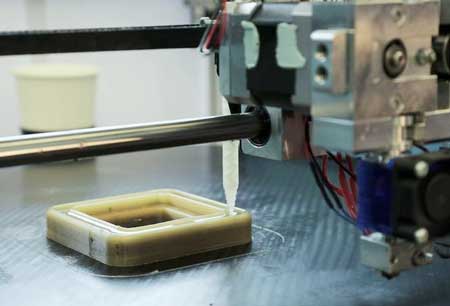
(Nanowerk News) Researchers at Fraunhofer IPA have developed a new process that combines 3D printing and casting. In additive freeform casting (AFFC), first a shell of the part is manufactured using FLM printing, then this shell is filled with a two-component resin. This saves time, increases stability of the part and allows new materials to be printed.Additive manufacturing, also known as 3D printing, already presents a wide range of advantages for industry.IPA expert Jonas Fischer explains: “You enter the CAD data for a workpiece and receive a finished part.”Small batches, prototypes and individual pieces are all faster and more cost effective to manufacture than is the case with injection molding. Moreover, complex structures and integrated functionalities can be created. However, there are still some weak points.


Only three minutes to harden


With FLM (fused layer modelling) printing, the most widespread method, a nozzle deposits the printed material in parallel lines. This creates seams and porosities.Jonas Fischer adds: “The material is not completely in the form like it is when molded. This means that the component has worse mechanical properties.”Furthermore, during FLM processes the nozzle applies each layer individually. It takes a long time for a large component to be constructed.A third disadvantage is that only plastics that become soft when heated (called thermoplastics) can be used with FDM printing. Thermosets, which remain stable after hardening regardless of any heat administered, cannot be printed.With additive freeform molding, researchers at Fraunhofer have now found a way to keep these downsides to a minimum.additive freeform moldingIn additive freeform molding, the shell of a part is constructed using FDM printing. A dosing unit in the printer then fills this with a two-component mixture. (Image: Fraunhofer IPA/Rainer Bez)To do this, they combined the additive process with a molding procedure. The first step is to manufacture the shell of the part via the FLM process.The experts use polyvinyl acetate (PVA), a water-soluble synthetic polymer, as the printing material. Subsequently, the shells are filled automatically with a precisely dosed quantity of polyurethane or epoxy resin.With polyurethane, it only takes three minutes for the filling to be cured. Next, the number of components can be increased if desired. As soon as the process is complete and the part has hardened, the shape is removed and placed in a water bath. This creates a 3D-printed workpiece with the properties similar to those of an cast part.
Manufacturing “in one piece” is possible

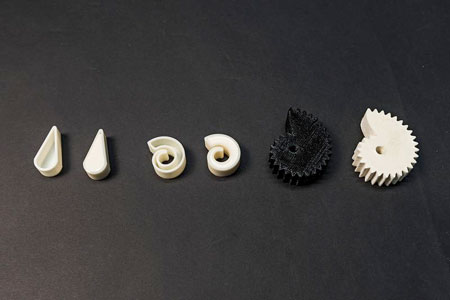
In order to inject the filling material into the mold, IPA researchers installed a special dosing unit for two-component materials in the 3D printer. This means it is possible to perform the entire process – printing the shell and the filling – in one piece. The printing process does not have to be interrupted and can be controlled fully digitally as with conventional 3D printing.3D-printed shapesIPA researchers have proven the feasibility of the process and created several prototypes. (Image: Fraunhofer IPA/Rainer Bez)Also, the procedure enables two-component resins to be used. Heat-resistant thermosets can be used as a construction material. Moreover, it is claimed that components can be manufactured much more quickly.Jonas Fischer adds: “You only need to print the shell – gravity does the rest of the work.” Last but not least, the components are reported to be significantly more stable as the material completely fills the form, so no porosities or air pockets occur.The new method is suited for a variety of application areas and industries. Fischer explains: “For instance, it can be used for electrical isolation components like sockets. Foams and cushions, such as those needed for safety elements, are also suited to this procedure.” In principle, the combined freeform casting is said to always be the preferred option when large, complex components are required in small quantities. Moreover, it can help to reduce weight.

Seeking further development partners

IPA researchers have successfully proven the feasibility of this process in a pre-research project. Furthermore, they created various components as prototypes. Now the researchers are looking for industry partners to support them in further developing the process for series production. They are also seeking materials manufacturers to improve the properties of the two-component mixture together with researchers. Companies with ideas for various application areas of thermosets are welcome too.

Source: Fraunhofer-Institut für Produktionstechnik und Automatisierung

https://www.nanowerk.com/news2/gadget/newsid=49778.php

March 23, 2018

Using Thermosets in Hybrid 3D Printing

Combining the benefits of 3D printing and casting

(Nanowerk News) Researchers at Fraunhofer IPA have developed a new process that combines 3D printing and casting. In additive freeform casting (AFFC), first a shell of the part is manufactured using FLM printing, then this shell is filled with a two-component resin. This saves time, increases stability of the part and allows new materials to be printed.Additive manufacturing, also known as 3D printing, already presents a wide range of advantages for industry.IPA expert Jonas Fischer explains: “You enter the CAD data for a workpiece and receive a finished part.”Small batches, prototypes and individual pieces are all faster and more cost effective to manufacture than is the case with injection molding. Moreover, complex structures and integrated functionalities can be created. However, there are still some weak points.


Only three minutes to harden


With FLM (fused layer modelling) printing, the most widespread method, a nozzle deposits the printed material in parallel lines. This creates seams and porosities.Jonas Fischer adds: “The material is not completely in the form like it is when molded. This means that the component has worse mechanical properties.”Furthermore, during FLM processes the nozzle applies each layer individually. It takes a long time for a large component to be constructed.A third disadvantage is that only plastics that become soft when heated (called thermoplastics) can be used with FDM printing. Thermosets, which remain stable after hardening regardless of any heat administered, cannot be printed.With additive freeform molding, researchers at Fraunhofer have now found a way to keep these downsides to a minimum.additive freeform moldingIn additive freeform molding, the shell of a part is constructed using FDM printing. A dosing unit in the printer then fills this with a two-component mixture. (Image: Fraunhofer IPA/Rainer Bez)To do this, they combined the additive process with a molding procedure. The first step is to manufacture the shell of the part via the FLM process.The experts use polyvinyl acetate (PVA), a water-soluble synthetic polymer, as the printing material. Subsequently, the shells are filled automatically with a precisely dosed quantity of polyurethane or epoxy resin.With polyurethane, it only takes three minutes for the filling to be cured. Next, the number of components can be increased if desired. As soon as the process is complete and the part has hardened, the shape is removed and placed in a water bath. This creates a 3D-printed workpiece with the properties similar to those of an cast part.

Manufacturing “in one piece” is possible

In order to inject the filling material into the mold, IPA researchers installed a special dosing unit for two-component materials in the 3D printer. This means it is possible to perform the entire process – printing the shell and the filling – in one piece. The printing process does not have to be interrupted and can be controlled fully digitally as with conventional 3D printing.3D-printed shapesIPA researchers have proven the feasibility of the process and created several prototypes. (Image: Fraunhofer IPA/Rainer Bez)Also, the procedure enables two-component resins to be used. Heat-resistant thermosets can be used as a construction material. Moreover, it is claimed that components can be manufactured much more quickly.Jonas Fischer adds: “You only need to print the shell – gravity does the rest of the work.” Last but not least, the components are reported to be significantly more stable as the material completely fills the form, so no porosities or air pockets occur.The new method is suited for a variety of application areas and industries. Fischer explains: “For instance, it can be used for electrical isolation components like sockets. Foams and cushions, such as those needed for safety elements, are also suited to this procedure.” In principle, the combined freeform casting is said to always be the preferred option when large, complex components are required in small quantities. Moreover, it can help to reduce weight.

Seeking further development partners

IPA researchers have successfully proven the feasibility of this process in a pre-research project. Furthermore, they created various components as prototypes. Now the researchers are looking for industry partners to support them in further developing the process for series production. They are also seeking materials manufacturers to improve the properties of the two-component mixture together with researchers. Companies with ideas for various application areas of thermosets are welcome too.

Source: Fraunhofer-Institut für Produktionstechnik und Automatisierung

https://www.nanowerk.com/news2/gadget/newsid=49778.php

March 21, 2018

Polyurethane Key to Robotic Fish

Scientists build a robotic fish to spy on ocean life

SoFi, a remotely controlled robotic fish, explores the Somosomo Strait in Taveuni, Fiji.

It looks like a fish. It swims like a fish. But it isn’t a fish.

So what is it?

It’s SoFi, the robotic fish!

Developed by researchers at MIT, SoFi is a soft-bodied robot that glides silently through the water with a smooth, undulating motion designed to mimic the movements of real fish.

It is the first robotic fish to contend with the currents and pressures of an actual ocean setting for an extended period of time.

In a study published Wednesday in Science Robotics, the authors describe how SoFi can nimbly navigate a coral reef off Fiji in three dimensions, swimming up, down, left, right and forward, all at the behest of a diver armed with what looks like a Nintendo controller.

The authors also report that the robot can handle water depths of about 60 feet, and appears to swim alongside real fish without spooking them.

“For us, this fish is magical,” said Daniela Rus, director of the Computer Science and Artificial Intelligence Laboratory at MIT, who led the work. “We imagine someday it might help us uncover more mysteries from the amazing underwater world that we know so little about.”

SoFi in action, being controlled remotely by a diver using an acoustic communication modem.
SoFi in action, being controlled remotely by a diver using an acoustic communication modem. (Katzschmann et al. / Science Robotics)

SoFi is a fairly small robot, about a foot and a half long and weighing in at just 3.5 pounds. A hydraulic pump moves water in its soft rubber tail from side to side, allowing it to swim in a fish-like motion.

Electronics including a Linux PC, along with a fisheye lens, are stored in the robot’s head. It runs off a small battery similar to what you would find in your smartphone, and in its current iteration it can swim for about 40 minutes at a time.

Many of SoFi’s parts are 3D-printed, making it relatively easy and inexpensive to reproduce.

The design of SoFi could be easily scaled up or down, Rus said, but if it were bigger it would be harder for a diver to get it into and out of the water, and if it were smaller it would struggle more against currents.

Building a robot that can function underwater comes with unique challenges, Rus said.

Its electronics need to be housed in watertight compartments that are able to withstand large changes in pressure as the robot moves up and down in the water column.

In addition, it needs to have adjustable buoyancy so that it can swim at different depths without floating off to the surface or sinking to the seafloor.

Communications are also an issue because radio frequencies used to communicate with robots on land don’t work in the water.

The anatomy of the soft robotic fish SoFi, and the remote control for diver use.
The anatomy of the soft robotic fish SoFi, and the remote control for diver use. (Katzschmann et al. / Science Robotics)

Rus said buoyancy was among the biggest challenges for her team.

“If you are a diver then you know you let the air out of your dive vest when you go down and put it in when you go up,” she said. “But sometimes as you go up the air you have expands so you need to let more out. It’s really quite tricky.”

To address this issue, the team created what they called a buoyancy control unit, with urethane foam chambers that can change their density by compressing or decompressing air.

The communication hurdle was surmounted using ultrasonic signals that allow a diver to operate SoFi with the help of a custom remote control. Using the remote, a diver can be about 50 feet from the robot and still control its movements.

Photos of SoFi taken every 2.6 seconds are merged to show its trajectory along a coral reef.
Photos of SoFi taken every 2.6 seconds are merged to show its trajectory along a coral reef. (Katzschmann et al. / Science Robotics)

Rus said her group would continue to make improvements to Sofi, including making it swim faster and giving it the ability to transmit video and do more accurate color imaging in the water. She said it’s possible the robot could learn to recognize specific fish and follow them on its own.

“We could task it to find a crown of thorns or a parrot fish or starfish and have it map the locations of these animals,” she said.

Rus’ ultimate goal is to create an instrument that can help biologists study ocean animals in an unobtrusive way.

“With this robot, I hope we can begin to peek into the secret lives of underwater creatures,” she said.

Kakani Katija, an engineer at the Monterey Bay Aquarium Research Institute who was not involved in the study, says the work is an important contribution to the bio-inspired design research community.

“The potential for studying animal behaviors with robotic mimics is especially exciting,” she said.

However, Katija added, more work needs to be done to determine whether SoFi can be used as a viable, long-term observational platform in the ocean.

Ken Smith, a marine ecologist also at the Monterey Bay institute who didn’t work on the study either, agreed.

“I think this new robotic fish has a lot of potential, being small, nonintrusive, with sufficient power to operate in turbulent waters,” he said. “Future versions with increased depth capability and longevity would be very valuable to marine scientists studying shallow-water ecosystems.”

http://www.latimes.com/science/sciencenow/la-sci-sn-robotic-fish-pacific-20180321-story.html

March 21, 2018

Polyurethane Key to Robotic Fish

Scientists build a robotic fish to spy on ocean life

SoFi, a remotely controlled robotic fish, explores the Somosomo Strait in Taveuni, Fiji.

It looks like a fish. It swims like a fish. But it isn’t a fish.

So what is it?

It’s SoFi, the robotic fish!

Developed by researchers at MIT, SoFi is a soft-bodied robot that glides silently through the water with a smooth, undulating motion designed to mimic the movements of real fish.

It is the first robotic fish to contend with the currents and pressures of an actual ocean setting for an extended period of time.

In a study published Wednesday in Science Robotics, the authors describe how SoFi can nimbly navigate a coral reef off Fiji in three dimensions, swimming up, down, left, right and forward, all at the behest of a diver armed with what looks like a Nintendo controller.

The authors also report that the robot can handle water depths of about 60 feet, and appears to swim alongside real fish without spooking them.

“For us, this fish is magical,” said Daniela Rus, director of the Computer Science and Artificial Intelligence Laboratory at MIT, who led the work. “We imagine someday it might help us uncover more mysteries from the amazing underwater world that we know so little about.”

SoFi in action, being controlled remotely by a diver using an acoustic communication modem.
SoFi in action, being controlled remotely by a diver using an acoustic communication modem. (Katzschmann et al. / Science Robotics)

SoFi is a fairly small robot, about a foot and a half long and weighing in at just 3.5 pounds. A hydraulic pump moves water in its soft rubber tail from side to side, allowing it to swim in a fish-like motion.

Electronics including a Linux PC, along with a fisheye lens, are stored in the robot’s head. It runs off a small battery similar to what you would find in your smartphone, and in its current iteration it can swim for about 40 minutes at a time.

Many of SoFi’s parts are 3D-printed, making it relatively easy and inexpensive to reproduce.

The design of SoFi could be easily scaled up or down, Rus said, but if it were bigger it would be harder for a diver to get it into and out of the water, and if it were smaller it would struggle more against currents.

Building a robot that can function underwater comes with unique challenges, Rus said.

Its electronics need to be housed in watertight compartments that are able to withstand large changes in pressure as the robot moves up and down in the water column.

In addition, it needs to have adjustable buoyancy so that it can swim at different depths without floating off to the surface or sinking to the seafloor.

Communications are also an issue because radio frequencies used to communicate with robots on land don’t work in the water.

The anatomy of the soft robotic fish SoFi, and the remote control for diver use.
The anatomy of the soft robotic fish SoFi, and the remote control for diver use. (Katzschmann et al. / Science Robotics)

Rus said buoyancy was among the biggest challenges for her team.

“If you are a diver then you know you let the air out of your dive vest when you go down and put it in when you go up,” she said. “But sometimes as you go up the air you have expands so you need to let more out. It’s really quite tricky.”

To address this issue, the team created what they called a buoyancy control unit, with urethane foam chambers that can change their density by compressing or decompressing air.

The communication hurdle was surmounted using ultrasonic signals that allow a diver to operate SoFi with the help of a custom remote control. Using the remote, a diver can be about 50 feet from the robot and still control its movements.

Photos of SoFi taken every 2.6 seconds are merged to show its trajectory along a coral reef.
Photos of SoFi taken every 2.6 seconds are merged to show its trajectory along a coral reef. (Katzschmann et al. / Science Robotics)

Rus said her group would continue to make improvements to Sofi, including making it swim faster and giving it the ability to transmit video and do more accurate color imaging in the water. She said it’s possible the robot could learn to recognize specific fish and follow them on its own.

“We could task it to find a crown of thorns or a parrot fish or starfish and have it map the locations of these animals,” she said.

Rus’ ultimate goal is to create an instrument that can help biologists study ocean animals in an unobtrusive way.

“With this robot, I hope we can begin to peek into the secret lives of underwater creatures,” she said.

Kakani Katija, an engineer at the Monterey Bay Aquarium Research Institute who was not involved in the study, says the work is an important contribution to the bio-inspired design research community.

“The potential for studying animal behaviors with robotic mimics is especially exciting,” she said.

However, Katija added, more work needs to be done to determine whether SoFi can be used as a viable, long-term observational platform in the ocean.

Ken Smith, a marine ecologist also at the Monterey Bay institute who didn’t work on the study either, agreed.

“I think this new robotic fish has a lot of potential, being small, nonintrusive, with sufficient power to operate in turbulent waters,” he said. “Future versions with increased depth capability and longevity would be very valuable to marine scientists studying shallow-water ecosystems.”

http://www.latimes.com/science/sciencenow/la-sci-sn-robotic-fish-pacific-20180321-story.html